Pages

Showing posts with label legend of zelda. Show all posts

Sunday, June 26, 2016

The Deep Legend of Purple Zelda

Discussed herein: the original Legend of Zelda, the band Deep Purple, the man responsible for what are arguably the two most famous compositions in video game music history, and open-ended questions about music law.

legend of zelda deep purple

Last week, a Los Angeles jury concluded that no, Led Zeppelin’s “Stairway to Heaven” did not plagiarize another song—or, at least, appropriate enough of that other song to constitute plagiarism and subsequent monetary compensation. Led Zeppelin got to continue living atop a towering pile of money that did not become a slightly-less-towering pile of money, and the 1960s band Spirit got a neat little footnote in its history when the estate of the band’s singer, Randy California, unsuccessfully tried to argue that a brief snippet from the intro to “Stairway to Heaven” sounded too much like Spirit’s 1968 song “Taurus.”

Neither being a member of that jury nor someone who claims to understand music on a constructional level, I can’t say whether that verdict was just. I can say, however, that to my ears, the two songs sound similar enough that it seems that the one could have helped bring about the other, regardless of whether anyone deserved money for that inspiration.

Listen for yourself. The “Stairway”-esque part of “Taurus” begins around the 44-second mark.


And here is “Stairway to Heaven,” just in case you’ve been living under a rock for the last forty years.


The plaintiff’s lawyers had claimed that because Spirit had played on the same bill as Led Zeppelin back in the day, it was plausible that members of the latter had heard “Taurus” and therefore used bits of it in writing “Stairway,” which was released in 1971. In my head, that seems like a fair enough argument, and I feel like people following the story in the news probably did too, especially in light of how the family of Marvin Gaye successfully sued Robin Thicke, to say nothing of similar squabbles making the news recently. (Tom Petty vs. Sam Smith comes to mind, even if it ended amicably, and now Ed Sheeran is being sued for alleged plagiarism as well.)

These kinds of stories stand out to me because I’m the kind of guy who frequently hears similarities between two songs that other people dismiss with “No, that’s just a common chord progression” or “No, that’s just a feature of this genre of music” or “No, you’re crazy.” For example, I think the old song “Smoke Rings” sounds remarkably like a downtempo version of the overworld theme from Super Mario Bros. 2.


I’m okay with accepting that the connection I’m making only exists in my head, but there’s this one similarity in particular that always jumps into mind when I read stories like these, because I think it’s a stronger connection to most: the Deep Purple track “April” and the dungeon theme from Legend of Zelda. And yes, there’s something slightly more thrilling to me about the prospect of a song working its way across the pop cultural continuum and ending up in a video game, at least in some form, years later.

“April” is the final track to Deep Purple’s third album, released in 1969. It’s a doozy. You probably know Deep Purple as the bad that performs “Smoke on the Water” or the hard rock version of that song from I Know What You Did Last Summer, but “April” is worth a listen too. It’s grand and orchestral, especially in its intro, and wouldn’t be out of place as the soundtrack to some medieval fantasy sequence, I say.


Or maybe that association comes from the apparent Legend of Zelda connection. At around the 2:00-mark in “April,” there’s a brief section that should sound familiar to anyone who played through the original Legend of Zelda for the NES. It’s the bit that concludes the game’s dungeon theme before the track loops back to the beginning. (That dungeon theme isn’t very long, and if you played through the game, you’d hear this section of music hundreds of times over.)

I made a video that lines the sections up side-by-side, in case that’s helpful.


Given my history of the playing “thing is like other thing” game, I’d be willing to write this similarity off as a random, meaningless one, but there’s slightly more to the story. Koji Kondo is the music whiz responsible for a lot of Nintendo’s most memorable compositions, including all the music for the original Legend of Zelda. What’s interesting about the Deep Purple connection is that Kondo himself has admitted to being a fan of the band. In a 2005 Nintendo Power interview, Kondo even said he once played in a band that frequently covered Deep Purple, so the odds that he would be familiar with “April” would be fairly high—at least as probable as Led Zeppelin having heard “Taurus.” Of course, in the end, the jury found that Zeppelin hadn’t stolen those guitar riffs—or at least that if they had, they weren’t substantial enough to warrant Zeppelin having to pay off anyone as a result.

I suppose, then, that I have to conclude this post on a note of confusion. I don’t understand how we can make a legal differentiation between homage, sample, legitimate borrowing, and lawsuit-worthy theft. (And yes, I have thought about how it’s notable that the multimillion-dollar exception to the rule would be a song titled “Blurred Lines.”) So I pose the question to anyone reading this who understands music or music law better than I do: Am I confused because these distinctions are better made by people who understand music on a fundamental level that I don’t? Or is it just that no one knows—and that every post-“Blurred Lines” lawsuit is gambling in favor of the odds of some judge or jury saying, “Yeah I hear it. Here, have a wheelbarrow full of money”? Is it weird that laypeople, musically speaking, would ever be given the opportunity to issue a verdict about something that seems like it should take inside knowledge of the music industry to understand?

Meanwhile, I keep “April” on my playlists in case I ever encounter a situation that needs to feel more epic. And every time I get two minutes in, I get to think about Legend of Zelda, whether or not it’s just a coincidence.

Miscellaneous notes:
  • Yes, this is was something I’ve written about on this blog before—eight years ago, in fact. I decided the Zeppelin lawsuit made the story timely enough for an update and expansion. I originally came across the info in the “cloubush” thread, which, eight years later, is still going strong.
  • There actually is a purple Zelda, literally. Her name is Hilda. She’s Zelda but purple. Go figure.
  • Koji Kondo composed the soundtracks for Super Mario Bros. and Legend of Zelda but not those for Metroid and Kid Icarus. He did, however, do the music for three early NES games that weren’t released in the U.S.—Mysterious Castle Murasame, Devil World and Shin Onigashima. Given how iconic the Zelda and Mario themes ended up becoming, we American gamers missed out.
  • Kondo also composed the music that ended up in Super Mario Bros. 2, and I wonder if the Deep Purple thing makes it anymore likely that he would have been inspired by “Smoke Rings” in creating that game’s soundtrack.
  • In 1970, Spirit released an album saddled with the improbable title Twelve Dreams of Dr. Sardonicus, and that’s one of those names that seems like a joke on The Simpsons.
  • Not that I nor anyone else actually needs to hear “Stairway to Heaven” again, but did you know that Dolly Parton does a cover of it? It’s actually not bad—not that Dolly is capable of bad things—and I wager she finds a layer to it that other cover-ers may not.
  • Spirit’s biggest commercial hit was 1968’s “I Got a Line of You,” which I’d heard before and which I’m surprised was done by the same band that did “Taurus.”


Video game music, previously:

Sunday, May 4, 2014

You Got Mario in My Zelda!

While Nintendo went crossover crazy in a big way back in 1999, when the first Smash Bros. game finally let players pit Mario against Link against Samus, I feel like Nintendo crossovers happen more frequently today. For example, who would have ever expected a Sonic the Hedgehog game getting bizarre Zelda- and Yoshi-themed stages? Why else would Nintendo have made the pack-in launch title for the Wii U Nintendo Land, which re-envisioned beloved Nintendo classics (and also Castle of Murasame) as one big amusement park? And how else to explain the Nintendo Remix games, which shake up old NES titles and let the pixels fall together in various mix-and-match ways?


But that’s not actually the case: Nintendo has always been down to let elements of its franchises bleed into others, subtly and not so subtly. I remember playing the fourth Legend of Zelda game, Link’s Awakening, and thinking the presence of Super Mario Bros. enemies was cool and surprising, but I just recently found out that the very first Zelda game has a Mario shout-out that I’d seen but not understood.

The third dungeon boss in Legend of Zelda is Manhandla, a spinning, four-“headed” plant, though if you play through the game without that information you’d be forgiven for thinking it’s actually just a lobster-claw monster. (And yes, that name seems a little suggestive. Its Japanese name, Testitart, is even more curious.)

via
Lobstery-ness aside, this monster is a plant, but not just any plant. Legends of Localization, an awesome website chock-full of trivia about old-school video games, offers a translation of the text from the Japanese manual: “A four-limbed, jumbo-sized Pakkun Flower. Speeds up with each limb lost. Possesses somewhat powerful offensive strength.”

via
And Pakkun Flower, in case you didn’t know, is the Japanese name from the Piranha Plant, the pipe-dwelling, Mario-eating flowers that first appeared in Super Mario Bros. The Zelda version of the monster even has the same blue-coloring as the underground Piranha Plants. It’s actually a very similar design, being pixelly chomping mouths and all, but I never noticed it despite having played through these games dozens of times.

via
(That’s not the only connection you can make with Pakkun Flowers, BTW. What do you think the Pac in Pac-Man means, anyway? Hooray for mobile mouths in video games!)

Legends of Localization also points out that the fifth dungeon boss, a hideous vagina monster named Digdogger, is also a crossover character: It’s one of the overgrown sea urchin bad guys from Nintendo’s Pac-Man wannabe, Clu Clu Land. Where they got that clunker Digdogger however, I can’t imagine. (Degodoga? Does that mean anything, Japanese-savvy people?)

Finally, something I found generally interesting: If you played Legend of Zelda in Japan, your game sounded very different than did the version we got here in the U.S. This handy page lays out all the differences, side-by-side — with samples.

Nintendo trivia, previously:

Wednesday, March 20, 2013

Finding the Feminine (if Not the Feminist) in Early Nintendo

If you don’t read about video games, then you probably don’t know of Anita Sarkeesian. She is a feminist blogger whose talking head stars in the “Feminist Frequency” online series, and she recently rose to a greater level of prominence as a result of a successful Kickstarster campaign to explore the role of female characters in video games. The campaign also elicited a shitstorm of harassment that basically proved Sarkeesian’s point that video game culture can have a nasty, misogynist bent to it, but the first video premiered on March 7 in spite of the small but active band trying to keep girls out of the treehouse.

image via
In the first installment, “Damsels in Distress,” Sarkeesian seems to be laying groundwork for the rest of the series, explaining the origins of the “lady tied to the train tracks” stock character and how it relates to video games. She actually talks about video games a lot less than you might expect — like I said, I’m guessing she’s building a foundation, but there’s a point when you may think, “She’s still going on about this?” — and the two franchises that get the most attention are Mario and Zelda. This too has earned her some criticism, as newer franchises feature more progressive politics than do these series that have remained fundamentally unchanged since they debuted in the 80s. But it’s Nintendo, and in addition to Mario and Zelda being two of the most long-lived successful video game franchises ever, those early days of the original Nintendo Entertainment System were hugely important to the medium. Thus, it’s a good place to start. Neither series has ever come close to gender parity, and regardless of whether you think they should, that is exactly why this very month has seen the release of hacked versions of Donkey Kong and Legend of Zelda that allow you to play as Pauline or as Princess Zelda and rescue their respective dudes.

This all made me think of a subject I haven’t picked up in a while.

Now, one of the responses to Sarkeesian’s first video pointed out that she didn’t mention one of the reasons the Mario and Zelda don’t evolve: Their creator, Shigeru Miyamoto, isn’t big on plot elements. He’d rather minimize backstory, let players get to the fun part and not bury the essence of the game. Especially back in the earlier days, Miyamoto wasn’t about to let co-workers who thought otherwise meddle with his brain babies. (That’s less the case now, and it’s worth pointing out that as the stories behind these games grew deeper, we got less wimpy female characters, like Rosalina and Midna.)

In that same early age of home console Nintendo, however, Mario and Zelda weren’t Nintendo’s only attempts at launching power franchises. They were just the most successful ones. A few months after Legend of Zelda hit shelves, Nintendo debuted two other games: Metroid and Kid Icarus. The two are “sister” series in more than one way. For example, Metroid baddies show up in Kid Icarus. In both, the screen can scroll both vertically and horizontally, whereas the first Mario and Zelda didn’t. Both were developed without Miyamoto’s participation; Gunpei Yokoi served as producer for both, and many of the staffers who worked on Metroid shifted to Icarus as they finished their work. Both didn’t receive sequels until years later. And both offer major roles to female characters that Mario and Zelda do not.

images via here and here
In Metroid, of course, the big reveal players get for completing certain requirements is finding out that Samus, the robot-looking dude they’ve been controlling all this time, is actually a woman — and what a woman! She’s wearing a weird mom bathing suit and everything!

Most people know that. But the game also pits Samus against a female(ish) big bad: the Mother Brain. There’s not too much explicitly female about a cycloptic brain in a jar, but all the literature discussing the Mother Brain as a “she” — even on Captain N, where she was inexplicably voiced by the guy who voiced Audrey II in Little Shop of Horrors.

image via
In the third Metroid game, the brain gets a body, and graphics designer Toru Osawa explained that his initial impulse had been to make her look like “an old lady living in my apartment complex.” You can still kind of see that in the final design:


That’s something that literally never occurred to me until this month: that a game debuting that early in the story of Nintendo would have a female hero taking down a female villain — an all-knowing, all-seeing, all-powerful big bad, no less.

Kid Icarus also boasts better feminist credentials. Though the hero is male — more a boy than a man, though I’m unsure if that matters — the big bad is female. It’s Medusa, who in the universe of the game is the goddess of darkness, and offered as the antithesis to Palutena, the goddess of light and the game’s damsel in distress. (Importantly, Medusa looks like a woman, but she also has a Mother Brain-y like form where she appears as a huge, one-eyed head… thing.) Yes, there’s a woman awaiting rescue at the end of the game, but there is something different about it being another woman who locked her up, especially when those characters function as stand-ins for God and the Devil, or at least Athena and a Lady Hades (Ladeez).

This all proves nothing, of course, and it’s worth underscoring that Metroid and Kid Icarus didn’t find the success that Super Mario Bros. and Legend of Zelda did. The former only became a successful franchise in 2002 and the latter just received its second sequel in 2012. But when you’re looking at the early days of Nintendo, with Princess Peach and Princess Zelda mostly sitting around in dungeons, it’s kind of cool that female characters in other games were being given something interesting to do: be evil, get captured or take of their clothes at the end of the game. There’s a case to be made for finding elements of the sacred feminine in Mario and Zelda, but it’s a dig to get there. With Metroid and Kid Icarus, it’s right there in the instruction booklet.

Gender and video games, previously:

Sunday, August 28, 2011

The Legend of Zelda’s Considerably Less Famous Brother

So who the hell is this prissy, pissy prick?


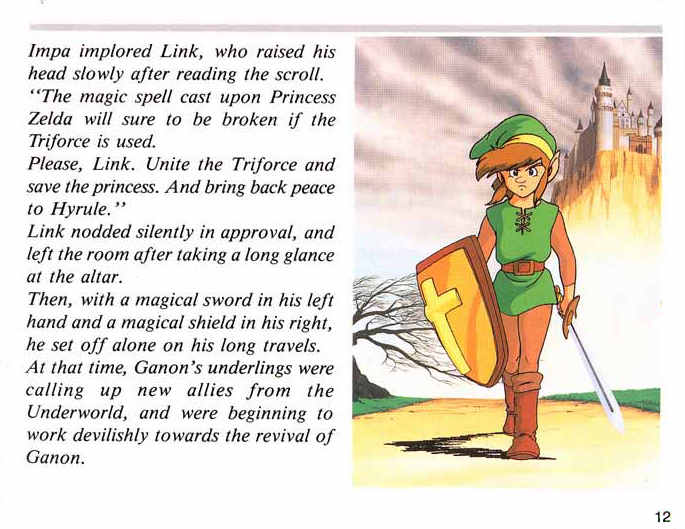
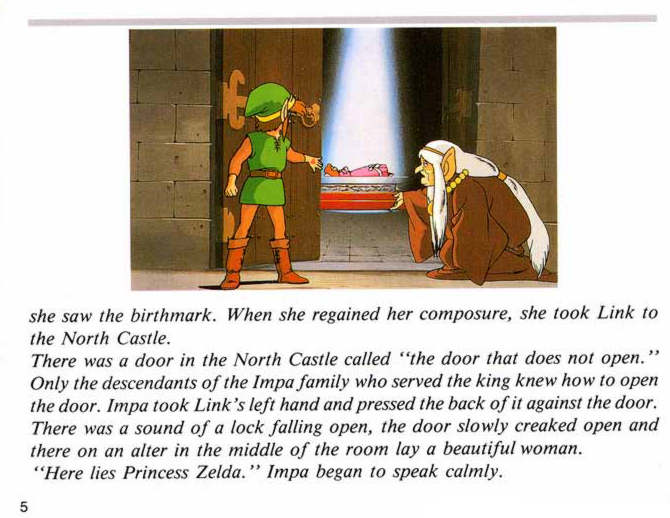
Short answer: It’s Princess Zelda’s brother. This dramatic little scene — recently posted on Game & Graphics, an awesome blog that features art from classic video games and their promotional materials — originally appeared in the instruction booklet for Zelda II: The Adventure of Link. But this bit of prologue illustrates a scene and characters that don’t appear anywhere in the game. While it’s not unusual for a video game to cram some extra exposition into the manual, but I’m interested in the decision to include this kid and then design him as they have. I mean, if you’re setting up a guy who’s such a short-term villain that he doesn’t even appear in the actual game, why model him after Jackie Earle Haley in Day of the Locust?

The prologue offers this much as background: When the king dies, the prince tries to get his well-manicured hands on the Triforce, but only Zelda knows its location. Aiding the prince in these efforts is an especially shady-looking magician — unnamed, like the prince himself — who threatens Zelda with a sleeping spell. (By the way, a psychologist with a penchant for pop culture could give a good take on the symbolism of the refined prince casting a hideous, demonic shadow.) Zelda still refuses and the magician, as promised, puts her under with an incantation so nasty that he drops dead on the spot. Finally remorseful, the prince locks Zelda in a room for safekeeping until someone can break the spell.

I like that story. It sets up why Zelda is napping for the duration of Zelda II, and it also gives a hint as to what the hell the franchise’s title means. (Allegedly, the prince decreed that all daughters born to the royal family should be named Zelda as a means of reminding everyone of the tragedy that befell his sister. You know, because of him.) What makes me scratch my head, however, is the prince’s look. Doesn’t he seem… a little young? a little bratty? a little effete? Why make him so much smaller than Zelda? Why give him such elegant curls? Why give him just the one visible tooth? When he could easily have been an imposing figure, why make him an angry, pubescent fop? Especially when the actual hero, Link, isn’t exactly a swaggering portrait of masculinity.


I mean, he can swing a mean sword, sure, but what kind of a guy wears jerkins and coordinates their tights with their boots? Also, I’d like to point out that this is the Zelda game where Link can transform into a fairy — wings, wand, ladyhair, pink Tinkerbell dress and all — in order to squeeze through keyholes.

The image of Prince What’s-His-Name sticks out so much because I remember playing the game through and never seeing this little shit. Honestly, he could be long dead, because who knows how long Zelda has been sleeping. But I was still disappointed. I really wanted to see him in action and find out how his appearance compared with his reputation. No, scratch that — I secretly wanted some kind of two-player co-op function in which you could play as this whip-cracking sassbucket, countering Link’s various special moves with such character-appropriate special moves as pouting, speaking cutting insults, ordering his butler to hit people and sulking while running a jewel comb through his silky locks. Now that would be an pixelly, eight-bit memory that this guy would like to reflect on.

For the record, the depiction of the prince isn’t the only bit of Nintendo-issued Zelda II art to take some creative license. For example, here’s how the booklet depicts Helmet Head, the game’s second boss:


And here’s what the same monster looks like in the game:


It’s not as show-stopping, is it? But I feel safe stating that the angriest royal dandy in video game-dom would have amped up the drama.

Monday, July 25, 2011

Pixelated Stars on a Six-Zero Sky

A few days ago, I wrote about the strange experience of hearing some early-generation video game music that didn’t suck — or that at least bore enough of a resemblance to something I’d listen to now that I could be okay with it. But when I said all that, I was misleading, I think, because I do have a soft spot for that music, that blippy, plinky soundtrack to my childhood. I know everyone doesn’t feel this way, not even people who grew up playing these, but I am to this day easily moved by certain eight-bit anthems.

And this, for some reason, is the one that movies me most.


I didn’t even really like this game that much, honestly. The first Legend of Zelda was great, but the second one threw a little too much at my young mind. (Leveling up? What does that even mean?) But watching the intro sequence immediately zaps me back to being about seven years old and feeling intimated by the apparent gravity of all this. Honestly, I didn’t know what the hell was going on, just that there was a sword and stars and space and whatever, and I think being completely in the dark helped instill in me that sort of childhood awe that doesn’t go away even when you know better.

I just felt like pointing that out.

Monday, June 27, 2011

The Dainty Pig and the Musical Goose

A long overdue update to My Big List of Strange and Wonderful Words. See? I’m still learning stuff.
pettitoes (PETT-ee-tohz) — noun: pig’s trotters, especially when used as food.
Cute word, right? Can’t you just picture Babe flitting across Hogget’s farm on pettitoes to the sound of a trilling xylophone? You can? Great. Now imagine those porcine tootsies lopped off and sent to a butcher’s case. That’s where pigs’ feet go to await some hungry hausfrau hoping to use them to make stock or gravy.


Just looking at the word pettitoes, you might think the etymology is obvious, what with petty coming from the French petit, “small,” and being used in English to mean essentially a derogatory version of the same thing. But it’s that second part, toes, that’s surprising. The word comes to English from the French term petit oie, meaning “little goose” and referring to that bird’s giblets. Apparently the term jumped from giblets to all manner of offal and then finally to pigs’ feet. I haven’t seen it stated specifically, but I assume the change in spelling and definition resulted from English speakers hearing the word and assuming it meant what it sounded like. At least one etymology book, however, simply sites that the word always referred to feet, but I’m willing to guess that the majority of sites offering the goose-to-pig switch have it correct.

One more bit on the French word ire, meaning “goose.” It’s related to Italian word for for the bird, oca, whose diminutive form is ocarina. The instrument — which nowadays is unknown to all but Legend of Zelda fans — is so named because its shape was thought to resemble that of a goose. Now you can tell your ocarina band all about this and sound extra cool.

See previous strange and wonderful words after the jump.

Word nerd? Subscribe to Back of the Cereal Box’s word-related posts by clicking here.

Sunday, June 12, 2011

My Lost History and My Holy Text

Christ, that was a lot.

Thinking back, my last clear memory involves me hoping I’d remember my birthday, because it was a good one, in that grown-up way where you don’t get drunk and fall down, but also because I couldn’t for the life of me remember my last birthday. I know I had one and I know I must have done something, but thinking back on that day, I literally can’t remember a single detail about it. I even checked this very blog to see if I might have posted a something, an anything that could jog my brain, but I only found this post, which basically consists of a defamatory aside about Canada and the following video:


And I don’t think that this show reflected on my actual birthday in anyway, but I could be wrong, see, because I don’t remember anything.

I may already be romanticizing last weekend, I suppose, because it logically would seem more pleasant based on what followed. The past work week hit repeatedly and relentlessly. to the point that all the individual weekdays blurred into a single, fiftysomething-hour span of me, bleary-eyed, typing away and wishing my brain had more time to think before it told my body what to do. But it’s done and I’m actually happy — again, in that funny, grown-up way — to be on the verge of another Monday. This week, at least, will be less busy and less cluttered with extravocational commitments.

But this all got me thinking, this inability to distinguish or even remember days: the work days last week, my recent birthdays, and did I just buy milk yesterday or has it already gone bad? It all goes together. And that’s for the best, I’d guess, otherwise we’d be mired in the details of every single second of every day. But at the same time, it’s funny what sticks out.

This year on my birthday, rain fell all over California — not hear in L.A., though it tried, but in most other places, including my hometown. When I spoke with my mom on the phone, she asked, “Can you remember it raining this late in the year before?” I did, specifically because it happened on my birthday: June 4, 1992. I can picture that afternoon in my head perfectly: getting picked up at school and finding a present waiting for me in the back seat. It was the Super Nintendo Legend of Zelda, which had hit shelves about a month before. I tore it open and began absorbing the contents of the instruction manual — the buttons, the art, the vaguest hints about the world waiting inside that plastic box.


And I was so wrapped up in all things Hyrule that I didn’t realize that it had begun pouring outside the car. Like, hard drops, and falling on baked-dry asphalt, so there was that smell, you know? In rained again on the drive to dinner. And while I don’t remember anything else about that birthday, my tenth, these parts wet and bright stand out even today.

If I’m going to forget whole strings of days, I’m at least happy I have still have some of the important ones. I’m writing it out so I don’t lose it.

Monday, February 21, 2011

Legend of Retrospectacle II: Adventure of the Link

What happened before has happened again, and the blogaversary post proved to be too-packed with flashbacking wonderment to make the blog feed. So do click on over to “Retrospectacle 3: Look Who’s Blogging Now” to see the history of this now eight-year-old blog in visual form.

So what’s with the Zelda reference?


Well, it seems that today also happens to be the twenty-fifth anniversary of the original Legend of Zelda, and it’s so like a beloved childhood pastime to show me up on my special day. I guess I’ll have to blog a lot more actively in the next twelve months if I want to outdo Zelda in time for February 21, 2012.

Saturday, January 1, 2011

Eastmost Penninsula Is the Secret

Easily one of the least helpful things ever stated in a video game:


Even ignoring “eastmost” (which probably exists as a result of character limits that prevented “easternmost,”) and “penninsula” (which probably exists as a result of the actual word being, like, impossible to spell), you still have “the secret.” Not “a secret.” Not “the secret doorway.” Just “the,” by itself, inspiring you only to poke around the pixely, peninsula-looking thing on the far right part of the map in hopes that you’ll accidentally find whatever surprise this message is trying to inform you of, all in a game that nobody would think of as having a singular, “the”-deserving secret.

It actually makes me appreciate the generic townspeople from the Zelda sequel who don’t even bother wasting your time.


Though you still have to wonder what Nintendo’s plan was in implementing literal know-nothings into a video game. At least she is apologetic about it.

Not indicative of my hopes for the new year, just representative of my general world view an expressed through the encompassing lens of video games.

(Images via secrettoeverybody.com, which I found as a result of self-Googling.)

Thursday, November 25, 2010

It’s a (Sexy) Secret to Everybody

Not the least bit Thanksgiving-related, but worth posting anyway:


From Game & Graphics, but inspired by this post on this very blog.

Tuesday, May 11, 2010

What Could Be Worse Than Eight-Bit Video Game Music?

I was easy to shop for in my younger days. I existed in such a perpetually video game-addled state that literally anything that had a Nintendo character slapped on it became the new best thing ever — at least next to actual video games. A Legend of Zelda binder? Awesome! A Super Mario board game that no one will ever want to play with me? Sounds great! Metroid pencils? All the better to write a list of additional video game-related merchandise that I want! I didn’t become picky — and therefore much more problematic around Christmas and my birthday — until later in my life, and I though have to shake my head at how dutifully I bought these shoddy products, I have to admit: There is something noble in being easy to shop for.

Not all these game-related knickknacks were necessarily terrible, however, and I recently discovered one in the back of the bookshelf at my parents’ home that brought back a few good memories.

This is it:

music1

Yes, it’s one of those books of simplified sheet music with the keyboard-like instrument built right in. I say keyboard-like instrument because it’s not an actual keyboard, which would be able to make music, but instead something a lot like a keyboard — in the way that a Super Soaker is a lot like an assault rifle. Oh, and the noise this thing makes: horribly tinny, wavering notes. You could compare the sound to those greeting cards that play awful versions of popular songs when you open them, but those at least come preprogrammed with a melody. With the keyboard-like instrument, the responsibility of arranging the notes into a discernible melody falls on you.

Don’t fret, though, because you have a little help in picking out that ditty. As I mentioned, the book has sheet music with each note color-coded and numbered so that if you are not blind you could theoretically find the right notes in the right order. Theoretically. And did I mention that the whole book is Nintendo-themed?

Hit the jump for a strange intersection of old school Nintendo, music and kid culture.


music2

Take this offering: “My Bonnie Lies Over the Ocean” by way of Zelda II. Not the first association I’d make, but it’s not too far off really. Sure, the lyrics are dreadfully lame in a way that could even rankle a little kid, and it doesn’t surprise me that whoever wrote them is credited only as T. Ellis and not a full name that could come back to haunt someone with aspirations of an actual music career. But I can give that a pass — and I likely did, back in the day. What strikes me most about this page is the illustration. It and the rest that follow are surprisingly not too awful and not too off-model, despite the fact that presumably no one affiliated with Nintendo had much to do with them. I mean, yes, it’s the result of a hand-drawn amalgamation of two images from the Zelda II instruction booklet — specifically this one and this one — but they’re fused together pretty well, or at least better than eight-bit Nintendo games are with folk music. Maybe that Nintendo Seal of Quality on the cover belongs there after all.

music3

Similar deal with this one: “Jingle Bells” by way of Super Mario Bros. 2. Because why not? I mean, Toad’s little mushroom hat looks wonky, but I like the result a lot more than lyrics such as “Little Toad takes a load, never slows him down” and “Princess has special skills, she is glad to share / If we need to jump real far or hover in mid-air.” But hey — at least someone read the instruction manual to the point that they have a basic understanding about how the game plays.

music10

Again, this Donkey Kong art isn’t half bad. Perhaps most surprisingly, it’s the only Nintendo-sanctioned art I’ve ever seen in which Pauline looks like her original in-game sprite — you know, like a dowdy pioneer woman. And given that association, the paring of Donkey Kong with “Clementine” actually makes sense.

music4

And then there’s this: A Metroid-flavored version of “The Hearse Song,” which I think I’ve only ever been aware of in relation to that one volume of Scary Stories to Tell in the Dark. You know, “The worms crawl in, the worms crawl out / The worms play pinochle in your snout”? And if I really must critique this book — and apparently I am making myself — then I have to question the artist’s decision to draw space monster Ridley — the one on the left — in a grinning, fetal form. Very weird, but no more so than appropriating a song that cautions children not to laugh at passing Hearses.

music5

And now we come to “La Bamba,” unchanged from its original Spanish version and matched with the Super Mario Bros. 2 B-stringers in a desert setting, for no real reason. I suspect T. Ellis got lazy on this one, and in doing so brought down the quality of the book. I can remember trying to play this one and failing. I mean, look at the colored note numbers. Look at how many there are. This shit would be hard for any child to play, much less on the provided keyboard-like instrument, which, as I’ve said before, sounded terrible. If nothing else, this one provided a valuable service in that it would prompt nearby parents and older siblings to check the batteries in the smoke detectors, because SURELY that persistent ringing noise can’t be that music-toy-thing. Right? And again, I can’t help but to look at the art and wonder how this particular image came to be. The snake coming out of the jar is actually well-drawn, if curiously gendered, but as you move into the background things go downhill. What happened that that Pokey in the back needed to be created? Artist says, “Damn, I’m running out of the sand-colored marker and I need something else to go back there. Guess I’ll draw another one of those cactus things. But I’ll make it look all dopey and sad — you know, for kicks.”

music9

I’m keeping my criticisms to myself for this one. The art looks pretty damn good. And the idea of substituting Death Mountain for Old Smokey? Genius.

music6

The next page offers more Super Mario Bros. 2, which I suppose should I remind us that in 1989 we thought Mario 2 was the next big thing. Little did the people compiling this book realize that that people would come to think of it as the black sheep of the series and that Nintendo itself would prevent most of its key elements from becoming mainstays of later Mario games. The art isn’t bad. I’m not sure how we’re supposed to read Peach’s expression. I’d imagine she is supposed to look worried about the fact that Birdo was firing eggs at her crotch, but her face says to me something more like “Shit, I think I left the iron on.” Doo dah, doo dah. And those last two lines of the first verse are simply too amazing for words: “Look out for Princess Toadstool now / She’s radical and cool.” She really is.

music7

“Frere Jacques”? No. I do not sing “Frere Jacques” without the compulsory “ding dang dong” at the end of the first verse. That’s classic songwriting you don’t screw with. And the accompanying art is a total abomination too. Remember when I said that the artist was running out of the sand-colored marker? I totally was telling the truth, because he or she clearly did not have enough to finish this piece. Nor was there enough ocean-color either, apparently. While we’re at it, why the hell are they all at the beach? There is no beach stage in the original Super Mario Bros. Did the artist also run out of grass color? Thank god all the blood color was used up before the artist could marker in the grisly aftermath of that Hammer Brother’s assault on the back of Peach’s head.

music8

And as happy as I am to see Donkey Kong Jr. get some love, I have to condemn this one as well. When the hell did “Apples and Bananas” become a traditional? Shame on you, T. Ellis. You got lazy again! Learning how to pronounce your vowel sounds has no place in the Donkey Kong games. And neither does a weird version of Donkey Kong Senior who has fists spouting directly out of his shoulders.

That’s all of them. I suppose some of you game-brained readers might get a kick out of this. And if you do, please ponder this: If the people who made this book had the license to use Nintendo characters, then why didn’t they also get the license for the Nintendo music? Really, if you’re talking about early Nintendo games and music, the Super Mario Bros. and Legend of Zelda themes did as much to draw players in as the graphics. And wouldn’t it have been more rewarding to poke out the melody to these tunes than goddamn “Camptown Races?”

I can’t actually remember if I liked this book or not, though I do remember using it and attempting to learn the songs. Except for “La Bamba,” they weren’t too tough, even with the limited sonic capabilities of the keyboard-like instrument. Regardless of whether this ever actually entertained me, I should say that I at least was not the only one who ever made music with it. When I scanned the book to get these images, the keyboard-like instrument was occasionally pressed against the glass. As the scanning mechanism moved back and forth, capturing the image of whatever page was being scanned, it did so with enough pressure to play the keys. Being a machine designed to take pictures and not to celebrate the wonder that is music, it played without heed to melody or rhythm. As I was sitting there, waiting for the scan to finish, I wondered if I sounded any better when I last attempted to make music with this thing.

Game geek? Subscribe to the video games-only feed for Back of the Cereal Box.

Saturday, March 27, 2010

The Coin Heaven Quickstep

Another gem from the “cloudbush” message thread: The music that plays during Peach’s Final Smash move in Super Smash Bros. Brawl is a sped-up version of Super Mario Bros. 3 “coin heaven” music, which plays on the up-in-the-clouds map of the fifth world and whenever Mario finds one of those coin-filled bank vaults in the sky.


A neat little Easter egg for long-time Nintendoites that also reminded me of an additional less-than-obvious musical reference in Brawl. A post over at Cruise Elroy discusses in great detail how the the Ocarina of Time medley, which plays on Brawl’s Zedla-themed stages, seamlessly blends in snippets from the various songs that Link has to play throughout the game. They’re nearly impossible to hear until someone points them out, but they’re there. Neat stuff.

Previous posts involving stuff taken from the cloudbush thread:
Game geek? Subscribe to the video games-only feed for Back of the Cereal Box.

Friday, February 12, 2010

David Lynch Meets Legend of Zelda

I’d bet that David Lynch does not play video games. I can’t say why, but I have a hunch that he’s just not that kind of guy. And if I told people that Lynch had an impact on one of the most widely played video games series ever, they probably wouldn’t believe me. And even if they did, they wouldn’t expect Lynch to have left his mark on a Nintendo series. But he did.

A few months back on this blog, I mentioned Iwata Asks, an online series in which Nintendo president Satoru Iwata talked to his employees about their creative processes. (I was happy that someone finally explained the origin of the “P” on the P-Wing in Super Mario Bros. 3, if you’ll remember.) A new Iwata Asks has gone up that details the Zelda series in promotion of an upcoming game. In it, Iwata speaks with two longtime developers, Takashi Tezuka and Eiji Aonuma, about The Legend of Zelda: Link’s Awakening, an early title released for the Game Boy. In it, Link washes up on a strange, dream-like island. The area is populated with suspicious characters that Link must interact with, and the developers said in the interview that the idea behind this setting came from Twin Peaks.


It’s not as outlandish as it sounds. People who weren’t around for Twin Peaks might have a hard time imagining just what a big deal the show was, at least for its first half. And I’ve heard before that it was even bigger in Japan. The actors from the show even appeared in character in TV ads for coffee. Here’s how it comes up in Iwata’s conversation:
Aonuma: Whoa, here we go. (laughs) Iwata-san, do you know about Twin Peaks?

Iwata: No. Bring me up to speed. (laughs)

Tezuka: We were talking about this before you arrived. I was talking about fashioning Link’s Awakening with a feel that was somewhat like Twin Peaks. At the time, Twin Peaks was rather popular. The drama was all about a small number of characters in a small town.

Iwata: Okay…

Tezuka: So when it came to Link’s Awakening, I wanted to make something that, while it would be small enough in scope to easily understand, it would have deep and distinctive characteristics.

Aonuma: At the time, I didn’t know what he was talking about. I was like, “What is this guy talking about?” (laughs) But since Twin Peaks was popular at the time…

Iwata: You thought he just wanted to be trendy?

Aonuma: Yeah. (laughs) I thought, “You really want to make Zelda like that?!” Now the mystery is solved. (laughs) When I was reading Tanabe-san’s comments in the strategy guide, I saw, “Tezuka-san suggested we make all the characters suspicious types like in the then-popular Twin Peaks.”
Tezuka goes on to explain that prior to Link’s Awakening, these “suspicious types” didn’t really exist in the series but they ended up carrying on to the later titles. So there you have it: Proof that not only did Lynch influence one Zelda game but also the series as a whole.

And I can totally see it now, even though I played the game after Twin Peaks’s run had ended and before I ever watched it. Link is stranded in an isolated area much like Agent Cooper is stuck in the remote, titular town. The people in both locations are eccentric, to say the least. Link runs around doing favors for these folks, learning little bits about them, and then ultimately stops the big bad and gets to leave. (In that respect, Link’s Awakening turns out a lot better for the hero than Twin Peaks does.) As someone who has loved David Lynch for a long time — and loved video games for longer — I am delighted to learn about the intersection of these two things I wouldn’t have ever expected to cross.

So that, in and of itself, it pretty damn neat, but there’s a bit more speculation to be had now, knowing that the game’s developers had Twin Peaks in mind. I’m going to hold off here just because it’s really of interest only to Twin Peaks nuts and Nintendo nerds — with an emphasis on the latter and bonus points if you’re both. Seriously, the geek radiation may melt your face. But click through to read the rest if you’re up for it.

Still here? Good.

Now, I could write forever in an attempt to unpack Twin Peaks and analyze every little part of it. However, if I had to pick out three big motifs from the show to talk about in the context of Link’s Awakening, it would be owls, dreams, and doppelgangers. Both Link’s Awakening and Twin Peaks have them. I don’t necessarily think these overlaps are intentional, but in the context of the Iwata Asks interview, I think it’s fun to look at further connections.

First up: the hooters.

a twin peaks owl

One of the many lingering mysteries about Twin Peaks is the meaning of a phrase spoken by several of the town’s suspicious types: “The owls are not what they seem.” The nature of the local owls may be mysterious to the characters on the show, but viewers quickly figure out that these birds don’t seem to have humanity’s best interest in mind. They watch various nighttime happenings from the trees, they are manifestations of the forest’s resident evil spirit (BOB, the show’s big bad), and they even have a creepy hangout called Owl Cave. There, characters find creepy pictoglyphs made by Native Americans that depict various supernatural phenomenon and even a map of the local area. Just a little Zelda-ish.


a zelda owl

Link’s Awakwning
features just the one owl — a nameless but wise character who guides Link on his adventure around the island. It too has clearly been lurking about, getting a feel how what goes on around it. And yes, it’s a lot more benevolent than the Twin Peaks owls, but it’s not above suspicion. During the game, Link learns that he’s trapped on Koholint Island, which exists only as a product of the dreams of the Wind Fish, a sort of deity that sleeps in a giant egg at the top of the island. (As we all hope to do one day.) If Link wants to go home, he must wake this sleeping thing up, but in doing so he’ll cause Koholint and its inhabitants to vanish forever, just as any dream would when the person having it wakes up. Therefore, though the owl is helping Link, it also wants Link to wipe the island from existence. Sort of a heady concept for a child’s game: save yourself by destroying reality. What’s more, when Link finally completes his quest and awakens the Wind Fish, the owl explains that it is actually a manifestation of the Wind Fish, sent out into the world to do its bidding—maybe kinda-sorta like how the Twin Peaks owls might be manifestations of BOB. It no longer needing to guide Link, the owl fades into thin air.

So that’s one: owls that essentially function differently in either work but who also have some fundamental similarities. The way dreams work in both Twin Peaks and Link’s Awakening matches up a little more closely. Twin Peaks is famous for its dream sequences to the point that even people unfamiliar with the show have some idea what they’re about: red drapes, zigzag-patterned floor, a creepy dancing little person, and backwards talking.

Below is the first glimpse of that dreamspace.


As the show progresses, Agent Cooper learns that Laura Palmer (the blonde woman) had the same dream at the same time he did. There’s a sense that perhaps dreams can be a place people can inhabit as they would a room or a geographical location. Later it comes to light that the dream took place in a supernatural space called the Black Lodge, a kind of hang-out for evil dream spooks. But despite it not being a physical location with a street address and a mailbox, Cooper and other characters physically enter the Black Lodge in the series finale. And the otherworldly beings that live in the Black Lodge can leave and appear to humans who are either dreaming or fully awake. Overall, there’s a lot more going on with dreams throughout the show, but the notion of being able to physically pass into and out of dreams as if they were physical places is the important one to keep in mind here.

Link’s Awakening has this concept too, to an extent. Whereas Super Mario Bros. 2 ends with the standard “It was all a dream!” revelation, the player learns mid-adventure that Link’s Awakening is set in a dream, even though it’s the Wind Fish’s and not Link’s. Regardless, Link is literally in a dream. The Wind Fish has created a small universe that Link can walk around in and interact with as if it were real — at least until it fades away and Link re-enters his own reality.

However, he’s not the only one to make it out of the dream. Though Zelda’s name appears in the game’s full title, the princess herself is absent from Link’s Awakening. In her place is a similar-looking young woman named Marin. She is the one who finds the shipwrecked Link at the game’s beginning and takes him home. She also longs for a different life, specifically as a seagull that can fly away to a new place. (As we all do.) She may get her wish: If the player can beat the game without letting Link die once, an altered version of the credits features Marin with wings, flying away. It’s not necessarily canon, but it does suggest that this girl who’s a product of a dream makes it out into the real world—at least as a parting gift to dedicated players.


Finally, there are the lookalikes. Twin Peaks has them, Link’s Awakening has them, and consequently most later Zelda games have them as well. As the name of the show might imply, Twin Peaks has a lot of doubling. Some of it is figurative. For example, Laura Palmer has two high school boyfriends. Characters lead double lives. Characters look alike. One pair of lookalikes even discovers that they’re half-sisters. It’s all very soap opera-ish. More important to this discussion, however, is the literal doubling. Sheryl Lee, the actress who plays Laura, also plays her identical cousin, Maddy. Cooper gets his own double when Bob possesses his body in the Black Lodge, stranding the good one there and sending an evil Cooper out into Twin Peaks. Even the Black Lodge itself has its own double, the White Lodge (of course).

laura and her lookalike
Link’s Awakening presents its doppelgangers and lookalikes differently, but I’m tempted to say that if anything from the game other than the “suspicious types” originated on Twin Peaks, it would be these. Right off the bat, there’s Marin. At the start of the game, Link confuses Marin for Zelda. For the rest of the game, Marin is right-hand gal when he needs her, getting herself abducted at one point but and ultimately helping him complete his quest and standing in for Zelda, who never gets mentioned again after Link’s initial mistake.

hey, it ain’t called legend of marin
A Zelda doppelganger in a Zelda game makes sense. What really helps set Link’s Awakening apart from the other games in the series, as far as being a bit “off,” is the presence of more out-of-place doppelgangers — specifically ones for Mario and Luigi. For Mario, it’s Marin’s portly father, Tarin. And if the mustache isn’t a giveaway, you learn that Tarin collects mushrooms (ding!) and at one point gets transformed into a raccoon (ding!). In the interview, Iwata himself notes the strangeness of this character, saying “Did that guy who looks like Mario appear because you wanted to make someone who looked suspicious? He did look suspicious, but….” And it is strange. He doesn’t belong there.

Tarin’s role is small, but Luigi’s is even smaller. Indignity of indignities — he’s a nameless chicken farmer. And that’s about it.

the koholint mario bros. — mushroom-picker and chicken farmer
Various Mario enemies make appearances too, including Super Mario Bros. 2 big bad Wart, who apparently only gets to appear in Nintendo games that turn out to be dreams. Link’s Awakening even draws from obscure Nintendo titles. There’s a cameo by Richard, a character from the Japan-only The Bell Tolls for the Frogs. It’s almost like Link’s Awakening has Nintendo characters taking roles in a play — or appearing in a dream in a mixed-up fashion. Later Zelda games still feature Marin, Tarin, and Mr. Chicken Farmer in a sense — as doppelgangers. (Yeah, the doppelgangers get doppelgangers). Marin shows up in Legend of Zelda: Ocarina of Time, more or less, as Malon — a ranch girl instead of an island girl. Tarin is Talon, Malon’s father. And someone who looks a whole lot like that chicken farmer is now Ingo, who works on Talon’s ranch but deeply resents his boss. And if that weren’t enough, yet again different version of these three show up again, in Legend of Zelda: Majora’s Mask, which bumps Link into a wonky version of his regular reality.

I’m happy that there’s a connection between a show I love and a game I enjoyed when I was a kid — certainly happy enough to put all this up. Again, I’m not trying to assert a definite causation or inspiration relationship between Twin Peaks and Link’s Awakening, but I do think the admission that the Twin Peaks played into the series at some point allows room for a little speculation.

If nothing else, the two works create an interesting dialogue about a few ideas you don’t see too often in TV shows or video games — and certainly not in conjunction with one other.  And since I’m on the subject — and probably never will be again — I’ll conclude by saying that I’d kill to watch a video of David Lynch playing video games and narrating what’s happening and what he thinks about it. Can we make this happen?

David Lynch, previously: