I just this week realized that I neglected to post and share a video I made late last year. It’s nothing major—just a silly thing I cranked out while at home for the holidays. I strung together a bunch of vintage workout clips and then paired them with the theme to the Dario Argento slasher movie Tenebre.
The song may be more familiar to you as “Phantom,” a remake by Justice.
I’d intended to use this footage as part of my horror movie video project, but in the end that veered in a different direction, and I didn’t have a place for this. In any case, I think the idea came to me while working out at the gym and watching one of the TVs play an episode of Bones in which this poor guy was reduced down to the smallest possible human fragments. Something about exercising my own body while being confronted by the inevitable conclusion of all human bodies seemed funny, so here you go: slasher music + workout videos.
In scouring YouTube for any usable footage from the right era and in a high enough resolution, however, I realize I may have included some segments that aren’t actually design to instruct you how to exercise. I think they may actually be gay softcore. You can see the segments at 0:59, 1:30, 1:51 and a lot of other places.
Am I crazy? Or am I revealing more about myself in how I don’t see any eroticism in this and not in any of the footage of women bending and flexing in their leotards? (Guys, I think I might be gay…?)
Here are the original clips in full.
Like, this is basically porn, right? It lacks frontal nudity or actual sex, but it’s designed to titillate more than it is to get the viewer into any kind of physical shape. Right? Aside form erect. Right? Also is it gay, necessarily, or is it just the style of the time, which reads as gay today? I am totally unable to tell.
In trying to identify what these videos might have been called, I did find one more that I hadn’t seen before. It’s exactly as ambiguously gay and porny as the others.
In 1996, I didn’t know I was gay. But I knew something was up.
That year, The Simpsons aired the episode “Homer the Smithers,” in which Homer must fill in as Mr. Burns’ assistant while Mr. Smithers is on vacation. Whenever Smithers calls in to check on the situation, you see a quick peek at where he’s spending his away time, and in one scene in particular, Smithers mentions that “picture-taking isn’t allowed at this particular resort.” He’s in a dance club, and he hangs up the phone because there’s a line forming behind him.
It’s a conga line. And it’s all dudes.
Being twelve years old and generally clueless about the world, I didn’t know what to make of this scene. I can remember asking my mom what kind of vacation place wouldn’t allow photography, and she had no idea. I didn’t mention the conga line of men, because despite not having an inkling about myself, I felt like that wasn’t something I should be expressing curiosity about.
I also didn’t mention a later scene in which Smithers is towing a pyramid of male waterskiers, all of whom are wearing pink speedos.
I suppose I’m writing this for two reasons. First, when I did realize a few years later, I still didn’t know much about the world. This episode informed my idea of what gay men were like, at least to an extent, and I guess I figured one day I would be going to some weird beach resort where photography wasn’t allowed. I haven’t done that, at least not yet, and I don’t know when I learned that these types of vacations weren’t a requirement of being gay. (Going to Fire Island apparently is a requirement, but social media tells me that this trips are throughly documented with photos. In any case, Palm Springs is closer to Los Angeles.) When you don’t have access to information about what gay people actually do and when you sure as hell don’t talk to anyone about it, it’s strange how this little scraps of representation end up becoming all you have.
Watching this episode twenty years later—it just aired on Sunday as part of the FXX Thanksgiving marathon—I also realize that I never thought I would have gotten to the point I’m at now. I’m gay. Anyone who matters knows. And all that happened well before it happened for Smithers. Before high school, he was the only gay character I knew well, and at some point I guess I figured I’d end up like him: quietly and inconspicuously gay, never being outright with it, and somehow living a smaller life as a result. That didn’t happen. I didn’t ever think about it terms of me outpacing Smithers until now, but I’m glad it happened.
The other point is a harder one to put into words, but it has something to do with being a kid who’d grow up to be gay, not being consciously aware of those feelings and yet somehow going through life seeing things and occasionally saying “Oh, that.” I’m not sure what I thought my brain was doing, but it’s weird to be paying attention to something without understanding what the draw is, if that makes sense. It wasn’t always so obvious, either—although it certainly does explain childhood obsessions with princesses but also with barbarians—and sometimes I think I’d perceive something as being gay-coded without actually understanding what all that meant. Before the “Homer the Smithers” episode aired, I can remember being in a bookstore and seeing a magazine that had Waylon Smithers on the cover. It happened to be Genre, which I’d later learn was an LGBT publication. I didn’t know that at the time, but the cover read something like “Is Waylon Smithers one of us?” on a bright pink background. This happened at a point in my life where I’d buy anything with a Simpsons character on it, but something told me that no, I shouldn’t ask to buy this particular magazine.
I’ve no idea what chain of decisions led me to skip it—not even pick it off the shelf, if I remember correctly—but now I wish I had a copy. I’d frame it.
EDIT: Here, I found the cover in question. Looks like the auction is over, however.
For all but the deepest subset of the Venn diagram overlap of nerds and homosexuals, this may well be your introduction to the bizarre gayness that is Cho Aniki. I’m honored to extend the opportunity.
I’m still on my kick about being from the generation of pixels and VHS static, and I’m still mucking around with weird video clips and lesser-known pop songs from the era as part of a larger project. I’m not quite sure yet what, exactly, that project will turn out to be, but at the very least it will be interesting to look at.
Yesterday, I finished one chunk of it that may just merit a post on its own. Here, please enjoy inasmuch as it can be enjoyed.
If your response to all this is “Wait, what the fuck?” then you are correct! This is footage from Cho Aniki, a Japanese video game series whose name translates as “Super Big Brother” and whose chief contribution to the world is a lot of nonsensical homoerotic imagery. The games have largely not been released outside Japan, and consequently a lot of people in the U.S. don’t know that it even exists, despite it being one of the stranger assemblages of pixels ever. This particular clip comes from a playthrough of the second game in the series, 1995’s Ai Cho Aniki. (The original video has been edited, truncated and manipulated. The song I synced to it is “Happy Station” by Fun Fun. Also also, what is the deal with Japan and eggplants?)
And if you’re interested, here’s another piece of the puzzle: the disco sequence from the Bollywood Nightmare on Elm Street, manipulated and destroyed, with another italo disco gem added in.
Heads up: This will spoil the first season of Stranger Things. If you haven’t finished it and don’t want it spoiled, don’t read this yet. Also, what are you waiting for? It’s only eight episodes. Call in sick today and finish it.
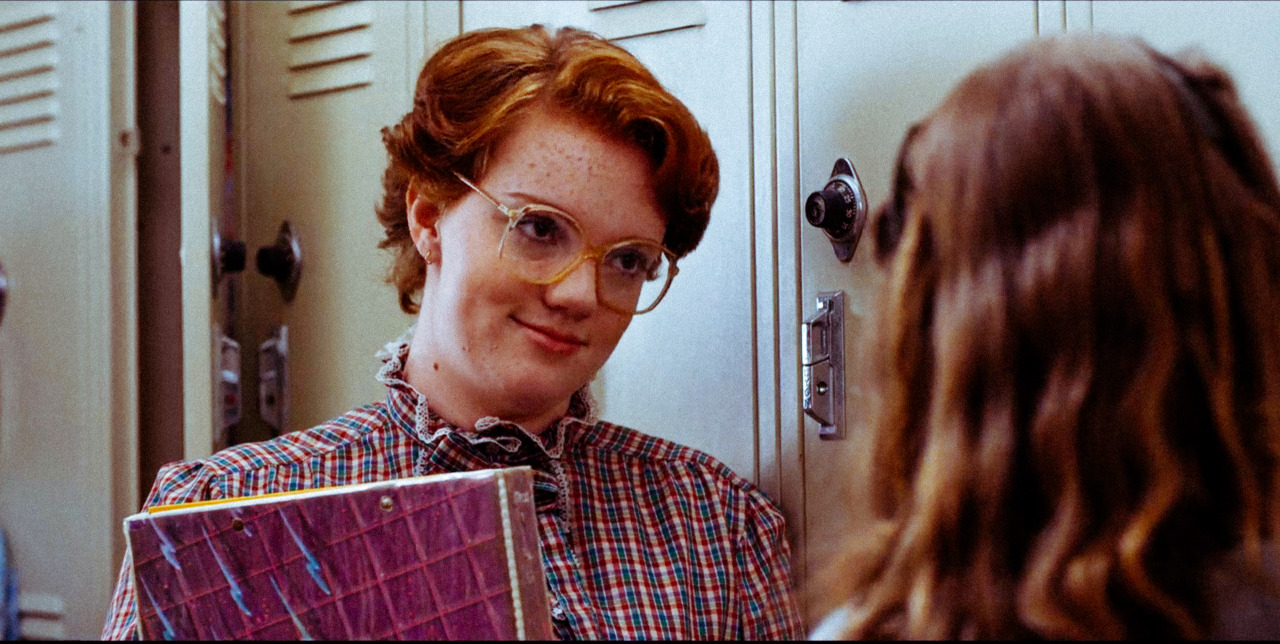
I’d been stoked for Stranger Things, and I felt gratified once it went live on Netflix that other people seemed to enjoy it as much as I did. However, all the social media posts about the show seemed to be echoing back to me one observation in particular that I didn’t expect: that Barb was awesome. I liked her a lot, despite her scant screen time, but I’m a weirdo who always roots for the underdog girl. In this instance, I was not alone in pulling for Barb. It also happens that most of the people posting about Stranger Things in my various feeds happened to be gay nerds of one stripe or another. So what is it about this mom-jeaned wonder that made gay dudes dig her? (You know, aside from her on-point-for-the-era fashion sense.)
After all, Barb (Shannon Purser) vanishes before the opening credits of episode three, when the shambling horror that is the show’s big bad pulls her into the swimming pool of doom, never to be seen again… save for a particularly nasty shot of her in the penultimate episode, when the viewer learns that yes, she’s completely dunzo—a corpse in the Upside-Down with a hell leech squiggling around in her mouth. It’s brutal to learn, especially if you, like me, had been hoping that she’d be rescued.
We gay nerds like our genre heroines, but Stranger Things actually offers four other female characters who get to do a lot more than Barb does. There’s Joyce (Winona Ryder), a small-time Sarah Connor who’s just the latest in a long line of fearless, strong moms in sci-fi works. There’s Eleven (Millie Bobby Brown), the telekinetic marvel who actually takes down the bad guys. There’s Nancy (Natalie Dyer), the Lisa Simpson-level goody two-shoes who finds an inner courage to become a hero in her own right. And there’s even Nancy’s mom (Cara Buono, a.k.a. Dr. Faye from Mad Men) who gets more to do than Barb does just by virtue of the fact that she survives through all eight episodes.
So why the hell would we like Barb so much? My theory is that for gay guys—and maybe also non-gay guys who had similarly difficult high school experiences—Barb reminds us of the selves we left behind back in the day, the not-yet-fully-realized versions that we want to go back and help or save or maybe just hug.
Based on the little we get to know about Barb in the first two episodes, we get that she’s Nancy’s smart and loyal best friend. She has a flair for fashion, but that doesn’t really put her on the radar of any of the popular kids, and she’s literally out of focus in the background of some of the shots in which Nancy is interacting with them. (If there’s a he-Barb lurking around somewhere, who can see her for the radiant, ruffled flower she is, we never get to see him.) She only gets invited to the party at the home of BMOC Steve Harrington (Joe Keery) because she is Nancy’s plus-one, and again, the boys don’t seem interested in her to the point that no one even reacts with much concern when she cuts her hand—and even then, she only cuts her hand in a vain attempt to shotgun a beer, just to prove to these cretins that yes, she’s like everyone else and can party like a normal kid. That felt familiar.
To paraphrase that great poet of our generation, Katy Perry, she’s a plastic bag who has yet to realize her status as a firework. Watching the second episode in particular, I wanted to tell Barb that it would be okay—that she’d get in to a good college where a bunch of art fags would celebrate her prim but daring style, and that everything would be okay in the end.
Only that doesn’t happen. It doesn’t get better for Barb. She dies without anyone aside from Nancy realizing how great she is, and even then, Nancy’s last interaction with her is shooing her away while she goes to make penis-vagina with Steve. Yes, even that is telling of the kind of relationships a lot of closeted gay guys had with their ladyfriends of choice back in the age of raging hormones. We’d be there, steadfast and protective, until the prospect of a more deeply realized male-female relationship presented itself, at which point we’d be left to wait downstairs while some people’s virginities were lost and others remained intact.
I’m projecting, sure, but I feel like for this gay guy in particular, the horror of Barb’s death wasn’t just that it seemed like if anyone should have been safe, it would have been her. No, it’s the weird “what if?” of never moving on from the Upside-Down of high school life and never having people finally appreciate you for the things that make you special. She has glam hausfrau style down, for sure, but I’m certain that’s not the only reason we gay nerds are rooting for her in a fashion way out of proportion to how much we see her onscreen.
I love you, Barb. I wish it had been different for you.
Miscellaneous notes:
I keep accidentally referring to the Upside-Down as the Underwhere, which I think should be the name of something.
Variety had a good interview with the Duffer Brothers that offers, among other things, some rationale about why Barb and Barb alone should have been the one character to get offed in the show’s first season, as well as the tidbit that Shannon Purser had never professionally acted before this series.
I was born in 1982, but that doesn’t mean I understand how women dressed in the first decade of my life. Consequently, it’s hard to tell if Barb’s style would have read as avant-garde in 1983 or just plain dowdy. I have similar issues with Jane Fonda’s wardrobe in 9 to 5.
Just in case you wanted a closer look at our last image of Barb, you can see it here. It’s awful. Barb deserved better.
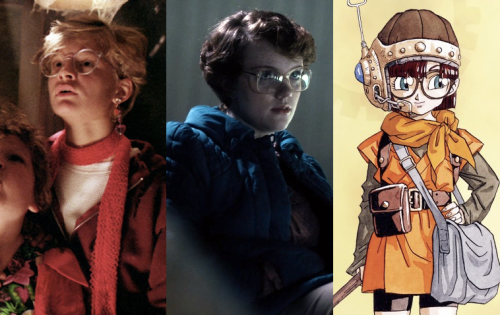
I maintain that Barb is equal parts Martha Plimpton’s character from The Goonies and Lucca from Chrono Trigger.
The TLDR version: My friend’s stepdad is responsible for Princess Peach being my gay nerd icon, because his actions resulted in her being a playable character in Super Mario Bros. 2.
I’d wager it’s strange for anyone to live in Los Angeles, but it’s especially weird when you were that certain type of lonely kid who used pop culture to relate to the world around you, just because this dumb city happens to be where a lot of that stuff originated. Stay here long enough, and you may end up bumping into one of the people responsible for some movie or TV show that hit you on a personal level. So far, I’ve had a few interactions with people where I had to temporarily dump journalistic pretense and say, “By the way, thank you — that thing you did helped me feel less broken.”
Back at the 2012 Indiecade in Culver City, I met Howard Phillips, a guy who shaped the childhoods of many young video game nerds by being the Nintendo’s first American employee and its unofficial ambassador to the U.S. I originally knew him from Howard & Nester, the Nintendo Power comic that had a cartoon version of him alongside Nester, the magazine’s mascot and a character Phillips himself created.
At Indiecade, the non-cartoon Howard Phillips was meeting and greeting a lot of people who, like me, grew up playing Nintendo games and realized that he helped shape their experiences. And I got to talk to him a little more than the average fan because I’m friends with his stepdaughter Katherine. She and I worked together at the time, and she had once bragged that her stepdad was the Game Master. I initially assumed she meant Captain N: The Game Master and that she was crazy, but she explained that “the Game Master” was one of Phillips’ monikers during his Nintendo heyday and that she therefore grew up having a level of access to Nintendo products that would have made my head explode. When I got a few extra minutes to speak with Phillips as Indiecade, the conversation veered into Super Mario Bros. 2, which was my favorite game — a fact that should already be known to you if you read my blog.
Phillips happens to be the person who informed Nintendo of Japan execs that the “true” sequel to the original Super Mario Bros. was too difficult for American players. And while there was a lot of doing on the part of Nintendo’s Japanese developers to transform a game called Doki Doki Panic into something that starred Mario and Luigi, the impetus, as I’ve understood the story, was this single decision my friend’s stepdad. When I spoke to him, I’m not sure I truly grasped that had it not been for him, this weird game with vegetable-plucking, magic carpets and a curious preponderance of masks probably wouldn’t have become part of my life. But more than just that, Super Mario Bros. 2 is important because it was the first game in the series that let you play as Princess Peach.
Back then, Peach was still known as Princess Toadstool, but she was otherwise the same character we have today: blond and wearing a tiara but nonetheless able to fight the bad guys as effectively as Mario and Luigi could. She was a captive in the first Super Mario Bros. and again in Super Mario Bros. 3 — and in fact when news of that later game came trickling out in the pages of Nintendo Power, I remember thinking, “It’s weird how they’re only showing screens with Mario and Luigi,” because why the hell would Nintendo ditch one of the best parts of the previous game with this new fancy sequel? But that’s exactly what Nintendo did. It would take until the Super Nintendo to see Peach playable again — but only in spinoffs like Super Mario Kart and Super Mario RPG. In fact, it wouldn’t be until 2007’s Super Paper Mario that she would be allowed into the side-scrolling, hop-and-bop action of the original titles, and it wouldn’t be until 2013’s Super Mario 3D World, which is in many ways a spiritual successor to Super Mario Bros. 2, that you could play as her in a “real,” non-spinoff Mario game.
(EDIT: It’s been pointed out that I forgot to mention 2005’s Super Princess Peach, the game that had the princess using her rapidly changing emotions as weapons — angry fire, pouring water for sad tears, etc. It’s possible I just wanted to forget it.)
In Super Mario Bros. 2, you could select which character you wanted to venture through each level, and on many occasions I’d play the whole thing through as Peach, just because I could and especially because I didn’t have to play as a male character if I didn’t want to. As time went on, I’d default to the female character in any game that gave the option. In Street Fighter II, I was Chun-Li. In Mortal Kombat, I was Sonya. In Donkey Kong County 2, I would routinely pick Dixie Kong and her whirling helicopter ponytail over Diddy Kong, the male counterpart who had no magic ponytail.
Growing up in a more rural, more conservative town, this was well and good for home console gaming but slightly awkward in public at arcades. I can remember going to a pizza parlor birthday party and bouncing from Darkstalkers (where I played as Felicia, the oversexualized cat-girl) to Tekken (where I played as Anna, a brassy female fatale who fights in an evening gown). This prompted one of the other kids to ask, “Why do you always play as the girl?” That was a scary question. I felt like I’d been caught doing something I shouldn’t have, and I think I weaseled out of answering by lying about these characters being the best ones per all those video game magazines I read. But I honestly didn’t know what the motivation was at the time. I liked playing as female characters but couldn’t explain why.
In fact, I think I only came up with a reason relatively recently. When I was a kid, I had no idea I was gay. Looking back, me being gay helps explain a lot of things I did, and I think it might explain this. I knew I didn’t want to be a woman, but I something about playing as a female character in these games felt right because they represented an alternative to the overtly macho types that comprised the majority of the character select screen, especially in fighting games.
As a boy, I was expected to succeed at certain things that I was simply not cut out to do: sports, being handy with tools, exuding confidence, not crying at the drop of a hat and “boy play” with miniature cars or whatever the hell else is socially acceptable for male children to entertain themselves with. I failed constantly, and as a result, I felt like I was disappointing the people who had these expectations. The one stereotypically male pursuit I excelled at was video games, and something compelled me to do so as female characters because they could be every bit as successful as male characters, even if they didn’t look the part of a traditional hero.
Like Peach. Look at her. Farrah Fawcett flip, jewelry, a ball gown that’s wholly impractical for adventuring. She’s pink — so very pink — because there was a considerably long time in video games when most female characters were pink, just so there’d be no mistaking their gender. In short, Peach is kind of a big sissy, but so was I, in a lot of ways, and the fact that she was coded in this manner made her all the more attractive to me. While none of the other three heroes in Super Mario Bros. 2 were exactly Stud McBeefcake — come on, Toad is damn near genderless — there was no doubt from the first time I fired up that game that the princess would be my hero of choice. She still is.
Post-Lara Croft, post-Bayonetta, post-it becoming general knowledge that the dude from Metroid is actually a woman, Peach probably seems antiquated to a lot of gamers. She’s a vestige of an age in which female characters generally just yelled for help as the big bad carried them away. However, she’s also quite possibly the female character who’s been playable in the most games ever, and in my head, it makes her all the cooler than she can still be the best, on her own merits, neither because of or in spite of her unabashed girliness. Should you choose her to be, Peach can kill the monsters, win the race, score the winning shot and, in the case of Super Smash Bros., kick the stuffing out of everyone and anyone.
In case you’ve made it this far and don’t know, Smash Bros. features video game mascots fighting each other, and from the second game on, Peach has been a playable character. I’m ending on this note because it ties back to Howard Phillips and Super Mario Bros. 2. Each character fights using moves that originated in whatever game they’re representing, and Peach’s repertoire draws from Super Mario Bros. 2. She pulls turnips from the ground and tosses them at her opponents, for example, and she can float in midair, and both of these elements originated in my favorite game.
Now, even if Phillips hadn’t set into motion the chain of events that created the American Super Mario Bros. 2, it’s quite likely that Peach would have ended up playable in subsequent Mario games anyway. She’s the main female character, after all. But she wouldn’t have ended up the way she is now had it not been for Nintendo ultimately deciding to substitute Doki Doki Panic for the game released as Super Mario Bros. 2 outside Japan. Doki Doki Panic’s heroes, a jolly Arab family, were transformed into Mario characters.
Imajin, the main hero with the average stats, became Mario. Papa, the strong one, became Toad. Mama, who jumped high, became Luigi, and cute little sister Lina, who could hover in midair and who, yes, is clad in pink, became Peach. Lina and the rest of her family have since been relegated to footnotes in video game history, but every time someone plays as Peach in Smash Bros. and floats for a second in the air to trip up their opponent, they’re using Lina’s old move. Thanks to Phillips (and Nintendo (and Super Mario Bros. 2))), she’s not completely lost. She’s just hidden.
This is all a very roundabout history lesson, but it seemed important to me. It’s the little details that make given movie or TV show or whatever resonate with you for the rest of your life. I like that Princess Peach is a big, pink powderpuff of a character, and that she’ll probably always be that way. It clicked with me when I was a kid, and as strange as it might sound, I feel like it put me on a path to figuring myself out later in life, all in addition to shaping subsequent video games for decades to come. And it all happened because my friend’s stepdad made a decision. He would probably be surprised to know that it had any big effect on one little gay nerd in the middle of California, but I’m happy to put it out there.
Miscellaneous notes:
Earlier this month, I wrote did a post about Troop Beverly Hills and how Shelley Long’s character treats her femininity as an asset and not an obstacle. I would have seen Troop Beverly Hills at the height of my Super Mario Bros. 2 fixation, now that I think about it, and writing that piece probably resulted in this piece.
Nester did eventually make it outside the pages of Nintendo Power, even appearing in a few games. Most notably, he got his own game in 1996, the Virtual Boy title Nester’s Funky Bowling, where he appeared alongside not Howard but a girl version of him named Hester.
The history behind how the American Super Mario Bros. 2 came to exist is explained in beautiful detail in Jon Irwin’s 2014 book, and if you loved the game half as much as I did, you may also enjoy this deep dig into it. Game Historian also has a good video on the history of Mario 2.
Peach may be the most famous playable character in a Nintendo game, but she’s not the first. Metroid came out two years before, though many players wouldn’t have realized its hero, Samus, was female. Mach Rider, which came out a year before Metroid, might also have a female hero, and then there’s Bubbles, the anthropomorphic goldfish hero of Clu Clu Land, which came out in 1984, even before Mach Rider, though there’s hardly much about Bubbles to identify her even as a goldfish much less a female one.
Two unheralded NES-era with female protagonists: The Krion Conquest and Ghost Lion, one of which stars a girl who may or may not be Kathy Santoni from Full House.
Finally, my love for female heroes made me fall in love with Athena, a SNK game that was ported to the NES. It’s not great, I realize in retrospect. Bad play control and punishing difficulty, but the lead character is girly as hell, and at one point you could transform into a mermaid. I was hooked, in spite of it all.
I told my parents I was gay on St. Patrick’s Day in 2005, effectively ruining a pleasant corned beef dinner. I was three months away from graduating college, and I wanted to integrate the worlds I lived in. My college friends knew, but essentially no one from home did. I blame the closure of the bowling alley in my hometown; with no alternatives, the favored pastime there had become discussion of unplanned pregnancies, divorces and the various other ways young people had disgraced their good family names. In any case, I knew I had to tell my parents before someone else did.
More than ten years later, those worlds still aren’t integrated. Here in Los Angeles, I’ve constructed this Neverland of gay nerds with whom I can talk to about Chun Li and Barbara Gordon and Princess Zelda in the same sentence and not get looked at like I’m some kind of space alien. When I go home, I revert. I don’t pack the cutoffs. I leave behind the purple V-neck T-shirt and take the blue one. My life as I live it in Los Angeles does not get discussed unless I force it.
I went home earlier this year, and my mom asked how I was doing. “This guy I used to know in Santa Barbara passed away, and also I got dumped,” I said. Mom: “Oh, I’m sorry your friend passed away.” That bait dangled, untouched. I chose not to force it. Because the divide has remained over the past decade, it is hard for me to make that drive up Highway 5, knowing that I’m going to sit through days and days of questions about what’s growing in my garden, the activities of college friends I haven’t kept in touch with and the name of my apparently singular female friend — “Megan? Stephanie? Which is it? Wait, there are two?” — at the exclusion of anything more personal.
The single best example of this refusal to talk about the gay son’s stubborn gayness occurred while I was helping my mom clean out the liquor cabinet, which had been chiefly stocked over the years by visiting New Zealanders landing at SFO with duty-free offerings and the belief that my family drinks the hard stuff. I stood on a step ladder and handed bottles down one by one, and my mother, who often narrates what she’s doing, read the labels out loud as I passed them to her. “Smirnoff Vodka. Bombay Sapphire Gin. Beefeater Gin.” Then I passed her a bottle of Mount Gay rum. Mom: “Oh, it’s…. it’s rum.” The bottle later vanished.
As I do on most holidays at home, I spent this past Thanksgiving dutifully working — the big turkey dinner, raking leaves, getting ahead of freelance assignments — with the closest connection I have to any other world being Scruff, usually sitting unattended on the dresser in my childhood bedroom. Having come off from being the only gay at a wedding the previous weekend, I desperately felt like I needed something, even if that something wasn’t much of anything. At home, Scruff is mostly glimpses into the sad life I’d have led if I’d stayed in town: torsos that can’t host. I don’t really engage. It’s just a window on a world that reminds me that I’ve made good choices for myself. Well, that and an occasional invite to go up to San Francisco, unsolicited and politely declined. (Me: “I live in L.A. and I’m really only interested in dating,” and every time I say that I feel like I might as well be saying “I live in Chicago and I hate wind” or “I live in Maui and I’m allergic to sunsets.”)
With all that said, you can appreciate my surprise at what my mother said when she and I got into an argument about politics — why I can’t vote for a candidate running on a conservative social platform and why liberal politicians are apparently ruining the country with wasteful economic policy. I countered with all the examples of the good that liberal politicians have done in the face of conservative opposition, and the conversation eventually turned to the point that it was liberals, not conservatives, would made it possible for me to get married one day.
Mom: “Well, as the parent of a gay person, I understand that.”
It was followed by a “but” about taxes, of course. I was stunned that it happened at all. In the ten years since I told my parents I was gay, I’d never heard either of them ever refer to me as a gay person. (My grandmother referred to gays as “people who are that way,” and that euphemism has endured in the family long since.) I got hung up on that one sentence to the point that I think I lost the argument, just because my brain wouldn’t process anything aside from the fact that my mother acknowledged something that’s fairly important to how I live my life but which had gone unspoken, at least when I’m in the room.
I hugged my mom and told her it was good talking to her. It was the least acrimonious ending to a political argument in the history of my family.
It may not seem like much, especially to those weirdos with enthusiastically supportive families, but it was the single marker of progress I’ve had in a struggle that’s been going on for ten years. There’s still a lot to do yet — I recently mentioned that I was hoping to adopt a dog soon and was quickly cautioned against getting one that is too small — but it’s my single greatest takeaway from this Thanksgiving trip home.
(Yes, picture is unrelated. I needed a picture. It was this or a display shelf of Mount Gay rum.)
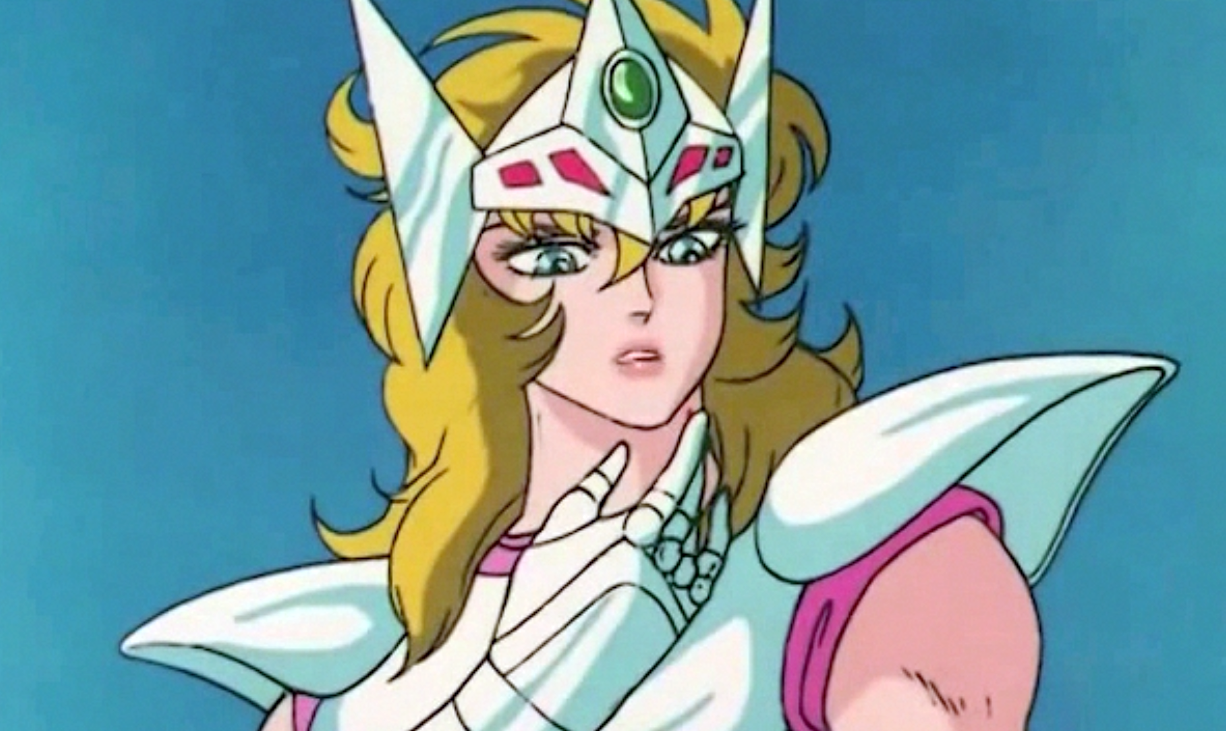
Last year, I started posting supercuts of the more conspicuously sexual parts of Saint Seiya, an anime series that started airing in Japan in 1986 and which later surfaced in English-speaking areas as Knights of the Zodiac. It’s pretty classic “dudes in armor” fighting action. It’s also gayer than gay sex. I don’t think it was meant to be so laden with innuendo, but it’s hard to read this series of grunts, glances and one-on-one fight sequences as anything other than thinly veiled dickbutt.
Free time has been harder to come by since the last post, but I’ve still been watching, grabbing spare scenes as I happened across them. Here’s the latest series of head-scratchers.
Some context:
0:01 — Hyoga gets his powers from Cygnus, the constellation shaped like a swan, and therefore must flap around like an elegant bird to create ice magic. Totally hetero, in the way a beautiful male figure skating routine is also totally hetero. His special move is Diamond Dust, which sounds more like a Sailor Moon attack, which should be familiar to those who grew up playing RPGs, and which is an actual meteorological phenomenon.
0:25 — Cygnus clutches his hands into a fist-pumping pose and fires off white energy blasts.
1:10 — Women play an odd role on the show. The female saints must keep their faces covered with a mask at all times, and that makes it all the stranger that Argol wields Medusa’s face as a weapon. There’s a theory that Medusa’s face is a symbol of the vagina dentata. Think about it: it’s a fanged, snarling version of a thing that’s usually not dangerous, and it’s lethal to even behold to say nothing about interacting with it. It’s also surrounded by coiled snakes which, if you’re taking this analogy to its full extent, could be interpreted a similarly dangerous version of pubic hair. Medusa is weaponized female beauty, and the fact that she attacks by making enemies rock hard? The symbolism is almost too much. Death-boners, all around, in the same way that that one Poison Ivy episode of Batman had gave people deadly, permanent wood.
1:18 — Argol has to turn his backside on enemies to unleash his weaponized vagina power. Hmm.
2:00 — Whenever anyone talks about putting anything into something that’s quivering, it’s easy to assume it’s sexual.
2:13 — I feel like Andromeda reads as a very feminine man. I mean, his name is Andromeda. He’s the only major male character to be named after a mythological character that is expressly female. But that makes it all the more interesting that his weapon is a snaking chain that lends itself to penile comparisons. In this scene, his chain goes limp.
3:27 — Perseus’ outfit. Just saying.
4:12 — Just look at the way Andromeda runs those chains through his hands. He’s like a snake-charmer.
And here are the previous clips.
(And there’s a little more on this particular weirdness here.)
My name is Drew, and I feel insecure about my facial hair.
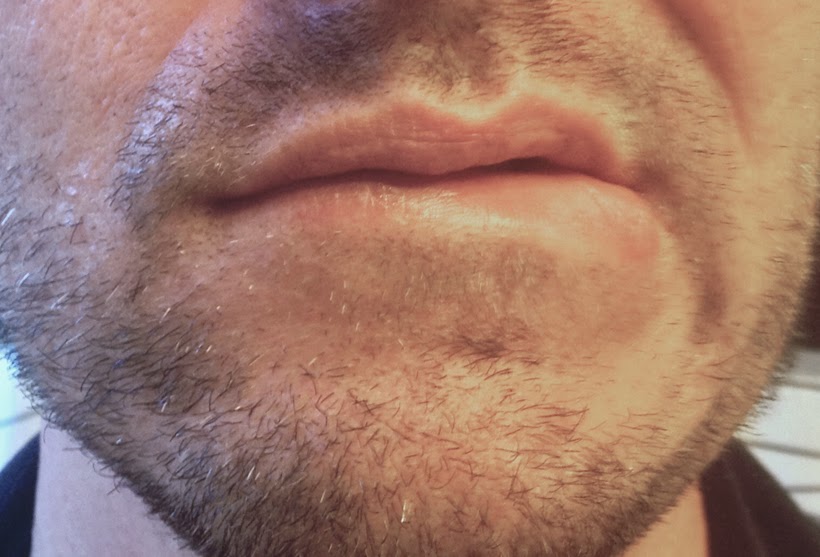
Let me describe for you a cycle that’s been going on for most of my post-pubescent life. Facial hair grows in, and stubble approaches beard status. About a week in, however, I begin to notice imperfections. “Oh, these few hairs don’t lie flat, and it looks patchy over yonder, and hey — have these two sides always been so asymmetrical?” I trim in an attempt to even it out. This maybe lasts a day or so, because when I’m next standing in front of the bathroom mirror, I realize that my attempts to fix the problem only made it worse. Of course, this only prompts me to try again to fix it, and in the end I end up buzzing it all away, back down to stubble, whereupon the cycle begins again.
(And no, clean-shaven is not an option for me. When I shave it off, I think I look like a kid play-acting as a grown-up. It creeps me out.)
Based on that description, you might think I’m critical of facial hair in general, but here’s the thing: I can’t remember the last time I saw some else’s stubble, beard, near-beard or whatever and had anything other than a positive reaction to it. Goatees excepted, I think facial hair better looks better than no facial hair, and I give everyone else a pass that I don’t give myself. At 32 years old, I’m basically good with the way I look and the way my body goes about its processes, but this one in particular I cannot accept. That’s maybe just how most people operate, saving their harshest judgment for themselves, but I’ve gradually become aware of the fact that I focus this harshness specifically on my facial hair.
I know calling my problem dysmorphia might rankle some, because body dysmorphia can be a life-ruiner of a problem that drives people to starve themselves or isolate themselves or plastic surgery themselves into oblivion. But before I wrote this, I read up on how dysmorphia affects people. Without going into too many specifics, I was surprised to learn that what I experience fits many of the criteria. I’m lucky I don’t experience it in a way that could impact my life more negatively, I realize, but it’s still something that’s bothered me for a decade. And it would feel better to stand in front of a mirror and not have my first reaction be, “No, this isn’t right.”
Alas, my permastubble is as good as I can do, Gawker’s condemnation of it notwithstanding. I’m fortunate to live in a part of the world where no one seems to notice or care that I’m trying to look like I always just getting back from a long weekend, but I also live in a part of the world with some commendable, magnificent beards that put me in my place. As a gay man, I have to wonder what insecurities may be prompting me to use facial hair as an easy, visible shorthand for masculinity. (“See? I am a man. Look, I have secondary sex characteristics and everything.”) And if I’m doing that, it’s odd that seizing upon a physical aspect of myself for which I can’t compensate by, say, working out more or investing in a codpiece.
I wrote this not to fish for compliments — other people’s assurances don’t do much to change my opinion about by pathetic beardlessness — but to put it out there to see if other guys ever feel the same way. Do you also suffer from suspicions that everyone else’s facial hair looks superior to your own? Do you find yourself trapped in a permastubble cycle? Is this an insecurity for straight guys in the same way it is for gay guys? Does anyone know the name of a good beard-wig supplier?
In the same way that The Simpsonsmade me vaguely aware of Eudora Welty years before I’d read her books, I first learned about Lesley Gore through The Simpsons. In that one episode where Marge goes on the lamThelma & Louise-style, her friend Ruth accidentally plays Gore’s “Sunshine, Lollipops and Rainbows” when she means to put in the cassette of “Welcome to the Jungle.” The song stuck with me — as a kid, because I thought it was funny, and as I got older, I realized it’s relentlessly cheerful to the point that it’s probably compensating for some crippling emotional pain.
The despair. It overwhelms.
Anyway, when the golden age of music downloading struck during my freshman year of college, I downloaded this Lesley Gore song to satisfy some weird Simpsons completionist urge. It was only then that I realized that Gore was also the singer of that midcentury drama queen anthem, “It’s My Party (And I’ll Cry If I Want to).” But for my money, Gore’s best song is “California Nights,” a wistful little number doing various chaste things at the beach. Here, watch the video for it.
You may be wondering why Lesley Gore was dressed in a pink kitty cat costume. I know I was. It turns out this is actually a clip from the old Adam West Batman series, which Gore guested on for two episodes in order to debut “California Nights.” She played Pussycat, a Catwoman sidekick who turned to a life of crime when she felt her dreams of being a rock-and-roll singer would not come to pass. This was all news to me, and I thought I’d seen every episode of the old Batman series.
It doesn’t take long for Catwoman to explain her plan: Pussycat is to use her feline wiles to seduce Robin. I know, I know. Naming a seductress Pussycat is a little on the nose — on the genitals? — even for Batman, but the truly interesting bit here is how Batman mythos converge with Lesley Gore’s own life. You see, Gore revealed in 2005 that she had been in a relationship with a woman for decades. (And if she didn’t sing some variation of “It’s My Party and I’ll Come Out If I Want to,” then she really missed a great opportunity.) To me, Lesley Gore’s sexuality seems notable for two reasons.
For one, it allows for a much darker reading of “Sunshine, Rainbows and Lollipops” — “Downpours, Colorblindess and Medicated Cough Drops,” if you will. The lyrics explain that existence has become sunshine, lollipops and rainbows because the speaker is in love. Love, however, doesn’t necessarily result in happiness when you’re a closeted teen pop idol in 1963. I’d imagine that at some point Gore noticed the irony of standing onstage and literally singing the praises of love. (At some point, she probably also noticed the irony of Pussycat.)
Secondly, her brief stint as Pussycat, who only ever appeared on the TV show, foreshadows a sidekick Catwoman would eventually get in the comics twenty-four years later: Holly Robinson. She never wore anything as sidekick-y as Pussycat’s get-up, but Holly was Selina Kyle’s right-hand woman for years, and she actually became Catwoman herself when Selina retired in 2006. Holly eventually came out as a lesbian as well. That’s not to say that Holly’s sexuality has anything to do with Lesley Gore’s, but it just makes for a nice little parallel for these two sidekicks to Catwoman. DC Comics introduced Batwoman back in 1956 to help quell real-life rumors that Batman and Robin gay, so that’s why it was all the more symbolic that DC reintroduced Batwoman in 2006 as a lesbian character. In an inadvertent way, Holly as an openly lesbian Catwoman makes good on something that’s just under the surface at in a different Bat-time and a different Bat-place with a closeted woman playing Pussycat.
Circle achieved in full. Way to be, superhero lesbians.
Extra bits:
“Marge on the Lam” is also what taught me about Garrison Keillor, though I wouldn’t get the joke until years later, when I heard my first broadcast of A Prairie Home Companion. “Oh, that’s what that one guy was.” This happens to me often, even today.
“Sunshine, Lollipops and Rainbows” debuted in the 1965 “beach party” movie Ski Party, which did, in fact, have beach scenes in spite of the snowy setting. The film starred Yvonne Craig, who in 1967 joined the cast of Batman as Batgirl. Additional circularity!
“It’s My Party” was Lesley Gore’s most famous song and also just one of those standards that everyone can at least hum the chorus to. But a lot of people don’t know that Gore later sang a “sequel” song, “Judy’s Turn to Cry,” in which the victimized narrator gets her revenge by kissing another boy and enraging the guy who left her in the first song, leaving Judy alone. Suck it, Judy. Why don’t more songs have sequels?
Gore also has a song titled “That’s the Way Boys Are,” and I kind of want there to be a response song along the lines of “Oh, How Would You Even Know, Lesley?”
While Holly Robinson was never Catgirl, Kitrina Falcone was, and her Catgirl outfit looks more or less like you’d imagine Pussycat’s, minus the camp.
For reasons I cannot explain even to myself, I continue to watch Saint Saiya, an 80s anime, and I continue to compile its baffling sexual imagery for your personal entertainment. You’re welcome. The following supercut takes us to episode 25 or so, and it may well be the gayest thing you see this week,
Of particular note: two separate bare bottoms (both male), falling in love with a woman you acknowledge looks exactly like your own brother, more Death Queen Island, fisting, [suggestive grunts], just the oddest dialogue choices coupled with the oddest line-readings, and a staggeringly gay big bad named Lizard Misty who is (a) not female, despite the fact that he looks like Princess Peach and is clearly wearing lip gloss; (b) a legitimately powerful foe, irrespective of his effeminacy; and (c) doesn’t perspire so much as radiate homoeroticism.
A lady, just a biologically male lady.
Saint Seiya and the weird sexy, previously:
And for a detailed breakdown of the extended gayfight in that last one, click here.
Honestly, I don’t know enough about anime to proclaim any given scene the most homoerotic-ever. However, I know an opportunity for over-reading when I see one, and the 80s action series Saint Seiya is fruitful, so to speak.
In the universe of Saint Seiya (or Knights of the Zodiac, depending on what translation you’re watching), saints are armor-clad superheroes who derive their powers from constellations, because no one on the Japanese side of this project knew a Catholic person.
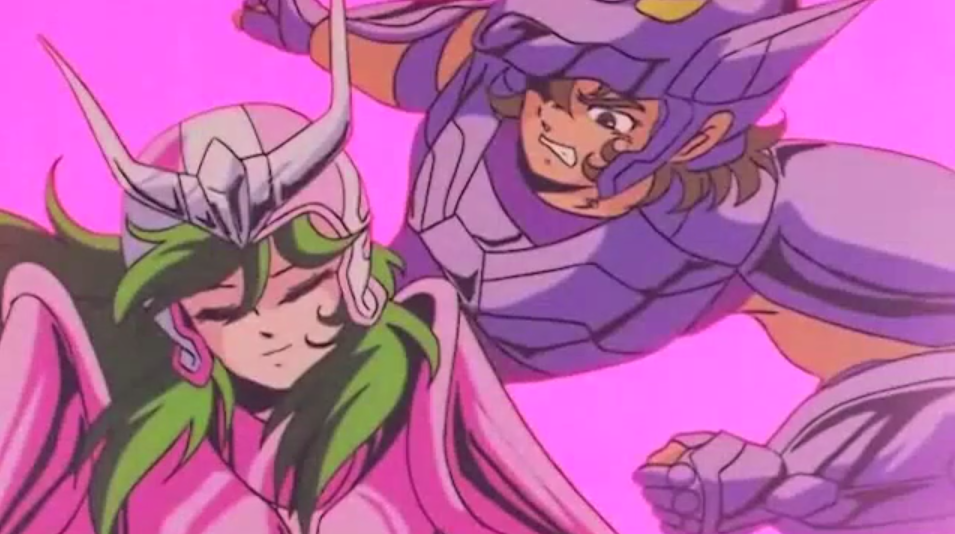
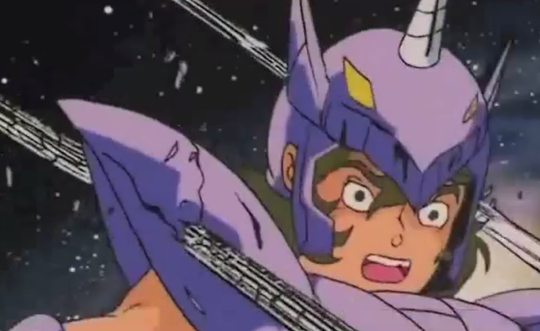
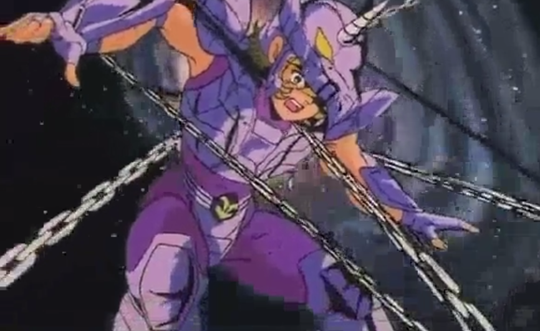
This scene, which comes from the series’ sixth episode, the pits the Andromeda saint — pink armor with an especially busomy-looking breastplate, and don’t forget that the constellation is named for Greek mythology’s No. 1 damsel in distress — against the purple-clad Unicorn saint. The more passive of the two, Andromeda resists fighting, but he’s goaded by Unicorn, whose most outstanding wardrobe feature, it should be noted, is a single protruding horn. “It sounds like the ladies really love you, don’t they, pretty boy?” Unicorn taunts. Andromeda is unflustered. “I’m sad, and filled with emptiness,” he says, which is clunky entendre but which still gets the point across. The two engage. We get a pink-hued freeze frame of the two intertwined — Unicorn looking focused and aggressive, Andromeda looking serene, even pleased.
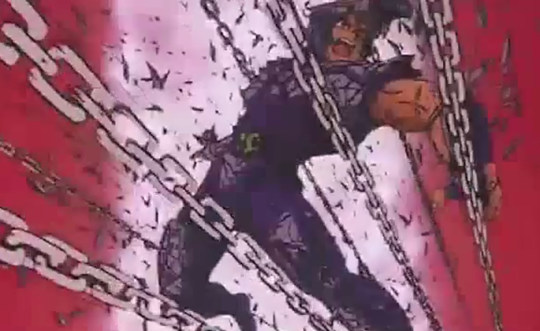
Andromeda, however, flips the script when he proves more powerful by virtue of his telekinetic control of a chain — a long, snaking instrument that acts like an extension of his body and which has a pointed tip at the end. (“That chain! It’s like a living thing!”) The scene inexplicably shifts to a celestial backdrop, where he’s superimposed on an image of the Andromeda constellation. It’s a mix of signifiers — phallic weapon combined with maiden imagery. Time literally stands still. Unicorn persists in attacking, and Andromeda calmly sends the chains after him, penetrating him repeatedly. (“Of all the parts of the Nebula Chain, the top is the strongest!” Really.) Based on the noises you hear from the crowd (and the reaction shot you see of the Lady Purple Hair), it’s all being done for the delight of female spectators. You don’t hear a single male voice cheering.
The lesson? Appearances are deceiving, and the dude with flowing ladyhair may be the strongest one in the room.
That’s pretty loaded, just from the standpoints of gender and sexuality. I realize there are always problems in a person from one culture using his terms to analyze something produced by a second culture. But no matter how a Japanese audience would have read the scene back in 1986, this guy over in America in 2014 has a hard time not seeing a whole lot of sexual cues.
Why am I watching Saint Seiya in 2014? I don’t really know. I was trying to look up one minor trivia point and ended up finding a cache of the episodes available online. It turns out I like the look of Japanese animation from back when I was a kid even if I wasn’t watching it at the time. I don’t know why. Regardless, the combo of awkward translations plus bizarre line-readings makes for a more entertaining experience than you might think. Case in point: “My cosmos is about to explode,” which is either bad grammar or bad innuendo or both.
I can’t tell you how many times I’ve re-encountered some half-remembered childhood thing as an adult and reacted with horror and amusement at what the younger me had actually seen without realizing it. Today, it’s the Capcom arcade game Black Tiger, the promotional art for which was what you see below.
It’s not just that the artist chose to emphasize the hero’s butt. No, it’s that the artist clearly relished the opportunity to depict an idealized, Mount Olympus bottom that’s just barely covered by a flap of loincloth in a way that’s almost teasing.
— “Hey, what if we just showed the barbarian hero character’s whole naked butt, for no reason?” — “Well, you can’t actually see his butt in the game.” — “Yeah, but gay kids.” — “Oh, all right.”
That’s how I imagine it, at least. For the record, barbarian warriors and homoeroticism have gone hand-in-hand (or dick-in-hand) since the days of the first pixelated loincloth. It’s also worth mentioning that there’s an alternate version of the Black Tiger arcade flyer that skews slightly less homoerotic by virtue of a more substantial buttflap, though the tagline “The more you play, more exciting it gets!” kind of sounds like an ESL endorsement for masturbation.
Here’s the game in action. Please enjoy the relatively little amount of butt the game has to offer, regardless of what that first flyer might indicate.
This was a big week for fans of samesies, but while many Californians took to the streets to celebrate the Supreme Court, I observed this momentous occasion by working at home and then falling asleep watching Comedy Central. It’s for this reason that I’m presenting a bit of gay history today. It may not affect as many people as does California catching up to that glittering bastion of liberality we call Iowa, but it’s a pretty good story nonetheless. Also, I just learned it yesterday, and it’s one of the best things I’ve learned in a long time.
Last April, pro basketball player Jason Collins announced he was gay, prompting many media outlets to decree that he was the first to come out while being a member of a major American sports team. Some, however, noted that this wasn’t the case: In particular, the San Francisco Chronicle noted that Glenn Burke, who joined the Dodgers as an outfielder in 1976, was out to his teammates.
Burke’s sexuality wasn’t exactly known to the public, but it wasn’t for a lack of effort on Burke’s part. From The Atlantic:
Burke made no secret of his sexual orientation to the Dodgers front office, his teammates, or friends in either league. He also talked freely with sportswriters, though all of them ended up shaking their heads and telling him they couldn't writethat in their papers. Burke was so open about his sexuality that the Dodgers tried to talk him into participating in a sham marriage. (He wrote in his autobiography that the team offered him $75,000 to go along with the ruse.) He refused. In a bit of irony that would seem farcical if it wasn't so tragic, one of the Dodgers who tried to talk Burke into getting "married," was his manager, Tommy Lasorda, whose son Tom Jr. died from AIDS complications in 1991. To this day, Lasorda Sr. refuses to acknowledge his son's homosexuality.
The Atlantic notes that Burke came out in a bigger way in a 1982 interview. He died from AIDS-related causes in 1995. This story itself seems worth telling, or at least worth telling if you’re anyone who cares about the various Jackie Robinsons of the world, but there’s actually an even more surprising footnote to Burke’s short baseball career: He may have invented the high five.
I know, I know. It’s weird to think of a word in which people didn’t slap palms as congratulations for a feat of athletic awesomeness, a perfectly barbed put-down, a righteous belch or “yeah, I hit that,” but we didn’t always have this gesture. In the way that it can be tough to determine exactly when a slang phrase enters the lexicon, we also can’t be sure exactly when high-fiving went mainstream, but Glenn Burke and Dusty Baker seem to get credit for giving the first on-the-record high five on Oct. 2, 1977, just after Burke hit his thirtieth home run. This ESPN.com article, notably written just a few days before Collins came out, does a fantastic job telling the story:
It was a wild, triumphant moment and a good omen as the Dodgers headed to the playoffs. Burke, waiting on deck, thrust his hand enthusiastically over his head to greet his friend at the plate. Baker, not knowing what to do, smacked it. “His hand was up in the air, and he was arching way back,” says Baker, now 62 and managing the Reds. “So I reached up and hit his hand. It seemed like the thing to do.”
The article, which goes on to describe the ambiguous relationship Burke shared with Tommy Lasorda’s son, says that the high five went “ricocheting around the world” from there, in spite of the fact that the game wasn’t televised. And there you have it. Yes, it does seem strange that the high five was born only a few years before I was, and yes, it’s entirely possible that someone else in the history of the world slapped someone else’s palms in a victorious fashion. But if they did, we don’t know about it. We do know about Glenn Burke, who along with Dusty Baker invented something that would live on, even when Burke himself or mainstream awareness of his athletic career or his status as the Jackie Robinson of gay baseball (“gaysball”) did not.
Does this mean that high fives in the early seasons of That ’70s Show were anachronistic? Yes, I suppose so. Does this not tie in nicely with what I posted on Wednesday? Yes, it really does. And does this also mean that any and all high fives are tacit endorsements of the gay agenda? Well, obviously.
When Empire of the Sun released “Walking on a Dream,” I thought the song was catchy in a way that made me scared that I’d soon hear it in commercials and movie trailers and then eventually hate it — you know, in the way that “Little Talks” has been ruined for me. It got some mainstream play, but in the end, I never felt overexposed to this song, so when Empire of the Sun announced their forthcoming album, Ice on the Dune, I got excited. The lead track sounded great. Everything was shaping up for a primo musical experience.
Then I saw the album art.
It’s, um, expressive and colorful.
Granted, the first album’s art suggested a meeting between Blade Runner and Liberace, but when that album came out, I drove an older car. My new car actually displays the album art of whatever I’m listening to, so I have to look at this gay cosplay version of Final Fantasy — which, of course, would be called Anal Fantasy — whenever I listen to the song… which is kind of often.
Can we stop and take a look at what someone thought made sense as an image that people would see and use as evidence in deciding whether to buy this album? If you’re more of an “outside kid” than I am and therefore don’t understand my comparisons to Final Fantasy, please examine this promo art for the tenth game in that series.
Now, imagine that this game — still with the saturated color, dramatic but ambiguous poses and unrealistically smooth skin textures — featured not only the hero but also this badass sorceress who had gnarly ice powers as well as, like, some major lady-tude and an enchanted headdress that gave her additional sartorial ferocity. And also she was interesting-pretty. And then a lot of dude-on-dude sex happened. Then you’d pretty much have the Ice on the Dune album art, just as a game. I’ll be honest: That kind of sounds like a video game I’d play. And I think it’s cool that Empire of the Sun — neither member of which, as near as online research can tell me, seems to be gay — went that direction for their new album. I’m just baffled as to why they did so whenever the album art pops up on my car console. It’s a weird reaction, I know — not so much judgment but just “Someone sure made some distinct choices, and I just want to know what their logic was.”
Also, if you want to make the video game I described, I’d basically have to buy it. Just saying.