Pages

Showing posts with label gender issues in video games. Show all posts

Sunday, April 24, 2016

How Howard Phillips Gave Princess Peach to Little Gay Nerds

The TLDR version: My friend’s stepdad is responsible for Princess Peach being my gay nerd icon, because his actions resulted in her being a playable character in Super Mario Bros. 2.


I’d wager it’s strange for anyone to live in Los Angeles, but it’s especially weird when you were that certain type of lonely kid who used pop culture to relate to the world around you, just because this dumb city happens to be where a lot of that stuff originated. Stay here long enough, and you may end up bumping into one of the people responsible for some movie or TV show that hit you on a personal level. So far, I’ve had a few interactions with people where I had to temporarily dump journalistic pretense and say, “By the way, thank you — that thing you did helped me feel less broken.”

Back at the 2012 Indiecade in Culver City, I met Howard Phillips, a guy who shaped the childhoods of many young video game nerds by being the Nintendo’s first American employee and its unofficial ambassador to the U.S. I originally knew him from Howard & Nester, the Nintendo Power comic that had a cartoon version of him alongside Nester, the magazine’s mascot and a character Phillips himself created.

via the howard & nester comics archive

At Indiecade, the non-cartoon Howard Phillips was meeting and greeting a lot of people who, like me, grew up playing Nintendo games and realized that he helped shape their experiences. And I got to talk to him a little more than the average fan because I’m friends with his stepdaughter Katherine. She and I worked together at the time, and she had once bragged that her stepdad was the Game Master. I initially assumed she meant Captain N: The Game Master and that she was crazy, but she explained that “the Game Master” was one of Phillips’ monikers during his Nintendo heyday and that she therefore grew up having a level of access to Nintendo products that would have made my head explode. When I got a few extra minutes to speak with Phillips as Indiecade, the conversation veered into Super Mario Bros. 2, which was my favorite game — a fact that should already be known to you if you read my blog.

Phillips happens to be the person who informed Nintendo of Japan execs that the “true” sequel to the original Super Mario Bros. was too difficult for American players. And while there was a lot of doing on the part of Nintendo’s Japanese developers to transform a game called Doki Doki Panic into something that starred Mario and Luigi, the impetus, as I’ve understood the story, was this single decision my friend’s stepdad. When I spoke to him, I’m not sure I truly grasped that had it not been for him, this weird game with vegetable-plucking, magic carpets and a curious preponderance of masks probably wouldn’t have become part of my life. But more than just that, Super Mario Bros. 2 is important because it was the first game in the series that let you play as Princess Peach.

Back then, Peach was still known as Princess Toadstool, but she was otherwise the same character we have today: blond and wearing a tiara but nonetheless able to fight the bad guys as effectively as Mario and Luigi could. She was a captive in the first Super Mario Bros. and again in Super Mario Bros. 3 — and in fact when news of that later game came trickling out in the pages of Nintendo Power, I remember thinking, “It’s weird how they’re only showing screens with Mario and Luigi,” because why the hell would Nintendo ditch one of the best parts of the previous game with this new fancy sequel? But that’s exactly what Nintendo did. It would take until the Super Nintendo to see Peach playable again — but only in spinoffs like Super Mario Kart and Super Mario RPG. In fact, it wouldn’t be until 2007’s Super Paper Mario that she would be allowed into the side-scrolling, hop-and-bop action of the original titles, and it wouldn’t be until 2013’s Super Mario 3D World, which is in many ways a spiritual successor to Super Mario Bros. 2, that you could play as her in a “real,” non-spinoff Mario game.

(EDIT: It’s been pointed out that I forgot to mention 2005’s Super Princess Peach, the game that had the princess using her rapidly changing emotions as weapons — angry fire, pouring water for sad tears, etc. It’s possible I just wanted to forget it.)


In Super Mario Bros. 2, you could select which character you wanted to venture through each level, and on many occasions I’d play the whole thing through as Peach, just because I could and especially because I didn’t have to play as a male character if I didn’t want to. As time went on, I’d default to the female character in any game that gave the option. In Street Fighter II, I was Chun-Li. In Mortal Kombat, I was Sonya. In Donkey Kong County 2, I would routinely pick Dixie Kong and her whirling helicopter ponytail over Diddy Kong, the male counterpart who had no magic ponytail.

Growing up in a more rural, more conservative town, this was well and good for home console gaming but slightly awkward in public at arcades. I can remember going to a pizza parlor birthday party and bouncing from Darkstalkers (where I played as Felicia, the oversexualized cat-girl) to Tekken (where I played as Anna, a brassy female fatale who fights in an evening gown). This prompted one of the other kids to ask, “Why do you always play as the girl?” That was a scary question. I felt like I’d been caught doing something I shouldn’t have, and I think I weaseled out of answering by lying about these characters being the best ones per all those video game magazines I read. But I honestly didn’t know what the motivation was at the time. I liked playing as female characters but couldn’t explain why.

In fact, I think I only came up with a reason relatively recently. When I was a kid, I had no idea I was gay. Looking back, me being gay helps explain a lot of things I did, and I think it might explain this. I knew I didn’t want to be a woman, but I something about playing as a female character in these games felt right because they represented an alternative to the overtly macho types that comprised the majority of the character select screen, especially in fighting games.

As a boy, I was expected to succeed at certain things that I was simply not cut out to do: sports, being handy with tools, exuding confidence, not crying at the drop of a hat and “boy play” with miniature cars or whatever the hell else is socially acceptable for male children to entertain themselves with. I failed constantly, and as a result, I felt like I was disappointing the people who had these expectations. The one stereotypically male pursuit I excelled at was video games, and something compelled me to do so as female characters because they could be every bit as successful as male characters, even if they didn’t look the part of a traditional hero.


Like Peach. Look at her. Farrah Fawcett flip, jewelry, a ball gown that’s wholly impractical for adventuring. She’s pink — so very pink — because there was a considerably long time in video games when most female characters were pink, just so there’d be no mistaking their gender. In short, Peach is kind of a big sissy, but so was I, in a lot of ways, and the fact that she was coded in this manner made her all the more attractive to me. While none of the other three heroes in Super Mario Bros. 2 were exactly Stud McBeefcake — come on, Toad is damn near genderless — there was no doubt from the first time I fired up that game that the princess would be my hero of choice. She still is.

Post-Lara Croft, post-Bayonetta, post-it becoming general knowledge that the dude from Metroid is actually a woman, Peach probably seems antiquated to a lot of gamers. She’s a vestige of an age in which female characters generally just yelled for help as the big bad carried them away. However, she’s also quite possibly the female character who’s been playable in the most games ever, and in my head, it makes her all the cooler than she can still be the best, on her own merits, neither because of or in spite of her unabashed girliness. Should you choose her to be, Peach can kill the monsters, win the race, score the winning shot and, in the case of Super Smash Bros., kick the stuffing out of everyone and anyone.

In case you’ve made it this far and don’t know, Smash Bros. features video game mascots fighting each other, and from the second game on, Peach has been a playable character. I’m ending on this note because it ties back to Howard Phillips and Super Mario Bros. 2. Each character fights using moves that originated in whatever game they’re representing, and Peach’s repertoire draws from Super Mario Bros. 2. She pulls turnips from the ground and tosses them at her opponents, for example, and she can float in midair, and both of these elements originated in my favorite game.


Now, even if Phillips hadn’t set into motion the chain of events that created the American Super Mario Bros. 2, it’s quite likely that Peach would have ended up playable in subsequent Mario games anyway. She’s the main female character, after all. But she wouldn’t have ended up the way she is now had it not been for Nintendo ultimately deciding to substitute Doki Doki Panic for the game released as Super Mario Bros. 2 outside Japan. Doki Doki Panic’s heroes, a jolly Arab family, were transformed into Mario characters.


Imajin, the main hero with the average stats, became Mario. Papa, the strong one, became Toad. Mama, who jumped high, became Luigi, and cute little sister Lina, who could hover in midair and who, yes, is clad in pink, became Peach. Lina and the rest of her family have since been relegated to footnotes in video game history, but every time someone plays as Peach in Smash Bros. and floats for a second in the air to trip up their opponent, they’re using Lina’s old move. Thanks to Phillips (and Nintendo (and Super Mario Bros. 2))), she’s not completely lost. She’s just hidden.

This is all a very roundabout history lesson, but it seemed important to me. It’s the little details that make given movie or TV show or whatever resonate with you for the rest of your life. I like that Princess Peach is a big, pink powderpuff of a character, and that she’ll probably always be that way. It clicked with me when I was a kid, and as strange as it might sound, I feel like it put me on a path to figuring myself out later in life, all in addition to shaping subsequent video games for decades to come. And it all happened because my friend’s stepdad made a decision. He would probably be surprised to know that it had any big effect on one little gay nerd in the middle of California, but I’m happy to put it out there.


Miscellaneous notes:
  • Earlier this month, I wrote did a post about Troop Beverly Hills and how Shelley Long’s character treats her femininity as an asset and not an obstacle. I would have seen Troop Beverly Hills at the height of my Super Mario Bros. 2 fixation, now that I think about it, and writing that piece probably resulted in this piece.
  • Nester did eventually make it outside the pages of Nintendo Power, even appearing in a few games. Most notably, he got his own game in 1996, the Virtual Boy title Nester’s Funky Bowling, where he appeared alongside not Howard but a girl version of him named Hester.
  • You may remember Katherine as the owner of the dog who fell victim to a hilarious skunkening last year. She currently hosts a delightful but suggestively named podcast about food history.
  • The history behind how the American Super Mario Bros. 2 came to exist is explained in beautiful detail in Jon Irwin’s 2014 book, and if you loved the game half as much as I did, you may also enjoy this deep dig into it. Game Historian also has a good video on the history of Mario 2.
  • Peach may be the most famous playable character in a Nintendo game, but she’s not the first. Metroid came out two years before, though many players wouldn’t have realized its hero, Samus, was female. Mach Rider, which came out a year before Metroid, might also have a female hero, and then there’s Bubbles, the anthropomorphic goldfish hero of Clu Clu Land, which came out in 1984, even before Mach Rider, though there’s hardly much about Bubbles to identify her even as a goldfish much less a female one.
  • Two unheralded NES-era with female protagonists: The Krion Conquest and Ghost Lion, one of which stars a girl who may or may not be Kathy Santoni from Full House.
  • Finally, my love for female heroes made me fall in love with Athena, a SNK game that was ported to the NES. It’s not great, I realize in retrospect. Bad play control and punishing difficulty, but the lead character is girly as hell, and at one point you could transform into a mermaid. I was hooked, in spite of it all.

Thursday, September 18, 2014

Lady Toad? The Gender of Everyone’s Favorite Anthropomorphic Mushroom

(Note: This posted ended up spawning two more about the Super Mario anime. Read part two and part three, if you like.)

Earlier this year, I found a great video game website, Clyde Mandelin’s Legends of Localization, that looks at the strange process of adapting video games made in one language for people who speak a different language. The site tends to focus on the little moments — the ones that didn’t necessarily make the game but the ones dedicated players nonetheless remember. For example, how do you save Lucca’s mom in the Japanese version of Chrono Trigger? Does that random scrap of paper make any more sense in the Japanese version of Final Fantasy VI? And what’s with this random Helen Keller joke? It’s always heartening to find someone else who not only cares about the little stuff and the odd stuff in old video games but who also spends time wondering about the decision-making process that led to them.

In one post, Mandelin writes about the strangeness of Toad not necessarily being the singular, distinct character we tend of think of him being. (This is something I wrote about a while back, and this flexible sense of “self-ness” is hardly unique to Toad — it works for Yoshi and Birdo too — or even unique to the Mario games.) Mandelin also brings up something I hadn’t heard before: the idea that Toad (or the Toads) were initially supposed to be female — the princess’s handmaidens, in fact.

He offers as evidence The Great Mission to Rescue Princess Peach!, an anime released theatrically in Japan in 1986. Like The Super Mario Bros. Super Show here in the U.S., it was a loose adaptation of the original, barebones Super Mario Bros. plotline. It added a lot in. It had to. And in place of the Mushroom Retainers (Kinopio, in the orginal Japanese) that Mario rescues at the end of every level are these distinctly feminine mushroom people.

Here’s a scene where Mario and Luigi free them from a spell that had turned them into coins.


They seem a little more human, a little more articulated than the generic Toads you see earlier in the film.


Later, Mario rescues a second Lady Toad. Again, the movie clearly genders her. This is a female mushroom who’s giving Mario a peck on the cheek.


At first, I thought this was a strange call on the parts of the creators of the anime, but the more I thought about it, the more it made sense. After all, if you happened across this Strawberry Shortcake-looking assemblage of pixels for the first time, would you think this character was wearing a vest? Or would it look more like a skimpy woman’s shirt?


(Confession time: When I was a kid, before I saw official artwork of Toad, I thought it was a bikini top. In my defense, those eight-bit days left a lot of room for interpretation. That’s actually a hot little number by mushroom standards.)

Mandelin addresses whether these female Toads mean anything beyond someone taking creative liberties with the story. A quote:
My first thought was to say, “Whatever, that’s just a cartoon movie, it doesn’t apply to anything.” But then I realized that the American cartoon series was pretty influential for fans. So I guess you can take it however you like, but at the very least it seems that a number of Japanese fans fondly remember Kinopios as being girls and wonder at what point they became guys.
I totally agree. I looked around as best I could and did not find much on whether Toad was at one point female. (Well, I found one message board thread — an ancient artifact, by online standards — that said the characters were ”presumably female” and that some sources call them ”Mushroom Girls.” It probably didn't help that I can’t easily search for Japanese sites.) But if this idea is floating around out there, it’s probably because young Super Mario Bros. fans saw this movie as kids — before the game’s universe expanded and before it was easier to see official Nintendo artwork of these characters — and it crystallized the idea that those guys who are telling you the princess is in another castle are actually gals.

For what it’s worth, the Toads depicted on the box art for the Japanese release of Super Mario Bros. don’t look especially feminine, but then again they also have visible belly buttons and one seems to be missing his eyes.


Nintendo eventually introduced female Toads into the games — in the RPG titles and then in Mario Kart: Double Dash!! as Toad’s female racing partner, Toadette.


Toadette has a similar same color scheme to that of the female characters from the anime, but then again so might any character that you’re trying to code as conspicuously female. There’s only so much you can do to gender a mushroom. In any case, I’d always thought of her as a Smurfette or a Skeeter — a female twist on an existing male character created just to even out the gender ratio. And while Toadette still is that, this possible tie to a much older Mario creation makes me a little more okay with her existence, even if those braids hanging off her head still freak me out. (WHAT ARE THEY? WHAT ARE THEY?!)

There are quite a few concepts introduced in The Great Mission to Rescue Princess Peach! that eventually worked their way into actual Mario games — and a few that could have easily but never did. Tomorrow, I’ll post about them. And I promise I’ll never, ever ponder about Toad’s gender again.

Miscellaneous mushroom bits:
  • The name “Toad” doesn’t show up until the American Super Mario Bros. 2 came out. He’s playable in that game — really, only because the game was based on a previous one that had four characters and because at this point in the franchise’s history there just weren’t any other candidates.
  • The character is noted in the Super Mario Bros. 2 instruction manual as “Mushroom Retainer (Toad),” to tell us that yes, he’s one of those things mentioned in the previous instruction manual, but he has a name now. It always seemed an odd choice, though, because they’d already stuck the princess with the name “Toadstool” and these two names are very similar. The only reason a mushroom would be named Toad is in reference to toadstools. I mean, Nintendo could have named the guy anything. Fungo. Mushy. Mr. Sporesburg. Truffles. Herman the Death Cap Man. The Great Matango. But they’re all “Nah. Toad. Toadstool. They go together. Let’s go get lunch.”
  • Does anyone else remember that article Electronic Gaming Monthly ran in the late ‘90s specifically about whether Toad was a boy or a girl? *cough cough rainbow racket cough cough*
  • Toad’s general design seems to have made animating him…. interesting. I can’t tell if he gave animators more creative freedom or just more work, but the fact that you don’t really know what’s going on with his body means that people making cartoons of him had to be clever. Is that a hat? Or is he growing a mushroom on his head? Is he wearing a diaper? Where are his legs? In the case of the Lady Toads, the animators made them more human-like and have them actual legs. In the case of some concept art previewing the Super Mario Bros. Super Show in a 1989 issue of Nintendo Power, the artist was clearly saying, “Oh, fuck it. It’s just a mushroom or whatever.”


I for one fell in love with this concept art when I first saw it. I wish this specific style carried over more to the actual cartoon than it did. Trip on nostalgic, if you like, and read Nintendo Power’s full write-up on the then-forthcoming series here.

Sunday, May 18, 2014

The Busiest Bosom in the Mushroom Kingdom

The setting: Japan, sometime in 1995.

“Hey, I think we should have a new female character in this Super Mario RPG game we’re making.”

“Oh, that would make sense.”

“Yeah, and maybe she could be a bad guy, because we don’t have many female villains in the series.”

“Sure, sure. That would probably be great.”

“Okay then. I was also thinking that she could have gigantic boobs.”

“Umm…”

“Like, just pendulous mammary sacs that jiggle hilariously when Mario hits her.”

“Umm…”

“Really, her proportions would just be obscene. Huge breasts, a teeny-tiny waist, and a long, flat, football-shaped head. Kind of like Betty Boop’s, but even broader. Like, her head is wider than her shoulders.”

“Okay, so I’m hearing a lot of ideas and—”

“Also, she would have the eyes of Janice from The Muppets.”

“…”

“And she’d also be wearing a parrot on her head, but it’s not dead. Like, in addition to her boobs going into a flan-like movement when struck, the parrot would also cry out in pain.”

“…”

“Like, in lieu of hair. Her hair would be the parrot. Parrot-haired.”

“…”

“Oh, and she’s in an evening dress. And I think it would be cool if she were always carrying a cocktail with her. Because that’s how you know she’s stylish but also a bad girl.”

“…”

“And she’s riding a crescent moon for no apparent reason.”

“…”

“So yeah, I think this would make for a good character. Like, a really popular character that would fit in well with the rest of the Mario crew, and maybe we could see her in the next Mario Kart game, perhaps riding the crescent moon again. I have a feeling she has staying power.”

“…”

“Hey, would she be any weirder than Birdo?”

{fin}

And then against all odds and good sense, Nintendo in 1996 released Super Mario RPG, where Mario fought the female big bad Valentina, giant boobs and all.

valentina boob shake

Her Japanese name is Margarita, which puts her neatly in line with the Mario tradition of female characters being named after things but also identifies her as a drunk. Valentina did not, in fact, appear in the next Mario Kart game nor any Mario game again.

(Sprite modified from sprite rips found here and here.)

Super Mario obscurities, previously:
=

Wednesday, February 12, 2014

The Ample Butt of Space Heroism

I changed my mind.

Just a few days ago, I posted here about how my search for examples of sexism in old-school video games just got too sad and sucky to bear. I mean, what did I expect? Now, however, I’m thinking there may be value in these offending images after all. Sure, there’s the awful quaintness in reacting with “Oh, how funny that anyone thought this was okay back in the day!” But there’s also the realization that no, the trends aren’t at all new, and the undercurrents of sexism were just as present back when we were big-eyed, unknowing little kids as they are now that we’re small-eyed, glaring adults.

Here is the first of the major offenders: the flyer for the 1991 Namco arcade shooter Burning Force. Based on this image alone, you’d be forgiven for thinking that the burning force in question was situated entirely within the heroine’s loins. Or her back-loins. Full of moxie and gumption, these hindquarters are.

via hardcore gaming 101
The artist's motivation, I suppose, being that most people would rather not play a futuristic shooting game in which the main character has a small but that is not prominently displayed. I mean, that is why I play shooting games. (A similar tactic has been applied for hunky male characters in barbarian-themed platformers.) Interestingly, the home console version of the game reduced the emphasis on the heroine’s tuckus. Buttocks are for seedy arcades and not the living room, after all.

Here, watch space cadet Hiromi Tengenji in considerably less sexualized action, killing indiscriminately, like God intended, instead of bearing her bottom like a jezebel.


Gender and video games, previously:

Saturday, February 8, 2014

The One Nintendo Heroine No One Talks About

No, Samus Aran wasn’t the first playable female character in a Nintendo game. She may not even be the second. In fact, there’s a game that came out nearly a year before Metroid that not only had an apparent female protagonist but which also made her gender a Metroid-style end-of-the-game surprise.

via vgmpf.com
First, one paragraph of background that’s skippable if you’re busy, but I swear the links are worth a click.

Last year, I wrote about Francesca, the hero an NES-era video game that shamelessly ripped of Mega Man, and I pointed out how the relative suckiness of this game, The Krion Conquest, was a shame, given how unusually boss Francesca looked on the box art. It was unusual to see a female character — playable or otherwise — looking neither cutesy or sexed-up, I posited, and I asked if anyone could think of examples of similar female characters. I got some good ones, and compiled them in a collection of old-school box art featuring women you wouldn’t want to fuck with (and also one so hilariously early ’90s that it threw me down a Full House rabbit hole). I thought it might be cool to do the opposite and make a collection of old-school NES-era box art that was sexist, but that quickly became depressing and lame. But if it weren’t for that search, I wouldn’t have found how why Samus Aran is only (arguably) number three in the succession of Nintendo leading ladies.

Whew.

So back in the early days, Nintendo had a hard time with clearly, obviously feminine protagonists. Technically the first was the Clu-Clu Land main character, a fish named Bubbles (Gloopy in the Japanese version). While any text you’ll find online today character uses feminine pronouns to discuss the character, someone just playing the game could scarcely tell that that Bubbles is a fish, much less a female one.

ripped by vile10, via spriter’s resource
And that’s fine. It’s actually even better that Nintendo didn’t make her pink and stick a bow on her. But if you had just rented the game from your local video loan depot, and it like so many game rentals lacked an instruction manual, you probably wouldn’t know that Bubbles was female.

You could say the same thing about Samus, really. Even if you had the Metroid instruction booklet, you wouldn’t know she was female because the text refers to Samus as being male, presumably to preserve the surprise of her true gender when you meet all the necessary requirements. That revelation, in case you’ve forgotten, involves Samus’ space armor coming off to reveal this:

via obsolete gamer
But a year before, Nintendo pulled an almost identical stunt with a character that’s largely been forgotten and whose gender seems to be remembered even less: Mach Rider, star of the 1985 title of the same name.

It looks like this, if you’re not familiar:


The game has Mach Rider racing from city to city in a post-apocalyptic 2112, dodging various Mad Max-looking bad guys. The game never received a sequel, but did spawn an arcade version, Vs. Mach Rider, that offered a clearer look at what the protagonist’s appearance.

Here’s what the character looks like at the start of the game:

via metroid database
A proto-Captain Falcon, you could say. But as you progress through the game, it gradually reveals a second image of a beautiful, Barbarella-esque woman standing precisely where the armored Mach Rider stood before — same pose even, from the waist down.

via metroid database
Most sites discussing this Mach Rider strangeness note that the game doesn’t explicitly state “Hey! Lookie! The Mach Rider is a girl! Your presumptions are dashed!” But to me, the implications are pretty clear, especially when you consider them in the context of Metroid’s similar reveal a short time later. In fact, the Metroid Database has its own piece on Mach Rider that points out that the matter might have been cleared up had the game ever received a proper sequel. It reads in part: “Imagine if Metroid never received a sequel, and all we had to work with was the original game. Would we perhaps be having this same discussion about Samus?”

In 1987, Nintendo (in partnership with Fuji Television Network) released Doki Doki Panic in Japan, and that game featured two clearly, indisputably feminine characters, and in 1998, that game was remade and released as Super Mario Bros. 2 in the United States, starring Princess Peach, pink dress and all.

Gender and video games, previously:

Friday, August 30, 2013

Video Game Women You Wouldn’t Fuck With

There’s a funny phenomenon I’ve mentioned before on this blog: finding some elusive online thing by simply blogging about how you can’t locate it yourself and then letting the answer come to you. This was the case with a previous post here, in which I said it seemed strange that no comprehensive, chronologically organized list of video games that have female heroes seemed to exist. The very first comment turned up that very list, along with suggestions for games that like The Krion Conquest featured female characters on the box art, looking tough and imposing in a way that we didn’t see back in the day and still don’t often enough see today.

Here’s what we got. Oh holy lord, how the represent a time that came and went. Like Athena here.

Athena NES box art

The title character looks full-on godly, which is appropriate, given the game. What you see here is a very American take on the same SNK character that eventually became the King of Fighters regular Athena Asamiya, who is more based on the Psycho Solider version of the character than the goddess-y one seen here. But the Psycho Soldier version gets a shout-out as well for looking rather badass.

SNK Psycho Soldier box art

She looks very Deanna Troi, but with Chun-Li’s thighs, which is a far cry better than how she looked in the Bob Wakelin art for the original title.

Athena box art Bob Wakelin

Yeah, the character skews a lot more cheesecake-y over in Japan, though to me the official art for her there reads as more cute than sexy. I’m not sure which is worse. Of note, aside from Athena’s bared skin? The minotaur’s phallic midriff, which Wakelin himself admits is a little weird.

The original Phantasy Star doesn’t disappoint.

Phantasy Star Japanese box art Sega Mega Drive

The heroine, Alisa, is clearly looking to cause some serious trouble. Please note how her breastplate doesn’t just serve as a boob-enhancing armor Wonderbra, especially in comparison to the Dolph Lundgren-looking lummox on her left. His breasts? Nuts. Maybe they swapped armor. Bonus points for the She-Ra-worthy kitty car familiar. I’m less psyched on the back-of-the-box art...

Phantasy Star Japanese box art Sega Mega Drive

But I suppose even non-stereotyped female video game characters need sleep. In fancy bedrooms. Overlooking surreal landscapes.

Alisa looks even tougher in the American box art. Certainly more action-ready.

Phantasy Star box art Sega Mega Drive

And her hunky friend with the armor boobs looks even more like something from the Folsom Street Fair. So there’s that.

Sega in 1985 released Ninja Princess, whose heroine was changed to a male for the Master System re-release. The original Japanese box art, however, is all about her.

Sega Ninja Princess box art

Sure, ninja-hime is a poorly aimed high-kick away from exposing her birth canal, but importantly she’s not doing that quite yet, at least from the angle provided. And while she looks tough, I like that Sega didn’t shy away from the fact that the main character was female, at least in this version. For context’s sake, 1985 was also the year in which Super Mario Bros. was released, and I’d imagine that most people who remember video games back then wouldn’t think of many home console games that starred female characters but weren’t overtly girly in their presentation of them. Here, the main character’s gender seems incidental to everything else about the game.


Similarly, there is Namco’s valkyrie heroine — from a Japan-only NES title, Adventure of the Valkyrie — also sports a hint of leg and a whole lot of plausible armor. I support.

Adventure of the Valkyrie Nintendo box art Namco

The sequel shows more of the valkyrie but preserves the dignity. I wonder if she’s the Scandanavian Kid Icarus?

spacehunter-famicom-スペースハンター

Spacehunter never made it to the states, but I wish it had — in spite of heroine Al Tiana’s pink leotard and because of her weirdly expressionless face. At least she’s not grinning for no reason. After all, there’s much spacehunting to be done.


Psychic World Sega Mega Drive box art

Not to be confused with Athena from Psycho Soldier, there’s also the Sega title Psychic World, which stars the psychic-enabled Lucia, who looks like all manner of space badass in the art for the Master System release.


The Game Gear release for the title puts Lucia in a more anime style, and that apparently necessitates the birth canal possibility, but she still looks like the superhero the game wants her to be.

Arrow Flash box art Sega

Check out Anna Schwinn on the box art for the Mega Drive title Arrow Flash, looking every bit the Samus Aran-type that Sega would have wanted her to be. What’s especially interesting is how the North American box art compares with the Japanese counterpart...

Arrow Flash Japanese box art Sega

The big difference here being that the American box art was telling you, “Hey, check out this video game about some space chick and her GIANT FUCKING ROBOT,” while the Japanese box art is just saying, “Ooh, look! A space girl!” In the latter, there’s really not anything more you can take away aside from the fact that the lead character is female, and while the colors and pose are identical for the two depictions of Anna, she looks a hell of a lot tougher in the American version.

And finally, Ghost Lion...

Nintendo NES Ghost Lion box art

I know I titled this post “Video Game Women You Wouldn’t Fuck With,” and I stand behind that even though in this instance I’d guess you wouldn’t want to fuck with this character because she looks annoying as hell. Just looking at our heroine here, I’d guess this hit shelves around 1985. Nope. Ghost Lion didn’t arrive in the U.S. until 1992, and that makes everything about this all the more baffling. It’s the video game equivalent of a Robin Sparkles video. Yeah, maybe the heroine, Maria, looks like a mallrat version of Sheena, Queen of the Jungle, if she were to be played by Tina Yothers instead of Tanya Roberts and also had been Photoshopped into the promotional materials because she refused to be photographed for weird personal reasons. (It does look like her face was pasted in, right?) But all that awfulness aside, you have to hand it to Kemco for not dressing Maria in pink, not showing off her body, and not giving her a tiara. And even if they had, I still feel like anyone’s take-away looking at the box art now would be “Wow, that is not a current look. Is the game about getting her to a theme party?”

The biggest difference between the American and Japanese versions, I suppose, would be that the Japanese version of Maria looks a lot pinker, though not offensively so. Also, the lion looks a lot cooler here.

Nintendo Japanese Ghost Lion box art

This? Appealingly dated. The Lisa Frank nightmare above it? A great example of how being very of-the-moment, aesthetically speaking, can make you horrendously, laughably dated shortly thereafter.

It wasn’t all sensible shoes and armor that actually works, however. In looking through these old titles, I saw a lot of butts, boobs and bows. I think maybe next time I’ll round them up. Also, I’m sure I missed some great examples of women in early video game box art. Did I? Tell me. I can include them in future posts.

Gender and video games, previously:

Thursday, August 15, 2013

The Krion Complex

No, this is a not one of those “raised, bumpy print” novels you’d find in the genre corner at the bookstore. It’s a video game, and I’m not bringing it up for the reasons the gaming nerds who read this blog might guess.

Krion Conquest box art

Back in the early days of home console video games, the name Vic Tokai didn’t exactly rank alongside the Segas and Nintendos. It wasn’t even among the Data Easts. But until it wasn’t anymore, this company was in the mix, releasing games that at the very least had memorable names — among them, From the Legend of Balubalouk, Block Gal, The Gene Machine, Kid Kool and the Quest for the Seven Wonder Herbs, King Salmon: The Big Catch, Daedalian Opus, and the game that Scott Pilgrim vs. the World gave a second life, Clash at Demonhead. And for the purposes of this post, it’s also notable that Vic Tokai developed a game called The Krion Conquest.

If you know much about the also-rans of the NES era, you may know that Krion has a reputation for being a shameless Mega Man rip-off. See for yourself:


From the background music to the robo-enemies to the fact that the witchy main character’s sprite color changes according to what special weapon she’s using, the game seems like a hacked Mega Man title. Steal from the best, I guess. I can say one good thing about The Krion Conquest, though: In translating the game for a Western audience, Vic Tokai chose to keep the lead character female. This is not always how games make their way out of Japan, importantly: A Sega Mega Drive title released that same year by Vic Tokai transformed from Magical Hat Flying Turbo Adventure, which starred a fellow wearing a turban, to DecapAttack, which stars a mummy named Chuck D. Head who, naturally, kills enemies by chucking his head at them because that’s more American. In the end, Americans got a wholly reformated game with new levels and completely altered graphics. It’s a different case with Krion, which ditched the original Japanese version’s intra-level cut scenes but at the very least kept the witch — Francesca in the American version, Doropie in the original — as the hero. In fact, not only did the game retain Francesca, but it embraced her femininity in a big way.


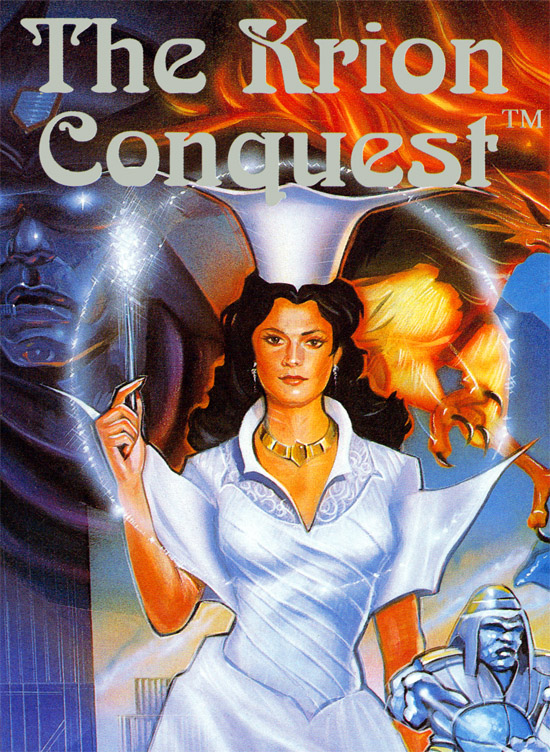
Check out the full version of the box art for the American release:

Krion Conquest box art

She’s pretty boss — thoroughly feminine with a touch of Glinda the Good Witch, yes, but not pink, not covered in bows and ribbons and not showing so much skin that she’s imperiling her personal safety. (Though identical onscreen, she’s far less cutesy here than she looked in the Japanese release. She also looks like Catherine Zeta-Jones. That is neither here not there.) I’m struggling to think of another female lead character in an NES-era video game who got the main spot on the box art and isn’t princessed out, be-bowed (like Ms. Pac-Man, whose gender basically hinges on that one accessory onscreen), violating the basic rules of armor (Arkista’s Ring, I’m looking at you) or just wholly disguised (looking at the Metroid box art, not even the most perceptive of us would have guessed Samus was a spacewoman and not a spaceman).

I’m now spinning my wheels in an effort to think of other female characters of that early home console era that got this treatment, and I can only come up with one that even comes close: Giana from The Great Giana Sisters, who shows up on the box art for the Commodore 64 release.

Great Giana Sisters Commodore 64 box art

She has a mighty, Supergirl-ish vibe, sure, but now that I look at in large format, I see she’s got some damn mighty nipples, too — visible straight on and in profile! Which is maybe less so with the progressive. It’s worth mentioning that Great Giana Sisters is only famous for being a shameless rip-off of Super Mario Bros., though it has endured where Krion has vanished. I suppose both games attempted to re-create the success of more popular series by stealing the play mechanics and then slapping some female characters into the protagonist roles in order to emphasize how different they were, so it’s maybe not surprising that the marketing emphasized the heroines. Still, I’d feel better if I could think of a single example from a wholly original series. I can’t. Today, we don’t remember The Krion Conquest for being much other than a mediocre Mega Man wannabe. That’s too bad. For one, it actually innovated the Mega Man play mechanics by, for example, enabling Francesca to charge up her projectile to unleash a more powerful attack. Mega Man 4, released nearly a year after Krion, incorporated the idea, so clearly Krion wasn’t entirely without merits. I’m more concerned with the gender politics here, of course, and I like that Vic Tokai elected to create a female main character and then run with it — and “do her right,” so to speak.

The Wikipedia page for Krion claims that even in the planning stages at Vic Tokai’s Japanese office, the decision caused controversy. I can see why. But to me — back then, a kid whose Super Mario Bros. 2 default was the princess and whose Gauntlet default was the valkyrie — this box art grabbed my attention enough that I stopped and said “This is the one.” That was the point, I think, and at the moment, that seemed like enough.

Francesca sprite from Krion Conquest / Magical Kids Doropie
via

(A concluding side note: Surprisingly, there’s no Wikipedia list of video games with female protagonists. And a Google search only turns up sloppy attempts that aren’t organized chronologically ordered. Of all that I found, Giant Bomb’s list is the best, but it’s far from complete. You’d think that would be a thing by now, right?)

 Gender and video games, previously:

Wednesday, March 20, 2013

Finding the Feminine (if Not the Feminist) in Early Nintendo

If you don’t read about video games, then you probably don’t know of Anita Sarkeesian. She is a feminist blogger whose talking head stars in the “Feminist Frequency” online series, and she recently rose to a greater level of prominence as a result of a successful Kickstarster campaign to explore the role of female characters in video games. The campaign also elicited a shitstorm of harassment that basically proved Sarkeesian’s point that video game culture can have a nasty, misogynist bent to it, but the first video premiered on March 7 in spite of the small but active band trying to keep girls out of the treehouse.

image via
In the first installment, “Damsels in Distress,” Sarkeesian seems to be laying groundwork for the rest of the series, explaining the origins of the “lady tied to the train tracks” stock character and how it relates to video games. She actually talks about video games a lot less than you might expect — like I said, I’m guessing she’s building a foundation, but there’s a point when you may think, “She’s still going on about this?” — and the two franchises that get the most attention are Mario and Zelda. This too has earned her some criticism, as newer franchises feature more progressive politics than do these series that have remained fundamentally unchanged since they debuted in the 80s. But it’s Nintendo, and in addition to Mario and Zelda being two of the most long-lived successful video game franchises ever, those early days of the original Nintendo Entertainment System were hugely important to the medium. Thus, it’s a good place to start. Neither series has ever come close to gender parity, and regardless of whether you think they should, that is exactly why this very month has seen the release of hacked versions of Donkey Kong and Legend of Zelda that allow you to play as Pauline or as Princess Zelda and rescue their respective dudes.

This all made me think of a subject I haven’t picked up in a while.

Now, one of the responses to Sarkeesian’s first video pointed out that she didn’t mention one of the reasons the Mario and Zelda don’t evolve: Their creator, Shigeru Miyamoto, isn’t big on plot elements. He’d rather minimize backstory, let players get to the fun part and not bury the essence of the game. Especially back in the earlier days, Miyamoto wasn’t about to let co-workers who thought otherwise meddle with his brain babies. (That’s less the case now, and it’s worth pointing out that as the stories behind these games grew deeper, we got less wimpy female characters, like Rosalina and Midna.)

In that same early age of home console Nintendo, however, Mario and Zelda weren’t Nintendo’s only attempts at launching power franchises. They were just the most successful ones. A few months after Legend of Zelda hit shelves, Nintendo debuted two other games: Metroid and Kid Icarus. The two are “sister” series in more than one way. For example, Metroid baddies show up in Kid Icarus. In both, the screen can scroll both vertically and horizontally, whereas the first Mario and Zelda didn’t. Both were developed without Miyamoto’s participation; Gunpei Yokoi served as producer for both, and many of the staffers who worked on Metroid shifted to Icarus as they finished their work. Both didn’t receive sequels until years later. And both offer major roles to female characters that Mario and Zelda do not.

images via here and here
In Metroid, of course, the big reveal players get for completing certain requirements is finding out that Samus, the robot-looking dude they’ve been controlling all this time, is actually a woman — and what a woman! She’s wearing a weird mom bathing suit and everything!

Most people know that. But the game also pits Samus against a female(ish) big bad: the Mother Brain. There’s not too much explicitly female about a cycloptic brain in a jar, but all the literature discussing the Mother Brain as a “she” — even on Captain N, where she was inexplicably voiced by the guy who voiced Audrey II in Little Shop of Horrors.

image via
In the third Metroid game, the brain gets a body, and graphics designer Toru Osawa explained that his initial impulse had been to make her look like “an old lady living in my apartment complex.” You can still kind of see that in the final design:


That’s something that literally never occurred to me until this month: that a game debuting that early in the story of Nintendo would have a female hero taking down a female villain — an all-knowing, all-seeing, all-powerful big bad, no less.

Kid Icarus also boasts better feminist credentials. Though the hero is male — more a boy than a man, though I’m unsure if that matters — the big bad is female. It’s Medusa, who in the universe of the game is the goddess of darkness, and offered as the antithesis to Palutena, the goddess of light and the game’s damsel in distress. (Importantly, Medusa looks like a woman, but she also has a Mother Brain-y like form where she appears as a huge, one-eyed head… thing.) Yes, there’s a woman awaiting rescue at the end of the game, but there is something different about it being another woman who locked her up, especially when those characters function as stand-ins for God and the Devil, or at least Athena and a Lady Hades (Ladeez).

This all proves nothing, of course, and it’s worth underscoring that Metroid and Kid Icarus didn’t find the success that Super Mario Bros. and Legend of Zelda did. The former only became a successful franchise in 2002 and the latter just received its second sequel in 2012. But when you’re looking at the early days of Nintendo, with Princess Peach and Princess Zelda mostly sitting around in dungeons, it’s kind of cool that female characters in other games were being given something interesting to do: be evil, get captured or take of their clothes at the end of the game. There’s a case to be made for finding elements of the sacred feminine in Mario and Zelda, but it’s a dig to get there. With Metroid and Kid Icarus, it’s right there in the instruction booklet.

Gender and video games, previously: