Pages

Showing posts with label super mario bros.. Show all posts

Sunday, September 20, 2015

This Is a Post About Undo Dog

Warning: This post is a fairly deep drill-down on a minor footnote in video game culture. If obscure Nintendo lore is not your thing, kindly move along and wait for a less niche post.

One of the most insignificant video game characters ever has recently returned to my life: Undo Dog. He’s technically a Mario character, though only in the loosest sense of the expanded Marioverse. He first appeared in 1992’s Mario Paint, a sort of Nintendo approximate of Photoshop that came packed with the Super NES Mouse and allowed players to draw and paint images and create crude animations that couldn’t be uploaded or transferred off the game pack in any way. Mario-branded but not really all that Mario-specific, the game came out when I was only ten, and I loved it. And one of the things I loved most about it was Undo Dog, the game’s equivalent of CTRL+Z.


Clicking him undoes whatever disastrous aesthetic decision you made, and he makes a crude bark noise when you click. If you let the mouse sit idle, he also dances about in the tool tray in the bottom of the screen, and if you opted to create your sixteen-bit masterpiece without background music, he’d occasionally sneeze. (He was allergic to silence, we gathered.)

Here, watch and listen.


Even at ten years old, I was a sucker for anything canine, and the fact that Nintendo chose to imbue one of the most functional aspects of Mario Paint with a dog personality is a great example of why I am a lifelong Nintendo loyalist. And the fact that the icon border around Undo Dog’s face was revealed in his “dancing in the tool tray” animations to be a weird, square collar? I was in love — with the character design but also with whatever clever person who implemented it.

I felt catered to — and that rarely happened when I was younger.

Given my history on this blog writing about various Super Mario games, it shouldn’t surprise you that even back then, I had an encyclopedic knowledge of them. I knew everything that a North American fan could know, and I was a strong supporter of the series’ also-rans. When Super Mario Kart came out in September 1992, the only thing that seemed more pressing than beating the game on every conceivable level was dreaming up ideas for the inevitable sequel, and I sank hours into this task. I drew maps for tracks based on levels from Subcon, the setting of Super Mario Bros. 2, and Sarasaland, the setting for Super Mario Land, and handpicked the characters that would join the roster of Mario Kart racers. No lie: I even drew new versions of the Super Mario Kart box art that featured then-unknown characters like Princess Daisy (the ruler of Sarasaland and a character most players wouldn’t have recognized back in the day), Birdo (Super Mario Bros. 2’s Yoshi prototype, essentially, and also the most gender-complicated bipedal dinosaur in the history of video games) and Wario (the minor Super Mario Land 2 villain that no one cared about once upon a time).

All of these characters eventually did become playable in later Mario Kart games, I should point out. However, my never-distributed, beyond-unofficial concept art also included characters like Pauline (the Donkey Kong damsel who has since been made to look like Sofia Vergara), Wart (the Super Mario Bros. 2 villain who has subsequently showed up as a Zelda character but never again as a Mario character) and an ultra-obscure Mario D-lister named Heavy Zed, who was in retrospect not a character in any way.


Heavy Zed was a big, dumb owl that Mario would hop onto in Super Mario Land 2 and prompt him into waking up and fluttering in a single direction until Mario encountered a second Heavy Zed, which he’d then hop onto. Essentially, he was a platform lift, like the dolphins in Super Mario World, but ten-year-old me didn’t care: He had a name and therefore deserved realization as a playable Mario character. Yeah, I had some big ideas.

Included on this wishlist was Undo Dog, just because he also had a name and I had seized on him as a thing worth paying attention to, and I drew him into my terrible mock Super Mario Kart 2 art, stockade collar and all. In retrospect, it seems silly and misguided in the way most fan fiction seems to anyone not at the heart of the subject matter’s core fandom. Time passed, and although I admit to being guilty of jotting out the occasional dream Mario Kart roster during my free moments — E. Gadd from Luigi’s Mansion! Dixie Kong! Captain Syrup! — I forgot about dumb ol’ Undo Dog.

And then Super Mario Maker came out. For those who don’t know, Super Mario Maker is essentially the game that Mario Paint should have been, and it allows players to create their own Mario levels and then upload them to be enjoyed by others. Presentation-wise, the game owes a great debt to Mario Paint, and this includes the implementation of Undo Dog as the CTRL+Z function, twenty-three years after the fact.

Here is a trailer to help you understand why Super Mario Maker is weird but great.


But there’s an additional reason I’m writing about Undo Dog today. One of the more fan service-y aspects to Super Mario Maker is that its Super Mario Bros. mode includes the ability to “costume” Mario as various characters from other Mario games — Bowser, Dr. Mario, Rosalina, etc. — as well as characters from other franchises — Zelda from Zelda, for example, or Kirby from Kirby or even the Wii Balance Board from Wii Fit.


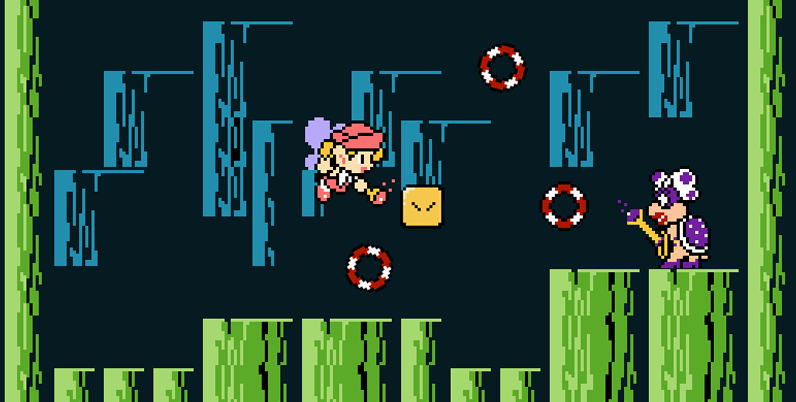
This is remarkable is that it plays into the new Smash Bros. style Nintendo is applying to all its franchises, in which characters from games that have little in common get to interact. I mean, hell — Super Mario Maker allows you to sub in Ness from Earthbound, the squid-kid from Splatoon, Foreman Spike from Wrecking Crew and even Lottie the Otter, from and Animal Crossing game that hasn’t even been released yet. And mixed up into all this is Undo Dog.

Per the game’s instruction manual, which doubles as an art book:


I’m not saying this makes Undo Dog a shoe-in for the next Mario Kart, exactly, but my inner ten-year-old is gratified to see the most minor of video game characters resurrected in my adult life, in a new age where Nintendo has gone Crisis on Infinite Earths with every game. I don’t think my placement of Daisy, Wario and Birdo in the Mario Kart karts was prescient, necessarily, but I’m currently placing more money on Undo Dog than I am on Heavy Zed, were that a bet to be made in some dank corner of the nerdy internet. And that is a surprising thing for a longtime video game fan to say, twenty-three years later, just like it was surprising to get a new Kid Icarus game after so many years and finally see a Super Mario Bros. 2-themed track in a Mario Kart game.

Go Undo Dog, you sneezing marvel, you. May your video game career be long and unusual.

Saturday, September 20, 2014

A Weird Walk Through the Mushroom Kingdom

Hi. Here’s the third and final part of my little series on that obscure Super Mario anime from 1986. (Or, as the non-video game-giving-a-shit-about portion of my readers consider it, a last deep dive into geekdom before I resume writing about funny old people I meet at the grocery store.)

In the first post, I wrote about how The Great Mission to Rescue Princess Peach! probably caused the rumor that Toad used to be a girl. In the second post, I wrote about all the other elements from the movie that later appeared in Super Mario Bros. video games. In this one, I’m just posting all the spare images and videos that I didn’t reason to post anywhere else.
Looking without reading! Fun!

As if the movie didn’t feature enough musical sequences, there’s also one where Mario fantasizes about wearing a tuxedo and waltzing with the princess. You know — for the dreamy-eyed romantics in the audience.


I have Mario dressed like a Mexican bandito. See, because he felt angry, so he just transformed into this costume. See?


And here is Bowser attempting to woo Peach by dressing in drag.


Screenwriting at its best! I actually don't get why these would be the subtitles here, honestly. Jugem is Lakitu’s Japanese name, but I have no idea why these subtitles would be in English when most of the rest are not, at least per the video from which I got this still.


You can tell by Mario’s eyes that he’s overwhelmed by the prince’s flagrant disregard for gender norms.


“Don’t come back!”


And finally... GIFs! You love gifs, apparently. I made these and they maybe don’t completely suck. Here is Mario allowing a sprouting beantsalk to tickle his bottom, to the dismay of everyone watching. “No, Mario, that is neither a sanitary nor an appropriate use of a beanstalk.”


Here is Mario making the “video game zombie” that he’d make a generation of kids make.


Here is a gif of Mario shattering that you can use to illustrate your next horrifically traumatic moment.


Here are mushrooms raining down from the heavens.


Here are suggestively pulsating mushrooms.


Here is Peach, kicking some major ass in a video game.


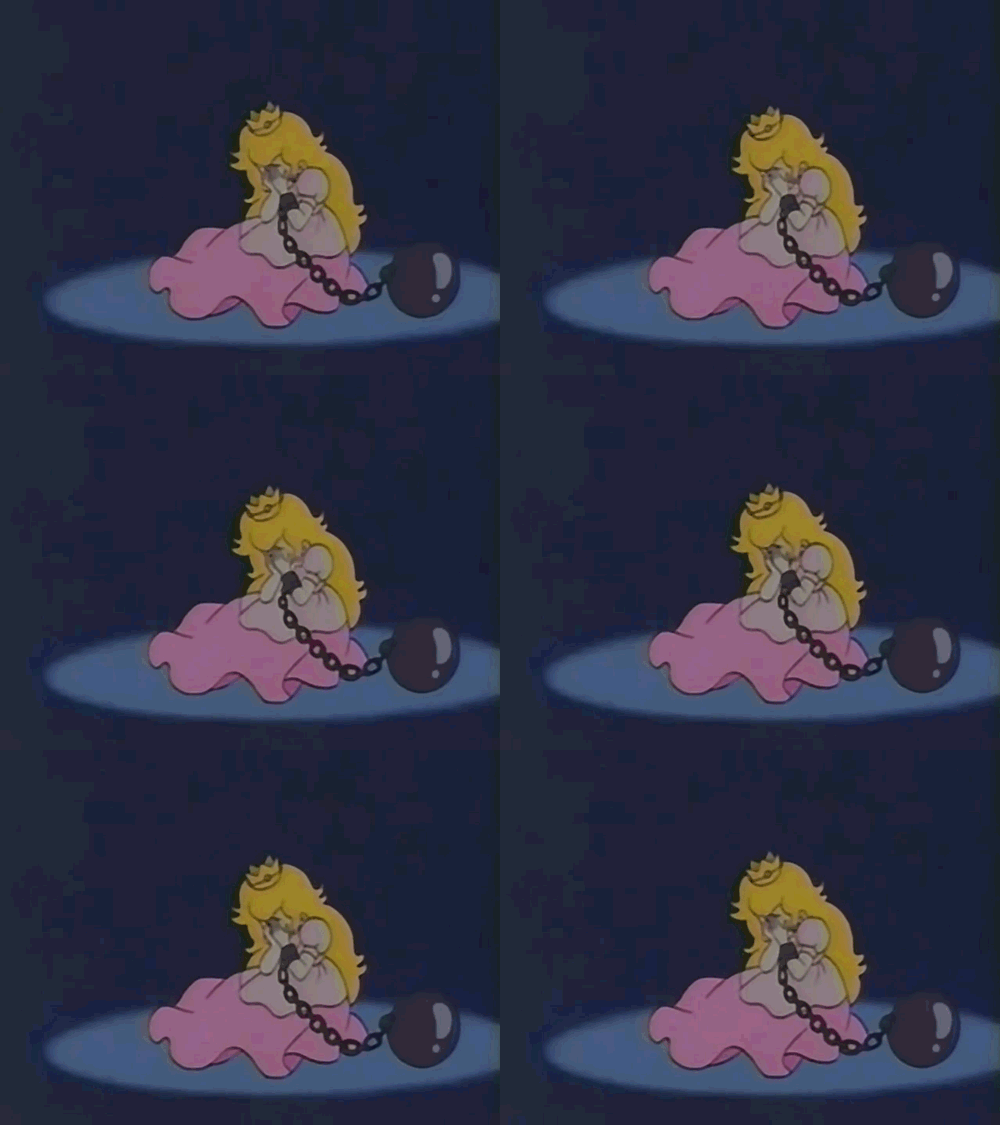
And here she is weeping in isolation. The two sides to Princess Peach!


Super Mario, previously:

Friday, September 19, 2014

Why the Super Mario Bros. Anime Matters, Even If You’ve Never Seen It

Yesterday, I got to explore a weird little Super Mario Bros.-related rumor that led me to The Great Mission to Rescue Princess Peach!, a 1986 movie that received a theatrical release in Japan only. As far as obscure Mario lore goes, it’s a strange one in that it’s something that would have been extremely familiar to Japanese kids growing up around the time, yet it’s something few of their Western counterparts would have even heard of, despite the Mario mania of the late 1980s and early 1990s. We simply never got the movie here, and that’s a shame, since it’s a beautiful rendering of these games back before Nintendo had really solidified what Mario’s world looked like.

First up, we might as well fix that lack of international exposure right now. It’s fairly simple to find it online, and you even watch it right here.


It’s only an hour long. According to the Mario Wiki, it was paired in theaters with a video guide to playing the Japanese version of Super Mario Bros. 2, the game we know in the U.S. as The Lost Levels. The game came out just a few weeks before the movie.

Watching the movie for the first time this week, I thought it was interesting how many details from the movie ended up working their way into the games. Some of it’s coincidence, I’m sure; the movie-makers were just exploring ideas that the game designers eventually would have had regardless. But some of them seem pretty spot-on. Today, I’m listing these off, as well as a handful of concepts that Nintendo maybe should have thought about incorporating.

For example, that same Mario Wiki article points out that the movie has a sequence where Luigi has a bad trip after eating the wrong kind of mushrooms. The scene could be a reference to the fact that The Lost Levels introduced nasty, trick mushrooms that hurt you instead of powering you up.


It seems plausible, even if it just makes me wonder how an eight-bit, pixelated psychedelic freak out might look.

The movie also features a scene where Mario and Luigi escape on a flying ship, years before the Super Mario Bros. 3 came out made airships a staple of the series.


When Mario and Luigi meet Lakitu, Mario ends up stealing Lakitu’s cloud and buzzing around the sky in it. That’s something that Nintendo eventually implemented in Super Mario World — and again now that Lakitu is a playable character in the Mario Kart games and you can stick anyone you want in his little cloudmobile.


In the movie’s climatic fight, Mario beats Bowser by grabbing him by the tail and then spinning-tossing him into the horizon in the style of an Olympic discus-thrower.


That’s remarkably similar to how Mario dispatches Bowser in Super Mario 64.


Again, that might just be an obvious way to excuse a giant turtle monster from your presence, but to me, this one in particular seems one of the most likely to be intentional among all the similarities between the movie and later games.

The game even has gargantuan versions of the typical Mario baddies — the very kind that got their own series of levels in Super Mario Bros. 3.

Super Mario Land of GIants

An odder coincidence, perhaps? These Goombas standing in this oversized boot. It could be nothing, of course, but the Nintendo fan in me really wants to connect them to the “Kuribo’s Shoe” Goombas from Super Mario Bros. 3.

Kuribo's Shoe

Super Mario Bros. 3 Kuribo's Shoe Goomba's Shoe

The Mario Wiki even points out how Luigi’s off-model color scheme — dark blue with yellow, as opposed to the traditional dark blue with green he has in official art or the white and green his original Super Mario Bros. sprite has — gets a nod in the new Smash Bros. game as one of Luigi’s palette swaps.

Luigi Smash Bros. alternate outfits

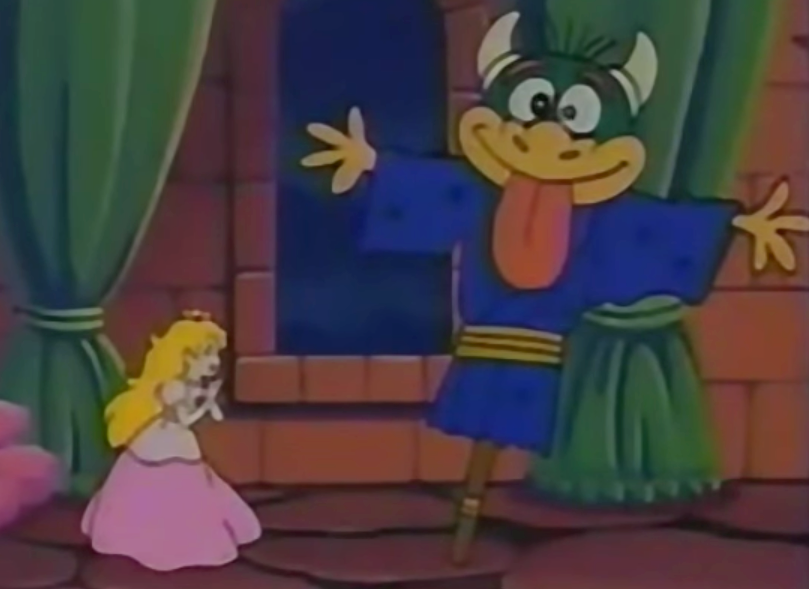
There’s even an odd scene where Bowser, in an effort to calm the captive Princess Peach, transforms into a scarecrow. That may mean something more in Japan than it does in the U.S., but to me that seems like an awfully specifically thing to turn into… especially since it was something Bowser and the other playable characters in Super Mario RPG could get transformed into.

Super Mario Bros. Bowser scarecrow

Super Mario RPG scarecrows

I’ve never seen scarecrow transformation as a negative status effect in any other video game. Is that, like, a problem in Japan? An epidemic of people turning into scarecrows?

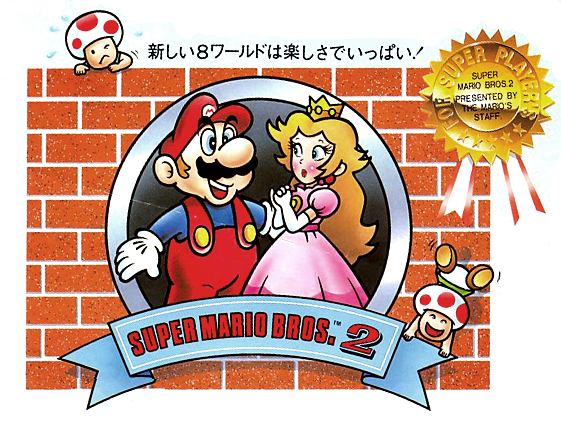
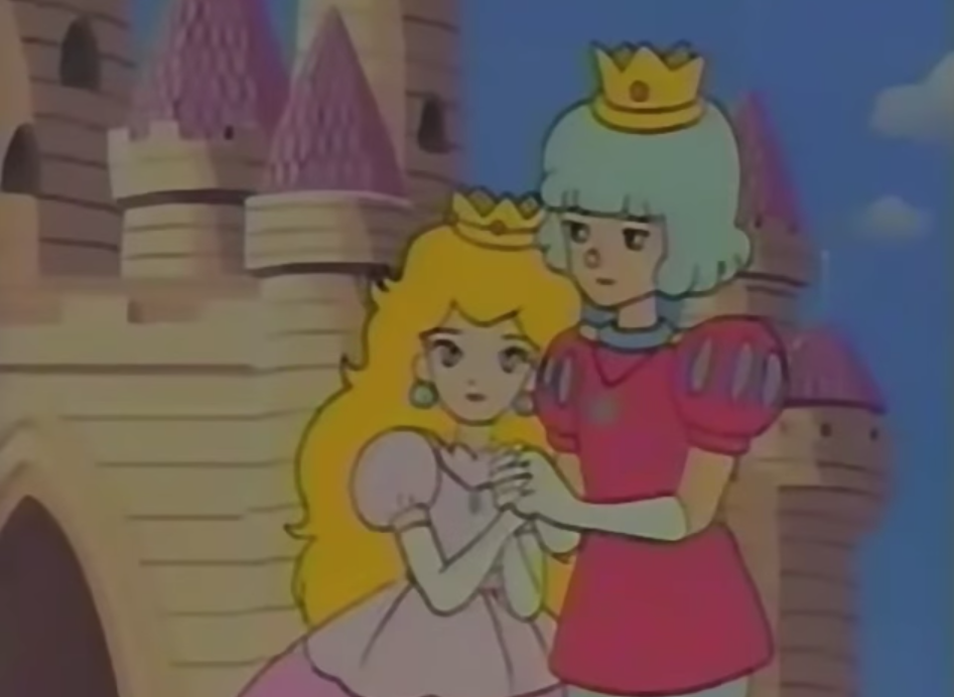
Perhaps the one aspect to The Great Mission to Rescue Princess Peach! that most gets my attention is Peach herself. Unless I’m mistaken, it’s this movie that made the princess look the way she looks today. Check out how she is drawn on box art for the Japanese release of Super Mario Bros.


The feline eyes are there, but everything else looks different — darker hair, a dress that looks like jammies and altogether a cruder look then she’d eventually get. In promotional art for The Lost Levels, Peach looked a lot closer to how she looks today, save for those dimples on her cheeks, which read as pimples in both the Super Mario Bros. and Lost Levels art. The dress is about right, the Farrah flips are in place, she’s a banana blonde, and she’s even sporting her trademark brooch.

Super Mario Bros Lost Levels artwork

She looks much more like this Lost Levels version in the movie.

Bowser Peach wedding

Well, she’s not wearing a butt on her head in the games, but you can see the resemblance, literal asshat notwithstanding. “But Drew, surely then it was the Nintendo artwork that finalized Peach’s appearance and not this non-canon movie. You are dumb!” But no! And also shut up! I’d suggest it might actually be the other way around. Do you know how long it takes to make an animated feature? Even an hour-long one? If the movie hit theaters juts a few weeks after The Lost Levels started selling in Japan, I’d say that someone had to decide beforehand how Peach was going to look. Maybe it was the animators at Toei. Maybe it was Nintendo giving notes to the animators. But either way, I think it was the movie that determined her appearance in a way that’s stuck for nearly thirty years.

Of course, some of the film’s original bits didn’t carry haven’t yet found a place in the Marioverse proper.

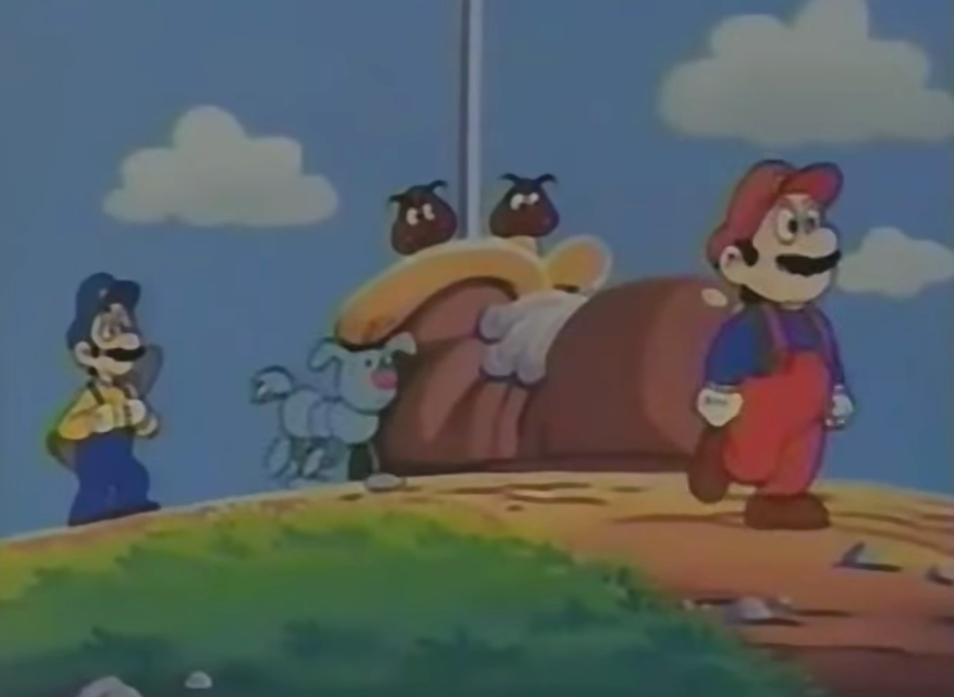
First up, them backgrounds. Back before Nintendo decided that every bush, rock and cloud needed an eerily grinning face on it, Super Mario Bros. skewed more surreal than saccharine. The game includes a few montages where you see vast expanses of the Mushroom Kingdom as it’s navigated by Mario, Luigi and Kibidango, their little canine friend with the weirdly ant-like body.


(Yes, it’s weird that the same song plays so often in a movie that’s only an hour long. Certain creative decisions were made, clearly.)

Maybe it’s the quality of the transfer, but the colors in these backgrounds look less saturated that the bright greens and cyans that defined Super Mario Bros. for a long time, and in an unexpected way, it lends the film a slightly less child-like feel. Eventually, Nintendo would come around to a degree, but it’s notable to see the Mushroom Kingdom look large, alien, and a little imposing instead of just Candyland-esque.

Speaking of Mario’s dog-like companion, Kibidango, who’s apparently named after a type of Japanese dumpling, failed to affect the series mythos in any direct way. It took until Super Mario World for Mario to get an animal buddy (Yoshi), and until Yoshi’s Island for Mario to meet a canine friend (the peculiarly nose-less Poochy). At the end of the movie, however, Kibidango transforms into Peach’s true love, dandy Prince Haru of Flower Kingdom, who was in search of the owner of the other half of his magical brooch when he was turned into a dog… ant… thing.

Prince Haru Haru-ōji ハル王子

Prince Haru Haru-ōji ハル王子

Prince Haru Super Mario

Haru may seem foppish, but at the end of the movie, everyone seems to agree that he’s a better match for Peach than the portly plumber is, and Mario sets off with only a kiss on the nose for his troubles. It’s probably a stretch, but you could say that there’s an echo of Prince Haru in Yoshi’s Safari, a Super NES shooting game that had Peach asking Mario to rescue the monarchs of a neighboring kingdom. The younger of the two — Prince Pine, whose Japanese name is a reference to pineapples and not pine trees, I'm just learning — has some vague similarities to Prince Haru, but the greatest of them is the fact that he’s a male monarch needing Mario’s help.

Prince Pine King Fret King Pot Yoshi's Safari

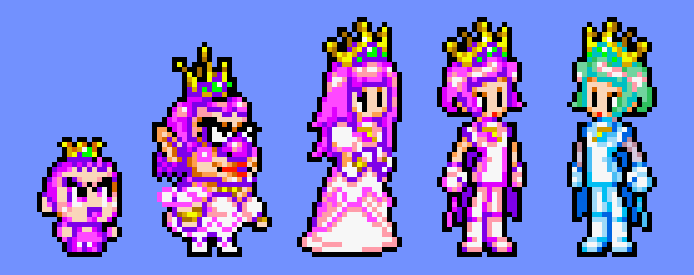
There’s also a debatable similarity in Princess Shokora, the damsel Wario rescues in Wario Land Advance. Her appearance varies according to how much money Wario earns over the course of the game, and her “most expensive” form is rather boyish — and not unlike Haru, who maybe looks a little girlish.

Princess Shokora all forms

And sort of similar to the way that Haru spends most of the movie as a dog, Shokora spends much of Wario Land Advance trailing Wario in the form of a little black cat.

In the “Lady Toad” post, I mentioned how Toad became a playable character in the American Super Mario Bros. 2 almost by default. He wasn’t named in the first game, and Nintendo simply needed a fourth character to round out the roster. Hypothetically speaking, had Nintendo brought The Great Mission to Rescue Princess Peach out in the U.S. and had Americans been familiar with the characters, it wouldn’t have been unthinkable that ol’ Haru might have gotten that fourth slot. You’d have had the two brothers and the two royal lovebirds, and today this dandy prince would be a staple of the series.

Just conjecturing, but it wouldn’t be unthinkable.

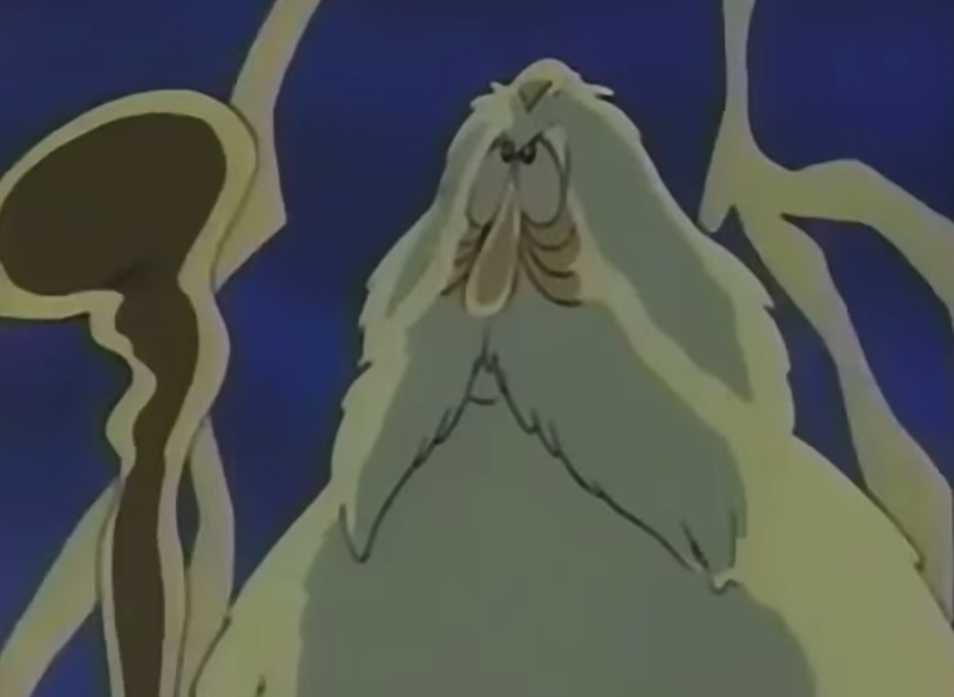
The game’s other original character is a kooky pile of beard hairs simply called the Mushroom Mystic. There’s nothing close to him in any of the games, by why shouldn’t there be? Perhaps we’d all like playing as a white pushbroom of an old man.

Mushroom Mystic

I have one final creative choice in The Great Mission to Rescue Princess Peach! that Mario lifers might be interested to know about. In the movie, Mario and Luigi aren’t plumbers, like there are in the American version of the games, or carpenters, like Mario was in Donkey Kong. They’re grocers. That’s… maybe an aspect to Mario’s mystique we could do without.

(Note: There’s also now a part three in this little series, if you’re interested.)

Thursday, September 18, 2014

Lady Toad? The Gender of Everyone’s Favorite Anthropomorphic Mushroom

(Note: This posted ended up spawning two more about the Super Mario anime. Read part two and part three, if you like.)

Earlier this year, I found a great video game website, Clyde Mandelin’s Legends of Localization, that looks at the strange process of adapting video games made in one language for people who speak a different language. The site tends to focus on the little moments — the ones that didn’t necessarily make the game but the ones dedicated players nonetheless remember. For example, how do you save Lucca’s mom in the Japanese version of Chrono Trigger? Does that random scrap of paper make any more sense in the Japanese version of Final Fantasy VI? And what’s with this random Helen Keller joke? It’s always heartening to find someone else who not only cares about the little stuff and the odd stuff in old video games but who also spends time wondering about the decision-making process that led to them.

In one post, Mandelin writes about the strangeness of Toad not necessarily being the singular, distinct character we tend of think of him being. (This is something I wrote about a while back, and this flexible sense of “self-ness” is hardly unique to Toad — it works for Yoshi and Birdo too — or even unique to the Mario games.) Mandelin also brings up something I hadn’t heard before: the idea that Toad (or the Toads) were initially supposed to be female — the princess’s handmaidens, in fact.

He offers as evidence The Great Mission to Rescue Princess Peach!, an anime released theatrically in Japan in 1986. Like The Super Mario Bros. Super Show here in the U.S., it was a loose adaptation of the original, barebones Super Mario Bros. plotline. It added a lot in. It had to. And in place of the Mushroom Retainers (Kinopio, in the orginal Japanese) that Mario rescues at the end of every level are these distinctly feminine mushroom people.

Here’s a scene where Mario and Luigi free them from a spell that had turned them into coins.


They seem a little more human, a little more articulated than the generic Toads you see earlier in the film.


Later, Mario rescues a second Lady Toad. Again, the movie clearly genders her. This is a female mushroom who’s giving Mario a peck on the cheek.


At first, I thought this was a strange call on the parts of the creators of the anime, but the more I thought about it, the more it made sense. After all, if you happened across this Strawberry Shortcake-looking assemblage of pixels for the first time, would you think this character was wearing a vest? Or would it look more like a skimpy woman’s shirt?


(Confession time: When I was a kid, before I saw official artwork of Toad, I thought it was a bikini top. In my defense, those eight-bit days left a lot of room for interpretation. That’s actually a hot little number by mushroom standards.)

Mandelin addresses whether these female Toads mean anything beyond someone taking creative liberties with the story. A quote:
My first thought was to say, “Whatever, that’s just a cartoon movie, it doesn’t apply to anything.” But then I realized that the American cartoon series was pretty influential for fans. So I guess you can take it however you like, but at the very least it seems that a number of Japanese fans fondly remember Kinopios as being girls and wonder at what point they became guys.
I totally agree. I looked around as best I could and did not find much on whether Toad was at one point female. (Well, I found one message board thread — an ancient artifact, by online standards — that said the characters were ”presumably female” and that some sources call them ”Mushroom Girls.” It probably didn't help that I can’t easily search for Japanese sites.) But if this idea is floating around out there, it’s probably because young Super Mario Bros. fans saw this movie as kids — before the game’s universe expanded and before it was easier to see official Nintendo artwork of these characters — and it crystallized the idea that those guys who are telling you the princess is in another castle are actually gals.

For what it’s worth, the Toads depicted on the box art for the Japanese release of Super Mario Bros. don’t look especially feminine, but then again they also have visible belly buttons and one seems to be missing his eyes.


Nintendo eventually introduced female Toads into the games — in the RPG titles and then in Mario Kart: Double Dash!! as Toad’s female racing partner, Toadette.


Toadette has a similar same color scheme to that of the female characters from the anime, but then again so might any character that you’re trying to code as conspicuously female. There’s only so much you can do to gender a mushroom. In any case, I’d always thought of her as a Smurfette or a Skeeter — a female twist on an existing male character created just to even out the gender ratio. And while Toadette still is that, this possible tie to a much older Mario creation makes me a little more okay with her existence, even if those braids hanging off her head still freak me out. (WHAT ARE THEY? WHAT ARE THEY?!)

There are quite a few concepts introduced in The Great Mission to Rescue Princess Peach! that eventually worked their way into actual Mario games — and a few that could have easily but never did. Tomorrow, I’ll post about them. And I promise I’ll never, ever ponder about Toad’s gender again.

Miscellaneous mushroom bits:
  • The name “Toad” doesn’t show up until the American Super Mario Bros. 2 came out. He’s playable in that game — really, only because the game was based on a previous one that had four characters and because at this point in the franchise’s history there just weren’t any other candidates.
  • The character is noted in the Super Mario Bros. 2 instruction manual as “Mushroom Retainer (Toad),” to tell us that yes, he’s one of those things mentioned in the previous instruction manual, but he has a name now. It always seemed an odd choice, though, because they’d already stuck the princess with the name “Toadstool” and these two names are very similar. The only reason a mushroom would be named Toad is in reference to toadstools. I mean, Nintendo could have named the guy anything. Fungo. Mushy. Mr. Sporesburg. Truffles. Herman the Death Cap Man. The Great Matango. But they’re all “Nah. Toad. Toadstool. They go together. Let’s go get lunch.”
  • Does anyone else remember that article Electronic Gaming Monthly ran in the late ‘90s specifically about whether Toad was a boy or a girl? *cough cough rainbow racket cough cough*
  • Toad’s general design seems to have made animating him…. interesting. I can’t tell if he gave animators more creative freedom or just more work, but the fact that you don’t really know what’s going on with his body means that people making cartoons of him had to be clever. Is that a hat? Or is he growing a mushroom on his head? Is he wearing a diaper? Where are his legs? In the case of the Lady Toads, the animators made them more human-like and have them actual legs. In the case of some concept art previewing the Super Mario Bros. Super Show in a 1989 issue of Nintendo Power, the artist was clearly saying, “Oh, fuck it. It’s just a mushroom or whatever.”


I for one fell in love with this concept art when I first saw it. I wish this specific style carried over more to the actual cartoon than it did. Trip on nostalgic, if you like, and read Nintendo Power’s full write-up on the then-forthcoming series here.

Sunday, May 18, 2014

The Busiest Bosom in the Mushroom Kingdom

The setting: Japan, sometime in 1995.

“Hey, I think we should have a new female character in this Super Mario RPG game we’re making.”

“Oh, that would make sense.”

“Yeah, and maybe she could be a bad guy, because we don’t have many female villains in the series.”

“Sure, sure. That would probably be great.”

“Okay then. I was also thinking that she could have gigantic boobs.”

“Umm…”

“Like, just pendulous mammary sacs that jiggle hilariously when Mario hits her.”

“Umm…”

“Really, her proportions would just be obscene. Huge breasts, a teeny-tiny waist, and a long, flat, football-shaped head. Kind of like Betty Boop’s, but even broader. Like, her head is wider than her shoulders.”

“Okay, so I’m hearing a lot of ideas and—”

“Also, she would have the eyes of Janice from The Muppets.”

“…”

“And she’d also be wearing a parrot on her head, but it’s not dead. Like, in addition to her boobs going into a flan-like movement when struck, the parrot would also cry out in pain.”

“…”

“Like, in lieu of hair. Her hair would be the parrot. Parrot-haired.”

“…”

“Oh, and she’s in an evening dress. And I think it would be cool if she were always carrying a cocktail with her. Because that’s how you know she’s stylish but also a bad girl.”

“…”

“And she’s riding a crescent moon for no apparent reason.”

“…”

“So yeah, I think this would make for a good character. Like, a really popular character that would fit in well with the rest of the Mario crew, and maybe we could see her in the next Mario Kart game, perhaps riding the crescent moon again. I have a feeling she has staying power.”

“…”

“Hey, would she be any weirder than Birdo?”

{fin}

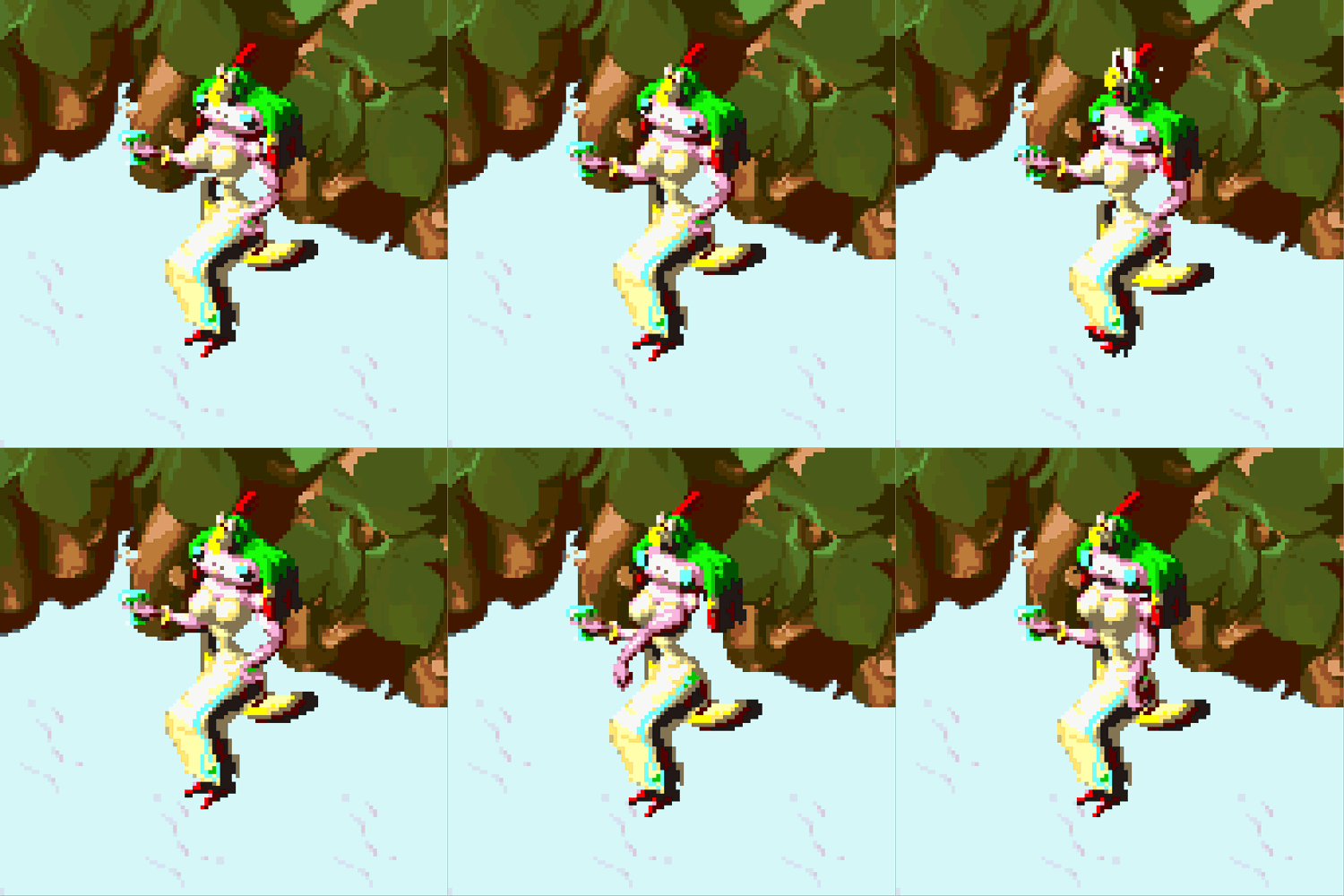
And then against all odds and good sense, Nintendo in 1996 released Super Mario RPG, where Mario fought the female big bad Valentina, giant boobs and all.

valentina boob shake

Her Japanese name is Margarita, which puts her neatly in line with the Mario tradition of female characters being named after things but also identifies her as a drunk. Valentina did not, in fact, appear in the next Mario Kart game nor any Mario game again.

(Sprite modified from sprite rips found here and here.)

Super Mario obscurities, previously:
=

Monday, May 12, 2014

Birdo, Saying Goodbye Forever

New skill acquired! I can now make frame-by-frame GIFs, Brother Brain-style, from old video game sprites that I extracted myself from old video games. I have learned how to do this for no other reason than that I wanted to see if I could, and I did.

Take that, voices in my head.


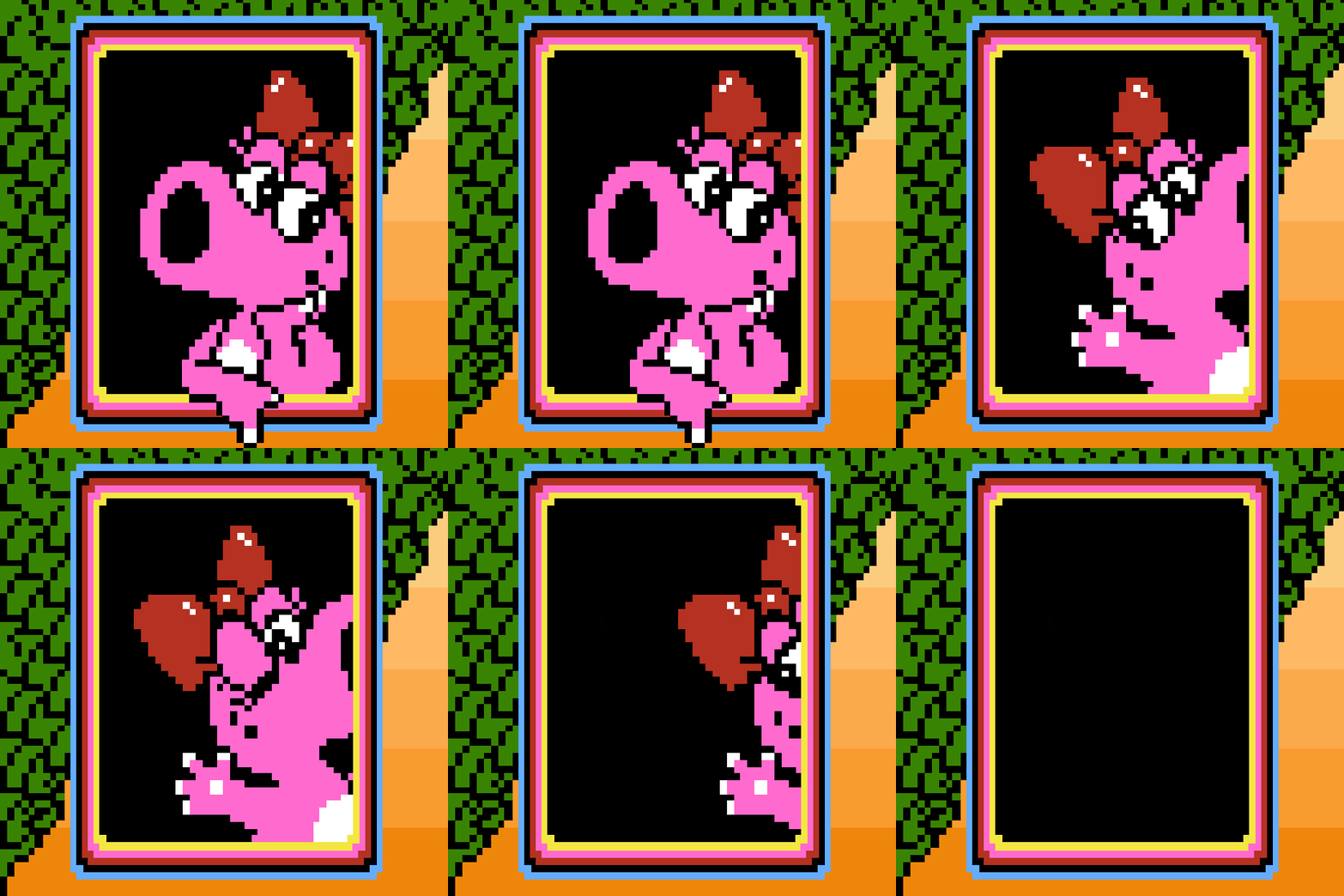
Yes, it’s everyone’s favorite gender-vague bidedal dinosaur, Birdo, modified from frames from the NES version of Wario’s Woods, a puzzle game that holds the record for being the final licensed title ever released for the original Nintendo console as well as the only one in which Nintendo let Toad have a starring role. Wario’s Woods is kind of a garbage bin of unloved Nintendo characters, and features quite a few who hadn’t made a dent elsewhere. (Remember, Wario was still a relatively new character when the game came out back in 1994.) Birdo appears as Toad’s helper.


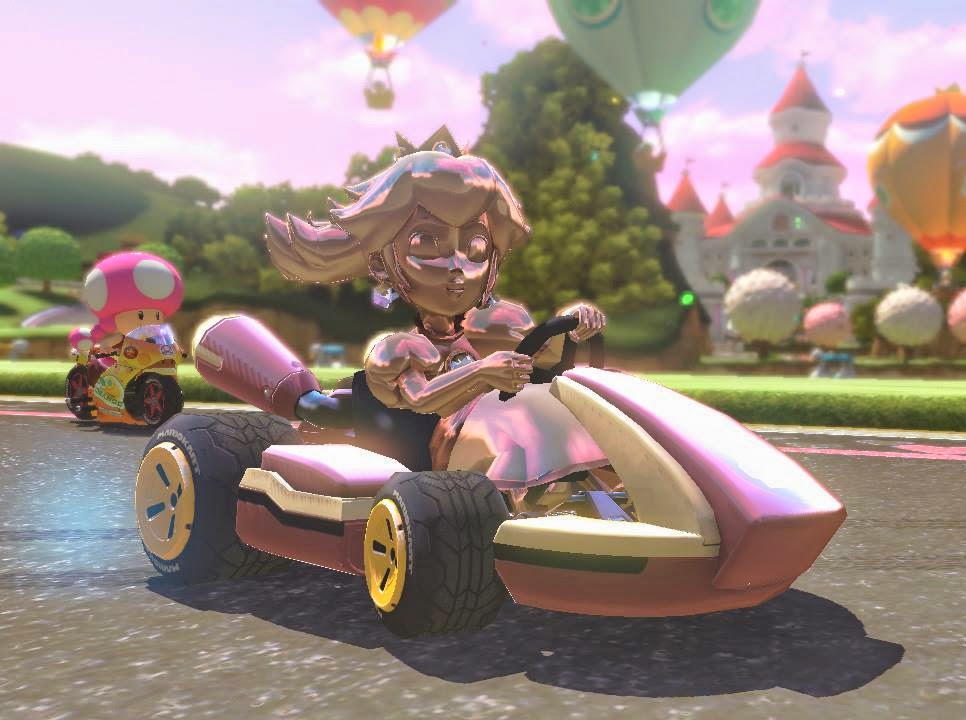
I suppose having Birdo peace out on an indefinite loop could be a commentary on Nintendo’s decision to ditch her for the new Mario Kart game in favor of head-scratchers such as Baby Rosalina and the monstrosity that is Pink Gold Peach.


I’m not bitter, but I do think it’s weird how Nintendo stocks their games with clone characters when they have a healthy roster of originals. But whatever: a new Mario Kart is a new Mario Kart. Here are my predictions for future Mario Kart contenders: Aged Mario, Fat Luigi, Undead Peach, Baby Undead Peach, Zinc Baby Mario, Titanium Baby Bowser, Embryonic Toad, See-Thru Dr. Mario, John Leguizamo Version Luigi, Gay Pride Yoshi, Never-Stops-Screaming Daisy, Feral Donkey Kong, Alopecia Mario, and, of course, a female Mario and Luigi named Marta and and Luisa. In fact, I can’t believe those last two haven’t happened yet.

Vroom.

Saturday, April 12, 2014

Fire Flowers

This is what I do when I’m bored, when I’m suffering from writer’s block, when I’m waiting for programs to download, when I’m wanting to see something I should have seen back when eight-bit graphics were considered very of-the-moment.


Pixel art, previously:

Sunday, February 16, 2014

Camp Crystal Lake by Way of the Mushroom Kingdom

In case there’s ever any wonder if a Super Mario game ever made a reference to the Friday the 13th movies, I present a minor enemy from Super Mario Land 2: J Son, an ambulatory hockey mask with a dagger stabbed into it.

via spriter’s resource, ripped by aj nitro
“J Son.” Get it?

Because what are your Nintendo-produced, hop-and-bop video games without a riff on an undead serial killer with a nasty Oedipus complex?

Super Mario obscurity, previously:

Wednesday, December 11, 2013

King Koopa's Kool Kartoon Klub for Kkids!

One of the things about The Simpsons that has always seemed anachronistic to me is Krusty the Clown. Bart and Lisa being kids born in the early 80s, they shouldn't be watching a live-action Bozo the Clown type, and it's all the more so now that Bart and Lisa are kids born in the early 2000s. I didn't grow up watching any Bozo facsimile every weekday afternoon. My cartoons just introduced themselves. In fact, I think I wouldn't have liked a non-animated presence in these children's programming blocks. (No, shut up -- it's perfectly normal and healthy for children to relate more to anthropomorphic cartoons than it is to other humans.) But apparently this wasn't the case for all kids my age, and some of us actually had regional kids shows.

via retrojunk
Like the ones who got King Koopa's Kool Kartoons.


Yep, King Koopa -- that is, not Bowser but his hairless DIC-universe alterego -- hosted a half-hour live show as a spin-off to The Super Mario Bros. Super Show!, which also featured live action intros to the cartoons. But while Super Show had Captain Lou Albano (R.I.P.) and Danny Wells (R.I.P.) introducing licensed Nintendo-themed cartoons, Kool Kartoons had Koopa (Cobra Commander voice actor Chris Latta, also R.I.P.) pushing public domain animated shorts, which must have seemed neither kool nor cool by comparison. According to Wikipedia, the show aired only during the 1989 holiday season in the greater Los Angeles area on KTTV Fox 11, though that was enough to earn it a local Emmy nomination. (I hope the nom was for excellence in terrorizing sensitive children via grotesque masks)

Apparently the kids in the audience got to take the T-shirts home with them, but they had to turn in the Koopa Troopa helmets after taping completed, which makes me wonder if any of them are still floating around in L.A. A Google search, alas, has turned up nothing. I'd imagine that most thrift stores that actually had these weird, flesh-colored turtle helmets sitting around wouldn't even know what the hell they were supposed to be.

 At least one kid from Whittier got a Power Glove out of it, though. That's something.


I mean, someone should have gotten something out of this -- you know, aside from nightmares about a real-life malformed Koopa forcing you to watch public domain cartoons.

Discussion question: Should 1989 be far enough along, culturally speaking, that people should know that switching out the letter "C" for the letter "K," especially in alliteration, has some nasty associations?

Thursday, November 14, 2013

How Super Mario 3D World Will Let You Kill God

Back in September, I wrote here about how I’m excited for a new Mario game in a way that I haven’t been since I was a kid. This week, Nintendo surprised fans with an additional reason to await Super Mario 3D World: an unlockable fifth character, Rosalina.


Okay, so you’re all, “Hey, I played the hell out of Mario Kart 64 and I don’t remember no Rosalina in there.” To which I’d explain that Rosalina is a relatively new addition to the series, having debuted in 2007 in Super Mario Galaxy. She’s subsequently showed up in the Mario Kart games as another Princess Peach-like alternative to Princess Peach. If Peach is Barbie and Daisy is Midge, Rosalina is the cosmic-powered, space princess version of Barbie that would never exist in the Barbie universe because it doesn’t get that weird. And you’d be all “Okay, yeah, whatever, I actually have to be somewhere else right now…?”

rosalina playable

What’s notable about Super Mario 3D World is that it’s part of the “main” Mario series — that is, not a tennis game and not an RPG — and it has Peach as a playable character for the first time since Super Mario Bros. 2 was released in 1988. But by adding Rosalina to the roster of playable characters, Nintendo has done something interesting: Peach is no longer the girl but just a girl — one of the female characters you can play as, not the only choice. This has never happened before in the history of Mario games — the hop-and-bop, grab-the-coin games where you save a princess at the end only this time you’re not saving the princess because for once she’s on the other side of the jail cell door.

But that’s not all.

In making Rosalina playable, Nintendo has allowed you to play as God, more or less. As it’s explained by the Game Overthinker, the Galaxy games explain that Rosalina is Lady Galactus, Creator of Worlds, whose job is creating, nurturing and controlling the galaxy. Basically, she’s responsible for all existence everywhere. So what is a seemingly omnipotent cosmic mother giantess doing hopping and bopping and coin-grabbing? Couldn’t she just blink the bad guys out of existence? I can only guess that she’s slumming it — seeing how the normal live, like a certain monarch who thought it would be a lark to play peasant. It doesn’t have to make sense. She’s God. She gets to do what she wants.

Funny side-affect of this, however: If you play as Rosalina and play badly, you get to kill God. That’s deep. Have fun with that, kids!

BTW, the game also includes a uniquely Luigi-centric version of the arcade game Mario Bros. It’s Luigi vs. Luigi.

luigi-bros-super-mario-3d-world

If we’re considering names for the palette swapped, alternate Luigi, can I suggest 2uigi?

Monday, October 28, 2013

Three-Dimensional Death in a Two-Dimensional World

Back in Donkey Kong, Mario died by spinning in a circle and landing flat on his back, with a little halo floating above his head.


However, he died differently by the time he got his second starring role — Mario Bros., which isn’t Super Mario Bros. but is instead the game that dumped him in the sewers, introduced Luigi and for the first time pitted them both against a host of creeping turtles. When one of those turtles got too close, Mario leapt to his death, more or less. It’s weird when you think about what you’re actually seeing: In a game where Mario spent the whole time either facing left or right and scurrying along a two-dimensional plane, he died by facing the screen and jumping off the platform, toward the screen.


This style of video game death wasn’t invented in Mario Bros. A year before, Nintendo released the direct sequel to Donkey Kong, Donkey Kong Jr., where the main ape died in a similarly theatrical manner: making bug-eyes at the screen, flailing his hands and then plummeting down with a cartoony slide whistle noise. But Mario did it in Mario Bros., and Nintendo used it again in Super Mario Bros., and that’s the game that hit big. Perhaps as a result of the popularity of Super Mario Bros., it ended up everywhere in video games from that era — mostly Mario-style platformers, of which there were many, but some other genres too. Your character died, and he or she looked at directly at the screen — at you, effectively — before they spasmed and leapt into oblivion. It’s like they were saying, “Hey. Fuck you. You killed me.” And then the leap. It seems strange, given that it ads a z-axis into a world that often only had an x and a y previously. But that’s how it happened.

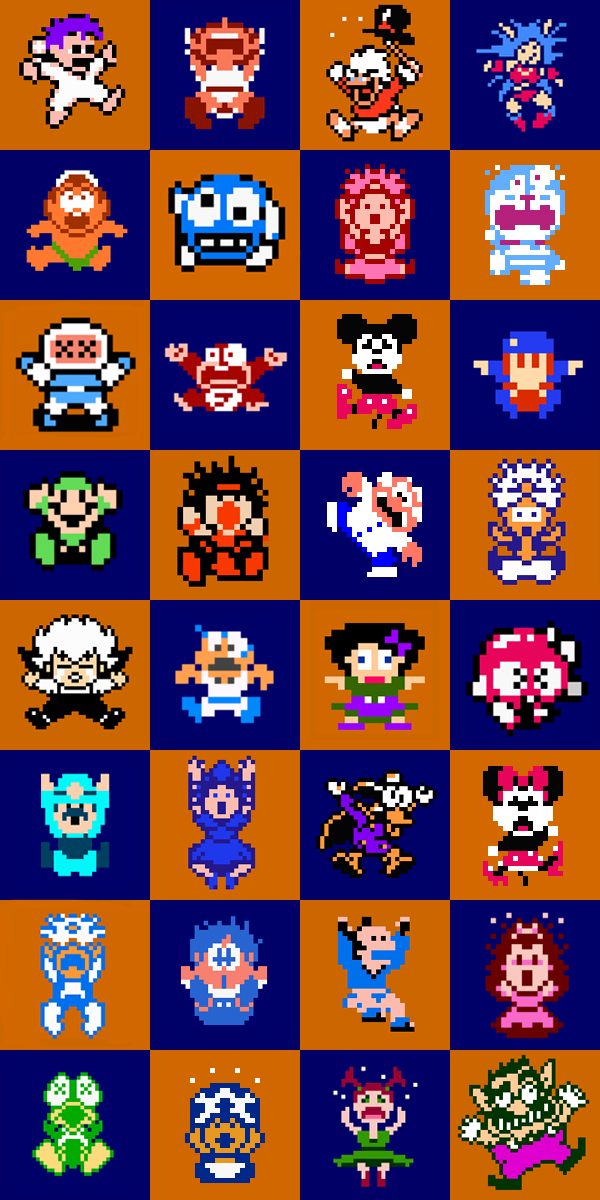
I don’t know how many games featured characters dying in some kind of variation on this Mario-style death, but I think it’s interesting how prevalent it once was in video games. And so I did a little look-through of NES sprites to see what I could pull find. What resulted is the eight-bit Halloween celebration you see below.

Enjoy it. This time, it’s not your failure.


A few notes:

Video games, previously:

Wednesday, March 20, 2013

Finding the Feminine (if Not the Feminist) in Early Nintendo

If you don’t read about video games, then you probably don’t know of Anita Sarkeesian. She is a feminist blogger whose talking head stars in the “Feminist Frequency” online series, and she recently rose to a greater level of prominence as a result of a successful Kickstarster campaign to explore the role of female characters in video games. The campaign also elicited a shitstorm of harassment that basically proved Sarkeesian’s point that video game culture can have a nasty, misogynist bent to it, but the first video premiered on March 7 in spite of the small but active band trying to keep girls out of the treehouse.

image via
In the first installment, “Damsels in Distress,” Sarkeesian seems to be laying groundwork for the rest of the series, explaining the origins of the “lady tied to the train tracks” stock character and how it relates to video games. She actually talks about video games a lot less than you might expect — like I said, I’m guessing she’s building a foundation, but there’s a point when you may think, “She’s still going on about this?” — and the two franchises that get the most attention are Mario and Zelda. This too has earned her some criticism, as newer franchises feature more progressive politics than do these series that have remained fundamentally unchanged since they debuted in the 80s. But it’s Nintendo, and in addition to Mario and Zelda being two of the most long-lived successful video game franchises ever, those early days of the original Nintendo Entertainment System were hugely important to the medium. Thus, it’s a good place to start. Neither series has ever come close to gender parity, and regardless of whether you think they should, that is exactly why this very month has seen the release of hacked versions of Donkey Kong and Legend of Zelda that allow you to play as Pauline or as Princess Zelda and rescue their respective dudes.

This all made me think of a subject I haven’t picked up in a while.

Now, one of the responses to Sarkeesian’s first video pointed out that she didn’t mention one of the reasons the Mario and Zelda don’t evolve: Their creator, Shigeru Miyamoto, isn’t big on plot elements. He’d rather minimize backstory, let players get to the fun part and not bury the essence of the game. Especially back in the earlier days, Miyamoto wasn’t about to let co-workers who thought otherwise meddle with his brain babies. (That’s less the case now, and it’s worth pointing out that as the stories behind these games grew deeper, we got less wimpy female characters, like Rosalina and Midna.)

In that same early age of home console Nintendo, however, Mario and Zelda weren’t Nintendo’s only attempts at launching power franchises. They were just the most successful ones. A few months after Legend of Zelda hit shelves, Nintendo debuted two other games: Metroid and Kid Icarus. The two are “sister” series in more than one way. For example, Metroid baddies show up in Kid Icarus. In both, the screen can scroll both vertically and horizontally, whereas the first Mario and Zelda didn’t. Both were developed without Miyamoto’s participation; Gunpei Yokoi served as producer for both, and many of the staffers who worked on Metroid shifted to Icarus as they finished their work. Both didn’t receive sequels until years later. And both offer major roles to female characters that Mario and Zelda do not.

images via here and here
In Metroid, of course, the big reveal players get for completing certain requirements is finding out that Samus, the robot-looking dude they’ve been controlling all this time, is actually a woman — and what a woman! She’s wearing a weird mom bathing suit and everything!

Most people know that. But the game also pits Samus against a female(ish) big bad: the Mother Brain. There’s not too much explicitly female about a cycloptic brain in a jar, but all the literature discussing the Mother Brain as a “she” — even on Captain N, where she was inexplicably voiced by the guy who voiced Audrey II in Little Shop of Horrors.

image via
In the third Metroid game, the brain gets a body, and graphics designer Toru Osawa explained that his initial impulse had been to make her look like “an old lady living in my apartment complex.” You can still kind of see that in the final design:


That’s something that literally never occurred to me until this month: that a game debuting that early in the story of Nintendo would have a female hero taking down a female villain — an all-knowing, all-seeing, all-powerful big bad, no less.

Kid Icarus also boasts better feminist credentials. Though the hero is male — more a boy than a man, though I’m unsure if that matters — the big bad is female. It’s Medusa, who in the universe of the game is the goddess of darkness, and offered as the antithesis to Palutena, the goddess of light and the game’s damsel in distress. (Importantly, Medusa looks like a woman, but she also has a Mother Brain-y like form where she appears as a huge, one-eyed head… thing.) Yes, there’s a woman awaiting rescue at the end of the game, but there is something different about it being another woman who locked her up, especially when those characters function as stand-ins for God and the Devil, or at least Athena and a Lady Hades (Ladeez).

This all proves nothing, of course, and it’s worth underscoring that Metroid and Kid Icarus didn’t find the success that Super Mario Bros. and Legend of Zelda did. The former only became a successful franchise in 2002 and the latter just received its second sequel in 2012. But when you’re looking at the early days of Nintendo, with Princess Peach and Princess Zelda mostly sitting around in dungeons, it’s kind of cool that female characters in other games were being given something interesting to do: be evil, get captured or take of their clothes at the end of the game. There’s a case to be made for finding elements of the sacred feminine in Mario and Zelda, but it’s a dig to get there. With Metroid and Kid Icarus, it’s right there in the instruction booklet.

Gender and video games, previously: