Pages

Showing posts with label pac-man. Show all posts

Monday, November 5, 2012

Those Forgotten Mario Kart Games Play Like a Dream

A few weeks back, I took the train down to meet some friends in Long Beach. They were delayed in picking me up, however, so I toddled to where people were and found a living, breathing arcade — one that had the arcade Mario Kart games, no less. You’d be hard pressed to find someone who loves Mario Kart more than I do, yet I’d never actually played these games, just because I’d never encountered them before. Finally seeing them, brightly colored and zippy as Mario Kart games tend to be, I knew what I had to do: sit down and play until my ride arrived.

The curious thing about Mario Kart Aracade GP, however, is that it were developed by Namco, the company that made Pac-Man, and only published by Nintendo. As a result, you can play as Pac-Man, Ms. Pac-Man and Blinky the ghost in addition to the usual Mario crew — and in the sequel, you can even race as a Tamagotchi, like you always wrote about doing in your Mario Kart fanfic.


And as another result, the following description that I gave to my friends and caused myself to sound like someone who’d abused cold medication: “It was actually pretty cool. There was this one stage where you were racing through, though this little pastoral scene, and then you drive into the crotch of a tree and it looks like a Disneyland dark ride, and then all of a sudden you’re going through what’s clearly supposed to be one of the Pac-Man mazes, only it’s three dimensional, and moving around you are the sprites from the original Pac-Man, only they’re three dimensional too, but still blocky, and they’re moving around you. But it’s only for a few seconds, and then the scene shifts and you’re back in the field and oh my god, I sound like I’m describing some weird, nerdy dream I had, but I swear that’s what actually happened.”

That’s what I said, more or less, but importantly it wasn’t some weird, nerdy dream. Here’s the proof:


If you’re comparing the game to the “real” Mario Kart games — the ones Nintendo acknowledge and re-create for retro courses in new games — you’d probably notice that the courses are a little bland. That said, the level of detail around you is amazing to the point that you almost want to blow the race in order to see what you’re zooming past.

Check out the Yoshi Park course, which plays like an actual amusement park:


The game is also expensive as hell to play — a major minus — but you have to nod approvingly in the direction of a Mario Kart that allows you to infect your opponents with the viruses from Dr. Mario.

Thursday, February 16, 2012

Hunger, Games

(Disclaimer: This post is not about Hunger Games in any way.)

Perhaps you are both a video game enthusiast and also a general smartypants. I mean, wow, your social calendar must be just exploding, but we’re not here to trade insults. Let’s just say you feel equally comfortable with a joystick or a copy of The Book of Lists in your hand, and when you’re not shuffling pixels around a screen you’re chasing down some new point of trivia that will just make you the envy of your message board cohorts.

If that’s the case, you might know that Pac-Man was, in his earliest incarnations, known as Puck-Man, and that his name was only changed because a vandal armed with a magic marker could have easily blacked out the edge of that “P” and rendered the game pornographic. A lot of you doubly nerdy types know that one. But why Puck-Man, especially given that he’s not all that hockey puck-like? The name comes from this Japanese word, paku paku, which describes the sound (kinda) but also the action (kinda) of chomping — literally “eating in big mouthfuls,” according to this collection of the Japanese quasi-onomatopoeia. (Basically, these words cover the sound effects we use but also name phenomenon that don’t actually make noise, like glimmering light or an intense stare. Also, they’re adverbs. It’s weird.) And paku paku is a sensible word to inspire Pac-Man’s name because eating is all he does. Hell, eating is all he is, given that the most basic representation of him is just a moving mouth.

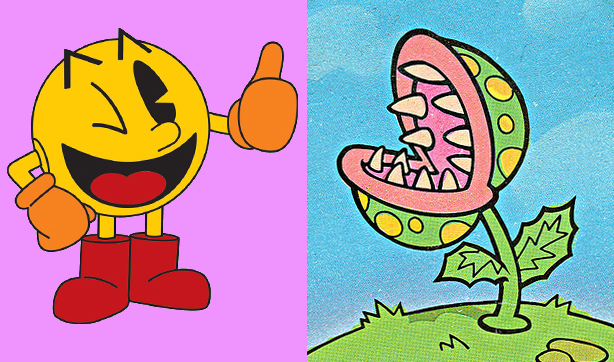
Keeping that in mind, Mr. Game-Playing Smartypants, consider this: In Japan, the name of the bitey, chompy, pipe-dwelling carnivorous weeds that you find in Super Mario Bros. is Pakkun Flower. The name totally comes from the same mouth-flapping Japanese word. And, now that you think about it, you have to admit: Both being video game characters that you’ve known more or less your entire life, they have a lot in common, Pac-Man and the Piranha Plant.


And that common thing is eating, constantly eating, even eating when there’s nothing to be eaten, but still biting, always biting, biting the air, eating the air, always eating. And if you’re that lame-o who exists at the precise cross-section of video game dork and trivia-scouting word nerd, this fact will seem neat and novel and totally noteworthy.

Friday, September 2, 2011

A Game of Shit

There exists a video game — specifically a Pac-Man clone released for the MSX — whose title is Oh Shit! I am not kidding. Here’s the European cover:


And here’s the Japanese version, which truncates that title simply to Shit:


That title is no misnomer: According to Hardcore Gaming 101, the game is an example of a kusoge. Literally translating from Japanese as “shit game” or “shitty game,” the term refers to a purposefully bad game that is meant to be enjoyed in a campy way. Think of hipsters watching Mama’s Family and you get the idea. But be honest: How many times have you been playing actual Pac-Man or one of its less shitty knock-offs and met your death-by-ghost-touch in a dark, dot-lined hallway and exclaimed simply “Shit!”?

Wednesday, April 14, 2010

Wakka Wakka... What the?

From the LG logo to Pac-Man with two simple modifications:


The above logo has been in use ever since this South Korea-based company shortened its name from Lucky Goldstar in 1995. Though the Lucky comes from the company’s original name, Lak-Hui Chemical Industrial Corporation, I still want to say that Lucky Goldstar is some Engrish attempt at making a brand name that would create positive associations with English-speakers — as in, like, Lucky Goldstar A+ No. 1 Homerun. Plus Pac-Man.

(Sources: Wikipedia, the “cloudbush” thread)

Previous items of interest from the cloudbush thread:

Friday, September 18, 2009

It’s a Secret to Everybody, Part Fourteen: Odds and Ends

(This is a reposting of just one section of my rather extensive “It’s a Secret to Everybody” post on video game etymologies. Click the link to see the whole shebang. Links to other sections are at the bottom of this post.)

Photobucket

As I’ve mentioned before in this series, music names such as those in Mega Man aren’t exactly rare. The Guilty Gear fighting game series, for example, went crazy with them, though grasping all of them on your own would require a command of rock bands as wide-ranging as Judas Priest, Led Zeppelin, Helloween, Testament and Metallica. Some are obvious: guitar-toting witch I-No namechecks Brian Eno. Others, of course, are more obscure, either intentionally or accidentally. As this site notes, for example, the nod that the name Millia Rage makes is only clear if you have any notion that there exists a heavy metal band called Meliah Rage. When translation mucks up the spelling, spotting the allusion gets twice as hard: Even if you knew of the Swedish pop band Cloudberry Jam, you might not suspect that the fighter named Kuradoberi Jam was a reference to it. Now, the latter beats out the former in terms of Google hits. And the fact that the series protagonist Sol Badguy references Queen only becomes apparent when you learn that Mr. Bad Guy was the name of Freddie Mercury 1985 solo album.

Queen’s work pops up in other games. Notably, the Ogre Battle series of strategy games is itself a reference to Queen’s 1974 song by the same name. (And yes, now that you think about it, it does seem strange that the games featured relatively few ogres.) The first game bore the subtitle March of the Black Queen, and indeed that too is one of the band’s songs. A sequel, Ogre Battle: Let Us Cling Together, also borrows from a Queen song, though the track is more commonly known as “Teo Torriatte.” This song also happens to feature two verses sung in Japanese. The games also feature a geographical area known as the Rhyan Seas, which references yet another Queen song, “Seven Seas of Rhye.”

So while some games traffic in allusions to some segment of popular culture, others aim for something more highbrow. Doesn’t mean they don’t make a mess of things, referencing this and that and ending up referencing all over themselves. Take Samurai Shodown, for example. (And while you’re taking it, if it strikes you as odd that the second word of the series title is missing a “W,” know that I have a post explaining that apparent mistake. It’s somewhat intentional.) Generally speaking, characters in these games tend to have real-life historical counterparts. Some directly influenced the game, while some loosely inspired it. For example, one of its recurring characters is Hanzo Hattori — a name that should be familiar at least from the Kill Bill character if not other manifestations of Japanese culture. The man was real. The historical Hanzo Hattori may not exactly resemble his representations in movies and video games, but the fact that his legacy continues to inspire writers and game creators today shows that he probably registered fairly high on the badass scale.

hazno_jubei_charlotte
hanzo, jubei and charlotte — revived to duel for our pleasure

Among the other characters directly inspired by historical personages:
  • Jubei Yagyu is a 17th-century samurai based on the 17th-century samurai Jubei Yagyu Mitsuyoshi, who is arguably the most famous figures to emerge from Japan’s feudal era.
  • And Shiro Tokisada Amakusa, depicted in the game as a kind of satanic wizard, is based on Amakusa Shiro, a leader of the largely Christian Shimbara Rebellion of the mid-17th-century. (The fact that a Christian revolutionary would be demonized as as an effeminate villain is fairly telling as to how Japanese history has chosen to remember this particular person. In the games, the character is so unmanly in his mannerisms that a person could easily mistake him for a woman. And the American dub of the Samurai Shodown skirted the gender confusion altogether by just depicting the character as a woman.)
  • The American fighter Andrew, who first shows up in Samurai Shodown VI, seems to be based on Andrew Jackson, Mr. Twenty Dollar Bill himself. I’ve put up a previous post on this blog that focuses on this strangeness and how the game seems to use Andrew to rag on American military policy. Worth a look.
  • And then there’s my absolute favorite of all the characters based on real-life: Charlotte, the French fencer. Her full name is given as Charlotte Christine de Colde — an odd-seeming surname for a Frenchwoman. In fact, it’s a likely mistranslation of the name of the woman she’s based on, Charlotte Corday, the celebrated assassin of revolutionary Jean-Paul Marat.
Other characters have historical ties, but more to the point of this post is that fact that others yet have names that mean something, even out of historical contexts. The first name of the very dark, very Crow-esque Kubikiri Basara, for example, literally translates as “throat-cutting.” The later games also feature a towering cannibal named Gedo Kusaregedo, whose name, I’m told, translates to “rotten bastard.” And Samurai Shodown 2 features a Prussian fighter whose name, Neinhalt Seiger, is a very bad approximation of the German for “nonstop victory” or “nonstop winner” — the German version of Engrish, maybe?

“Period piece” fighters such as Samurai Shodown aren’t the only ones who can feature characters whose names actually mean something, of course: My astonishment that such-and-such Japanese character has a name that doubles as a meaningful chunk of syntax is pretty silly, when I think about how many American names mean something that would be obvious to an English-speaker. On the flipside, I can’t help but be amused, for example, that Kyo Kusanagi, hero of the long-running King of Fighters series, has a last name that means “grass-cutter.” My association? The decidedly unheroic literal translations lawnmower, even after I’ve read that the name Kusanagi has certain significance to Japanese folklore.

Other characters’ Japanese roots are less pronounced, though no more apparent to the casual English-speaking video game player.

inky_pinky_blinky_miru
inky, pinky, blinky and... miru?

A while back, Destructoid put up a good post on the meaning of the names of the Pac-Man ghosts — that is, both the real names and their nicknames that the game’s attract mode displays. Far from being meaningless, they actually help explain why Inky, Blinky, Pinky and Clyde behave the way they do, though it’s a bit clearer in Japanese. I have my own post on the ghosts and their names, and I also talk about some of the other ghosts, which exist apparently. Also-rans like Miru and Yum-Yum deserve their fair share of shout-outs, I say. As for Pac-Man himself, it’s pretty well-established that his name comes from the paku-paku-paku noise he makes as he gobbles dots. And it’s an often-told and pretty self-explanatory story about why his creators eventually opted not to go with their first choice for his name, Puck Man, for the character’s American debut. I have a post on these Pac-matters here.

Another early inhabitant of the arcades is Mappy — not a clone of Pac-Man but instead a wholly different title by Pac-Man’s developer, Namco. Mappy perhaps doesn’t stir up as much nostalgia as other Namco titles, but it’s a solid one. Billed as a literal cat and mouse game, players control a policeman mouse in environments crawling with feline cat burglars. About five seconds into the first quarter and any sane person would realize the game has fairly little to do with maps. The odd title comes from the Japanese slang term mappo, meaning “police officer.” The online dictionaries of Japanese slang that I found didn’t include mappo, but I’m inclined to believe the term means what it’s purported to mean and that the etymology for Mappy is true. An otherwise unrelated police robot named Mappo appears in two Nintendo releases, GiFTPiA and Captain Rainbow.

kidicarus222_Mappy_arcadeflyer
it’s not about maps

In the Japanese version of the game, one of Mappy’s villainous cat characters goes by the name Nyamco — a cross between the name the developer, Namco, and the Japanese onomatopoeia for the noise a cat makes.


master_higgins_adventure_island_Tak
master higgins, master higgins, and master higgins’s japanese namesake

In an interesting marketing move, Hudson Soft — the developer and publisher behind the vaguely Mario-like Adventure Island games — at least twice rebranded the series protagonist for release in different language territories. American players know the grass-skirted, pot-bellied hero as Master Higgins, but in Japan, he’s Takahashi Meijin (“Master Takahashi”), which also happens to be the nickname of Toshiyuki Takahashi, real-life executive at Hudson Soft. (It wasn’t his idea, but he nonetheless went with the suggestion that he — then only the company’s vice-president and someone famous for video game-playing prowess — should be the character featured in the game, though he’s later admitted that being the protagonist in a notoriously difficult title was disconcerting because it was he would be was repeatedly dying. The name Master Higgins didn’t cut it Mexico, however, and, according to Wikipedia, when the game hit that market, the protagonist was unofficially redubbed Capulinita, in honor of the Mexican comedian Capulina, whom Higgins apparently resembles.

The whole “It’s a Secret to Everybody” series:

Wednesday, October 29, 2008

Blinky, Pinky, Inky and Clyde: Smarter Than You Think

At the moment, I am haunted by the ghosts of Pac-Man. Unlike regular hauntings, which more often make people go crazy or become possessed or move away, this timely supernatural occurrence has prompted me to write another entry in the games-and-names file.

Way back when, I blogged about a prolonged night at Elsie’s in which I sat next to the Pac-Man machine and ended up watching the attract mode for way longer than I should have. As the lights flashed and repeatedly drew my attention, I watched the introduction of the game’s characters again and again and I noted that the four ghosts have two sets of names. Where as the four are introduced as Blinky (the red one), Pinky (the pink one), Inky (the blue one) and Clyde (the orange one), they’re also given an alternate set of names: Shadow, Speedy, Bashful and Pokey, respectively.

image courtesy of spritestrich

It gets weirder: This particular machine was one of the ones that contains all the major Pac-Man games and therefore scrolled through them, one by one. The included ghosts change. In Ms. Pac-Man, Clyde is replaced by another orange ghost, Sue, possibly in an effort to even out the gender ratio. In Pac-Man Jr., Sue is replaced with Tim, also orange.

But it all seems arbitrary, right?

In a sense, it is. However, Ashley Davis, a blogger over at Destructoid, put a post up last week specifically on the Pac-Man ghosts and why they got the names that they did. In short, though it might seem like Blinky, Pinky, Inky and the Clyde-Sue-Tim hivemind hover around dot-filled mazes in the exact same way, they don’t. In fact, the way they move is explained by their nicknames.

As Davis explains it, Clyde (a.k.a. “Pokey”) might seem like he’d move especially slowly, but he doesn’t. Instead, he moves around at a normal speed but not at all in pursuit of Pac-Man. He does his own thing; if he happens to snag Pac-Man and make him rotate counterclockwise into oblivion, it’s a total coincidence. His Japanese name, Otoboke, translates to something like “stupid” or “dopey,” Davis explains. Thus, “Pokey” — or, as we shall interpret it, “mentally challenged.” Thus, if Clyde kills Pac-Man, it’s probably as a result of the player being equally as mentally challenged.

Inky, as Davis explains it, is equally unlikely to kill Pac-Man. His Japanese name, Kimagure, translates to “whimsy.” And it might seem like his pattern is based on pure whimsy, but it’s apparently not. As it’s explained on the Twin Galaxies forum, Inky’s position on the screen may seem random, but it’s actually based on a the relationship between Pac-Man and Blinky, the red ghost. More or less, Inky resides on the part of the screen that’s twice as far from the distance between the red ghost and two spaces in front of Pac-Man. It’s very complex.

Pinky (a.k.a. “Speedy”) doesn’t actually move any faster than the rest of the ghosts. His Japanese name — Machibuse, “ambusher” — is more accurate, as she takes it upon herself to trap Pac-Man into corners with the help of the Blinky. (This website, by the way, switches the Japanese names for Inky and Pinky, but since it’s in the minority on the matter, I’ll assume it’s a mistake.)

And then there’s Blinky (a.k.a. “Shadow”). In Japanese, he’s Oikake, “chaser.” He bases his movements on Pac-Man himself, always with the goal of reducing the amount of distance between himself and the yellow dot-gobbler. If the vertical distance is greater, he’ll do what he can to reduce that so long as the horizontal distance doesn’t become greater, in which case he’ll reduce that instead. Davis notes that when Pac-Man consumes a certain number of dots, the behavior of Blinky — and only Blinky — changes. He goes into what is known among Pac-Man aficionados as “Cruise Elroy” mode. (Davis supplies some guesses as to where the term might come from, but she rightly leaves it as being obscure.) In this mode, Blinky moves faster than he would normally be able to.

Interesting, in my book, for two reasons: The four ghosts each have their own programmed motivation for getting around a given maze (one) and these motivations are hinted at by their names (two).

Davis leaves out one additional ghost, however, who’s little known even among those who pride themselves in their Pac-Man skills: the especially obscure green ghost, Miru (also translated as “Mil,” unfortunately). I read about her while browsing Wikipedia sometime back and had been meaning to reveal her existence to the world for a while before the Destructoid post gave me an opportunity. Miru appears in the 1983 Japan-only title Pac & Pal, which Wikipedia alleges could be the rarest Pac-Man title.


I’m fairly certain that Miru is the only truly female ghost in the series, Sue and Pinky’s names notwithstanding. You can tell by the fact that she, like Ms. Pac-Man herself, wears a bow on her head. And that’s a sure a sign of femininity as there ever was. (She looks like “a gooseberry with legs,” according to Wikipedia.) She apparently zooms around the maze, unaffected by the evil ghosts, and will grab items. If Pac-Man doesn’t intercept them from her, they get dropped in the “ghost box” in the center of the maze, where they become lost forever.


In short, Miru doesn’t sound like all that much help. In some versions, she’s apparently replaced by Chomp-Chomp, Pac-Man’s dog. If that’s not a slap in the face to early gender equality in video games, I don’t know what is.

courtesy of strategywiki.org

And that, my friends, is everything I know about the Pac-Man ghosts, their weird alternate personas, their additional American alteregos, and their dumb little sister that no one talks about anymore.

EDIT: I’ve found a bit more on the ghosts. First, what’s in the comments below is accurate. Pac-mania did, in fact, introduce new ghosts into the mix. The green one is, in fact, named Funky and the gray one Spunky, though they’re also apparently known as the far less fun-sounding “Common” and “Gray Common.” And Sue does reappear, now purple.

However, these aren’t the last of the ghosts. There’s also one named Yum-Yum, who appears in Jr. Pac-Man as some kind of Juliet to Jr. Pac-Man’s Romeo. The latter’s boyhood is represented by the fact that he wears a little propeller beanie on his head, while the former’s femininity is once again represented by the fact that she wears a bow. Below is a screenshot, which I nabbed from this YouTube clip.

Here’s Jr. Pac-Man, just after he’s dropped off by the stork.


And here’s little Yum-Yum meeting Jr. for the first time.


Finally, regarding the big four ghosts, I noticed in Chris Kohler’s Game Over a little section on their names. He translated the Japanese names of Clyde, Inky, Pinky and Blinky as “Slow,” “Capricious,” “Ambush” and “Chaser.” He also notes that the four Japanese versions of the ghosts have their own Japanese nicknames, just as the American versions have nicknames. The nicknames, in order are Guzuta, Aosuke, Pinky and Akabei, three of which are references to their respective ghosts’ colors. “Pinky” is obvious. The Japanese word for “red” is aka, and the word for “blue” is ao. Kohler theorizes that Guzuta comes from the Japanese guzutsuku, meaning “to linger” or “to languish.” Now we know.

Pac-Man, previously:
The intersection of video games and all things verbal, elsewhere on this blog:
Game geek? Subscribe to the video games-only feed for Back of the Cereal Box.

Friday, August 22, 2008

The First Lady of Video Games

I’ve previously noted how Google searches for “world’s largest suppository” and “opalescent dragon” turned up less interesting results than I hoped for. I have a new one today, and one that I’m a little more disappointed to present: Google does not seem to have a definite answer to my query of “first female video game character.”

I’d always thought it was Ms. Pac-Man, but I’ve never been sure. Her Wikipedia page makes no mention of it, though that might be because it’s actually for the game Ms. Pac-Man and not the character herself. This blog and this video game character fan site posit that the one to hold this title is, in fact, the be-bowed female counterpart to Pac-Man. (She’s not necessarily his wife, hence the “Ms.”). However, Google also little else. (Some results posit Street Fighter II’s Chun-Li or Metroid’s Samus, though I’m sure neither is the first.) And searching for the phrase sans quotation marks turns up little else of interest. 

image from hefnatron.com

So it is Ms. Pac-Man, right? Hopefully some other soul with nothing better to do but to Google this will now come across this page and correct me if I’m wrong.

Pac-Man, previously on Back of the Cereal Box:

Tuesday, April 22, 2008

High on Power Pills, No Doubt

This headline, which appeared atop my Gmail inbox this morning, seemed hilarious until I found out who Adam "Pacman" Jones was.


This is what I get for not paying attention to football. Here's the actual story, for those feeling the need to read further.

Friday, January 4, 2008

Frothing Girl, Oozing Boy — The Gender Mysteries of Clu Clu Land

I’ve found something interesting about Clu Clu Land, everyone’s favorite childhood video game.

What’s that? Clu Clu Land was only you’re second favorite?

Okay, I guess I can deal with that sad fact. I mean, when I say “Nintendo,” the first thing I think of is a Pac-Man knock off that more or less faded into obscurity after hitting the market in 1984. Oh, and it started a fish that didn’t look like a fish. Classic!

image courtesy of aho-aki.seesaa.net

image courtesy of inside-games.jp

In any case, for the few of you who don’t know, Nintendo did release a game called Clu Clu Land back in the early days of the NES. And it did, in fact, bear a few similarities to Pac-Man, though the game mechanics were just different enough that I wouldn’t necessarily call it a full-blown rip-off. The game starred Bubbles, a “bubblefish” who didn’t look much like an anyfish and had her navigating a series of mazes. Just as Pac-Man had to evade the ghosts as he zoomed around his mazes, Bubbles had to avoid prickly unira, or sea urchins. Her main mode of defense — and this is where the game works especially differently from Pac-Man — was spitting bubbles at the urchins to stun them and them running them into a wall, where’d they dissolve into the standard 100 points.

The game takes place underwater and all the main players are sea creatures, but Clu Clu Land weirdly doesn’t allow Bubbles to swim so much as spin. It’s hard to explain, though the below video might help.


As you can see, the playing board consists of various pegs that Bubbles spins around, as if she were holding onto them with one hand. (Yes, it’s technically a pole dance.) If she lets go, she’ll continue in the direction she was facing at that instant. If she wants to switch directions, she’ll have to snag onto another peg and start spinning around it again. Spinning is central enough to the game that its name is actually a transliteration of the Japanese onomatopoeia kuru kuru, which also appears in the title of another Nintendo game that revolves around (ha) spinning, Kuru Kuru Kuruin.

image courtesy of n-philes.com

Bubbles beats a maze by swinging around the right pegs. Passing through the “correct” spaces triggers the appearance of a small gem — or as the game refers to them, gold ingots. When all the gems have been uncovered, they form an image, kinda-sorta in the style of connect-the-dots.

But her pole dancing isn’t what made me want to write about her. No, I recalled something today that I initially learned a few years ago: While in the U.S. her name is “Bubbles” and she’s female, in Japan, the character is named “Gloopy” (or “Groopy” or “Guruppi,” depending on who’s doing the translating) and he is male. Or at least I’ve been informed that this is so. It’s documented online fairly often at least that there’s a some confusion about the characters’ in different parts of the world.

Either way, Bubbles is definitely a lady in the U.S., which could make her the first-ever playable female character that Nintendo ever created. (Nintendo, remember, did not create Ms. Pac-Man.) And that itself is odd, since there’s absolutely nothing about her that looks feminine, and one notch odder yet when you take into account that she was showing up in a time when female video game characters wore bows and dresses and generally did everything and anything they could to look girly. And if Nintendo did change Gloopy the Boy to Bubbles the Girl en route from Japan to the United States, it would have been a highly unusual move for a video game company at the time — and, really, one that doesn’t make a lot of sense.

Then there are the names, of course, which struck me as vaguely sexual. (Hence the post title.) I suppose there’s no reason why “Gloopy” couldn’t have been a female character’s name. But I’m glad I changed it.

image courtesy of crossovers.blogia.com

Bubbles never went on to much stardom after 1984, though she did score both a cameo in Smash Bros. Melee as a trophy and another as an unlockable playable character in the Game Boy Advance game DK: King of Swing. (Weird, I know. It doesn’t take place underwater and she’s surrounding by Donkey Kong’s extended simian gang. But whatever.) But at least now she gets to have the legacy of having ambiguous gender.

That’s something.

Tuesday, April 24, 2007

His Phallic Nose

I stumbled across this old bit of promotional art for Pac-Man, back when his Japanese called him "Puck Man." The "puck" — which apparently stemmed from the onomatopoetic paku paku paku noise he makes as he gobbles dots — was rightfully switched out in favor of "pac" for the American release, as us rowdy types would have no doubt had a field day with the name.


Looking at this art, however, I think I'm more disturbed by the coincidence of the name "Puck Man" and the penis-like protrusion sticking off his face. I'm guessing the shortening of the Pac-Man's nose was in furtherance of the effort to de-pornify him.

Wednesday, June 28, 2006

Love You Like I Love Myself

If a word doesn’t already exist for the phenomenon of cartoon couples looking like male-female fraternal twins, then the Germans aren’t on top of their game. A few examples:

Porky Pig and Petunia Pig


The entire Disney crew (Mickey, Minnie, Donald, Daisy et al.) but most notably supporting characters Clarabelle Cow and Horace Horsecollar, who look related despite the fact that they're different species


Pac-Man and Ms. Pac-Man


Chief Wiggum and his wife, Sarah


Kirk and Luann Van Houten


Mort and Muriel Goldman


And Toad and Toadette


Just to name a few.

As you can see, animators have been creating love interests for pre-existing characters and routinely making these sweethearts look like they share way too much DNA to be dating — or worse, mating. They really do look like brother and sister, all of these folks. It’s interesting that cartoonists would want to make these characters — most of them intended for young audiences — look like they’re committing incest. However, it’s more probable that the resemblance stems from (a) the animators’ lazy reluctance to create an entirely new model for a second-tier character and (b) the fact that having the characters look alike helps to tie them together. You see Daisy Duck waltz onto the scene, and even if you’ve never seen a Disney cartoon before, you know straight away that she’s involved with Donald in some way.

It’s like the Skeeter Syndome. As the people who made “Muppet Babies” clearly realized, a dearth of female characters can easily be remedied by making a female twist on a male character. That’s how the show got Skeeter, the girl counterpart to Scooter, who had existed in the regular, non-animated “Muppet Show” for years. (Granted, Skeeter was Scooter’s twin, not his love interest, but the idea still holds water.) In the end, any given group of characters gets to even out the gender ratio, but at the expense of looking like a bunch of inbreeders. And it’s been happening, apparently, since cartoon characters have been around.

An interesting note, however, is Kirk and Luann Van Houten. Since they’re on a show that seems to be conscious of trends on TV shows — especially animated shows — they’re resemblance could be intentional. How else could somebody explain why Milhouse is the way he is? What’s more, “The Simpsons” has featured both Kirk’s dad and Luann’s mom, who are on opposite sides of the family but nonetheless bear the resemblance. The twist comes in that the Van Houtens have been divorced for nearly as long as the show has featured them as a married couple. This, to me, is an interesting twist on the whole look-alike couple, and the kind of twist on a standard formula that once made “The Simpsons” a good show. The ones who look like they must belong together actually don’t and now hate each other.

And as for the Goldmans from “Family Guy,” I can only guess that they — being the awkward, bespectacled parents of an equally awkward, bespectacled son — are a Van Houten family knock-off, at least in a broad sense. But hey — “Family Guy” has to owe something to “The Simpsons,” right?