Really, you present yourself with your own difficulties by living in a city whose name actively thwarts pronunciation by anyone speaking English as a second language. But that’s only a small part of the problem, linguistically speaking, for Des Moines may mean “shitface.”
According to an etymological theory sponsored by Etymonline.com, the name of this Iowa metropolis may derive from the Miami-Illinois word mooyiinkweena, which is fun to say even before you learn that it translates as “shitface” — frommooy, “excrement,” and iinkwee, “face.” According to Etymonline, the name was given to the inhabitants of the region by the Peoria Indians, in a grand Native American tradition of making fun of your hated neighbors. (Etymonline, by the way, points out that Peoria itself has become a dirty word in American pop culture, however.)
There’s another theory that the city name comes from the French des moines — “from the monks” or “of the monks” — but what is the fun in that?

Showing posts with label some rather salty language. Show all posts
Showing posts with label some rather salty language. Show all posts
Tuesday, December 18, 2012

Saturday, November 10, 2012
You’re Late, But I Swear I’m Not Being Rude About It
Certain English words have an inherently nasty sound, often because their multisyllabic, Latin origins give them the ring of a clinical term for something impolite. I’d wager that for this reason, words such as gesticulate, fallacious, masticate amd testaceous have all been rejected by public speakers in favor of a more wholesome-sounding synonyms. Here’s one that’s new to me, much in the vein of a previous word of the week, the Betty Draper-appropriate iracund.
I wonder if the rather unfriendly sound of cunctation has prevented it from becoming a commonly used, easily recognized word. Hell, it lost out to tardiness. The word only sounds worse as you trace it back. It comes from a Latin verb whose infinitive form, unfortunately, is cunctor. The first person single present form, cuncto, can be translated as either “I delay,” “I hesitate” or “I dawdle” but not “I use the word that makes the woman hit me.”
cunctation (kungk-TAY-shun) — noun: a delay; tardiness.Can’t you imagine accusing someone of chronic cunctation and getting a more hostile reaction that the word merits? I can. Or is that a memory? It’s hard to say when you’re slapped so hard.
I wonder if the rather unfriendly sound of cunctation has prevented it from becoming a commonly used, easily recognized word. Hell, it lost out to tardiness. The word only sounds worse as you trace it back. It comes from a Latin verb whose infinitive form, unfortunately, is cunctor. The first person single present form, cuncto, can be translated as either “I delay,” “I hesitate” or “I dawdle” but not “I use the word that makes the woman hit me.”
Previous words of the week after the jump.
Friday, September 2, 2011
A Game of Shit
There exists a video game — specifically a Pac-Man clone released for the MSX — whose title is Oh Shit! I am not kidding. Here’s the European cover:

And here’s the Japanese version, which truncates that title simply to Shit:

That title is no misnomer: According to Hardcore Gaming 101, the game is an example of a kusoge. Literally translating from Japanese as “shit game” or “shitty game,” the term refers to a purposefully bad game that is meant to be enjoyed in a campy way. Think of hipsters watching Mama’s Family and you get the idea. But be honest: How many times have you been playing actual Pac-Man or one of its less shitty knock-offs and met your death-by-ghost-touch in a dark, dot-lined hallway and exclaimed simply “Shit!”?

And here’s the Japanese version, which truncates that title simply to Shit:

That title is no misnomer: According to Hardcore Gaming 101, the game is an example of a kusoge. Literally translating from Japanese as “shit game” or “shitty game,” the term refers to a purposefully bad game that is meant to be enjoyed in a campy way. Think of hipsters watching Mama’s Family and you get the idea. But be honest: How many times have you been playing actual Pac-Man or one of its less shitty knock-offs and met your death-by-ghost-touch in a dark, dot-lined hallway and exclaimed simply “Shit!”?
Sunday, August 21, 2011
I Need to Talk to You About Your Saliva Problem
It’s a fine word whose meaning can be guessed just by the way it sounds — like fizz or waffle or Filipino. The word of the week is one of these.

World Wide Words points out that even if you don’t know what it means, “nobody hearing it could possibly consider it a compliment.” It’s a valid point; whether you conclude that slubberdegullion means “individual who is disliked for some reason” or “tiny organ that malfunctions and consequently fills its host body with toxic pus,” you know to take offense when the word is applied to you. (I cannot imagine someone interpreting anything aside from these two meanings.) Though used all too rarely today, the word has been making members of the English-speaking world feel bad about their prodigious saliva creation since 1610, according to Etymonline. World Wide Words notes that slubberdegullion once appeared in print in the company of a great many other strange but appropriately mean-sounding words in Urquhart’s 1653 translation of Gargantua and Pantagruel. Rarely has such a list been compiled, I’d guess, except maybe by a Simpsons writer looking to compile a list of insults for Mr. Burns to call Homer. (Okay, fine, I’ve been watching The Simpsons this weekend.) Anyway, read this:
Previous words of the week after the jump.
slubberdegullion (SLUHB-er-dee-GUHLL-ee-un) — noun: 1. a filthy, slobbering person; a solven, villain or louse. 2. A worthless person. 3. A drunk and/or an alcoholic.A visual aid:

World Wide Words points out that even if you don’t know what it means, “nobody hearing it could possibly consider it a compliment.” It’s a valid point; whether you conclude that slubberdegullion means “individual who is disliked for some reason” or “tiny organ that malfunctions and consequently fills its host body with toxic pus,” you know to take offense when the word is applied to you. (I cannot imagine someone interpreting anything aside from these two meanings.) Though used all too rarely today, the word has been making members of the English-speaking world feel bad about their prodigious saliva creation since 1610, according to Etymonline. World Wide Words notes that slubberdegullion once appeared in print in the company of a great many other strange but appropriately mean-sounding words in Urquhart’s 1653 translation of Gargantua and Pantagruel. Rarely has such a list been compiled, I’d guess, except maybe by a Simpsons writer looking to compile a list of insults for Mr. Burns to call Homer. (Okay, fine, I’ve been watching The Simpsons this weekend.) Anyway, read this:
The bun-sellers or cake-makers were in nothing inclinable to their request; but, which was worse, did injure them most outrageously, called them prattling gabblers, lickorous gluttons, freckled bittors, mangy rascals, shite-a-bed scoundrels, drunken roysters, sly knaves, drowsy loiterers, slapsauce fellows, slabberdegullion druggels, lubberly louts, cozening foxes, ruffian rogues, paltry customers, sycophant-varlets, drawlatch hoydens, flouting milksops, jeering companions, staring clowns, forlorn snakes, ninny lobcocks, scurvy sneaksbies, fondling fops, base loons, saucy coxcombs, idle lusks, scoffing braggarts, noddy meacocks, blockish grutnols, doddipol-joltheads, jobbernol goosecaps, foolish loggerheads, flutch calf-lollies, grouthead gnat-snappers, lob-dotterels, gaping changelings, codshead loobies, woodcock slangams, ninny-hammer flycatchers, noddypeak simpletons, turdy gut, shitten shepherds, and other suchlike defamatory epithets; saying further, that it was not for them to eat of these dainty cakes, but might very well content themselves with the coarse unranged bread, or to eat of the great brown household loaf.It’s worth noting that Urquhart uses the alternate spelling slabberdegullion and uses the word as an adjective, but it’s even more worth nothing the adjective shite-a-bed exists, because you may have not been using it enough so far in you life. Today is the day that changes, lest I have reason to call you a turdy-gutted milksop.
Previous words of the week after the jump.
- acné excoriée des jeunes filles, adulterine, ageusia, ambeer, anosmia
- barrack, bissextile, bloofer, breastsummer
- catholicon, cecaelia, cephalophore, cherpumple, chilver, cockernonnie, coprolalia, couvade, cranberry morpheme, crwth, culaccino, cummingtonite
- deasil, decussate, deuteragonist, dingbat, dingle
- eidolon, epeolatry, epopt, espalier, etui, exoterica
- fabiform, Feghoot, fissilingual, Föhnkrankheit, folderol, froward
- gallinipper, grandgore, grue, guilloche, gyaru
- hippopotomonstrosesquipedaliophobia, hogo, honorificabilitudinitatibus
- ignivomous, iracund, isabelline, itaiitai
- jabroni, jamais vu, jehu, jumentous
- kaffir, kakopygian, kayfabe, knipperdollin
- leman, lemniscate, limnovore, linsey-woolsey, longicorn
- malacia, malison, milt, mongo, mooncalf, morepork, muzjiks
- narrenfreiheit, nef, nihilartikel, nobiliary particle, nosism
- ochanee, ogonek, ombré, ooglification, orchidectomy, ordured, orf
- pace, pareidolia, pavonated, perendiate, perigee, petrichor, pettifogger, pettitoes, phlegmagogue, pismire, pogonip, pong, pruniferous, puggle, pulveratricious, purse
- quacksalver, quagga, qualtagh, quidnunc, quiff
- ronion, roynish, rubirosa, rumpsprung, runcible
- salmagundi, scrutator, seneschal, sharrow, shebang, sinople, stan, stevedore, suovetaurilia
- tappen, teratogenesis, tergiversate, tetromino, thagomizer, thon, tiffin, tittery-whoppet, tmesis, toby, tutoyer, tyro
- ucalegon, ultramontane, umiaq, umquhile
- veneficial, verdigris, vespertilionine, vinegeroon
- weeaboo, widdiful, williwaw, witzelsucht, wooper looper
- xenodocheionology, xyster
- yazoo, ypsiliform, yoink
- zanjero, zenzizenzizenzic, zinnober, zugzwang
Thursday, May 13, 2010
It Was Supposed to Say Aunt
Photographed by Spencer at the Fairfax swap meet:
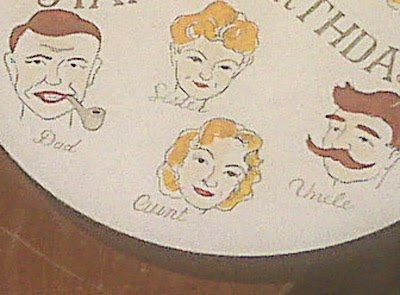
It is a birthday plate. (Hmm?) It has images of family members on it. (Uh…?) But the real confusion results from that rather ornate letter “A.” Larry David once faced a similar problem on Curb Your Enthusiasm:
Surely, we could have picked a better word for the sisters of our parents.

It is a birthday plate. (Hmm?) It has images of family members on it. (Uh…?) But the real confusion results from that rather ornate letter “A.” Larry David once faced a similar problem on Curb Your Enthusiasm:
Surely, we could have picked a better word for the sisters of our parents.
Monday, July 7, 2008
Felicity Schickfick
As the result of aimless Wikipedia-wandering, I somehow ended up on the page for Heather Graham’s character in Austin Powers: The Spy Who Shagged Me. Why she warrants her own Wikipedia page, I couldn’t tell you, but the article includes an interesting section in which it lists the various ways her name — “Felicity Shagwell,” a pun in the classic Bond girl fashion — was translated into other languages. Some good ones:
 “It’s tough being a globe-trotting pun,” says Heather Graham.
EDIT: Of course, I meant to say "Bond girl," not "Bong girl," though I suppose a bong girl would think sex puns are hilarious.
- In Danish: Felicity Bollergodt, with boller godt literally translating to “fucks nice.”
- In Dutch: Felicity Neuktgoed, with neukt goed meaning “fucks well.”
- In French: Felicity Felicity Bonnebez, with bonne baise meaning “good fuck.”
- In French-speaking parts of Canada: Félicité Chaudolit, with chaud au lit meaning “hot in bed.”
- In German: Felicity Schickfick, meaning “Felicity Fucknice.”
- In Italian: Felicity Ladà, with the last name translating as “(she) gives it.”
- In Portuguese-speaking Brazil: Felicity Façobem, meaning “Felicity (I) Do It Well.”
- In Portuguese-speaking Portugal: Felicidade NaCama, translating in full to “happiness in the bed” and the only one of the translations that uses her first name in the sense of happiness.
 “It’s tough being a globe-trotting pun,” says Heather Graham.
Monday, April 7, 2008
Of All the Abbreviations
Nearly forgot.
We ran a story last week that mentioned the San Francisco-based law firm Morrison & Foerster, an institute which I only have awareness of by virtue of its web address, www.mofo.com. Yes, "mofo." I can only imagine that the other meaning of the term "mofo" has been brought to the senior partners' attention and that they chose to keep the web address.
This makes me happy.
We ran a story last week that mentioned the San Francisco-based law firm Morrison & Foerster, an institute which I only have awareness of by virtue of its web address, www.mofo.com. Yes, "mofo." I can only imagine that the other meaning of the term "mofo" has been brought to the senior partners' attention and that they chose to keep the web address.
This makes me happy.
Tuesday, February 26, 2008
Anthropomorphic Pottymouth
Some time back, I went nostalgic and fired up Animal Crossing, a old Nintendo title involving ditch-digging and weed-pulling that nonetheless held my attention for a good few months. (There's also a guitar-playing dog involved. It's hard to explain.) In the game, the player is a villager living in a commune of talking, clothes-wearing animals, all of whom demand the player's attention at least once a day. They get upset if the player neglect to speak to them at least once every twenty-four hours. (They're kind of bitches that way.) Needless to say, the residents of my humble burg were quite upset that I hadn't bothered to say hi in thirty-six months.

Also, I'd forgotten until then that certain more impressionable villagers occasionally ask the player to teach them new words. Case in point: Rosie, a blue cat whom I'd apparently taught to say "cocktease," a phrase that she has apparently been using rather recklessly these past two-and-a-half years.
It's true what the people promoting this game said: It is just like more enjoyable version of real life.
Also, I'd forgotten until then that certain more impressionable villagers occasionally ask the player to teach them new words. Case in point: Rosie, a blue cat whom I'd apparently taught to say "cocktease," a phrase that she has apparently been using rather recklessly these past two-and-a-half years.
It's true what the people promoting this game said: It is just like more enjoyable version of real life.
Thursday, February 22, 2007
Fucking the Subjunctive
A few days back, George wrote on I’m Not One to Blog, But… about the origins of the phrase God bless you. Though the accuracy of his history seems to range between “fudged” and “delightfully embellished,” as near as I can tell, the post reminded me of an extensive conversation I once had with Vicky, a now long-time-ago Nexus copy cat, about whether English could entirely drop the subjunctive mood from English.
Though I wasn’t offended by her idea, I responded with two words: “Fuck you.”
She laughed.
For those for whom grammar falls into that gray category of shoulda-kinda-learned (a mental place that often houses the multiplication tables beyond twelve, central African geography and the reason we celebrate Cinco de Mayo), the subjunctive mood is a form that verbs take in English, similar to how verbs have tenses and voices and all that, only it is nearly invisible and undetectable in most speech and writing. Americans typically only learn about it when they start taking foreign language classes because the mood factors into Spanish or French a lot more.
Generally, verbs take the subjunctive in following situations:
You may have noticed that a quality many forms of the subjunctive have is that they sound like normal sentences with the wrong choice of verb implemented in them. Since the pronoun I is a singular, nominative pronoun, it might seem more correct to use was with it, since the two usually go together. (I was tired. I was running. I was technically a woman until the softball accident.) In fact, saying If I was taller actually doesn’t sound all that incorrect. Anybody listening would understand your meaning so well that it seems one could, in fact, do away with the subjunctive altogether and make everyone’s life more grammatically correct and therefore easier.
This is what Vicky said. And to an extent, I agreed with her.
This silly mood has been rendered a peculiarity in English so much so that it’s all but banished to the back of grammar textbooks, where teachers can’t get to it in the allotted duration of a school year. However, even if people are less and less conscious of how and why it works, they will still use it. For whatever reason, I argued to Vicky, so many of English’s little verbal groups put their verbs in the subjunctive. My old writing teacher called them “set phrases.” I call them “word buddies” or “gangs of words.” They’re little chunks of language that, for whatever reason, persist over time in a certain sequence. Wikipedia offers the following as examples:
The best examples of word buddies, however, has to be the jussive subjunctive — the form of it used when the speaker is invoking a supernatural power. God bless you, for example. You’re not saying “Hey, God! Go bless that guy!” or “God, bless him.” You’re saying “May God bless you,” only the “may” gets dropped. (Apparently people are too busy ordering around God’s benevolence to be polite. Nice one, Christians.) Or, you know, there’s also “fuck you.”
What’s that? Oh. Fuck you. You. Fuck you.
Rude, yes. But grammatically correct and understandable when you consider that that all-too-common phrase is spoken in the subjunctive.
Think about it. You’ve doubtlessly said it before. You may hear it on an almost daily basis, depending on what kind of asshole you are. But when you look at the phrase fuck you grammatically, it’s not immediately clear what sentiment the phrase is trying to express — you know, aside from hatred. I doubt the desired meaning is Fuck yourself, as that insult exists in its own right. Why would the self get dropped? It seems too important to be chopped off the end. And I don’t think you’re saying “I’m going to fuck you,” because that’s not necessarily insulting, depending on how and to whom it is spoken. Despite its ambiguity, however, fuck you always manages to convey the right emotion. Noting that fuck you and bless you are structured similarly and used in practically identical grammatical contexts — if opposite social contexts — it seems reasonable to conclude that the blasphemous one is another example of the jussive subjunctive mood.
“No! God doesn’t fuck people!” you may say.
That’s true. With the exception of Mary, God stays out of mortal business. Knowing, however, that the rest of those musty word buddies — bethatasitmay, and all those other set phrases that might as well be one word, given how we use them — originate from an older period of English in which the subjunctive was commonplace, think about the superstitions people back then had. About fucking. And supernatural entities.
That’s right. The Devil fucks you.
It seems plausible to me that far from being a command or a request, fuck you is actually a invocation of the Devil or his underlings to fly into you bedroom and ravage your privates in your sleep. Literally, fuck you could be May the Devil savage you in your sleep. And that, I have to admit, is probably the worst curse I could ever think to hurl at somebody.
Thus, grammar once again saves the day, by proving that an often-used insult is an entirely proper construction with a rich social history, that a rarely used and little understood aspect of English is alive and well on the lips of drivers throughout southern California, and that you’ve probably invoked engorged demons into the lives of your enemies.
Fuck you. Bless you. It’s all the same. Thank grammar!
And sleep with you knees together tonight.
Though I wasn’t offended by her idea, I responded with two words: “Fuck you.”
She laughed.
For those for whom grammar falls into that gray category of shoulda-kinda-learned (a mental place that often houses the multiplication tables beyond twelve, central African geography and the reason we celebrate Cinco de Mayo), the subjunctive mood is a form that verbs take in English, similar to how verbs have tenses and voices and all that, only it is nearly invisible and undetectable in most speech and writing. Americans typically only learn about it when they start taking foreign language classes because the mood factors into Spanish or French a lot more.
Generally, verbs take the subjunctive in following situations:
- When wishing (I wish I were taller rather than the indicative I wish I was taller)
- When stating a condition contrary to fact (If I were taller, then I could see down her shirt.)
- When someone is commanding, suggesting or recommending (I demand that the leering, tall man leave, rather than I demand that the leering, tall man leaves, as it would be spoken in a more typical sentence.)
You may have noticed that a quality many forms of the subjunctive have is that they sound like normal sentences with the wrong choice of verb implemented in them. Since the pronoun I is a singular, nominative pronoun, it might seem more correct to use was with it, since the two usually go together. (I was tired. I was running. I was technically a woman until the softball accident.) In fact, saying If I was taller actually doesn’t sound all that incorrect. Anybody listening would understand your meaning so well that it seems one could, in fact, do away with the subjunctive altogether and make everyone’s life more grammatically correct and therefore easier.
This is what Vicky said. And to an extent, I agreed with her.
This silly mood has been rendered a peculiarity in English so much so that it’s all but banished to the back of grammar textbooks, where teachers can’t get to it in the allotted duration of a school year. However, even if people are less and less conscious of how and why it works, they will still use it. For whatever reason, I argued to Vicky, so many of English’s little verbal groups put their verbs in the subjunctive. My old writing teacher called them “set phrases.” I call them “word buddies” or “gangs of words.” They’re little chunks of language that, for whatever reason, persist over time in a certain sequence. Wikipedia offers the following as examples:
- if need be
- so be it
- be that as it may
- far be it from me
- truth be told
The best examples of word buddies, however, has to be the jussive subjunctive — the form of it used when the speaker is invoking a supernatural power. God bless you, for example. You’re not saying “Hey, God! Go bless that guy!” or “God, bless him.” You’re saying “May God bless you,” only the “may” gets dropped. (Apparently people are too busy ordering around God’s benevolence to be polite. Nice one, Christians.) Or, you know, there’s also “fuck you.”
What’s that? Oh. Fuck you. You. Fuck you.
Rude, yes. But grammatically correct and understandable when you consider that that all-too-common phrase is spoken in the subjunctive.
Think about it. You’ve doubtlessly said it before. You may hear it on an almost daily basis, depending on what kind of asshole you are. But when you look at the phrase fuck you grammatically, it’s not immediately clear what sentiment the phrase is trying to express — you know, aside from hatred. I doubt the desired meaning is Fuck yourself, as that insult exists in its own right. Why would the self get dropped? It seems too important to be chopped off the end. And I don’t think you’re saying “I’m going to fuck you,” because that’s not necessarily insulting, depending on how and to whom it is spoken. Despite its ambiguity, however, fuck you always manages to convey the right emotion. Noting that fuck you and bless you are structured similarly and used in practically identical grammatical contexts — if opposite social contexts — it seems reasonable to conclude that the blasphemous one is another example of the jussive subjunctive mood.
“No! God doesn’t fuck people!” you may say.
That’s true. With the exception of Mary, God stays out of mortal business. Knowing, however, that the rest of those musty word buddies — bethatasitmay, and all those other set phrases that might as well be one word, given how we use them — originate from an older period of English in which the subjunctive was commonplace, think about the superstitions people back then had. About fucking. And supernatural entities.
That’s right. The Devil fucks you.
It seems plausible to me that far from being a command or a request, fuck you is actually a invocation of the Devil or his underlings to fly into you bedroom and ravage your privates in your sleep. Literally, fuck you could be May the Devil savage you in your sleep. And that, I have to admit, is probably the worst curse I could ever think to hurl at somebody.
Thus, grammar once again saves the day, by proving that an often-used insult is an entirely proper construction with a rich social history, that a rarely used and little understood aspect of English is alive and well on the lips of drivers throughout southern California, and that you’ve probably invoked engorged demons into the lives of your enemies.
Fuck you. Bless you. It’s all the same. Thank grammar!
And sleep with you knees together tonight.
Subscribe to:
Posts (Atom)