Pages

Showing posts with label the devil himself. Show all posts

Saturday, June 29, 2013

A Rather Busy Day for Satan

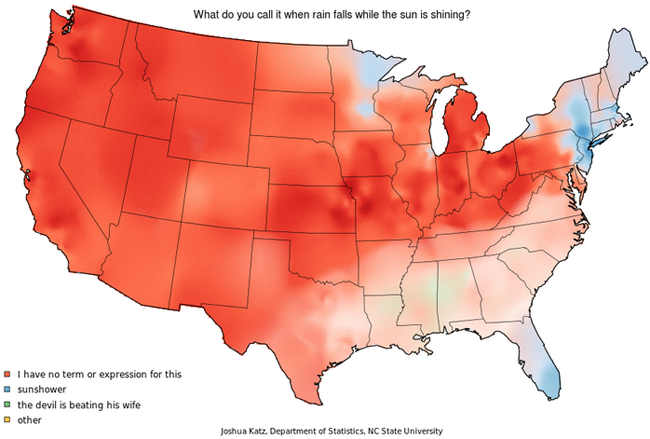
Most Americans with a passing interest in language probably already clicked through the dialogue maps posted recently by North Carolina State. They should have, anyway. These maps are damn cool. Colored splotches show you what regions of the U.S. say what, and for this flat-accented Californian who’s used to hearing people on TV talk like me, it’s helpful to be reminded how differently my fellow Americans can speak. (“That’s what they call soda over there? Oh my god, they’re so weird.”) But of all the dialectical breakdowns featured in the study, this one grabbed my attention most: “What do you call it when rain falls while the sun is shining?”

sunshower the devil is beating his wife

The map would seem to be accurate: I’m in that yellowish southern California splotch that would say “other.” (Obviously, the answer is “You’re on vacation in Hawaii, because this never happens anywhere else.”) I had never heard the expression sunshower, and while that seems like a sensible enough name for this type of weather, the superior term just in terms of batshit, backwoodsy folksiness has to be The devil is beating his wife, which I’d also never heard before (a-cuz California) and which has to be one of the more head-scratchy English idioms I’ve ever heard.

So what’s the deal? Here are the three theories I found online:
  • It could be just that unexpected raindrops are happening because they’re Mrs. Devil’s tears, according to this message board post.
  • According to this post on the same thread, it could also mean essentially “a mixed blessing” — to have rain during sun is a mix of bad and good, in the way that beating your wife is bad but maybe it’s not so awful when the wife in question is married to the devil. #controversial
  • And then there’s the theory I like best: Posted unsourced on Wikipedia, it states that rain during sunshine is a rare, beautiful thing, and because the devil hates anything good, he’s taking his anger out on his wife.
This Word Detective post also attempted to find the origin to this expression and came up with nothing conclusive, though the author does note that similar phrases exists outside the Southern U.S. For  example, Hungarian has The devil is getting married, and German has The devil is having a parish fair. And this guide to English translated into idiomatic French offers Le diable bat sa femme et marie sa fille (“The devil is beating his wife and marrying his daughter”) as the equivalent of It rains and shines at the same time, so way to go France for upping the ante by wedging incest into a discussion of a pleasant meteorological phenomenon.

According to Wikipedia, those who use these “devil” phrases are in the minority. Most idioms describing this kind of weather describe it as being some kind of special animal party. Among others:
  • In South Africa, a monkey’s wedding
  • In India and Japan, a fox’s wedding
  • In Korea, a male tiger gets married to a fox
  • In Morocco and France, a wolf’s wedding
  • In parts of Africa, a leopard’s wedding
  • In Kenya, a hyena’s wedding
  • In Bulgaria, a bear’s wedding
  • In northern Iran, a jackal’s wedding
  • And in El Salvador, just to be difficult, it’s a deer is giving birth
All of which, of course, are far cuter than domestic violence, devil-related or not.

Friday, October 24, 2008

The Ever-Recurring Invocation of Infernal Imps

As a result of an unexpected series of jumps across the world wide web, I ended on an online version of James Charles Wall’s 1904 book Devils — Their Origin and Their History. Weird, I know, but the book’s warped and somewhat naïve worldview encouraged me to continue with it, kind of in the way I’m compelled to have conversations with old people who still stay “Siam” when they mean “Thailand” and “Mohammedians” when they mean “Muslims” and “mimeograph” when they try to mean “fax machine.”

Below, I’ve recorded some highlights:

In casual invocation of the Devil’s name: The Devil is adjured not only at the coster’s stall but at the dinner-table, sometimes even before the ladies have left the sterner sex to the enjoyment of nicotine; while the drawing room, the ballroom and the boudoir are not altogether innocent of the same.

No, not the coster’s stall!

On the demon family tree: Devils form a large family of every age and nationality. The Talmudists asserted that they numbered 7,405,926. How they arrived at these numbers it is impossible to say; yet, after all, these were but few compared with the same learned authorities’ numbering of the angels who guarded souls from the attacks of these seven and odd million; they run into the quadrillions, a matter of sixteen figures.

That’s some sound census data right there.

On devils and their “colouring”: Devils are said to vary considerably in color, but from the same causes as their human victims their own variation of tint: torrid or temperate zones affect them not. We hear of blue devils lurking before the uncontrollable vision of those who have become confirmed inebriates and pass through a sort of Patrick’s Purgatory, such as is so vividly described by medieval historians of the Emerald Isle.

I don’t know what I’m more amused by: the sheer revulsion I imagine when this guy writes about people from torrid regions or his willingness to enforce what, for all I know, was a brand new stereotype about Irish people back when this was written.

On devil-worship in the East: There exists an order of devil-priests who set up their altars to those of the orthodox Buddha. Their oaths are made in the Devil’s name. His name is mentioned with reverence and with a prefix equivalent of your highness. They will not even pronounce any word beginning with the sound sh, that being solely reserved for his name Sheitan (i.e. Satan)… Among these people the Devil is worshipped under the form of a bronze-gilt cock.

No joke here. This just does not seem accurate. Why would “Easterners” use the Judeo-Christian word for the Devil?

And more: China simply teems with them; indeed, there is one particular province known as “Demonland.”

No.

On Jewish devils: The ancient Jews supposed that the demons were propogated like mankind; they ate and drank, were married and divorced.

Doesn’t supposing that demons marry and divorce ascribe a certain level of civility to them that this author would disagree with?

On the demonic hierarchies: From another source is gathered the distribution of the satanic embassies and the minister to whom they are allotted. Thus, Belphego is the Devil’s ambassador in France; Tharung, in Spain; Hutgin, in Italy; Martinet, in Switzerland; and Belial, in Turkey. His grand almoner is Dagon; His banker is Asmodeus, and the chief of the eunuchs is Succor Benoth. His theatrical manager is Kobal; master of ceremonies, Verdelet; and the court fool, Nybbas… No mention is made of a navy in connection with Hell… In fact, there must be one continuous drought in those quarters.

If we actually knew the names and locations of these Satanic emissaries, wouldn’t it be fairly easy to stop them? You know — with Jesus power?

The book also includes some cool artwork, like this one which depicts some Englishman’s imagining of what a Japanese devil should look like:


And this one, depicting the fall of Lucifer:


In conclusion: The Devil is bad, but it’s okay to be obsessed with him if you do it under the pretenses of academia. Either way, for reading and writing this, respectively, you and I will probably be joining J. Charles Wall in Hell.

Friday, October 10, 2008

The Blustery Day

It may never rain in Southern California, but it gets windy occasionally, and, really, it’s those days you have to watch out for.

I doubt I would have ever let windy days in Santa Barbara rattle me if I hadn’t taken the job at the newspaper. For the oblivious and urban, I’d imagine, this type of weather means minor inconveniences: wide wakes of dust near open windows and assaulting specks in the eyes during the walk from the parking spot to the office.

I no longer think this way.

Especially in early, dry autumn, I think about fires. Twice, now, I’ve had Independence Day ruined: last year’s Zaca Fire last year, which actually started on July 4, and this year’s Gap Fire, which was sparked on July 1. Plans for holiday relaxation and beachside fireworks-viewing went up in smoke, so to speak, on both occasions. Zaca and Gap may have resulted from human actions, but both blazes nonetheless became hot and sassy centers of my universe during their respective lifespans.

I have the house to myself this weekend. If some horrible firebeast showed up and consumed my plans — and, hell, maybe my house — then we’d have established a pattern, wouldn’t we? We just might. Today, both the county fire department and the Los Padres forest service announced that they would be temporarily increasing ready-and-able staff as a result of hot, dry winds blowing on a hot, dry day over wilderness that, by and large, is also hot and dry. Bad alignment of the stars.

It seemed important to me — and probably only me — that these two notes of caution referred to the winds differently. The first called them Sundowners — or, specifically, “Sundowner-type winds,” which Sundowners most assuredly are — and the second called them Santa Anas — or, specifically, a “Santa Ana wind event.” (It’s diction like this that also gives us “male subject” in police reports when the author actually means “man.” You have to love the law-and-order approach to English, which is at least better than the Law & Order style to English.) At some point, I learned the differences between these two types of winds — or “wind events,” if you want to be formal and therefore verbose about it — but I couldn’t remember today and looked them up.

Wikipedia describes the Santa Ana winds as strong, dry offshore winds that characteristically sweep through Southern California and northern Baja California in late autumn into winter. It goes on to note that they can be either hot or cold but are often thought of as being warm because their arrival can bring the highest temperatures of the year. For obvious reasons, they can also turn a small fire into a large problem.

The term Sundowner, conversely, refers to a wind phenomenon that occurs in Santa Barbara. This I did not know. I thought the term was much more widespread. Probably as a result of its limited habitat, the Wikipedia article on Sundowners is much shorter than the one on Santa Anas. It explains them as follows:
A Sundowner is an offshore wind which occurs when a region of high pressure is directly north of the Santa Barbara area, the part of the California coast which trends east-west. When the pressure gradient is perpendicular to the axis of the Santa Ynez Mountains, which rise directly behind Santa Barbara, the winds blow with greatest force. These winds often precede Santa Ana events by a day or two, as it is normal for high pressure areas to migrate east, causing the pressure gradients to shift to the northeast.
Given this, I suppose that both press releases could be correct: The first was sent only to Santa Barbara media, while the second one went to most outlets in Southern California. And I guess I shouldn’t quibble: I myself apparently am inclined to pronounce “Santa Ana” as “Santee Ana,” possibly because it’s just easier to say and possibly because my hometown sits beneath a mountain whose name is often pronounced by second-, third-, and fourth-generation residents as “Santee Ana Peak.” Either way, it’s a Southern California shibboleth: I sound like some bumpkin awaiting Santy Claws on Krishmush.

In spite of the fact the wind has been blowing all day in Santa Barbara, the origin of Sundowner seems obvious. Wikipedia makes no mention of it, but it goes into some depth for “Santa Ana,” whose origin is stranger than you might think. Despite the existence of the Santa Ana mountains, the Santa Ana River and the Santa Ana Canyon in Southern California, no one sure whether the winds took their name from these geographical features. The origin is obscure. One especially fun theory traces the term to a corruption of the Spanish term for the phenomenon: “Santana winds,” from the Spanish vientos de Satán, which, in turn, comes from a translation from some unspecified pre-Spanish language. The devil, I guess, really is in the details, at least for the topic at hand.

I should note that Wikipedia is politely questioning the accuracy of this claim with a little superscript “citation needed” floating beside the paragraph that contains it. I don’t know why the Spanish would have said vientos de Satán instead of vientos del diablo. (I do know, however, that Carlos Santana just recently played at the Santa Barbara Bowl, so he may well be involved in this as well. I’ll keep you posted.) This point is further complicated by the existence of yet another meteorological term, Diablo winds, which refer specifically to Santa Ana-like winds that occur around San Francisco. Wikipedia claims that this term arose much more recently: in 1991, when area media coined it in connection with the firestorm in Oakland that year. It may have originated, Wikipedia continues, “from the observation that the wind blows into the inner Bay Area from the direction of the Diablo Valley in adjacent Contra Costa County, and [because of] the fiery, sensationalist connotation inherent in devil wind.”

Any discussion of the connection between breezes and Beelzebub should rightly mention the superstition that the Santa Ana winds make people act bizarrely, violently, angrily, and unexpectedly. Strangely, Wikipedia makes no mention of it on the Santa Ana page itself, save for in the section labeled “Santa Ana winds in popular culture,” but I could swore that Joan Didion did in that one book she wrote. (You know — the one where she writes beautifully about some element of California? That single one?) Supposed mood-altering properties are, however, discussed in the entry for foehn winds. (I know, I know — yet another wind. It’s a little tedious to me too, at this point, though the addition of this one makes for four winds, which is also the title of a Bright Eyes song that happens to mention “The Great Satan” as well as the phrase “slouching towards Bethlehem, which was also the title of a Joan Didion book and could very well be the one I’m thinking of.) Also known as föhn winds, Foehn winds — which, as I understand them, occur in Central Europe but are not restricted to that area — are believed to cause some sort of mental illness. In German, the word for this affliction is Föhnkrankheit, which would be altogether wonderful from a verbal standpoint if it wasn’t associated with some major negatives, such as a 10 percent increase in suicides. The discussion of Föhnkrankheit is fairly limited, and any scientific explanation has yet to be proven for it and its apparent cousin illness, Sanatanakrankheit.

At the moment, the winds seem to have died down somewhat. I don’t feel crazy, although the scraping of tree branches against the metal gutter and the spectral swinging of my neighbor’s screen door may push me to that point if the air starts moving again. I’m not presently on fire and, if all goes well, I’ll get a full, unscorched weekend of solitude out of this yet.

Tuesday, October 9, 2007

Pantalones Giganticus (Or, the Devil Himself)

A little monster, quite literally, may be terrorizing my beloved, upcoming Smash Bros. Brawl.

ashley the strange, basically

I know, I know. Most people who read my blog could give a damn about the above witchlet or this video game or video games in general. But trust me on this one — there are interesting things going on here and I'm using them to touch on some of my pet interests: language, translation, urban legends, religion, unnecessarily close readings of lyrics and weirdly hidden counterculture messages in popular media. Just trust me.

Tonight's update at the Smash Bros. Brawl blog revealed that Ashley's theme from WarioWare: Touched! will be one of the game's musical tracks — and in an up-tempo, big band reconstruction, too. Personally, I'm happy. The original tune stands out in my mind as one of the more memorable video game songs I've ever heard. That's saying a lot, both because I've played a lot of video games and because music in them tends to verge somewhere between forgettable and irritating. Even more notable: Ashley's theme has lyrics. And they don't suck. I somehow doubt she'll be making a playable appearance. Nonetheless, this post makes for an interesting one at the Brawl blog in that Brawl designer and blogger Masahiro Sakurai refers readers to its Japanese version. There, you can hear the Japanese singer for Ashley's part — younger, sweeter and entirely less saucy. This strikes me as being noteworthy because, by and large, international video game companies either try to eliminate differences between different area's versions of the same game or just not mention them.

Just because I think it's a clever little ditty, here are the lyrics to Ashley's theme. (The parts sung by Ashley herself are italicized. The non-italicized lines are sung by a Disney's Haunted Mansion-style host of ghouls.)
Who's the girl next door living in the haunted mansion?
You better learn my name 'cause I am Ashley!
She knows the darkest spells and she brews the meanest potions
You might be the ingredient I seek

Don't let yourself be fooled by her innocent demeanor
You should be afraid of the great Ashley!
She doesn't play with dolls, and she never combs her hair
Who has time for girly things like that?

Eye of newt, I cast a hex on you
Grandma's wig, this'll make you big
Kitten Spitz, soon your pants won't fix
Pantalones Giganticus!

Oh no, not again!

She could rule the world, and still finish all her homework
Everyone knows that I'm the greatest Ashley!
You better watch your step or she'll cast a spell on you
I turned my teacher into a spoon

I must flip through my spellbook, and yes it's true
I don't have as many friends as you.
But I think you're nice and maybe we could be friends
And if you say no, you're toast

Who's the girl next door living in the haunted mansion?
You better learn my name 'cause I am Ashley!
Just remember this when you see her on the street
I'm the cruelest girl you'll ever meet
And for the sake of comparison, here's the lyrics to the Japanese version, translated into English. (Credit goes to GameFAQs contributor Enigmapoeia and his awesome video game song lyrics guide.)
Everyone's most popular person in the world
It's all about her Ashley
Everyone turn around to see her glance
It's only natural for Ashley, that's me

Everyone has an admiration throughout the world
It's all about her Ashley!
The great Ashley's magic is so supreme!
It's a party tonight!

EnOre Bmu N — it is a laughter spell
Si O I Ra Wn — what could be that spell?
I Ed A M — I don't remember this one
Ah! It's detestable! I'm getting bored!

Everyone's most popular person in the world
It's all about her Ashley
There are no impossibilities with the great Ashley
Nothing is strong to me!

The sea of the night sky has plenty of s
I am all alone
I want to make friends with everyone
How should I be good?

Everyone's most popular person in the world
It's all about her Ashley
The great Ashley's magic is so supreme!
It's a party tonight!
Far different, these two versions, but that could just be the translation. I can't help but pay special attention to the fact that the Japanese version contains a hidden backwards message in English. See that string of nonsensical letters in the third verse? It's the one part of the song that isn't normally sung with Japanese lyrics. (In the original, even Ashley's name approximates "Ashuri" more than "Ashley.") If you take the individual word parts and read them backwards, they spell "Made in Wario is number one." (Made in Wario is the Japanese name for the series of games we call "WarioWare" here in the States.)

That hidden message makes for a cute little footnote in all this, but it would seem to add credibility to the still-likely-false rumor that the English version of the song contains a Satanic message when played backwards. Yes, backwards messages from the Devil hidden in music is, like, one of the most played-out urban legends ever, I know. But the fact that Ashley herself comes off as a fairly evil character — in the games, her companion is a small impish demon named Red and she does live in a haunted mansion, after all— makes for a package that amounts to a cross-continental tangle of weird. It's a well-documented fact among Nintendo nerds like myself that Ashley's English theme, when played backwards, includes a line that sounds remarkably like "I have granted the kids to hell" or "I have condemned the kids to hell" or "I grant the kids to hell" or "I condemn the kids to hell." (This YTMND posting of it choses the first interpretation, but in the tradition of seeing pictures in clouds or the Virgin Mary in toast, you can take it however you like.) The only reason that anyone ever stumbled onto this fact is that the game the song debuted in included a mode in which various theme songs could be played at a tempo the player himself controlled. Odd, no? It might almost seem as though the programmers wanted the supposedly hidden message to be found. Allow me to explain: The game in question, WarioWare: Touched!, employed an usual control scheme in which players only used a stylus and the Nintendo DS touchscreen to play. In other words, no buttons, just various swipes and jabs with the little plastic pen-like instrument. The game also included various unlockable "toys" that basically showed off what one could do with said touchscreen. One of these toys was a record player, which could be used to play selected in-game music. And by swirling the stylus in either a clockwise or counterclockwise direction, one could either speed up or reverse the music, much as one could with a real-life record player. To some, the fact that Nintendo would have included such a feature further bolsters the notion that this whole backmasked secret message was intentional.

It wasn't. I don't work at Nintendo nor have I checked this out with any of the nice people who made this game, but I feel pretty safe in stating that the crazy conspiracy theory of Ashley-as-the-Devil and Nintendo-as-satanists amounts to utter bullshit. As far as urban legends go, however, it makes for a pretty good one.

For the one of you who actually made it to the end of this post, here's a clip from WarioWare: Twisted! featuring Ashley's intro sequence and her English theme song.


Thursday, February 22, 2007

Fucking the Subjunctive

A few days back, George wrote on I’m Not One to Blog, But… about the origins of the phrase God bless you. Though the accuracy of his history seems to range between “fudged” and “delightfully embellished,” as near as I can tell, the post reminded me of an extensive conversation I once had with Vicky, a now long-time-ago Nexus copy cat, about whether English could entirely drop the subjunctive mood from English.

Though I wasn’t offended by her idea, I responded with two words: “Fuck you.”

She laughed.

For those for whom grammar falls into that gray category of shoulda-kinda-learned (a mental place that often houses the multiplication tables beyond twelve, central African geography and the reason we celebrate Cinco de Mayo), the subjunctive mood is a form that verbs take in English, similar to how verbs have tenses and voices and all that, only it is nearly invisible and undetectable in most speech and writing. Americans typically only learn about it when they start taking foreign language classes because the mood factors into Spanish or French a lot more.

Generally, verbs take the subjunctive in following situations:
  • When wishing (I wish I were taller rather than the indicative I wish I was taller)
  • When stating a condition contrary to fact (If I were taller, then I could see down her shirt.)
  • When someone is commanding, suggesting or recommending (I demand that the leering, tall man leave, rather than I demand that the leering, tall man leaves, as it would be spoken in a more typical sentence.)
Stuff like that. There are others, but I don’t want a grammar lesson to foil my attempt at being interesting. That last form I gave for which I gave an example is the most important here, so don’t forget it. Raise your eyes slightly and re-read it if you feel you have to.

You may have noticed that a quality many forms of the subjunctive have is that they sound like normal sentences with the wrong choice of verb implemented in them. Since the pronoun I is a singular, nominative pronoun, it might seem more correct to use was with it, since the two usually go together. (I was tired. I was running. I was technically a woman until the softball accident.) In fact, saying If I was taller actually doesn’t sound all that incorrect. Anybody listening would understand your meaning so well that it seems one could, in fact, do away with the subjunctive altogether and make everyone’s life more grammatically correct and therefore easier.

This is what Vicky said. And to an extent, I agreed with her.

This silly mood has been rendered a peculiarity in English so much so that it’s all but banished to the back of grammar textbooks, where teachers can’t get to it in the allotted duration of a school year. However, even if people are less and less conscious of how and why it works, they will still use it. For whatever reason, I argued to Vicky, so many of English’s little verbal groups put their verbs in the subjunctive. My old writing teacher called them “set phrases.” I call them “word buddies” or “gangs of words.” They’re little chunks of language that, for whatever reason, persist over time in a certain sequence. Wikipedia offers the following as examples:
  • if need be
  • so be it
  • be that as it may
  • far be it from me
  • truth be told
All of these are phrases any English speaker should be familiar with because they’re spoken so often that they’re ingrained into our brains. As we speak, these centuries-old synapses fire from our brains into our tongues and then out comes these word buddies — staid but in perfectly grammatical subjunctive mood. I’d imagine most people never stop and think about how awkward these phrases sound if the listener doesn’t understand the subjunctive mood. Seriously? “If need be”? Why not “If need is”? Why would that verb even be in that sentence without a good reason?

The best examples of word buddies, however, has to be the jussive subjunctive — the form of it used when the speaker is invoking a supernatural power. God bless you, for example. You’re not saying “Hey, God! Go bless that guy!” or “God, bless him.” You’re saying “May God bless you,” only the “may” gets dropped. (Apparently people are too busy ordering around God’s benevolence to be polite. Nice one, Christians.) Or, you know, there’s also “fuck you.”

What’s that? Oh. Fuck you. You. Fuck you.

Rude, yes. But grammatically correct and understandable when you consider that that all-too-common phrase is spoken in the subjunctive.

Think about it. You’ve doubtlessly said it before. You may hear it on an almost daily basis, depending on what kind of asshole you are. But when you look at the phrase fuck you grammatically, it’s not immediately clear what sentiment the phrase is trying to express — you know, aside from hatred. I doubt the desired meaning is Fuck yourself, as that insult exists in its own right. Why would the self get dropped? It seems too important to be chopped off the end. And I don’t think you’re saying “I’m going to fuck you,” because that’s not necessarily insulting, depending on how and to whom it is spoken. Despite its ambiguity, however, fuck you always manages to convey the right emotion. Noting that fuck you and bless you are structured similarly and used in practically identical grammatical contexts — if opposite social contexts — it seems reasonable to conclude that the blasphemous one is another example of the jussive subjunctive mood.

“No! God doesn’t fuck people!” you may say.

That’s true. With the exception of Mary, God stays out of mortal business. Knowing, however, that the rest of those musty word buddies — bethatasitmay, and all those other set phrases that might as well be one word, given how we use them — originate from an older period of English in which the subjunctive was commonplace, think about the superstitions people back then had. About fucking. And supernatural entities.

That’s right. The Devil fucks you.

It seems plausible to me that far from being a command or a request, fuck you is actually a invocation of the Devil or his underlings to fly into you bedroom and ravage your privates in your sleep. Literally, fuck you could be May the Devil savage you in your sleep. And that, I have to admit, is probably the worst curse I could ever think to hurl at somebody.

Thus, grammar once again saves the day, by proving that an often-used insult is an entirely proper construction with a rich social history, that a rarely used and little understood aspect of English is alive and well on the lips of drivers throughout southern California, and that you’ve probably invoked engorged demons into the lives of your enemies.

Fuck you. Bless you. It’s all the same. Thank grammar!

And sleep with you knees together tonight.