Pages

Showing posts with label cartoons. Show all posts

Saturday, August 29, 2015

Best Entree-Ordering in a Lead Role

Early in the series run of Tiny Toons, there was an episode that took place in Hollywood. Just like the old Looney Tunes shorts once did, this episode features caricatures of the real-life celebrities. Also just like with the old Looney Tunes cameos, most of the references went over my head. I was eight. What can I say?

However, I came across one of them just recently, and it’s worth noting that it’s one of the few jokes in the episode that is not dated. Meryl Streep orders dinner in a restaurant, then promptly receives an award for ordering dinner in a restaurant. She yawns through a “thank you” and then stuffs the statuette into her purse, which is already full of awards.


I’m fairly certain that this would have been my introduction to Meryl Streep’s reputation as an award magnet. It may have been the first time I’d heard of her at all, really. (She-Devil came out in 1989, but I can’t remember if I saw it in theaters or not.)

The joke is that Meryl Streep is such a good actress that it’s nigh impossible for her not to collect awards left and right. When the episode aired in 1990, Meryl Streep was the best. Twenty-five years later, she still is. Yes, I heard you muttering about your Julianne Moores and your Cates Blanchett, but Meryl is just one Oscar away from tying Katharine Hepburn’s record for the most ever won by a single actor, and she’s already the most-nominated actor ever. Every other actress of a certain age starring in a somber film about people coming to terms with things is just lucky that Meryl is not springboarding off their corpses, squashed-Goomba-in-Super Mario Bros.-style, to reach even greater heights of success.

(Sorry.)

There’s no big take-away here, just a quick observation that in an industry defined by change and in which women especially cycle in and out of fashion with alarming speed, Meryl Streep is a constant.

MERYL STREEP IS MY CONSTANT.

For the record, there was one celeb joke that little, pea-brained me got right off the bat.


Do you get it? It’s because Roseanne is fat. I cannot recall if eight-year-old me found this funny.

The sequence also burns off a Cher cameo just to make a “compact car” pun.


The joke that would end up having the greatest significance in my adult life, however, is a teeny-tiny background one appearing on the valet sign.


Twenty-five years later, this Los Angeles resident can tell you that this has also has not really changed.

Tiny Toons, previously:

Thursday, June 25, 2015

How Tiny Toons Introduced Me to the Justice League

Let’s talk about September 1992. I had fairly recently turned ten, I had become the proud owner of a Super Nintendo, and I didn’t know what DC Comics was.

Everyone had seen the Michael Keaton Batman, of course, and the sequel had been one of the previous summer’s biggest hits, but I don’t think I had any real understanding of how Batman and his affiliates fit into any sort of larger universe. As far as I knew, Batman, as a series was a thing on its own, no more likely guest-star Superman or Wonder Woman than Spider-Man or The Incredible Hulk. The animated Batman series had only started airing on September 5, 1992, and that depiction of Batman was very Gotham City-focused. I had never seen Super Friends and had never opened a comic book.

Like The Simpsons and later Animaniacs, however, Tiny Toons taught me a lot of pop culture, even if I’d only understand the references years down the line. And on September 15, 1992, Tiny Toons aired a segment titled “The Just-Us League of Supertoons,” and it gave me my first look at an expanded DC universe.

Written by Paul Dini, who’d was also a writer for Batman: The Animated Series and its spinoffs, this episode centers around Batduck, the Batman parody the show had introduced back in 1990 — notably well before the premiere of Batman: The Animated Series, making it the first time I’d seen an animated version of Batman. And the episode has Batduck and his Robin stand-in, Decoy, joining up with an exclusive team of superheroes who are all Tiny Toons versions of actual DC characters.

There are Superbun and Wonder Babs.


The Flash parody is assigned to the Tiny Toons equivalent of the Roadrunner.


Aquaman is Aquamutt, and I think the episode is making a joke about Aquaman’s uselessness by having him played by Byron Basset, a Tiny Toons character without a clear Looney Tunes analogue and who never did much aside from sleep in a weird, dog-puddle formation.


Shirley the Loon, the most pop culturally complex character on the show, shows up here playing Hawkloon, a play on Hawkgirl and a hint at the future of the DC Universe, where Hawkgirl would become a more important character than Hawkman, the character to which she ostensibly serves as a sidekick. When Batman: The Animated Series evolved into Justice League in 2001, Hawkgirl was the team’s second female member, after Wonder Woman, and now the CW spinoff of The Flash, Legends of Tomorrow, will feature Hawkgirl as a main character once again. I’m certain this Tiny Toons episode was the first time I’d eve heard of Hawk-anything, however.


It’s probably also the first glimpse I got of Black Canary, who in this parody is played by an actual canary and named Pink Canary. She doesn’t really do anything, aside from wear the teeniest set of fishnet stockings in the history of cartoons, but at least she doesn’t make a domestic violence joke.


Green Arrow becomes Teen Arrow, though there’s not any reason in particular that he’s being played by the Tiny Toons version of Wile E. Coyote.


And finally there’s Fifi playing Scentanna, a version of Zatanna, the Justice League’s No. 1 spellcaster. Just a few months later, Batman: The Animated Series would introduce Zatanna as a one-off character. Voiced by Julie Brown, Zatanna is the only non-Batman series character to show up in the original run of the series. It’s not surprising: Paul Dini is a Zatanna superfan and it may be no coincidence that he married a real-life stage magician.


Watching the episode today, it’s hard not to focus on the fact that they sexed Fifi up. I mean, look at this pose.


This is how fetishes get started. Sexiness aside, if this counts as a Zatanna appearance — and I’d say it kind of does — then this is her first-ever appearance on TV or in a movie.

You can view the entire segment below, should you be interested.


To me, it’s interesting to think about Dini getting these DC Comics characters show up in parody form years before they showed up in earnest on Justice League and Justice League Unlimited, a show that sent me down many and many a research hole learning the characters’ long, weird histories. I’ll bet that Dini might have thought this parody might be his only chance to get these lesser-known DC characters to show up on screen. I’ll bet not even he thought that Tiny Toons would end up being a stepping stone towards building the DC Comics universe and getting more people invested in it.

Through this episode and in a lot of other ways, Tiny Toons helped make Batman: The Animated Series happen. And it in turn helped shape Batman at large, helped make Batman what he is today. Think about it: If Tiny Toons hadn’t happened, Paul Dini might not have had the opportunity to move onto the animated Batman, where Dini introduced the character Harley Quinn, who transitioned to the comics and who is now debuting in the live-action, big-screen Suicide Squad.

Weird, right?

Miscellaneous notes:
  • Julie Brown would eventually also voice Minerva Mink on Animaniacs, another female cartoon character who was, for better or worse, sexed up more than most.
  • What is the deal with sexualizing skunks? There aren’t that many anthropomorphic skunks out there, and most of the famous ones are overly amorous.
  • The Just-Us League of Supertoons has better gender parity than most superhero teams on TV shows or in movies.
  • Since this episode aired, all of the characters have shown up in some live-action DC adaptation — except for Wonder Woman. Batman v. Superman, which boasts the first live-action appearance of Wonder Woman since the Lynda Carter days, opens in theaters on March 25, 2016. The CW’s Legends of Tomorrow debuts sometimes in early 2016. Therefore, there’s a chance Hawkgirl will star in her own show before Wonder Woman appears in a supporting role in someone else’s movie. For what it’s worth, Ciara RenĂ©e already cameoed as Kendra Saunders in the season finale of The Flash. It was just a non-speaking role, but she already technically beat Wonder Woman to the punch.
  • Speaking of Harley Quinn, the news that Courtney Love was briefly considered for playing the role in a sequel to Batman & Robin allowed me to point out to a whole new group of readers that the character was inspired by a scene in Days of Our Lives. I will never tire of pointing this out to people.

Friday, April 10, 2015

That Time Tiny Toons Made a Domestic Violence Joke

Sometimes you wake up and suddenly remember a single gag in a cartoon you haven’t watched for twenty-five years.

The Tiny Toons version of Tweety Bird is Sweetie Pie, a smug, pink little thing that is thoroughly unpleasant. There’s this one short, “Eating Between the Lines,” that’s solely about her efforts to eat Bookworm, a sort of non-speaking non-character that is a worm who likes books. It plays like a typical Wile E. Coyote short, with Sweetie trying repeatedly to catch Bookworm and then getting injured, but there’s this one gag that happens in which Bookwork drops a book on Sweetie. After she gets smashed on the head, you see that the title of the book is The Mike Tyson Story, and Sweetie says “Now I know how Robin Givens feels.”

No, really.


Looney Tunes, Tiny Toons and a lot of other cartoons throw in little winks to adults who may be watching — the character of Shirley the Loon is at least conceptually a joke about Shirley MacLaine, and that is also a weird thing to include in a children’s show — but is it surprising that people thought this joke was okay? I mean, it’s not that funny, for one. And Givens alleged Mike Tyson abused her in 1988, so the joke wasn’t even all that timely. It just seems like the kind of thing to which a censor would respond with, “Yeah, maybe we don’t need this joke about the lady who got beat up by her killing machine of a husband?”


My take-away on this, I guess, is that 1990 was a very different place than 2015 is, in that if a kids’ show made a similar joke — say, with Rihanna and Chris Brown in place of Givens and Tyson — the internet would be instantly in a state of outrage about it. Twenty-five years ago, you could get away with more when you thought that no one was looking, or at least no one had a means to instantly, publicly tell the world that they were offended.

Sweetie’s voice may sound familiar if you watched Dexter’s Lab. It was provided by Candi Milo, who was the second actress to voice Dexter, and you can hear a little bit of Dexter in the way Milo voices Sweetie.

When cartoons were weird, previously:

Sunday, February 22, 2015

American Garnet

I haven’t posted about Steven Universe since late last year, when I was all agog about the pilot. I have been watching, though, and I’ve been liking how the show has slowly built a universe that’s equal parts kaiju fights and beachside campfires.


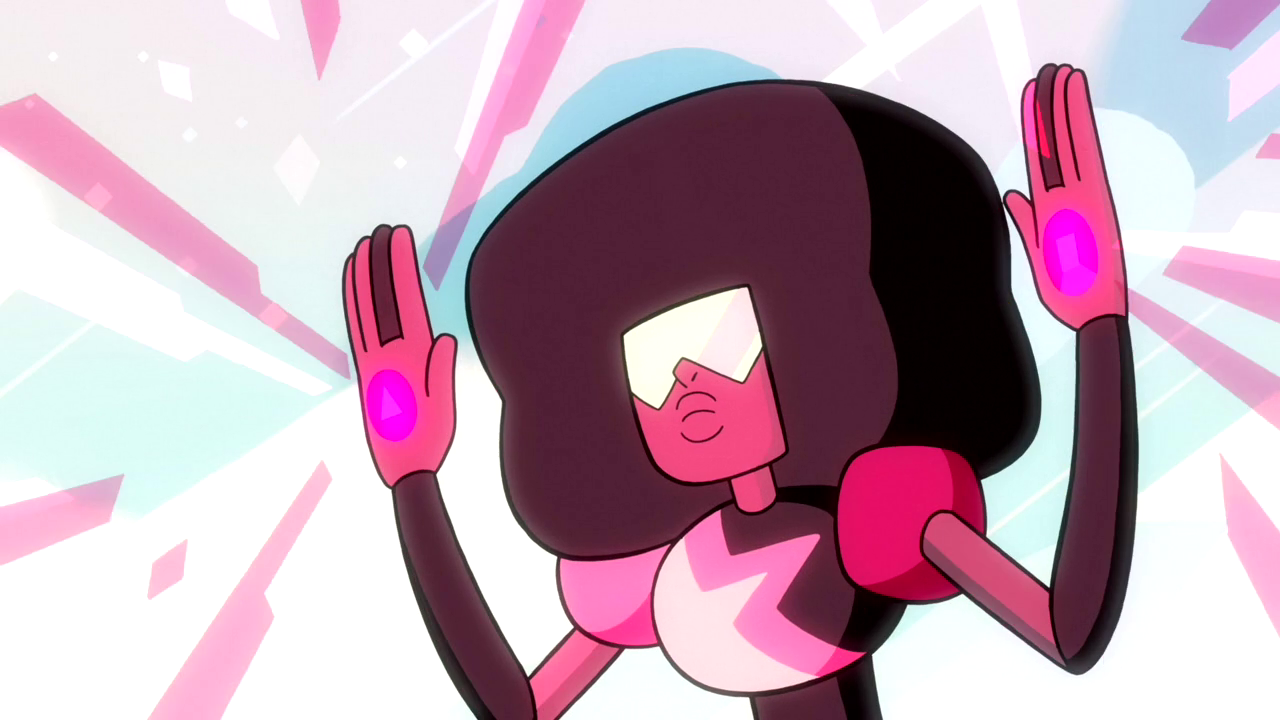
The show has also offered the world three awesome superheroines: the willowy, Diane Chambers-like Pearl, the brash, Cree Summer-sounding Amethyst and my personal favorite, Garnet, a towering, laconic woman whose stylish glasses hide a third eye, because she’s that rad. She comes off like a cross between Storm and Cyclops — always collected, always with a plan… the glasses, I guess — and I can’t think of another kids’ show that features a character quite like her.

Garnet isn’t big on emoting, especially in comparison to her teammates. This suits her character just fine, but I initially wondered if this arose from the fact that the woman who voices her hasn’t acted all that much. She’s Estelle, who came to fame alongside those other mononymic British singers Adele and Duffy. I didn’t think I was familiar with Estelle’s non-superhero work until I realized she sang “American Boy,” this flirty, upbeat track that seems at odds with Garnet’s stoic personality. I wouldn’t have guessed that the same person could sing that song and play Garnet, but hey — maybe Estelle has acting range after all.

Here’s the weird thing: The version of “American Boy” I have came to me via a mix CD exchange back in 2008, and it seems different from all the versions I’m seeing on iITunes, on YouTube and elsewhere online. The version that became popular features Kanye West rapping alongside Estelle. My version doesn’t. I prefer it. (If there’s an option for a Kanye-less version of anything, I prefer it, generally.) I don’t know if my version is an original mix or retread focusing just on Estelle’s vocals. But because I just couldn’t find it all that easily online, here’s Estelle’s “American Boy,” minus Kanye.


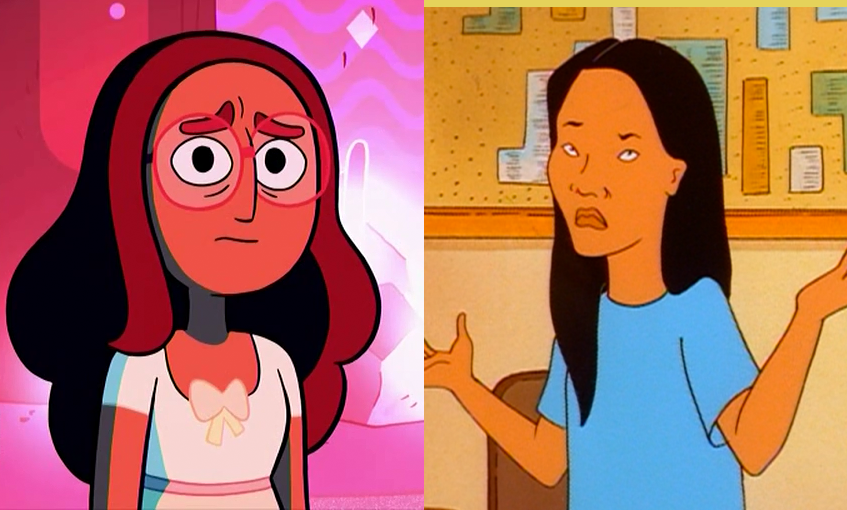
One quick Steven Universe-related postscript: On the show, Steven is a pudgy, irrepressibly imaginative boy who maybe-sorta has a love interest in Connie Maheswaran, a bookish girl-next-door type with overprotective parents. I’d like to think her name is an homage to Connie Souphanousinphone from King of the Hill, the bookish girl-next-door type who also had overprotective parents and who dated Bobby, another pudgy, irrepressibly imaginative boy.


Anyone else see this? I will maybe inquire further to find out if it’s actually a thing.

Monday, November 3, 2014

That One Bizarrely Twin Peaks-y Episode of Darkwing Duck

Seeing how last month was bookended by posts about the second coming of Twin Peaks and unusually scary sitcom episodes, this seems like a logical place to kick off November.


Nearly a year after the last episode of Twin Peaks aired, the Disney cartoon Darkwing Duck aired an episode inspired by the David Lynch series. Given how cartoon production works, I’d imagine that this episode “Twin Beaks” was conceived at the height of Twin Peaks mania — and a point when the Darkwing showrunners figured Twin Peaks was a shoe-in for a third season. As it stood in 1992, however, “Twin Beaks” arrived a little late to ride the Twin Peaks bandwagon, as the wagon’s wheels had fallen off long beforehand.

Its lateness probably didn’t make much of a difference to its target audience — kids like me, just ten years old at the time — didn’t get the references, and just reacted with, “Oh, okay, This episode is a little weird. Yay, cartoons!” I had only the scantest awareness of Twin Peaks at the time, as I was forbidden from watching it. All I ever saw was the bits advertised on ABC. In fact, I didn’t actually watch Twin Peaks until college, after the religious experience of watching Mulholland Drive in the theater. When I finally did, I thought about this Darkwing Duck episode and how all of its weirdness made sense — or as much sense as you can make when you’re springboarding off David Lynch.

Today, I’m impressed this episode got made. It’s defiantly weird, even for a cartoon like Darkwing Duck, which skewed edgier than most Disney fare, and there’s something noble in doing a genre parody that will fly over the heads of most of the people who watch it. In case you have never seen it — or in case you just remembered it as that inexplicable Darkwing Duck with the strummy guitar for no apparent reason — I’ve made a condensed version of it, with all the Twin Peaks-y moments and a rough semblance of the plot. It’s like Cliffs Notes — for nostalgia! Because this is how we live now!


Highlights and notes after the jump.

A primer in case Darkwing Duck was never part of your particular Disney afternoon: It’s a spinoff of DuckTales that has Scrooge’s pilot, Launchpad McQuack, leaving Duckberg for St. Canard, where he plays sidekick to the Batman-like resident superhero. The plant-duck-thing you see at the beginning of the clip is Dr. Bushroot, who’s basically the Poison Ivy of the Darkwing Duck universe.

The first especially Twin Peaks moment occurs just after the one-minute mark. That background music doesn’t occur anywhere else in the series aside from this episode, unless I’m mistaken. It sounds just like the darker parts of “Laura’s Theme.” Around the two-minute mark, you hear even more riffs on Angelo Badalamenti’s music, and the “Twin Beaks” theme is close enough to “Falling” that it puts me in the very same relaxed mindset, knock-off status notwithstanding.

I don’t think the character name Trudi is coincidental: Though Norma owns the diner, there’s recurring Twin Peaks character named Trudy who works as a waitress at the Great Northern. Giving Trudi Nadine’s eyepatch is actually a fitting way to further tie Norma and Nadine together, really.

Around the 2:40 mark, you see Dr. Bushroot’s dried up body wrapped in plastic and tossed into the river. Even understanding the source material, I have to admit that this is an oddly dark moment for a Disney cartoon. Would you have expected that a series that exists in the DuckTales universe would so directly address the topic of death? And corpses?

The musical effect that accompanies Bushroot’s corpse falling into the river is oddly lighthearted and whimsical. This may have been intentional.


I like how Darkwing ultimately offers a more concrete explanation for a talking log than Twin Peaks ever actually did.

I also didn’t realize while watching as a kid that Darkwing himself is kind of jerk to his friends. He just has the crankiest responses.

Two thirds of the way through, the episode takes a sharp turn into B-movie sci-fi, Invasion of the Body Snatchers-style, which isn’t any weirder than anything else that happens in the story, really, and which may have resulted from the writers didn’t have an ending to Twin Peaks that they could trace their way to. (Really, we still don’t, all these years later.) I suppose it does tie in well enough with Twin Peaks’ theme of doubling. Darkwing’s dream sequence isn’t particularly David Lynch-inspired, but it is weird as hell. I say that in a good way: It’s always good to see unbridled lunacy in something that kids watch.

And then in the end, the warning “The cows are not what they seem” is explained away by having the Earth’s saviors be alien cows, who arrive and blast in the cabbage clone menace with lasers. Maybe the weirdest thing of all in this episode would have to be the revelation that the spacecows come from “the planet Larson on the far side of the galaxy,” which is nod to Gary Larson’s cow-populated Far Side comic that gets wedged into the episode despite the lack of any tie to Twin Peaks. Again, I’m not complaining: I actually got this reference when the episode first aired, and it made me feel smart.

According to IMDb, Ruth Buzzi is the voice of the spacecow. (And yes, the voice of Gosalyn is clearly the same person who provided the voice of the original Babe.)

This episode isn’t the only Twin Peaks parody to be called “Twin Beaks.” That may not be all that surprising, considering that your options are limited when making a kid-friendly riff on a supernatural soap opera about a dead homecoming queen. A February 26, 1991, episode of Sesame Street features a “Monsterpiece Theater” segment that is also titled “Twin Beaks.”


I’m pretty sure those dual-beaked bird puppets would have given me nightmares if I’d seen them as a kid.

And in case my abbreviated Twin Peaks wasn’t enough for you, you can watch the full clip below.


For now, anyway.

Weird TV, previously:

Monday, June 9, 2014

Super Milli Vanilli Bros.

You think back on the weird little pop culture nothings you experienced as a kid, and you sometimes wonder, “Did that actually happen the way I’m remembering it? Or did my feeble childhood brain and the passage of time distort all that into something far weirder than it actually was?” With me, it’s usually the latter. In this one instance, it’s not.

princess peach milli vanilli

Yes, the Mario Bros. did once meet Milli Vanilli.

I’m not going to say that the Super Mario Bros. Super Show and its various sequel series don’t hold up all these years later, but that’s mostly because I never went back and invested much time in them since they were first on. I did, however, just now rewatch the October 27, 1990, episode “Kootie Pie Rocks” just for the sheer what-the-fuck-in-a-time-capsule factor. It’s just kind of baffling to think that yes, this episode existed.

Here’s the plot:

The princess — and remember, she’s Princess Toadstool at this point, and not Princess Peach — is stoked to visit New York City in “the real world” to watch a concert by her favorite music group, Milli Vanilli. (How Top 40 reaches all the way to the Mushroom Kingdom, we’ll never know.) Here the duo is dancing, per the magic of DIC animation:

milli vanilli super mario bros.

Bowser’s terrible daughter, Kootie Pie, gets word of this and throws a fit. (Another name note: It’s Wendy, but it’s not. For reasons I’ve never had explained to me, the DIC Mario cartoons renamed Bowser’s kids instead of using the rock star-inspired names they have in the games.) To appease Kootie Pie, Bowser beams Milli Vanilli into his airship mid-concert — “Koopnapped,” per Toadstool, even if that doesn’t make sense.

At the Koopa Kastle, Kootie Pie uses her magic wand to turn Rob and Fab into accountants — you know, because then they would be unable to sing their hit songs — but Mario devises a plan to free them: Sneak in dressed as a racially insensitive back-up band and help Milli Vanilli perform. Kootie doesn’t question why a back-up band would inexplicably show up, so she transforms Rob and Fab back and then proceeds to be too stupid to realize that Mario and Luigi’s instrumentation sucks, with the awkward implication being that Milli Vanilli performs poorly when live and unproduced. The group escapes back to New York City. Rob and Fab dedicate “Girl, You Know It’s True” to the princess, which, when you think about the implications, is the greatest slight of all.

Miscellaneous notes:

Kootie Pie sounds like an evil Cyndi Lauper. And yeah, she’s awful.


She also puts on a mini-skirt to go the concert instead of wearing her usual outfit of high heels, Marge Simpson pearls and no clothes whatsoever. 


This is what Milli Vanilli fans looked like, per The Adventures of Super Mario Bros. 3:


This frame is also awkward:


For what it’s worth, DIC actually acquired the rights to “Blame It on the Rain,” and “Milli Vanilli” actually “sing” it in the episode, though of course it’s weird to think about now how Fab Morvan and Rob Pilatus are playing cartoon versions of themselves lip syncing to someone else’s recording of the song. This episode aired just twenty days before the band’s Grammy was revoked.

Rob Pilatus was found dead of a suspected drug and alcohol overdose on April 2, 1998. As long as we’re talking about weird musical connections to make with Super Mario Bros., it’s worth noting that Wendy O. Williams, the Plasmatics lead singer for whom Bowser’s daughter takes her name, committed suicide just four days later.

Since the last time I wrote about my theory about the Koopalings’ names, it turns out that Larry Koopa (Cheatsy in the cartoons) wasn’t named after Larry King but instead after U2 drummer Larry Mullins Jr. I’d guessed Larry King just because Morton Koopa Jr. was named after Morton Downey Jr., the talk show host who had previously worked as a singer-songwriter, and I guessed that if one Koopaling could have a talk show host namesake, so could another. Nope!

The background paintings are actually decent:


If you want to watch the whole episode, Youtube user Unknown Archive has posted it in full on YouTube, in good quality and with a few bits that have been otherwise lost as a result of the fact that all subsequent airings of the episode replace Milli Vanilli’s music with generic filler. The fact that someone bothered to go back in and restore the original audio and deleted scenes for such a shitty moment for television is kind of awesome.


And that is all. Go outside maybe!


Super Mario pop cultural connections, previously: 

Tuesday, February 18, 2014

Athena by Way of Kelly Kapowski

Apologies if the rest of the video game-savvy world already jumped on this one decades ago, but I just learned there’s a new bit of relevance for Captain N: The Game Master. And I’m always happy to bring up Captain N.

A two-sentence primer, in case your childhood Saturday mornings played out differently than mine did: Captain N was a cartoon series that sought to blend the universes of various NES-era video games by uniting them though a “real world” protagonist: Kevin Keene, a San Fernando Valley teen who gets beamed into a video game universe where he gets to interact with characters from the Mega Man, Kid Icarus and Castlevania franchises. Kevin, however, was an original creation, as was the sole female character: Princess Lana, the regent of Videoland.

Here’s the intro sequence, in case you’re confused (and you probably should be):


It’s Princess Lana that I’m interested in. Even though I’ve loved the Kid Icarus series since I was wee, I only recently realized how much Lana looks like the Kid Icarus damsel in distress, a green-haired goddess called Palutena, her name apparently a corruption of Parthenos, one of the appellations for Athena. I mention all this just because it’s weird to think of the princess from a video game-themed Saturday morning cartoon show in the context of the virgin war goddess for whom the Parthenon was built.

Check them out, side by side: Lana, old school Palu and Palu as she looks in the recent, revamped Kid Icarus:


Depsite the premise, Captain N actually pulled from a narrow selection video game universe. Princess Zelda was appearing on the Zelda cartoon, and Princess Toadstool on the Super Mario Bros. Super Show, and neither Castlevania nor Mega Man had leading ladies at the time. That leaves Kid Icarus, the only game with an all-powerful, female monarch on the throne. I mean, look at them. Doesn’t Princess Lana look like a ’90s-tastic riff on this Greek goddess character? The gaming website Flying Omelette even goes as far to point out that “[Lana] looks more like Palutena than Mega Man looked like Mega Man or Simon Belmont looked like Simon Belmont.” Surely, they’re also close enough that one could be the inspiration for the other, right?

Right, it turns out.

I did some poking around and asked the people who designed the Captain N characters. The show originated with the Australian artist Fil Barlow. His fantastic concept art actually had the newspaper deliverer from Paperboy as the lead, among other differences. Subsequent characters, Barlow explained to me, were designed by other artists. He suggested I ask lead character designer Marcello Vignali about the Palutena-Lana connection. Vignali’s response to my email:
When we were working on Captain N, the Nintendo corporation gave us a bunch of 8-bit images of their characters. But, in some other cases they sent us some drawings or packaging art. I can't remember for sure if that was the case with Palutena, but from the look of her design that certainly was where her design came from. The similarity is too close to be a coincidence. Kudos to you!
Not quite a 100-percent sure confirmation, but I’ll take it. And I’m happy to learn that I’m not just seeing things. There’s more relevance for this right now than there might be otherwise, because there’s a chance that Palutena might be playable in the new Smash Bros. game. It’s an unfounded rumor, if a readily believable one, and I’d like to think that it, if true, means Princess Lana isn’t just trapped in memories of the messy pop culture of the early ’90s. Some form of her is still hovering about, acting all empowered. One more note from Mr. Vignali, about the Captain N version of Metroid big bad Mother Brain:
A funny story. When we were designing Mother Brain, the Nintendo corporation didn't give us any art for it. Instead, they gave us a video game. Unfortunately, none of us were good enough to get to the Mother Brain level -- and the DIC animation studio didn't want to pay us artists to sit around playing a video game. So, one of the secretaries brought in her son and he got us to the Mother Brain level. We grabbed some screen shots and were able to complete the design.
Ha. In the end, Mother Brain ended up a creature like none other on Saturday morning TV, even being voiced by Levi Stubbs, the lead singer for The Four Tops and also the voice of Audrey II in Little Shop of Horrors. Mother Brain, by the way, was also announced as appearing in the new Smash Bros. game, and I feel unusually catered to — like someone is using my memories of back then to help determine what’s coming back now.

Cartoons, previously:

Sunday, January 26, 2014

The Core of the Powerpuff Girls

With The Powerpuff Girls being in the spotlight once again this past week — for good and for bad — it seems like as good a time as any to point out a little linguistic oddity specific to the show.


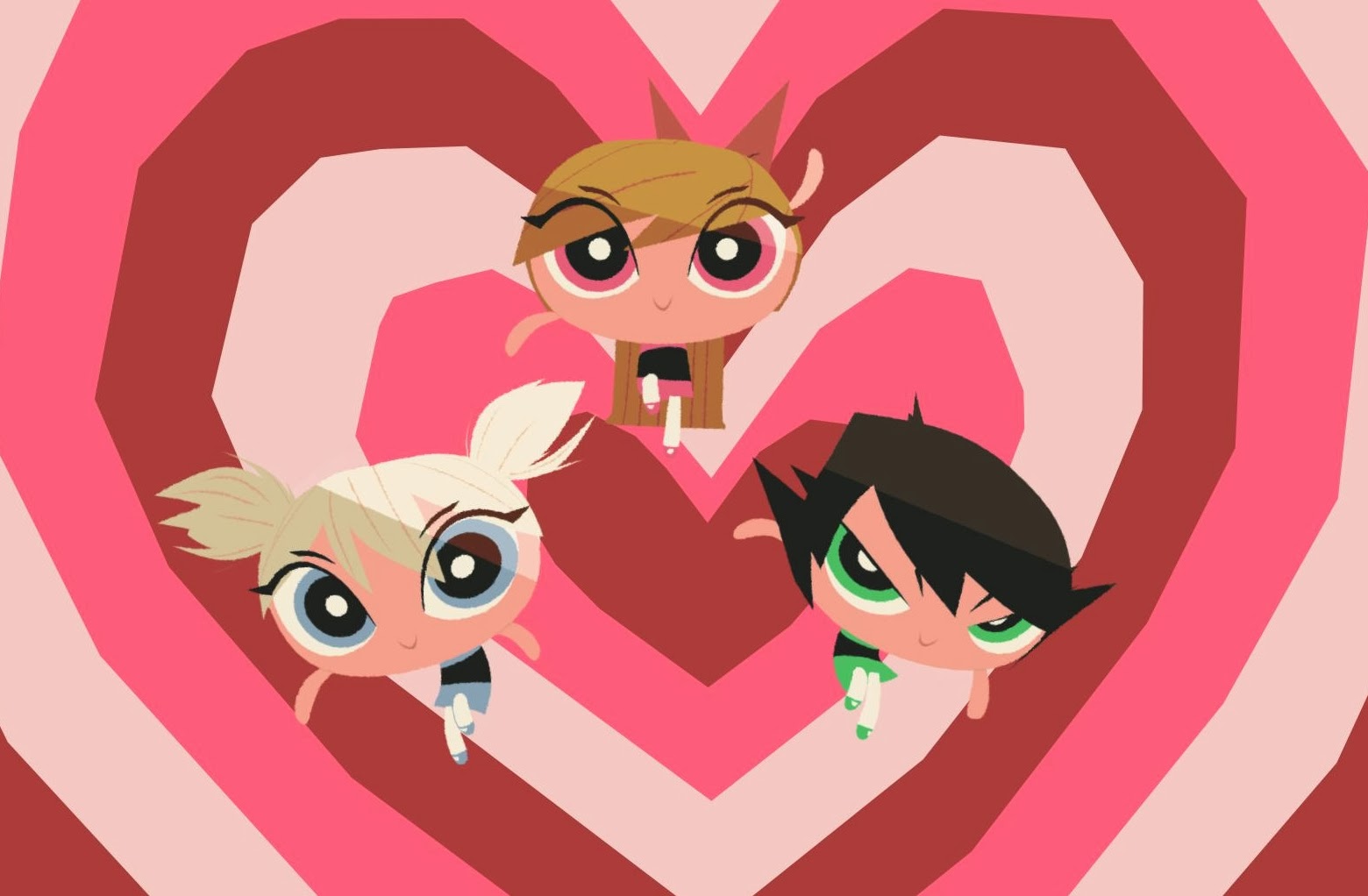
If I asked you what the protagonists’ names had in common, you’d probably point out that they all start with “B” — Blossom, Bubbles and Buttercup. And if I asked you what else these names had in common, you’d probably point out that the three names all happen to be common nouns — blossoms and bubbles and buttercups can all be objects separately from being these characters. But if I asked you what third quality all three of these names shared, I’d imagine not everyone would realize that all three also have internal doubled consonants — the double “s” in “Blossom,” the double “b” in “Bubbles” and finally the double “t” in “Buttercup.” It’s kind of hard to spot, since we tend to pay more attention to the beginning and endings of words than to whatever is in the middle, but here’s why I think this was something the show’s creators realized: the two candidates we have for Powerpuff Girl No. 4 have double consonants too.

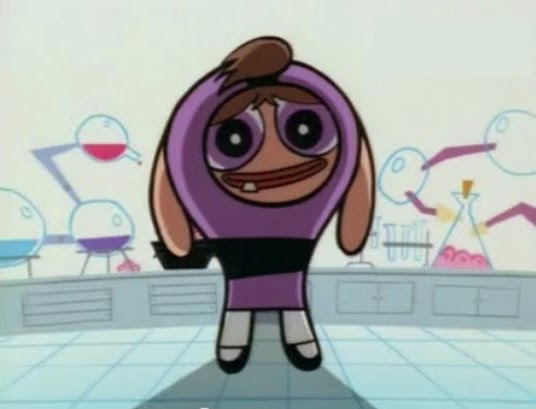
There’s an episode where the girls attempt to create a fourth sister using the same scientific process that created them, only they do it wrong, and the resulting girl is… different. She gets named “Bunny.” Later, she explodes.


See, poor Bunny is missing out on the “everything nice” part of the equation.

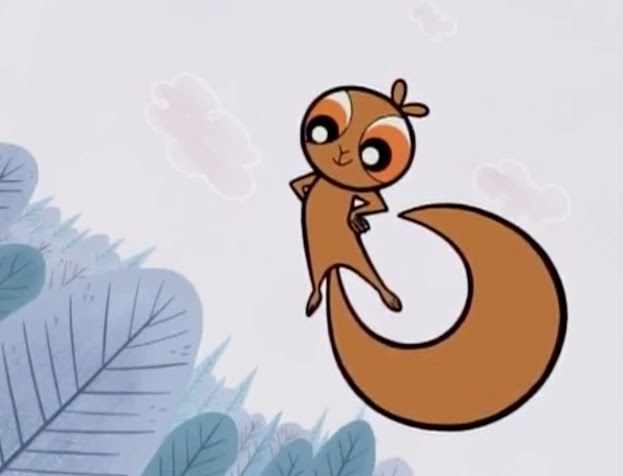
And there’s an episode where the girls get a Chemical X-empowered pet squirrel. They name her “Bullet.”


So that’s it. There’s no great meaning here, just a hard-to-spot trend and a reason to remind people that The Powerpuff Girls existed and we should be happy that it was as smart as it was. Double internal consonants — who even thinks of that?

Tuesday, January 21, 2014

Wicked Women of Literature / Heroines of Saturday Morning

We’ll get to this lady in a second, after a brief but related detour through academia. Promise.


If there’s one thing that I remember about The Faerie Queene, it’s the length. This sixteenth-century epic happens to be one of the longest poems in the English language. That’s not exactly an achievement, in the way that growing the world’s longest fingernails is a thing, yeah, in one sense, but on a more practical level, no one wants to see that. Cut your fingernails, you weirdo.

If there’s a second thing I remember about The Faerie Queene when my college literature class slogged through it, it would be my surprise at how soul-crushingly boring someone could make a sprawling epic about knights and maidens and sorceresses and dragons. You’d think it would rock. It emphatically does not. Edmund Spenser wrote the whole thing as a mash note to both Queen Elizabeth — whose stand-in in the poem is the title character, Queen Gloriana — as well as to Protestantism, and there’s something mean and deceitful in using adventure stories as a ruse for teaching Christian morality. (“Hey, wait a minute! This apparently fun thing is actually about Jesus! Everyone, they’re trying to teach us religion!”) I remember my eyes crossing as a I tried to differentiate one allegorical character from another — at one point, you meet three knights named Sansfoy, Sansjoy and Sansloy, or Faithless, Joyless and Lawless — and too many of the women have cutesy-cute, on-the-button-nose names that all smooshed into a pink blob in my brain — among them, Fidessa, Fraelissa, Duessa, Belphoebe, Amoretta, Florimell, Hellenore, Mirabella, Abessa and Pastorella.

And if there’s a third thing that I take away from The Faerie Queene, it’s the essay I had to write for the in-class midterm. As an English major, I found these offensive even in classes where I gave a damn about the reading material. We should have been asked to go home and slave over a ten- or twenty-page essay, not scrawl down ideas in a blue book without time to polish the writing in the way we’ve been taught to do. Regardless, I picked the essay topic that had us write on female villains in The Faerie Queene. I jotted down some ideas about how Spenser used the character Malecasta (literally “badly chaste,” figuratively “skank box”), and then I handed in the bluebook, happy to end my interactions with stupid Edmund Spenser and his adventures with the Protestant Jesus.

When I got the graded blue book back in class, I saw that I got partial credit on the essay. I went over my T.A.’s notes — a checkmark here, a “good” there — and then finally a sentence written at the bottom that read more or less like this: “Good points, well-reasoned, but you really needed to give the character’s proper name. I think you meant MALECASTA but you put CASTASPELLA. She’s from She-Ra.”

The T.A. was right. I had written “Castaspella” in every spot where I had meant to write “Malecasta.” I was pissed.

I think I threw that blue book away immediately after, but now I wish I’d framed it, as a testament to the fact that Edmund Spenser may have wasted weeks of my time, but he still couldn’t make a dent in what childhood cartoons had done to my brain.

That’s… a victory, right?


“Prisoners of Beast Island” > The Faerie Queene. Filmation > Edmund Spenser. There, I said it.

Saturday, January 18, 2014

Polly Lou Livingston: Sexy Elephant

If you don’t watch Adventure Time, you most likely have no interest in Polly Lou Livingston. Really, even if you do watch Adventure Time, you still might not know who she is. Let me tell you: She voices Tree Trunks, the miniature green elephant who bakes pies and who somehow gets to be the most sexually mature character on the show.


This may sound strange, me reading sexuality into a cartoon character on a show for kids, but trust me. On a show on which so many episodes focus on love of one sort or another, it’s notable how Tree Trunks has longings that burble forth in the form of depth-charge flirtations and a twangy, confident sensuality that you don’t normally associate with cartoon elephants. (Yes, she’s more grown-up about it than LSP, even if LSP talks about it more.) The most recent Adventure Time saw her marrying Mr. Pig, so perhaps she’ll burble less now, but I will guess that she won’t lose that sensuality. No matter what plotlines come Tree Trunks’ way, she’ll still be voiced by Polly Lou Livingston, the source of all that oomph. Her performance is so wonderfully unusual that each time I watch a Tree Trunks episode, I remind myself to find out exactly who this beguiling elephant is in real life.

I finally did.

Adventure Time was her voice acting debut, and she got the role as a result of being a friend of creator Pendleton Ward’s mother. Few pictures of her exist online, but a 2009 column on her in the San Antonio Current paints a more vivid portrait of her than any photos could. Key phrases:
  • “Somewhere between a hinge in quest of lubricant and Blanche Dubois as channeled by Olive Oyl, there’s no other tonality quite like it.”
  • “a genuine Lone Star Auntie Mame (or perhaps the love child of Eudora Welty and George Burns).”
  • “Chardonnay held aloft, massive jawbreaker necklace firmly secured, red sneakers propelling her five-foot-two frame from air kiss to air kiss — she’s her own Andy Warhol ‘Happening.’ As Polly Lou herself puts it, ‘Darlin’, if you’re not having any fun with fashion you’re missing the en-tiiire point.’”
Still, her fashion sense is one that demands visual documentation, so here is every photo I could find:

via
via
via
via
Of course, it’s her voice that makes me love her — and Tree Trunks. If you haven’t had the pleasure, please allow me. For example, here is Tree Trunks maintaining her genteel manners in the face of living wall of flesh.


And here is Tree Trunks in that same episode, proclaiming herself “the sexiest adventurer.”


Notably that episode ends in a way that underscores the sexier aspects of the character: her biting a crystal apple framed by branches that look peculiarly like labia. (And no, thinly veiled sexual metaphors are not exactly rare on Adventure Time.)


I mean, she is famous for her pie, first and foremost. In spite of or maybe because of that, a lot of her plots concern romance. She got a love ballad to sing with Mr. Pig, and Adventure Time chose to play it straight.


That same San Antonio Current column offers three sentences about Polly Lou Livingston’s love life: “I met my husband, Bobby Livingston, on a blind date in Rockport when I was home from Stephens College one summer. He was a Corpus Christi boy, recently out of the Air Force. We both transferred to the University of Texas together and were married for 49 years until his death in 2000.”

I posted the “Dream of Love” clip because it’s the first thing I thought of when I read about her husband having died. Even though she was voicing a cartoon elephant, I suppose Polly Lou knew what she was singing about.

Tuesday, November 12, 2013

Lena (the) Hyena

Like most children of the 80s, I was emotionally scarred by Who Framed Roger Rabbit?. And yeah, I don’t know what the creators were thinking with the whole Judge Doom reveal at the end either, aside from possibly fulfilling their part of some sort of dark pact with the American nightlight industry. It truly was a messed-up thing to unleash upon our young psyches. But as horrifying as Judge Doom was, it’s not the scene that haunted me. Now this may be one of those moments where I’m revealing more than I realize, but the scene that actually gave me nightmares starred a different scary toon: Lena Hyena.


If you don’t remember, Lena shows up in a scene in which Eddie is trekking through Toon Town in search of Jessica Rabbit. Eddie thinks he’s found her, but the sexy silhouette proves misleading: He’s actually just found Lena, a hag-faced anti-Jessica who reacts to Eddie’s presence with an unbridled lady lust not often seen in children’s cartoons. Eddie, of course, wants no part of her — really, no part — but Lena pursues him anyway. Something about her lusty, pop-eyed wild takes bothered me to the point that I had dreams about her chasing me down, making kissy-faces and showing me her weird lady underwear. Ahem.

Here’s the “A MAAAAAN?!” scene in case you don’t remember:


As with much of Who Framed Roger Rabbit?, this scene is actually rooted in cartoon history, or at least thereabouts. A similarly named character appeared in the Al Capp comic strip Li’L Abner. (And in case you don’t follow me on my various social media, the title character is far hunkier and much less Baby Huey-esque than his name might imply. Just FYI.) In Abner, Lena was purportedly the ugliest woman in the world — even fouler than existing hag characters such as the witchy Nightmare Alice and the undateable Sadie Hawkins, the latter of whom the dance is named. From Wikipedia’s description:
Lena was so ugly that anyone who saw her was immediately driven mad. No sane person, therefore, could tell you what she looked like. After weeks of teasing his readers by hiding Lena's face behind “censored” stickers and strategically placed dialogue balloons, Capp invited fans to draw Lena in a famous nationwide contest in 1946.
That contest — which elicited over 500,000 entries and which was judged by a Justice League of beauty experts consisting of Frank Sinatra, Boris Karloff and Salvador Dali — was won by Basil Wolverton, whose take on Lena was truly, mind-bendingly gnarly.


If that image rings a bell — and it did with me, despite the fact that I didn’t grow up reading Li’l Abner — it’s probably because Wolverton’s uniquely awful take on ugly popped up in old MAD magazines, reprints of which I did read during my youth. Examples:

via
via 
via
via
via
 And here’s a detailed look at that Lena sketch:

via
Comparatively, the Roger Rabbit take on Lena doesn’t look half bad. I can only imagine how scarred I’d have been had Lena Hyena been an animated version of Wolverton’s gross-out horrors.

Pop culture minutiae, previously:

Monday, November 4, 2013

Steven Universe Is Beautiful, and Here Are 40 Reasons Why

I watched the first episode of the new Cartoon Network series Steven Universe, which premieres tonight at 8, and I’m happy to report that I loved it. Steven Universe could become a big deal for Cartoon Network. I hope it does, at least. It looks beautiful. It reminded me of Ponyo in the way it smooshes goofy and serious together onto a colorful landscape, and the character design suggests a world that Osamu Tezuka might have dreamed up — lanky Pearl in particular.

In case you need convincing about how great Steven Universe looks, here are 40 stills from the pilot that show off the majesty and hint at what it may be capable of.

Steven Universe pilot screengrabs stills


Also? Happy to report that I approve of Estelle as a voice actress. Singers do not always make for good voice actors, but Estelle does as Garnet. Also also?I have investigated and discovered that “American Boy” holds up pretty well. Your day will perhaps be better if you give the original take on it a spin right now.