Pages

Showing posts with label new zealand. Show all posts

Monday, December 10, 2012

Things I Did Not Purchase While in New Zealand

(A round-up.)


Bovil, because I presumed it tasted about as good as it sounds.


Ham-and-tongue-flavored spread, because not only would ham and non-animal-specified tongue make for a nasty flavor combination but also this isn’t even ham and tongue. This is just the flavor of ham and tongue. So what is the spread, exactly? That’s a great fucking question.


New Zealand’s weirdly personalized Coke, which encouraged me to drink with a bunch of people I don’t know. The biggest strike, however? No “Share a Coke with Drew.” Sure, there’s “Share a Coke with Meena” — Meena! — but not Drew.


“Come on, kids — don’t you want to eat Santa’s legs?”


No joke here. I just don’t understand the tagline. Is “See how it runs” supposed to underscore that the salt pours smoothly out of the container? Is that Cerebos table salt’s greatest virtue — pourability? And is the kid pouring salt on a frog?


“Come on, kids — suck on something gay!”


If I were an inanimate human-shaped object and not a real human, I’d look less self-satisfied.


Having visited New Zealand since childhood, I’m heartened to see that it’s developed a real national culture to rival that of the other colonies.


I suppose the existence of a New Zealand pig-hunting magazine called More-Pork is weird enough, but it gets even weirder when you consider that there’s a native New Zealand owl called the morepork. So it’s a pig-hunting magazine whose name is a pun on a native animal that is not a pig. Just baffling, really.


What I hope happened is that this dog belongs to the owner of the company, and this is the best picture they could get, because the owner has not realized that his beloved canine is a criminally insane monster who only wants to sink his teeth into soft child-meat. Because if that’s not the case, then it’s just unknowable how anyone would have okayed this photo for the box design.

I pray he does not haunt your dreams as he does mine.

Monday, December 3, 2012

A Family Plot

Had you told me the weekend before Thanksgiving that I’d be soon flying to New Zealand once again, I would have told you that nothing could convince me to make the journey on such short notice. And then had you told me that I’d be enduring the long, sleepless flight over and back within the span of a single week, I’d laugh again. However, when you’re told that your grandmother has died, you act accordingly.


For the most part, I’ll skip the trite observations about the impossibility of death — the cognitive disconnect between the box at the funeral and the tall, bunheaded, rugby-loving woman who used to come visit her American grandchildren. It does cross your mind, though, doesn’t it? — where there was once a person, there’s now just a body, suddenly and simply, and you just want the person to jump back into this newly empty vessel. Why can’t it be so simple? Just. go. back. in. None of that occurred to me as I carried the coffin in — bore the pall, I guess you could say, even though no one ever states it that way — but that maybe resulted from the fact that we walked in, the six of us and Granny-in-a-box, to a reworking of “Don’t Dream It’s Over”, and no, I’m not kidding, and yes, that’s the most ridiculously New Zealand thing to happen ever. No, it was strangest after the service, when the coffin just sat in the back of a car where anyone who wanted to could drop flower petals on it. People talked. I couldn’t really, not while knowing that my grandmother was in a wooden box in the sun on an unseasonably warm New Zealand spring day. Whenever I thought about it, my head swam in a manner that I’ve only experienced once before: in a medical lab with a partially dissected cadaver. I suspect that I’m keenly allergic to death.

The photo I’ve posted above shows my dad’s family’s cemetery plot — a single rectangular acre surrounded on each side by paddock and currently containing the remains of only about ten of my family members. It’s serene, but only if you can accept mourning your loved ones in the presence of cows. Really, the family plot represents an older, less settled New Zealand, when private cemeteries made practical sense. Nonetheless, it’s where members of my family can choose to be buried today. And nonetheless that, it’s not where my grandmother chose to be: She opted instead to have her ashes scattered around the house where she raised her children. And while I can understand the significance of this location to her, I can’t yet understand why she’d decide against giving her descendants a permanent spot to mourn her — a site like a gravestone that would be forever dedicated to her memory.

Or am I just thinking about death in a more old-fashioned way than my grandmother did?

No one talked about this, before or after the service, though I did answer more than once about whether I participated in team sports and where Californians put their sheep.

Sunday, December 2, 2012

Hand-Washing — You’re Doing It Wrong

At least according to the more fastidious minds of New Zealand, who think that hand-washing should involve more steps than you have fingers on your hand.


Click on the image to enlarge, because it’s really worth your time to determine if you’ve been cleaning your dorsums properly. Have you?

Sunday, November 25, 2012

Where the Birds Sing a Different Song

Before I even woke up, my brain registered trouble. My dream shifted from a simple mistaken identity drama to something more surreal when the audio gave way to a soundtrack of unfamiliar music. Literally everything in the dream stopped so I could give full attention to these squeaks and beeps and unnatural flourishes. Then the dream ended, but before I could open my eyes and realize where I had been sleeping, I knew I was far from home: Awake but shut-eyed, I could still hear that music. It got into my dream. It was really happening. And it was the noise of birds we don't have in California.

It's been a long time since I've been far enough away from home that the birds sang a different song. I'd forgotten how strange it is to wake up and know that you're in the wrong place even before you figure out exactly where you are. I hadn't even realized that Los Angeles has birds that sing loud enough to overpower the noise of traffic, but they do. I suppose I missed them, just for a second.

Thursday, March 3, 2011

Suck It, Ireland!

Irish Spring-brand soap, you are significantly less special, as you are no longer the only hygienic product named for an English-speaking, non-American nation.


That’s right, you can now Febreeze your apartment into smelling like New Zealand, which I assume to be a combination of sheep feces, Hobbit feet and shellfish. Personally, I should blame Peter Jackson for this, but I’m instead going to blame dumb Americans who like to think that New Zealand is some kind of tropical paradise populated by white people.

Tuesday, August 3, 2010

Hooters Say: You’re Not Porking Enough!

At best, it’s a request for more pig-meat. At worst, it’s something far less innocent. In either case, it’s the word of the week.
morepork (pronounced… um… like it’s spelled) — noun: an owl of the genus Ninox inhabiting New Zealand and Australia.
I offered the pronunciation the way I did not to crack wise — or “be cheeky,” as the moreporks might say — but to note that the pronunciation of the word changes quite a bit depending on whether you’re a North American English-speaker or not. In general, I think you’re meant to pronounce the word as you would the words more and pork. However, because Britons, Aussies, Kiwis and others pronounce the letter “R” differently than I do, the American pronunciation of the word loses quite a bit.

(image credits: stuff.co.nz, tiritiri matangi island, churchmousenz)

As you can see, the morepork has the unfortunate quality of always looking totally freaked out.

Originally, morepork and other, less funny names for this owl such as mopoke and boobook began as onomatopoetic representations of its two-syllable hoot. (That is, the owls may not be what they seem, but they’re actively telling you what they are. The tendency to announce themselves may be characteristic of New Zealand birds, as the kiwi bird’s name is also onomatopoetic.) You can tell by the latter two names that you’re not meant to hear an “R” in morepork, but I’m actually not sure how an American should approach this one. With an affected British “R”? Or as he or she normally would, even though doing so would deprive the word of its reason for existing?

This simple matter could easily be extrapolated into a whole book about interplay and imitation between Americans and Britons. We’ll call it The Morepork in the Mouth of the American. And it will surely mention the Winnie the Pooh character Eeyore, who, as I’ve noted earlier, suffers a similar fate. His name is also onomatopoetic — specifically of the noise a donkey makes. But you wouldn’t know it to hear an American pronounce Eeyore’s name. Coming from someone in A.A. Milne’s homeland, however, Eeyore sounds a lot like the American way of referring to a donkey braying, hee-haw. Plus “R,” minus “H.” Transcontinental English mathematics.

According to the site Curious Words and Phrases, though the word morepork appears in Terry Pratchett’s Discworld novels in the name of the city Ankh-Morepork, Pratchett said the resemblance is coincidental, though the owl may have been retroactively incorporated into the insignia for the city. Curious Words and Phrases also notes that morepork was used in the The Harp in the South, a novel by New Zealand author Ruth Park:
Not black,” cried Hughie. “I won't have my wife looking like a morepork’s widow.” This pleased him, and he lay there chuckling for some minutes, repeating “morepork’s widow.”
But even being half-New Zealander, I don’t have a clue what morepork’s widow could mean. Ruth Park, I cannot fail to note, gained some fame later for the popular Muddle-Headed Wombat series of books. Oh, down under people — why must you be so down under?

Finally, it’s worth mentioning that the owl saddled with this name is also known to some by yet other names, including ruru, spotted owl, marbled owl and tawny frogmouth. That last one is erroneous because the tawny frogmouth is a separate species. And that’s mention enough for me to post a rather endearing photo of a frogmouth doing what it does best: making a goofy face.


For a bird that most cultures associate with wisdom, owls spend a lot of time looking all stupid.

Previous strange and wonderful words:
Word nerd? Subscribe to Back of the Cereal Box’s word-related posts by clicking here.

Thursday, February 11, 2010

Attack of the Sheepotaur

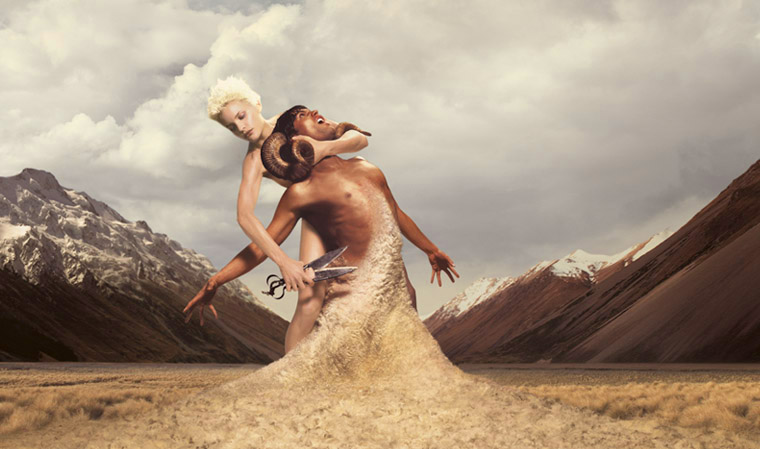
Little did I know when I put up a post here a few months ago titled “The Sheep Man Cometh” that I’d eventually find something even more deserving of that title. (This is what I get for continuing to blog about video games.) May I present an even creepier humanoid sheep, courtesy of the good people at New Zealand thermal clothing company Icebreaker:


Feel weird about it, people. Even that tagline seems suggestive of a love that dare not baa its name.

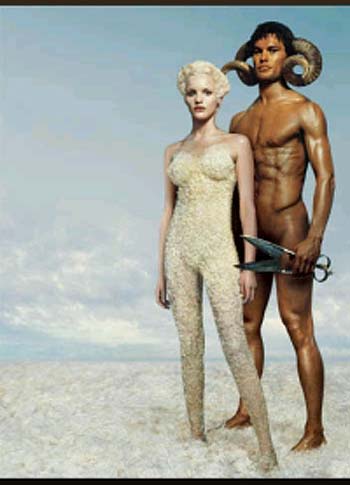
Also, “enjoy” a close-up of the couple that is roughly one-fourth sheep:


That muscular ram-man is up to no good with that naked nymph on his back. Icebreaker specializes in keeping you warm, but she’s not wearing any clothes, so we’re left to assume how ram-man plans to raise the temperature.

This isn’t my first run-in with Icebreaker’s sexually grotesque ads. The company seems to specialize in visuals that suggest some freaky mating between humans and the wooly ones. During my last trip to New Zealand, I managed to spot these images:


I just don’t understand the idea behind this — by which I mean that I do but I find it both off-putting and suggestive of the New Zealand stereotype of what shepherds do with their flocks in the lonely hours of the night. It would kind of like an emblematically French company using anthropomorphosized frogs or a recognizably American company using fat eagles eating hamburgers and spilling mayonnaise all over their bibs.

Icebreaker — it keeps you warm while it sins against nature.

Tuesday, February 9, 2010

The Land of Milfs

The one solo trip I made during the New Zealand adventure was to Milford Sound — a picturesque inlet on the South Island’s west coast that I failed to travel to during the last trip. It’s actually not a sound but a fjord, as it’s an ocean inlet created by glacial movement. But let’s not kid ourselves: That first syllable is the one that should be capturing our attention.

I’m glad I went. It was indeed beautiful, though I have to admit that the flight to Milford was generative of better pictures than the boat trip down to the Tasman Sea. Maybe I caught it during an off-day. Time your trip right and you see a hundred waterfalls and penguins. I, however, saw about five waterfalls in addition to seals and seagulls, all of which I can see for free in California, within walking distance of my house.

That being said, please do enjoy my pictures.

flight to milford sound 18

flight to milford sound 15

flight to milford sound 13

flight to milford sound 12

flight to milford sound 5

flight to milford sound 2

milford sound 11

milford sound 1

Ha ha. “Milf.”

Monday, February 8, 2010

Tomato Peak

Near where my dad grew up, there’s an overlook called Te Mata Peak. It’s not too high up, but the views are amazing, especially on a day where a few passing clouds can cast shadows on the land below.

te mata peak 4

te mata peak 2

te mata peak 3

te mata peak 5

I should probably own up to the fact that my appreciation of this place belies some home state pride. When we were there, it was the New Zealand’s equivalent of July. Thus, typically verdant hills were gold, and the landscaped looked more than a bit like California, just better — maybe because I’d never seen it before and maybe because New Zealand is inherently beautiful. Fellow Californians: You see the resemblance, right?

I normally don’t fear heights, but that first picture shows the view from a ramp from which people go hang gliding. I have to admit that I can’t think about jumping off over that valley — flying attachment or no flying attachment — without my stomach going into knots.

Sunday, February 7, 2010

Surrender Your Jandals

Last time I was in New Zealand, my friends and I stopped in Cardrona, at the Bra Fence, an unexplained roadside tribute to the ladies’ undergarment. It no longer exists today, so amuse yourself with these photos I took back in 2006.

the bra fence

pink bra on the bra fence

dina at the bra fence

This most recent trip, we drove through the small North Island town of Kaeo and found a sort-of successor: the Jandal Fence. (New Zealanders inexplicably use the term jandal for what we in California would call sandal or more specifically flip-flop. Wiktionary posits that jandal could be a blend of sandal and Japanese.)

jandal fence 2

jandal fence 3

Overall, not as risqué and overall not as good, but hey — it’s stuff you wear posted on a fence, so you have to like it. Otherwise they kick you out of New Zealand.

There’s a joke somewhere in here about flip-flips and bras being designed to limit that kind of motion, but I can’t quite pull it together.

Friday, February 5, 2010

Encyclopedia Drew and the Missing Maori Fuck

I may not be taking a break from New Zealand-related posts here, but I’ll at least stop posting photos. I’d hate to make you readers feel like your trapped in my living room, watching an endless slideshow of pictures without people in them, but I do have a bit to say about the experience of spending the first month of the year over there, down there, tucked in the corner of the world.

Many New Zealand cities retain the names given to them by the indigenous Maori people. This is especially the case on the North Island. Being Americans driving from one place to the next, we’ve always had fun trying to accurately pronounce these place names. The short ones are easy. Those beginning with the ng sound, like Ngongotaha and Ngunguru, continue to trip me up. And long ones — Taumatawhakatangihangakoauauotamateapokaiwhenuakitanatahu foremost among them — are really tough, even if Maori is pronounced almost phonetically.

Before this most recent trip, I would have said that Maori was fully phonetic, but it’s not, apparently. Among many Maori, some non-Maori New Zealanders, and basically anyone speaking in an official capacity, there’s now a movement to pronounce the letter combination wh like an English f in order to pronounce it more like Maori would have before the arrival of Europeans. (Attempts to represent this language using the Roman alphabet may have changed the pronunciation, I would assume as a result of Europeans writing down what they thought they heard rather than what was actually being spoken. Wikipedia notes, however, that the pronunciation of wh is variable.) Thus, the town whose name I’ve been pronouncing as Whangarei should actually be Fangerei. Whanganui is Fanganui. And Whakatane is, unfortunately, Fakatane, a fact that I’m sure lots of people have fun with, especially if they don’t care for that particular town.

Yes, this is where I’m going with this: the F-word.

With the wh-f switch in mind, listen to the strange thing that happened to us while we traveled through Rotorua. We stopped at a place I’d never been before: the “thermal village,” Whakarewarewa. It’s a geothermal hotspot, a historic but still-active Maori village, and place where Maori people celebrate their culture. At the beginning of the tour, the guide walked the group through the pronunciation of the site’s full name, Te Whakarewarewatanga O Te Ope Taua A Wahiao but also noted that most people today just call the place Whaka for short. Now, knowing how wh is supposed to be pronounced, Whakarewarewa, Whaka and the long version should seemingly be pronounced with an f sound at the beginning. However, during our tour, it never was. Weird, right? I mean, if any place was going to use the allegedly proper Maori pronunciation, it would be this one, right?

I didn’t realize this strangeness until after the tour and therefore didn’t get to ask about it, so I’m now left to make one of three conclusions.

First, there’s the possibility that the English f sound just isn’t right. Though the letters wh in Maori words sometimes gets pronounced with an f — or, if you want to be technical about it (and why shouldn’t we?) the IPA [f], which is described as a labiodental fricative, literally a noise made by the friction of air between teeth and lips. But the Maori wh can also be a sound represented by the IPA symbol [ɸ] — a bilabial fricative, a sound made by friction between both lips. (Side note: I love when the IPA symbols actually look like a human mouth making the associated noise.) There’s an example of this noise here. (Warning: You may find it kind of hilarious.) But I can’t really hear the difference between it and [f]. At most, it sounds like a cross between someone blowing out birthday candles and a dismissive air puff released by a person who is incredulous or annoyed. (You may be making this noise now.)

Then there’s the possibility that not all Maori people think they should change their pronunciation of wh, which seems possible since this group as a whole may not always agree. Why should they? They’re human and regional differences are things humans seem to love creating.

Finally, there’s a third possibility that I think may be the correct one. If you’re a Maori person, and you’re stoked on your culture and especially stoked on showing off both your culture and your home to foreigners who are curious to learn about it, you might not appreciate snickering every time you speak the name of where you live. With the f pronunciation, Whakarewarewa would sound a lot like Fuckarewarewa. And when it’s truncated to Whaka, it would sound almost exactly like the New Zealand pronunciation of the word fucker. And that would be enough the make people laugh. And that would me awkward. (Believe me: When I was in London, particularly in museums or historical spots, I had to suppress laughter every time someone spoke regina in the British way.) In my head, it doesn’t seem out-of-the-question that the Whakarewarewans would convene and one day resolve to continue with the old w sound, even if f was more accurate, just so they and their guests would never treat the site like a joke. Furthermore, it may also be the case that the Whakarewarewa residents, proud thought they might be, don’t want to sound rude to foreigners, and this politeness may be trumping correctness.

In the end, I don’t know the real answer. Maybe people more Maori-savvy than I am will Google their way here and set me straight. Also, I have sent off an email to the best address I could find in hopes that someone can give me an official answer. I hope whoever reads it sees that I’m genuinely curious and not trying to poke fun, lest they tell me to whuck off.

Sunday, January 24, 2010

A Report From the Adventure Sport Capital of the World

As I write this, I'm on my way out of Queenstown, the birthplace of bungee and now a mecca for thrillseekers worldwide. And while time and financial restraints meant that I had to forego many of the city's main attractions, I was fortunate enough to partake in a new offering that's being billed as the next craze in adventure sports: gobsmacking. As were many of the others in the area, our hotel gave us a discounted rate to try gobsmaking out. We were not disappointed.

The way the sport works is like this: You get picked up at your hotel at about 7:30 in the morning and then driven out to a hill overlooking the city. Staff briefs you on safety procedures and suits you up in all necessary equipment. Then, around 9, you trot to the top of the lookout, where a big Scottish guy named Angus punches you in the face a hard as he can.

The idea behind the sport is that it's the ultimate test of fortitude. Unlike bungee, which offers the illusion of danger without any significant chance of injury, the harm is guaranteed with gobsmacking. By participating, you have to supress your body's most primal need for self-preservation. The result is an unforgettable battle between your voluntary and involuntary impulses --- and thrills aplenty.

Those up for repeat gobsmacks can opt for different arrangements. For example, Angus can also punch you in the chest and then make fun of you. And for the truly adventurous, there's the option of letting Angus punch you and then toss you down a five-foot embankment.

The cost of participation --- $430 USD, with our hotel discount --- may seem steep, but it was entirely worth the cash dropped and blood shed to get an early jump on what is sure to be the next big thing in adventure sports. If you're in Queenstown or plan to travel through soon, ask after the original gobsmacking package. (Or, if you want, look for the dozens of similar offers sure to spring up in its wake. Already we heard of a similar deal up the road where these kids from Peru come an throw rocks at you.) It's your chance to prove that you'll let nothing stop you from living on the edge --- even the promise of certain bodily injury.

Monday, January 18, 2010

The Sheep Are Trying to Tell Us Something

But what? I think their unsophisticated sheep communication abilities are only able to give us the first two sounds in what would otherwise be a valuable message. "Bahrain"? "Bafflement"? "Badminton"? Perhaps we will never know. However, that first syllable is so clearly "baa" that I must take a moment to chuckle at what various other cultures think sheep say: fwaah (French), maham maham (Spanish), googoogoowah (Chinese), and worst of all ¡vivilaravi! (German).

Seriously, despite having the collective brain power of shower mold, sheep herds do find ways to communicate with nearby humans. For example, they remind us all of their status as grazing, cellulose-processing powerhouses by burping, farting, shitting and pissing at all times, even when they're actually consuming more plant material that they will utilize as energy for future burps, farts, shits and pisses. Standing in front of a herd of sheep, then, is sort of like watching a bunch of people eat at Burger King. (I make that joke realizing that no one reading a blog that specializes in video game etymology and sexually perverse subtext in obscure pop culture has eaten at Burger King in the past decade. Stay with me here, snobs.)

The wooly-backed masses have other ways of communicating. They stamp their feet when angry. They pant like dogs when hot. And, when released from fenced-in prisons, they are prone to jumping in the air only to kick out their legs in brief but jubilant displays. However, there is one more thing that sheep do, and it does not make me feel any better about them or myself. When shoved into a corral, whether at the request of humans or dogs, they tend to anxiously breathe through their noses in unison.

Picture, if you will, stepping up to a wooden fence behind which stand a hundred sheep that have just been pushed from their cushy pasture land to a new, smaller pen that leads to God-knows-where. The sheep turn and look at you with their stupid, yellow eyes and for a few seconds it's quiet enough that you can hear a noise that sounds almost like the ocean. It's actually the whole lot of them breathing in unison, furiously and quickly. It's the panicked breathing of idiots that don't understand what's happening but know on some level that they should be afraifd. When Thomas Harris wrote about the silence of the lambs, he clearly hadn't spent enough time around the species to know about something worse: panic breathing in unison.

Today, the breathing stopped only when the sheep had been loaded onto a truck that transported them to a magical place that makes them into dinner. I point this out not to drive home any vegetarian point --- I do eat sheep --- but instead to point out the irony in these animals having panicked with good reason on the day they died. Sheep, being dumb, do this panic breathing whether they're lined up to be tagged or flea-dipped or dressed in oversized British lady clothes for humorous birthday card photos. These sheep doubtlessly did so every time they were pushed into a corral out of a primal dread of death that somehow overrode their primitive brain circuitry. Today, however, was the first time this instinct would have proved correct.

There's something in that, I feel, and there's something in the reaction of one lucky ewe that, upon my uncle's second inspection, proved to be too young for the slaughterhouse. Being deprived of its flockmates, it bleated like it had been the only kid in class not invited to the party. In a way, it was that tragic figure. Only it was too dumb to know it had dodged a metaphorical bullet --- and a literal bolt gun. Its panic breathing had been rendered unremarkable by virtue of being a solo effort --- and unprophetic by virtue of it having survived today.

The sheep are trying to tell us something, and that message is a lot more complex that they could ever understand.

Wednesday, January 13, 2010

Yin, Yang and John

New Zealand, as a nation, likes making an effort at being green. Failing that, it likes making an effort at seeming green. The telltale signs are everywhere. Case in point: the toilets.

photo

We have these flush activators in America, with the buttons each being composed of one part for little flushes and another for bigger ones. But here they're everywhere --- homes and hotels --- as if the entire toilet-using population of New Zealand is in on the effort to conserve water whenever possible. The funny thing about these buttons is that they are composed of two organic, interlocking halves, which means they essentially form a yin-yang symbol. The one above --- found in my hotel bathroom --- even has little eyes, though one is weirdly winking. (Ol' Winky is for when you don't need to clean out the whole bowl.) And because I see these buttons every time I use a toilet, I get reminded of the Taoist symbol for spiritual balance between three and six times a day, depending on my fluid intake.

Toilet philosophy, of course, is nothing new. The bathroom is maybe better suited for pondering than any other room in the house. But in this case, the fixtures are mapping bodily functions onto existing philosphical concepts. Inadvertantly, yin (dark, negative and feminine) gets associated with the bathroom activities that require a full flush and yang (light, positive and masculine) with the less intrusive expulsions.

And, being male myself, I find these associations funny. But I'm pretty sure that I'm the only person to pass through New Zealand bathrooms and have this thought, so I guess the joke will remain an inside one.

As far as other matters go, the weather is fair but the kiwi birds remained hidden.

Friday, October 23, 2009

Who Gives a Fig About Sydelle Pulaski?

Two points of verbal interest for your Friday.

First, a new term that, much in the manner of cranberry morpheme and kangaroo word, strikes me as funny and oddly informal even though it is the correct way to refer to a particular linguistic concept: false friend. It refers to words in different languages that don’t mean the same thing but resemble each other to the point that they look like they should mean the same thing. Wikipedia offers a few examples of these verbal frenemies, the one most familiar to me being the English embarrass and the Spanish embarazada. The latter sounds like it should mean what the former does, but, as anyone who’s taken introductory Spanish knows, it actually means “pregnant.” Hilarity ensues. There’s a whole list of them, but I’m far less interested in the examples than I am in the term itself, which calls to mind two words who act all nice in person but then send defamatory text messages about each other to their cognates and synonyms.

The other bit involves a thing that I assumed had been invented by my father and was unique to my family: the phrase a wigwam for a goose’s bridle. This nonsensical string of words was used often in my house as a response to any question centered around the word what. For example: What are you looking for? What are we having for dinner? What did you get me for my birthday? In retrospect, I don’t know why we weren’t more forthright in answering each other’s questions. It turns out it that the phrase has been used in all English-speaking countries, especially Australia and New Zealand. And my dad is from New Zealand, so the story checks out. According to Wikipedia, the second word in the phrase at one point was not wigwam but whim-wham, an obsolete bit of vocabulary meaning “whimsical object” or “trinket.” (Curious, then, that the word would have been made more whimsical by attaching it to a headgear for a goose.) As whim-wham fell out of use, the phrase replaced it with wigwam. This substitution strikes me as an odd one, given that the phrase was most popular in nations whose residents had little reason to know the name of a Native American dwelling unit. But that’s the story nonetheless. Over at World Wide Words, Michael Quinion has collected a few other nonsense responses used to deflect questions by nosy passersby and inquisitive children. Among them:
  • a whim-wham for ducks to perch on
  • a whim-wham for a treacle mill
  • a whim-wham to wind the sun up
  • layovers to catch meddlers
  • a silver new nothing to put on your shoe
  • airlos to catch medlos
  • a whipple for a dooses poke
  • a pair of kitty britches
  • a wigwam for a goose’s bridle and a crutch for a lame duck
  • a whim-whom for grinding smoke
Now please go enjoy your Friday.

Wednesday, September 10, 2008

And With a New Woolen Sweater, Too

Amusing advertisement promoting New Zealand tourism, from Noam's blog.


Click image for bigger, more readable, more charming version.

Wednesday, October 31, 2007

These Lambs Ain't Silent

Very appropriate to have received on Halloween, this postcard came from the now-New York-located Kristen, who is attending grad school to learn how to make monster movies. I think.


It's a real film, and one that I might tack onto my Netflix queue. (I just hope I don't somehow get the other Black Sheep instead.) I could swear KrisDina and I had a conversation about this very possibility — or, more realistically, inevitability — while driving through a road-blocking flock while in New Zealand, but that could just be my imagination.

Read the back! The back!


A demographic of one indeed. And please note that stamp Kristen used to send this postcard bears a picture of Marvel comics superheroine and zombie ninja Elektra, making this the second association between a comic book character and Kristen this year.

For the record: another time sheep were disturbing.

Tuesday, October 9, 2007

The New Zealand Story

The time has come again for me to venture into strange and wonderful video games that I never played as a child. Today's pick: The New Zealand Story, also known as Kiwi Kraze. I can vaguely remember seeing a flashier version of this game in arcades way back when. And given my proclivity for all things New Zealand, you'd think I would have bothered to plunk in a few quarters. Not so. However, I found an emulated version of the NES port of the game at Nintendo8.com and decided to give it a shot.

After all, this game was made by Taito, which also produced a more familiar and more popular video game, Bubble Bobble, the characters from which later went on to appear in Snood-inspiration Bust a Move. All that, plus a heroic kiwi bird protagonist? How bad could such a convergences of quirks be?


Based off this title screen, pretty damn bad.

The hell? What is that font? What is with the strange grinning bear face under the top score? And what, for the love of God, are all those green monsters? Not one looks even remotely like a kiwi or anything remotely New Zealand. It's not the other kind of kiwi that I'm meant to play as, is it?

This, friends, does not bode well. Maybe if I watch the attract mode a little while longer, this will get better.


It didn't.

A be-goggled bear firing an arrow and riding on the floating disembodied head of another bear. And those names? Not a single Japanese one in the bunch.


My antagonist!

Wikipedia tells me that this warlus-looking fellow is actually a leopard seal — a carnivorous species that actually does live in New Zealand but doesn't, to my knowledge, eat kiwi birds. Yet nonetheless Mr. Purple Leopard Seal appears to have stuffed a gaggle of kiwis into a sack, surely not for benevolent purposes. As the heroic kiwi, it's my job to rescue them, one by one.

Here we go.


Okay, I apparently misspoke when I called the hero a kiwi bird. The limitations of eight-bit video game technology — or, perhaps, the designer's understanding of what a kiwi bird looked like — have resulted in the controllable character looking more like a standard farm baby chick. And what that sleeping olive-colored beast in the cage is supposed to be is completely beyond me.


Am I in a zoo or a children's playroom? Without knowing the answer, I'll push my little kiwi onward, past the hordes of villainous conches, which periodically spit out green globs of goo. Having never encountered wild conches, I'll have to assume this trait is taken directly from real life and that said goo does, in fact, make you die instantly.


Ack. Apparently the leopard seal has also employed strange British police officer-style minions, which, of course, toss boomerangs. The various stereotypes of the British colonies have been melded into a single, mindless, generic video game enemy.


Tragically, the game employs the one-hit-and-you're-dead rule, a vestige from the arcade days when people were being duped out of their quarters and tokens. On a home console, it's more frustrating than anything else.


An exit! And a baby kiwi colleague! Can I be done with this now?


With this part, at the very least. In all, that was rather painless. You know, except for dying.


The map screen.

WHAT?! I'm actually in New Zealand?! Auckland, no less?! Jesus! They should have just called this Escape from Auckland. Had I realize that Auckland was full of all manner of projectile-vomiting mollusks and crazed colonial stereotypes, I would have never vacationed there. KrisDina, if you're reading this now, we're lucky to have escaped with our lives. I'm sure The New Zealand Story resulted in countless children developing negative impressions of little Australia Jr., which is why nobody ever wants to travel there today.

I don't know from experience, as this game's shoddy controls and tinny music angered me such that I never actually had the patience to get Mr. Kiwi Chick out of Auckland, but I'm told each subsequent stage is also based on a real-life New Zealand locale. (I'm assuming, however, that the stages represent this places in name only, judging that the Auckland I saw wasn't made entirely of butter yellow bricks.) The stages, in order, as as follows: Rotorua, Waitomo Caves, Wellington, Strait Cook, Hanmer Springs, and Mount Aoraki.

Weird, to say the least. Bare minimum, I can presume that somebody actually looked at a map of New Zealand before retuning to de`sign more anonymously weird enemy sprites.

Like I said, I got bored before I got out of Auckland, so let's pick up — and end off — there.


Mr. Kiwi was approached by what I can only describe as a floating, pink whale ghost wrapped in cellophane. Those snowflake-looking objects were coughed at him by the polter-whale, which Mr. Kiwi dodged long enough to be swallowed whole.


And here he is inside the belly of the whale — the cellophane is easier to see now, please note. Mr. Kiwi must attack the whale's stomach from the inside, all the while dodging drops of stomach acid that rain down on him. Doing so proved difficult, and I never got to see the miraculous site that is an enraged Rambo kiwi bird bursting forth victorious from a dead whale's gut. As neat as that sounds, I've moved on.

New Zealand Story, I'm done with you.