Pages

Showing posts with label weird animals. Show all posts

Monday, January 12, 2015

Boops boops in a Bucket

Way back when, I made the mistake of listing off all the species I could think of whose genus names are the same as their species names. In short, their scientific name is the same word repeated: Bison bison, Chinchilla chinchilla, Iguana iguana, as well as the more exotic-sounding ones such as Bubo bubo (the Eurasian eagle-owl) and Mephitis mephitis (the striped skunk).

I call the post a mistake because it’s subsequently only given some people the opportunity to point out how I’m an idiot for omitting their favorite same-name scientific creatures. Among those I skipped were Gulo gulo — the common wolverine, which I’ve just found out is called “skunk bear” in some circles — and the sea snail Volva volva volva, which, yes, is named for exactly the reason that you’d guess. But just before the end of 2014, another double-namer was brought to my attention that seemed worthy enough for its own post.

This is that post. (And unlike some, this person pointed it out nicely.)


Yep, Boops boops, a big-eyed little fish otherwise known as the bogue. Technically, that name is pronounced “BOH-ops BOH-ops” — literally “cow eye, cow eye” — but why not better the world and just refer to this guy as “BOOPS BOOPS”? The Wikipedia page for the species even has a perfectly reasonable, scientifically accurate caption that nonetheless sounds like it the chorus of some old-timey children’s rhyme.


All hail Boops boops, your new favorite intersex Atlantic demersal and semi-pelagic feeding fish!

And if I still haven’t mentioned your favorite double-named species, please notify me without calling me an idiot.

[Touches own nose. “Boops boops!” Touches own nose. “Boops boops!”]

Amminall fun, previously:

Friday, April 11, 2014

How This National Geographic Cover Came to Be (A Work of Fiction)

First, the cover in question:


And now the scene: an editorial meeting in the main office of National Geographic’s headquarters in Washington D.C. All relevant departments direct their attention to the editor in chief, who asks what species could most deserve the cover of the long-awaited exotic pets issue. The room immediately erupts into frenzied suggestions. “Lions!” “Antelopes!” “Perhaps a lemur wearing a dog collar?” “I like ibexes!” But eventually, the rumble dies down, as each attendee realizes that his or her idea doesn’t perfect capture the spirit of the issue. A timid voice from emerges from the back of the room.

“What about hedgehogs?”

The rumble returns, but with a different focus. “Oh, there she goes again.” “Sit the fuck down, Nedra.” “She’s always talking about fucking hedgehogs.” “Who hired Nedra, anyway?” The editor-in-chief indulges her: “What is it about hedgehogs that makes you think they deserve the cover, Nedra?”

Right hand tugging nervously at her left elbow, Nedra begins. “Well, I’ve always thought they were neat. They are kind. They are clean. And I know it’s an unpopular opinion, but there’s more National Geographic could be doings for them…”

The editor-in-chief nods cautiously.

“And also my hedgehog’s name is Mrs. Bananas and she eats bananas and I have to keep the lights off in my house so she feels safe and she also likes peas.”

The rumble begins again. “Fuck this idiot.” “She’s insane!” “I think she’s simple.” “I’ll bet she doesn’t even own a fucking hedgehog, this dumb, crazy liar.” Realizing she’s losing her chance, Nedra gives it one last shot, her voice no longer timid.

“And also sometimes Mrs. Bananas rolls into a ball and it makes her sneeze and it’s cute and also I disposed of all the photo files.”

The room quiets. The EIC: “What did you say, Nedra? You got rid of our photos?”

“Umm. Maybe.”

“Young lady, are you saying you got rid of each and every photo that National Geographic has or ever will run of a wild animal?”

“… Yes. I threw them all into the Potomac last night. Mrs. Bananas and I broke in. No one notices us. You have no other options now.”

“But why would you do that?”

“Well… because now you have no choice but to acknowledge Mrs. Bananas. And hedgehogs everywhere.”

The editor-in-chief looks sternly at Nedra for a few moments before once again nodding his head. “Well-played, Nedra. Mrs. Bananas shall have her day.” And then the rest of the National Geographic begins a begrudging slow clap. As the EIC walks over and puts his hand on Nedra’s shoulder, she scoops Mrs. Bananas out from the pocket of her olive-green blazer. She cuddles the little critter next to her face,weeping tears of joy. And in a voice almost too quiet to be heard, she says, “We did, Mrs. Bananas. We did it.”

{ FIN }

And that, my friends, is the only way I can imagine how anyone thought that the wildest, most exotic animal National Geographic could put on the cover of this issue was a fucking hedgehog.

Tuesday, November 5, 2013

A Raccoon Eating Grapes Whilst Sitting at the Dinner Table

It is as I say. Dina tells me that the man is saying "Are you done eating the grapes? No, there's one left." Fascinating.


What I wish the man was actually saying: "And here is the place card for our special guest, Mister Mitts. DO NOT REACH ACROSS MISTER MITTS'S FOOD. HE DOES NOT LIKE THAT."

Monday, July 8, 2013

The Demon Duck of Doom

I really can’t top that phrasing, so it’s the post title. How this isn’t yet a band name, a book title or the next summer blockbuster, I have no idea. But here, check this out:


Above  you see the skull of the Bullockornis panei, a bird species that lived 15 million years ago in what we now call Australia but would then have been called the worst place to live ever. You see, this member of the Dromornithidae (“swift-running birds”) class of megafauna, according to Wikipedia, would have stood eight feet, two inches tall and would have weighed up to 550 pounds. More disturbingly, this article says that paleontologists think the large beak indicates the Demon Duck of Doom ate meat. A quote from Dr. Steve Wroe from the Australian Museum: “My hunch is that it ate plant material, but also significant amounts of meat — it was formidable enough that it could have eaten whatever it wanted.” Hence the rather evocative nickname.

As someone still scarred by childhood memories of charging golf course water traps with thoughts of chasing ducks and geese only to immediately be deterred by an onslaught of hissing, flapping, honking and beak-snapping, I must say that this is the worst news I’ve heard lately. Fifteen million years isn’t barrier enough.

(This nightmare is brought to you via Spencer and his knowledge of beastmonsters, ultimately from this Atlantic article.)

Sunday, February 3, 2013

A Thousand Dogs!

Increasingly specific snapshots of the celebrations following the 1933 London dog license amnesty, the details of which I’m not totally sure about but the gist rather obvious.


Ladies and gentlemen, Reginald Russtucket, inventor of the dog hat.

(Original photo via Retronaut.)

Saturday, August 4, 2012

The Longstanding Hatred Between Elephants and Dragons

Here are some facts about elephants that even the most well-read pachydermophile may find surprising:
Elephants have no knee joints, so if they fall down they cannot get up again. To avoid falling, the elephant leans against a tree while it sleeps. To capture an elephant, a hunter can cut part way through a tree; when the elephant leans against it, the tree breaks and the elephant falls. Unable to rise, the beast cries out, and a large elephant tries to lift it up, but fails. In some accounts, twelve elephants next attempt to lift it, and also fail. Finally a small elephant comes and succeeds in raising the fallen one.
And here are more:
The elephant’s life span is three hundred years. They travel in herds, are afraid of mice, and courteously salute men in whatever way they can. They once lived in both in Africa and India, but now only live in India.
And finally this chunk of information:
The dragon is the enemy of the elephant, and hides near paths where elephants walk so that it can catch them with its tail and kill them by suffocation. ... When it is time to give birth, the female wades into a pool up to her belly and gives birth there. If she gave birth on land, the elephant's enemy the dragon would devour the baby. To make sure the dragon cannot attack, the male elephant stands guard and tramples the dragon if it approaches the pool.
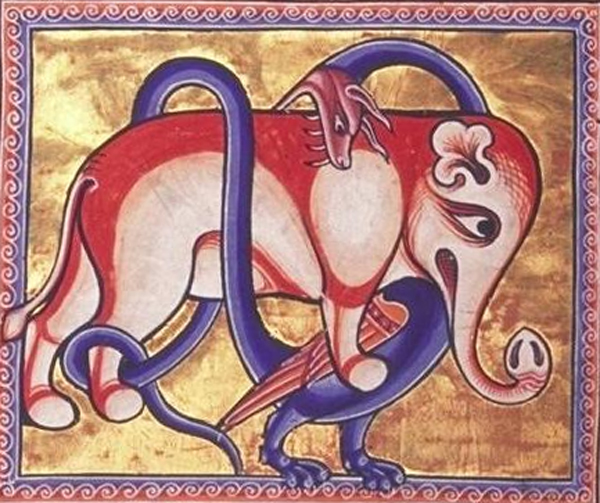
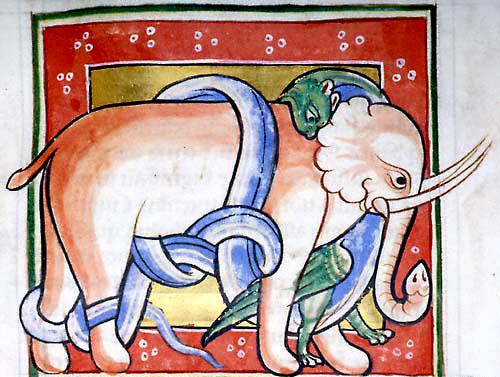
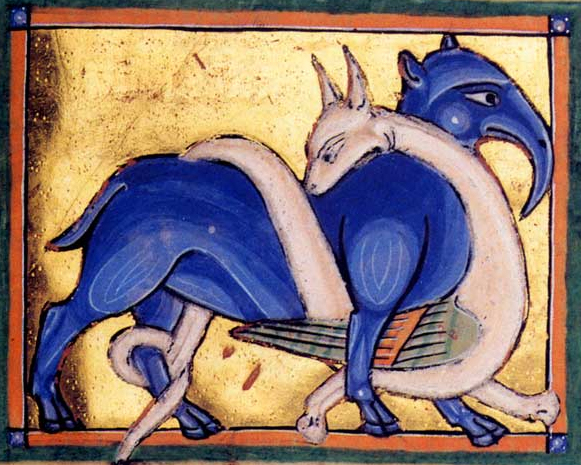
Yep, that’s the one I was looking for — the one that explains, inasmuch as it can be explained, the strange medieval meme of illustrating elephants locked in combat with dragons. Poking around Tumblr, I found this post, which featured an elephant that was either appealingly stylized or appealingly erroneous:


Curious about why anyone would draw such a thing, I searched and ended up at The Medieval Bestiary, where I found that when artists of the day weren’t drawing elephants carrying bricked fortresses on their back, they often did so fighting with serpentine dragons:


I suppose it shouldn’t be surprising that elephants would appear in medieval European art. Elephants did and still do, after all, live within walking distance of Europe — it would be a long walk, yes, and it might even be more like stamping distance, if we’re being technical about it, but still. Looking at the depictions themselves, however, I’d guess that many artists based their illustrations off descriptions of elephants without ever having seen one in person. So what gives? It’s apparently allegorical. Quoting the Medieval Bestiary once again:
The elephant and its mate represent Adam and Eve. When they were still without sin in the Garden of Eden, they did not mate, but when the dragon seduced them and Eve ate the fruit of the tree and gave some to Adam, they were forced to leave Paradise and enter the world, which was like a turbulent lake of pleasures and passions. The elephants mated and she conceived, and “gave birth on the waters of guilt.” The big elephant represents the law, which could not raise up mankind from sin, nor could the twelve elephants, which represent the prophets. Christ is the small elephant who succeeded to raising the fallen. The burning skin and bones of the elephant represent the commandments of God, which allow nothing evil to enter the pure soul.
So there you go: perfectly sensible.

In closing, I want to say that I really hope some fourth-grader researching elephants stumbles onto this blog post and presents all this information to his class.

Monday, July 30, 2012

Aurochs, Twice in One Weekend

Last week, it was the dodo. This week, it’s the aurochs. What’s an aurochs, you ask? (I’m so glad you asked, by the way.)

via wikipedia
The ancestor to domesticated cattle, the aurochs sounds like the dinosaur of grazing hoofed things. Measuring as tell as six feet at the shoulder and weighing as much as 1,500 pounds, according to Wikipedia, these animals possessed some major muscle, which made their purportedly fierce tempers all the more dangerous. Yet we domesticated them, we turned them into common cows (presumably using the same unnatural selection process that turned wolves into teacup poodles), and then, in 1627, the last aurochs died in Jaktorow Forest in Poland.

All of this was news to me as of Saturday, when I read about the aurochs for the first time. For the life of me, I can’t remember why or how I learned about these animals, but I did. Then, just on Sunday, Spencer emailed me a link to a Cabinet article on the extinction of the aurochs and the efforts of some German, World War II-era zoologists, the Brothers Heck, to revive the species. It’s fascinating, and I strongly suggest you give it a read.

Two takeaways:

First, the Hecks believed that domestication ruined animals by inducing neoteny (the retention of juvenile traits in adults), and the Cabinet article evidences this believe with some rather primitive sketches of animals in their natural forms and then their suckier, mushier, tamer forms. It kind of looks like an adult drew some animals and then a child who couldn’t follow directions attempted to re-create the drawings.

via cabinet
Yes, humans too. Remember, this was World War II-era Germany. And no, I don’t know what’s going on with that fish or why domestication apparently turned it into a giant single-celled organism. Science is weird!

And secondly, the mouflon. The article mentions this animal, and because its name sounds like something delicious, I looked it up. It’s a sheep subspecies, and it’s quite regal.

via wikipedia
Is it wrong if I imagine that mouflon : aurochs : majestic forest wolf :: overfed 4-H sheep : constantly farting Holstein : bug-eyed Chihuahua that shakes when it’s not in the protective enclosure of its owner’s purse?

Friday, July 20, 2012

Speaking Ill of the Extinct

Looking back at the history of the names humans used to refer to the dodo, you can appreciate that we didn’t care all that much for this bird during our brief period of interaction with it.

dodo display at the oxford museum of natural history, via bazzadarambler  

So there’s dodo, which Etymonline claims comes from the Portuguese doudo, “fool, simpleton.” I’m unsure whether they called it this as a result of the way it looked — remarkably like one of my gradeschool teachers, I’d like to point out — or how it lacked any natural fear of humans and would just trot right up to whatever sailor arrived onshore. It’s probably a little bit of both.

While I trust Etymonline, it’s worth pointing out for the purposes of this conversation that less accepted theories trace the word back to other sources. Wikipedia has collected them, and they’re almost consistently unflattering. For example, Errol Fuller’s 2002 book Dodo — From Extinction to Icon provides two alternate etymologies: the Dutch words dodoor, “sluggard,” and Dodaars, “fat-ass” or “knot-ass.” Before dodo stuck as a name — and boy did it, seeing as how it’s still a term for a hopelessly stupid person, more than 300 years after the actual dodo ceased to exist — there was walghvogel. An explanation, via Wikipedia’s excerpt of Dutch admiral Wybrand van Warwijck’s journal from his 1597 voyage to Mauritius:
[F]inding in this place great quantity of foules twice as bigge as swans, which they call Walghstocks or Wallowbirdes being very good meat. But finding an abundance of pigeons & popinnayes [parrots], they disdained any more to eat those great foules calling them Wallowbirds, that is to say lothsome or fulsome birdes.
Yes, “wallowbirds.” Not exactly a testament to the dodo’s appeal. Others? Wikipedia also notes dronte, meaning “swollen,” and kermisgans, “in reference to the birds fattened for the Kermesse festival,” according to Cheke and Hulme’s 2008 book Lost Land of the Dodo. The poor dodo even gets dinged on the level of its scientific name: After the bird’s extinction, Carl Lineaus named it Didus ineptus, literally “inept dodo.” The current scientific name is Raphus cucullatus, which I’m happy to report is not a ding against the bird’s mental faculties or physical appearance.

Poor dodo. We should have maybe been a little nicer to you while we had the chance, and also then maybe we shouldn’t have introduced all those invasive species that made you die. But in defense of all the name-calling: take another look at that photo of the dodo exhibit. You have to admit: If that face is at all representative of what it looked like in life, it didn’t appear to be having a great time.

Monday, July 16, 2012

Nine Animals That Got Screwed When Scientific Names Were Handed Out (And Six That Didn’t)

Oddly, binomial nomenclature permits animals to have the same genus and species name but not plants. Don’t believe me? Look at every plant name ever. The ones that approach duplication fall just short: Ziziphus zizyphus, for example. Better known as the common jujube — and shouldn’t that be its own blog post? the differentiation between the jujubes that grows in the ground and the jujubes you buy at the movie theater concession stand? — its name is spelled differently at the genus and species levels for no reason other than to avoid tautonym status. Animals and animal-namers, however, don’t have to worry about repetition, and as a result, certain species sound horribly unimaginative. Others don’t. Yes, I have listed the ones that stood out to me.
Ones that sound boring and unimaginative:

Bison bison
Chinchilla chinchilla
Iguana iguana
Gorilla gorilla
Hyaena hyaena
Mops mops
Rattus rattus
Indicator indicator
Gecko gecko
And, conversely, those who sound unusually cool for having their exotic-seeming biological name repeated twice:

Vulpes vulpes
Lynx lynx
Bubo bubo
Cygnus cygnus 
Bombina bombina 
Mephitis mephitis

Of interest, if you have gotten this far: Some Hybrid Animal Math.

Monday, July 9, 2012

Encyclopedia Drew and the Dubious Diorama

When I visited the Natural History Museum, I escaped the fate that befell poor Sally Draper and did not, thankfully, begin my period immediately after viewing the animal dioramas.


Yes, in true Don Draper fashion, Mad Men fibbed and passed off Los Angeles Natural History Museum as its New York counterpart. This is not news, and this post isn’t about Sally’s diorama-prompted womanhood. No, I’m actually more concerned with the oryxes.


The Arabian oxyx, according to the Natural History Museum’s website, is notable for a horse-like gait and the fact that it, when moving in profile, appears to only have a single horn and therefore may have been responsible for belief in unicorns. But even that’s not enough to warrant this post. No, here’s what did. Not the oryx family but way in the back corner…


Do you see it?


Okay, you have to see it now — a cat whose shitty expression is masked by the cat-colored grass around it. The diorama placards made no mention of Grassy Grumplepuss, leaving me to consider several possible explanations:
  • The diorama curator placed the cat, but a higher-up exercised an anti-cat agenda and saw to it that the cat was not mentioned at all.
  • The diorama curator’s cat died while he was making this particular exhibit, and so he taxidermied the cat and slipped it into the background as a way of letting future generations appreciate the severity of his cat’s scowl.
  • It’s actually a live cat that snuck into the museum, Mrs. Basil E. Frankweiler-style, and it’s posing as if it were taxidermied so as to avoid detection.
  • It’s the mouse-deterring version of a scarecrow, and the museum would rather not publicize its rodent problem.
  • The museum placed the cat in the exhibit, unannounced, and they’re giving out prizes to whoever spots it first. (Me! I did! Give me the gift certificate.)
  • Ghost cat.
  • Something something illuminati symbolism.
  • Oryxes naturally have guardian angels that take the form of cats, but the museum — being a scientific institution — is reluctant to endorse such spiritualist notions, and so the resourceful museum-goer is left to research on his own and come to his own conclusion.
  • “Oh, shit. We have this extra cat. Will anyone care if I just stick it in the oryx diorama? I need to take lunch, like, now.”
Your input is valued and appreciated.

Previous Encyclopedia Drew mysteries:

Sunday, July 1, 2012

Elvis Is Alive… in the Snarls of Horny Animals

How I arrived at this week’s word: +1 for it sounding funny, +1 for it having to do with animals, +10 for it having to do with sex, +.5 for it having come from Dina, +1 for it having an apparently confusing etymology, and you know, now that I think about it, another +5 for it sounding funny.
flehm (FLEM or FLAYM, I suppose) — verb: to exhibit the flehmen response, i.e., to draw back the lips, allowing scent to reach the Jacobson’s organ, an auxiliary olfactory organ found in many animals.
So not so much this:


But more at this:


Many animals can pull off such a stylish snarl, but when it’s a felid — housecats to lions — or an ungulate — deer, rhinos, sheep and giraffes, among others, though horses are by far the most entertaining — they’re not doing it to appear more badass. Instead, they do it to let some stank into their vomeronasal organ, a handy little button inside their mouth that allows them to analyze smells — especially urine smells — for information such as “Who made this?” and “Who long ago did they make it?” and also “Would they maybe want to procreate with me?”

As a verb, flehm comes from the term Flehmen response. In fact, you could also just use flehmen as a verb to mean the same thing, as in, “Is the tapir displeased with me? Or is it just flehmening?” Beyond that, however, I don’t know where this term came from, aside from German. Merriam-Webster says only that it comes from the German flehmen, which means that exactly what the English flehmen does. It had to come from somewhere, but maybe you’d need the German version of Etymonline to find out.

There’s also the weirdness of the pronunciation. Technically, flehmen is pronounced exactly like you’d pronounce flamin’, and that makes me feel a whole new kind of gross about Flamin’ Hot Cheetos. But if the word you’re using is just flehm, I feel like any speaker of American English would naturally pronounce it like you would phlegm. Because this is the sort of word that is only ever going to be used by animal science grad students, there are no dictionary entries for flehm that include pronunciation notes. And in my head, that gives me the authority to just say that it should be “flem,” if for no other reason that to avoid making people think you’re speaking rather nonchalantly about a flaming horse.

In closing, I’d like to share something else that reminds me of Dina: Vlem, a one-off Rachel Dratch character from the season of 30 Rock she was allowed to be on:


Thanks, Dina (who also suggested dewlap and flews), but also thank you, Vlem. Appy Valentime Day to us all.

Previous words of the week after the jump.

Sunday, June 17, 2012

The Hadouken of the Undersea World

— “Hey Drew, what’s the coolest thing you learned this week?”
— “Oh, just something that made me more impressed with crustaceans than I ever thought possible.”
— “Is that a fact? Well, can you some up this whole miraculous marvel with a word that sounds too goofy to be scientifically accurate?”
— “Why, yes I can. You know, I should make it my word of the week.”
shrimpoluminescence (SHRIMP-oh-loom-in-ESS-ens) — noun: sonoluminscence — that is, the emission of short bursts of light from imploding, sound-agitated bubbles — caused by the pistol shrimp or mantis shrimp.
According to Discover magazine’s blog Not Exactly Rocket Science, one sea creature has a left hook mean enough to destroy even the toughest mollusk shells and crustacean exoskeletons: the mantis shrimp. Bruiser reputation notwithstanding, it looks like the offspring of a Chinese parade dragon and that gay lobster that the B-52s once sang about. 

Observe:


Also, it’s neither a mantis nor a shrimp, as the NERS article points out. Take care to remember this. You wouldn’t want to offend this creature, for he owns a set of claws that he can unfurl at speeds of 23 meters per second — about the speed of a .22 caliber bullet, according to Wikipedia and the fastest “punch” of any animal, according to NERS. And if that first punch doesn’t break through the target — say, an oyster shell or your scuba-masked face or whatever — the mantis shrimp can punch again. And again. Just from a “Hey, look what nature gave me!” perspective, that alone is impressive, but these blindingly fast attacks have surprising results in addition to reducing fellow undersea-dwellers into ceviche with brute force. According to NERS, “[The punch] creates a pressure wave that boils the water in front of it, creating flashes of light (shrimpoluminescene — no, really) and immensely destructive bubbles.”

So a real-life hadouken, more or less.

(modified from creative commons-friendly photo found here.)

Now hold on: My analogy is actually less stupid than you might think. According to Wikipedia, the shimpoluminescent attack allows the mantis shrimp to further damage its opponent without physically touching it.
The collapse of these cavitation bubbles produces measurable forces on their prey in addition to the instantaneous forces of 1,500 newtons that are caused by the impact of the appendage against the striking surface, which means that the prey is hit twice by a single strike — first by the claw and then by the collapsing cavitation bubbles that immediately follow. Even if the initial strike misses the prey, the resulting shock wave can be enough to kill or stun the prey. The snap can also produce sonoluminescence from the collapsing bubble. This will produce a very small amount of light and high temperatures in the range of several thousand kelvins within the collapsing bubble, although both the light and high temperatures are too weak and short-lived to be detected without advanced scientific equipment.
Among the myriad special moves that an animal could unleash in a fight, you probably wouldn’t imagine that bubble creation would be among the most damaging, but it apparently is. The shock waves created by the collapse of these bubbles — inertial cavitation, in sciencespeak — can create small dents in the stainless steel boat propellers, NERS claims. Amherst’s Patek Lab features some videos that offer us slow-eyed humans are best chance at seeing the mantis shrimp’s attack in motion:


Given all the build-up of preceding paragraphs, that may not look like much, but consider that the video was shot at 5,000 frames per second and is shown in the above clip at only 15 frames per second. See the little flash? That’s shimpoluminescence in action. Isn’t it strange to know that there’s a real-life equivalent of those cartoony smacks and pows you see illustrating when a punch has connected? Here’s another video:


And yes, in case you’re wondering: Mantis shrimp can break through aquarium glass — in a single strike, no less.

(Hat tip on this one: this tweet by Adam Norwood.)


Previous words of the week after the jump.