Pages

Sunday, July 24, 2011

Proper Care for Your Headless Saint

I like specific words. No, scratch that. I like words that exist despite the fact that most sane people would never have good reason to use them. On that note, may I present the word of the week?
cephalophore (SEF-uh-LOH-four) — noun: 1. a saint who is generally depicted carrying his or her own head. 2. a cephalostat designed to take in-sequence-oriented facial photographs and gnathostatic models.
Guess which definition I think is more interesting?
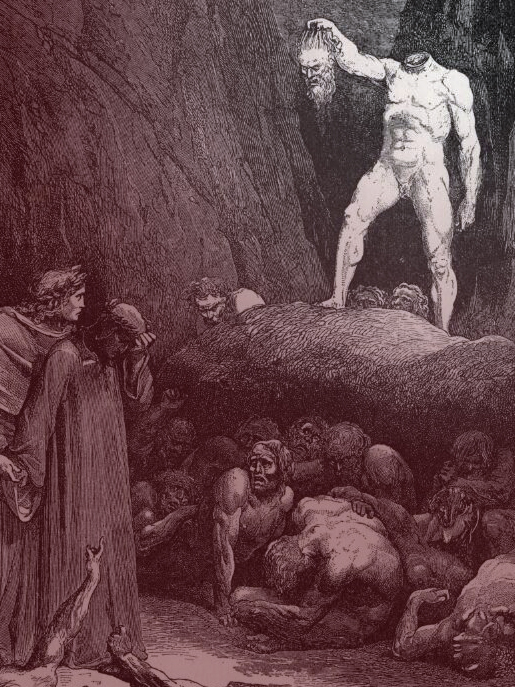
modified detail from the dore inferno illustrations / not a saint but you get the point

I’ll be honest: I’m not even sure what that second definition means. Yes, I’m going Catholic for this one and reveling in the bizarre violence that typifies tales of martyrdom. Really, the saints were a great P.R. move for the Catholic Church in that they draw in kids for the same reason that lurid crime comics, Greek myths and the young adult horror fiction books do: violence, the occasional action sequence and sometimes even some paranormal shenanigans. This post has all of these.

Lest you think that cephalophore is just an art term used to describe the way statues or paintings indicate that a saint was decapitated, know that it also describes people who people supposedly trotted around, head in hand, fueled by Jesus power — or devil magic, in the case of non-Jesus-affiliated cephalophores such as the Headless Horseman or the Green Knight. According to Wikipedia, the most famous Christian cephalophore is probably Denis, the patron saint of Paris, who allegedly walked six miles after his beheading to the summit of the tallest hill in the city, Montmartre.
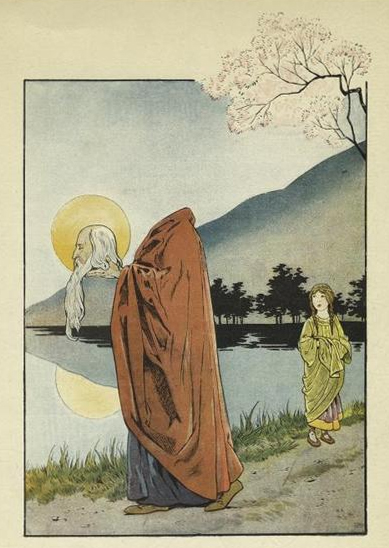
note how the artist circumvented the halo problem
There, Denis’s head delivered a sermon, despite the considerable handicap of having had its vocal chords severed, before Denis’s body finally dropped dead. I presume finally dying resulted in the body dropping the head. It’s possible it rolled down Montmartre before someone caught it. (“Someone grab that head, otherwise it will be difficult to prove this implausible story!”)

Other, less famous saints are allegedly also cephalophores, but it’s a truly C-list group. St. Gemolo, anyone? St. Juthwara? St. Emygdius? St. Valerie of Limoges? No, of course not. No one is looking to these guys for confirmation names.

The word cephalophore comes from the Greek kephale, meaning “head,” and a form of the verb pherein, “to carry,” which you also see in words like transfer and refer as well as names like Christopher, “Christ bearer,” and Lucifer, “light bearer.” But I’m more interested in the artistic implications of the cephalophore. See, the trouble with depicting saints carrying their own heads, as opposed to regular godless people doing the same, is that it forces the artist to make a choice: Do I put the halo on the head as it rests in the hands? Or do I put it above the neck stump, where it would have been had the head not been lopped off? It’s a choice that makes you really consider the physics of halos — or at least makes you think like a serial killer posing his victims in some kind of grim tableau. Or you know what? It can be both. Why shouldn’t it?

st. denis at notre dame / halo placed, you know, wherever

More mutilation made holy: the horrible story of St. Agatha and her “bells on a plate,” which, it turns out, totally aren’t bells and oh god the depravity of it all.

Previous words of the week after the jump.
Word nerd? Subscribe to Back of the Cereal Box’s word-related posts by clicking here.

Saturday, July 23, 2011

They Bombed Their Smurfing Brains out

If you’re like me, you’ve always wondered what Smurfette would look like as a mangled, charred corpse. Well, wonder no longer friends, because footage of this exact image exists!


This spot — which aired in 2009 on Belgian TV — was sponsored by UNICEF to raise awareness about African child soldiers. (The text at the end reads “Don’t let war destroy the children’s world.”) In this CBS news article, one of the ad folks who dreamed up the spot explained it this way: “We see so many images that we don’t really react anymore. In 35 seconds, we wanted to show adults how awful war is by reaching them within their memories of childhood.”

Credit for this find goes to the Topless Robot article “Eight Facts About the Smurfs That Are Surprisingly Interesting,” which also taught me that the late Smurfs creator, Peyo, seems to have detested Smurfette, in which case he probably wouldn’t have minded that her lifeless body is the only one you can really identify in the UNICEF spot.

Thursday, July 21, 2011

Suggestive Salad

So this is a thing: candle salad.


insofar as Amy Sedaris made it on Bravo once and then someone made a Wikipedia page for it. That’s good enough for me! But seriously, check the page out now. Wikipedia isn’t convinced the article meets its stringent notability standards, so learn all about this wholly inappropriate salad while you can.

Wednesday, July 20, 2011

Marta and Luisa Throw a Dance Party

Hey there. Meet the Great Giana Sisters.


Look familiar? No? How about a different perspective:


Get it now? Yes, these sisters are distaff rip-offs of the Mario Bros., and not just because they’re a pair of Italian siblings staring in a video game. The level design in The Great Giana Sisters so closely resembles that in Super Mario Bros. that Nintendo sued it off the shelves after its release. Kotaku just did a “Hey! Remember old stuff?” post on it this week, and though I’ve known about this game for some time, I’d never actually seen it in motion. So I watched, but more importantly I listened. Given that the game was released in 1987, I’m damn impressed with what it did with tinny eight-bit sound.

Give the title track a spin:


At the beginning, it sounds a lot like the opening theme to an Italian horror movie from that wonderful late 70s-early 80s time period that I’m so fond of. At about the 0:45 mark, it breaks down into something else that I noticed even more in this track:


I could be way off on this, but doesn’t this sound remarkable like most of the parts of certain electro-indie bands playing today? I’m getting a distinctly Crystal Castles vibe here — much more so than I get from other dance, chiptune-inspired and -influenced stuff out there. (And yes, by the way, there is an old school video game named Crystal Castles, and no, that isn’t where the band gets its name.) I think it’s a profound similarity, just filtered through the comparatively primitive sound-processing abilities of the ZX Spectrum game system. Compare, oh, say “Crimewave,” for example.


Do you hear it too? Is my brain pixels? Should by electroclash band be called Is My Brain Pixels?

In closing, I would like to note that it was almost a year ago that I put up a post in which I theorized that the faux eight-bit sounds of Mega Man 9 sounded weirdly like the Scissor Sisters.

Robots Before There Should Be Robots

When I wrote about history’s first mechano-man (or at least the first guy on record to get a spare part), I said that people of the fifteenth-century wouldn’t have known what a robot was. And they wouldn’t, at least according to how we use the word today.


That thing is, robots as a general concept wouldn’t have been completely unfamiliar to some people, depending their level of education. Presented for you consideration: two instances of robots, essentially, from back before robots should have been a thing.

First, there’s Hebrew bruiser himself, the golem. What do you call a hunk of inanimate material that walks around on two legs and follows commands? Well, if it exists in Jewish folklore, you call it a golem, but you might as well call it a robot. Think about it: Golems “turn on” as a result of a word, a written command. Isn’t that a computer program in its most essential state? As the stories go, most golems lumber around and smash things in the style of robots from 50s B-movies — or maybe like Frankenstein’s monster, who also is kind of a golem, just powered by electricity rather than commands — but technically, Son Number One himself, Adam, is a golem. According to the second creation story in Genesis, God made Adam from clay — “[kneaded] him into a shapeless husk” and then breathed life into him. So following that mushy golem logic, we’d be golems too. And that’s a different kind of weird.

And then there are the helperbots. Had anyone in ol’ Iron Fist’s time been familiar instead with Greek mythology, they might have known about Hephaestus, the smithy god who supposedly forged golden assistants to help him in his metalworking efforts. (I assume that some text at point in time gives these steampunk helper-bots had names. I can’t find them.) When you’re talking about his Roman equivalent, Vulcan, they’re specified as metallic slave-girls, which, of course, lends the story a whole Roman-style sexy element. Hephaestus also made a guard robo giant enough to make even the biggest fan of Japanese TV proud: Talos, a towering bronze automaton who protected Crete my smashing nearby ships with boulders. Dude — that’s an action figure right there. Kids would love that

I’ll be honest, this kind of creeps me out, kind of in the same way I feel about that carving of the Mayan dude who’s supposedly piloting a spaceship or that Egyptian snake-in-the-jar that some people think is a lightbulb. I see the connection, I don’t know what to make of it, and the whole time I’m telling myself “Well, that shouldn’t be.”

I wonder if this gets to anyone else the way it does to me — not just that an vague awareness of robot technology seems to lurk in stories eons before it could exist in real life, but also that the conception of it back then matches up so well how robots exist in pop culture today. Maybe the human mind has always wanted to make its own people? Or its own cheap labor? Maybe the basic idea of these creations just hasn’t significantly changed since way back in the day? Or is it that these artificial workers that populate old stories ended up informing the creative processes of scifi writers ever since?

Monday, July 18, 2011

Ass-Licking, Iron-Fisting: A History Lesson

Why couldn’t any history class I’ve ever taken be this interesting?

From the June issue of Wired, I learned the story of Gottfried “Götz” von Berlichingen, the fifteenth-century German knight who had a robotic hand. As Wired begins, “The Six Million Dollar Man, Darth Vader, Robocop — we have a passion for badasses who restore their mortal bodies with machinery.” Well, Berlichingen, known sometimes as Götz of the Iron Hand, lost a part of his body most vital to his warrior profession when, as Wikipedia explains, “enemy cannon fire forced his sword against him.”


I’m going to say right now that if this ever happened to me, someone living the current day with a wide array of medical options, I’d probably just die, because the combo of cannon and sword working against me seems like too much. I would just ask to quietly pass away, down in the mud and the puddle of what used to be my sword arm.

Ol’ Götz was made of sterner stuff — metaphorically so but soon literally as well. He ordered the construction of a prosthetic which by today’s standards might be somewhat crude but to Götz’s contemporaries transformed him into a walking robotic terror — or at least would have, had they had awareness of robots back then. As Wired notes, the replacement has “articulated fingers controlled by gears, [with which] he was able to grip anything from a sword to a quill pen.”

diagram of the actual hand, which, yes, is not an actual hand, but still
The article doesn’t comment on his penmanship, but Götz maintained his status as a terror on the battlefield, fighting, pillaging, ransoming all across Germany before dying in piece at age 82. The steampunk cyborg arm remains on display today in Jagsthausen Castle in Germany, but this relic isn’t Götz only lasting legacy. A 1773 play about the man’s life has him respond as follows to a demand for his surrender: “Er aber, sag’s ihm, er kann mich im Arsche lecken!” Translated, that would be something like “He, however, can lick me in the ass.” The quote, which according to Wikipedia is known today as the Gotz quote.


The quote would later inspire Mozart to write at least one but and possibly two cannons, Leck mich im Arsch, which I don’t feel needs a translation, and Leck mir den Arsch fein recht schön sauber, or something like “Lick my ass fine, well and clean.” It’s the second one that’s the more vulgar of the two, so of course I’ll be offering the translated lyrics in full:
Lick my ass nicely
Lick it nice and clean
Nice and clean, lick my ass
That's a greasy desire
Nicely buttered
Like the licking of roast meat, my daily activity
Three will lick more than two,
Come on, just try it,
And lick, lick, lick.
Everybody lick their ass for themselves.
It doesn’t seem noted that this second, more scatological canon is directly inspired by Götz, so I suppose it’s possible that Mozart simply springboarded of the earlier canon into new levels of depravity. It may also be that Mozart simply set new, filthy lyrics to a composition by Wenzel Trnka, which, if you ask me, is an amazing fuck you from the former to the latter.

Game nerd that I am, I suspect that Götz has one more cultural connection: Who’s got German heritage, crazy battle skills and two thumbs (one of which is mechanical)? This guy.


He’s a fairly unpopular character in the second Samurai Shodown and a controllable character despite the notable handicap of not being a samurai in anyway. His name is different — Neinhalt Sieger, as I wrote in one of my “games ’n’ names” posts, is a bad approximation for “non-stop victory” in whatever you’d call the German version on Engrish — but I’m willing to bet that Götz at least partly inspired the character because the series also features fighters based on real-life historical personages including but not limited to Andrew Jackson, Charlotte Corday and various Japanese notables. And, you know, he’s a menacing German knight with a mechano-arm.

Yeah, games are weird sometimes, but hey — so are Germans.

“Now That’s Interesting,” previously:

Sunday, July 17, 2011

In Praise of The Night Stalker

Not Richard Ramirez and not that guy in Goleta that they never actually caught, but the fictional, non-murdering person who went by this name: Kolchak: The Night Stalker.


How did I not realize how great this show was and why have I wasted time watching things that aren’t it?

Here’s the deal: Darren McGavin plays Carl Kolchak, a newspaper crime reporter who investigates paranormal cases week to week. He never sets out to, but much in the way death plagues Jessica Fletcher’s every Sunday brunch or weekend getaway, strangeness has a way of finding Kolchak. The show ran for just one season — September 1974 to March 1975 on ABC — before being cancelled, but it stands out as a clear predecessor for shows like The X-Files and Buffy, as far as monster-of-the-week episodes go. What’s maybe most remarkable is how fresh it feels. Don’t misunderstand: The Night Stalker looks like the mid-70s and the special effects reflect this. To get an idea of the flavor, watch the opening credits.


But I think the very 70s-ness of The Night Stalker only makes it more appealing. It’s a good kind of dated, for one, and the fact that this aired in the same era as Good Times, Rhoda and Happy Days makes it all the more surprising how dark it could get. This show has a high body count — on par with your average X-Files, usually — and that it’s not scared to get weird, even for a show about the paranormal. It does the vampire and werewolf episodes you’d expect, of course, but others go even further beyond typical TV fare. There’s one that has him chasing a rakshasa in a Jewish neighborhood, for example, and I can honestly say that I can’t recall a single other episode of television in which Hebrew and Hindu cultures united to battle a demon.

That’s my pitch, and you’re free to look into the show on your own — it’s available on DVD, and that’s how I’m watching it now — but I have a second point to make, and it’s only of interest to people who have seen the show.

I have to say that I’m fascinated by one of Kolchak’s fellow reporters, a prissy Ned Flanders of a guy named Ron Updyke, who’s clearly gay in spite of the fact that the show just tap-dances around the matter, so to speak, using various codes — he’s fastidiously dressed, he mingles with high-society types, he’s cultured, he’s a native of San Francisco, he’s less masculine in ever way than Kolchak is. (And he’s played by Jack Grinnage, who played one of the toughs in Rebel Without a Cause, which at this point means about as many gay points as driving a freshly groomed min-pin around in your Miata.) This is far from the only show to feature this kind of sissy stock character, but the weird thing about The Night Stalker is that he serves no other purpose than to be a sissy. He’s not written to be particularly funny, but his sole purpose seems to be to make a few catty remarks per episode and otherwise refrain from interacting with the larger plot in any way. Usually, he gets less screentime than any of the one-off characters that Kolchak meets in a given week’s investigation.

It’s very strange, and I can only guess that he exists for the same reason that the Gil Chesterton character existed on Frasier: to make the main character seem straighter my comparison. See, Kolchak seems weirdly neutered, especially for a hardboiled mystery-solver type. Eight episodes in, and I haven’t seen him express the slightest interest in any of the attractive women he’s met with. He even pays a prostitute to not have sex with him in one scene. Contrasting Kolchak against an stereotypically effeminate works, I suppose, to underscore his masculinity, but I can’t imagine why that’s a simpler solution than just giving the poor guy a one night stand,