Pages

Showing posts with label medusa. Show all posts

Sunday, March 24, 2013

Centaurs for Girls!

I’m not saying you’re going to write a fantasy novel one day. That’s up to you. But suppose you do sit down and pen a tale of swords and magic and weird sex, you may want to jump into it prepared with the kind of vocabulary that will endear to your target audience of nitpicking nerds. In advance, you’re welcome.
kentaurides (ken-tar-EE-deez) — noun: the female centaur.
Yep, there’s a special word for lady centaurs, even though they weren’t popular even back in the day. According to Wikipedia, the best-known in Greek mythology was Hylonome, and she’s only known for killing herself when her centaur husband dies in battle. That sets the bar pretty low for female centaurs making something of themselves. Perhaps as a result of not being all that interesting, these figures show up more in art than they do in literature.

second-century mosaic, via wikipedia
seventh-century relief inexplicably depicting medusa as a centaur, via wikipedia
Why would someone decide it would be fun to make Medusa into a centaur? Classical fan fiction, I would guess. A fun thing to note, perhaps: There’s a Wikipedia category for centaurs and another one for fictional centaurs, and not all the pages appearing in the former appear in the latter.

When I think about the logistics of a female version of these randy, barechested horsedudes, it seems logical that there would be a lot of the various geeky media, but I can only think of three off the top of my head. The “Pastoral Symphony” segment of the original Fantasia features some whose brazen toplessness seems surprising, given how the film was released back in 1940. (If Ariel and her type wore clamshell bras, should the Fantasia centaurettes be wearing horseshoe bras?)


And then there’s Golden Axe, a game that’s yielded some interesting bits for word nerds previously on this blog. In the second arcade installment f the game, you could play as a female centaur named Dora, who’s easily the most bad-ass character to get saddled with that name ever, even if her weapon is a weird, American Gladiators-style jousting Q-tip.

via

via
There’s also centaur Leela in the Futurama fantasy parody episode, but I’m not sure if this is poking fun at the lameness of “busty lady centaur” stock character (is a thing, maybe?) or just assigning Leela a role that’s awkward and unfeminine. Whatever the case (and whatever the fate of the horse-centric literature that will one day provide us all with a window in your psyche), know this much about this fancy new word kentaurides: As is the case with the related word centaur, we are not especially sure where it came from. The centaurs themselves we know come from the drunken, unholy union between stable boy and equine beauty. That’s just common sense biology. The wordy end of it, however, is a bit murkier.

Previous words of the week after the jump.

Tuesday, November 29, 2011

The Further Sexual Misadventures of Medusa

It has been a trying day, and this is all I can offer you.


It’s as sensible a follow-up as any to my idiot ramblings on Medusa’s sexy underpinnings.

Tuesday, November 15, 2011

Snakes on a Dame

(Discussed herein: Batgirl, the female genitalia, Greek mythology, movie monsters, the “pretty” Medusa problem, priapism (metaphorically), Sigmund Freud, Uma Thurman, video games.)

Think about monsters — the stock spooks, the scary movie types. If pressed to name the boogeymen from those old, black-and-white-and-thereabouts horror films, who lurks to mind? Dracula? The Wolfman? The Creature from the Black Lagoon? Some unnamable mummy? Maybe Frankenstein’s monster, which you might actually call Frankenstein and I’ll let it slide because it’s not the point? But think about this: They’re all dudes. Sure, you might have mentioned the Bride of Frankenstein, but she’s less of a monster in her own right. She is like Batgirl — a thing, sure, but a thing that was only brought into existence as female counterpart to a more central male character. And that holds true for the actual plot of Bride of Frankenstein as well as this frank, smartypants discussion of monsterology.

So then, I’ll pose a second question: Name a famous female monster — a specific one. You have your options, I’d imagine. La Llorona or Lady Snow, depending on your worldview, but they’re not A-list by American pop culture standards. Maybe a whole bunch of black, pointy hat-types. The Wicked Witch of the West? The evil queen from Snow White — Disney version, of course. Maybe other witches, even though they’re not exactly monsters? Maybe a succubus? Maybe Morrigan from DarkStalkers in particular? But I’d wager that any culturally literate person should eventually arrive at Medusa. (Yes, I’m still on this one, a full week later, though it’s far from a new fixation for me.)

medusa, per clash of the titans — the “good” one
She’s not on the level of Dracula or the Wolfman, but she is more a monster than some green-skinned hag on a broom. And she’s iconic in the way of the major big bads are — she’s got the snaky locks, she’s scowling, she’s often depicted wearing a toga. I put Medusa in the big leagues, honestly, because I grew up playing video games, and she happens to show up in them fairly often, I suspect because game designers wanted to throw in a female monster and have gamers not feel so bad about wailing on her. She is loathsome, after all. That’s the point of her: Athena transformed Medusa into an ugly beast to punish her. But thinking about her and the relative lack of widely recognized monstresses in Western culture, I realize that a lot of what she’s about is overtly feminine and metaphorically sexual.

Freud said so, anyway. And I know, Freud thought everything was sexual, but in his essay Medusa’s Head, he astutely asserted that Medusa’s story is all about fear of castration. Her head, which, in the story of Perseus gets lopped off and then toted around Greece like some sort of steampunk petrification ray, is both a symbol of a man’s fear of castration — his “head” getting lopped off in a similar manner — as well as the supposedly treacherous female genitalia. In her book Pandora: Women in Classical Greece, Ellen Reeder takes the idea a little farther: Those writhing snakes? Pubic hair. Her face, basically is a snarling vagina dentata, hungrily threatening worldwide manhood in a more literal way than Freud perhaps meant.


So here’s where I take this train of thought — and all apologies if this is something that academically minded mythology wonks realized when they added two and two together eons ago — but if everything about her physicality seems to suggest sex, and the effect of seeing Medusa is that it turns people to stone, isn’t their a link to be made between her “bad” sexuality and the world’s worst boner? I mean seriously: She gets guys so erect they’ll never be able to be with another woman… because she literally petrifies them.

But that leads me to my final big point: If Medusa’s whole thing is aggressive female sexuality combined with weapon-grade ugly, what’s with the trend of depicting her as a rather beautiful creature?

I bring this up because of my namesake, in a sense. Way, way, way back in the day, when I started this blog and decided, “What the hell? My AIM screen name would make a great URL!”, I kind of tied myself to that beloved video game of my youth, Kid Icarus, a Greek mythology-themed Nintendo platformer that is notable for being one of the few old-school Nintendo games to have a female big bad. Yep, it’s Medusa, and she’s even set up as the antagonist to the game’s damsel, an Athena stand-in named Palutena. When you fight Medusa, she’s a snarly, reptilian thing until you fire the final killshot, at which point she transforms into something smaller and recognizably feminine and not unlike how I described her earlier: snaky locks and wearing a toga. Nintendo has since revived Kid Icarus as a franchise and will soon be releasing a new title, Kid Icarus: Uprising, that once again pits the title character as a pawn in the fight between Palutena and Medusa. Only this is how Medusa looks now:


Clearly, the years have been kind to her. It’s hardly the only time she’s been depicted as sexy or at least cute. Even a simple Google image search for her name turns up about as many sexy Gorgons as hideous ones. Hell, in that Harry Potter rip-off movie that dressed up folksy British magicks in Greek mythology drag, Medusa was played by Uma Thurman.

I’m not sure how to feel about this.

Does the idea of a pretty Medusa totally miss the point? Is it wrong to make her aesthetically pleasing (at best), vampy and sexed up (at worst) just to make her more acceptable when the whole point of her is that her repugnance makes her dangerous?

Or is a madeover, de-uggified Medusa is actually quite progressive, because the fact that she’s female and uses her looks as a weapon only makes her dangerous but not necessarily ugly? Isn’t she all the more dangerous — and subversive — if her outsides actually don’t match her evil intentions? Isn’t the pretty Medusa flying in the face of that fairy tale trope of pure, beautiful princess-versus-withered, embittered hag? And was she ever ugly, necessarily, or was it that “fatally unattractive” was the simplest shorthand ancient Greek storytellers would have had for a woman around whom you had to be careful?


I’m positive that there have to be fewer Google hits for “sexy Wicked Witch of the West.”

Saturday, November 5, 2011

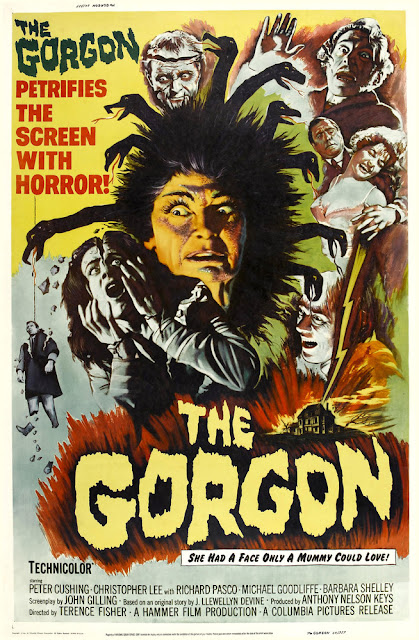
She Had a Face Only a Mummy Could Love

The night’s entertainment: the 1964 Hammer film The Gorgon, because cheap horror is never better than when it’s so very British and so very cavalier with its source material.

 
But I’m a sucker for Medusa and a sudden onset of California winter has me homebound, so whatever. The movie tells the story of the titular monster hiding in an abandoned castle in Germany, allegedly because she fled there after her two sisters were slain. One of the sisters, yes, is named Medusa, so that’s at least right, but this surviving member of the headsnake sisters is named Megaera and the other dead one is Tisiphone. Technically, these latter two are Furies, and the association is strong enough that forms of Megaera’s name mean “shrew” in more than one European language. (The Furies, by the way, are not to be confused with the furries, about which I will not speak, and Megaera is not to be confused with Hercules’s lady love Megara, who in the orginal myth literally gets torn to shreds by him. Let’s just re-write everything while we’re at it?)


The super pressing Gorgon-related question we should be asking, however, is this: If the Gorgon sisters caused whatever they looked at to turn to stone, how the hell did they live together? Careful planning? Deliberate placement of mirrors? Bells around their necks? Was it like Ned and Chuck on Pushing Daisies? Is there possibly a sitcom here? Maybe with Marcia Cross, Jane Leeves and Jami Gertz? Can someone get on this pronto?

My little pet monster, previously:

Sunday, September 28, 2008

Isn't It Gorgonic?

You doesn’t have to try too hard to prove that what early video games put in their instruction manuals didn’t always match up to what appeared on screen. Nonetheless, I was surprised at how very off-model Nintendo’s take on Medusa was when her appearance in Kid Icarus’s instruction manual is compared against what she looked like in the game.

As the concept art puts it:


And her two in-game sprites, neither of them approximate what the instruction manual promised:


The glaring, wall-sized face of death is how she first meeting the player. The swooning, toga-clad woman appears when Missus Big Face crumbles away. Maybe the instruction manual blended the two into one? Wall face or not, this two- or three- or ugly-faced woman is the first-ever female big bad in a Nintendo game, unless I’m mistaken.

There’s no big conclusion here — just a little thought that I had the time to post.

Thursday, November 9, 2006

Snake Wig

Since I first discovered Greek mythology as a kid, I’ve been entranced by it. As a product of Catholic school, I spent a lot of my childhood hearing Biblical stories. In their own right, they’re good, I suppose. Occasionally, they feature the type of extreme violence that grabbed my attention. Greek mythology, however, offered everything: blood, guts, all manner of weird sex, and such freaky monsters that they’re still showing up in random bits of popular culture today.

Easily first among the toothy, mismatched creatures Greek mythology offers us is Medusa. She’s a longtime love of mine. I’ve even written about her before on this blog — “Fiorenze Henderson” and “Pentimento” and “Medusa Meets Monty Python” — but most notably in a post in which I theorized that she could be a symbol for the vilified female artist. Gaze and statues and all that. It makes sense. Look into it. She’s strange and supremely lethal and quite confusing given her dual origin stories.

A sketch of Miss M., done during a boring history lecture

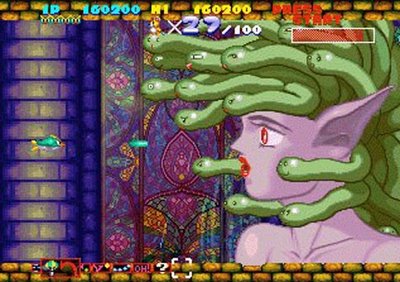
Recently, a fellow blogger wrote a retrospective of the many appearances of ol’ Snakeylocks in video games. She’s a regular, whether she’s depicted as a vixen with an awkward hairdo or an out-and-out monster. Whatever the design, she’s popular in video games because she’s from Greek mythology — thus her presence doesn’t offend Christians — and she’s a powerful female figure.

Reading the article sent me looking into Medusa. I was surprised to find that her name means “queen” — or, literally, “female ruler” or “female guardian” — in some old form of Greek. How odd. Some postulate that the Medusa character may have arisen from a particularly disliked female ruler whom folklore had transformed into a literal monster by the time the Greeks began telling stories. I, however, would wager that something else may have caused the name “Medusa” to ultimately be associated with the ugliest, the most dangerous and the most genuinely awful woman in the canon of literature. (Yes Jezebel and Lady MacBeth were bad, but people could at least look at them without dying.)

Before I ended up completing the English degree I started college pursuing, I bounced around in a few different departments. I took four linguistics classes with Arthur Schwartz, a great professor who helped me get more out of the language I grew up speaking than anybody else who’s ever taught me. One of the things that has long stood out in my head is the phenomenon of words for “left” becoming pejorative over time. For example, look at the following words for “right” from various Indo-European languages.
  • Latin: dexter
  • Italian: destra
  • German: recht
  • French: droite
  • Spanish: derecho
  • Persian: rast
If you’ll notice, a sound pattern is shared by these words. They either start with “d” or “r,” and most of them have both the “d” and “r” syllables in them. Clearly, these words share an etymological connection. And this would make sense, especially since they refer to a basic human concept and the various listed languages all originate in the same basic area.

Now note the same languages’ words for “left.”
  • Latin: sinister
  • Italian: mancino
  • German: link
  • French: gauche
  • Spanish: izquierda
  • Persian: chap
The relationship among these words vanishes. It might initially seem curious that the words for “left” wouldn’t share a connection with their respective opposites do. However, as Prof. Schwartz explained, another basic human concept is the profanity of the left hand. That side of the body — and especially that hand — is considered so dirty, in fact, that the centuries and centuries of using it eventually makes it impolite to use, similar in the way that “sinister” today means “evil” in English. Thus, before people began writing words down, they’d cycle through words for this idea fairly quickly. Even now that language is more formalized, we’re still doing it. The American expression “left-handed compliment” helps prove this.

This post, however, concerns Medusa. Using the logic of the eventual debasement of words for “left,” I’d wager something similar happened with Medusa. Just as the longstanding view of western culture regards the left hand as the inferior of the right, women, unfortunately, have long been regarded as the inferiors to men. I think that because of this prejudice, words referring to women also suffer the same fate.

I can think of a few examples in contemporary English-speaking culture. Another bit I learned in one of Schwartz’s classes is that a little-known word exists that is a perfect homonym for “queen.” It’s “quean,” which is sometimes spelled “kwean” or “kween,” depending on who’s doing the translating. Now obsolete, “quean” refers to women of little status — nobodies, serfs and the like. The Scots still use it this way. Outside of Scotland, however, the word can also refer to a prostitute or even a male homosexual, the latter of which is made all the more confusing by the fact that we use the more familiarly spelled “queen” today to also mean a male homosexual. The whole essence of what I’m going for here is that queens and queans could easily be considered social opposites. And I find it very interesting that a language would allow for two words with identical pronunciation to mean opposites.

Though it’s probably the best example, we have a few terms we use commonly that work in a similar way. The word “madam,” for example, should be a term of respect, but I know I can’t hear it without hearing the meaning that refers to women in charge of brothels. Likewise, “lady” should be the respectful way one refers to a woman of standing, but to call a woman that — as in, “Listen, lady” — is often considered impolite. A “princess” is more commonly understood as a spoiled girl than the Diana or Cinderella types. “Mary,” long the most common girls' name in the United States, is now a commonly understood term for a male homosexual, which doesn't carry as much perjorative weight today, sure, but did when the term first originated. And then there's “spinster,” “mistress,” “witch,” “bitch,” and “actress” as opposed to “actor.” Even the title “Miss” is now considered improper.

It happens. Words take on new meaning over time, and unless they refer to what their speakers consider good, those meanings often turn out to be bad. I can only imagine that “Medusa” — being an old, old word — has slowly transformed into from a female ruler to the single worst female entity you’d ever want to encounter.

I just enjoy that this monster has roots in something far different. In Sexual Personae, Camille Paglia writes that Medusa is an inherently sexual character. “She is Medusa, in whom Freud sees the castrating and castrated female pubes. But Medusa's snaky hair is also the writhing vegetable growth of nature. Her hideous grimace is men's fear of the laughter of women.” I think she makes a point. And I also think that whether people process the notion of Medusa’s origins or not, they’re aware of her dual nature on some level.

To go back to the Medusa-in-video games post, why else might this loathsome woman come to be represented as beautiful?


Nothing is more interesting than when it’s something and that things opposite at the same time. Does that even make sense?

Sunday, December 25, 2005

Medusa Meets Monty Python

Perhaps you've noticed my tendency to discuss odd tidbits of popular culture, sometimes in groups that wouldn't necessarily seem to go together and sometimes in groups that don't go together. I like these little pieces of random and I think it shows.

Last week, I came across and article that namechecks, among other things, Medusa, the basilisk, "The Ring," a Monty Python sketch, Stendhal Syndrome, Lady Godiva, a song called "Gloomy Sunday" and that creepy "Red Room" Flash site that allegedly infatuated my new little friend, Nevada-tan. These subjects wouldn't readily seem to share any quality warranting their presence in the same article. And before I read the Wikipedia entry on "Motif of harmful sensation," I wouldn't have expected anything other than something I wrote to include them all, either.

To explain, the motif of harmful sensation is a rather clunkily named phenomenon in which a person is killed or otherwise harmed simply by perceiving something, usually visually or aurally. For example, the video tape in "The Ring" causes people to die, whereas most video tapes do not. Looking at Medusa's face also kills people — though, by turning them to stone, though I suppose that total body petrification should kill someone as well. Looking at most other people, however, does not result in this effect.

I have been aware of this notion for some time, and even been attracted to it, though I never thought to put a name to it or anything. (If I had, I think I would have picked something better than "motif of harmful sensation." Maybe something like "thing-that-isn't-usually-bad-is" or "bad perception thing" or "gooberstumpis" or something.) The motif of harmful sensation, as the Wikipedia calls it, is quite an old concept that has arisen repeatedly in various world cultures.

Notable examples:
  • Like Medusa, the mythical medieval animal called the basilisk, a bird-looking serpent that could turn people to stone just by looking at them.
  • There's a plant called the mandrake that supposedly emits a human-like shriek when it is plucked. The shriek causes instant death.
  • The Stendhal syndrome is a supposedly documented effect in which people become dizzy or ill after viewing a painting or other work of art that they find particularly dazzling.
  • The Chuck Palahniuk novels Lullaby and Diary. In the former, hearing the lyrics to a certain song causes instant death. In the latter, a woman's drawings cause a severe form of Stendhal syndrome.
  • "Gloomy Sunday," also known as the "Hungarian Suicide Song," a little ditty that purportedly drove scads of Hungarians to kill themselves. (I've actually heard the Billie Holiday version of the English translation and like it quite a bit.)
  • The whole thing with the number of God in that movie "Pi."
  • A Monty Python sketch in which the British invent a joke so funny that anyone who hears it will die laughing. The joke is then used as a weapon against the Germans in World War II.
Best part of all, the article also mentions that creepy haunted eBay painting. In fact, the only glaring omission I see is that episode of "The Tick" in which the Queen of the Ottoman Empire tried to steal the Most Comfortable Chair in the World, a seat so accommodating that anybody who sits it in is unable to leave it of their own volition. But that might be different. Maybe.

I'm not sure why I find this so fascinating, but I think it might have something to do with that fact that these things, if they existed, would be forbidden to be perceived — unless you had a death wish, of course. So on top of never being able to see them because they're not real, I would be dead if I had seen them. Shoot.
[ link: the full article ]