You probably remember the 5.6.7.8’s from the finale of Kill Bill: Vol. One. They’re the all-girl rockers covering “Woo Hoo” and “I’m Blue” onstage before everyone starts losing limbs. You may also know them as the band that all those Vonage ads made you start hating, but they seem to have stopped, and thank god for that.
But they have this other, better song called “I Walk Like Jayne Mansfield.” It’s an original, and even if I shuffled “Woo Hoo” off my iTunes — again, because Vonage — this one remained.
Just recently, I found what, precisely, the 5.6.7.8’s were playing off with that track: Mansfield’s side career as a singer and, in particular, the 1965 track “Suey.”
She’s not singing, exactly. She’s sing-talking. If you wanted to get weird about it, you could say that what she’s doing is kinda-sorta a progenitor to rap. Though she certainly wasn’t the only one to do it, she is sing-talking over a beat, and what else is rap, really?
By the way, that’s Jimi Hendrix on lead guitar.
If you’d like to hear Mansfield’s actual singing voice, she had a B-side that same year, “As the Clouds Drift By,” which also features guitar work by Hendrix.
For a song that should be melancholy, it sounds ridiculously saccharine to the point that it’s trying to cover up for something dark. But then you realize you’re watching a slideshow of Mansfield’s heyday while listening to lyrics like “How you left me alone” and “Why’d you drift away?” and “I wonder where you are,” and it gets dark.
Also, after having heard the 5.6.7.8’s version of “Woo Hoo” a million times, it’s strange to hear the original. Ladies and gentlemen, The Rock-a-Teens!
Side note: If Casey Wilson wasn’t born to play Jayne Mansfield in a biopic, I don't know what to believe anymore.
Musical connections I should have made earlier, previously:

Showing posts with label kill bill. Show all posts
Showing posts with label kill bill. Show all posts
Wednesday, October 1, 2014

Sunday, April 3, 2011
A (Mostly) Satisfied Mind
So now I know: The Bride, at the end of the first volume of Kill Bill made good on her threat that she’d cut off another one of Sofie Fatale’s body parts.
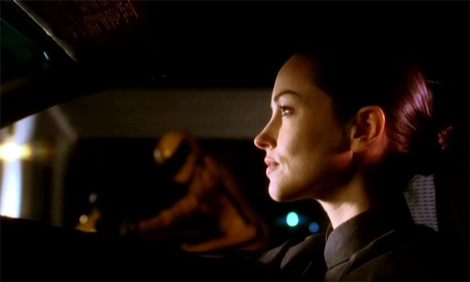
Possibly because I imagined that rage inspires creativity, I guessed that when the Bride said she’d amputate something “that you will miss,” she was referring to Sofie’s breasts. She wasn’t. In the extended version of the scene in Kill Bill: The Whole Bloody Affair, the Bride takes off Sofie’s remaining arm. Cue gushing. True, it had already been done, but it still sent a message.
However, rewatching Kill Bill for the first time in years, I realize I still have a few questions about the story. And they are these:
Kill Bill, previously:
Possibly because I imagined that rage inspires creativity, I guessed that when the Bride said she’d amputate something “that you will miss,” she was referring to Sofie’s breasts. She wasn’t. In the extended version of the scene in Kill Bill: The Whole Bloody Affair, the Bride takes off Sofie’s remaining arm. Cue gushing. True, it had already been done, but it still sent a message.
However, rewatching Kill Bill for the first time in years, I realize I still have a few questions about the story. And they are these:
- B.B. is four years old. So is Vernita’s daughter, Nikki. What are the odds that both B.B. ands Nikki were both fathered by Bill? I mean, why wouldn’t Bill sleep with all the female Deadly Vipers? And wouldn’t the revelation of them being half-sisters make for a great plot twist for when Nikki and B.B. face off? That is, if Volume Three ever happens?
- That said, why is Vernita allowed to leave the group when Beatrix was not? Is it only because Bill loved Beatrix? This may actually be the case, given that Budd has clearly also left the group by the time Volume Two takes place.
- Is Elle supposed to be older than Beatrix? In real life, Daryl Hannah is about ten years older than Uma Thurman, and you can tell in the movie just by looking at the two actresses. (No offense intended, Ms. Hannah.) But upon considering the plot, it seems like Elle joined the squad after Beatrix. She’s clearly resentful for having played second fiddle to Beatrix for so long, and she trained with Pei Mei after Beatrix, which is how Elle was able to kill him without Beatrix knowing. Perhaps Elle was just older when Bill recruited her?
- Is Bill present when O-Ren’s parents get murdered? I’ve read this a few times, and I’d heard the animated part of Whole Bloody Affair clears this up with a few extra frames, but I still couldn’t tell. Supposedly, based on the the sword and the rings sported by the guy who kills Mr. and Mrs. O-Ren, you can argue that he’s actually Bill in his younger days. If that is Bill there, I wonder if O-Ren knew this.
- So the final cut of the movie lacked a chapter included in an early version of the script. In it, Gogo’s sister, Yuki, chases Beatrix around Los Angeles in an ice cream truck. You can hear and see the truck driving around Pasadena at the beginning and end of the first chapter. It’s a nice little nod to what could have been, I guess, but I wonder if Tarantino kept it because he filmed the Vernita scene without having decided whether to include this chapter as well.
- Seeing the movie this weekend, I realized that Aubrey Plaza is a Gogo Yubari who channeled her malevolence into sarcasm. Think about it. (Not a question, I know.)
- Why “Arlene Machiavelli”?
- Dude, seriously: What is up with Tarantino and naming Kill Bill characters after letters?
- While we’re at it: I still can’t think of a good reason why Tarantino thought to bleep Beatrix’s name until Elle speaks it.
- Where, exactly, was the scene with Michael Jai White supposed to fit in?
- Why two different sets of credits? Seeing Volume Two back in the day, I guessed that the two different credits — the one with the whole cast and then the one with Beatrix driving her car — resulted from the film being split into two halves. But what I watched last night is supposedly the cut of the film that initially screened at Cannes. (I mean, it did have the French subtitles.) This version still had both credit sequences. It sounds weird to say in reference to this movie, but doesn’t two separate sets of credits seem like, well, overkill?
Kill Bill, previously:
Thursday, March 11, 2010
Less Intimidating Members of the Deadly Viper Assassination Squad
Recall, if you will, Kill Bill’s Deadly Viper Assassination Squad: Beatrix Kiddo (“Black Mamba”), Oren Ishii (“Cottonmouth”), Vernita Green (“Copperhead”), Budd (“Sidewinder”) and Elle Driver (“California Mountain Snake”). Presumably, had Kiddo not made good on the imperative stated in the film’s title, Bill could have extended membership to other murderers. He did, after all, lack the redhead and brunette needed to make a complete set.
Among available, though far less badass, code names:

Above: the eyelash viper, unless you think it can’t possibly be intimidating.
Among available, though far less badass, code names:
- Ball python
- Banana boa
- Beak-nosed worm snake
- Butterfly adder
- Candy stick
- Children’s python
- Christmas Island blind snake
- Deaf adder
- Eyelash boa
- Monocled cobra
- Muck rattler
- Rainbow boa
- Red carpet viper
- Rusty moccasin
- Sunbeam snake
- Water pilot

Above: the eyelash viper, unless you think it can’t possibly be intimidating.
Monday, June 23, 2008
Death, Cars and the Power of Names
A thought upon seeing Death Proof for the third time.
As I said in my first blogged essay on the film, the first set of girls — Syndey Poitier, Jordan Ladd and Vanessa Ferlito’s characters, plus Rose McGowan, depending on how you look at it — function in a significantly different way than do the second set — Tracie Thoms, Rosario Dawson, and Zoe Bell, plus Mary Elizabeth Winstead, depending on how you look at it, and I’m not just talking about how the fact that the second group survives the film. In essence, the first group are the film’s Marion Cranes — the flighty ladies ultimately doomed by their inability to act as adults. The second group act more sensibly and manage to defeat the film’s big bad, so I’ll call them the Lila Cranes.
 left to right: Marion Crane, Marion Crane and Marion Crane
Seeing the film for a third time has helped me notice a strange trend in the first half, with the Marions. There’s some strange goings-on with these characters’ names. Maybe it’s unintentional on Quentin Tarantino’s part, but the fact his other films have included some names that indicate that he does, in fact, name his characters for a reason make me think he could have planned this out. Fun with names abound in Tarantino films, by the way. In Kill Bill alone, there’s a staggering amount of “letter play” going on, with this name and that name referencing individual letters: Beatrix (B), Bill (B), their daughter BB, Bill’s brother Budd (another B), O-ren (O), Jeanie Bell (G), Elle Driver (L), Karen Kim (a double K), Gogo Yubari (a double G), and two axed characters, Yuki Yubari (a double Y) and L.F. O’Boyle. Aside from that, a lot of the characters have more than one name. Uma Thurman’s character alone goes variously by The Bride, Beatrix Kiddo, Black Mamba and Arlene Machiavelli and is damn near buried under a gravestone marked Paula Schulz.
But back to Death Proof.
Back when I took classes, I can remember literature professors speaking more than once of an old superstition about wariness about telling strangers your name. Knowing a person’s name, in various senses, gives others a certain power over that person. You can call them out, curse them out, Google them ad nauseam, file a lawsuit against them, stalk them on MySpace or, at the very least, tell everybody you know that So-and-So isn’t the superstar he or she claims to be.
I’ve talked up the point too much by now, but I feel like it’s worth pointing out that the three main Marions — who, again, meet bad ends — each encounter some odd business with men and their names. (I’m only picking the three, because they’re the only real main characters in the first part. Lana Franks, who dies in the big crash scene midway through the scene, basically has three lines and only serves to drive the Marions into certain death. Pam (McGowan), who gets more than three lines, is clearly excluded from the main group.) Julia (Poitier), for example, is almost universally known as Jungle Julia, the name she uses as a DJ. The only person who ever uses her full name is Pam, who’s known Julia since childhood and freely divulges that Julia wasn’t always the statuesque beauty she is today. (Or was, given that she’s dead now.) There’s a big difference between Jungle Julia and Julia Lucai, and there’s a big difference between knock-out and a gangly junior high schooler. With Arlene (Ferlito), a fake name manages to simultaneously protect her and put her in danger. Julia, as part of her radio show, announces that her friend will be visiting from out of town and encourages men to approach her, buy her a drink and recite a passage from “Stopping by Woods on a Snowy Evening.” Only Julia tells her listeners that this friend is named “Butterfly,” which manages to protect her identity a little bit. And finally there’s Shanna (Ladd), who takes offense to a bar dude accidentally calling her “Shauna.” She’s protective of her name, a rightly so. “Now there is one thing every girl in the whole world whose name is ‘Shanna’ has in common with each other: We all hate the name ‘Shauna.’ And we really hate when people call us ‘Shawna.’ Remember it’s Shanna Banana, not Shauna Banahnah.”
It’s all a moot point, this name protectiveness, I guess, because, as I said, they all die. The women in the second half of Death Proof don’t, and no one seems to talk about their names all that much. Maybe that’s intentional and maybe it’s not, but there’s a lot that Tarantino wrote to parallel between the film’s two halves — bad things happening on birthdays, lousy Hollywood boyfriends, nasty business with legs — and other elements that don’t, in an apparent effort to contrast the second group against the first group.
As I said in my first blogged essay on the film, the first set of girls — Syndey Poitier, Jordan Ladd and Vanessa Ferlito’s characters, plus Rose McGowan, depending on how you look at it — function in a significantly different way than do the second set — Tracie Thoms, Rosario Dawson, and Zoe Bell, plus Mary Elizabeth Winstead, depending on how you look at it, and I’m not just talking about how the fact that the second group survives the film. In essence, the first group are the film’s Marion Cranes — the flighty ladies ultimately doomed by their inability to act as adults. The second group act more sensibly and manage to defeat the film’s big bad, so I’ll call them the Lila Cranes.
 left to right: Marion Crane, Marion Crane and Marion Crane
Seeing the film for a third time has helped me notice a strange trend in the first half, with the Marions. There’s some strange goings-on with these characters’ names. Maybe it’s unintentional on Quentin Tarantino’s part, but the fact his other films have included some names that indicate that he does, in fact, name his characters for a reason make me think he could have planned this out. Fun with names abound in Tarantino films, by the way. In Kill Bill alone, there’s a staggering amount of “letter play” going on, with this name and that name referencing individual letters: Beatrix (B), Bill (B), their daughter BB, Bill’s brother Budd (another B), O-ren (O), Jeanie Bell (G), Elle Driver (L), Karen Kim (a double K), Gogo Yubari (a double G), and two axed characters, Yuki Yubari (a double Y) and L.F. O’Boyle. Aside from that, a lot of the characters have more than one name. Uma Thurman’s character alone goes variously by The Bride, Beatrix Kiddo, Black Mamba and Arlene Machiavelli and is damn near buried under a gravestone marked Paula Schulz.
But back to Death Proof.
Back when I took classes, I can remember literature professors speaking more than once of an old superstition about wariness about telling strangers your name. Knowing a person’s name, in various senses, gives others a certain power over that person. You can call them out, curse them out, Google them ad nauseam, file a lawsuit against them, stalk them on MySpace or, at the very least, tell everybody you know that So-and-So isn’t the superstar he or she claims to be.
I’ve talked up the point too much by now, but I feel like it’s worth pointing out that the three main Marions — who, again, meet bad ends — each encounter some odd business with men and their names. (I’m only picking the three, because they’re the only real main characters in the first part. Lana Franks, who dies in the big crash scene midway through the scene, basically has three lines and only serves to drive the Marions into certain death. Pam (McGowan), who gets more than three lines, is clearly excluded from the main group.) Julia (Poitier), for example, is almost universally known as Jungle Julia, the name she uses as a DJ. The only person who ever uses her full name is Pam, who’s known Julia since childhood and freely divulges that Julia wasn’t always the statuesque beauty she is today. (Or was, given that she’s dead now.) There’s a big difference between Jungle Julia and Julia Lucai, and there’s a big difference between knock-out and a gangly junior high schooler. With Arlene (Ferlito), a fake name manages to simultaneously protect her and put her in danger. Julia, as part of her radio show, announces that her friend will be visiting from out of town and encourages men to approach her, buy her a drink and recite a passage from “Stopping by Woods on a Snowy Evening.” Only Julia tells her listeners that this friend is named “Butterfly,” which manages to protect her identity a little bit. And finally there’s Shanna (Ladd), who takes offense to a bar dude accidentally calling her “Shauna.” She’s protective of her name, a rightly so. “Now there is one thing every girl in the whole world whose name is ‘Shanna’ has in common with each other: We all hate the name ‘Shauna.’ And we really hate when people call us ‘Shawna.’ Remember it’s Shanna Banana, not Shauna Banahnah.”
It’s all a moot point, this name protectiveness, I guess, because, as I said, they all die. The women in the second half of Death Proof don’t, and no one seems to talk about their names all that much. Maybe that’s intentional and maybe it’s not, but there’s a lot that Tarantino wrote to parallel between the film’s two halves — bad things happening on birthdays, lousy Hollywood boyfriends, nasty business with legs — and other elements that don’t, in an apparent effort to contrast the second group against the first group.
Saturday, January 26, 2008
The Calendar on Your Wall Is Ticking
Dina, to answer your question.

This is Kami and I on Halloween in 2005, I think. I'm a Crazy 88 from Kill Bill, Kami is a flamingo. I'm stabbing her because that's what Crazy 88s do to waterfowl. I scanned this photo, which previously did not exist in digital form, because Kami recently emailed me with the below image.

This is Kami and I. I'm not sure when, but possibly in 2004 or 2005. She had been invited to a school-themed party in which attendees were expected to dress up like they went to a private school and then follow a class schedule that had people shifting from room to room. Flaming Dr. Peppers in the science lab, body shots in Sex Ed, drinks vaguely associated with historical figures in history. You get the idea. In all, the party worked pretty well. But Kami had the idea to dress up as exchange students and act like we didn't understand anything. Hence the awkward, vaguely foreign clothes.
Now you know Dina. World, you too.
This is Kami and I on Halloween in 2005, I think. I'm a Crazy 88 from Kill Bill, Kami is a flamingo. I'm stabbing her because that's what Crazy 88s do to waterfowl. I scanned this photo, which previously did not exist in digital form, because Kami recently emailed me with the below image.
This is Kami and I. I'm not sure when, but possibly in 2004 or 2005. She had been invited to a school-themed party in which attendees were expected to dress up like they went to a private school and then follow a class schedule that had people shifting from room to room. Flaming Dr. Peppers in the science lab, body shots in Sex Ed, drinks vaguely associated with historical figures in history. You get the idea. In all, the party worked pretty well. But Kami had the idea to dress up as exchange students and act like we didn't understand anything. Hence the awkward, vaguely foreign clothes.
Now you know Dina. World, you too.
Thursday, January 24, 2008
Action Movies and Bad Decisions
Discussed herein: bad decisions, pompous movie reviewers, Cloverfield, various kinds of death, Scream, whether Sofie Fatale's dismemberment in Kill Bill was realistic or not, the difference between watching a movie and being in a movie
People think highly of themselves when it comes to reviewing action movies, I’ve noticed. Even the most self-depreciating schlub will credit himself with having laser-precise critical thinking abilities in bullet-ridden, explosion-rattled action scenes. He’ll criticize a movie’s characters for making decisions that seem illogical, all from the comfort of his theater seat and with the buffer of reality between him and the on-screen action. Given the luxury of retrospect, which action movies rarely provide, these characters might also realize the flawed nature of their actions, I suppose, though the more frequent result of boo-boos in shoot-em-ups would probably be getting shot up.
Mr. Naysayer irks me just a little. Though he has every right to say that a characters’ illogical actions prevented him from enjoying a give n movie, I feel like he might be holding folks on screen to higher standards than he would himself if he were plunked into a real-life version of a hokey action scene.

A discussion of Cloverfield on a blog I’ve started following prompted this train of thought. (And for the record, stop reading if you have any desire to see Cloverfield without knowledge of what kind of horrible end the film’s characters meet.) More than a few readers said they felt annoyed at the inherent stupidity of the movie’s human protagonists. (I specify “human protagonists” because the real star, of course, is the monster.) I admit that these people’s decision to travel back into a destroyed Manhattan to rescue a friend was a foolish one. The characters themselves probably realized this two, seeing as how all but one dies in some kind of horrible fashion. (In order: taken down along with the collapsing Brooklyn Bridge, swollen to the point of bursting as a result of some evil monster venom, eaten and then spit out, and then broiled the military-initiated inferno that ultimately destroys all of Manhattan. Only one of the six escapes the island on a helicopter, and even her survival isn’t assured.) But given their fractured mental state and the events leading up to their ill-fated trek through the city, I wonder if they could have been able to make a good decision.
In the film, de facto leader Robert (Michael Stahl-David) seems shellshocked enough by the arrival of the monster and the subsequent death of his brother Jason (Mike Vogel) on the bridge that a phone call from a seriously injured Beth (Odette Yustman) sends him back to rescue her. Lily (Jessica Ford), the only apparent survivor and the girlfriend of the newly dead brother, agrees to come along too, possibly out of some displaced grief over the end of her relationship — if she and Jason are no longer, then why shouldn’t every effort be made to help Robert and Beth? In a way, her decision to come along can almost make sense in light of the fact that whatever heroics she performs could erase her guilt at letting Jason die. Finally, two more — amateur videographer Hud (T.J. Miller) and sardonic hanger-on Marlena (Lizzy Caplan) — follow along in a manner one reviewer accurately described as lemming-like. But even then, does walking into certain death with people you know beat out risking possible death alone? Hud and Marlena seem to think so, even though people in that situation probably wouldn’t have ever consciously processed that thought.
Yes, the decision is a terrible one. But it’s easy to say that because we the audience members don’t share the bonds of friendship that we’re led to believe drive these characters to act like assholes. (A thought: Saving Private Ryan meets Godzilla.) My defense of the characters' collective lack of logic was perhaps a lousy one: It’s a monster movie and therefore it doesn’t matter. But even the review that the Independent ran this week noted that Cloverfield’s human protagonists are essentially the extras in the movie. The heroes working to stop the beast don’t figure largely into the story, and, much like the unimportant normals appearing in most such films, these "extras" do stupid things and die. For some, it seems, these people’s decisions proved far more problematic. I have to wonder, though, even if they didn’t make choices as horrendously bad as the Cloverfield cast’s, would they really be so on top of their game? How, exactly, does one not die in a monster attack?
The situation reminds me a lot of Scream, a good movie that spawned a whole genre of deathly boring imitators whose characters seems all-too-aware of how people should act in movies but died anyway. In Scream, Neve Campbell’s character has that awesome line about slasher movies in which she calls them “insulting” because they routinely feature “some stupid killer stalking some big-breasted girl who can't act who is always running up the stairs when she should be running out the front door.” Then she’s promptly put in her place when the killer comes after her and she stupidly flees up the stairs, proving that even the most self-aware person might cease to function so calmly and coolly when thrust into an adrenaline-raddled state. To compare this all to another film, I’m going to recall how some friends deemed Kill Bill unrealistic for having Bellagio-style fountains of blood flowing from body holes. I countered with “That’s the point, you shit,” and followed up with the notion that most of them haven’t ever chopped off somebody’s arm with a samurai sword and for all they knew, Sofie Fatale’s dismemberment happened entirely realistically.
In the end, I guess my point is entirely moot. As I already said, everybody has their own opinion about what in a given movie worked and what didn’t. However, I just hope that people declaring that the girl running down the alley in a life-or-death frenzy should have totally turned left when she instead turned right. (The idiot.) Movie characters definitely must be held to some sort of realistic standard for the choices they make, but those critiquing these movies should also stop and ask themselves two questions: “Would I have actually been able to think clearly, given the situation?” and “Do this quibbles in motivation really matter in this kind of movie?”
People think highly of themselves when it comes to reviewing action movies, I’ve noticed. Even the most self-depreciating schlub will credit himself with having laser-precise critical thinking abilities in bullet-ridden, explosion-rattled action scenes. He’ll criticize a movie’s characters for making decisions that seem illogical, all from the comfort of his theater seat and with the buffer of reality between him and the on-screen action. Given the luxury of retrospect, which action movies rarely provide, these characters might also realize the flawed nature of their actions, I suppose, though the more frequent result of boo-boos in shoot-em-ups would probably be getting shot up.
Mr. Naysayer irks me just a little. Though he has every right to say that a characters’ illogical actions prevented him from enjoying a give n movie, I feel like he might be holding folks on screen to higher standards than he would himself if he were plunked into a real-life version of a hokey action scene.

A discussion of Cloverfield on a blog I’ve started following prompted this train of thought. (And for the record, stop reading if you have any desire to see Cloverfield without knowledge of what kind of horrible end the film’s characters meet.) More than a few readers said they felt annoyed at the inherent stupidity of the movie’s human protagonists. (I specify “human protagonists” because the real star, of course, is the monster.) I admit that these people’s decision to travel back into a destroyed Manhattan to rescue a friend was a foolish one. The characters themselves probably realized this two, seeing as how all but one dies in some kind of horrible fashion. (In order: taken down along with the collapsing Brooklyn Bridge, swollen to the point of bursting as a result of some evil monster venom, eaten and then spit out, and then broiled the military-initiated inferno that ultimately destroys all of Manhattan. Only one of the six escapes the island on a helicopter, and even her survival isn’t assured.) But given their fractured mental state and the events leading up to their ill-fated trek through the city, I wonder if they could have been able to make a good decision.
In the film, de facto leader Robert (Michael Stahl-David) seems shellshocked enough by the arrival of the monster and the subsequent death of his brother Jason (Mike Vogel) on the bridge that a phone call from a seriously injured Beth (Odette Yustman) sends him back to rescue her. Lily (Jessica Ford), the only apparent survivor and the girlfriend of the newly dead brother, agrees to come along too, possibly out of some displaced grief over the end of her relationship — if she and Jason are no longer, then why shouldn’t every effort be made to help Robert and Beth? In a way, her decision to come along can almost make sense in light of the fact that whatever heroics she performs could erase her guilt at letting Jason die. Finally, two more — amateur videographer Hud (T.J. Miller) and sardonic hanger-on Marlena (Lizzy Caplan) — follow along in a manner one reviewer accurately described as lemming-like. But even then, does walking into certain death with people you know beat out risking possible death alone? Hud and Marlena seem to think so, even though people in that situation probably wouldn’t have ever consciously processed that thought.
Yes, the decision is a terrible one. But it’s easy to say that because we the audience members don’t share the bonds of friendship that we’re led to believe drive these characters to act like assholes. (A thought: Saving Private Ryan meets Godzilla.) My defense of the characters' collective lack of logic was perhaps a lousy one: It’s a monster movie and therefore it doesn’t matter. But even the review that the Independent ran this week noted that Cloverfield’s human protagonists are essentially the extras in the movie. The heroes working to stop the beast don’t figure largely into the story, and, much like the unimportant normals appearing in most such films, these "extras" do stupid things and die. For some, it seems, these people’s decisions proved far more problematic. I have to wonder, though, even if they didn’t make choices as horrendously bad as the Cloverfield cast’s, would they really be so on top of their game? How, exactly, does one not die in a monster attack?
The situation reminds me a lot of Scream, a good movie that spawned a whole genre of deathly boring imitators whose characters seems all-too-aware of how people should act in movies but died anyway. In Scream, Neve Campbell’s character has that awesome line about slasher movies in which she calls them “insulting” because they routinely feature “some stupid killer stalking some big-breasted girl who can't act who is always running up the stairs when she should be running out the front door.” Then she’s promptly put in her place when the killer comes after her and she stupidly flees up the stairs, proving that even the most self-aware person might cease to function so calmly and coolly when thrust into an adrenaline-raddled state. To compare this all to another film, I’m going to recall how some friends deemed Kill Bill unrealistic for having Bellagio-style fountains of blood flowing from body holes. I countered with “That’s the point, you shit,” and followed up with the notion that most of them haven’t ever chopped off somebody’s arm with a samurai sword and for all they knew, Sofie Fatale’s dismemberment happened entirely realistically.
In the end, I guess my point is entirely moot. As I already said, everybody has their own opinion about what in a given movie worked and what didn’t. However, I just hope that people declaring that the girl running down the alley in a life-or-death frenzy should have totally turned left when she instead turned right. (The idiot.) Movie characters definitely must be held to some sort of realistic standard for the choices they make, but those critiquing these movies should also stop and ask themselves two questions: “Would I have actually been able to think clearly, given the situation?” and “Do this quibbles in motivation really matter in this kind of movie?”
Wednesday, May 23, 2007
O-Ren Before There Was an O-Ren
A rare title card from the Japanese film Lady Snowblood.

It's a fantastic movie that Kill Bill owes more to than perhaps any other influence. Think of Kill Bill's plot set in 1700s Japan and with Lucy Liu's character, O-ren Ishii, as the heroine on the hunt for revenge. Considering that Lady Snowblood came out in 1973, the above image is in remarkable condition, so much so that it looks like it could actually be a still from a scene in the intentionally retro Kill Bill.
Of course, that may well have been the point.
It's a fantastic movie that Kill Bill owes more to than perhaps any other influence. Think of Kill Bill's plot set in 1700s Japan and with Lucy Liu's character, O-ren Ishii, as the heroine on the hunt for revenge. Considering that Lady Snowblood came out in 1973, the above image is in remarkable condition, so much so that it looks like it could actually be a still from a scene in the intentionally retro Kill Bill.
Of course, that may well have been the point.
Saturday, April 7, 2007
Gruesome Friday
In inexcusable defiance of the Good Friday mandates, I spent one-eighth of it in a movie theater, staring at a film countless other sickos and disaffected weirdoes had no doubt been awaiting for months: Grindhouse. In my defense, I didn’t drink all day and while I was eating my hamburger I was secretly wishing that I had more French fries instead of a said meat patty.
That basically equals not eating meat, right?
.jpg)
Anyway, the point of the occasion was not just to catch the first legitimately good post-modern horror movie since Scream or even to watch two movies for the price of one. No, I went to see Tarantino’s latest. I saw Pulp Fiction on VHS, Jackie Brown on DVD and, finally, both volumes of Kill Bill in theaters — four times each, including once back-to-back at Campbell Hall. I think Tarantino’s movies are fun and eye-popping — yes, literally, ha ha — but also interesting commentaries on cinema itself and on the melting pot nature of California society. Simply put, I think Kill Bill was one of the most fascinating feminist films I have ever seen, even if it took a rather roundabout route to get to its message of maternal might.
To be fair, I was pleasantly surprised by Planet Terror, Robert Rodriguez’s contribution to the double feature. The idea of an Aliens-style zombie flick in which the undead are inexplicably wearing camouflage and shooting machine guns should repulse me, but Rodriguez made the jokes work surprisingly well and found a kickass leading lady in the form of Rose McGowan. I’ve had a small crush on McGowan ever since my 14-year-old self saw her in Scream — which incidentally came out ten years ago and marked the last time McGowan landed a decent role. As good as McGowan was, I’d be remiss to skip mention of Wendy Peppercorn herself, Marley Shelton, whose partially paralyzed bisexual syringe nympho doctor made for some of the film’s funniest moments, as the typical partially paralyzed bisexual syringe nympho stock characters often do.
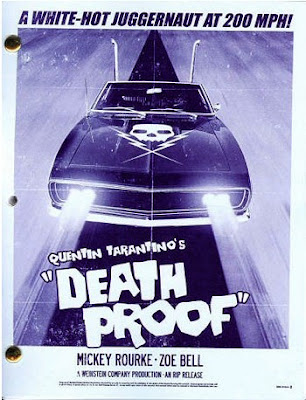
The real treat for me, however, was Death Proof, Tarantino’s contribution and a slasher in the loosest sense of the term. I’ve been perplexed by some reviews of Grindhouse which praise Planet Terror and deride Death Proof as dull, dialogue heavy and oddly paced. Granted, I’ve already blown by cover as a Tarantino fanboy by the preceding paragraphs, so my critical analysis of the film has already been rendered moot. Regardless, let me say that Death Proof expertly combined the slasher and car chase movies together to make a film that is uniquely American in its symbolism and perhaps a culmination of years of Freudian readings of previous lady-stalked-by-psycho-pervert movies.
I’ll go ahead anyway, if you’ll permit. (And please, if you have not seen the movie, please do so. It’s good. Also, what follows will spoil the film. You have been warned.)
Let me explain.
The film quickly introduces Jungle Julia (Sydney Poitier, formerly of Veronica Mars), an Austin DJ who meets up with two friends — Shanna (Jordan Ladd), a local, and Arlene (Vanessa Ferlito), a visitor — for drinks, food and more drinks. During the second round of drinking, Pam (Rose McGowan, playing the dumb blonde twin of her Planet Terror self) shows up and makes small talk with Stuntman Mike (Kurt Russel), a seemingly pitiable creep who drives a muscle car. When everybody is done drinking, Pam hitches a ride with Stuntman Mike, who assures that his car is “death proof” — only he means for him specifically and not Pam. Stuntman Mike whips the car around in such a manner that Pam is crushed to death inside the passenger side of the cab. Mike promptly flips a U and chases after Julia, Arlene and Shanna — who are purportedly heading up to a lakeside cabin for a girls’ weekend, a stereotypical set-up for a slasher movie plot if there ever was one — passes the girls, flips another U and then slams head-on into their car in one of the most jarringly gruesome crash scenes I have ever seen in a movie. Tarantino replays the moment of impact over and over again from each girl’s perspective. You see Julia’s leg get severed, Shanna be ejected high into the sky and the tires of Mike’s car drag across Arlene’s face in the back seat. It’s devastating, especially since the film does a decent job of making these girls seem likeable.
Mike survives.
Sometime later, we see another foursome: stuntwoman Kim (Tracie Thoms, light years away from her characters in Wonderfalls, Rent or The Devil Wears Prada), stuntwoman Zoe (Zoe Bell, Uma’s stuntwoman from Kill Bill, playing a slightly off version of her badass New Zealand herself), make-up artist Abernathy (Rosario Dawson) and starlet Lee (Mary Elizabeth Winstead). The girls are taking a road trip in celebration of a short holiday from work on a new movie.
Zoe admits that she wanted to pass through a certain rural town in order to test ride a certain model of Dodge Challenger — specifically the one Kowalski drives in Vanishing Point — and play ship’s mast, a game involving a person spreading themselves on a speeding car’s hood by securing hands to sideview mirrors with belts. They do — minus Lee, the collateral for use of the car — and Stuntman Mike shows up, delighting in the chance to run the women off the road. The women fight back, however, and following a half-hour car chase through the rural roads of Tennessee — actually Buellton and Solvang cow country — they manage to flip Mike’s car, whereupon they beat him to death in scene reminiscent of Faster, Pussycat! Kill! Kill!
Short and sweet.
What's driving me nuts is trying to figure out why the first group of girls died and the second survived. Death Proof marks the second occasion in which Tarantino has put female characters on a mission to violently rectify a wrong committed by an older male character. Now, as much of a dick as Tarantino can be, I think he earnestly loves women — as a group, as individuals and sometimes two at a time. And while the occasional grindhouse-era film did feature women as masters of their own fate — Switchblade Sisters, Lady Snowblood and Black Mama, White Mama, to name a few — more often than not the women in these movies either amounted to pretty background set pieces or cannon fodder. Thus, I feel like Tarantino is now making films that give these women a chance to strike back and mistreat their male captors with the same malice that their forerunners suffered.
So why favor the stuntwomen but allow the DJ and her friends to die so horribly?
I may be way off, but I feel like Tarantino may have written the two sets of women specifically to explain his thinking on the "right" kind of female movie character. Essentially, Julia and her friends are party girls. We don't see them do anything but drink, dance, smoke cigarettes, smoke pot and then die. Aside from breaking the cardinal rules of how to survive a horror film, Julia and her friends also exhibit ways in which they embody the stereotype of "the weaker sex."
Julia, an otherwise confident and powerful woman, steps away from the group to send pathetic text messages to some moviemaker love of hers. When it's clear the man will not be meeting up with her, she drunkenly texts "UR A ASSHOLE!" to him and mopes. Shanna seems too dumb to realize that the boys at the bar who can't remember her name probably don't give a shit about her other than as a sex object. And Arlene lets Julia guilt trip her into giving Stuntman Mike a lap dance as a dare. (The act, arguably, could be what seals the girls' fate as Mike's next victims.) Even Pam, a relatively minor character, speaks in a catty manner about growing up in Austin with Julia and then foolishly gets into a stranger’s car. Bad move, Pam.
The four later women act more sensibly. First off, they have passions — jobs they genuinely seem to love. Also, both Kim and Zoe are masculinized by the fact that they are stuntwomen and also, as we learn, gearheads. They get why the primo Dodge Challenger is such a big deal. However, both are feminine in their behavior — Kim admits to growing up watching John Hughes movies, for example, and all four dish about guys. They key difference here, as I see it, is how the rest of the girls treat their lovelorn member. Whereas Julia's friends don’t discourage her from pining for her director boyfriend, Abernathy's crew tell her to get over herself when she explains her unrequited love for her own auteur lover. Essentially, the group demands that its members stand up for themselves.
This notion comes into play when Abernathy, previously passive in how she deals with people, requests that they chase after Stuntman Mike. I believe her words come out as something like “Let’s kill the fucker.” Given such encouragement from a previously non-active character — a make-up artist and a mother, as Zoe mentions — the three launch after Mike’s car and eventually relish in beating the crap out of him. (He did, after all, endanger their lives as a means of getting his kicks.)
In a way, one could liken to Death Proof’s two parts to those of Psycho — with Julia, Arlene and Shanna being the dingy, flighty Marion Cranes who seem like they would be the central characters but who suddenly and violently fall victim to the killer. Kim, Zoe and Abernathy would be the level-headed Lila Cranes, who appear in the second segment and manage to reason their way out of a dangerous situation and avenge the death of their “sisters.”
That’s what I have so far, at least as something that can explain a movie that seems to be eliciting a divided reaction among viewers.
Other weirdness about Death Proof that merits mentioning:
That basically equals not eating meat, right?
.jpg)
Anyway, the point of the occasion was not just to catch the first legitimately good post-modern horror movie since Scream or even to watch two movies for the price of one. No, I went to see Tarantino’s latest. I saw Pulp Fiction on VHS, Jackie Brown on DVD and, finally, both volumes of Kill Bill in theaters — four times each, including once back-to-back at Campbell Hall. I think Tarantino’s movies are fun and eye-popping — yes, literally, ha ha — but also interesting commentaries on cinema itself and on the melting pot nature of California society. Simply put, I think Kill Bill was one of the most fascinating feminist films I have ever seen, even if it took a rather roundabout route to get to its message of maternal might.
To be fair, I was pleasantly surprised by Planet Terror, Robert Rodriguez’s contribution to the double feature. The idea of an Aliens-style zombie flick in which the undead are inexplicably wearing camouflage and shooting machine guns should repulse me, but Rodriguez made the jokes work surprisingly well and found a kickass leading lady in the form of Rose McGowan. I’ve had a small crush on McGowan ever since my 14-year-old self saw her in Scream — which incidentally came out ten years ago and marked the last time McGowan landed a decent role. As good as McGowan was, I’d be remiss to skip mention of Wendy Peppercorn herself, Marley Shelton, whose partially paralyzed bisexual syringe nympho doctor made for some of the film’s funniest moments, as the typical partially paralyzed bisexual syringe nympho stock characters often do.
The real treat for me, however, was Death Proof, Tarantino’s contribution and a slasher in the loosest sense of the term. I’ve been perplexed by some reviews of Grindhouse which praise Planet Terror and deride Death Proof as dull, dialogue heavy and oddly paced. Granted, I’ve already blown by cover as a Tarantino fanboy by the preceding paragraphs, so my critical analysis of the film has already been rendered moot. Regardless, let me say that Death Proof expertly combined the slasher and car chase movies together to make a film that is uniquely American in its symbolism and perhaps a culmination of years of Freudian readings of previous lady-stalked-by-psycho-pervert movies.
I’ll go ahead anyway, if you’ll permit. (And please, if you have not seen the movie, please do so. It’s good. Also, what follows will spoil the film. You have been warned.)
Let me explain.
The film quickly introduces Jungle Julia (Sydney Poitier, formerly of Veronica Mars), an Austin DJ who meets up with two friends — Shanna (Jordan Ladd), a local, and Arlene (Vanessa Ferlito), a visitor — for drinks, food and more drinks. During the second round of drinking, Pam (Rose McGowan, playing the dumb blonde twin of her Planet Terror self) shows up and makes small talk with Stuntman Mike (Kurt Russel), a seemingly pitiable creep who drives a muscle car. When everybody is done drinking, Pam hitches a ride with Stuntman Mike, who assures that his car is “death proof” — only he means for him specifically and not Pam. Stuntman Mike whips the car around in such a manner that Pam is crushed to death inside the passenger side of the cab. Mike promptly flips a U and chases after Julia, Arlene and Shanna — who are purportedly heading up to a lakeside cabin for a girls’ weekend, a stereotypical set-up for a slasher movie plot if there ever was one — passes the girls, flips another U and then slams head-on into their car in one of the most jarringly gruesome crash scenes I have ever seen in a movie. Tarantino replays the moment of impact over and over again from each girl’s perspective. You see Julia’s leg get severed, Shanna be ejected high into the sky and the tires of Mike’s car drag across Arlene’s face in the back seat. It’s devastating, especially since the film does a decent job of making these girls seem likeable.
Mike survives.
Sometime later, we see another foursome: stuntwoman Kim (Tracie Thoms, light years away from her characters in Wonderfalls, Rent or The Devil Wears Prada), stuntwoman Zoe (Zoe Bell, Uma’s stuntwoman from Kill Bill, playing a slightly off version of her badass New Zealand herself), make-up artist Abernathy (Rosario Dawson) and starlet Lee (Mary Elizabeth Winstead). The girls are taking a road trip in celebration of a short holiday from work on a new movie.
Zoe admits that she wanted to pass through a certain rural town in order to test ride a certain model of Dodge Challenger — specifically the one Kowalski drives in Vanishing Point — and play ship’s mast, a game involving a person spreading themselves on a speeding car’s hood by securing hands to sideview mirrors with belts. They do — minus Lee, the collateral for use of the car — and Stuntman Mike shows up, delighting in the chance to run the women off the road. The women fight back, however, and following a half-hour car chase through the rural roads of Tennessee — actually Buellton and Solvang cow country — they manage to flip Mike’s car, whereupon they beat him to death in scene reminiscent of Faster, Pussycat! Kill! Kill!
Short and sweet.
What's driving me nuts is trying to figure out why the first group of girls died and the second survived. Death Proof marks the second occasion in which Tarantino has put female characters on a mission to violently rectify a wrong committed by an older male character. Now, as much of a dick as Tarantino can be, I think he earnestly loves women — as a group, as individuals and sometimes two at a time. And while the occasional grindhouse-era film did feature women as masters of their own fate — Switchblade Sisters, Lady Snowblood and Black Mama, White Mama, to name a few — more often than not the women in these movies either amounted to pretty background set pieces or cannon fodder. Thus, I feel like Tarantino is now making films that give these women a chance to strike back and mistreat their male captors with the same malice that their forerunners suffered.
So why favor the stuntwomen but allow the DJ and her friends to die so horribly?
I may be way off, but I feel like Tarantino may have written the two sets of women specifically to explain his thinking on the "right" kind of female movie character. Essentially, Julia and her friends are party girls. We don't see them do anything but drink, dance, smoke cigarettes, smoke pot and then die. Aside from breaking the cardinal rules of how to survive a horror film, Julia and her friends also exhibit ways in which they embody the stereotype of "the weaker sex."
Julia, an otherwise confident and powerful woman, steps away from the group to send pathetic text messages to some moviemaker love of hers. When it's clear the man will not be meeting up with her, she drunkenly texts "UR A ASSHOLE!" to him and mopes. Shanna seems too dumb to realize that the boys at the bar who can't remember her name probably don't give a shit about her other than as a sex object. And Arlene lets Julia guilt trip her into giving Stuntman Mike a lap dance as a dare. (The act, arguably, could be what seals the girls' fate as Mike's next victims.) Even Pam, a relatively minor character, speaks in a catty manner about growing up in Austin with Julia and then foolishly gets into a stranger’s car. Bad move, Pam.
The four later women act more sensibly. First off, they have passions — jobs they genuinely seem to love. Also, both Kim and Zoe are masculinized by the fact that they are stuntwomen and also, as we learn, gearheads. They get why the primo Dodge Challenger is such a big deal. However, both are feminine in their behavior — Kim admits to growing up watching John Hughes movies, for example, and all four dish about guys. They key difference here, as I see it, is how the rest of the girls treat their lovelorn member. Whereas Julia's friends don’t discourage her from pining for her director boyfriend, Abernathy's crew tell her to get over herself when she explains her unrequited love for her own auteur lover. Essentially, the group demands that its members stand up for themselves.
This notion comes into play when Abernathy, previously passive in how she deals with people, requests that they chase after Stuntman Mike. I believe her words come out as something like “Let’s kill the fucker.” Given such encouragement from a previously non-active character — a make-up artist and a mother, as Zoe mentions — the three launch after Mike’s car and eventually relish in beating the crap out of him. (He did, after all, endanger their lives as a means of getting his kicks.)
In a way, one could liken to Death Proof’s two parts to those of Psycho — with Julia, Arlene and Shanna being the dingy, flighty Marion Cranes who seem like they would be the central characters but who suddenly and violently fall victim to the killer. Kim, Zoe and Abernathy would be the level-headed Lila Cranes, who appear in the second segment and manage to reason their way out of a dangerous situation and avenge the death of their “sisters.”
That’s what I have so far, at least as something that can explain a movie that seems to be eliciting a divided reaction among viewers.
Other weirdness about Death Proof that merits mentioning:
- In both segments, it’s the visitor who makes the group the target of Stuntman Mike. Initially, Arlene — a New Yorker, judging by her accent — sees Mike revving his car outside a restaurant they’re entering. Then she later gives him a lap dance knowing that he had followed the group from one stop to the next throughout the night. In the second part of the film, Zoe says being in the United States for the first time has finally given her an opportunity to check out the mythical car from Vanishing Point. Shortly after they find it, Mike shows up.
- In the second segment, Abernathy mentions that the man she’s pining for slept with someone else — specifically Daryl Hannah’s stand-in on the movie she’s working on. Lanna Frank — Julia’s dealer and a less-important member of the group that dies in the first half of the film — is played by Monica Staggs, who actually was Daryl Hannah’s stunt double in Kill Bill.
- When McGraw theorizes that Stuntman Mike kills women with his car in order to achieve sexual pleasure, he sets a very odd tone for the scene in which the stuntwomen, having turned the tables on Mike, chase after him, ramming him from behind. In the car crash-as-sicko sex metaphor, they’re raping him.
- Both segments of Death Proof feature conversations in which someone is corrected for mispeaking. In the first, Shanna corrects a male character for calling her "Shauna." Shanna explains that "Every girl named Shanna has one thing in common: They hate the name 'Shauna.'" In the second part, Lee is joking chided for assuming Zoe is Australian. Says Abernathy: "Never call a Kiwi and Aussie."
- Quentin Tarantino has to be the only white guy I know of who can write a part for a tall, beautiful black woman, cast Sidney Poitier’s daughter in the role, and then name the character “Jungle Julia” — all without getting his ass kicked.

Subscribe to:
Posts (Atom)