In inexcusable defiance of the Good Friday mandates, I spent one-eighth of it in a movie theater, staring at
a film countless other sickos and disaffected weirdoes had no doubt been awaiting for months:
Grindhouse. In my defense, I didn’t drink all day and while I was eating my hamburger I was secretly wishing that I had more French fries instead of a said meat patty.
That basically equals not eating meat, right?
.jpg)
Anyway, the point of the occasion was not just to catch the first legitimately good
post-modern horror movie since Scream or even to watch two movies for the price of one. No, I went to see Tarantino’s latest. I saw
Pulp Fiction on VHS,
Jackie Brown on DVD and, finally, both volumes of
Kill Bill in theaters — four times each, including once back-to-back at Campbell Hall. I think Tarantino’s movies are
fun and eye-popping — yes, literally, ha ha — but also interesting commentaries on cinema itself and on the melting pot nature of California society. Simply put, I think
Kill Bill was one of the most fascinating feminist films I have ever seen, even if it took a rather roundabout route to get to its message of maternal might.
To be fair, I was
pleasantly surprised by Planet Terror, Robert Rodriguez’s contribution to the double feature. The idea of an
Aliens-style zombie flick in which the undead are inexplicably wearing camouflage and shooting machine guns should repulse me, but Rodriguez made the jokes work surprisingly well and found
a kickass leading lady in the form of Rose McGowan. I’ve had a small crush on McGowan ever since my 14-year-old self saw her in
Scream — which incidentally came out ten years ago and marked the last time McGowan landed a decent role. As good as McGowan was, I’d be remiss to skip mention of
Wendy Peppercorn herself, Marley Shelton, whose partially paralyzed bisexual syringe nympho doctor made for some of the film’s funniest moments, as the typical partially paralyzed bisexual syringe nympho stock characters often do.
The real treat for me, however, was
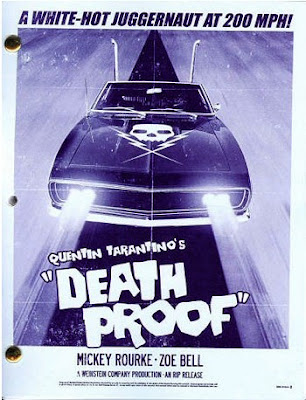
Death Proof, Tarantino’s contribution and a slasher in the loosest sense of the term. I’ve been perplexed by some reviews of
Grindhouse which praise
Planet Terror and
deride Death Proof as dull, dialogue heavy and oddly paced. Granted, I’ve already blown by cover as a Tarantino fanboy by the preceding paragraphs, so my critical analysis of the film has already been rendered moot. Regardless, let me say that
Death Proof expertly combined the slasher and car chase movies together to make a film that is uniquely American in its symbolism and perhaps
a culmination of years of Freudian readings of previous lady-stalked-by-psycho-pervert movies.
I’ll go ahead anyway, if you’ll permit. (And please, if you have not seen the movie, please do so. It’s good. Also, what follows will spoil the film. You have been warned.)
Let me explain.
The film quickly introduces
Jungle Julia (
Sydney Poitier, formerly of
Veronica Mars), an Austin DJ who meets up with two friends — Shanna (
Jordan Ladd), a local, and Arlene (
Vanessa Ferlito), a visitor — for drinks, food and more drinks. During the second round of drinking, Pam (Rose McGowan, playing the dumb blonde twin of her
Planet Terror self) shows up and makes small talk with
Stuntman Mike (
Kurt Russel), a seemingly pitiable creep who drives a muscle car. When everybody is done drinking, Pam hitches a ride with Stuntman Mike, who assures that his car is “death proof” — only he means for him specifically and not Pam. Stuntman Mike whips the car around in such a manner that Pam is
crushed to death inside the passenger side of the cab. Mike promptly flips a U and chases after Julia, Arlene and Shanna — who are purportedly heading up to a lakeside cabin for a girls’ weekend, a stereotypical set-up for a slasher movie plot if there ever was one — passes the girls, flips another U and then slams head-on into their car in one of the
most jarringly gruesome crash scenes I have ever seen in a movie. Tarantino replays the moment of impact over and over again from each girl’s perspective. You see Julia’s leg get severed, Shanna be ejected high into the sky and the tires of Mike’s car drag across Arlene’s face in the back seat. It’s devastating, especially since the film does a decent job of making these girls seem likeable.
Mike survives.
Sometime later, we see another foursome:
stuntwoman Kim (
Tracie Thoms, light years away from her characters in
Wonderfalls,
Rent or
The Devil Wears Prada),
stuntwoman Zoe (
Zoe Bell, Uma’s stuntwoman from
Kill Bill, playing a slightly off version of her badass New Zealand herself), make-up artist Abernathy (
Rosario Dawson) and starlet Lee (
Mary Elizabeth Winstead). The girls are taking a road trip in celebration of a short holiday from work on a new movie.
Zoe admits that she wanted to pass through a certain rural town in order to test ride a certain model of Dodge Challenger — specifically the one Kowalski drives in
Vanishing Point — and play
ship’s mast, a game involving a person spreading themselves on a speeding car’s hood by securing hands to sideview mirrors with belts. They do — minus Lee, the collateral for use of the car — and Stuntman Mike shows up, delighting in the chance to run the women off the road. The women fight back, however, and following
a half-hour car chase through the rural roads of Tennessee — actually Buellton and Solvang cow country — they manage to flip Mike’s car, whereupon they beat him to death in scene reminiscent of
Faster, Pussycat! Kill! Kill!Short and sweet.
What's driving me nuts is trying to figure out why the first group of girls died and the second survived.
Death Proof marks the second occasion in which Tarantino has put female characters on a mission to violently rectify a wrong committed by an older male character. Now, as much of a dick as Tarantino can be, I think he earnestly loves women — as a group, as individuals and sometimes two at a time. And while the occasional grindhouse-era film did feature women as masters of their own fate —
Switchblade Sisters,
Lady Snowblood and
Black Mama, White Mama, to name a few — more often than not the women in these movies either amounted to pretty background set pieces or cannon fodder. Thus, I feel like Tarantino is now making films that give these women a chance to strike back and mistreat their male captors with the same malice that their forerunners suffered.
So why favor the stuntwomen but allow the DJ and her friends to die so horribly?
I may be way off, but I feel like Tarantino may have written the two sets of women specifically to explain his thinking on the "right" kind of female movie character. Essentially, Julia and her friends are party girls. We don't see them do anything but drink, dance, smoke cigarettes, smoke pot and then die. Aside from breaking the cardinal rules of how to survive a horror film, Julia and her friends also exhibit ways in which they embody the stereotype of "the weaker sex."
Julia, an otherwise confident and powerful woman, steps away from the group to send pathetic text messages to some moviemaker love of hers. When it's clear the man will not be meeting up with her, she drunkenly texts "UR A ASSHOLE!" to him and mopes. Shanna seems too dumb to realize that the boys at the bar who can't remember her name probably don't give a shit about her other than as a sex object. And Arlene lets Julia guilt trip her into giving Stuntman Mike a lap dance as a dare. (The act, arguably, could be what seals the girls' fate as Mike's next victims.) Even Pam, a relatively minor character, speaks in a catty manner about growing up in Austin with Julia and then foolishly gets into a stranger’s car. Bad move, Pam.
The four later women act more sensibly. First off, they have passions — jobs they genuinely seem to love. Also, both Kim and Zoe are masculinized by the fact that they are stuntwomen and also, as we learn, gearheads. They get why the primo Dodge Challenger is such a big deal. However, both are feminine in their behavior — Kim admits to growing up watching John Hughes movies, for example, and all four dish about guys. They key difference here, as I see it, is how the rest of the girls treat their lovelorn member. Whereas Julia's friends don’t discourage her from pining for her director boyfriend, Abernathy's crew tell her to get over herself when she explains her unrequited love for her own auteur lover. Essentially, the group demands that its members stand up for themselves.
This notion comes into play when Abernathy, previously passive in how she deals with people, requests that they chase after Stuntman Mike. I believe her words come out as something like “Let’s kill the fucker.” Given such encouragement from a previously non-active character — a make-up artist and a mother, as Zoe mentions — the three launch after Mike’s car and eventually relish in beating the crap out of him. (He did, after all, endanger their lives as a means of getting his kicks.)
In a way, one could liken to
Death Proof’s two parts to those of
Psycho — with Julia, Arlene and Shanna being the dingy, flighty Marion Cranes who seem like they would be the central characters but who suddenly and violently fall victim to the killer. Kim, Zoe and Abernathy would be the level-headed Lila Cranes, who appear in the second segment and manage to reason their way out of a dangerous situation and avenge the death of their “sisters.”
That’s what I have so far, at least as something that can explain a movie that seems to be eliciting a divided reaction among viewers.
Other weirdness about
Death Proof that merits mentioning:
- In both segments, it’s the visitor who makes the group the target of Stuntman Mike. Initially, Arlene — a New Yorker, judging by her accent — sees Mike revving his car outside a restaurant they’re entering. Then she later gives him a lap dance knowing that he had followed the group from one stop to the next throughout the night. In the second part of the film, Zoe says being in the United States for the first time has finally given her an opportunity to check out the mythical car from Vanishing Point. Shortly after they find it, Mike shows up.
- In the second segment, Abernathy mentions that the man she’s pining for slept with someone else — specifically Daryl Hannah’s stand-in on the movie she’s working on. Lanna Frank — Julia’s dealer and a less-important member of the group that dies in the first half of the film — is played by Monica Staggs, who actually was Daryl Hannah’s stunt double in Kill Bill.
- When McGraw theorizes that Stuntman Mike kills women with his car in order to achieve sexual pleasure, he sets a very odd tone for the scene in which the stuntwomen, having turned the tables on Mike, chase after him, ramming him from behind. In the car crash-as-sicko sex metaphor, they’re raping him.
- Both segments of Death Proof feature conversations in which someone is corrected for mispeaking. In the first, Shanna corrects a male character for calling her "Shauna." Shanna explains that "Every girl named Shanna has one thing in common: They hate the name 'Shauna.'" In the second part, Lee is joking chided for assuming Zoe is Australian. Says Abernathy: "Never call a Kiwi and Aussie."
- Quentin Tarantino has to be the only white guy I know of who can write a part for a tall, beautiful black woman, cast Sidney Poitier’s daughter in the role, and then name the character “Jungle Julia” — all without getting his ass kicked.

 left to right: Marion Crane, Marion Crane and Marion Crane

.jpg)
