Pages

Wednesday, July 10, 2013

These, Tragically, Are the Frequently Asked Questions

“Who are you and how did you get in here?”

“Can you speak up?”

“Are you, like, someone’s friend or something?”

“Did you dress like that because you thought you were going somewhere else?”

“Wait, is that a joke?”

“Did we go to high school together?”

“Were you that guy who was in the library all the time?”

“What ever happened to you?”

“Did you, like, just move to L.A. recently?”

“So with all that writing, are you a big deal writer now?”

“Isn’t that kind of rude thing to say?”

“Where are you going?”

“If you’re headed over there, can you get me another drink?”

“Did he just say what I think I heard him say?”

“Wait, what was his name? Donald?”

Tuesday, July 9, 2013

I’ll Tickle Your Catastrophe

You may be asking why I used valuable time to do this. The answer, as it frequently happens to be, is “procrastination!!!” Well, that and the strange feeling that the end of this one line of Falstaff’s from Henry IV — “Away, you scullion! you rampallian! you fustilarian! I’ll tickle your catastrophe” — sounds remarkably more like a Belle & Sebastian lyric than an actual threat. Hence…

rare belle sebastian album

In a column on Shakespearean insults, Angela Tung says this use of catastrophe refers to the butt, but Falstaff is actually threatening to kick the addressee’s bottom, not tickle his anus. Just FYI.

Original llama image via.

Monday, July 8, 2013

The Demon Duck of Doom

I really can’t top that phrasing, so it’s the post title. How this isn’t yet a band name, a book title or the next summer blockbuster, I have no idea. But here, check this out:


Above  you see the skull of the Bullockornis panei, a bird species that lived 15 million years ago in what we now call Australia but would then have been called the worst place to live ever. You see, this member of the Dromornithidae (“swift-running birds”) class of megafauna, according to Wikipedia, would have stood eight feet, two inches tall and would have weighed up to 550 pounds. More disturbingly, this article says that paleontologists think the large beak indicates the Demon Duck of Doom ate meat. A quote from Dr. Steve Wroe from the Australian Museum: “My hunch is that it ate plant material, but also significant amounts of meat — it was formidable enough that it could have eaten whatever it wanted.” Hence the rather evocative nickname.

As someone still scarred by childhood memories of charging golf course water traps with thoughts of chasing ducks and geese only to immediately be deterred by an onslaught of hissing, flapping, honking and beak-snapping, I must say that this is the worst news I’ve heard lately. Fifteen million years isn’t barrier enough.

(This nightmare is brought to you via Spencer and his knowledge of beastmonsters, ultimately from this Atlantic article.)

Sunday, July 7, 2013

A Suicidal Short Story About My Eighth-Grade Teacher

The subject of suicide had come up in class, not because anyone had killed themselves but because such discussions happen often among 13-year-old Catholics, who are just getting smart enough to wonder how well the church rules work in real-life situations. It might have seemed as though we were testing our teacher, and we may have been, but we were generally interested to find out exactly how much you could do without being condemned to Hell, and we’d therefore force her to walk us through the morality of scenarios such as “What if a bad person tricked you into thinking you’d killed your entire family, and you became so grief-stricken that you killed yourself? Would that be suicide or would that be murder? What if the bad person had planned the whole thing specifically with the goal being to make you kill yourself? Would you both go to Hell?” Now that’s a fictional example, because I can’t remember what led into the suicide talk, but I can clearly recall once asking her about the morality of working in a factory that made electric chairs, given the church’s stance against capital punishment. “What if you just swept the floors there?” “Okay, what if you made the part that actually kills people but you had to take the job to take care of your family?” “What if you son grows up to the a saint?” No, I don’t know why this seemed important. I probably just didn’t want to do work.

In a similar way, I vividly recall how the suicide conversation ended. This is more or less a direct quote from my teacher: “When people kill themselves, they think, ‘Oh, they’ll miss me when I’m gone. They’ll feel so bad. They’ll feel so sorry.’ But you don’t know that. For all you know, after you commit suicide, everyone will be dancing. They’ll be saying, ‘Hooray! Glad she’s gone!’”

Don’t ask me why, but that memory popped into my head today. For a long time, I thought it was a rather nasty way to think about suicide, with your family literally dancing on the grave you put yourself in, but now, at thirty-one years old, I think my teacher may have had the right tactic. In explaining something as dicey as suicide to a bunch of thirteen-year-olds, it was actually fairly reasonable advice: Don’t give them the satisfaction of killing yourself. Hang around and be a pill longer. That’s the real revenge — your enduring existence.

Saturday, July 6, 2013

Places That Haven’t Yet Been the Setting for Horror Movies

Altoona, Pennsylvania

The Old Spaghetti Factory

The one women’s restroom with the tampon machine

Aruba

A rental car

A house that Judd Nelson used to live in, it turns out

An country club that needs to learn a lesson about accepting those who are different

A “hands on a hard body” contest that’s filmed in real time

BART

The set of a reality show that is a thinly veiled parody of Project Runway

The National Spelling Bee

That one last page of Where’s Waldo? where they’re all Waldo but in this instance one of them is a cold-blooded killer

Coachella

A ventriloquist convention

The Bread Loaf Writer’s Conference

Fun bonus info: I almost listed “one of the California Missions,” but then I remembered the cinematic footnote that is Incubus, a 1965 William Shatner film that was filmed at Mission San Antonio de Padua and, perhaps more notably, is entirely in Esperanto. It’s also allegedly cursed, and I’m not sure which sin is more likely to have brought that bad luck — the Esperanto or the fact that the filmmakers lied to get the church’s okay to shoot a horror movie there.

Previous lists:

Saturday, June 29, 2013

A Rather Busy Day for Satan

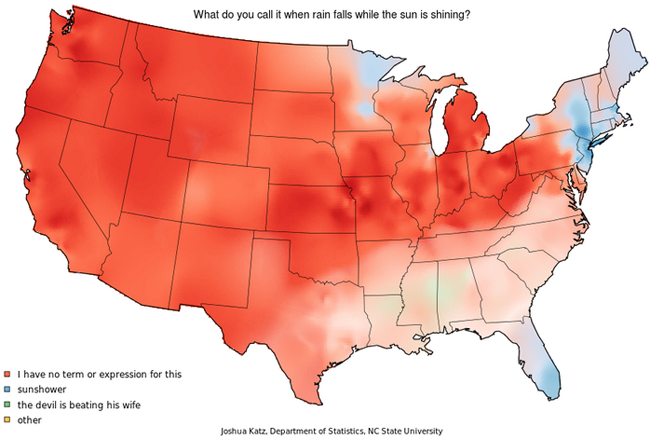
Most Americans with a passing interest in language probably already clicked through the dialogue maps posted recently by North Carolina State. They should have, anyway. These maps are damn cool. Colored splotches show you what regions of the U.S. say what, and for this flat-accented Californian who’s used to hearing people on TV talk like me, it’s helpful to be reminded how differently my fellow Americans can speak. (“That’s what they call soda over there? Oh my god, they’re so weird.”) But of all the dialectical breakdowns featured in the study, this one grabbed my attention most: “What do you call it when rain falls while the sun is shining?”

sunshower the devil is beating his wife

The map would seem to be accurate: I’m in that yellowish southern California splotch that would say “other.” (Obviously, the answer is “You’re on vacation in Hawaii, because this never happens anywhere else.”) I had never heard the expression sunshower, and while that seems like a sensible enough name for this type of weather, the superior term just in terms of batshit, backwoodsy folksiness has to be The devil is beating his wife, which I’d also never heard before (a-cuz California) and which has to be one of the more head-scratchy English idioms I’ve ever heard.

So what’s the deal? Here are the three theories I found online:
  • It could be just that unexpected raindrops are happening because they’re Mrs. Devil’s tears, according to this message board post.
  • According to this post on the same thread, it could also mean essentially “a mixed blessing” — to have rain during sun is a mix of bad and good, in the way that beating your wife is bad but maybe it’s not so awful when the wife in question is married to the devil. #controversial
  • And then there’s the theory I like best: Posted unsourced on Wikipedia, it states that rain during sunshine is a rare, beautiful thing, and because the devil hates anything good, he’s taking his anger out on his wife.
This Word Detective post also attempted to find the origin to this expression and came up with nothing conclusive, though the author does note that similar phrases exists outside the Southern U.S. For  example, Hungarian has The devil is getting married, and German has The devil is having a parish fair. And this guide to English translated into idiomatic French offers Le diable bat sa femme et marie sa fille (“The devil is beating his wife and marrying his daughter”) as the equivalent of It rains and shines at the same time, so way to go France for upping the ante by wedging incest into a discussion of a pleasant meteorological phenomenon.

According to Wikipedia, those who use these “devil” phrases are in the minority. Most idioms describing this kind of weather describe it as being some kind of special animal party. Among others:
  • In South Africa, a monkey’s wedding
  • In India and Japan, a fox’s wedding
  • In Korea, a male tiger gets married to a fox
  • In Morocco and France, a wolf’s wedding
  • In parts of Africa, a leopard’s wedding
  • In Kenya, a hyena’s wedding
  • In Bulgaria, a bear’s wedding
  • In northern Iran, a jackal’s wedding
  • And in El Salvador, just to be difficult, it’s a deer is giving birth
All of which, of course, are far cuter than domestic violence, devil-related or not.

Friday, June 28, 2013

The First High Five

This was a big week for fans of samesies, but while many Californians took to the streets to celebrate the Supreme Court, I observed this momentous occasion by working at home and then falling asleep watching Comedy Central. It’s for this reason that I’m presenting a bit of gay history today. It may not affect as many people as does California catching up to that glittering bastion of liberality we call Iowa, but it’s a pretty good story nonetheless. Also, I just learned it yesterday, and it’s one of the best things I’ve learned in a long time.

Last April, pro basketball player Jason Collins announced he was gay, prompting many media outlets to decree that he was the first to come out while being a member of a major American sports team. Some, however, noted that this wasn’t the case: In particular, the San Francisco Chronicle noted that Glenn Burke, who joined the Dodgers as an outfielder in 1976, was out to his teammates.

glenn burke dodgers baseball card

Burke’s sexuality wasn’t exactly known to the public, but it wasn’t for a lack of effort on Burke’s part. From The Atlantic:
Burke made no secret of his sexual orientation to the Dodgers front office, his teammates, or friends in either league. He also talked freely with sportswriters, though all of them ended up shaking their heads and telling him they couldn't writethat in their papers. Burke was so open about his sexuality that the Dodgers tried to talk him into participating in a sham marriage. (He wrote in his autobiography that the team offered him $75,000 to go along with the ruse.) He refused. In a bit of irony that would seem farcical if it wasn't so tragic, one of the Dodgers who tried to talk Burke into getting "married," was his manager, Tommy Lasorda, whose son Tom Jr. died from AIDS complications in 1991. To this day, Lasorda Sr. refuses to acknowledge his son's homosexuality.
The Atlantic notes that Burke came out in a bigger way in a 1982 interview. He died from AIDS-related causes in 1995. This story itself seems worth telling, or at least worth telling if you’re anyone who cares about the various Jackie Robinsons of the world, but there’s actually an even more surprising footnote to Burke’s short baseball career: He may have invented the high five.

I know, I know. It’s weird to think of a word in which people didn’t slap palms as congratulations for a feat of athletic awesomeness, a perfectly barbed put-down, a righteous belch or “yeah, I hit that,” but we didn’t always have this gesture. In the way that it can be tough to determine exactly when a slang phrase enters the lexicon, we also can’t be sure exactly when high-fiving went mainstream, but Glenn Burke and Dusty Baker seem to get credit for giving the first on-the-record high five on Oct. 2, 1977, just after Burke hit his thirtieth home run. This ESPN.com article, notably written just a few days before Collins came out, does a fantastic job telling the story:
It was a wild, triumphant moment and a good omen as the Dodgers headed to the playoffs. Burke, waiting on deck, thrust his hand enthusiastically over his head to greet his friend at the plate. Baker, not knowing what to do, smacked it. “His hand was up in the air, and he was arching way back,” says Baker, now 62 and managing the Reds. “So I reached up and hit his hand. It seemed like the thing to do.”
The article, which goes on to describe the ambiguous relationship Burke shared with Tommy Lasorda’s son, says that the high five went “ricocheting around the world” from there, in spite of the fact that the game wasn’t televised. And there you have it. Yes, it does seem strange that the high five was born only a few years before I was, and yes, it’s entirely possible that someone else in the history of the world slapped someone else’s palms in a victorious fashion. But if they did, we don’t know about it. We do know about Glenn Burke, who along with Dusty Baker invented something that would live on, even when Burke himself or mainstream awareness of his athletic career or his status as the Jackie Robinson of gay baseball (“gaysball”) did not.

Does this mean that high fives in the early seasons of That ’70s Show were anachronistic? Yes, I suppose so. Does this not tie in nicely with what I posted on Wednesday? Yes, it really does. And does this also mean that any and all high fives are tacit endorsements of the gay agenda? Well, obviously.

Now That’s Interesting!, previously: