Is The Simpsons funny again? That’s a question TV nerds like to ask. The answer depends on your point of view. No, it’s not “Marge vs. the Monorail”-level funny, but that’s one of the best episodes of any TV show ever. However, The Simpsons is definitely funnier now than it was during its worst moment, the terrible, terrible “Saddlesore Galactica,” which just plain sucked. Nowadays, if I’m home at 8 p.m. on Sunday, I will watch, and I’m usually not disappointed, but I have noted that the show seems to have lost its heart. It’s meaner now, I think, and its jokes skew a lot darker. In fact, The Simpsons now seems better paired with Family Guy than ever in that way. Like I said, this could either be a plus or a minus, depending on your point of view.
Myself, I don’t mind dark humor. And that’s why I can say this bit from a 2011 Simpsons episode is one of the funniest things I’ve seen in a long time: “Autotuned Disaster Victim.”
But I don’t know if I can blame The Simpsons for squeezing humor out of “Oh, you’re an angel now,” mostly because I’m kind of surprised the show beat the real world to reducing someone like this to a meme.
Whatever. I don’t get tired of watching. And that’s great news, considering how someone made a ten-hour extended cut of it.
Way to go, internet! And yes, I’m aware of the weirdness of watching a pseudo-YouTube clip on YouTube.

Thursday, April 11, 2013

Wednesday, April 10, 2013
Scooby-Doo Meets David Lynch
Maybe I would be that guy and attempt to sell you on a quasi-“grown up” version of Scooby-Doo that ditches the one-off mysteries for season-long arcs, but I won’t now. The show has already been canceled, so I’m too late, and statistically speaking, you’re probably too late as well. However, I will at least say that Cartoon Network aired two seasons of Scooby-Doo! Mystery Incorporated, a show that made an excellent case for secular humanism (no, really) while combining pop culture references and actual character development to create the world that Freddy, Daphne, Velma, Shaggy and Scooby always deserved to live in. This is a show where Clark and Ellen Griswold from the Vacation movies and Brenda and Dylan from 90210 were recurring characters, where Udo Kier voiced a homicidal parrot, and where thinly veiled versions of Taylor Lautner and Paula Deen ended up being bad guys that those meddling kids unmasked. I enjoyed this show, and not just because it seemed to take place in a fictionalized version of my Santa Barbara.
Cartoon Network is running out the remaining episodes, and they make for something worth watching while I’m doing situps or mindless computer work or what-have-you, and tonight I watched a recently-aired episode where Scooby slips into a dream world. And it just happened to be the dream world from Twin Peaks.
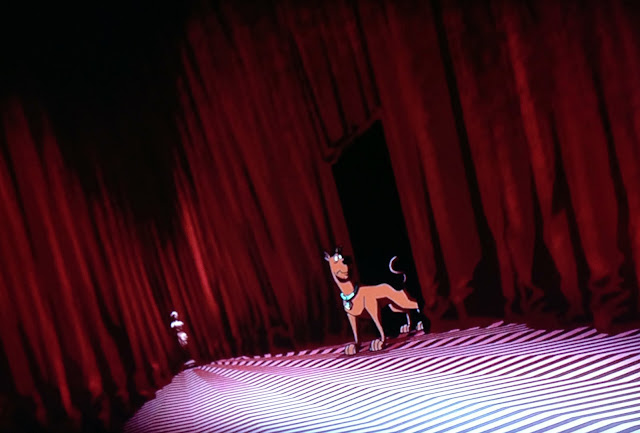
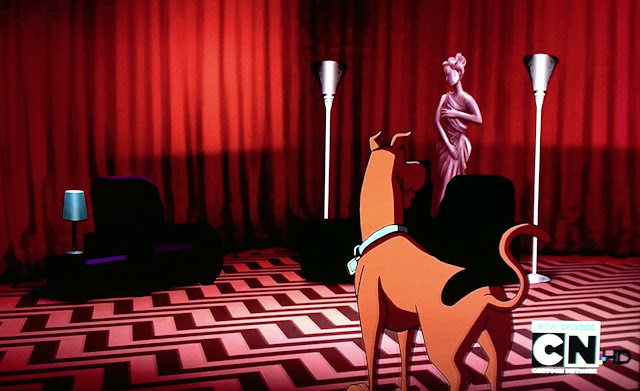
If you must know, it was Scooby’s way of getting information from his little dachshund girlfriend, who has started warning him about Nibiru because been possessed by a spirit that’s voiced by Amy Acker, whose casting could be a reference to Angel, where Acker played Fred, whose body was also possessed by a wise, powerful entity that didn’t have nice things to say. And yes, the Red Room sequence also featured a dancing dwarf who was voiced by Twin Peaks’ resident dancing dwarf, Michael J. Anderson, backwards talking and all.
These things make me happy — that Scooby-Doo could exist in the Red Room, just for a moment, if only on a series that kids didn’t get (because “What the hell is Twin Peaks?” asks the nine-year-old Cartoon Network fan who’s only tuning in to watch Adventure Time) and that people my age didn’t watch (because “Isn’t Scooby-Doo for babies and didn’t Freddie Prinze Jr. ruin it?). I’m sure this isn’t the last we’ll see from the original Scooby gang, but I have to assume that future iterations won’t make the mistake of skewing so adult, with “adult” in this context being the kind of legally grown-up weirdo who still watches cartoons.
Lynchiness, previously:
Cartoon Network is running out the remaining episodes, and they make for something worth watching while I’m doing situps or mindless computer work or what-have-you, and tonight I watched a recently-aired episode where Scooby slips into a dream world. And it just happened to be the dream world from Twin Peaks.


If you must know, it was Scooby’s way of getting information from his little dachshund girlfriend, who has started warning him about Nibiru because been possessed by a spirit that’s voiced by Amy Acker, whose casting could be a reference to Angel, where Acker played Fred, whose body was also possessed by a wise, powerful entity that didn’t have nice things to say. And yes, the Red Room sequence also featured a dancing dwarf who was voiced by Twin Peaks’ resident dancing dwarf, Michael J. Anderson, backwards talking and all.
These things make me happy — that Scooby-Doo could exist in the Red Room, just for a moment, if only on a series that kids didn’t get (because “What the hell is Twin Peaks?” asks the nine-year-old Cartoon Network fan who’s only tuning in to watch Adventure Time) and that people my age didn’t watch (because “Isn’t Scooby-Doo for babies and didn’t Freddie Prinze Jr. ruin it?). I’m sure this isn’t the last we’ll see from the original Scooby gang, but I have to assume that future iterations won’t make the mistake of skewing so adult, with “adult” in this context being the kind of legally grown-up weirdo who still watches cartoons.
Lynchiness, previously:
Sunday, April 7, 2013
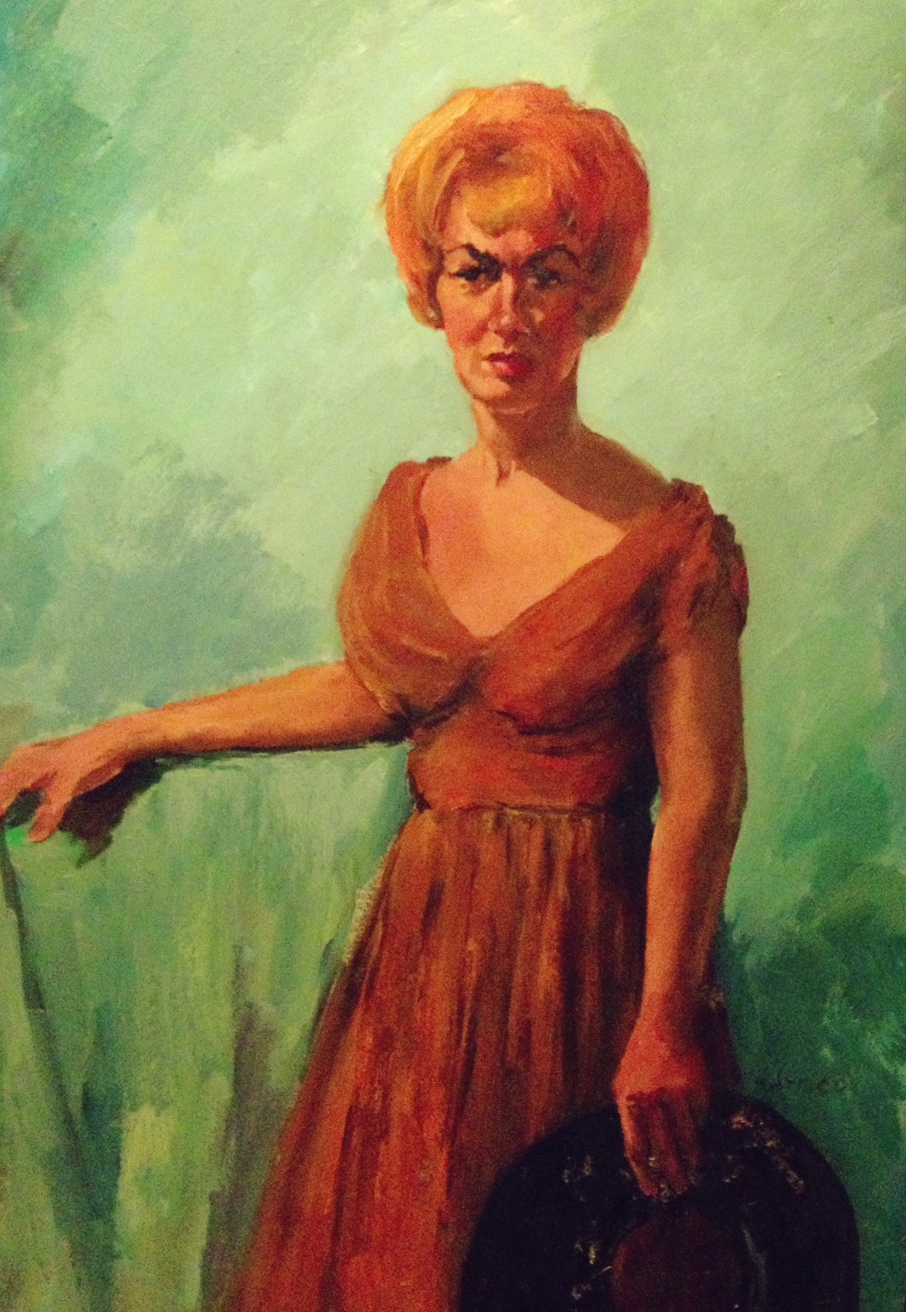
The Portrait of Lorina Dunlop
(An imagined drama based on a painting found in a thrift shop basement.)

— She hates it.
— But I captured her perfectly.
— That’s the problem. You painted her the way she looks. And she looks like Agnes Moorehead with cramps. Her eyebrows look like a cursive letter “M.”
— Her eyebrows do look like cursive letter “M.”
— Believe me, I know. But she feels the expression you’ve captured makes her look angry and judgmental.
— I think she looks… thoughtful.
— She does look thoughtful, but she’s thinking about how much money we wasted on hiring you to do her portrait.
— Has it occurred to you that your wife simply complains a lot?
— Yes.
— And has it occurred to you that if I painted her with an unfurrowed brow, she wouldn’t look like your wife?
— It has. In fact, unfurrowed, she’d look like her younger sister, Gladys, who is radiant and beatific.
— Well, I’m sorry if you’re not happy.
— No, I said she hates it.
— I… don’t follow.
— Young man, you’re very talented, very perceptive. You spend a days with Lorina, and I do feel that in capturing her likeness in this painting, you captured the essence of who she is as a person. I’ve been married to Lorina Dunlop for thirty-seven years — thirty-seven inconsolable years spent under the scowl you’ve re-created in this painting. That’s thirty-seven years of wine-drunk cackling at my expense, the majority of that time with an increasing brood of children who share their mother’s disposition. So please don’t misunderstand my message when I tell you that my wife hates the painting.
— …
— I’d like your most elaborate frame — gold and shiny, if you can, something showy. I’m hanging in the living room, immediately opposite the front door.
— She hates it.
— But I captured her perfectly.
— That’s the problem. You painted her the way she looks. And she looks like Agnes Moorehead with cramps. Her eyebrows look like a cursive letter “M.”
— Her eyebrows do look like cursive letter “M.”
— Believe me, I know. But she feels the expression you’ve captured makes her look angry and judgmental.
— I think she looks… thoughtful.
— She does look thoughtful, but she’s thinking about how much money we wasted on hiring you to do her portrait.
— Has it occurred to you that your wife simply complains a lot?
— Yes.
— And has it occurred to you that if I painted her with an unfurrowed brow, she wouldn’t look like your wife?
— It has. In fact, unfurrowed, she’d look like her younger sister, Gladys, who is radiant and beatific.
— Well, I’m sorry if you’re not happy.
— No, I said she hates it.
— I… don’t follow.
— Young man, you’re very talented, very perceptive. You spend a days with Lorina, and I do feel that in capturing her likeness in this painting, you captured the essence of who she is as a person. I’ve been married to Lorina Dunlop for thirty-seven years — thirty-seven inconsolable years spent under the scowl you’ve re-created in this painting. That’s thirty-seven years of wine-drunk cackling at my expense, the majority of that time with an increasing brood of children who share their mother’s disposition. So please don’t misunderstand my message when I tell you that my wife hates the painting.
— …
— I’d like your most elaborate frame — gold and shiny, if you can, something showy. I’m hanging in the living room, immediately opposite the front door.
Saturday, April 6, 2013
I Don’t Know Where I’m Going, Domino!
I interviewed Dyan Cannon on Friday. She was lovely. If you’re not especially well-versed in things that happened before the olive green-turquoise-burnt orange decades, she would be the actress who played one-fourth of the title characters in Bob & Carol & Ted & Alice, which is a movie you should see. The interview concerned The Last of Sheila, which is also a movie that you should see but which carries more clout by virtue of being a cult classic. It’s a stylish murder mystery, and the trailer adeptly demonstrates what sort of aesthetic the director was going for. Observe:
Dyan is the beautiful blonde you see freaking the fuck out at around the forty-second mark. Bonus points: The Last of Sheila was written by Anthony Perkins and Stephen Sondheim, who, unless I’m mistaken, were boning at the time, so I suppose it’s impressive that they finished the script.
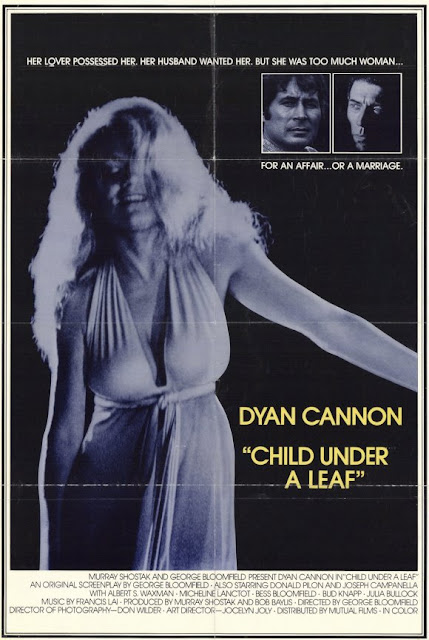
However, had I watched the following scene from a different Dyan Cannon film, the inexplicably titled Child Under a Leaf, all of my questions would have been about it. Please watch this 2:25 clip, which also features Dyan playing a blonde who’s freaking the fuck out. From now on, it shall be what I show people if they ever ask me what in media res means.
Questions I’d ask Dyan:
Apparently they had real stars back then, but not so much with the graphic design skills.
Dyan is the beautiful blonde you see freaking the fuck out at around the forty-second mark. Bonus points: The Last of Sheila was written by Anthony Perkins and Stephen Sondheim, who, unless I’m mistaken, were boning at the time, so I suppose it’s impressive that they finished the script.
However, had I watched the following scene from a different Dyan Cannon film, the inexplicably titled Child Under a Leaf, all of my questions would have been about it. Please watch this 2:25 clip, which also features Dyan playing a blonde who’s freaking the fuck out. From now on, it shall be what I show people if they ever ask me what in media res means.
Questions I’d ask Dyan:
- Why did you want the baby so badly?
- Were you trying to rescue your baby or kidnap the weird man’s baby?
- Wait, do any of these characters know each other at all? Who is kidnapping whom?
- Is the baby kidnapping the adults?
- Yeah, but maybe is it? Secretly?
- Was your character really named “Domino”? Did someone really think that was an okay name for a person to have?
- Can you tell me who did the music? Because it’s awesome and I want it to be my ringtone.
- Do you think the baby realized how much cuter it looked when it wasn’t crying and that’s why it’s suddenly all pleasant-looking at the end?
- And finally, who the hell OKed the poster?
 |
| via |
Friday, April 5, 2013
Upon Seeing the New Evil Dead
(In which I ask myself some relevant questions.)
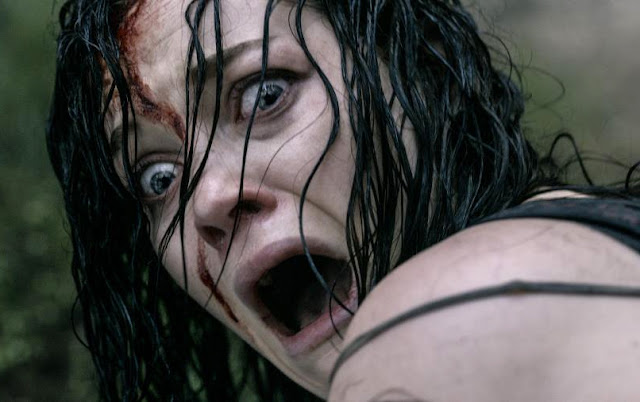
So Drew, I hear you saw The Evil Dead.
Yes, I did.
So I don’t care if you spoil this for me: Do any of the characters deserve all this hell?
No — people don’t deserve dismemberment. However, as far as narrative arcs are concerned, the horror experienced by Mia (Levy) is what she has to go through to exorcise her demons and overcome her drug dependency. After all, that’s why the characters go to the cabin to begin with: so Mia can dry out. That’s obvious. You could make a case that Olivia (Jessica Lucas) exerts a certain level of hubris in thinking that she, a nurse, could provide the level of care that a hospital would in helping Mia overcome her habit. Mia’s brother, Dave (Shiloh Fernandez) has to die, to compensate for leaving Mia to care for her mentally ill mother, the trauma of which probably caused Mia’s drug habit. And stupid Eric (Lou Taylor Pucci) is the one who reads from the Necronomicon, inviting the demonic presence to begin with, so that sealed his fate. That leaves Natalie (Elizabeth Blackmore), the least developed of the five characters. She doesn’t do anything that would warrant her awful fate, but she also basically doesn’t do anything one way or the other. There’s a moment when possessed Mia bites Natalie and then Natalie cuts off her hand in an effort to prevent getting turned. It doesn’t work, but there was a moment when I was wondering which of the characters would step up and become the hero. It might have been interesting if this limp dishrag of a woman had suddenly found a well of strength and saved the day — if she, now one-handed like Ash in the original seres — could have become the new Ash. That didn’t happen. Mia is the stronger character, and I guess her dying then being jolted back to life allowed the script to have her endure the most heinous torture and then come back as the hero. She sacrifices one of her hands too, BTW, before she dukes it out with her own evil self. Like Ash in Evil Dead 2. So yeah, Mia is the new Ash. But I also feel like Mia being the source of most of the evil but also eventually the hero is an example of the writers pissing down both legs — which literally happens, by the way, just to Olivia, before she cuts her face off with broken mirror shards. That I can’t do anything with. I’m not sure I’m supposed to do anything besides recoil in horror from it.

So Drew, I hear you saw The Evil Dead.
Yes, I did.
The original Evil Deads were kind of slapstick-y and funny. Was this movie like that?
No, it wasn’t. Not at all.
The trailer kind of made it look like a grueling experience — a degradation of the human body and spirit.
This would be an instance where the trailers aren’t misleading.
So why did you see it, exactly?
I’m not sure. I think it has something to do with the fact that I went to Disneyland earlier this week and needed, like, the opposite of Disneyland.
Did you win tickets or something?
No, I bought tickets.
That’s “tickets” in the plural.
Yes, there was a second person who also wanted to watch this movie. He kind of has a background in movies and special effects and all that, so I feel like he had a better excuse than I did.
Oh. Well, I see that cute little Jane Levy from Suburgatory was in it. She’s funny and sassy and Emma Stone-ish on TV. Did she get to be like that in this movie?
Well, at one point, when she’s possessed by the demon, she tells threatens to suck her brother’s cock. Some people laughed at that.
In the trailer it looked like she, well, made out with the thin edge of a box cutter and renders herself fissilingual.
You know it. Now I can say I’ve paid to see that happen in a movie theater. It was not the most disturbing thing to happen in the movie.
I heard there’s a prominent theme of drug addiction and the stress of trying to quit the habit. Might The Evil Dead be a good movie to watch if you’re struggling with substance abuse?
No. Oh, god no.
So did you like it?
I’m not sure I can say that I liked it, exactly. But I can tell you that it delivered everything I wanted it to.
Hey, remember when you say Django Unchained and had a problem with the level of violence in general but especially with the intensity of violence directed at its sole female character? Did you feel differently about this movie?
Yes. Even though the level of violence was much higher, though not exactly Dead Alive-level high, to the point where you can interpret it as silly, I’m weirdly more okay with The Evil Dead. I’m guessing that might be a result of Evil Dead not trying to situate its violence in a point in history or attempting any sort of message with it.
So pointless violence is better than meaningful violence?
When you say it like that, my theory sounds pretty fucking stupid, doesn’t it?
No, it wasn’t. Not at all.
The trailer kind of made it look like a grueling experience — a degradation of the human body and spirit.
This would be an instance where the trailers aren’t misleading.
So why did you see it, exactly?
I’m not sure. I think it has something to do with the fact that I went to Disneyland earlier this week and needed, like, the opposite of Disneyland.
Did you win tickets or something?
No, I bought tickets.
That’s “tickets” in the plural.
Yes, there was a second person who also wanted to watch this movie. He kind of has a background in movies and special effects and all that, so I feel like he had a better excuse than I did.
Oh. Well, I see that cute little Jane Levy from Suburgatory was in it. She’s funny and sassy and Emma Stone-ish on TV. Did she get to be like that in this movie?
Well, at one point, when she’s possessed by the demon, she tells threatens to suck her brother’s cock. Some people laughed at that.
In the trailer it looked like she, well, made out with the thin edge of a box cutter and renders herself fissilingual.
You know it. Now I can say I’ve paid to see that happen in a movie theater. It was not the most disturbing thing to happen in the movie.
I heard there’s a prominent theme of drug addiction and the stress of trying to quit the habit. Might The Evil Dead be a good movie to watch if you’re struggling with substance abuse?
No. Oh, god no.
So did you like it?
I’m not sure I can say that I liked it, exactly. But I can tell you that it delivered everything I wanted it to.
Hey, remember when you say Django Unchained and had a problem with the level of violence in general but especially with the intensity of violence directed at its sole female character? Did you feel differently about this movie?
Yes. Even though the level of violence was much higher, though not exactly Dead Alive-level high, to the point where you can interpret it as silly, I’m weirdly more okay with The Evil Dead. I’m guessing that might be a result of Evil Dead not trying to situate its violence in a point in history or attempting any sort of message with it.
So pointless violence is better than meaningful violence?
When you say it like that, my theory sounds pretty fucking stupid, doesn’t it?
So I don’t care if you spoil this for me: Do any of the characters deserve all this hell?
No — people don’t deserve dismemberment. However, as far as narrative arcs are concerned, the horror experienced by Mia (Levy) is what she has to go through to exorcise her demons and overcome her drug dependency. After all, that’s why the characters go to the cabin to begin with: so Mia can dry out. That’s obvious. You could make a case that Olivia (Jessica Lucas) exerts a certain level of hubris in thinking that she, a nurse, could provide the level of care that a hospital would in helping Mia overcome her habit. Mia’s brother, Dave (Shiloh Fernandez) has to die, to compensate for leaving Mia to care for her mentally ill mother, the trauma of which probably caused Mia’s drug habit. And stupid Eric (Lou Taylor Pucci) is the one who reads from the Necronomicon, inviting the demonic presence to begin with, so that sealed his fate. That leaves Natalie (Elizabeth Blackmore), the least developed of the five characters. She doesn’t do anything that would warrant her awful fate, but she also basically doesn’t do anything one way or the other. There’s a moment when possessed Mia bites Natalie and then Natalie cuts off her hand in an effort to prevent getting turned. It doesn’t work, but there was a moment when I was wondering which of the characters would step up and become the hero. It might have been interesting if this limp dishrag of a woman had suddenly found a well of strength and saved the day — if she, now one-handed like Ash in the original seres — could have become the new Ash. That didn’t happen. Mia is the stronger character, and I guess her dying then being jolted back to life allowed the script to have her endure the most heinous torture and then come back as the hero. She sacrifices one of her hands too, BTW, before she dukes it out with her own evil self. Like Ash in Evil Dead 2. So yeah, Mia is the new Ash. But I also feel like Mia being the source of most of the evil but also eventually the hero is an example of the writers pissing down both legs — which literally happens, by the way, just to Olivia, before she cuts her face off with broken mirror shards. That I can’t do anything with. I’m not sure I’m supposed to do anything besides recoil in horror from it.
Thursday, April 4, 2013
Twenty Free Movie Titles
The titles are self-explanatory, I feel. Take as needed. I don't need co-author credit on these, but if you want to tell people to go to my blog in your acceptance speech(es), that would be cool.
Six Kitchen Fights and an Explosion
The Absolute End of Michael Cera
The Cactus Who Loved Balloons
Now Who's an Invalid?
Fishes in Desperate Need of Bicycles
ZZZZZZZZZZZZAP!!
Mrs. Sperm Donor
The Sound of Mus-EEEEEEEEK!
Astrid Wildfern's Darkest Secrets
The Family That Slays Together
Revenge of the Manatees
Out of the Way, Mom!
Wilbur vs. Elmer
The Overripe Pear
Pantsless in Pasadena
Let's Make Ayn Rand Spin in Her Grave!
Hamlet on Stilts
When Pole Vaulters Find Love
Your Public Disgrace
The Family That Still Slays Together: Murderson Family Reunion!
Wednesday, April 3, 2013
My Problem With the Thirteenth Floor
Does it strike anyone else as being especially quaint that high-rises in the western world still pretend that they have no thirteenth floor? Christmas holidays have become winter breaks, Halloween now celebrates candy and costumes rather than pagan rites, yet the power of the number thirteen endures, just because it’s vague and secular enough that no one gets to be offended by it. The superstition trumps basic counting: You can stand on the sidewalk and number the windows from lobby to penthouse, but when you walk into the elevator, you usually find some alternative math on the buttons. And, of course, you usually don’t see a thirteenth floor.
The buttons are sometimes arranged so that you’d be less likely to notice the gap, and I can’t decide if I prefer it displayed in this sneaky manner or just with the twelve and fourteen right next to each other, like it’s the most normal thing in the world. Either way, just remember your numbers — in order — and you’ll find that it takes the same amount of time to get from the eleventh to the twelfth floor as it does to take to get from the twelfth to the fourteenth.
And all this math-defying silliness just because of an irrational fear that thirteen of something will more likely bring about doom than eleven or twelve of something, even though we obliviously we come across thirteens all the time in our lives and manage not to die from them. You’re just as likely to die on one floor as another, and the number thirteen will probably play no more centrally into your death than will the number two (say, the number of ice cream trucks that hit you), the number 107 (say, your body weight when that eagle carried you away), the number ten (say, the number of poison darts they shot you with before you stopped singing), the number thirty-three (say, the number of Red Bulls your assistant estimates you drank that weekend) or the number five (say, the age of your assailant).
Here’s my legitimate question: If people are really all that worried about the undefined misfortune that will result from this number, can I spend the night in hotels’ thirteenth floors for less money? Clearly, it’s a huge safety risk — why else pretend it doesn’t exist, San Jose Airport Marriott? — but I’m brave enough to say that it’s no more dangerous than staying on any hotel floor, save for the ground floor in a motel, which is a guaranteed sentence. No, let me stare misfortune in her creased, sun-damaged face. Make it fun. Make it the death-defying package. Go and Final Destination up those hallways to make a night in the hotel a night of living on the edge.
I understand that hotels and our taller apartment buildings may worry that people won’t find undefined misfortune all that comforting. That’s cool. You need to make money, vertical buildings. But if you’re set on keeping us from living on these floors, instead placing non-residential, non-overnight facilities there such as maintenance rooms, restaurants and pools, then consider this: Doesn’t the undefined misfortune you’re anticipating stand an equal chance of taking our janitors, diners or swimmers? You must admit: Each role poses a risk that non-janitors, non-diners and non-swimmers don’t have to worry about. (For each, it’s E. coli.)
Clearly, I’m right. So please allow me to offer the best solution to this dilemma. Build the thirteenth floor. Label it as such on the elevator dial. But then populate it with whatever combination of murderers, black cats and grease fires seems appropriate so that when the elevator does stop there, people can say, “Hey, it’s not just a superstition. See? The thirteenth floor really is bad news.” And everyone else in the elevator will say, “Yes, it’s true. We live in an advanced society.” And then the murderer’s hookhand will snag whoever’s closest to the door and drag them out, but everyone else will nod in agreement and how far we’ve come as a society. “To think,” they’ll say, “our ancestors once feared the thirteenth floor for no reason at all!”
No, that’s not better, but it’s sensible, you know?
And speaking of, would it not be sensible to fear the number twenty-six more on account of it being two thirteens?
 |
| via flickr user iseethelight (CC license) |
And all this math-defying silliness just because of an irrational fear that thirteen of something will more likely bring about doom than eleven or twelve of something, even though we obliviously we come across thirteens all the time in our lives and manage not to die from them. You’re just as likely to die on one floor as another, and the number thirteen will probably play no more centrally into your death than will the number two (say, the number of ice cream trucks that hit you), the number 107 (say, your body weight when that eagle carried you away), the number ten (say, the number of poison darts they shot you with before you stopped singing), the number thirty-three (say, the number of Red Bulls your assistant estimates you drank that weekend) or the number five (say, the age of your assailant).
Here’s my legitimate question: If people are really all that worried about the undefined misfortune that will result from this number, can I spend the night in hotels’ thirteenth floors for less money? Clearly, it’s a huge safety risk — why else pretend it doesn’t exist, San Jose Airport Marriott? — but I’m brave enough to say that it’s no more dangerous than staying on any hotel floor, save for the ground floor in a motel, which is a guaranteed sentence. No, let me stare misfortune in her creased, sun-damaged face. Make it fun. Make it the death-defying package. Go and Final Destination up those hallways to make a night in the hotel a night of living on the edge.
I understand that hotels and our taller apartment buildings may worry that people won’t find undefined misfortune all that comforting. That’s cool. You need to make money, vertical buildings. But if you’re set on keeping us from living on these floors, instead placing non-residential, non-overnight facilities there such as maintenance rooms, restaurants and pools, then consider this: Doesn’t the undefined misfortune you’re anticipating stand an equal chance of taking our janitors, diners or swimmers? You must admit: Each role poses a risk that non-janitors, non-diners and non-swimmers don’t have to worry about. (For each, it’s E. coli.)
Clearly, I’m right. So please allow me to offer the best solution to this dilemma. Build the thirteenth floor. Label it as such on the elevator dial. But then populate it with whatever combination of murderers, black cats and grease fires seems appropriate so that when the elevator does stop there, people can say, “Hey, it’s not just a superstition. See? The thirteenth floor really is bad news.” And everyone else in the elevator will say, “Yes, it’s true. We live in an advanced society.” And then the murderer’s hookhand will snag whoever’s closest to the door and drag them out, but everyone else will nod in agreement and how far we’ve come as a society. “To think,” they’ll say, “our ancestors once feared the thirteenth floor for no reason at all!”
No, that’s not better, but it’s sensible, you know?
And speaking of, would it not be sensible to fear the number twenty-six more on account of it being two thirteens?
Subscribe to:
Posts (Atom)