Pages

Showing posts with label books. Show all posts

Saturday, August 30, 2014

Children's Books That I Wish I Owned or Also Maybe That I Had Written

See post headline for further clarification.


And finally, the back cover of Ant and Bee and Kind Dog. It has a certain Adventure Time quality, doesn’t it?


And just for sheer mirth, the back cover to Les Mesadvetures d’un Chien.


(Image sources: Woofin, Kind Dog, Playful, Dinner, Mesadventures, Picklepaw, Hubbard, Pretzel.)

Monday, May 6, 2013

Elsie and the Looking Club

An old book held and celebrated for its cover but not flipped through and then pondered after the fact:


Wait, so is it about a weirdly sexy cow and her friends that spend all day looking at a mirror?

Or is it about a club that just likes looking at Elsie, the weirdly sexy cow, who may not be the most appropriate friend for these children to have?

What, exactly, are they watching Elsie do? Cow stuff? Lady stuff?

Does Elsie know they are watching? (I mean, she looks like she is into it.)

Or do they just all go around looking at things, Sexy Elsie and her human child-friends that maybe she had kidnapped for all I know, because they live in a strange world where a slender-shouldered, elegant cow-woman is somehow not the most interesting thing to look at?

But she is unusually sexy for a cow, no?


Did the children make the daisy chain for her? Is that hinting at something awful? Though literally speaking, they would have had to, because elegant forehoof notwithstanding, she doesn’t have the fingers necessary to weave daisies together.

Is it weird if I can only imagine the worst possible uses for the bucket at the bottom of the illustration?

Are they milking her?

Are they “milking” her?

God, I hope they are milking her and not “milking” her.

Is it a “looking but not touching” club?

Tuesday, April 16, 2013

Shadow of the Monsoon

"Yeah, looking at it now. The art is great, and I like the way you've contrasted the wistful look of Private Wilkies against the calculating expression on Frau Harolda. The abstracted plants in the foreground are lovely. So… listen, we feel a little awkward about asking this, but… do you think that a monsoon is a type of jungle cat?"


Oh, the treasures of The Iliad, which redeems the Valley. (One here and one here. They suited the square from of Instagram better. This one did not.)

Tuesday, January 15, 2013

Yanked Up From the Ground

After the fact, I know, but here it is anyway: I closed 2012 by watching the little-remembered film version of Play It as It Lays. I enjoyed it even if it cast a shadow over the end of the year.

via


It’s not a film you’d watch to feel happy, but it’s beautiful, in the way a windy, dusty day in a bad corner of California can still seem beautiful. I keep thinking about it — the notion of Maria Wyeth still playing even though she knows there’s no way to win, even though it’s raining on a cemented-over backyard, where nothing will grow. And it’s in that sense of a foiled harvest that the film uses a certain word — a word I had to look up, because I hadn’t heard it before.

It’s my first word of 2013.
deracinate (dee-RASS-en-ate) — verb: 1. uproot 2. to remove or separate from a native environment or culture; especially: to remove the racial or ethnic characteristics or influences from.
From the French dĂ©raciner, meaning about the same and coming from the Late Latin radicina, the diminutive of radix, which Etymonline points out is also the word that gives us radish. It’s one of those inherently beautiful words, I say, even if it means something awful. The metaphorical meaning might let you forget that a plant, when uprooted, can’t survive. Humans do, however. Or at least Maria, that stubborn Southern California radish, manages to survive.

It’s a good word. Thanks for that, Joanie.

It seems that Play It as It Lays is so poorly remembered, in fact, that good images from it are hard to find online. But I do have this:

via
Yes, that’s Anthony Perkins’s head, unceremoniously cropped into the bottom corner. Honestly, it’s probably the least indicative frame possible, lacing Tuesday Weld and all, but I can attest that it’s from the movie.

That’s it.

Previous words of the week after the jump.

Wednesday, December 12, 2012

How I Met John Cheever

Toward the end of college, I posted on this blog a reminiscence about Eudora Welty, whom Prof. Waid made me read often and whom I had previously only known about from The Simpsons — from that one crossover episode with The Critic, in fact, in which she’s revealed to be a champion belcher. Eudora Welty was still alive at the time. She could have seen the episode, I suppose, or at least had one of her nurses could have related to her the gist of it.

At the moment, I’m reading John Cheever, who entered my life similarly: an episode of Seinfeld, “The Cheever Letters,” which people today probably remember as the one with the line “the panties your mother laid out for you.” It’s also the episode where George has to tell Susan’s parents that Kramer burned down their cabin, but the matter worsens considerably when the sole surviving item from the Ross family getaway turns out to be a cache of love notes that John Cheever wrote over the course of an affair with Susan’s father. (Sample line, from Mr. Cheever to Mr. Ross: “I fear my orgasm has left me a cripple.”) Cheever was not alive at the time the episode aired, and knowing what I know about his life now, it’s strange that his predilection for dudes would be my only takeaway, since Cheever kept quiet about it during his life. As for Seinfeld, it’s also strange that the matter never arose later, when George drove Susan to lesbianism, but only temporarily, proving that bisexuality runs in the Ross family. The Rosses recur throughout the series, and their marriage seems none the worse for the Cheever revelation, but perhaps their union is built the unshakable foundation of hating George Constanza.

But back to literary matters.

Now I know more, and I can respect Cheever as a writer and not just as the butt of a joke on Seinfeld. Of the short stories I’ve read so far, my favorite is “Metamorphoses,” a series of four short(er) stories that riff on Greek mythology — or at least seem to. The fourth one, featuring a man who quits smoking and then loses his mind, doesn’t seem to work in conjunction with any myth I know. Anyone got a thought about what mythological character Mr. Bradish is supposed to be?

The third story spends one long paragraph describing Nerissa, the daughter of a glamorous, high society woman who has inherited none of her mother’s graces, and I can’t remember a passage that more beautifully details someone so unattractive. Cheever’s words introduce the character with equal amounts of disdain and affection, and I like it so much that I’m now sharing it with you. And you should read it.
Enter Nerissa then, into her mother’s drawing room. She is a thin and wasted spinster of thirty. Her hair is gray. Her slip shows. Her shoes are caked with mud. She is plainly one of those children who, without bitterness or rancor, seem burdened with the graceless facts of life. It is their destiny to point out that the elegance and chic of the world their mothers have mastered is not, as it might appear to be, the end of bewilderment and pain. They are a truly pure and innocent breed, and it would never cross their minds or their hearts to upset or contravene the plans, the dreams, the worldly triumphs that their elders hold out for them. It seems indeed to be the hand of God that leads them to take a pratfall during the tableaux at the debutante cotillion. Stepping from a gondola to the water stairs of some palace in Venice where they are expected for dinner, they will lose their balance and fall into the Grand Canal. They spill food and wine, they knock over vases, they step into dog manure, they shake hands with butlers, they have coughing fits during the chamber music, their taste for disreputable friends is unerring, and yet they are like the Franciscans in their goodness and simplicity. Thus, enter Nerissa. In the process of being introduced, she savages an end table with her hipbone, tracks mud onto the rug, and drops a lighted cigarette into a chair. By the time the fire is extinguished, she seems to have satisfactorily ruffled the still waters of her mother’s creation. But this is not perversity; it is not even awkwardness. It is her nearly sacred call to restate the pathos and clumsiness of mankind.
I transcribed it myself. I actually couldn’t find this text anywhere online, aside from the not-especially-copy-and-pastable scan of the original article, as it ran in The New Yorker on March 2, 1963.

Saturday, November 3, 2012

The Standout Passage from Robert Bloch’s Psycho II

One summer, I took a class in horror movies. I realize now that this decision resulted from a desire to live out the sitcomish notion of a throwaway college elective such as Intermediate Thumb Wrestling or Robert Loggia Appreciation. Of course, it backfired, and the class turned out to be terrible. All I could take away from the experience was the professor’s analysis of the scene in Wes Craven’s New Nightmare were Heather Langenkamp’s husband gets stabbed by Freddy Krueger’s claw: “metaphoric castration by the disembodied hand of infantile masturbation,” and yes, that’s an exact quote (I wrote it down) and no, I am not making that up. Well, I took away that and Psycho II.


Not that we watched Psycho II or even the orginal Psycho, I don’t think, but the class reader — which was thick, rest assured — included a chapter from the book Psycho II, the sequel that the original book’s author, Robert Bloch, published shortly before the release of the cinematic Psycho II. The two sequels, however, aren’t related: Bloch published his sequel after Universal rejected his story as a basis for the movie. In retrospect, Universal made the right call. Whereas the movie Psycho II focuses on Norman Bates returning to his hometown upon his release from the loony bin, the book Psycho II ditches Norman almost entirely. The story opens rather spectacularly, with him murdering two nuns and then escaping from a mental institution, but he then lurks in the shadows for most of the book, with the action focusing instead on his doctor and the cast and crew of a Hollywood film based on the murder of Mary Crane. (Yeah, it’s Mary, not Marion, as the character was named when Janet Leigh played her in the movie. Maybe they thought naming the victim “Mary” was too obvious a hint about Norman’s mommy issues?)

Once the story arrives in Los Angeles, however, it just meanders about, like a tourist trying to find where all the rich, famous people hang out on Hollywood Boulevard. The only commonality it has with the movie Psycho II, now that I think about it, is its treatment of Marion’s sister, the far more sensible Lila. In the book, Lila marries Marion’s boyfriend, Sam Loomis, and the two get stabbed to death in the hardware store they own. In the movie, Lila still married Sam, even though he doesn’t appear, and she dies from getting stabbed in the mouth in such a horrendous fashion that you actually feel bad for Vera Miles, who got her hair done and who put on her best dress suit to make this silly sequel and now look how they treat me.

But Vera Miles’s Lila is important, because she exemplifies a pronounced, recurrent theme though all the Psycho manifestations: twins, doubles, and good/bad twists on the same character. (By the way, is there a term that means “double but with a significant difference that makes the double an opposite as well”? Because there should be.) I mentioned before, Lila works as a more composed, rational version of Marion, and that’s why Lila is the Crane sister who survives the first Psycho, whereas Marion is the flighty twit whose impulse decisions take her to the Bates motel. If you look at Norman and Marion as the central characters of the first half of Psycho, Sam and Lila could be viewed as the flipside pair. In the film, they even look like Norman and Marion, respectively.

These sets abound in the later Psycho movies — and hell, even the movie itself got a “bad twin” in the form of the Gus Van Sant remake — and in the book Psycho II. However, the strangest instance of them happens in the very passage that was included in my horror movies class reader. It’s brief, but memorable, mostly because it’s the gayest thing ever, and it hits out of nowhere, and trying to imagine how it fit into the overall novel’s plot actually prompted me to buy a copy of the book and see for myself. The passage focuses on Paul Morgan, the actor playing Norman Bates in the movie-within-the-book. (I should point out that the movie being made is titled Crazy Lady, which… is a choice that Robert Bloch made for some reason.) A minor character, Paul struggles with the role because he’s convinced he needs to play Norman as gay even though that’s not really Norman’s deal.

The following passage appears near the end of the book, in a series of check-ins with characters connected to the movie and contemplating their existence in Hollywood:
“This really is a picnic,” Paul Morgan said. He gestured toward the nude males crowding behind him at the dressing table’s three-paneled mirror. “I mean, look at all those buns and weenies!”

Robert Redford giggled. “Speak for yourself, dearie. Whenever I see naked bodies, it just reminds me that God didn’t know very much about anatomy.”

“Let’s not be blasphemous.” John Travolta peered at his image intently, teasing his eyelashes. “Why are you always putting down religion?”

“Because my grandmother was raped by the Mormon Tabernacle Choir.”

“Are you sure it wasn’t your grandfather?”

Everybody let out a shriek except Clint Eastwood. He glanced up from the chair in the corner, where he sat waxing his legs. “You’re a fine one to talk — you and your group-gropes.

Sylvester Stallone elbowed his way to the mirror, pursing his mouth as he applied lipstick. “Personally, I detest the action at orgies. It’s like opening a dozen beautifully wrapped Christmas packages and finding them all empty.”

“But isn’t that what we’re doing here?” Robert Redford asked. “We’re peddling illusions not just the bare necessities.”

Clint Eastwood rose. “It’s getting late. You’d better stuff your bare necessities into your jeans and get downstairs before Queenie throws a snit fit.”

Burt Reynolds tossed his powder puff into a tray on the dressing-room table. “Oh my God, I forgot! That party of Iranians is coming in again tonight.”

“Not again!” John Travolta made a face. “Iranians suck.”

“Doesn’t everybody?” asked Paul Morgan.

There was a hoot, and Clint Eastwood moved beside him, nodding appreciatively. “That’s telling them, hon. Don’t pay attention to what they say. I know it’s your first time here, but there’s nothing to get uptight about. Just remember, Queenie’s here to protect you.”

Paul nodded, reaching for his Jordaches and peek-a-boo blouse.
Yes, it’s a group of bad twins — celeb lookalikes working as prostitutes. You find out in the next paragraph that it truly is Paul Morgan posing as a Paul Morgan-looking rent boy, and he’s ended up in a gay brothel because he’s a method actor to the point that he’s willing to let a party of randy Iranians enter him. In no other section of the book does Bloch exude such a campy sensibility, and even more strangely, the scene concludes with Paul heading down to meet the clientele, at which point he’s never mentioned again.

So how does it fit into the plot of Psycho II, after all these years? It doesn’t, it turns out, even if it works thematically with the overall series. It’s just the section in Psycho II that makes you say, “Well, that was certainly something.” And you wonder if you’ll ever be able to work the phrase “his Jordaches and peek-a-boo blouse” into your own fiction.

In case you’ve made it this far, you can read a defense of the Psycho remake that I wrote back in 2003, when I was not even twenty-one. I don’t completely get where I was coming from back then, but I will maintain that there’s more going on in that movie, and people might see it if they could overlook the sacrilegious nature of its existence.

Wednesday, June 27, 2012

The Singing, Dancing, Mystery-Solving Actresses of the 1940s

Ann Rutherford has died.

This may not mean anything to you. But because Ann Rutherford starred in Gone With the Wind, I had to take note of her passing at work. I researched her life a bit. I found out what else she did during her life aside from play Scarlett O’Hara’s sister, Carreen, she with the car accident verb name. It turns out that Rutherford had a rather rich body of work, and she played roles as diverse as the Ghost of Christmas Past in an adaptation of A Christmas Carol to Lydia Bennet in Pride and Prejudice. As near as I can tell, the best role of her career didn’t occur onscreen, however, but in a book: According to Wikipedia, Rutherford in 1942 starred as herself in the Nancy Drew-esque mystery novel titled Ann Rutherford and the Key to Nightmare Hall.


Rutherford didn’t write the novel, nor was the novel about “her,” strictly speaking. Instead, it’s about what amounts to an alternate universe version of her in which she’s not famous and leads a life wholly different and more skeleton key-rich to the one she led in actual 1942. It’s not as ridiculous as it might initially seem. Really, didn’t the Olsen twins have an entire line of books based on this very concept? (And if they somehow didn’t, shouldn’t they have?) In spite of the strangeness of this concept, the book was not unique. It was just one entry in a series of similar books — not centered around Rutherford but a who’s-who of actresses popular enough but not so prestigious that they’d be above lending their likenesses and names to a story in which they’d be imperiled but presumably not killed. The Whitman Authorized series, as these books are known, often pitted its actress-sleuth protagonist against various Axis powers, sometimes even mentioning how the heroine performed for the troops between detective escapades. (Patriotic! Emulatable!) 

There are sixteen books in all:


The best titles, by far, have to be Ginger Rogers and the Riddle of the Scarlet Cloak (because “Hey! Way to do something more than just dance!”), Shirley Temple and the Screaming Specter (because “Hey! Way to extend that career beyond the ‘child actor’ years!”), and Gene Tierney and the Invisible Wedding Gift (because “Bitch, who brings an invisible gift to a wedding?”). In a different way, it’s also amusing to see titles like Jane Withers and the Swamp Wizard and Bonita Granville and the Mystery of Star Island, because I feel like these books would be the modern-day equivalent of Rachel Leigh Cook and the Haunted VHS — in short, no one knew who the hell the protagonists were approximately ten minutes after the books were published. (Alternate jokes: Leelee Sobieski and the Demonic Dial-Up and Stacey Dash and Fiendish Furby.) But far funnier than any just-short-of-modern-day equivalent is the fact that these books actually existed. Really, can we look as the beyond-child-stardom Shirley Temple on the cover of Shirley Temple and the Spirit of Dragonwood?


What kind of World War II-era, dragon-symbolized, anti-Japanese adventure could pseudo-Shirley Temple possibly have gone on?

And then there’s also Judy Garland. Now, for everyone else featured in these books, the stories were purely fictional, but given Garland’s history, I prefer to imagine that The Hoodoo Costume is actually a nonfictional account of her investigating such mysteries as “Who the hell drank all my rum?”, “Why won’t the doctor prescribe me more pills?”, “What day is it?”, “Toto? Where are you, Toto?” and “Where the hell do I live?” I mean, look at the illustration below. I think she’s actually trying to find her own house.


And what the hell is she carrying? Some sort of Basset Hound-skin handbag that matches her coat? The world’s wrinkliest muff? Does she just have one long arm? Where the hell is Liza?

I’m clearly already committed to this world of star-studded mystery. In closing, I’d like to express my hopes that we all one day become entangled in an actress related mystery.

Tuesday, May 8, 2012

Water, Water, Oil, Oil, Room Service, Room Service

I know what you’re thinking: What is Princess Vespa without the unmistakable spark that Daphne Zuniga brought to the role?


But the takeaway here isn’t the proof that someone at some point adapted Spaceballs as a novel. No, it’s that one person in particular did: Jovial Bob Stine. He also made book-like-things out of Ghostbusters II and Big Top Pee-wee, but you probably know of him for different reasons. The same author wrote a great many more books under the name R.L. Stine, including the whole of the Goosebumps series (yes, yes, “mah fravrit berks”) as well as the Fear Street series, which I never read but which I will always remember for their bumpy-textured covers depicting ambiguously unhappy teens at night.

I actually know very little about R.L. Stine. The Goosebumps books only became a thing right when I was growing out of them, and I felt the older-skewing titles threatened my adolescent masculinity, what with their relatable heroines and approachable-seeming male love interests with their tucked-in shirts. But looking at this guy’s collected work, I realize he’s a freaking Stephen King for the puberty set, exorcising this bit of nascent existential angst and that bit of hormonal confusion with near-horror, semi-suspense and the mild macabre. It’s actually almost impressive that he actually exists — you know, as opposed to Franklin W. Dixon or Carolyn Keene — and this one guy actually thought up so many technically different nightmare scenarios for young people.

Then again, in complete contradiction to the that last statement, there are the synopses to R.L. Stine’s Babysitter tetralogy to suggest that such a body of work could be amassed by any idiot with a rainy afternoon and a pair of dice with stock plot devices taped to them.

More or less straight from Wikipedia:
The Babysitter: Sixteen-year-old Jenny Jefferes receives threatening calls while she is babysitting, and the person making the threats turns out to be Mr. Hagen, the father of the boy she’s watching. He hates babysitters because an inattentive one accidentally killed his daughter. Mr. Hagen initially offers to take Jenny home but instead takes her to a rock quarry where he tries to kill her but then fails to killer so badly that he himself dies.

The Babysitter II: Suffering from nightmares about a zombified Mr. Hagen rising from his grave, Jenny has begun to see a psychiatrist. While babysitting a malevolent boy genius, her psychiatrist’s receptionist attempts to kill her.

The Babysitter III: Jenny goes on a babysitting outing with her cousin, Debra, when threatening calls begin again. Then Debra finds out the calls are coming from Jenny, whose mind has been overtaken by a “Mr. Hagen” personality.

The Babysitter IV: Jenny attempts to put her dark babysitting-related history behind her by accepting another babysitting job. She is terrorized by murderous ghost children.
Had the series continued into Jenny Jeffers’s seventeenth year of life, I can only imagine what horrors she would have faced on yet more ill-advised babysitting jobs, , and I can only imagine that the synopses get shorter yet. Something in the ballpark of “Jenny babysits kids who turn into dinosaurs, also Jenny is two robot twins.”

Tuesday, February 28, 2012

The Team-Up the Adventure Genre Has Been Waiting For

Surely, this cannot be an accident, right?


However, it’s beyond me how it is that Rin Tin Tin and Tintin haven’t already teamed up. I know, I know — poor Snowy would be heartbroken at first, but I feel he’d come around during a moment of especially high-caliber adventure.

Tuesday, February 7, 2012

Building a Meta Narrative… in Bed

Call this a spiritual sequel to my post about Ambrose Burnside, the man whose celebrated face wool gave the English language the word sideburns. If you’ll recall, before I knew the etymology, I’d always thought how remarkable it was that a man named Burnside had such magnificent sideburns. It would have been as if Pamela Anderson had born Pamela Bagsfun. Of course, I learned the error in my thinking, but there’s still the strange occasion on which someone’s name ends up being just bizarrely perfect for their station in life.

So I like William Faulkner. And that’s not saying that I don’t fear the bastard to some degree, both because anyone who could drink like he could demands that you fear him, and because his stories cause reverberations in a deep part of my brain near where my surreal subconscious lives, and strange things tend to come loose when I spend too much time in a Faulknerian place. In college, I read more of Faulkner than I did of any other single author, and while he has played a less significant role since I graduated, I stumbled upon a little fact about him while writing up a piece on To Have and Have Not, the 1944 Humphrey Bogart-starring adaptation of the Ernest Hemingway novel. Faulkner, improbably, collaborated on the screenplay, and being reminded of this strange Californian dogleg to his career got me reading.


It turns out that during his time in Hollywood, William Faulkner took up with a number of women, but perhaps foremost among them was the script girl to Howard Hawks, who directed To Have and Have Not. This woman was Meta Carpenter, and while there’s much to be said about her life — she worked on The Maltese Falcon, Who’s Afraid of Virginia Woolf?, Prizzi’s Honor, and The Graduate, according to IMDb and her New York Times obituary, and The Longest Chapter has posted a letter from Ms. Carpenter that shines some light on who she was — I’m just going to focus on her name.

Maybe Meta Carpenter isn’t the most Faulknerian name ever, but let’s say that William Faulkner himself turned in a draft to an editor, and the story featured a writer whose works call back and forth to each other, with characters’ fictional lives weaving in and out of the stories to the point where the author has, chapter by chapter, slat by stat, constructed a self-referencing, self-contained universe. And let’s say that one day that author met a woman whose job was monitoring the scripts upon which movies are built — the verbal scaffolding, if one will. And let’s say that they had a passionate love affair, with dangling clauses dropping into open signifiers. Well, if that happened, even if the author were as esteemed as William Faulkner, and he chose to name the love interest Meta Carpenter, then the editor might very well have called William Faulkner up and explained that perhaps the name was just a little too on-the-nose, and that the story might benefit if he re-named Meta Carpenter something that didn’t seem to cut quite so straight to the heart of what she was, what he was, and really, what any great writer is.

Of course, Meta Carpenter’s parents named her without any knowledge of the kind of woman she’d be and the role she’d play in coaxing life from words and word-makers.

The fact that Meta Carpenter eventually married and became Meta Wilde? Well, that’s another post, I think.

Names are not insignificant, even in real life:

Monday, February 6, 2012

The Only Book I Know Featuring a Character Born in My Hometown

Joan Didion’s A Book of Common Prayer. Part one, chapter three. Page twenty-two in the 1995 Vintage International printing.


I have not read it yet, but given how well Joan Didion knows California, I have to imagine she chose Hollister to Charlotte Douglas’s hometown for a reason. And my first guess would be that it’s a stand-in for a sort of west coast anytown, but her reasoning could be — and probably is — more profound than something so simple. Either way, this is easily a cultural highlight for a smallish, breezy that at one point was literally known for its hayseeds.

Will report when I know.

Monday, January 23, 2012

Myra / Myron

I found a note jotted down on the back page of a copy of Myra Breckenridge.


In case you can’t read it, it says, “How does a child’s irrational fear of everything and its irrational confidence that things will be taken care of live side by side?” I did buy the copy of the book, and I’m eager to find out if reading it will explain what it means.

Sunday, January 22, 2012

Watercress Girl Revisited

In looking for images of the watercress girl  for that last post, I found this particularly great vintage book cover featuring a watercress girl if not the watercress girl.


I meant the Henry Mayhew character. Regardless, this book cover is as probably as visually appealing as any watercress girl has ever been made to look. Such is the fate of a character who’s literally one basket of wilted greens away from selling herself on the street.

It looks like everything in my elementary school library.

Sunday, February 27, 2011

What Now Remains for the Unhappy Signora Psyche Zenobia?

“A Predicament” is the only Edgar Allen Poe story to feature a female narrator. Keeping that in mind, please enjoy this Wikipedia summary of it and draw your own conclusions.
The bizarre story follows Signora Psyche Zenobia. While walking through the city with her five-inch-tall poodle Diana and three-foot-tall servant Pompey, she is drawn to a large Gothic cathedral. As she makes her way into the steeple, she ponders life and the metaphor of surmounting stairs: “One step remained. One step! One little, little step! Upon one such little step in the great staircase of human life how vast a sum of human happiness or misery depends! I thought of myself, then of Pompey, and then of the mysterious and inexplicable destiny which surrounded us... I thought of my many false steps which have been taken and may be taken again.”
At the steeple, Zenobia sees a small opening that she wishes to look through. Standing on Pompey's shoulders, she pushes her head through the opening and realizes she is in the face of a giant clock. As she gazes out at the city beyond, she soon finds that the sharp minute hand has begun to dig into her neck. Slowly, the minute hand decapitates her, which it will do for the remainder of the story. At one point, pressure against her neck causes her eye to fall and roll down into the gutter and then into the streets below. She is annoyed not so much that she has lost her eye but at “the insolent air of independence and contempt” it had while looking back at her. Her other eye follows soon thereafter.
“At twenty-five minutes past five in the afternoon, precisely,” the clock has fully severed her head from her body. She does not express despair and is, in fact, glad to be rid of the “head which had occasioned... so much embarrassment.” For a moment, Zenobia wonders which is the real Zenobia: her headless body or her severed head. Comically, the head then gives a heroic speech (unwritten in the story), which Zenobia’s body cannot hear because it has no ears. Her narration continues, however, without her head, as she is now able to step down from her predicament.
Pompey, in fear, runs off, and Zenobia sees that her poodle has been eaten by a rat. “What now remains for the unhappy Signora Psyche Zenobia?” she asks in the last lines. “Alas — nothing! I have done.”

Wednesday, February 16, 2011

Where Pixelated Ashes Grow Like Digital Wheat

It takes two to make an accident.


I don’t know how many people combined efforts to create this, but I am extremely glad that it happened.

Thursday, April 15, 2010

Trick Question: Nothing Rhymes With Lust!

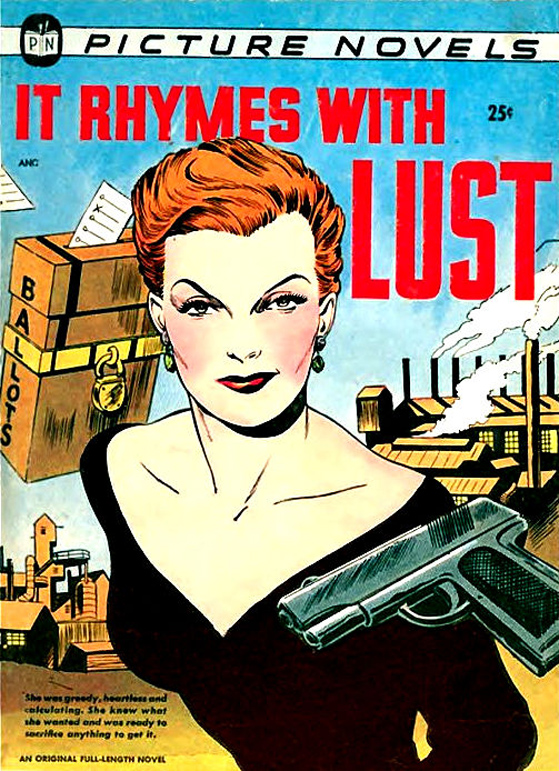
A book cover:


What you see above is basically the literary equivalent of those hieroglyphics that show the ancient Egyptians Egyptian-walking around vases with wavy lines in them. Some people — mostly crazypantses whose job descriptions include -ologists that you’ve never heard of before — say these wavy line vases are proof that the old pharaohs had light bulbs with working filaments. But, as we know, if you didn’t patent it, push it and popularize it, you don’t get to claim it. So sorry, Egyptians, but most of use are just going to assume that your “light bulbs” are actually jar-shaped snakehouses, probably in tribute to some god whose head was one animal and his body was another animal. One these animals may be a snake.

The preceding paragraph exactly describes the curious case of It Rhymes With Lust. EXACTLY. Published in 1950, the book was the first-ever attempt to tell a novel-length story through pictures. Yes, it’s considered the first graphic novel, even though Arnold Drake — one half of the duo who wrote Lust — termed the book a “picture novel.” The intended audience was not children but adults — or at least the kind of adults who would enjoy noirish tales of sex, greed, and political corruption. However, these hoped-for readers didn’t take the bait. St. John Publications released another picture novel — The Case of the Winking Buddha, a mystery story — but that would prove to be the last. Not until 1976 did longer comic books start to be widely referred to as “graphic novels,” and they’re still inching toward all-around acceptance in the U.S. today. As the A.V. Club asks in its review of Lust upon its 2007 reissue, where might the genre be today if this false start in 1950 had instead been a success?

Like I said, totally the same deal with the Egyptian snake bulbs and Rhymes With Lust.

It’s interesting to me, this little footnote in the history of comic books, but what I find most tantalizing is not how Lust’s success could have changed the evolution of graphic novels. It’s the cover. Mostly the title. What is the it, exactly, that rhymes with lust? And which of the many rhymes for lust could the title be referring? Crust? Must? Plussed? (The ever-elusive opposite of nonplussed, of course.) Flust? Zizzust? Hippopotamus’d? Given the look of the tan, presumably windblown town in the background, I would presume that the rhyme could be dust. In truth, the thing that rhymes with lust is the name of the story’s femme fatale: Rust Mason. Yes, the story’s epitome of sex and passion is named after the army buddy your grandpa used to go on hunting trips with, before the accident. I don’t want to criticize what is remembered today as a bold literary venture into a genre unknown to U.S. writers and readers, but maybe it would have been more successful if the main female character didn’t share her name with the unfortunate condition of a gardening trowel left out on a wet night. (Left Out on a Wet Night — now there’s a book title! Doris, get creative on the line!)

And yes, by the way, the woman featured on the cover is, in fact, Rust herself. (Given what parts of her are featured, I suppose bust would have been a decent guess, too.) Really, once you look at the woman, the name Rust Mason doesn’t seem so inappropriately unfeminine. She may be linked with lust, at least in someone’s head, but her cropped hair and sharp facial features make her look downright manly. I’m also amused as to what else Matt Baker included on the cover in order to hint at what kind of story It Rhymes With Lust might be: a handgun and a ballot box, hovering magically around Rust’s bust. Personally, I think the whole story seems a lot more appealing if you interpret these images literally. “It Rhymes With Lust is a story about a woman who gets a gun and a ballot box thrown at her moments after she looks directly into the camera while getting her picture taken.” I’d read that. In fact, I think I just did. But I’d also want to have words with whoever threw the ballot box. “Theodore,” I’d begin, even if his name wasn’t Theodore, just to cheese him off, “This is not what we use ballot boxes for. Ballot boxes are not weapons. Guns are weapons. You could learn a lot about weapons from your friend on the other side of Rust, who threw the gun at her. Because guns, Theodore, are weapons.”

To conclude, what I’d like to think is a quote from the It Rhymes With Lust: “But sultry Rust Mason didn’t have to throw guns, not even in a town like Guntoss Gulch, where the streets crawled with the type of miscreants who’d throw their guns at you as clock you in the head with a ballot box. No, Rust Mason threw something else: sex. Which she poured into water balloon and tossed at passersby from her balcony.”

For the record, I would also read a book about a woman who throws sex-filled water balloons.

Comics, previously:

Monday, March 29, 2010

Men Who Love Translation Oddities

Well, one man, anyway: me. I’m sure there are others, but I’ll refrain from speaking for all of them.

This weekend, I was looking at a bookstore display for Stieg Larsson’s The Girl With the Dragon Tattoo and The Girl Who Played With Fire, the first two books of the late author’s Millennium trilogy. I’ve only read the first. The version of it that I bought — yellow and green cover with a Chinese dragon design — seems to be the most widely distributed one. It looks like this:


 I say it’s an effective cover, even if the colors displayed prepared me for a different sort of story than the one told in the book. Before I picked up my copy, I knew nothing about The Girl With the Dragon Tattoo — not that it was originally written in Swedish, not that it took place in Sweden, not even that it was a detective story. Just judging the book by its cover, I imagined that the titular tattooed lady was herself Asian, some vampy stereotype existing in a previous decade, maybe someone who could have existed in Robert Towne’s Chinatown. A dumb decision to leap to, in retrospect, but that’s why we’re cautioned against this very activity. Dragon Tattoo is bleak and graphic and, since it begins in the dead of a Swedish winter, not exactly colorful, at least in the literal sense. It grows and changes and eventually gets splashed with quite a bit of blood red by the end, and by the time I finished the last page I was glad I’d read it. Nonetheless, the cover caught my eye, and I don’t feel embarrassed to have the book resting on my shelf.

In the bookstore, I saw plenty of copies with this good version of the book, but also several of the Spanish translation, which, inexplicably, had a far worse cover — chromatically appropriate, maybe, but overall poorly designed and downright ugly.


See, rather than abstracting the titular character by focusing on her tattoo, whoever designed this garbage chose to depict her as a tattoo-less waif, distorted and cartoonish to the point that she looks like a failed attempt and drawing a realistic Natasha Fatale from Rocky and Bullwinkle. Clearly, someone hates Spanish-speakers and wants to deter them from reading the book. I also wonder why the title would have been rendered Los hombres que no amaban las mujeres, literally “The men who do not love the women,” instead of something using a form of the verbs odiar or detestar, which both mean “to hate.”

The Spanish version is a translated version of the original Swedish title, Män som hatar kvinnor, “Men who hate women.” Since the novel concerns various awful things done to several female characters, it’s actually a better title for the story, even if it wouldn’t have sold as many copies in the U.S. (Worst case scenario: Man with rage issues buys Men Who Hate Women thinking it’s a self-help book, only to get some awful, awful ideas.) Furthermore, as far as the first novel goes, the tatted-out Lisbeth Salander isn’t really the main character; she shares that responsibility with Mikael Blomkvist, a middle-aged investigative reporter who’s less sexy and overall less interesting than Lisbeth. (I’ve not read the series any further, but it wouldn’t surprise me if Larsson ultimately made the series Lisbeth’s story.) Putting Lisbeth at the forefront certainly seems to be the tactic employed by the people who marketed the Swedish-language film adaptation. Lookit:


There they are, Lisbeth and Mikael both, but it’s clear that Lisbeth gets more emphasis, just by virtue of where she’s situated in the photo. For this film’s subtitled, English-language release, however, the poster uses the same photo of actress Noomi Rapace but omits the actor playing Mikael entirely:


And, again, the title was changed to The Girl With the Dragon Tattoo, because it’s simply grabbier to us English-speakers.

The English title also fits better with the structure of the second book, The Girl Who Played With Fire. In the original Swedish, it’s basically that: Flickan som lekte med elden. The theme doesn’t hold, however, with the third book, The Girl Who Kicked the Hornets’ Nest, as the original Swedish has it as Luftslottet som sprängdes — “The Air Castle that blew up.” The Spanish titles for these books, by the way, are La chica que soñaba con una cerilla y un bidon de gasolina (“The girl who dreamed about a match and a gasoline can”) and La reina en el palacio de las corrientes de aire (“The queen in the palace of the airflows”).

Translation, previously:

Monday, February 15, 2010

Less Pumpkin, More Inferno

I’d never thought of it in this way, but there’s a theory put forth by Linda Badley in her 1996 book Writing Horror and the Body that likens Carrie to a dark modernization of the Cinderella story. Sue Snell is the godmother figure, who tries to make life better for the tormented Carrie. And both stories have their climax set at a formal party where the respective casts see the undoing of any efforts to elevate the status of the victimized Cinderella character.

Of course, in place of the carriage’s transformation back into a pumpkin, Carrie ends with her killing everybody in an firestorm, so that would be small difference between the two stories.

This post going up the day after Valentine’s Day is totally coincidental, I swear.

Saturday, July 18, 2009

Already Secretly Married

I know little of the work of Emilie Loring, though I can surmise quite a bit by scanning the titles of her books. You, who may also know little of Loring, can do the same.
  • Beckoning Trails
  • When Hearts are Light Again
  • Throw Wide the Door
  • How Can the Heart Forget?
  • Forever and a Day
  • I Hear Adventure Calling
  • Love Came Laughing By
  • Love with Honor
  • A Candle in the Heart
  • Rainbow at Dusk
  • Spring Always Comes
  • Behind the Cloud
  • Where Beauty Dwells
  • With This Ring
  • Gay Courage
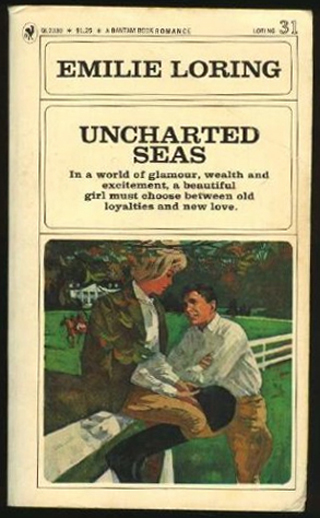
Okay, Gay Courage sounds a little weird, but based on what she chose to title her other books, it seems like a pretty safe bet that Loring might have enjoyed Nights in Rodanthe, though even she would have thought better than to have saddled a book with a clunker title like that one. Of the covers I found online, the one for Uncharted Seas.


Can you see what’s wrong with this book cover? I’d say it’s either that Loring picked the worst possible title for a novel about the horsey set or that whoever painted the art read neither the book nor its title.

Easily the best part of my quick glimpse into the life of this prolific author, however, would be the following note on her Wikipedia page, which speaks more of Loring’s authorial tendencies than a mere list of here titles can. I quote:
There are several repeating motifs in her work that annoy some readers and amuse others. Among them are a girl who is twenty-three with red hair, a dark-haired lawyer or aspiring politician for a hero, a quotation-spouting secondary character, a fan back chair, a Mandarin coat, a Chinese lacquer screen (room divider), New England as a setting or character trait (“New England granite”), and a black-and-white spotted dog…. She has a habit of describing every flower in sight, as well as the outfits of the heroine and supporting characters in detail. Like time capsules, a great deal can be learned about the dress, etiquette, social classes, and political and economic conditions of the year each book was written in. Commonly used plot-lines in her novels are the Lost Will, Ward Grows Up, Orphaned Girl, Sickly Sister, Marriage of Convenience/Contract, and Already Secretly Married.
By the way, every entry in that list of recycled plotlines would have made for an appropriately Loringesque novel title — Already Secretly Married particular. They’d also make for good band names — again, Already Secretly Married in particular.