What follows is a short story about a place I no longer work at.
About a year ago, I was approached by a coworker who I’d estimate to be between forty and fifty years old. “Hey, you work for social media, right?” she asked me. In this case, she happened to be correct: I did, in fact, do social media. But I’m going to say this was just luck on her part, because that’s how anyone in her age bracket approached anyone in my age bracket, even if only three or four people in the entire company had social media-doing as part of their job description.
Me: Yes. What’s up?
Her: Where online can I find those little movies?
(I waited for her to expand. She did not.)
Me: I’m sorry, I don’t know what movies you’re talking about.
Her: Those little movies you see everywhere.
Me: I… Are you talking about YouTube?
Her: No, not YouTubes. They’re smaller than YouTubes.
Me: Vines?
Her: Oh, maybe. Where are Vines?
Me: Go to vine.co, and they’re all there.
(She checks on her computer for a few moments.)
Her: No, not these, I don’t think. What I’m looking for is even smaller. They’re, like, these tiny, little films.
Me: Are you talking about actual short films? Like, student films that are short?
Her: No, you watch them online.
Me: Where online?
Her: Everywhere.
Me: Do we have them on our site?
Her: No, but we should.
Me: Can you tell me a little bit more?
Her: They’re tiny. They’re like the size of a postage stamp.
Me: …
Her: And they only last a second or two and they just repeat as soon as they’re done. And sometimes they have words on them.
Me: Oh. You mean gifs.
Her: Gifs?
(She said that single syllable with great difficulty, l should add, as if it had letters from some foreign alphabet in it.)
Me: Yeah, that’s called a gif.
Her: Okay, gifs. Where are the gifs?
Me: Well, they really are everywhere.
Her: But where are they stored? If I want some, where do I go to find them?
Me: All of them? Well, they’re not actually stored in one given place. What are you looking for?
Her: I’m not looking for any one in particular. Okay, so when people make them, where do they put them online to be stored before they get disseminated all over the internet?
Me: Like, there is no single place.
Her: It’s not like YouTubes?
Me: No, it’s not like YouTubes.
Her: But who makes them?
Me: Like, everyone. Anyone.
Her: Okay, but is someone paying them to make these?
Me: No, basically. People just make them for free.
Her: They make them for free and they just put them anywhere?
Me: Yes.
(She typed away at her computer a bit.)
Her: All right, that seems a little weird. I think I’m going to ask around.
Me: Oh, okay. Good luck.
She never asked me again about anything.
And before you interpret this little anecdote as a young-ish person making fun of an old-ish person for not quite understanding technology, let me tell you that she spoke the sentence “I think I’m going to ask around” in a way that it also communicated “Oh, you dumb-dumb, blathering on nonsense. I’m so certain that you’re wrong, because you’re so clearly a worthless dumb-dumb. Go off and continue being a dumb-dumb.”
I’d like to think that she asked an even younger person who was equally unable to help her. And I’d like to think that she’s still looking for the one single place where all the gifs come from.
A funny story, previously:

Tuesday, August 19, 2014

Monday, August 18, 2014
What Philip Morris Can Teach Us About Basic Shopkeeping
CIGARETTES!
IN SPACE!
If you follow my Tumblr, you may have seen Philip Morris’s awesomely atrocious instructional video from 1987, which features a space lady singing alternate, cigarette-centric lyrics to the Pointer Sisters’ “Jump.”
Just try and get it out of your head.
Sample lyrics: “Yes, I know how you do / Want to make more profits than you do / So I’m gonna show you / It’s that never-ending story / About moving inventory / To push your cigarette dollars higher! / I’ll show you how, I’ll show you how / to make your sales and profits soar! / Yes, you’ll sell more, more more!”
On one hand, this woman is truly giving it her all. She’s sporting Marlboro colors like a trooper. She’s a decent dancer. And you can’t say she’s not trying to convince you that she truly is a space traveler who landed on earth to impart valuable cigarette-selling information. In a way, this little production fits in line with a long-standing tradition of industrial musicals, which for decades had professional singers and songwriters selling out in an effort to sell products.
On the other, more honest hand, no. Just no. “Jump” was four years old when this video was made, and it hardly seems worth the trouble of ripping off an aging hit if the big take-away is that you should keep in stock the things your customers like to buy. (“Stock! To match demand / Stock up! All the top brands / You keep your loyal customers happy! / Stock, stock, stock on up!”) Doesn’t that seem like a fairly straightforward shopkeeping principle? To sell people what they want? Isn’t that a foundational aspect of capitalism?
However, it turns out the YouTube posting was only part of a longer video that Philip Morris screened for people who might have reason to sell cigarettes. The full, 16:25-length video exists at UC San Francisco’s archive of tobacco industry videos.
Wondering if Philip Morris had more to say beyond basic retail principles, I watched the whole thing. Here is the collected flavor country wisdom I can share with you.
There’s some tragic irony in the space lady, presumably an aspiring actress-singer-dancer, telling the audience that selling cigarettes is more important than show business. She does exactly this, following it up with “You’re in business to make money, and nothing increases profits like cigarettes!” If that’s true, she probably should have quit her dancing career and just sold cigarettes in a liquor store.
Someone on the creative side of the video thought it sensible that the space lady should narrate the entire video in an echoing “space voice.” And everyone else involved apparently responded with, “Yeah, that doesn’t seem like it would get annoying at all. Good idea, Bruce.”
On skipping over the obvious answer, which is “because they’re addictive,” this questionable factoid: “Why are cigarettes so profitable? The value of a carton of cigarettes sold as either a pack or as cartons far exceeds the average price of items found at retail.”
The space lady really hammers home the idea that you should continue to sell the things that customers like, and also that those things are exclusively cigarettes — Philip Morris-brand cigarettes in particular, obviously. One of the ways she conveys this is with synonyms, which is a rhetorical technique of questionable effectiveness. “Cigarettes are a proven profit producer for your store. They are an above average — above average! exceptional! superior! — product for your store, so you see why it’s important — important! vital! key! — to keep them in store.”
“Use the appropriately sized merchandizer to display cigarettes and stock them with sufficient brand packagings to satisfy customers’ wide range of preferences.” So… put the cigarettes on a shelf where people can reach them, and don’t instead put zero cigarettes on said shelf? Don’t, like, put the cigarettes in a hole in the ground? Or in an angry bear’s mouth?
“Take Marlboro. Everyone does! In fact, people buy more Marlboros than Cokes every year. ‘What? You’re kidding!’ ‘Coke? No!’ Yes! Marlboro is the number one-selling consumer packaged product in the world.” This I can’t quite believe, even considering how many more people were smoking back in 1987. Can this be true? Or did the writer fudge the math my counting individual cigarettes instead of packs? Would I put that past the same person who wrote the dialogue “Take Marlboro. Everyone does!”? No. No, I wouldn’t.
“Stock according to demand and out-of-stock situations disappear. Customers smile and sales and profits soar. And everybody’s happy!” Well, until cancer.
“Cigarette-smokers are some of the most fiercely loyal creatures on the fact of the planet.” Yes, because they’re addicted. And again, they’re happy only until the cancer sets in.
And finally, a retail strategy that I can’t imagine seemed high-tech, even by the standards of 1987: “Space Command, a computerized space-management system which simulates retail store environment, which also improves planogramming capabilities.”
So what have we learned? Nothing, unless you weren’t aware that Philip Morris was creepy and that it’s easier to sell products when you have them to sell, as opposed to selling things you can’t physically sell. Oh, and if you want to get an ad jingle stuck in someone’s head, just re-write the lyrics to a Pointer Sisters song. Because that shit will not leave your head.
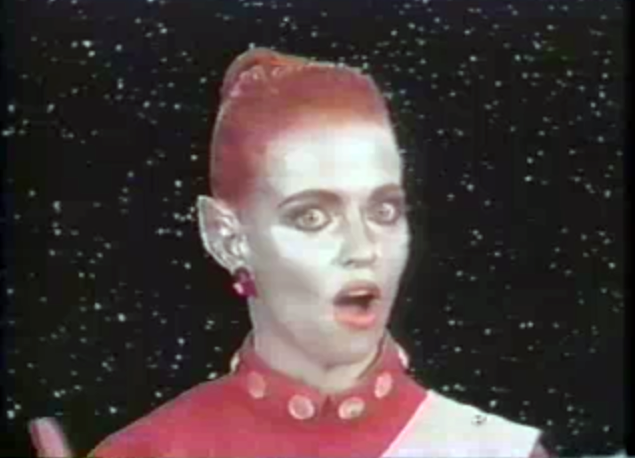
And what happened to the space lady? You may be surprised to learn that she grew up to me Emily Deschanel, start of TV’s Bones.
No, that’s not true.
I made that up just now.
I really wanted to find out who she is but could not. I would like to believe that someone who later went on to legitimate fame has this silver-and-red skeleton hanging in her closet. Space lady, if you’re out there an no longer zipping from planet to planet, hit me up. I have some questions for you.
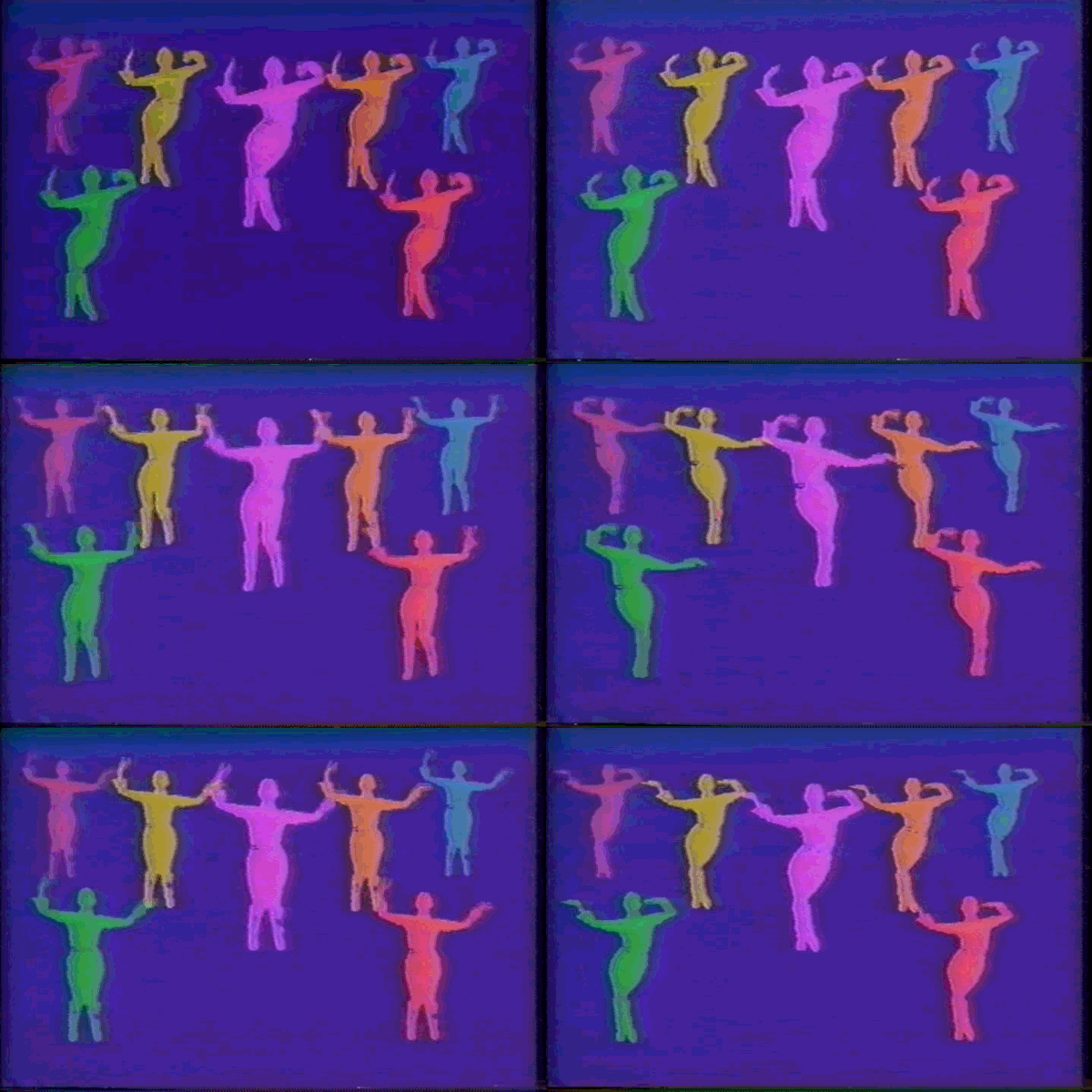
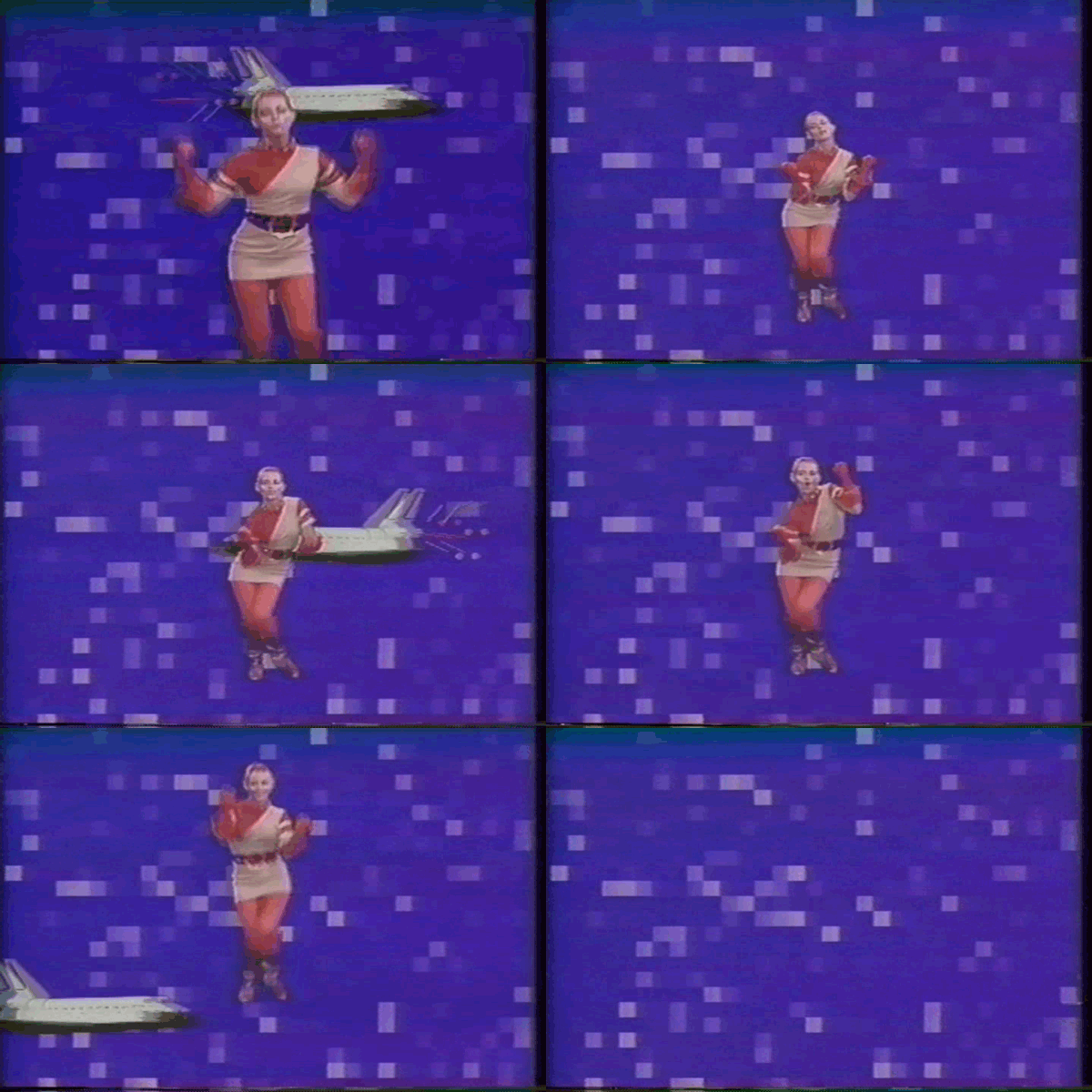
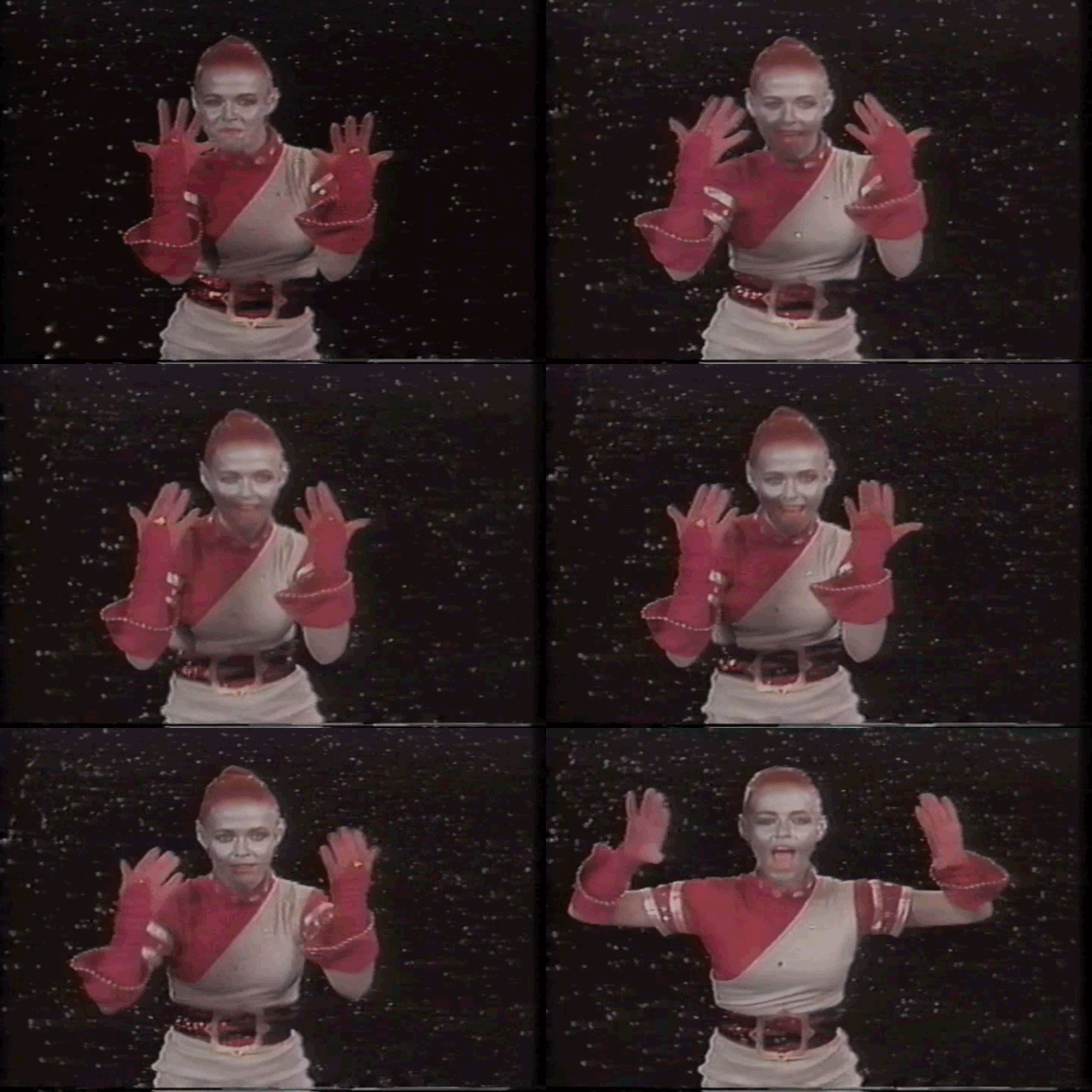
Can’t fault your dance moves, though.
It’s funny because it’s old, previously:
IN SPACE!
If you follow my Tumblr, you may have seen Philip Morris’s awesomely atrocious instructional video from 1987, which features a space lady singing alternate, cigarette-centric lyrics to the Pointer Sisters’ “Jump.”
Just try and get it out of your head.
Sample lyrics: “Yes, I know how you do / Want to make more profits than you do / So I’m gonna show you / It’s that never-ending story / About moving inventory / To push your cigarette dollars higher! / I’ll show you how, I’ll show you how / to make your sales and profits soar! / Yes, you’ll sell more, more more!”
On one hand, this woman is truly giving it her all. She’s sporting Marlboro colors like a trooper. She’s a decent dancer. And you can’t say she’s not trying to convince you that she truly is a space traveler who landed on earth to impart valuable cigarette-selling information. In a way, this little production fits in line with a long-standing tradition of industrial musicals, which for decades had professional singers and songwriters selling out in an effort to sell products.
On the other, more honest hand, no. Just no. “Jump” was four years old when this video was made, and it hardly seems worth the trouble of ripping off an aging hit if the big take-away is that you should keep in stock the things your customers like to buy. (“Stock! To match demand / Stock up! All the top brands / You keep your loyal customers happy! / Stock, stock, stock on up!”) Doesn’t that seem like a fairly straightforward shopkeeping principle? To sell people what they want? Isn’t that a foundational aspect of capitalism?
However, it turns out the YouTube posting was only part of a longer video that Philip Morris screened for people who might have reason to sell cigarettes. The full, 16:25-length video exists at UC San Francisco’s archive of tobacco industry videos.
Wondering if Philip Morris had more to say beyond basic retail principles, I watched the whole thing. Here is the collected flavor country wisdom I can share with you.
There’s some tragic irony in the space lady, presumably an aspiring actress-singer-dancer, telling the audience that selling cigarettes is more important than show business. She does exactly this, following it up with “You’re in business to make money, and nothing increases profits like cigarettes!” If that’s true, she probably should have quit her dancing career and just sold cigarettes in a liquor store.
Someone on the creative side of the video thought it sensible that the space lady should narrate the entire video in an echoing “space voice.” And everyone else involved apparently responded with, “Yeah, that doesn’t seem like it would get annoying at all. Good idea, Bruce.”
On skipping over the obvious answer, which is “because they’re addictive,” this questionable factoid: “Why are cigarettes so profitable? The value of a carton of cigarettes sold as either a pack or as cartons far exceeds the average price of items found at retail.”
The space lady really hammers home the idea that you should continue to sell the things that customers like, and also that those things are exclusively cigarettes — Philip Morris-brand cigarettes in particular, obviously. One of the ways she conveys this is with synonyms, which is a rhetorical technique of questionable effectiveness. “Cigarettes are a proven profit producer for your store. They are an above average — above average! exceptional! superior! — product for your store, so you see why it’s important — important! vital! key! — to keep them in store.”
“Use the appropriately sized merchandizer to display cigarettes and stock them with sufficient brand packagings to satisfy customers’ wide range of preferences.” So… put the cigarettes on a shelf where people can reach them, and don’t instead put zero cigarettes on said shelf? Don’t, like, put the cigarettes in a hole in the ground? Or in an angry bear’s mouth?
“Take Marlboro. Everyone does! In fact, people buy more Marlboros than Cokes every year. ‘What? You’re kidding!’ ‘Coke? No!’ Yes! Marlboro is the number one-selling consumer packaged product in the world.” This I can’t quite believe, even considering how many more people were smoking back in 1987. Can this be true? Or did the writer fudge the math my counting individual cigarettes instead of packs? Would I put that past the same person who wrote the dialogue “Take Marlboro. Everyone does!”? No. No, I wouldn’t.
“Stock according to demand and out-of-stock situations disappear. Customers smile and sales and profits soar. And everybody’s happy!” Well, until cancer.
“Cigarette-smokers are some of the most fiercely loyal creatures on the fact of the planet.” Yes, because they’re addicted. And again, they’re happy only until the cancer sets in.
And finally, a retail strategy that I can’t imagine seemed high-tech, even by the standards of 1987: “Space Command, a computerized space-management system which simulates retail store environment, which also improves planogramming capabilities.”
So what have we learned? Nothing, unless you weren’t aware that Philip Morris was creepy and that it’s easier to sell products when you have them to sell, as opposed to selling things you can’t physically sell. Oh, and if you want to get an ad jingle stuck in someone’s head, just re-write the lyrics to a Pointer Sisters song. Because that shit will not leave your head.
And what happened to the space lady? You may be surprised to learn that she grew up to me Emily Deschanel, start of TV’s Bones.
No, that’s not true.
I made that up just now.
I really wanted to find out who she is but could not. I would like to believe that someone who later went on to legitimate fame has this silver-and-red skeleton hanging in her closet. Space lady, if you’re out there an no longer zipping from planet to planet, hit me up. I have some questions for you.
Can’t fault your dance moves, though.
It’s funny because it’s old, previously:
Saturday, August 16, 2014
Dreaming of Pixelated Summers
It’s the simplest of gifs, really: just four frames. But I can’t stop watching it, can’t stop letting it make me think of jaunty little ocean adventures from one port to another on little pixel ships.

That or magic eye puzzles. Oceanside magic eye puzzles.
(Original screengrabs via Luminous Arc, via Spriter’s Resource.)
Beautiful pixels, previously:
(Original screengrabs via Luminous Arc, via Spriter’s Resource.)
Beautiful pixels, previously:
Tuesday, August 12, 2014
Left-Handed Ghosts and Familiar Music
Short version: the right idea, but the wrong video game franchise.
More than two years ago, I posted here on this blog about a Japanese disco track that sounded to me like something I’d heard in a video game — specifically something dire and commanding and urgent, like you might hear during a boss battle. It’s the 1978 song “Southpaw” by Japanese band Pink Lady, and the part I’m referring to happens just in the first few seconds.
Did you hear it? It’s the part that starts around the nine-second mark. I always heard it, but for the life of me, I couldn’t figure out why it sounded familiar. And then just this week, someone pointed out to me why: Ghosts ’N Goblins.
Again, did you hear it? Just right at the beginning.
“Southpaw” predates Ghosts ’N Goblins by seven years, so if anything, the composer of the game’s score would have been paying tribute to the Pink Lady track. I’m not sure it’s any more than a coincidence, but at least this settles why a Japanese pop song from before I was born sounded like something I should already know.
To end your day on a highest of possible notes, here is Pink Lady performing their 1977 hit “UFO” in a video that seems to have been filmed on their apartment complex stairs.
And here’s a talented sight reader playing the Ghosts ’N Goblins theme in a ragtime style so naturally that you’ll have a hard time believing he’d never laid eyes on the sheet music before.
Video game music, previously:
More than two years ago, I posted here on this blog about a Japanese disco track that sounded to me like something I’d heard in a video game — specifically something dire and commanding and urgent, like you might hear during a boss battle. It’s the 1978 song “Southpaw” by Japanese band Pink Lady, and the part I’m referring to happens just in the first few seconds.
Did you hear it? It’s the part that starts around the nine-second mark. I always heard it, but for the life of me, I couldn’t figure out why it sounded familiar. And then just this week, someone pointed out to me why: Ghosts ’N Goblins.
Again, did you hear it? Just right at the beginning.
“Southpaw” predates Ghosts ’N Goblins by seven years, so if anything, the composer of the game’s score would have been paying tribute to the Pink Lady track. I’m not sure it’s any more than a coincidence, but at least this settles why a Japanese pop song from before I was born sounded like something I should already know.
To end your day on a highest of possible notes, here is Pink Lady performing their 1977 hit “UFO” in a video that seems to have been filmed on their apartment complex stairs.
And here’s a talented sight reader playing the Ghosts ’N Goblins theme in a ragtime style so naturally that you’ll have a hard time believing he’d never laid eyes on the sheet music before.
Video game music, previously:
Tuesday, August 5, 2014
Donkey Kong and the Damsel in No Distress Whatsoever
It doesn’t seem terribly productive to read anything into old arcade cabinet art, but that’s not exactly a look of horror on Pauline’s face as she’s being kidnapped, is it?

Also, based on her tongue, she may be ill. Also, based on this take on Donkey Kong, I’m wondering if he could be a blood relation to John C. Reilly.
The various Kongs, previously:
Also, based on her tongue, she may be ill. Also, based on this take on Donkey Kong, I’m wondering if he could be a blood relation to John C. Reilly.
The various Kongs, previously:
Monday, August 4, 2014
Floating in a World of Julee Cruise
Not that I’m going to start a “things I heard on the radio” tag, but here is another post about something I heard on the radio.
Yesterday, I wrote about hearing something that sounded familiar and not being able to determine why. Today, I present a more successful version of this situation. Recently, I happened across This Mortal Coil’s “Song to the Siren.” While I’d heard it before, listening to it in the car I was struck by how much it reminded me of David Lynch and Twin Peaks and, in particular, the music of Julee Cruise.
See if you hear it too.
When I got home, I read up on the song and discovered that it actually has a significant history with David Lynch’s work. Lynch wanted to use the song in Blue Velvet but couldn’t. He therefore ended up reaching out to a then-unknown composer named Angelo Badalamenti, who was on-set helping Isabella Rossellini get her vocals right for the performance of the title track. From a recent Rolling Stone piece on Lynch and Badalamenti’s work together:
Cruise eventually sang in the title track to Twin Peaks, though her vocals would be excised from the portion shown before every episode. She also appeared on the show and in the prequel move as well, and Lynch and Badalamenti, in turn, wrote and produced additional songs for her throughout the next decade — and it all happened because a certain Tim Buckley cover was too expensive.
Incidentally, Cruise has a small cameo in another famous piece of culture about murders in a small town: a remix of her track “Artificial World” is playing in Tatum’s bedroom during the “Bam! Bitch went down” scene in Scream — because mid-’90s teens loved them some Julee Cruise dance remixes. Can anyone point me toward a non-remixed, original version of “Artificial World”?
Yesterday, I wrote about hearing something that sounded familiar and not being able to determine why. Today, I present a more successful version of this situation. Recently, I happened across This Mortal Coil’s “Song to the Siren.” While I’d heard it before, listening to it in the car I was struck by how much it reminded me of David Lynch and Twin Peaks and, in particular, the music of Julee Cruise.
See if you hear it too.
When I got home, I read up on the song and discovered that it actually has a significant history with David Lynch’s work. Lynch wanted to use the song in Blue Velvet but couldn’t. He therefore ended up reaching out to a then-unknown composer named Angelo Badalamenti, who was on-set helping Isabella Rossellini get her vocals right for the performance of the title track. From a recent Rolling Stone piece on Lynch and Badalamenti’s work together:
“David reluctantly agreed to write a lyric, and he thought writing a new song was absolutely preposterous because ‘Song to the Siren’ was his favorite song of all time,” Badalamenti says. “But Isabella came to the recording studio, where we were recording Blue Velvet, and she handed me a little piece of yellow paper and, in David's handwriting, it said, ‘Sometimes a wind blows and you and I float in love and kiss forever in a darkness and the mysteries of love come clear....’ I’m reading this and saying, ‘Hey man, where are the rhymes? And more important, where are the hooks that a song needs?’” To make things more quizzical, the only musical directions Lynch gave Badalamenti were to “compose something with no beginning and no end” and to make it “just ethereal beauty.”Here is that song:
Dumbfounded, the composer sat at his keyboard, staring at Lynch's scratch paper, and held a “long, soft, sustained, wide-voiced B major chord” for maybe a minute or more. “I was just listening to this chord, and it set a mood for me,” he recalls. “The melody just floated out and I knew that I married David’s description to this poetic lyric. I never changed a single word.” And thus, “Mysteries of Love” was born.
Cruise eventually sang in the title track to Twin Peaks, though her vocals would be excised from the portion shown before every episode. She also appeared on the show and in the prequel move as well, and Lynch and Badalamenti, in turn, wrote and produced additional songs for her throughout the next decade — and it all happened because a certain Tim Buckley cover was too expensive.
Incidentally, Cruise has a small cameo in another famous piece of culture about murders in a small town: a remix of her track “Artificial World” is playing in Tatum’s bedroom during the “Bam! Bitch went down” scene in Scream — because mid-’90s teens loved them some Julee Cruise dance remixes. Can anyone point me toward a non-remixed, original version of “Artificial World”?
Sunday, August 3, 2014
The Pleasurable Irritation of Misplaced Nostalgia
On one hand, this post may appeal especially to the video game-literate members of my audience. On the other, it speaks to a larger sensation that I'm sure we have no word for.
Here is Rene Aubry’s “Seduction,” an instrumental piano piece that I heard yesterday on KCRW.
Now, please, what does it sound like? Aubry released the song on his 2013 album, Forget Me Not, which means that whatever I’m thinking of mostly likely came out before, but something about this song triggers my nostalgia sensors nonetheless. Just given my own history, it’s likely whatever it reminds me of came from a video game, just because a life playing video game has meant a lot of time listening to instrumental “wallpaper” music. To me, the Aubry song sounds like a minor key version of something in a major key, but for the life of me I can’t say what.
Is it this? Is it this? Does this trigger anyone else’s nostalgia sensors? This is driving me crazy, but in a way I don’t especially mind.
Here is Rene Aubry’s “Seduction,” an instrumental piano piece that I heard yesterday on KCRW.
Now, please, what does it sound like? Aubry released the song on his 2013 album, Forget Me Not, which means that whatever I’m thinking of mostly likely came out before, but something about this song triggers my nostalgia sensors nonetheless. Just given my own history, it’s likely whatever it reminds me of came from a video game, just because a life playing video game has meant a lot of time listening to instrumental “wallpaper” music. To me, the Aubry song sounds like a minor key version of something in a major key, but for the life of me I can’t say what.
Is it this? Is it this? Does this trigger anyone else’s nostalgia sensors? This is driving me crazy, but in a way I don’t especially mind.
Subscribe to:
Posts (Atom)