Pages

Showing posts with label things biblical. Show all posts

Tuesday, July 26, 2011

People and Their Silly Severed Heads (a Follow-Up)

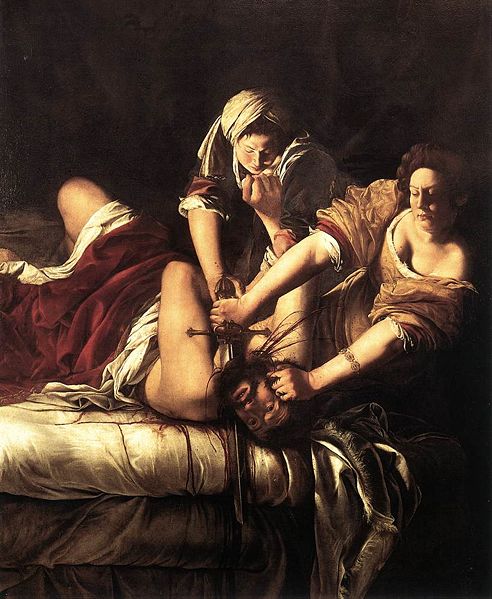
So let’s be honest: There’s virtually no occasion on which someone be in the presence of a severed human head — theirs or someone else’s — and it doesn’t seem a little awkward. However, if you’re going to be a cephalophore and tote around a head like a big Christmas turnip, you may as well do it in a manner that will be immortalized in art. That’s the lesson we should take away from the Biblical story of Judith, the wily widow who gets an Assyrian general drunk, cuts off his head, and then shows people. The combination of Judith’s virtuous beauty and her raw aggression made the scene of her lopping off Holofernes a popular subject for painters.

See? Lucas Cranach the Elder’s treatment of the subject matter depicts Judith as poised, sly and powerful, whereas Holofernes wears an expression that we can only read as “What, bitch?” Just lovely.


Many chose to depict her carrying away the man’s head in a basket but some of whom instead painted the actual assassination. These ones are the most interesting. 

However, Spencer pointed out to me after me that certain artist’s rendition of Judith and Holofernes made for some interesting projections. Take Caravaggio’s painting.


Holofernes looks shocked, Judith looks like she’s concentrating more on the prevision of the act that the person she’s doing it to and finally Judith’s maid looks as if she’s goading Judith on. That all being said, it’s enlightening to know that, per Wikipedia, Caravggio based Holofernes on himself, Judith on his former mistress and the maid on the mistress’s mother. Which is cute.

Conversely, there’s Artemesia Gentileschi’s treatment of the same scene: the moment of death.


Gentileschi also mapped personalities from her life onto the characters. As Wikipedia points out, Judith looks a lot like Gentileschi herself, while Holofernes looks loopks like Agostino Tassi, a painter in his own right who’s today best known for having raped Gentileschi.

With background like this, I could actually not got tired of looking at biblical paintings by dead Italians.

Tuesday, December 14, 2010

Shopping Malls and the Book of Exodus

I made a strange connection a while back while reading about The Munsters. With good reason, I should point out. The great Bryan Fuller — who I believe made Pushing Daisies specifically or my enjoyment — has announced that he will reboot everyone’s second-favorite creepy family as something fantastic and wonderful, possibly in a way that includes Kristen Bell. Anyway, I couldn’t recall what Yvonne De Carlo, who played Lily in the original series, had done with the rest of her career. Turns out that pre-Munsters, De Carlo played Moses’s wife in the famous, Charles Heston version of The Ten Commandments. Her Wikipedia page even uses a still from The Ten Commandments. So there’s that.

But what surprised me is that her character isn’t noted as being Tzipporah, as I’m used to seeing it, but Sephora, which also happens to be the name of the cosmetics store chain. So what gives?

According to Sephora’s website, the chain’s name comes from a combination of Tzipporah (because ol’ Mo-mo’s wife was quite the looker, apparently) and the Greek word sephos, meaning “pretty.” The Wikipedia for the store, however, says sephos means “beauty.” And finally both this Greek-to-English dictionary and all of Google seem to say that sephos means nothing outside of Sephora-related claims. Even more strangely, Tzipporah (which apparently means “bird” in Hebrew) simply translates into Greek as Sephora, independent of any made-up word that means “beauty” or “pretty” or “clean-pored mallrat princess.”

Weird, then, but it’s not unheard of for a company to fudge its history or etymology to make itself sound better. But there’s one more aspect from the whole Sephora brand that makes me think the name might still be tied to its Old Testament roots. The logo:


That slender, “S”-shaped figure that appears above the text may look a bit like an abstract women’s body, but Wikipedia claims it’s actually an abstracted, “S”-shaped flame. Considering how fire plays into Exodus and particularly how God first speaks to Moses, I wonder if the symbolism may have been intentional, at least at some point.

Thursday, June 24, 2010

The Ineffective Fallen Angel

Long ago, most people could apparently conceive of monsters only as mix-and-matched composites of existing animals. I don’t find this aesthetic particularly scary. Actually, it seems kind of fun. Can I place an order for a sea otter with eagle wings and a panda face? Because that would totally rock. But whatever — back-in-the-day folk lacked imagination, and this failing is especially obvious when you consider the form they gave to the Adramelech, a Biblical boogeyman supposedly worshipped by the residents of Sepharvaim, which doesn’t sound like a place that has nice restaurants.

Of all the terrifying animal parts to mash together to create Adramelech’s body, did they have to pick the body of a human, the head of a donkey and the tail of a peacock?


Not scary, right?

Granted, this is only a depiction of the demon per Collin de Plancy’s Dictionnaire Infernal, so we have to assume that de Plancy jazzed it up a little. But still — disregarding the fact that Adramelech is not wearing any pants, doesn’t he look more like some goofy thing Alice would meet in Wonderland than he does a demon of hell? (According to this page, he’s actually both president of the high council of the devils and keeper of the wardrobe of the demon king, which sound like a pretty important jobs.) Yet children were allegedly sacrificed to Adramelech, even though he looks like a thing that might have entertained them on their birthdays.

Of course, it does not help that a description of his appearance could literally be given as “ass-face, cock-butt.”

Hell, you’ll have to do a lot better than this.

Wednesday, October 8, 2008

Call an Opthamologist

Downsides of my office: Fluorescent lights, limited parking, and a particular cheap brand of coffee that I like to call “gut rot.” Upsides: among a few others, occasional, interesting conversations about words.

A few weeks ago, a co-worker — who, as a result of her upbringing, has very good reasons to be unfamiliar with the New Testament — asked me if a person who gave an interview with the paper could have possibly misquoted Jesus. The sentence was this: “Don’t worry about the mote in your brother’s eye, worry about the beam in your own.” Without really reflecting on the word mote, she interpreted the passage to mean that one shouldn’t waste time worrying about a moat — as in, the body of water — when one has some sort of wooden plank that could be used to cross such a barrier. Which makes sense, really, if you haven’t already been told what we’re supposed to think that Jesus actually meant with this strange chunk of syntax. (I’m sure it sounded great in Aramaic.) The quote struck my ears as strange as well, because my Catholic education had familiarized me with a different though not necessarily better translation of the quote: “Why do you look at the speck that is in your brother's eye, but do not notice the log that is in your own eye?” This one avoids using the word mote, which doesn’t get used all that much in modern American English. I think that alone helps the (supposedly) intended meaning to be clearer: Don’t rag on someone for some small fault when you yourself are guilty of something even worse.

To me, the problem with this bit of Christian wisdom is that the wording of it always distracted me from the meaning. When seven-year-old me first heard this one, I was too amused or horrified or just generally preoccupied with the notion of a guy walking around with a portion of Abraham Lincoln’s childhood home sticking out of his eye socket. (What if he turned around? What if a woodpecker lived on him? If he fell forward, would it kill him?) Really, it reminds me of the whole “Lily Allen has a ladder in her tights” thing, which itself was confusing and ridiculous until I found out what it meant.

Beam doesn’t help the situation much, either, especially because now it makes me think of someone taking a laser pointer to the face. Actually, that might be the best way to explain it to seven-year-olds today.

According to this website, which conveniently lists specific Bible passages as different editions translate them, the following are also considered fair game, at least by some whacko sect of Christianity somewhere:
  • “sawdust” and “wooden beam”
  • “grain of dust” and “bit of wood”
  • “splinter” and “beam”
  • “craisin” and “pineapple”
Okay, I made the last one up, but it makes just as much sense as all these carpentry terms. (Oh that Jesus — always talkin’ shop.)

As I said earlier, mote is almost equally problematic, especially if the passage is being recited and not read from the page. Which is too bad, really, because mote is a cool word. Say it to yourself. Ten times. Loudly. Now don’t you feel a little bit better about life?

Aside from confusion with the water-filled river that you put around your castle to keep out invaders, mote is notable for one other reason, as one Shakespeare-savvy intern pointed out during the offices original discussion of this matter. Mote is also a character in A Midsummer Night’s Dream, which itself should not be confused with A Midsummer Night’s Cream. Mote appears as one of Queen Titania’s attendant fairies, alongside Peaseblossom, Cobweb and Mustardseed. It’s easy to forget about Mote, however, because she — or possibly he, I guess — never speaks. In fact, some productions of the play leave the character out altogether.

To complicate the matter even further, some editions of the play render the name as “Moth” instead, which pretty much eliminates the possibility that a reader could interpret the name as a pun on the word mute, which the character could very well be, since she or he has no lines.

Following that logic, I personally would like to read the Jesus quote as “Don’t point out the moth in your neighbor’s eye, when you have the trunk of General Sherman, the tallest tree in the world, in your own.”

Unless that overstates the point.

EDIT: At Spencer’s request and for the sake of accuracy, this post has been retitled “See an Ophthalmologist” from its original title, “See an Optometrist.”

Saturday, May 31, 2008

This Sounds Like Ted Max Amateur Hour

I realize now that calling the day on which I offer my word-of-the-week "Dia de las Palabras Nuevas" was a mistake. It just doesn't roll off the tongue. (Though, now that I think about that expression, it occurs to me that a great many unpleasant things can roll of tongues. Vomit, for example. Or phlegm.) In any case, I think I'll stick with The Saturday Wordiness from here on out.
jehu (JAY-hoo) — noun: a cabbie, or a reckless driver
Yes, I realize those two definitions could be considered synonymous. I think that's the point. Almost doubtlessly a term that's been around a while, judging from the fact that it comes to us from the Bible. Jehu, for you Old Testament illiterate, was one of the kings of Israel, and a military leader known for his chariot attacks, hence his transformation into a common noun. Notably, Jehu's backstory seems to be populated by other people with "J" names that have made their way into common parlance. For starters, he's the son of Jehosaphat — who, to my knowledge, wasn't known for jumping — and he's also the one responsible for ordering that slutty, smutty Jezebel to be thrown out the window, whereupon dogs ate her. (A favorite childhood story, that one.) And if "jezebel" isn't a familiar modern term for you, then you must keep especially good company.

A random note on Jezebel, while I'm on the subject: Wikipedia claims that Jezebel was the aunt of Dido, who, in my opinion, is one of the more interesting mythological ladies and another member of ancient royalty who met a fairly bad end.