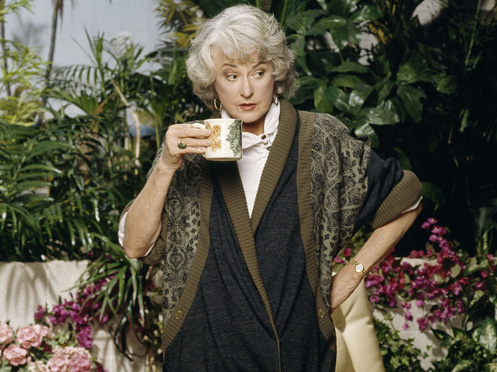
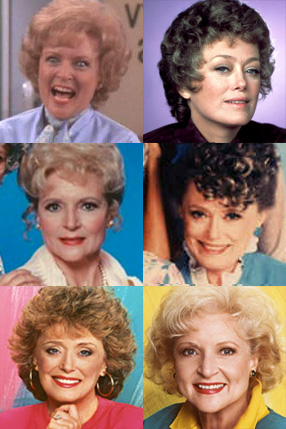
About a year ago, I interviewed a handful of writers from The Golden Girls about their experiences on the show. The piece did fairly well, mostly because a certain sort of ’80s child will reflexively click on anything Golden Girls-related but also maybe because I got a few good anecdotes out of the writers, including the best Bea Arthur story I’d ever heard. The pieced was published in Frontiers, however, and that magazine has ceased to exist—like, in any form. It’s even gone from the Google cache, weirdly, and the original post now seems to be completely inaccessible.
Because I really liked this piece and because someone recently reached out to me asking if I had a copy of the text, I figure some other people might still like to read it. Here’s the writer’s room oral history piece in its entirety.
St. Olaf and Big Daddy and thereabouts, I guess.
Thank You for Being a Friend — A Golden Girls Oral History
More than 20 years later, the ladies are still sharing cheesecake, still talking life lessons out on the lanai and still making fans laugh. The final episode of The Golden Girls aired May 9, 1992, but thanks to around-the-clock reruns and a devoted fan base, Dorothy, Rose, Blanche and Sophia have endured in a way other TV characters haven’t. From the show’s first season, The Golden Girls has especially enjoyed popularity among gay audiences. (L.A.’s Golden Girlz Live is perhaps the greatest realization of that popularity—the shining brooch on the Dorothy Zbornak ensemble that is Golden Girls fandom, if you will.)
In honor of the show’s continued success and its unique appeal to gay viewers, Frontiers spoke with some of the show’s writers about what sets the queen of sitcoms apart from the rest. Featured in this interview are Mort Nathan, co-executive producer and writer; Jamie Wooten, producer and writer; Winifred Hervey, co-producer and writer; Stan Zimmerman, writer; and Jeff Duteil, writer of the “Dorothy’s lesbian friend” episode.
Mort Nathan, on starting on the show from day one with writing partner Barry Fanaro: We took the job knowing it would be writing for characters in their 60s, but the actresses were very skeptical. I remember that when we met Bea Arthur, she looked at us and said, “You’ve got to be kidding. How can these children write for us?” I told her, “Bea, give us a month. We’ll figure it out.” She said a month was fair, and then Betty White said, “Not one more day, darling.”
Winifred Hervey: These were ladies who had done Maude and Mary Tyler Moore. Estelle Getty had been on Broadway. These were substantial women, who’d had people like Norman Lear write for them, and they didn’t know that these people who were 25, 26 years old could write for them. But it worked. They got past that and they loved us.
Nathan: These women had a chance at revitalizing their careers, and they wanted to make sure they were in good hands. When my writing partner and I left after four years, though, it was as if we were going off to war. They were very upset. They loved us, and we loved them right back.
Hervey: When it was explained to me in the beginning, I think it was still being called Miami Nice. But the cast — they could have said the show was about anything and I would have signed up just to work with these women. And it was created by Susan Harris, who at the time was one of the brightest comedy writers in Hollywood. She had done Soap and Benson, and to work with Susan and [executive producers] Paul Junger Witt and Tony Thomas, that was a huge honor.
Stan Zimmerman: Casting those four — it was just magic in bottle. I remember back then, we didn’t have computers to look up the ratings. Remember, we didn’t know if it was going to be a hit. We knew it was funny, but you never know. And we wouldn’t know until we got in Monday what the ratings were. And they would say, “We’re No. 15 this week.” And we’d all go crazy. And next week they’d say, “We’re No. 8.” And then it was, “We’re No. 1.” And then it was “We’re No. 1” again.
Nathan: The ladies were happy to be at the top of their craft for a second time. Bea, Betty and Rue McClanahan were all big stars before, but work had gotten sporadic. But Golden Girls made them stars again, and they loved it — not because of their egos but because of the work. Sometimes the shows were three, four, five minutes too long just because the live audience’s laughs were so huge. Those people had such a great time, which means the ladies had such a great time.
Jeffrey Duteil: The show had a huge gay following — and right away, too. I remember getting ready on Saturday nights. We’d go meet friends at the bars or whatever, and while we were getting ready, we’d watch The Golden Girls. A lot of the gay bars back then, even Revolver, would tape the episode and then show it on the screen. A lot of them had viewing parties — even Golden Girls cocktails. And this was back in the first season.
Jamie Wooten, who joined the show with writing partner Marc Cherry in the fifth season: Marc and I watched a lot of television, and Golden Girls was our favorite show. We pitched an idea about Blanche’s dead husband having fathered an illegitimate child. It went well and they asked us to join the staff. It was surreal. We couldn’t believe we got onto our favorite show.
Zimmerman, on joining with writing partner James Berg: We came in and pitched a whole bunch. We were scared to death, and they just said, “No, no, no.” We were literally out the door, and I turned around and said, “What if Rose’s mother comes to visit?” And they were like “And?” I don’t know what I said, but they told us to sit back down. And we wrote it.
Hervey: Writing on the show, I learned a lot about staying true to the characters, leaning the actors’ voices and their strengths. Some people do one-liners really well. Some people do monologues. Like Bea hardly ever did long stories the way Betty, Rue and Estelle did. But I also learned you didn’t always even need to write words; actors like Bea could do a lot with just the lift of an eyebrow and get a laugh with just that.
Zimmerman: If it was [a line for] Bea Arthur, you could just have Rose say something dumb, and then all Dorothy would need to do is give a look. We discovered that all in the first season. We discovered Rose telling her long stories. We just started writing these St. Olaf stories and that became a runner. It was my school in structuring a joke and making sure it comes from the character. You can’t put Rose’s line in Dorothy’s mouth. If you were given lines from the show blind, you could easily say, “That’s Sofia. That’s Rose.” Now so much of TV isn’t written that way, and it’s bland.
Wooten: There was an interesting thing that Witt Thomas did in order to save money. Smaller guest parts were done at the table reads by writers. It was such a thrill. We would sit there and read these parts with the cast, and if you could make one of them laugh? Come on! Who ever gets to do that?
Nathan, on the Emmy-winning script for the “Rose dates a little person” episode: We would come up with ideas that service the character. Rose, for example, was a woman trying to re-establish her life and move forward. We figured that would start with dating. The premise of the show was that people who were 60 or 70 weren’t drastically different from people who were 20 or 30; everyone wants to be happy. We asked what conflict would be interesting for Betty, playing this naïve character, and would put her in an awkward position romantically. And that morphed into Rose going out with a little person, just because that presented her with these additional hurdles.
Duteil: The experiences the characters had, they spoke to people. Everyone says people like it because it reminds them of their own mothers or aunts or whatever, but I think back then, when AIDS was rampant and coming out was still a big deal, the gay community really felt these characters were an extension of their own communities. They were accepting and funny and bitchy. The best fag hags a guy could have. They were accepting.
Hervey: What we would do was we’d put a whole bunch of stuff in there and we’d know we wouldn’t get it all through. We’d put 10 things in, and there’s only one you really want, and in the end you get it. I remember they let us do this joke, and I couldn’t believe it: Blanche was talking about having smuggled a guy into her dormitory at finishing school, and there was a knock at her door and she remembers having politely hello’d with her foot, all up in the air. We thought it was hilarious and it would never get to air, but it did. And it got a huge laugh.
Zimmerman, on the episode where Rose’s mother visits: Bea Arthur’s mother had died two days before we filmed that, and the producers went to her and said they would cancel filming. She said, “Absolutely not.” She came from the theater. The show must go on. But that scene with Estelle, where Sophia thanks Dorothy for treating her like a person and not an old lady — you can see that Bea can’t look her in the eye. And I noticed that, because I knew what was going on. It’s this beautiful moment. I could just feel it between the two of them. It chokes right in her throat, to be there and thinking of your mother. But good actors use what you have, and she was that vulnerable and open.
Hervey: Bea was always my favorite. I left after the third season, and that’s the year she won her Emmy for Best Actress. I was at the ceremony, and after she gave her speech she came over and said, “Winifred, did you hear I mentioned your name, you little twat?” She was mad because I left.
Nathan: TV Guide had done a piece on the show: “The Golden Girls — Is it still as good as it was the first year?” And they asked random people what they thought of the show, and this one housewife said she didn’t think the show was as good and that Bea Arthur’s character wasn’t as interesting. They mentioned her by name — Mrs. Betty Johnson, Sioux Falls, Iowa. So Bea reads this at lunch and then gets on the phone and asks information for this Betty Johnson’s number. And she calls her. And she picks up, this TV Guide woman, and Bea says, “This is Bea Arthur, and I want to talk to you about what you said in TV Guide.” The woman was horrified. She said she was misquoted. “I didn’t mean it. Is it really you? I love the show. I take it back.” And Bea goes, “That’s what I thought. OK, that’s better.”
Hervey: And then Bea said “That person’s going to go tell everyone that I called her, and no one’s going to believe her.”
Zimmerman: Years later, [Berg and I] were going to see that movie The Opposite of Sex, and ahead of us in line was Bea Arthur and Angela Lansbury. And we were like, “Holy fuck — we’re sitting right behind them. And they were laughing at the dirtiest stuff in that movie. And it was Mame. That was everything. We were like, “Who drove? How many cocktails did they have on the way over?”
Hervey: One time we were at the studio on Cahuenga and Bea had stopped for gas on the way home, and she realized she’d forgotten her credit card. So she tells the guy at the station, “I’m good for it. I’m Bea Arthur. I’m on The Golden Girls.” He had no idea who she was, and so she ended up driving with the guy back to the studio, back to her dressing room, to get her credit card to prove who she was. And we all thought that was funny — that the show was so huge and this guy who works two blocks from the studio wouldn’t know who Bea Arthur was.
Nathan: Rue hadn’t been a sex object for a while before the show started, and all of a sudden she was playing the femme fatale again. It was in the first few weeks of the show, and she said, “The most amazingly strange thing happened. I was walking down the street and these construction workers started screaming at me. They were screaming, “Hey, Blanche” and they were saying these filthy things and grabbing their personal parts suggestively.” And I said “No kidding!” And she leaned into me and said, “To be honest, I loved it.”
Wooten: I personally loved writing Blanche. I’m from North Carolina, so the southern vixen came easily to me. I just loved seeing what she did with it. There was an episode called “Journey to the Center of Attention,” where Blanche, who was the queen of the Rusty Anchor bar, took Dorothy there and then became jealous when Dorothy became as popular. Rue was wonderful in that.
Nathan: We were doing a thing where Betty White was on a harness and we had to swing her in at a specific time. She was literally coming down from the rafters, and we couldn’t get it right. So we’d bring her down, hoist her back up, and she’d be swinging around again. Sometimes she’d be upside-down. Sometimes she’d be flying around like a kite. This went on for a half-hour, and someone eventually says to me, “Mort, maybe you should give Betty a break. She’s in her 60s and you’re hanging her upside-down from a wire. So I look up at Betty, who was half-upside-down, and I ask, “Betty, would you like a break?” And she screams down, “That would be nice, darling!” We brought her down, but what struck me about that was that she did not want to break the professionalism of the moment. She would have hung there until she passed out before she’d break the rhythm of the show. I thought, “That is one tough lady.”
Zimmerman: People are always surprised when I tell them that when I was on Golden Girls, there were no gay people there. [Berg and I] were the first. Early on, Estelle pulled us to the side of the set and said, “You’re one of us.” And I was like, “Yeah, we’re Jewish.” And she was like, “No, gay.” She thought of herself as part of the family, because of Torch Song Trilogy. Right then and there, we fell madly in love with her.
Wooten: The gay community loved Estelle, and she loved them right back. I spent time with Estelle outside the show, and I saw firsthand just how much she meant to them — us. I never met her husband or her children, but she was never alone. I think a lot of us helped her fill her time off set. She’d set me up on blind dates. Some went well, and some went horribly awry. But she really blossomed late in life, and I really treasure my time with her.
Duteil, on the stirring defense of gay marriage that Sophia delivers in his episode: That speech coming from her made it better than if any other character had said it. You might have expected other characters to have said that, but for Sophia — the oldest one, who’s from a different generation — it meant more. It also meant a lot that they chose that episode to submit for the Emmys that year — just the fact that it dealt with that subject matter. They could have picked another episode, but they didn’t.
Zimmerman: People always say the show seemed gay or it had a gay vibe. I think it was because the women were sexually active. They talked about it like gay men do. But it was never thought of as having a gay sensibility. I’d like to take credit for all of that, but I really can’t.
Hervey: To me, the show was diverse because I am black. So I was diverse. I really didn’t know about who was gay and who wasn’t. I didn’t even know Stan and Jim were gay until much later, to be honest. But we were pretty young back then.
Duteil: I’d always like to push the envelope as far as gay stuff goes. So I wrote the episode where Dorothy’s lesbian friend falls in love with Rose. I got an Emmy nomination for it, and it changed my life. It was my first break. I didn’t win the Emmy. I lost to an hour-long Family Ties where they killed off Alex’s best friend. Maybe if I’d killed off my lesbian, I would have won.
Wooten: Because the show was a big, fat hit, they left us alone. We wrote the episode where Blanche’s gay brother wants to get married, and not once did anyone say a word to us. There were no questions. It was only after the episode aired that we got hate mail, but no one ever said, “Don’t do this.” We had total support. But I was naïve. For example, I was listed in the phone book. And after that episode aired, they found me, and I had these blisteringly horrible phone messages. I learned a lesson there, but we wanted to make a statement, and we were allowed to do that.
Nathan: These characters were decent, funny people who had a good perspective on the issues that people were going though, and I think that’s why people in the gay community gravitated toward it. [The characters] were quirky people, but they were also people who wouldn’t stand for bigotry, wouldn’t stand for racism, wouldn’t stand for sexism. At the end of the day, they always landed on the right side of people’s struggles.
Zimmerman: They were playing it in gay bars, but the great thing about this show was that the fans went from little kids to grandparents — everybody of all age brackets and sexual persuasions. It’s a beloved show. That doesn’t happen too often, and that’s what I think has allowed it to maintain this crazy staying power.
Wooten: Rue used to visit us when we lived in North Carolina. She was so cute, she made me call her Cousin Rue, because we were both Southern. And I said, “Rue, why is this show still on?” By then it was in reruns on every channel, and she looked at me like I’d lost my mind. She said, “Jamie, it’s the new I Love Lucy.” And I thought about it. She was right — not in that it’s the same as I Love Lucy, but Golden Girls repeats and repeats and you’ll just watch it. “Oh, I’ve seen this one a million times. I’ve seen them all a million times.” But there’s something about it that pulls you in.
Showing posts with label golden girls. Show all posts
Sunday, February 19, 2017
Thank You for Being a Friend
Read more:
bea arthur,
betty white,
golden girls,
something i wrote,
tv
Thursday, March 3, 2016
The Best Bea Arthur Story I’ve Ever Heard
I grew up with The Golden Girls. I watched it on Saturday nights with my parents, because when you’re a kid living somewhere that’s a bit further than a bike ride from any of your friends, that’s a standard evening’s entertainment.
I remember that Sophia Petrillo taught me the word “slut,” which I promptly used at school. I got in trouble, of course, and when my teacher asked me where I’d learned that word, I said “Golden Girls.” It’s weird thinking about how a show about four old ladies could have been a corrupting influence, but I’d wager it did more good than harm.
Years later, I found out the show had a huge gay following, and this was surprising because I thought it was just a weird thing that I really liked. It was gratifying. It made me feel more connected to a community I didn’t have that much first-hand experience with, even if I didn’t immediately understand why it would have resonated with gay dudes. This past week, I got to interview some of the people who wrote for the show. We talked about their experiences on the show, but also why they thought the show got the devoted following it did, and why people — gay and otherwise — still watch the show today.
The piece appears in the print edition of Frontiers, but I’m going to direct you to the online version. I ended up getting so many good stories from those writers that I added an extra 1,000 words online — just because I knew there were people out there who would want to learn as much as possible about what it was like behind the scenes on the show.
And in particular, I’d like to draw your attention to one story that is my absolute favorite. I was speaking to Mort Nathan, an executive producer on the show who also co-wrote a lot of episodes, including the one where Rose dates a little person, and he told me something that affirms everything I’d want Bea Arthur to be.
“TV Guide had done a piece on the show: ‘The Golden Girls—Is it still as good as it was the first year?’ And they asked random people what they thought of the show, and this one housewife said she didn’t think the show was as good and that Bea Arthur’s character wasn’t as interesting. They mentioned her by name—Mrs. Betty Johnson, Sioux Falls, Iowa. So Bea reads this at lunch and then gets on the phone and asks information for this Betty Johnson’s number. And she calls her. And she picks up, this TV Guide woman, and Bea says, ‘This is Bea Arthur, and I want to talk to you about what you said in TV Guide.’ The woman was horrified. She said she was misquoted. ‘I didn’t mean it. Is it really you? I love the show. I take it back.’ And Bea goes, ‘That’s what I thought. OK, that’s better.’”
I just can’t believe she fucking called the woman. I mean, can you imagine? Hearing that voice on the other end of the line, and she’s knows you said something about her and she wants to have words with you? And this is pre-Twitter, pre-internet. She just found this woman and reached out. I love it. It’s awesome.
Winifred Hervey, who also wrote a lot of great Golden Girls episodes, also told me that story, but she added one part that makes me like it even more: “And then Bea said, ‘That person’s going to go tell everyone that I called her, and no one’s going to believe her.’”
Just perfect.
I remember that Sophia Petrillo taught me the word “slut,” which I promptly used at school. I got in trouble, of course, and when my teacher asked me where I’d learned that word, I said “Golden Girls.” It’s weird thinking about how a show about four old ladies could have been a corrupting influence, but I’d wager it did more good than harm.
Years later, I found out the show had a huge gay following, and this was surprising because I thought it was just a weird thing that I really liked. It was gratifying. It made me feel more connected to a community I didn’t have that much first-hand experience with, even if I didn’t immediately understand why it would have resonated with gay dudes. This past week, I got to interview some of the people who wrote for the show. We talked about their experiences on the show, but also why they thought the show got the devoted following it did, and why people — gay and otherwise — still watch the show today.
The piece appears in the print edition of Frontiers, but I’m going to direct you to the online version. I ended up getting so many good stories from those writers that I added an extra 1,000 words online — just because I knew there were people out there who would want to learn as much as possible about what it was like behind the scenes on the show.
And in particular, I’d like to draw your attention to one story that is my absolute favorite. I was speaking to Mort Nathan, an executive producer on the show who also co-wrote a lot of episodes, including the one where Rose dates a little person, and he told me something that affirms everything I’d want Bea Arthur to be.
“TV Guide had done a piece on the show: ‘The Golden Girls—Is it still as good as it was the first year?’ And they asked random people what they thought of the show, and this one housewife said she didn’t think the show was as good and that Bea Arthur’s character wasn’t as interesting. They mentioned her by name—Mrs. Betty Johnson, Sioux Falls, Iowa. So Bea reads this at lunch and then gets on the phone and asks information for this Betty Johnson’s number. And she calls her. And she picks up, this TV Guide woman, and Bea says, ‘This is Bea Arthur, and I want to talk to you about what you said in TV Guide.’ The woman was horrified. She said she was misquoted. ‘I didn’t mean it. Is it really you? I love the show. I take it back.’ And Bea goes, ‘That’s what I thought. OK, that’s better.’”
I just can’t believe she fucking called the woman. I mean, can you imagine? Hearing that voice on the other end of the line, and she’s knows you said something about her and she wants to have words with you? And this is pre-Twitter, pre-internet. She just found this woman and reached out. I love it. It’s awesome.
Winifred Hervey, who also wrote a lot of great Golden Girls episodes, also told me that story, but she added one part that makes me like it even more: “And then Bea said, ‘That person’s going to go tell everyone that I called her, and no one’s going to believe her.’”
Just perfect.
Read more:
a funny story,
bea arthur,
golden girls,
tv
Tuesday, March 8, 2011
Rose, Blanche and the Various Colors in Between
Except for Estelle Getty, the stars of Golden Girls would have been familiar to most TV viewers, and, at that, they would have been already associated with certain types of characters. This is perhaps most true for Bea Arthur, as Dorothy Zbornak is cut from the same cloth as Maude from Maude. But I’m not talking about Bea Arthur today. (Apologies, Bea.) No, I’m more concerned with this: On Golden Girls, Betty White and Rue McClanahan got a chance to play characters who contrasted against the types they’d previously played on TV.
White would have been familiar as the superficially sweet but truthfully evil Sue Ann Nivens from The Mary Tyler Moore Show. And after that, Betty White appeared on Mama’s Family (version 1.0, pre-syndication years) as Ellen, the snobbish oldest daughter of Vicki Lawrence’s character. McClanahan, on the other hand, would have been best remembered as Vivian, the dim but goodhearted friend of Maude. And after that, she became the prim Aunt Fran on the same era of Mama’s Family that White appeared on. Thus, if Golden Girls had stuck to the trend, Betty White should have played man-hungry Blanche and Rue McClanahan should have played airheaded pollyana Rose.
In fact, as many Golden Girls buffs know, that was originally the plan. However, White and McClanahan were aware enough of the public’s perception of them as actresses that they thought it would be better TV — and, truth be known, more fun — to play against type, so they swapped roles at the suggestion of Jay Sandrich, frequent Mary Tyler Moore director and also the director of the Golden Girls pilot. As White explained in an interview:
Of course, I can only guess, but it’s fun to think about.
Unrelated, more or less: Isn’t it weird that Rue McClanahan was in Starship Troopers?
TV, previously:
White would have been familiar as the superficially sweet but truthfully evil Sue Ann Nivens from The Mary Tyler Moore Show. And after that, Betty White appeared on Mama’s Family (version 1.0, pre-syndication years) as Ellen, the snobbish oldest daughter of Vicki Lawrence’s character. McClanahan, on the other hand, would have been best remembered as Vivian, the dim but goodhearted friend of Maude. And after that, she became the prim Aunt Fran on the same era of Mama’s Family that White appeared on. Thus, if Golden Girls had stuck to the trend, Betty White should have played man-hungry Blanche and Rue McClanahan should have played airheaded pollyana Rose.
In fact, as many Golden Girls buffs know, that was originally the plan. However, White and McClanahan were aware enough of the public’s perception of them as actresses that they thought it would be better TV — and, truth be known, more fun — to play against type, so they swapped roles at the suggestion of Jay Sandrich, frequent Mary Tyler Moore director and also the director of the Golden Girls pilot. As White explained in an interview:
[If] I was going to play another man-hungry neighborhood you-know-what, the audience was going to equate it with Sue Ann and just a continuation of her role. So [Sandrich] had the bright idea to have Rue, who was intended to play Rose, play Blanche. Rue had just come off Mama’s Family, where she played a quiet and rather mousey sister. So it was a perfect switch, in hindsight. … And Rue, my god, she took Blanche out into orbit where I would have never dared to go. So I just think it worked out beautifully. If I had half the sex life Blanche had I would have been dead from exhaustion.As a result, the roles of Rose Nylund and Blanche Devereaux came to define White and McClananhan, regardless of how many characters they had portrayed previously. (By the way, the English major in me can’t help pointing out that the meaning of the characters’ names would make more sense if Blanche, “white,” had been the naive one and Rose, a sensual red color, would have been the vixen.) Credit the success of the show or the life that either actress breathed into the characters, but I can think of few other actors who became so defined by their roles so late in their careers. Even today, nearly twenty years after Golden Girls concluded, it seems hard to think of either Betty White or Rue McClanahan without also thinking about Rose and Blanche. And I’d guess that could result from Rose being a little closer to Betty White’s actual personality and Blanche being closer to Rue McClanahan’s. The former’s marriage to Allen Ludden is the stuff of frosting and hayrides and all-American picnics; the latter had tumultuous relationships with men, though she was married to her sixth and final husband the longest, from 1997 to her death in 2010.
Of course, I can only guess, but it’s fun to think about.
Unrelated, more or less: Isn’t it weird that Rue McClanahan was in Starship Troopers?
TV, previously:
Read more:
golden girls,
pop culture minutiae,
tv
Thursday, November 4, 2010
Dong Dong! The Dong Is Dong
I’d been tasked with finding something snappy and blogable on Tuesday night, perhaps something election-related. Low on energy and ideas, I thought about how Christine O’Donnell had been shut down and jumped to the same association that a thousand other bloggers probably made: “Ding Dong! The Witch Is Dead!” from Wizard of Oz. MGM’s legal team being as fierce as you might expect, no YouTube clips of the movie’s version of the number were easily found. So I figured I’d settle. Then I found the brainmelt.
Reaction to the Del Rubio Triplets’ performance of “Ding Dong! The Witch Is Dead”: First my eyes bugged out of my head like a boy cartoon seeing an attractive female counterpart cartoon. Then they melted down my face. Then the rest of my soft tissue melted through the nearest face-hole. Finally: “Did she just say ‘I’m such a mean old jew’?”
I should also note that the results I got for some kind of official “Ding Dong! The Witch Is Dead” still turned up more appropriate content than my original search, “Dong Dong! The Witch Is Dead!”
I should also note that the Del Rubio Triplets once made a guest appearance on Full House as REM (Renee, Eleanor and Martha) and covered “Whip It.”
They were also on Golden Girls. They played “Neutron Dance.”
Um. They were also on Married With Children.
Not to pull another sitcom into this, but don’t they look like three Jerry Seinfeld’s moms? This all is kind of too much to deal with. But I can’t stop. Because it’s been that kind of day -- that’s why.
I should also note that the results I got for some kind of official “Ding Dong! The Witch Is Dead” still turned up more appropriate content than my original search, “Dong Dong! The Witch Is Dead!”
I should also note that the Del Rubio Triplets once made a guest appearance on Full House as REM (Renee, Eleanor and Martha) and covered “Whip It.”
They were also on Golden Girls. They played “Neutron Dance.”
Um. They were also on Married With Children.
Not to pull another sitcom into this, but don’t they look like three Jerry Seinfeld’s moms? This all is kind of too much to deal with. But I can’t stop. Because it’s been that kind of day -- that’s why.
Sunday, November 23, 2008
Where They Chain Up the Sun
What follows is a speculative origin for the personified cure-all that is Jenny Lewis’s Fernando.
I first heard this song more than two years ago, at a benefit for 826 Valencia that featured Lewis alongside such folks as Aimee Mann, The Mountain Goats, Sarah Vowell and John Krasinski. I liked the song and downloaded it straightaway, even if it was a lousy live recording of it taken from a performance on Late Night With Conan O’Brien. Lewis finally released a polished studio version of “See Fernando” just this year, with her new Watson Twins-free solo album, Acid Tongue. Now, after having listened to the good version a few dozen times in my iPod, I have to wonder who this Fernando guy is — or at least who he is to Jenny Lewis.
If you have no idea what I’m speaking of, here is the best clip of “See Fernando” I could find. (The official, fancypants video is likely forthcoming.)
The lyrics, according to this website, are these:
Aside from the random allusions to biblical and mythological characters such as Prometheus — who himself was chained up, not for sun-related misdeeds but for giving primitive man the gift of fire — and Jezebel — who appears as a verb here and whose bodymeat was eaten by dogs, the verse lyrics do not seem to be saying much of anything — lyrics for the sake of lyrics. None of it gives us any clue who Fernando might be or why Lewis might have attached this name to the guy who can do everything. My initial thought was that it had something to do with the San Fernando Valley, which she could have had some experience with during her previous career as a child star but which I’d also imagine she would not today equate with anything good.
As a result of no further leads, the mystery lingered until last week, actually, when a series of links dumped me on the blog Heartless Doll, specifically on its list of reasons why The Golden Girls was and is good. The show’s sixth listed virtue is the fact that watching it offers glimpses of people who are now big names but were relative nothings at the time they guest starred. Sure enough, Jenny Lewis is included on this list.
The proof, both of her appearance and her weird, Baby Doll-like accent:
Is it significant to anyone else that her appearance on fairly well-known show would have revolved around a prized teddy bear named Fernando? Could this one walk-on — admittedly only one among a great many during Lewis’s early years — have made such a impression on her that she’d recall it as an adult? And if not, who the hell is Fernando?
Dammit, Jenny, could you please just Google yourself and tell me?
Previous songs of the week:
I first heard this song more than two years ago, at a benefit for 826 Valencia that featured Lewis alongside such folks as Aimee Mann, The Mountain Goats, Sarah Vowell and John Krasinski. I liked the song and downloaded it straightaway, even if it was a lousy live recording of it taken from a performance on Late Night With Conan O’Brien. Lewis finally released a polished studio version of “See Fernando” just this year, with her new Watson Twins-free solo album, Acid Tongue. Now, after having listened to the good version a few dozen times in my iPod, I have to wonder who this Fernando guy is — or at least who he is to Jenny Lewis.
If you have no idea what I’m speaking of, here is the best clip of “See Fernando” I could find. (The official, fancypants video is likely forthcoming.)
The lyrics, according to this website, are these:
I wear a ponytail like a waterfallThere’s a lot going on in this song, but not a lot of it necessarily meaning much. The verses pretty much describe various states of being the speaker or the addressee have arrived at — some enviable, some not, some completely inexplicable — and then offers a single solution to all of them: seeing this dude Fernando, who lives where the sun is chained up and who will apparently buy everybody champagne.
Loudspeaker or land slide
I have a room key and a Johnny
A good buzz, feeling all right
Pitch a tent, pop a top
Forget about what you ain’t got
See the sites, sleep until night
Stamp your feet, turn out the lights
If you want to go where they chain up the sun
See Fernando, see Fernando
He’ll buy a bottle of suds for you and everyone
See Fernando, see Fernando
If you’re high strung or stressed out
Down in the dumps, been turned out
Stabilized, motorized, insecure or fable-ized
Curious or furious, picked apart like Prometheus
Legalized, penalized, simplify, dry out your eyes
If you want to go where they chain up the sun
See Fernando, see Fernando
He’ll buy a bottle of suds for you and everyone
See Fernando, see Fernando
You’ve been Jezebeled, back from hell
Cooling off, feeling well
Tired of talking, talked out
Ticked off or toughed up
Too talled or backed up
Haven’t made your mind up
DVDed or TVed
Tired of falling to your knees
If you want to go where they chain up the sun
See Fernando, see Fernando
He’ll buy a bottle of suds for you and everyone
See Fernando, see Fernando
And if you want to go where they chain up the sun
See Fernando, see Fernando
He’ll buy a bottle of suds for you and everyone
See Fernando, see Fernando
Aside from the random allusions to biblical and mythological characters such as Prometheus — who himself was chained up, not for sun-related misdeeds but for giving primitive man the gift of fire — and Jezebel — who appears as a verb here and whose bodymeat was eaten by dogs, the verse lyrics do not seem to be saying much of anything — lyrics for the sake of lyrics. None of it gives us any clue who Fernando might be or why Lewis might have attached this name to the guy who can do everything. My initial thought was that it had something to do with the San Fernando Valley, which she could have had some experience with during her previous career as a child star but which I’d also imagine she would not today equate with anything good.
As a result of no further leads, the mystery lingered until last week, actually, when a series of links dumped me on the blog Heartless Doll, specifically on its list of reasons why The Golden Girls was and is good. The show’s sixth listed virtue is the fact that watching it offers glimpses of people who are now big names but were relative nothings at the time they guest starred. Sure enough, Jenny Lewis is included on this list.
The proof, both of her appearance and her weird, Baby Doll-like accent:
Dammit, Jenny, could you please just Google yourself and tell me?
Previous songs of the week:
- The B-52s, “Funplex”
- Bill Withers, “Who Is He (And What Is He to You?)”
- Bruce Springsteen, “I’m on Fire”
- The Budos Band, “His Girl”
- The Fiery Furnaces, “Ex-Guru”
- CSS, “Music Is My Hot, Hot Sex”
- Men at Work, “(Land) Down Under”
- RJD2, “A Beautiful Mine”
- Roy Orbison, “I Drove All Night”
- She & Him, “Why Do You Let Me Stay Here?”
Read more:
all things verbal,
golden girls,
jenny lewis,
music,
mysteries,
names,
overanalyzing lyrics
Wednesday, March 21, 2007
Sweetie, Take it Hot
It was found inadvertantly.
And then another was found.
And a third, easily the best of the bunch.
And then another was found.
And a third, easily the best of the bunch.
Read more:
designing women,
dynasty,
golden girls,
tv,
video clip,
weird stuff online
Subscribe to:
Posts (Atom)