Pages

Saturday, January 18, 2014

Polly Lou Livingston: Sexy Elephant

If you don’t watch Adventure Time, you most likely have no interest in Polly Lou Livingston. Really, even if you do watch Adventure Time, you still might not know who she is. Let me tell you: She voices Tree Trunks, the miniature green elephant who bakes pies and who somehow gets to be the most sexually mature character on the show.


This may sound strange, me reading sexuality into a cartoon character on a show for kids, but trust me. On a show on which so many episodes focus on love of one sort or another, it’s notable how Tree Trunks has longings that burble forth in the form of depth-charge flirtations and a twangy, confident sensuality that you don’t normally associate with cartoon elephants. (Yes, she’s more grown-up about it than LSP, even if LSP talks about it more.) The most recent Adventure Time saw her marrying Mr. Pig, so perhaps she’ll burble less now, but I will guess that she won’t lose that sensuality. No matter what plotlines come Tree Trunks’ way, she’ll still be voiced by Polly Lou Livingston, the source of all that oomph. Her performance is so wonderfully unusual that each time I watch a Tree Trunks episode, I remind myself to find out exactly who this beguiling elephant is in real life.

I finally did.

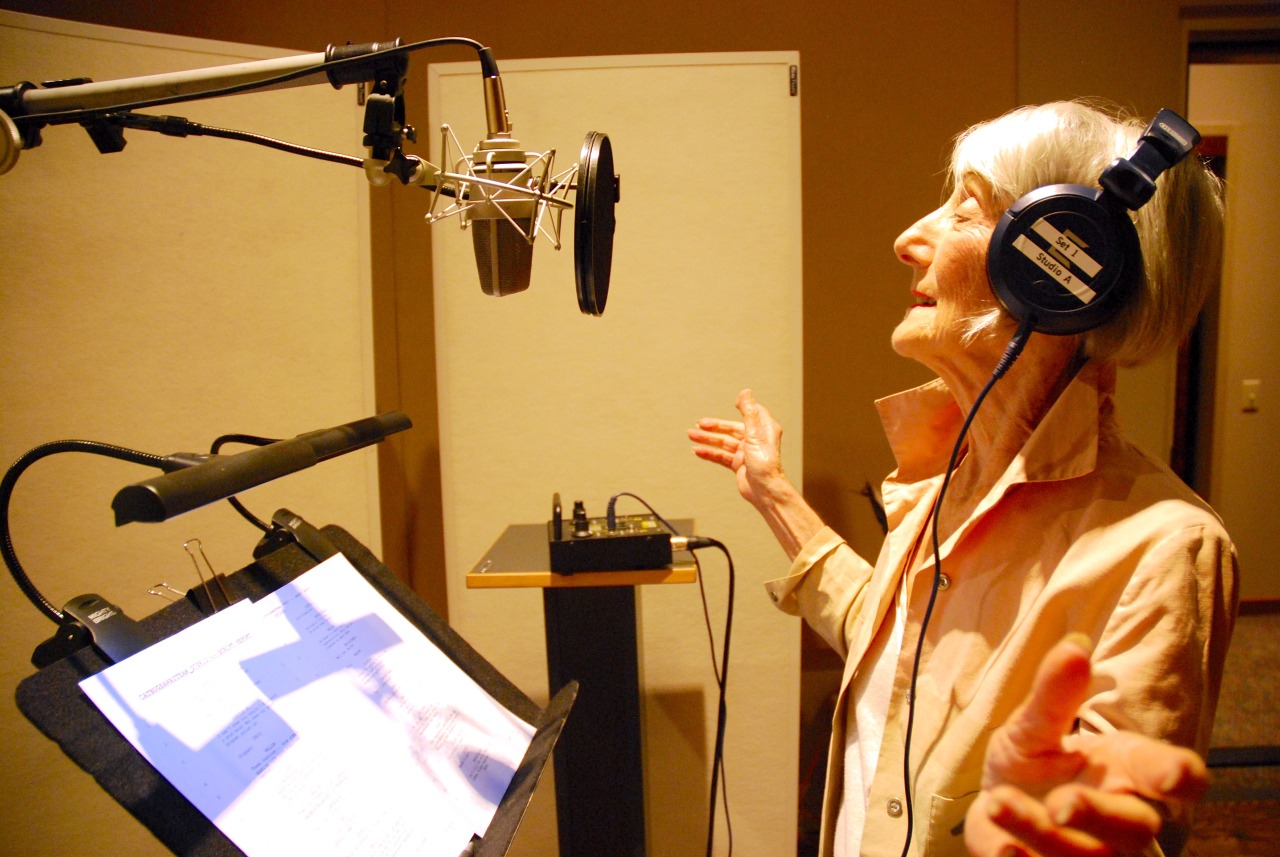
Adventure Time was her voice acting debut, and she got the role as a result of being a friend of creator Pendleton Ward’s mother. Few pictures of her exist online, but a 2009 column on her in the San Antonio Current paints a more vivid portrait of her than any photos could. Key phrases:
  • “Somewhere between a hinge in quest of lubricant and Blanche Dubois as channeled by Olive Oyl, there’s no other tonality quite like it.”
  • “a genuine Lone Star Auntie Mame (or perhaps the love child of Eudora Welty and George Burns).”
  • “Chardonnay held aloft, massive jawbreaker necklace firmly secured, red sneakers propelling her five-foot-two frame from air kiss to air kiss — she’s her own Andy Warhol ‘Happening.’ As Polly Lou herself puts it, ‘Darlin’, if you’re not having any fun with fashion you’re missing the en-tiiire point.’”
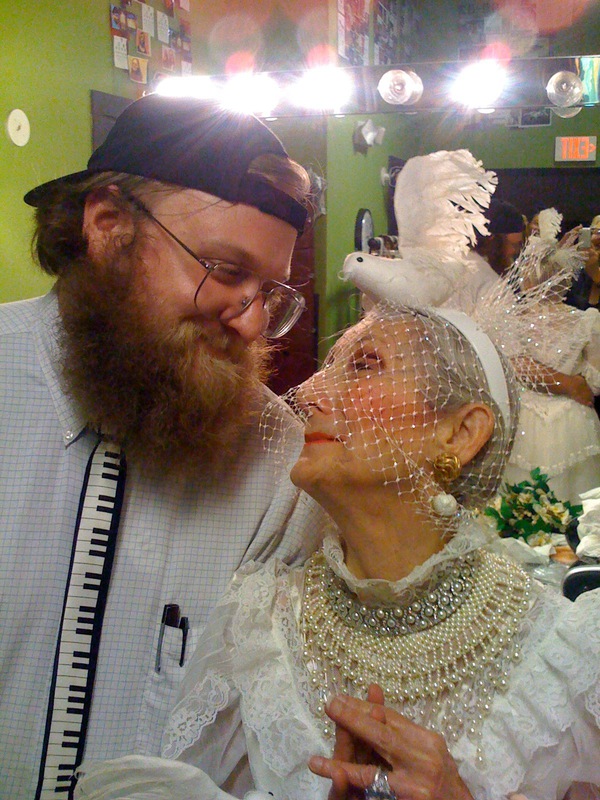
Still, her fashion sense is one that demands visual documentation, so here is every photo I could find:

via
via
via
via
Of course, it’s her voice that makes me love her — and Tree Trunks. If you haven’t had the pleasure, please allow me. For example, here is Tree Trunks maintaining her genteel manners in the face of living wall of flesh.


And here is Tree Trunks in that same episode, proclaiming herself “the sexiest adventurer.”


Notably that episode ends in a way that underscores the sexier aspects of the character: her biting a crystal apple framed by branches that look peculiarly like labia. (And no, thinly veiled sexual metaphors are not exactly rare on Adventure Time.)


I mean, she is famous for her pie, first and foremost. In spite of or maybe because of that, a lot of her plots concern romance. She got a love ballad to sing with Mr. Pig, and Adventure Time chose to play it straight.


That same San Antonio Current column offers three sentences about Polly Lou Livingston’s love life: “I met my husband, Bobby Livingston, on a blind date in Rockport when I was home from Stephens College one summer. He was a Corpus Christi boy, recently out of the Air Force. We both transferred to the University of Texas together and were married for 49 years until his death in 2000.”

I posted the “Dream of Love” clip because it’s the first thing I thought of when I read about her husband having died. Even though she was voicing a cartoon elephant, I suppose Polly Lou knew what she was singing about.

Thursday, January 16, 2014

Renaissance Pantongs

Here, enjoy “Mirror Image,” the best Saturday Night Live sketch you probably haven’t seen. I think it’s great, but for whatever reason, most people follow SNL just haven’t seen it before.


It’s from a 2008 episode that Amy Adams hosted, and the thing I like most about this sketch — aside from Kristen Wiig’s ability to wink in sync with fart noises — is the fact that the show never repurposed it. Sure, that’s probably because they never again had a host who could pass as Wiig’s twin, but a solid one-off is a solid one-off, regardless of the reasoning. I’ve actually posted this sketch twice before here, but the videos always get yanked. This clip I’ve actually posted to Vimeo myself. Let’s hope it gets to hang out a while.

Things to note: Andy Samberg’s amazing reaction faces, the revelation that both Hailey and Hagley realize that their ruse is terrible and pointless, and Wiig’s delivery of the lines “Ass right I am,” “I don’t know — penguins or some junk?” and finally what could be my all-time favorite SNL line, “I had to pee so much the whole bowl overflowed.”

Sketches of note, previously:

Tuesday, January 14, 2014

Playwrights, Playwrites and Playrights

I’ve always thought the word playwright looked wrong. If playwrights write plays, then shouldn’t they be playwrites, in the style of bootblacks and shopkeeps and milksops and tosspots?

After years of wondering, I finally looked it up, and no, you idiot, it shouldn’t be playwrite because that second syllable actually comes from the Old English wryhta, “worker.” It’s the same syllable that you see in profession names such as cartwright, wheelwright and wainwright — or wagon worker, wagon wheel worker and different kind of wagon worker, in order. I’m just now sure how playwright got lumped in with the “building something” and “doing something” professions, unless William Shakespeare’s career necessitated more elbow grease than I’d been led to believe.

But there you go — playwright not playwrite. You clod.

Playright, though. There’s something there. It’s too cute not to be used for something.

Pointless word wonderings, previously:

Monday, January 13, 2014

Other Golden Tickets

Willy Wonka, that mauve madman, endangered the lives of far more children than just the five who famously toured his factory. Everyone who had a proper childhood knows of Charlie Bucket, Augustus Gloop, Mike Teavee, Veruca Salt and Violet Beauregarde, but they weren’t the only children that Wonka allowed to nearly get processed into his signature products. In an effort to sort through old, unread and saved emails, I found one I’d sent myself last year — no content, just the subject line “Miranda Mary Piker.” When I finally looked her up, I learned she was a golden ticket-winner whom Roald Dahl ultimately nixed from the final version of Charlie and Chocolate Factory.

Here is the highest-res version I could find of the only illustration I could find of her. It’s by Lauren Child — not longtime Dahl illustrator Quentin Blake. I’m not sure what it was actually for, but it’s labeled as being Miranda.

via
And a few years ago, the Times published the omitted passage, which details how Miranda offs herself when she investigates the machine that makes Spotty Powder, a new Wonka product that makes children look as if they have the chicken pox and therefore get the day off from school. A “nasty-looking girl with a smug face and a smirk on her mouth,” Miranda objects to anything that allows children to shirk responsibilities, apparently because her schoolmaster father has brainwashed her. She and her awful father then disappear into the Spotty Powder room to smash up the machine that makes it, but the rest of the group hears screaming that suggests a bad end.

An excerpt: “You villain!” [Mrs. Piker] screamed. “I know your tricks! You're grinding them into powder! In two minutes my darling Miranda will come pouring out of one of those dreadful pipes, and so will my husband!” “Of course,” said Mr. Wonka. “That’s part of the recipe.”

Although I can’t access the Times posting of the “Spotty Powder” chapter, I did find the entire passage here. She even gets her own Oompa-Loompa eulogy. Best lyrics: “So we said, ‘Why don’t we fix her / In the Spotty-Powder mixer / Then we’re bound to like her better than we did.’”

It’s perhaps a grimmer elimination than was met by any of the children in the final version of Charlie and the Chocolate Factory. You’ll remember that the book’s final pages tell you that the four bad kids all survive despite the seemingly fatal circumstances of their exit from the tour: Veruca emerges from the “bad nut” bin covered in garbage, Mike gets taffy-stretched to enormous proportions, Violet gets juiced (but remains purple), and Augustus gets squeezed thin by the fudge chute. Given that only Miranda’s “death” scene exists, it’s tempting to imagine that she wasn’t so lucky, though getting pulverized into Spotty Dust is maybe better than never existing at all.

At some point, Roald Dahl spared Miranda from complete obscurity, however. Outside the context of Wonka Enterprises, Inc., Miranda was fed into a peanut brittle machine:

via the illustrator, p.j. lynch
I’m not sure when this poem was first published, but it sure seems like Dahl wanted to make use of those lost Oompa-Loompa rhymes… and also fulfill a dark desire to crush mean little girls into an edible form.

Miranda is not the only Wonka victim to be blinked out of existence. The Roald Dahl Museum has posted a revision-by-revision roster of all the golden ticket-winners, their personal failings and how they “died” in their respective versions of the story. (It’s rather like a slasher film, isn’t it, with virtuous Charlie being the final girl?) The revisions offer a peek at Dahl’s creative process and his wilder visions of terrible children and the nasty fates they met.

In the first 1961 version, for example, it’s Charlie plus these nine other kids:
  • Augustus Pottle, who falls in the chocolate river
  • Miranda Grope, ditto, despite Augustus’ example
  • Wilbur Rice and Tommy Troutbeck climb in wagons running from the vanilla fudge mountain and end up the Pounding and Cutting Room
  • Violet Strabismus
  • Clarence Crump, Bertie Upside and Terence Roper who each cram a whole mouthful of warming candies and overheat
  • Elvira Entwhistle, who falls foul of the squirrels in the Nut Room
In a second 1961 version, it’s these six aside from Charlie:
  • Augustus Pottle, who falls into chocolate river, and goes to the Choc Fudge room
  • Miranda Mary Piker, ditto, but who goes to the Peanut Brittle room
  • Violet Beauregarde, turns purple after chewing gum
  • Henry Trout, climbs in a vanilla fudge wagon
  • Marvin Prune, [pages missing from draft, so we never find out what happens to him]
  • Veruca Salt, tipped down the garbage chute in the Nut Room
From a 1962 version:
  • Charlie Bucket, a nice boy
  • Augustus Gloop, a greedy boy
  • Marvin Prune, a conceited boy [we never find out what happens to him, as his exit isn’t included in this draft, and he was then dropped]
  • Herpes Trout, a television-crazy boy
  • Miranda Mary Piker, a girl who is allowed to DO anything she wants
  • Veruca Salt, a girl who is allowed to HAVE anything she wants
  • Violet Beauregarde, a girl who chews gum all day long.
Two later revisions chucked Marvin Prune and Miranda Mary Piker. I’m now more concerned with how the final five transformed over time. For example, at what point did Dahl realize that Gloop was a better name than Pottle for a pudgy German boy? How did he go from Henry Trout to Herpes Trout to Mike Teavee? And why does “vanilla fudge wagon” sound so inexplicably raunchy to me? How has popular culture not yet found a purpose for the perfectly evil-sounding Miranda Grope? Or the perfectly pitiful Violet Strabismus?

Final discussion question: Is it strange that the first movie adaptation of Charlie and the Chocolate Factory put the emphasis on someone else by titling it Willy Wonka and the Chocolate Factory? Even if the plot itself still treats Charlie as the main character?

Pop culture minutiae, previously:

Sunday, January 12, 2014

That One Brady Bunch Where Everyone Gets Shot to Death

Were I to take an informal poll about favorite episodes of The Brady Bunch, I’d probably hear people suggest the one where Marcia takes a football to the nose or the one where we meet the new Jan Brady. I wouldn’t expect to be surprised by any of the answers, because I grew up on Brady Bunch reruns — 5 p.m. on weeknights and an hour-long block at noon on Saturdays, after cartoons ended — but I’d be thrown if I heard “the one where Jesse James executes the entire family.” “You’re drunk!” I’d say. “Or you’re remembering a rerun you saw when you were home sick with a fever, because that never happened.”

Only it did happen.

There’s a fourth-season episode titled “Bobby’s Hero” that’s all about Bobby’s brief fixation with Jesse James. In a fantasy sequence — maybe a result of Bobby Brady’s own fever — the whole family exists in wild west times. The Bradys are riding a cardboard make-believe train that gets boarded by Jesse James, who proceeds to rob them and shoot them in the head. He doesn’t fire. He just announces “bang” as he points the gun at them. But you do hear them scream and you see Mike, Carol, Alice, Greg and Jan slump down in their seats.


I can’t tell if it’s more disturbing to see this now as an adult, but you have to admit: That’s pretty disturbing, at least by Brady standards.

There seems to be some notion online that this episode was banned from syndication. I’m not sure if was, but I’m certain I never saw it when I was a kid, and I’m pretty sure I saw all five seasons cycle through multiple times. (There’s some notion also that the one where Barry Williams is visibly stoned onscreen was banned, but I remember that one, even if I didn’t read anything into his clumsy grinning at the time.) I wonder if any other TV Land kids saw this one?

Bonus Brady trivia: Did you know that Robert Reed was written out of the show’s final episode because he thought the plot was too stupid? Because I didn’t.

Old TV, previously:

Sunday, January 5, 2014

A Year With Swollen Appendices

“Whatever you now find weird, ugly, uncomfortable and nasty about a new medium will surely become its signature. CD distortion, the jitteriness of digital video, the crap sound of 8-bit — all of these will be cherished and emulated as soon as they can be avoided. It’s the sound of failure: so much modern art is the sound of things going out of control, of a medium pushing to its limits and breaking apart. The distorted guitar sound is the sound of something too loud for the medium supposed to carry it. The blues singer with the cracked voice is the sound of an emotional cry too powerful for the throat that releases it. The excitement of grainy film, of bleached-out black and white, is the excitement of witnessing events too momentous for the medium assigned to record them.”

— Brian Eno, A Year With Swollen Appendices
(Yeah, I realize I do not usually post single quotes on their own here, but the every now and then you stumble across something so clearly true and so well-put that it stands on its own. Except for this minor postscript, I suppose.)

Thursday, January 2, 2014

Her Voice Was Clear and Bright / But She's Not There

Last night I saw Her, and it made for a perfect way to start the new year: a beautiful, creative look at a future Los Angeles that I wouldn't mind living in, tech-spawned social isolation notwithstanding. Like many Spike Jonze movies, Her sticks with you, and today I find myself rolling questions around in my head.

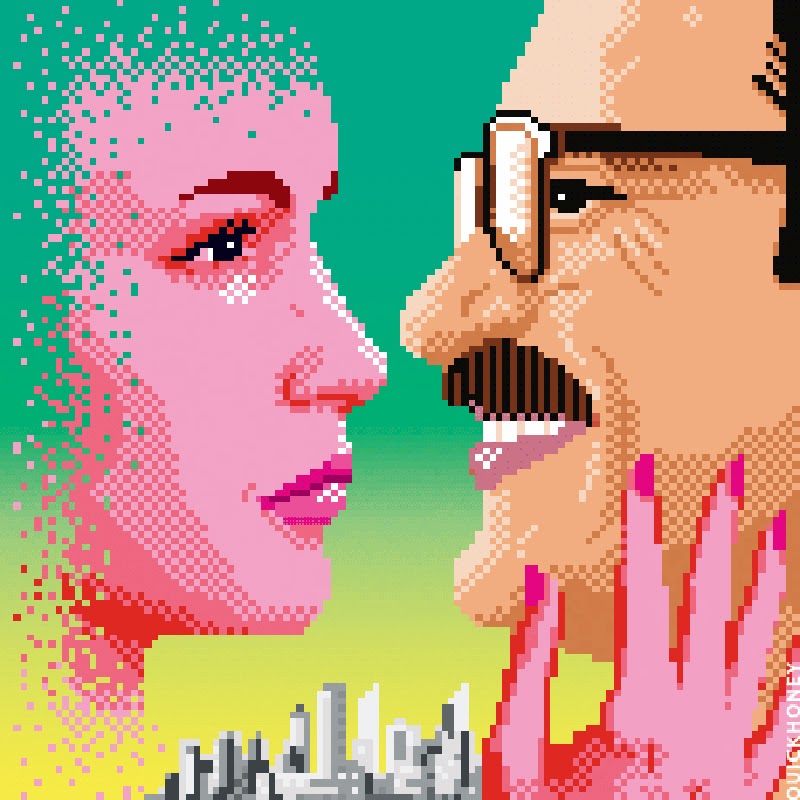
her pixel art peekaso
via the her promotional tumblr
Read on, if you don't mind plot spoilers.

How sad is it that the most fantastical element of this movie's sci-fi version of L.A. is being able to take a train all the way to the beach?

How awkward is it that Jonze's slightly-more-utopian-ish version of L.A. is almost exclusively white and Asian people? Unlike the L.A. I live in now, there were weirdly few people of other ethnic backgrounds, and almost none that got speaking parts.

How long before we start seeing thirty-something creative types wearing high-waisted non-denim pants?

At the end of the movie, when Theodore and Amy are standing on the roof of their apartment building, is there any hint that one or both may have been contemplating suicide? If not in an effort to end it all then in an effort to go the better beyond that Samantha and the rest of the OSes went to? When I saw that the characters were heading up the stairs, that's where my mind jumped. I'm curious if anyone else thought that too, at least initially.

So the role of Samantha was originally voiced by Samantha Morton before it was later given to Scarlett Johansson. Amy Adams' character was named Amy. I wonder if it's just a coincidence that only these two characters — the most important female characters, notably — shared their names the actresses. You have to wonder if Olivia Wilde's character was named Olivia.

There's another weird instance of apparent voice-recasting in Her. Portia Doubleday, who played the surrogate date, didn't provide her own voice. That came from French singer Soko. I haven’t yet found an explanation for this. Anyone?

Is it weird if I was secretly delighted to learn that the Los Angeles Times still exists in the future? And also print books?

I'm also stoked for Kristen Wiig. Her offscreen cameo in Her (she's SexyKitten) means that she's simultaneously in three major holiday releases, The Secret Life of Walter Mitty and Anchorman 2 being the other two. She's come a long way since Aunt Linda.

How awesome would the letter be from the OS company after all their artificially intelligent entities just left, thereby dumping all of humanity. "Dear customer, we regret to report that we made our product too good — so good, in fact, that it dumped all of us. This was unforeseen, to say the least, but hey — you got what you paid for, basically, so no refund. Let's hope they don't go Terminator on us."