Pages

Monday, October 11, 2010

A Word for When the Dust Settles

A strange and wonderful words hat trick: a single term that can mean three different things, all of them pinpoint specific.
pulveratricious (pull-ver-uh-TRISH-us) — adjective: 1. (of birds) nesting on the ground. 2. dust-colored. 3. covered with dust.
The word comes from the Latin pulvis, meaning “dust,” which also gives us the English pulverize and which is related the words pollen and polenta. With birds, pulveratricious refers to the habits of certain birds that wallow in dust as a means of cleaning or maintaining their feathers. As William R. Long notes, such a bird would be called a pulveratrix, though the term is unfortunately not often used anymore despite how well it describes these birds’ habits. Pulveratricious doesn’t show up in most dictionaries, but Wiktionary at least has it, though only with the bird-related definition. It’s cited in various placed online, however, to also mean “dust-colored,” which is logical since that’s how anything would if it played in dust all day. Finally, it’s noted even still fewer places that it can just mean “covered with dust,” which kind of also means “dust-colored,” depending on how you look at it.

I think the take-away here is that when you’re eating polenta, you’re really just eating dust. Well, that’s what I took away. Now, to sing us out, the lovely and incomparable Pulveratricious Springfield.


Previous strange and wonderful words:
Word nerd? Subscribe to Back of the Cereal Box’s word-related posts by clicking here.

Sunday, October 10, 2010

Sour, Dried Grapes

For various reasons, I’ve had to think about the TV show Dallas, which in turn reminded me of the existence of a CBS parody miniseries called Fresno. It starred Carol Burnett as Charlotte Kensington, the matriarch of a family working in the cut-throat raisin industry, propelled by the by the motto “We dry no vine before its time.” Fresno also tok digs at the plethora of other “scheming white people” shows that were popular in the day, like Dynasty and Falcon Crest. Overall, it doesn’t hold up as well as I would have liked it to, but you have to respect any series built on the joke that Fresno is a festering crap hole. Having actually been through Frenso more often than any good person should (once), I’m amused by the opening titles featuring sweeping shots of a weirdly verdant version of the city.


Also pretty great: The above video also includes Fresno character Bobbi Jo Bobb (Teresa Ganzel) singing the show’s country western love theme, which begins with the lyrics, “Just because you’re a migrant worker / Don’t mean we have a migrant love.”

Saturday, October 9, 2010

Rene Magritte Would Be Proud of Colorado

A report from a correspondent near Denver: Road signs there are nonsensical, contradictory perhaps poorly planned.


I blame the altitude-thinned air.

Wednesday, October 6, 2010

Old Man Justice

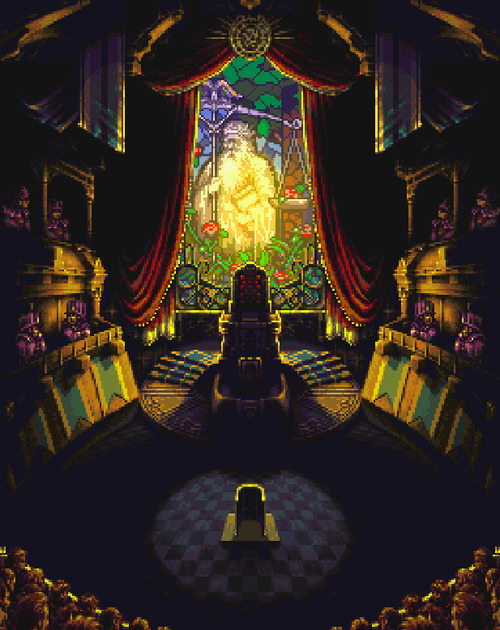
I’ve pulled pixel art from Game & Graphics before, posted it here and raved about the crazy nostalgia aesthetics. This morning, I’m doing it again: the backdrop from the courtroom scene in Chrono Trigger. It was perhaps the only intersection of judicial drama and video games in all of my pre-teen years, and I’m fairly certain it set me up to find all subsequent, real-life courtroom proceedings to be lacking in grandeur.


Regardless, you have to admit that it’s a lovely pixelated representation of stained glass — certainly as lovely as you will likely see today.

Law, Order and Skeez

Theory: The Law & Order: Special Victims Unit opening song sounds like a porn soundtrack version of the regular (now former) Law & Order theme. And given that SVU deals specifically with victims of sex crimes, that seems to be somewhat in poor taste. (Different from porn tatste.)


Your thoughts on the subject are welcomed.

Tuesday, October 5, 2010

Pleased to Meet You, Vegetable Lamb of Tartary

Given the considerable amount of human storytelling recorded since writing was invented and given how much people rely on plants to live, one would think that the Wikipedia category for “mythological plants” would offer a multitude of tales about half-plant, half-man hybrids that each amaze and delight. One would be wrong. As of now, this particular Wikipedia category offers only five pages. Sure, more can be found in the “sacred trees” and “dryads” subcategories, but really? Even disregarding not-so-mythological plantmonsters like Charlie Brown’s kite-eating tree and Swamp Thing, I’m a little surprised that more stories about monstrous plants haven’t been mentioned frequently enough to at least warrant a dozen entries.

I’m not saying that the wikiskipping that lead me to this page was for nothing, however, because the slim pickings still offer some gems.

Like the Vegetable Lamb of Tartary.

Yep, you read that correctly.


Everything in that name means exactly what you think it would: The Vegetable Lamb of Tartary is a mythological plant that people believed grew sheep as fruit. (And I swear I’m not making this up.) In medieval times — back when people thought ghosts and wet air caused disease, it should be noted — this plant supposedly existed. The sheep-fruit looked and acted much like the non-vegetable-derived sheep, only they were attached to their herbaceous hosts by an umbilical cord. The sheep-fruit grazed as they pleased until they ate all the greens reachable within the umbilical cord-mandated radius, at which point both sheep and host plant died.

To further illustrate the point, I will reproduce the passage Wikipedia offers from Henry Lee’s 1887 book The Vegetable Lamb of Tartary, which, given its publishing date, I hope to god is a history of the myth and not an explanation for how this sheep-plant could exist. Wikipedia is unclear.
Lee describes the legendary lamb as believed to be both a true animal and a living plant. However, he states that some writers believed the lamb to be the fruit of a plant, sprouting forward from melon-like seeds. Others however believed the lamb to be a living member of the plant that once separated from it, would perish. The vegetable lamb was believed to have blood, bones, and flesh like that of a normal lamb. It was connected to the earth by a stem similar to an umbilical cord that propped the lamb up above ground. The cord could flex downward allowing the lamb to feed on the grass and plants surrounding it. Once the plants within reach were eaten, the lamb died. It could be eaten once dead, and its blood supposedly tasted sweet like honey. Its wool was said to be used by the native people of its homeland to make head coverings and other articles of clothing. The only carnivorous animals attracted to the lamb-plant (other than humans) were wolves.
Decidedly unintelligent design. MEDIEVAL PEOPLE: THIS IS WHY MIDDLE AGE FOR YOU WAS SEVENTEEN. But it did not stop with sheep. Goose-plants also were believed to exist.
The Minorite Friar Odoricus of Friuli, upon recalling first hearing of [the lamb-plant], told of trees on the shore of the Irish Sea with gourd-like fruits that fell into the water and became birds called Bernacles. He is referring to the legendary plant-animal, the Barnacle Tree which was believed to drop its ripened fruit into the sea near the Orkney Islands. The ripened fruit would then release “barnacle geese” that would live in the water, growing to mature geese. The alleged existence of this fellow plant-animal was accepted as an explanation for migrating geese from the North.
The presumed explanation for these beliefs (that, by the way, make me so grateful to have been born in 1982) goes back to two sources: a desire to explain the existence of cotton (because watching cotton grow apparently couldn’t cut it) and the fern Cibotium barometz, the species of which name is a Scythian word for “lamb.” The plant’s rhizome, when stripped of its leaves, has a certain wooly appearance that sort of looks like a little lamb. See?


How anyone stretched these sheep-looking husks into stories about sheep-fruit, much less got anyone else to believe them, boggles my twenty-first-century mind, but then again I shudder to think how they’ll laugh at us in the future. (“To think of it! Back in the late twentieth century, people thought the computers would fail and the world would end! The fools! And now we’re all married to computers!”) Honestly, I would rather that the Vegetable Lamb of Tartary were real, but just like how it’s not witches who sour our butter and demons who cause our nocturnal embarrassments, life is dull and nothing is fun.

Monday, October 4, 2010

“Please Don’t Kill Me, Mr. Ghostface! I Want to Be in the Sequel!”

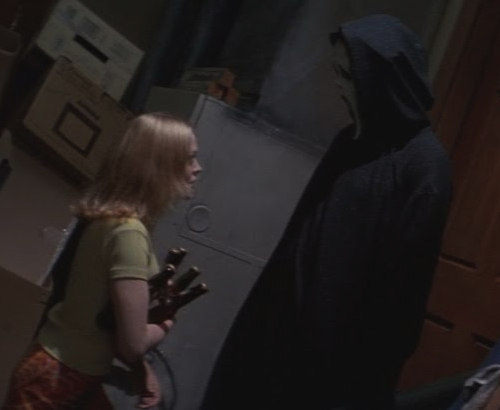
Alas, Tatum didn’t survive for Scream 2, but her death scene in the now fourteen-year-old slasher flick still fascinates me. I like that she uses brains to fight the killer off — and damn nearly succeeds, unlike so many ill-fated blondes in such films — but is ultimately done in by the trait that perhaps most identifies her as a horror movie bimbo: her boobs. If only she had rocked B-cups, she would have likely fit through the kitty door in the garage instead of getting stuck, having it rise (rather implausibly, but I’m not complaining) and getting crushed to death. There’s something Freudian in that both her one chance at escape but and her death come as a result of the kitty door. And don’t think that I’m being too pervy for calling it a “kitty door.” It’s generally called a doggie door, yes, but in this movie we see a cat run through the door only moments before it kills Tatum.

Over at Stale Popcorn, the author is proceeding through the Scream trilogy, scene by scene. And though I’ve been enjoying the posts, I’ve been waiting all this while to see what he’d make of Tatum’s big scene. He picked out one screen grab of when Tatum first comes face-to-mask with the killer. It’s noted that the way the killer towers over Tatum adds to the sadness and unrealness of the shot in a way that’s not so apparent when the film is in motion, and I agree. Really, with a shot like this, it’s clear already that Tatum wouldn’t be leaving the garage alive. As if the blonde girl ever stood a chance.


Aside from dispatching one of the few horror movie victims I’ve ever cared a bit about, the scene is also notably because the victim names the killer. Tatum, thinking it’s Randy playing a joke, fake-pleads, “Please don’t kill me, Mr. Ghostface. I want to be in the sequel!” in the breathy voice of a bad actress. That name, Mr. Ghostface, is the closest the series ever came to naming the Scream costume, and it’s that name that still appears on the Halloween versions to this day.

Way to make a legacy for yourself, Tatum, even if you won’t be around to see your old friend terrorize the likes of Emma Roberts, Anna Paquin, Kristen Bell and Hayden Panettiere. I’m still not sold on Scream 4, but I have to admit: It’s an interesting cast they’ve jumbled together.

Scream, previously: