This fan-created art of Super Mario Bros. 2 big bad Wart makes me extraordinarily happy.
Super Mario Bros. 2, previously:

Wednesday, August 13, 2008


Tuesday, August 12, 2008
I Am, We Are, Mario Is, They Are
As everybody knows, the internet was invented to give people a chance to argue endlessly about subjects that don’t really matter. A while back, I stumbled onto one of these.
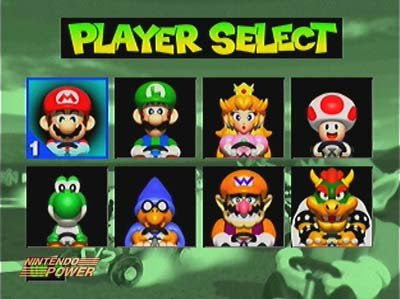
Below is a screenshot of a beta version of Mario Kart 64. If you’ve actually played the game, you might notice that it looks different than what eventually arrived on the Nintendo 64. The character models look a little more cartoony, and Donkey Kong isn’t there. In his place is a Magikoopa — one of those wizard turtles who occasionally show up in Mario games. I found it here, and people using this message board couldn’t agree whether this character was just a generic Magikoopa or a specific one — Kamek, a character introduced as a bad guy in the game Yoshi’s Island.
I know, I know — God bless the internet. It’s like bickering over whether Greedo shot first, only without the widespread interest. That’s what I get for wandering onto message board. The argument, however, raises a point about translation differences in video games and a sense of “self-ness” that works different in other cultures than it does in mine. Essentially, a person or a creature can simultaneously be an individual and all members of its group. A little heady for something that grew out of an message board argument about Mario Kart, but it’s true.
Think about Pokémon, if you happen to have been exposed enough to it. It’s mascot is Pikachu, who is an individual character, but Pikachu is also a race of characters, who looks exactly like Pikachu and are all called Pikachu. It doesn’t jive with the American notion of celebrated individuality — “I’m the best me there is!” — but it’s nonetheless accurate.
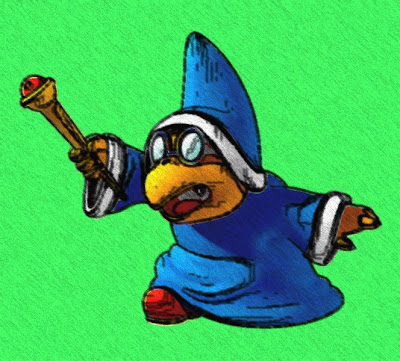
The answer to the Mario Kart argument is that the would-be kart-driving turtle is both Kamek and a generic Magikoopa. (“Stop, you’re all right. And you’re all losers.”) Kamek is an unique character in the west, for sure, but in his home country, he’s known as Kamekku, but so are all the generic, non-talking, quickly stomped Magikoopas. In short, not everyone makes the distinction that we might here in the U.S. or in other Western cultures.
Since the above beta screenshot is the closest Kamek or any of his generic counterparts got to being playable in Mario Kart, most casual video game players probably have no idea who is, but the self-as-all concept applies to some of the better known Mario characters as well.


For example, Yoshi is Yoshi, the sticky-tongued, green dinosaur buddy who has followed Mario around since Super Mario World. But at the same time, a Yoshi is also the entire race of dinosaur characters that look just like Yoshi, except when they’re colors other than green. And even when they’re other colors, they’re still called Yoshi. It’s very strange, when you think about it.
Maybe Yoshi isn’t the best example. Take Birdo. She’s the pink dinosaur — though Yoshi can be pink sometimes, so don’t get them confused. (This is the least of the identity problems these two bipedal lizards share.) Birdo herself isn’t even always pink, however; she shows up in other games in all manner of shades and sometimes even shows up onscreen in multiples. They’re all Birdo, even if none of them happen to be the Birdo.
Likewise again with Toad. Little generic Toads showed up as far back as the original Super Mario Bros., but only with Super Mario Bros. 2 did he get the name “Toad.” They’re everywhere now, but they’re not always necessarily the Toad, except when they are. All Toads look the same, to a degree. At the very least, there’s a ton with blue vests and red mushroom spots. This last one is further complicated by the fact that latter-day Mario games now feature the old man version of Toad, Toadsworth, and a girl version of Toad, Toadette. They don’t appear in multiples, however, so it seems like they exist as are unique characters. That is, all female Toads aren’t called Toadettes and all old man Toads aren’t Toadsworths.
At least we can all rest easy knowing that there’s only one Mario — except when you’re playing something like Smash Bros. and there are multiples of him on screen, but that’s a different logical snag.
Below is a screenshot of a beta version of Mario Kart 64. If you’ve actually played the game, you might notice that it looks different than what eventually arrived on the Nintendo 64. The character models look a little more cartoony, and Donkey Kong isn’t there. In his place is a Magikoopa — one of those wizard turtles who occasionally show up in Mario games. I found it here, and people using this message board couldn’t agree whether this character was just a generic Magikoopa or a specific one — Kamek, a character introduced as a bad guy in the game Yoshi’s Island.

I know, I know — God bless the internet. It’s like bickering over whether Greedo shot first, only without the widespread interest. That’s what I get for wandering onto message board. The argument, however, raises a point about translation differences in video games and a sense of “self-ness” that works different in other cultures than it does in mine. Essentially, a person or a creature can simultaneously be an individual and all members of its group. A little heady for something that grew out of an message board argument about Mario Kart, but it’s true.
Think about Pokémon, if you happen to have been exposed enough to it. It’s mascot is Pikachu, who is an individual character, but Pikachu is also a race of characters, who looks exactly like Pikachu and are all called Pikachu. It doesn’t jive with the American notion of celebrated individuality — “I’m the best me there is!” — but it’s nonetheless accurate.

The answer to the Mario Kart argument is that the would-be kart-driving turtle is both Kamek and a generic Magikoopa. (“Stop, you’re all right. And you’re all losers.”) Kamek is an unique character in the west, for sure, but in his home country, he’s known as Kamekku, but so are all the generic, non-talking, quickly stomped Magikoopas. In short, not everyone makes the distinction that we might here in the U.S. or in other Western cultures.
Since the above beta screenshot is the closest Kamek or any of his generic counterparts got to being playable in Mario Kart, most casual video game players probably have no idea who is, but the self-as-all concept applies to some of the better known Mario characters as well.


For example, Yoshi is Yoshi, the sticky-tongued, green dinosaur buddy who has followed Mario around since Super Mario World. But at the same time, a Yoshi is also the entire race of dinosaur characters that look just like Yoshi, except when they’re colors other than green. And even when they’re other colors, they’re still called Yoshi. It’s very strange, when you think about it.
Maybe Yoshi isn’t the best example. Take Birdo. She’s the pink dinosaur — though Yoshi can be pink sometimes, so don’t get them confused. (This is the least of the identity problems these two bipedal lizards share.) Birdo herself isn’t even always pink, however; she shows up in other games in all manner of shades and sometimes even shows up onscreen in multiples. They’re all Birdo, even if none of them happen to be the Birdo.
Likewise again with Toad. Little generic Toads showed up as far back as the original Super Mario Bros., but only with Super Mario Bros. 2 did he get the name “Toad.” They’re everywhere now, but they’re not always necessarily the Toad, except when they are. All Toads look the same, to a degree. At the very least, there’s a ton with blue vests and red mushroom spots. This last one is further complicated by the fact that latter-day Mario games now feature the old man version of Toad, Toadsworth, and a girl version of Toad, Toadette. They don’t appear in multiples, however, so it seems like they exist as are unique characters. That is, all female Toads aren’t called Toadettes and all old man Toads aren’t Toadsworths.
At least we can all rest easy knowing that there’s only one Mario — except when you’re playing something like Smash Bros. and there are multiples of him on screen, but that’s a different logical snag.
Monday, August 11, 2008
Down Where It’s Wetter
My paper is putting out a shark-themed issue this week. Yes, I realize that Shark Week was officially last week, but hey — we’re an alternative weekly, so I guess we get to have an alternative Shark Week.
In any case, I sat in on a meeting to think of cover lines for our shark issue. This process basically amounts to group stream-of-consciousness brainstorming, wherein the participants blurt out anything that comes to mind that might have some relation to the cover story at hand — appropriately themed idioms, puns, any available alliterations, pop culture references, and whatever else comes to mind. Almost instantly, I got the Little Mermaid song “Under the Sea” stuck in my head, specifically the lyrics “Darling it’s better / Down where it’s wetter / Take it from me.” My God. What a filthy, filthy collection of lyrics, even for a Disney movie with more than its share of sex joke urban legends associated with it. This chunk of the song seems especially filthy when you remember that it’s sung by Sebastian, a crab, and it seems especially strange when you remember that it’s being sung to a woman who lacks any apparent human body parts from the waist down.
Past mermaidery:
And then there’s also the odd connections between Disney’s version Little Mermaid and Mary Magdalene, which I stumbled onto while trying to find a good list of the sex-related urban legends surrounding the film. I’d previously read about Mary-related imagery associated with mermaids in general but had no idea that anyone, much less Da Vinci Code author Dan Brown, had tried to make ties the between Jesus’s supposed number one lady and the Disneyfied version of mermaid who wanted legs. See here and here and here.
In any case, I sat in on a meeting to think of cover lines for our shark issue. This process basically amounts to group stream-of-consciousness brainstorming, wherein the participants blurt out anything that comes to mind that might have some relation to the cover story at hand — appropriately themed idioms, puns, any available alliterations, pop culture references, and whatever else comes to mind. Almost instantly, I got the Little Mermaid song “Under the Sea” stuck in my head, specifically the lyrics “Darling it’s better / Down where it’s wetter / Take it from me.” My God. What a filthy, filthy collection of lyrics, even for a Disney movie with more than its share of sex joke urban legends associated with it. This chunk of the song seems especially filthy when you remember that it’s sung by Sebastian, a crab, and it seems especially strange when you remember that it’s being sung to a woman who lacks any apparent human body parts from the waist down.
Past mermaidery:
And then there’s also the odd connections between Disney’s version Little Mermaid and Mary Magdalene, which I stumbled onto while trying to find a good list of the sex-related urban legends surrounding the film. I’d previously read about Mary-related imagery associated with mermaids in general but had no idea that anyone, much less Da Vinci Code author Dan Brown, had tried to make ties the between Jesus’s supposed number one lady and the Disneyfied version of mermaid who wanted legs. See here and here and here.
Sunday, August 10, 2008
Happy Quoll Tag to You As Well!
After a brief delay in the posting of the blogs on the website, I'm attempting a comeback. To kick off the renewed commitment to the posting of the blogs on the website, I've chosen to slip in a word-of-the-week. Just pretend this went up Saturday. What, you were expecting Maria Bamford?
McKean goes on to elaborate on the term:
Not the greatest pick, I'll admit, but interesting enough. In the end, I was a little disappointed that this all had nothing to do with quolls or tags that one might attach to said quolls. I probably should have just run with quasihemidemisemiquaver and left it at that.
Previous words of the week:
qualtagh (pronounced something like KWAL-tog, I'd guess, though the internet is not forthcoming with an official pronunciation) — noun: the first person you meet after leaving your house on some special occasion. Also, the first person entering a house on New Year’s Day.This is one of those that appears in collections of strange words and has little use otherwise. In fact, I found this word in Erin McKean's Weird and Wonderful Words and a lot of Google hits for the term reference that very book. To complicate matters somewhat, people seem not to know exactly where the word comes from to the point where anybody I saw had broken it down into etymological chunks. McKean suggests "first foot" as an apposition for the term, and I wonder if that two-word renaming might actually be a calque from Manx English into the non-Manx English that I tend to prefer. People do seem to agree that qualtagh comes from the Isle of Man. This rundown of various season-based Manx customs includes it, anyway.
McKean goes on to elaborate on the term:
The new year’s qualtagh, for luck, is supposed to be a dark-haired man. A red-headed or female qualtagh is unlucky. Other things to bring luck to the house on New Year’s Day include serving black-eyed peas, having the qualtagh bring shortbread and whiskey (sounds fine for any day of the year), and sweeping all the garbage in the house out through the front door before midnight on New Year’s Eve (so that any of the misfortune of the past year is gone, not to return).A neat little superstition, no? Word-based social network Wordie — "like Flickr, but without the photos" — offers a little more insight. User Reesetee, whose name may or may not be an Animal Crossing reference, claims that the word at one point "referred to the custom of going in a group from door to door at Christmas or New Year, making a request for food or other gifts in the form of a song." So there's that, too, providing that Reesetee hasn't set out to pull the collective legs of all us word nerds.
Not the greatest pick, I'll admit, but interesting enough. In the end, I was a little disappointed that this all had nothing to do with quolls or tags that one might attach to said quolls. I probably should have just run with quasihemidemisemiquaver and left it at that.
Previous words of the week:
Thursday, August 7, 2008
The Tiny Earth
Though the Wii has brought video games back into my life to a degree, I don’t play them as much as I used to. As you may have already realized, however, I do spend some time thinking back on the old titles I played and, even more often, the ones I played repeatedly.
Wikipedia serves as an endless source of nostalgia for these bygone games, offering little reminders of my childhood with whatever details the articles’ writers deem encyclopedic enough. (“That’s right. Link did have to use the hammer to knock down the trees that hid New Kasuto, the predecessor to which had been reduced to a ghost town, literally. What fun!”) I occasionally write about these old memories, but only when I can justify it somehow — by tying a game to some obscure bit of trivia, like I did with Teresa and the Hopping Chinese Zombies, or by putting the game in the context of wistfulness for my own childhood, like I did with “Messages From Sahasrahla.” Somehow, I feel guilty about remembering just for the sake of remembering — not so much because I worry that you the reader might find unjustified nostalgia less interesting, but more that I feel I have to make it matter. Video games, viewed as such, don’t matter all that much to most people, maybe because they truly are just silly toys or maybe because most people haven’t given them the thought I have.
Consider this all, then, a prologue for what I’ll discuss in the below paragraphs and, retroactively, as an explanation for every other rant on the bytes and sprites that I’ve duped you into reading here.
Drop any associations you might have about the words “final” and “fantasy” used in conjunction. (Especially if your immediate association is Own Pallett’s pre-Arcade Fire project, which, by the way, is named after the video game series) Though the series has proved monumentally popular since its debut in 1987, most people haven’t played any of the twelve full-fledged Final Fantasy installments so far, and that includes even you geek-savvy Back of the Cereal Box readers, I’d wager. A quick explanation: For the most part, the Final Fantasy games exist independently of each other, with each sequel taking place on a world with a unique geography and history. Some games, especially early ones, skew medieval, some futuristic, some into an alternate past where the mechanical technology includes innovations that it shouldn't have yet. My favorite, by far, was Final Fantasy 6, which is often known as Final Fantasy VI or, due to the fact that these games appeared in the United States in a different order than they did in their native Japan, Final Fantasy 3.
To anyone who played and truly appreciated the game, Final Fantasy 6 likely represents a pinnacle of sorts for the 16-bit age of gaming. It offered a rather comprehensive storyline that seemed downright epic when I first played it in late 1994. (In retrospect, the travails of its twelve main characters strike me as a little hokey and maudlin. This could very well stem from the fact that the game’s plot was not written for an American audience, in which case I suppose I should be less judgmental.) Perhaps what helps the game stand the test of time nonetheless, I feel, is the fact that it has no genuinely central character despite having a single cohesive plot. The creators tell the story through the interactions of many different protagonists, each with his or her personal cast of supporting players. These individual stories slowly evolve into a central struggle. No mean feat, I’d say, even for a work of literature. The game’s story falls short of any true literary greatness, but for a video game and for something played by 12-year-old me, it was pretty engrossing.
The point of this all — and my chance to demonstrate how my Latin training paid off, as I look back on the game as a piece of text, written and then re-written in a different language — is that the significance of certain words chosen actually lent Final Fantasy 6 a deeper meaning than I realized as a kid. Remember when I said the game lacked a true central character? That’s still true, but two characters come closer to being the main protagonists than any others. They also happen to both be female — a relative rarity, both for the Final Fantasy series and for video games in general during the time this one came out. The game is divided into two distinct halves: the first in which the heroes attempt to thwart the villain from accomplishing something dreadful, and the second, which takes place one year later, after the dreadful thing has happened and has drastically changed the world for the worse. The first half begins focused around Terra, a young woman who cannot remember who her own past. Her gradual discovery of where she came from probably constitutes the first half’s most important plot thread. It drives a lot of the action. In the second half, the player begins as Celes, a supporting character from the game’s first half who gradually reunites the heroes to finally defeat the megalomaniac who caused the world to fall into its less-than-happy state in the first place.
 terra, looking more beautiful than 16 bits could have ever made her appear,
in promotional art for final fantasy 6
Aside from the obvious parallels between Terra and Celes — both are only 18 years old at the story’s beginning, both exhibit paranormal abilities that initially set them apart from the rest of the game’s human population, and both begin the story in the service of the story’s villain — their very names suggest their nature as complementary components. Terra’s name, of course, comes directly from the Latin word for “earth,” while Celes’s would seem to suggest a truncated form of the name “Celeste,” which comes from caelestis, meaning “heavenly.” This merits notice not only because earth and sky carry symbolic significance as elements of the natural world, but also because the game itself takes place on the ground, as characters trot about the landscape, and in sky, as airships and a floating island figure heavily into the plot. (Had there been a third segment and had the game featured the sea as a significant setting, I would have bet its start-off character would have been named “Marin” or “Maria.” In fact, the game mentions an unseen character named Maria, a much-discussed opera diva, whose dead-on resemblance to Celes serves as a pivotal plot point in the game’s first half.) One of the theories that a beloved English professor once espoused (as have surely countless others in the profession) is that good fiction does not feature arbitrarily named characters, and for years I’d like to assume that this sort of planning went into Final Fantasy 6.
However, to assume it happened on the Japanese end of things would be incorrect, I eventually learned. However appropriate the symbolism that Terra and Celes’s names might imply, it can only be attributed to Ted Woolsey, an American and a longtime video game translator who has drawn some criticism for taking liberties with the original texts. (Others, however, defend him for doing a good job, given the constraints. More on those in a moment.) In the original Japanese, Terra is “Tina,” named so by her Japanese creators allegedly because the name sounds more strange and exotic to Japanese ears. Celes is still technically “Celes,” but her name could have been translated just as easily into English as “Ceres,” the name of the Roman goddess of the harvest. In that case, I’d guess her first name is pronounced less like the last name of the tennis player Monica Seles and more like a rhyme for “puh-leez.” Not only does it grate on the ears, but it blows my whole theory to linguistic smithereens.
Further evidence against my theory about the connection being important to the characters’ inceptions lies in the name of another character, Strago, a wizened old sage whose name in the Japanese version is “Stragus,” making his full name “Stragus Magus” — literally “wizard wizard.” (A stretch, I guess, but a translation that’s rooted in good standing. The Italian verb strego means “I bewitch,” a form of the verb stregare, and strega means “witch.” Stragus therefore seems like a reasonable masculine approximate, especially when you consider that it was filtered through Japanese. Magus is defined in English simply as “magician” or “sorcerer.” Thus, “wizard wizard.”) One of the technical hardships of translating character names from Japanese stems from the fact that the symbols that constitute written Japanese pack in a lot more linguistic info than do the letters of the Roman alphabet. As a result, the original Japanese game may only allot a certain number of spaces to fit names that, for the game’s original language, would have been more than enough. Once translated, however, the original names may not fit, leaving translators to either change the name or fiddle with the internal workings of the game to allow for more letters. (A good example of translators choosing the former: The game Chrono Trigger only allowed for five-letter names, leaving the protagonist’s name “Crono,” despite the fact that the game’s title used the correct spelling, “Chrono.” Different complications may arise as well. A prominent character in Final Fantasy 4, for example, is known as “Rydia,” despite the existence of the far more common name “Lydia.”) In Final Fantasy 6, this fate befell Stragus and gave him his slightly altered American name, Strago.
We already know how Tina became “Terra,” but I initially wondered if this sort of truncation could have resulted in Celes being chopped back from “Celeste.” Nope. “Celes” is officially translated as such, regardless of where she’s being appreciated. Thus, it would seem as though the “earth vs. sky” notion was never originally intended to apply to the two characters. I have to assume, then, that the metaphoric parallel the English version of the game introduces is unique, whether by design or by accident, and that we English-speakers were lucky to play through a version of the game with such a subtle but effective literary element. Strange, though, to think that it happened after-the-fact and possibly as a result of a total accident. I appreciate it, regardless, perhaps all the more so because it resulted from a translation upon a translation, and anyone who lend literary weight to words twice-translated has done well in my book. I like that I can approach content from a video game in this fashion, but also that such content can even make me think about the creators’ intentions and symbolism and language and meaning in a way that would more often be reserved for film or art or literature.
So there you have it: more pointless video game nostalgia that I’ve attempted to make seem like less of a waste of your time with the addition of context. Did I elevate it? Did I just lower myself? Will I ever have the guts to wax nostalgic on my own blog just for the sheer joy of remembering things that once made me happy?
Words in games, previously:
Wikipedia serves as an endless source of nostalgia for these bygone games, offering little reminders of my childhood with whatever details the articles’ writers deem encyclopedic enough. (“That’s right. Link did have to use the hammer to knock down the trees that hid New Kasuto, the predecessor to which had been reduced to a ghost town, literally. What fun!”) I occasionally write about these old memories, but only when I can justify it somehow — by tying a game to some obscure bit of trivia, like I did with Teresa and the Hopping Chinese Zombies, or by putting the game in the context of wistfulness for my own childhood, like I did with “Messages From Sahasrahla.” Somehow, I feel guilty about remembering just for the sake of remembering — not so much because I worry that you the reader might find unjustified nostalgia less interesting, but more that I feel I have to make it matter. Video games, viewed as such, don’t matter all that much to most people, maybe because they truly are just silly toys or maybe because most people haven’t given them the thought I have.
Consider this all, then, a prologue for what I’ll discuss in the below paragraphs and, retroactively, as an explanation for every other rant on the bytes and sprites that I’ve duped you into reading here.
Drop any associations you might have about the words “final” and “fantasy” used in conjunction. (Especially if your immediate association is Own Pallett’s pre-Arcade Fire project, which, by the way, is named after the video game series) Though the series has proved monumentally popular since its debut in 1987, most people haven’t played any of the twelve full-fledged Final Fantasy installments so far, and that includes even you geek-savvy Back of the Cereal Box readers, I’d wager. A quick explanation: For the most part, the Final Fantasy games exist independently of each other, with each sequel taking place on a world with a unique geography and history. Some games, especially early ones, skew medieval, some futuristic, some into an alternate past where the mechanical technology includes innovations that it shouldn't have yet. My favorite, by far, was Final Fantasy 6, which is often known as Final Fantasy VI or, due to the fact that these games appeared in the United States in a different order than they did in their native Japan, Final Fantasy 3.
To anyone who played and truly appreciated the game, Final Fantasy 6 likely represents a pinnacle of sorts for the 16-bit age of gaming. It offered a rather comprehensive storyline that seemed downright epic when I first played it in late 1994. (In retrospect, the travails of its twelve main characters strike me as a little hokey and maudlin. This could very well stem from the fact that the game’s plot was not written for an American audience, in which case I suppose I should be less judgmental.) Perhaps what helps the game stand the test of time nonetheless, I feel, is the fact that it has no genuinely central character despite having a single cohesive plot. The creators tell the story through the interactions of many different protagonists, each with his or her personal cast of supporting players. These individual stories slowly evolve into a central struggle. No mean feat, I’d say, even for a work of literature. The game’s story falls short of any true literary greatness, but for a video game and for something played by 12-year-old me, it was pretty engrossing.
The point of this all — and my chance to demonstrate how my Latin training paid off, as I look back on the game as a piece of text, written and then re-written in a different language — is that the significance of certain words chosen actually lent Final Fantasy 6 a deeper meaning than I realized as a kid. Remember when I said the game lacked a true central character? That’s still true, but two characters come closer to being the main protagonists than any others. They also happen to both be female — a relative rarity, both for the Final Fantasy series and for video games in general during the time this one came out. The game is divided into two distinct halves: the first in which the heroes attempt to thwart the villain from accomplishing something dreadful, and the second, which takes place one year later, after the dreadful thing has happened and has drastically changed the world for the worse. The first half begins focused around Terra, a young woman who cannot remember who her own past. Her gradual discovery of where she came from probably constitutes the first half’s most important plot thread. It drives a lot of the action. In the second half, the player begins as Celes, a supporting character from the game’s first half who gradually reunites the heroes to finally defeat the megalomaniac who caused the world to fall into its less-than-happy state in the first place.
 terra, looking more beautiful than 16 bits could have ever made her appear,
in promotional art for final fantasy 6
Aside from the obvious parallels between Terra and Celes — both are only 18 years old at the story’s beginning, both exhibit paranormal abilities that initially set them apart from the rest of the game’s human population, and both begin the story in the service of the story’s villain — their very names suggest their nature as complementary components. Terra’s name, of course, comes directly from the Latin word for “earth,” while Celes’s would seem to suggest a truncated form of the name “Celeste,” which comes from caelestis, meaning “heavenly.” This merits notice not only because earth and sky carry symbolic significance as elements of the natural world, but also because the game itself takes place on the ground, as characters trot about the landscape, and in sky, as airships and a floating island figure heavily into the plot. (Had there been a third segment and had the game featured the sea as a significant setting, I would have bet its start-off character would have been named “Marin” or “Maria.” In fact, the game mentions an unseen character named Maria, a much-discussed opera diva, whose dead-on resemblance to Celes serves as a pivotal plot point in the game’s first half.) One of the theories that a beloved English professor once espoused (as have surely countless others in the profession) is that good fiction does not feature arbitrarily named characters, and for years I’d like to assume that this sort of planning went into Final Fantasy 6.
However, to assume it happened on the Japanese end of things would be incorrect, I eventually learned. However appropriate the symbolism that Terra and Celes’s names might imply, it can only be attributed to Ted Woolsey, an American and a longtime video game translator who has drawn some criticism for taking liberties with the original texts. (Others, however, defend him for doing a good job, given the constraints. More on those in a moment.) In the original Japanese, Terra is “Tina,” named so by her Japanese creators allegedly because the name sounds more strange and exotic to Japanese ears. Celes is still technically “Celes,” but her name could have been translated just as easily into English as “Ceres,” the name of the Roman goddess of the harvest. In that case, I’d guess her first name is pronounced less like the last name of the tennis player Monica Seles and more like a rhyme for “puh-leez.” Not only does it grate on the ears, but it blows my whole theory to linguistic smithereens.
Further evidence against my theory about the connection being important to the characters’ inceptions lies in the name of another character, Strago, a wizened old sage whose name in the Japanese version is “Stragus,” making his full name “Stragus Magus” — literally “wizard wizard.” (A stretch, I guess, but a translation that’s rooted in good standing. The Italian verb strego means “I bewitch,” a form of the verb stregare, and strega means “witch.” Stragus therefore seems like a reasonable masculine approximate, especially when you consider that it was filtered through Japanese. Magus is defined in English simply as “magician” or “sorcerer.” Thus, “wizard wizard.”) One of the technical hardships of translating character names from Japanese stems from the fact that the symbols that constitute written Japanese pack in a lot more linguistic info than do the letters of the Roman alphabet. As a result, the original Japanese game may only allot a certain number of spaces to fit names that, for the game’s original language, would have been more than enough. Once translated, however, the original names may not fit, leaving translators to either change the name or fiddle with the internal workings of the game to allow for more letters. (A good example of translators choosing the former: The game Chrono Trigger only allowed for five-letter names, leaving the protagonist’s name “Crono,” despite the fact that the game’s title used the correct spelling, “Chrono.” Different complications may arise as well. A prominent character in Final Fantasy 4, for example, is known as “Rydia,” despite the existence of the far more common name “Lydia.”) In Final Fantasy 6, this fate befell Stragus and gave him his slightly altered American name, Strago.
We already know how Tina became “Terra,” but I initially wondered if this sort of truncation could have resulted in Celes being chopped back from “Celeste.” Nope. “Celes” is officially translated as such, regardless of where she’s being appreciated. Thus, it would seem as though the “earth vs. sky” notion was never originally intended to apply to the two characters. I have to assume, then, that the metaphoric parallel the English version of the game introduces is unique, whether by design or by accident, and that we English-speakers were lucky to play through a version of the game with such a subtle but effective literary element. Strange, though, to think that it happened after-the-fact and possibly as a result of a total accident. I appreciate it, regardless, perhaps all the more so because it resulted from a translation upon a translation, and anyone who lend literary weight to words twice-translated has done well in my book. I like that I can approach content from a video game in this fashion, but also that such content can even make me think about the creators’ intentions and symbolism and language and meaning in a way that would more often be reserved for film or art or literature.
So there you have it: more pointless video game nostalgia that I’ve attempted to make seem like less of a waste of your time with the addition of context. Did I elevate it? Did I just lower myself? Will I ever have the guts to wax nostalgic on my own blog just for the sheer joy of remembering things that once made me happy?
Words in games, previously:
Saturday, August 2, 2008
Because Ants Aren't Insignificant Enough Already
Ants are pitiful things, constantly toiling away but likely to have their day’s work wiped out in an instant by the passing of some oblivious larger animal. And that’s saying that this comparative giant passes by without stepping on the ant itself, destroying him as well. Sure, ants have aphids to look down upon, but that’s not a whole lot to make them feel better.
It seems like needless further insult, then, that there exists a term for ants that’s even more demeaning. It’s my word of the week.
This connection between ants and urine surprises me. I’ve heard of people mention the smell of ants before but have never noticed it myself. (Perhaps this means that my nose has just adjusted to a constant urine stench. Which would be bad. For me.) I guess it’s an actual thing, then.
This association between ants and urine is also the origin of the term pissant, which is related to pismire. Never having looked the pissant up but having understood its meaning from context, I had just assumed that the fact that it sounded like the word piss was a coincidence. It had never seemed especially vile or derogatory, and perhaps it’s not, in spite of the fact that piss is pretty much the most impolite synonym for urine that I can think of. (I’d say piss is to urine as shit is to feces. Now there’s one you didn’t see on the SAT.) The AHD defines pissant simply as “one who is insignificant” or, in an obsolete sense, as just “ant.” It also notes that pissant was modeled on pismire
Previous words of the week:
It seems like needless further insult, then, that there exists a term for ants that’s even more demeaning. It’s my word of the week.
pismire (PISS-myre) — noun: an antPismire, which I found on that vocab test I posted in this week’s link dump, sounds awful, I’d guess because it pairs piss and mire, both of which have fairly negative connotations. One of those connotations even reflects the word’s etymology. The American Heritage Dictionary says that pismire comes from the Middle English pissemyre — with the pisse meaning “urine” and coming from the smell of the formic acid that ants secrete and the mire meaning “ant,” probably Scandinavian in origin and related to the Danish word myre, “ant.”
This connection between ants and urine surprises me. I’ve heard of people mention the smell of ants before but have never noticed it myself. (Perhaps this means that my nose has just adjusted to a constant urine stench. Which would be bad. For me.) I guess it’s an actual thing, then.
This association between ants and urine is also the origin of the term pissant, which is related to pismire. Never having looked the pissant up but having understood its meaning from context, I had just assumed that the fact that it sounded like the word piss was a coincidence. It had never seemed especially vile or derogatory, and perhaps it’s not, in spite of the fact that piss is pretty much the most impolite synonym for urine that I can think of. (I’d say piss is to urine as shit is to feces. Now there’s one you didn’t see on the SAT.) The AHD defines pissant simply as “one who is insignificant” or, in an obsolete sense, as just “ant.” It also notes that pissant was modeled on pismire
Previous words of the week:
Skyway
Wish me luck. Don't feel like explaining why I'm asking for this favor, but, please, just wish me luck.
Forty times you may question your life
Four to five with a hunting knife
Before you find out if you survive
Questioning marks have turned into stars
For the record you remember the few
Who for a second time you bid adieu
Forty days in the neon haze
Festering dreams are dressed in fakeries
You follow the skyway
You follow your right away
You follow the streets and the cars
And the shadows and the stars
Forty lessons you may hear from the sun
You never listened to a single one
Fallen leaves whisper like thieves
Not that you mind, you live on stolen time
You follow the skyway (etc.)
Fist loaded with a furious disdain
Your velocity will be your shame
Fast motion like a curious flame
The best I can do is to turn my back on you
You follow the skyway (etc., twice over)
Subscribe to:
Posts (Atom)