Pages

Showing posts with label doki doki panic. Show all posts

Saturday, December 21, 2013

The Happiest Arabian Family in Video Game-dom

Meet Imajin and his family.


You’re going to see a lot of them in this post.

I recently did something I’d only done once before in my life: sent away for a Japanese video game. Last time was years ago, and I did it to play a sequel to a beloved game that never made it outside Japan. This time, however, I bought a video game cartridge that I’ll probably never play.
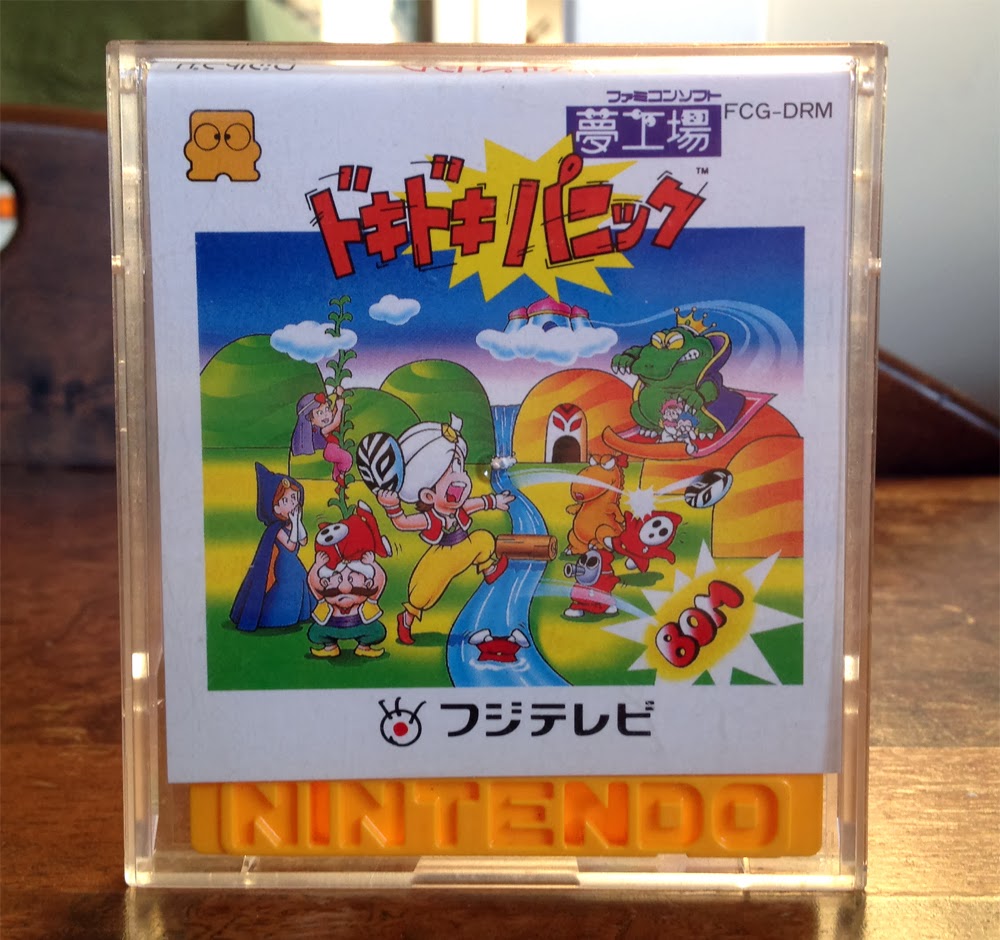

It’s Doki Doki Panic, the game that became Super Mario Bros. 2, meaning that it’s for the Japanese version of the NES and that I therefore have no system to plug it into. I’m actually not sure why I even bought it, other than to possess a thing that always seemed out-of-reach. I can say this much, though: Flipping through the instruction manual makes for a very “red universe-blue universe” moment, because it means seeing familiar elements in a context that feels inherently wrong. It’s like someone mucked with the timeline and re-wrote history.

Here, you can play along too.


The official box art, for example, features the heroes, a jolly Arabian family, fighting the big bad and his monsters. It should look familiar even if you’d never heard of Doki Doki Panic, first because the big bad, Mamu, became Wart for the game’s transformation into Super Mario Bros. 2 and second because the box art for the Super Mario version of the game re-creates this scene, almost pose for pose.(Note, though, the latter is the artwork for Super Mario USA, the version of the American take on the game that Nintendo eventually released in Japan. The American box art for Super Mario Bros. 2 looks different, of course.)


Unsure what’s going on here, exactly, but I’ll say this much: My childhood could have benefitted from more anthropomorphic video game cartridges giving me instructions.


Something else I could have benefitted from in my childhood? Video games that devoted four pages of the instruction manual to storylines. It’s pretty clear that Mamu is trying to get a taste of those delicious winged moppets that Arabian culture is so famous for. I know what’s going on, more or less, and I know that the storybook motif explains why the final world is missing a level — I’ll bet it’s the ripped page in the bottom corner of page 8 — but if anyone can provide a word-for-word translation, I’d be eternally grateful.

I like how they show you the Bad Dream Machine right there in the manual, on the bottom of page 6, so as to prevent the “What the hell is that supposed be?” reaction I had when I got to the last room of the game back in the day.

I’ve mentioned before here that the pet monkey is not playable in the game, and I will point out a second time how that seems like a terrible oversight on Nintendo’s part. That said, they have dressed the monkey well.

Hit the jump for more.


Here, the “Mario” of the game, Imajin, admonishes you for something. I know not what.


Walkin’ toward each other, like you do. Again, I know not why.
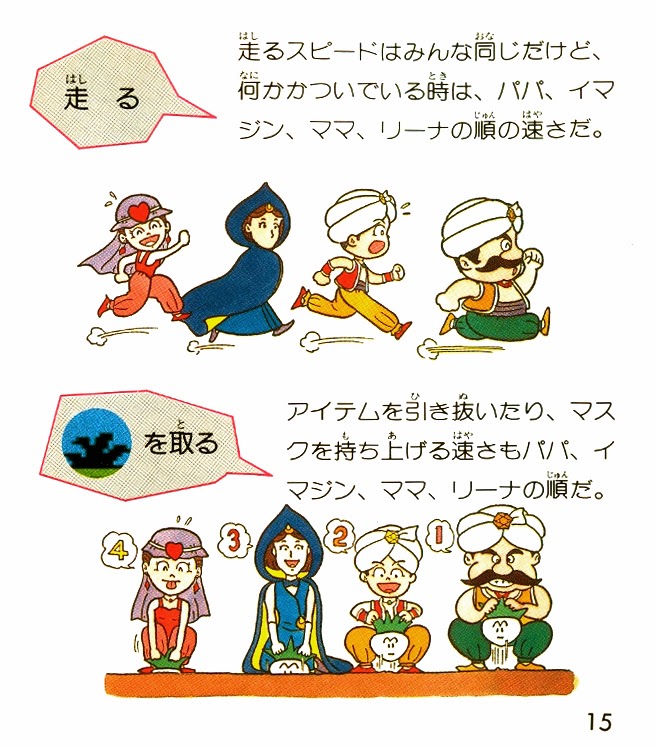

Here, you learn about the various characters’ special abilities. Only you don’t need to, because they’re the same abilities as the Mario 2 cast. It’s interesting how these characters are now all but forgotten, yet they’re the reason certain Mario elements exist today. For example, Lina and Mama run more slowly than Imajin and Papa, but they compensate with superior jumping abilities. Those same jumping abilities are still around today, so it’s actually Lina and Mama who are responsible for Peach hovering in middair and Luigi jumping especially high in Super Mario 3D World.

It’s also worth pointing out that the Super Mario Bros. 2 instruction manual re-created these images too, but I suppose it’s just the most sensible way to convey this info graphically.


I can’t seem to find a good, large version of the vegetable-plucking line-up, but it was there in the manual too, and it even got re-created in the in-game intro to Super Mario Advance.


 (Yes, it does in fact look like twerking, now that you see it in GIF form.)


Such a happy family, even despite the abduction of their children! I actually had a conversation on Twitter about Doki Doki Panic being rare in that it lets you play as all the members of a family: the mom, the dad and the kids. It was suggested that I write up something on such video games, but I actually got stuck after thinking of only one other: Legacy of the Wizard. I wonder if there are any more.


Again, more of Imajin where we’re used to seeing Mario. Everything else is basically unchanged, save for those weird masks on the bottom of page 20, which became mushroom blocks in Super Mario Bros. 2. (And if you’re curious about the abundance of masks in Mario 2, see this post.)


An overview of items. Again, it’s more or less the same, with a few obvious substitutions like the inexplicable racist blackface head getting switched out for a Koopa Troopa shell. Curious how Doki Doki Panic still has a star to grant you invincibility, Super Mario-style, when it wasn’t intended as a Mario game. 


Yep, the extra life-granting slot machine got its start in Doki Doki Panic too, so I guess you could say that’s where the Super Mario 3D World version comes from. (The music is a dead give-away.)


A little weirdness here: Apparently Doki Doki Panic treats the gray Shy Guys as a separate enemy, while the American version doesn’t. I’m wracking my brain to remember if the gray ones acted any differently. Anyone? (Also, a little trivia: They only put one red Snifit in either version of game, even though he appears on both box arts.)


Only one “red world” moment, and it’s the less demonic-looking Phanto mask. (I prefer mine as frightening as possible.) But there are two other oddities here that might be explained by the images coming from a beta version of the game: the background behind that Beezo and whatever platform the Bob-Omb is walking on, which doesn’t appear in Super Mario Bros. 2. 


Only one bit here: While they kept the original artwork for every other enemy, Nintendo re-drew Pokey the Amblin’ Cactus for the Super Mario Bros. 2 manual to look cuter but less like how he looks in-game. (See?) I just imagine some art director declaring, “It’s all good but this shitty-looking cactus has got to go.”


Both the American and Japanese versions of the game make the weird decision to show art of big bad but not a screenshot of how he actually looks in the game, even though he looks basically exactly like the art depicts. It would have been more surprising if you got to the last stage and the big bad had, like, blonde pigtails and a pink sundress. And yeah — no Clawgrip (or even Clawglip) here, as he’s unique to Mario 2.

Also, might any of you Japanese-savvy readers be able to translate page 37? I know it has something to do with this phone card featuring Imajin and Lina next to Mario and Peach.


Another odd tie between this game and the Mario games before Nintendo turned it into a Mario game. “Greetings, Arabian kids from an unrelated game. We are going to blink you out of existence shortly!”
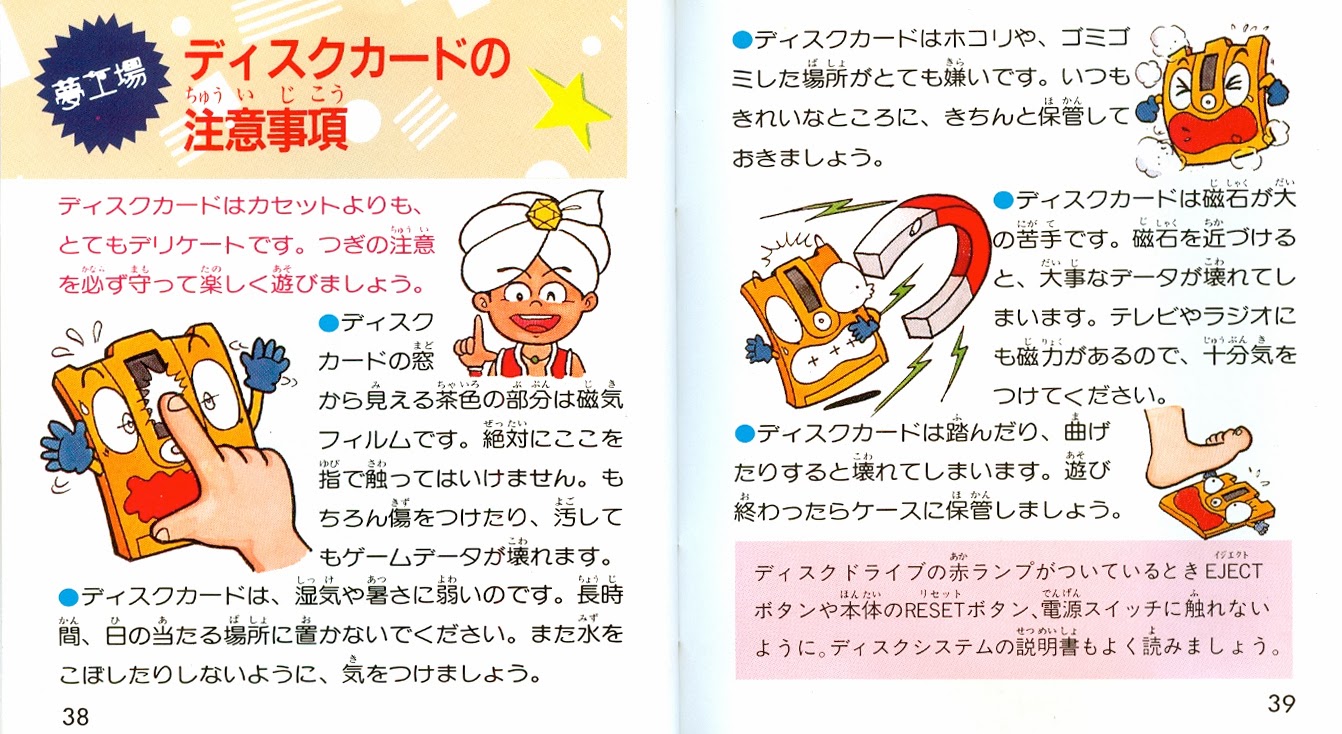

More life lessons from an anthropomorphic video game cartridge. The life lesson you’re getting here is not to be a dick, I guess. The “don’t touch the magnetic strip” part seems especially invasive.

And that’s it. 

Is it weird to feel nostalgic for something you didn’t actually experience? That’s the feeling I got flipping through this manual. Short of going back in time and playing it as a kid, I think I’ve gotten about as much as I can from this footnote in video game history. I don’t know if anyone else has gotten as much from it as I have. I think it was learning about the existence of Doki Doki Panic and how it had been retroactively absorbed into the Mario series that sparked an interest in “continuity immigrants,” as the aptly named Jor-Ellis Island refers to them. I’m also pretty sure that Doki Doki Panic is responsible for my love of overlooked, underappreciated and otherwise forgotten video games from this time period.

Maybe more than anything else, however, what really pings my “back in the day”-dar is the artwork. I don’t know who did the illustrations for Doki Doki Panic, but they nailed that “classic Nintendo” look. Should Nintendo ever release a collection of all this hand-drawn instruction booklet artwork one day, I know of at least one nerd who’d be happy to own it.

This? This is my childhood right here, even if this was a game I never played:


And another:

doki doki panic official art super mario bros. 2

And another:


And finally, befitting his sad fate of getting wiped out of existence by an Italian plumber, we’ll close on Imajin getting electrocuted. 


Video games, previously:

Saturday, November 23, 2013

Taking a Page from Super Mario Bros. 2

I write about Super Mario Bros. 2 a lot, I realize, especially considering that the game is now twenty-five years old. I suppose that results from the combination of it being especially surreal, even by Super Mario standards, and me having encountered it at the perfect age to be asking “Hey, why is that?” I actually still ask “Why is that?” fairly often. One of the things that had always bugged me about the game is its level structure. Super Mario Bros. makes sense: four sets of levels each composing a world, and eight world altogether. It’s all tidy and even. Super Mario Bros. 2 isn’t so easy: It has seven worlds, but an irregular number of stages.

The first world has three levels.


The desert world has three.


The ice world has three.


But the last world — the one on the clouds — only has two.


Granted they’re longer than most other levels, and harder too, but it should probably surprise most first-time players that it’s the second level that ends with a fight against the biggest of the big bads. There is no surprise third level.

“Hey, why is that?”

The answer, apparently, lies in the source material: Doki Doki Panic, the Japanese NES game that was remade into the American sequel we call Super Mario Bros. 2. In Doki Doki Panic, the four heroes are an Arabian family trying to rescue two children, Piki and Poki, who were sucked into a magical storybook. Also, there’s a pet monkey, but the monkey doesn’t get to do anything, which anyone can tell you is a lost opportunity on Nintendo’s part.


Watch the dramatic kidnapping (plus listen to a weirdly off-key version of a tune that should be familiar to anyone who beat Super Mario Bros. 2).


It doesn’t show it in the intro, but the storybook motif explains the missing final level, at least according to this page: In the scuffle, the final page of the book accidentally gets destroyed. Yep, the final level is missing because the ending of the book got removed. You, the player, has to go through the game and beat the big bad, essentially re-writing the lost ending.

Weird, right? And possibly a little meta? Especially when you look back on those stage intro screens I posted above and you realize that they retain that “page of a book” motif? They literally look like stacks of paper.

I’m assuming this backstory comes from the instruction booklet, which I (a) don’t have aside from this snippet and (b) couldn’t read anyway because it’s in Japanese. Can anyone with such access and a functional understanding of Japanese verify? The Mario Wiki, being a wiki made by and for crazed fans, isn’t so hot with the documentation and citation.


Previous times Super Mario Bros. 2 made me question things:

Saturday, July 24, 2010

What’s With All the Masks in Super Mario Bros. 2?

Not too long ago, someone found my blog while Googling to find out about the weird preponderance of masks in Super Mario Bros. 2. My blog, I guess, has become a stopping point for most people looking for random bits of Mario 2 info, and I couldn’t be happier about that. Anyway, I didn’t know why so many masks appear in the game, but they do. Check out these masked nogoodniks, for example.


Add to them the end-of-the-stage hawk’s mouth you have to jump through to proceed to the next stage. It looks enough like a mask as it is, but in the original Japanese version of the game, Doki Doki Panic, exiting a stage involved stepping through a more humanoid mask:


And the blocks that are shaped like mushrooms in Mario 2 are also cosmetic changes. They replaced yet more masks.


Mask-tastic — appropriately so in that Doki Doki Panic itself was given a figurative mask in the form of a graphical makeover to dress it up like a Mario game. But I never saw how the masks connected with Doki Doki Panic’s Arabian-themed setting. The original game starred a happy little Arabian family that was replaced my Mario and company when the game was translated for American audiences, yet elements of the original theme remain. The American incarnation still features magic carpets and snakes hiding in vases and distinctively Middle Eastern-sounding music in the underground scenes.

But I recently found a video that might explain the masks. Doki Doki Panic — full title: Yume Kōjō: Doki Doki Panic, “Dream Factory: Heart-Pounding Panic” — was designed by Nintendo to promote Fuji Television’s 1987 “Dream Factory” showcase, with the cartoon Arabian family being both the stars of the game and the mascots for the event. They show up in the video below — which is advertising the convention, not the game — but so do a whole lot of freaky masks.


I can only guess that the masks were also part of the convention’s overall motif. And since the game was developed specifically for the convention, those design elements were incorporated. And it also makes sense that the setting of Mario 2 and Doki Doki Panic is some kind of dream world, given that the name of the convention was Dream Factory. (Weirdly, only Mario 2 has the main character waking up at the end and realizing that the game’s events were just a dream and didn’t really happen.) But it seems like a weird aesthetic combo for a technology convention — Arabian stuff, masks and dreams — and I wonder if it refers to a specific story or other cultural element that I just don’t know about.

And even an explanation for that wouldn’t fully account for one of the strangest bits: The turtle shells you can throw at enemies in Mario 2 were bizarre blackface heads in Doki Doki Panic. I know Japanese culture doesn’t approach issues of race the way we do in the U.S., but, as this gamer-artist points out, what you see below looks a lot like either a depiction of blackface or the head of a pickaninny


It’s all very strange, but that’s why I like it — and continue to think about these things years after I stopped playing this game.

Super Mario Bros. 2, previously:

Friday, May 14, 2010

Toad Had a Bad Dream

What an overworked mushroom sees when he sleeps:

toad has a bad dream
Made from sprites from Super Mario Bros. 2, Super Mario All-Stars and Doki Doki Panic. And too much goddamn time.

Friday, August 29, 2008

The Forgotten Jar Pixies

Anyone that actually played through the first Super Mario Bros. all the way to the end of level 8-4 should remember the game’s ending: a generic thank you from a pixelated mess that is supposed to be Princess Peach followed by Mario’s inexplicable reappearance back at the beginning of level 1-1. Only now the game’s levels were populated with the hard-to-kill beetle enemies. Beetle World, my brother and I called it.

Super Mario Bros. 2 offers something a little more cinematic.

When Mario — or, as the case may be, Luigi, Peach or Toad — does in the game’s final boss, Wart, by tossing a sufficient number of vegetables into his mouth, he dies, causing to materialize a door that leads to a plugged-up vase. Mario — or, again, whoever — pulls the plug and out spring eight strange-looking fairies whom the game hasn’t previously mentioned in any way. They don’t introduce themselves, but celebrate their liberation from their cruel amphibian captor and push his corpse crowd surfer-style into oblivion. (Yes, the game is strange.)


Then, of course, Mario wakes up, revealing the whole of Super Mario Bros. 2 to be a dream. As he snoozes away, the “cast” scrolls by — again, very cinematically, even more so than many games since. Included in the list of characters — in the list of enemy characters, no less — is the mysterious fairy. Its apparent name: Subcon — a fairly lame play on the word subconscious. Which is especially strange, since the name of the place in which Super Mario Bros. 2 takes place — per the game’s instruction manual and its intro screen as well — is also Subcon.

See for yourself:


images courtesy of the video game museum

The obvious conclusion would be that the little characters are, in fact, called “Subcon,” and the fact that they share their name with the place they live in is either a happy coincidence or some great symbolic association. (They are their country. Like America Ferrera or something.) As any keen-eyed person who has ever played Super Mario Bros. 2 through knows, however, the end credits are chock-full of typos. Birdo is “Ostro.” Clawgrip, the rock-throwing crab boss, is “Clawglip.” And so forth. So perhaps the Subcon fairies’ names are screw-ups as well. “Ostro” and “Clawglip” have been fixed down the line in various Super Mario Bros. 2 remakes, however, and the “Subcon” name has remained.

So who or what the hell are these things?

As far as I know, they’re just as mysterious in the game’s original version, Doki Doki Panic. (If they’re better explained and you know this and you’re reading this now, by all means please tell me.) And while a lot of that which populates Super Mario Bros. 2 was eventually pulled into the stable of regular Mario game elements, these little weirdos never showed up again.

I guess we’ll never know. Unless we’ve played through Doki Doki Panic and know the secret, in which case you probably do know and should tell me pronto.

EDIT: Just found the Doki Doki Panic ending on YouTube. Cleared up nothing.


Except that the Arabian family owns a pet monkey.

THANKS A MILLION. PUSH START TO REPLAY.

Wednesday, April 4, 2007

Long Live the Frog King

A curious thought: Thought the fat frog called “Wart” has only technically been the last boss of one Mario game, Super Mario Bros. 2, the process of remakes, reworkings and upgrades to the game's engine have quintupled Wart’s appearances.


In short:
  • Doki Doki Panic
  • Super Mario Bros. 2
  • Super Mario USA (in Japan)
  • The Super Mario All-Stars version of Super Mario Bros. 2
  • Super Mario Advance
And that’s not counting cameos in Legend of Zelda: Link’s Awakening or Animal Crossing. The former is odd because it features him as “Mamu,” which was the character’s name in the original Japanese version of Super Mario Bros. 2, Doki Doki Panic. Presumably that version of the character should have been long forgotten by the time Nintendo cranked out Link’s Awakening six year’s later. The matter is made more mysterious by the fact that both Super Mario Bros. 2 and Link’s Awakening take place in a setting that is later revealed to be the product of a dream. Odd stuff.

Now that I think about it, it’s also strange that all the Super Mario media of my youth — the cartoons, the children’s books, etc. — featured Wart fairly prominently, as Super Mario Bros. 2 had just come out at the time and, from a marketing perspective, it probably seemed like a sure bet that the character would continue in Mario mythos on equal footing to that other big bad, Bowser. But Wart never again appeared in a “new” game and has been all but forgotten now.

A kid today looking at those some low-grade cartoons and books would probably be confused as to who the frog thing is.