Pages

Showing posts with label arabic. Show all posts

Monday, June 7, 2010

Armpit of Orion! Armpit of Orion! Armpit of Orion!

I recently rewatched Beetle Juice for the first time since I saw it as a kid and ended up wondering why Tim Burton would have wanted to name his title character what he did.


The title of the movie reflects how the name is pronounced and how Beetlejuice himself tricks Winona Ryder’s character into speaking his name and consequently making him appear to cause trouble; he can’t say it himself, so he plays charades and makes Lydia see an anthropomorphic beetle and a carton of Minute Maid, in that order. However, in the movie itself beyond the opening credits, the name is spelled Betelgeuse. The name shares it spelling with that of the brightest star in the constellation Orion. According to Wikipedia, this celestial body gets it name from the Arabic al-Jauzā, a feminine name. But beyond that, the origin is uncertain. Some sources state that the name can be roughly translated as “the central one.” It may have been a transcription error with the name Yad al-Jauzā, “the hand of al-Jauzā,” that led to the name Betelgeuse. If that first letter — represented in the Arabic alphabet letter “ﻴ” — was misread as a “B,” then it could have given rise to what we non-Arabic-speakers call the star today. During the Renaissance, the star’s name was written as Bait al-Jauzā, “house of Orion,” though it was apparently believed that this meant “armpit of Orion” widely enough that the current Persian name for it is derived from this. Still others think it was always Ibṭ al-Jauzah, “armpit of Orion,” at least until it degenerated into forms such as Bed Elgueze, Beit Algueze, and Bet El-gueze, which would have led to the non-Arabic name for the star.

It’s worth noting that the very reliable Online Etymology Dictionary just offers “armpit of the central one” without any notation of the apparent controversy about where the term actually came from.

I haven’t found any associations with the star that seem like they could have inspired Tim Burton to name his most famous demonic character in its honor, but Wikipedia does point out that shellac can and probably does contain crushed insects and is therefore sometimes referred to as beetlejuice, though this fact is appended with one of those superscript “citation needed” notes, so who knows if this is actually enough of a thing to have influenced Burton. But hey — at least take this as news that food products that use shellac, such as Skittles, are not vegetarian-friendly.

Wednesday, October 22, 2008

Guacamole Window

In sending an email to my copyeditor last week, I mistyped the code for an em dash (ALT+0151) and ended up producing a symbol that look remarkably like a butt. Not only did I decide against retyping the proper symbol, I actually pointed out the random butt symbol. “Look! I mistyped and made a butt! Isn’t that strange?”

Very professional, I know. In any case, the symbol looked like this:


This eventually caused me to look at the Microsoft Word symbol bank in order to find out what this symbol actually was and, subsequently, to mock the people whose printed language uses butts. Apparently the symbol is ot — a form of the early Cyrillic character omega, a ligature with the character te. It can mean “from,” I’m told. I will continue to imagine that it means “butt.”

In trying to find the Cyrillic butt symbol on my home computer, I ended up noting a few of those other symbols that don’t make much sense to monolingual Americans like myself. I’ve scrolled past them many times and always wondered what they did. Now I know.

First up: The End of Ayah.


I’m calling it The Magical Fishbowl.

Ayah
is the Arabic word for “sign” or “miracle.” (It’s a cognate with the Hebrew word ot, which also means “sign,” though the similarity between that the above ot is probably just a coincidence.) According to Wikipedia, Ayah most often refers to one of the 6,236 verses of the Qur’an, which Muslims each regard as each being a sign from Allah himself. After each one, as near as I understand it, there appears the above symbol with the verse number inside it.

Then there’s this one, which looks a bit like a poorly drawn Star of David but, being Arabic in origin, probably isn’t.


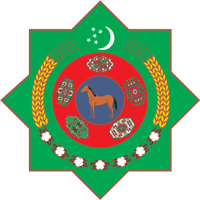
It’s actually the Rub El Hizb — which translates to English as something like “lord of the group” or “sustainer of the party” or “supporter of the sect” or something along those lines. It’s a popular motif for flags and whatnot — you’ve doubtlessly noted it on that Turkmenistan coat of arms that you’ve been seeing everywhere — but also is used to represent the end of a chapter in Arabic calligraphy. Finally, I’m told that the Rub El Hizb represents “an eighth of a juz’,” but I can’t even to begin to figure out what that means.


And finally we have the Place of Sajdah, which I repeatedly read as “Palace of Sajdah,” which sounds a lot more fantastic than the actual name but which doesn’t lend itself to quick and easy Googling. There’s surprisingly little about this one online, at least under the name I have understood to use for it, but it would appear to be the symbol for the notion of prayerful prostration — sajdah, also known as sujud. I don’t understand the connection between the act and the symbol, unless it’s supposed to be an abstracted for of a human, bent down in prayer, wit the diamond-shaped part at the top being that person’s head.

More on punctuation, typogrpahy and other such symbols: