Pages

Sunday, February 6, 2011

Mr. Drew’s Improbable Vocabulary

I won’t lie; I was reminded of this word as a result of the preceding post.
Feghoot (FEG-hoot) — noun: a humorous short story or vignette ending in a pun.
Rarely do I get to reference “Little Bunny Foo Foo” in my writing, but today I can. Thought it’s been a long time since the Wee Sing Silly Songs album has figured into my life, I can remember being confused by this stupid bunny song back when I was a kid. As you’ll recall, Foo Foo, the protagonist, is warned by some genius loci fairy woman to treat field mice more kindly. (Admission: In trying to remember the lyrics, I at first thought that Foo Foo was “scooping up the field mice / and pooping on their head,” but this isn’t the case. He’s actually “bopping them on the head,” which seems more appropriate for a children’s song but also like a far lesser crime, if you ask me.) If he continues acting the park of the jerkass, the fairy explains, she will transform him into a “goon,” whatever that means. I couldn’t tell at the time. I asked, was told that a goon is like a henchman, more or less, and acted like that solved the problem even though it totally didn’t. Even looking up the word today, there’s no widely used definition for goon that would explain the fairy’s threat.

After reading about Feghoots, I understand that the only reason that the word goon was included in the lyrics was to set up the atrocious pun the serves as the moral of the story. Although I have no recollection of this, the song ends after Foo Foo has been turned into a goon, at which point the narrator notes that the lesson to take away is “Hare today, goon tomorrow.” (Forced smile. Eye roll. Vomit. Eye bleeding. Death rattle.) This is what Feghoots do, more or less, and despite their tendency to induce cringes and (I’m assuming) the tendency for audiences to murder the people who tell such tales, they persist. You might also know about Feghoots if you ever watched Rocky & Bullwinkle cartoons. The “Mr. Peabody’s Improbable History” segments — you know, the ones with the snide, effeminate dog and the developmentally disabled boy he inexplicably hired as an assistant? — each end with Mr. Peabody offering a terrible pun. (Example: In this installment about the formation of the Texas Rangers, Mr. Peabody and Sherman meet the Dallas Kid, whom Peabody claims went on to found an amusement park so famous that a book was written about it. Sherman: “Durrrr, really? (drools) Mr Peabody: “Why yes. Haven’t you ever heard of Dallas in Wonderland?” Egregious, I know, but it illustrates the point.)

A question you may be asking: Why would the term for these sorts of stories be a word that sounds like what a hateful immigrant woman would call the confirmed bachelors upstairs? According to Wikipedia, this sort of storytelling device originated with the science fiction series Through Time and Space With Ferdinand Feghoot, written by Reginald Bretnor (under the anagram name Grendel Briarton) beginning in the 1950s. (Not sure where Bretnor came up with Feghoot as a name, however.) Sort of like the Mr. Peabody shorts, the stories had Ferdinand Feghoot traveling through time and going on adventures that last only a few paragraphs and always finish with a play on a well-known phrase. Feghoot fans still write new stories today. Some even ones without the Feghoot character. Take this one, from the online Feghoot collection Tarzans Tripes Forever:
After Mary Poppins became older, she gave up being a nanny and retired to the West Coast of the United States. After a while, she became bored and decided to open up a small detective agency specializing in solving crimes using her psychic ability and strong nose. She opened a small space on Hollywood Boulevard and posted her sign proudly. It read: “Super California Mystic, Expert Halitosis.”
Gut-busting, right? Your gut, busted.

I dwell on bits of culture that I consider to be awful, mostly because I want to understand what fans see in them. Such is the case here. The stories themselves are insubstantial — flash fiction, really — and really only serve to generate a painful pun. I actually wouldn’t be surprised in the least if the pun were written first and then the story constructed just to get from point B to point A. But I’ll bet most people don’t write them; they just read them. Why? Does the satisfaction lie in seeing how the author wraps up the various stray bits into the word play punchline? Is this like people who eat the poisonously hot chili peppers or something? Is it a test of endurance that you can make it through these without becoming so annoyed they swear off the written word? I’m at a loss.

Fun word, though. Feghoot.


Previous strange and wonderful words:
Word nerd? Subscribe to Back of the Cereal Box’s word-related posts by clicking here.

Mr. Brain

The original posting of this simply read “There’s a whole lot of wrong going on here.” I can add nothing more.


Via Meiko.

Saturday, February 5, 2011

The Premier Tramp of the New York Area

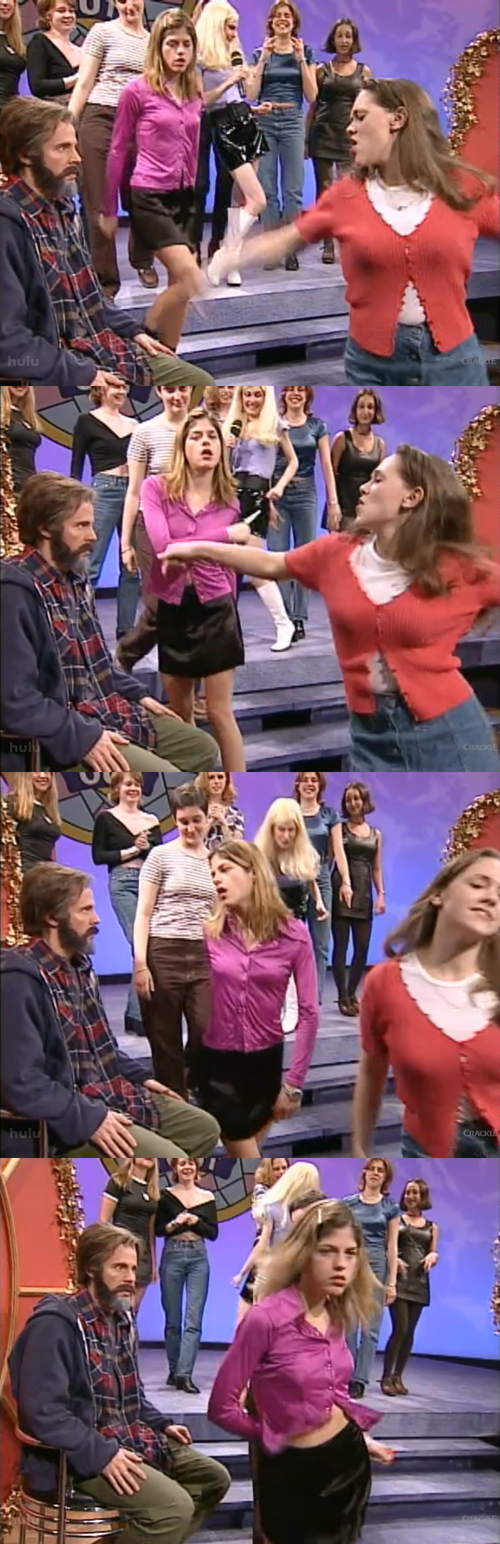
I’m cleaning and watching the series run of The Dana Carvey Show on Hulu. You know, like you do. It’s worth a try, if you like comedy, at least to see folks like Stephen Colbert and Steve Carrell and others before the The Daily Show made having that name seem popular. (Also a plus: Ace & Gary, pre-SNL.) But in glancing at my monitor as I walked by, I saw someone else who had appeared before making it big: Selma Blair.


She’s blonde, about 24 years old and nowhere near as hot as she looks now, but that’s her, in full-on goof mode, making a face that suggests she might be missing or lacking a chromosome, God love her. The sketch features her as one of the nixed possibles from an episode of Singled Out featuring Dana Carvey as Ted Kaczynski which OH MY GOD MOST NINETIES THING EVER I’M GRUNGE-PUKING ON MY COPY OF SO I MARRIED AN AXE MURDERER.

According to IMDb, it’s not Blair’s first role. That’s a 1995 episode of Adventures of Pete & Pete that I actually remember, even if I can’t picture her in it. In fact, it doesn’t even appear on IMDb, but I’m certain that’s her. Right?

Along similar Cruel Intensions-y lines: that time I spotted Christine Baranski in an episode of The Brady Bunch and the time I saw Swoosie Kurtz drunk at the airport.

Friday, February 4, 2011

A Total Dernface

I swear that this is the last of my posts about my parking lot. But this one merited a mention, I felt. Spotted on the walk to my car last night:


For most people, this would elicit a reaction of “Oh, hey, lady from Jurassic Park,” but for me it brought me to a specific facial expression that I have incorporated into the essence of my being:


I mean, this beautifully bizarre woman has twisted her face into a reasonable approximation of a tragedy mask. It’s unreal, even in a film as unreal as Blue Velvet. I want to frame it. I want to paint it. I want to Photoshop it into a background wallpaper. Actually, the last of these three I actually did:


This, sadly, beats out my Lara Flynn Boyle sighting to become the closest to David Lynch as I’ve gotten yet.

Thursday, February 3, 2011

Fringe Event No. Two

A follow-up to the post about Anna Torv’s character on Fringe apparently having a parking space in my office lot: So does Joshua Jackson’s Fringe character:


For those of you who don’t watch Fringe, this is basically like coming side-by-side parking spots labeled Fox Mulder and Dana Scully.

With a Name Like That, She’d Better Be Hot… or a Dude

Honestly, I don’t mean to distract myself, but you know how Wikipedia can be. There I was, at work, reading about Lisa Rinna — yes, at work and for work — and I ended up reading about Nick Fury: Agent of S.H.I.E.L.D., a little-known 1998 comic book adaptation starring David Hasselhoff. Already, I’ve said enough to explain why this film may have escaped your awareness, even if you care who Nick Fury is. (The short answer: He’s the eyepatch-sporting character Samuel L. Jackson played in the Iron Man movies and will return for next year’s Avengers movie.) In the 1998 film, Rinna played a character named La Contessa Valentina Allegra de la Fontaine. That only being the kind of name that a soap opera villainess, drag queen or kickass comic book character can have, I had to click through.

In Marvel comics, it turns out, the Contessa is one of those sexy but capable but sexy ladies who prefers catsuits to body armor and yet somehow still hasn’t died. She looks like this:


Given the Contessa’s banging, Bond girl body, it should be no surprise that in her forty-two-year run in Marvel comics, she has ended up in bed with Nick Fury more than once. Their first sexual encounter, however, is the most notable because the Contessa’s “one-page seduction” of Fury, as Wikipedia refers to it, had to be edited to conform with the Comics Code Authority. From Wikipedia:
In the third-to-last panel, de facto Marvel art director John Romita Sr. redrew a telephone that had been taken off the hook for privacy, placing the receiver back in the cradle; in the last panel, an image was removed and replaced with a closeup of an item from earlier in the page — a phallic long-barreled gun in a holster. [Romita explained,] “So one panel had the stereo in Fury's apartment to show there was music playing, cigarettes in the ash tray in one, there was a sequence of intercut shots where she moved closer to him, much more intimately, there was a kiss, there was a rose, and then there was one panel with the telephone off the hook, which the comic book code made him put back on. ... [T]he last panel on that page had Nick and his old lady kneeling, with their arms around each other, and that was entirely too much for the Code, so the panel was replaced with a picture of a gun its holster.”
And I’m writing about this because I’m struck not only by how much of a rather vanilla sex scene had to be edited in a comic where people spend most of their time shooting guns at each other but also the specific signifiers of sex that had to be omitted. Maybe I’ve been living in houses without landlines for too long, but it seems so strange to me that leaving a phone off the hook would signify sex and that redrawing the panel to show the phone hung-up, ready to take incoming calls, dispelled the sexiness enough to get an approval. Then, to take a panel showing a man and woman embracing and replace it with a gun in its holster? That seems even worse, honestly. An embrace is an embrace; there’s not much symbolism to it, but the gun slid into its pocket — surely a flesh-colored sheath, designed for it, specifically for it, keeping it warm, the way it likes — actually suggests more to me than than a straightforward depiction of clothed, physical affection ever could.

It’s baffling to me, but then again this is coming from a guy who has authored the Penis Vagina Twins series of superhero-detective comics (contract pending.)

Wednesday, February 2, 2011

Hellmouth Much?

In certain ways, in most ways, I had a sheltered childhood during which I learned about the world mostly through popular culture. If I didn’t see a given movie or read a given book, I wouldn’t know something, unless the thing in question somehow related to sheep, apricots, New Zealand or one of the few other things I learned about through actual experience.

So when I first heard the phrase “X much?” I didn’t know what the hell I was being asked. You know what I’m talking about — “Excited much?” to someone who is clearly overenthusiastic, “Hair gel much?” asked to someone with statement hair, “Have bark much?” asked to a tree. Eventually I figured it out. Asking “X much?” is an ironic way to point out either that a person is, does or has too much X or, in some cases, doesn’t do X enough, as with “Walk much?” being asked to someone who just tripped. (I realize I sound like an academically minded 90s-era drug-dealer with all this talk of having and doing X. Just go with it.) Late last year, I saw a Language Log post that detailed the origin of the phrase. As far as anyone can tell right now, the first documented use of “X much?” seems to a 1978 Saturday Night Live “Nerds” sketch in which Todd (Bill Murray) asks Lisa Loopner (Gilda Radner) “Underdeveloped much?” to imply that she’s flat-chested.


That notwithstanding, the OED cites other pop culture references in its entry for this use of much, all of them equally close to my heart (thought none of them being things I’d be exposed to until at least mid-high school. According to the OED, the phrase first appears in 1988’s Heathers — “God, Veronica, drool much?” and later as “Jealous much?” — but was popularized by the 1992 Buffy movie — “Excuse much! Not rude or anything.” The post also notes that it’s used in the TV show’s 1997 pilot, “Welcome to the Hellmouth,” in a line spoken by Cordelia — “Morbid much! I didn’t ask!” — in response to Buffy wondering if a recently deceased person had vampire marks on his body.

I know Buffy played with language a lot, but it makes me particularly happy that it, SNL and Heathers have a place in the OED. I’ll eagerly await the next edition to see if chatter in the cafe, fuck me gently with a chainsaw or schwing eventually get their due.

Pop culture and words, previously: