Pages

Showing posts with label ha ha — this person's name. Show all posts

Tuesday, May 4, 2010

Ha Ha — This Goddess’s Name

What do you know about Greek grain goddesses? Okay, stop running away from me. Even if you don’t care, you should, because old stuff.

And you probably at least know about the story of Demeter, the goddess of grains and the harvest, who accidentally created the seasons — and, in doing so, Seasonal Affective Disorder — when her daughter Persephone had to spend part of the year hanging out in Hades. Sad, lonely grain goddess = dead plants. Grain goddess rejoined with daughter = springtime. This apparently was enough to quiet inquisitive ancient Greeks. So yeah, Demeter’s the main plant lady and certainly the most important, with Persephone being runner-up, mostly because she’s pretty well-known and is sometimes depicted as holding a sheaf of grain. (Carrying stuff is the ancient Greek way of signifying a personality, kind of like how weather a leather jacket is in modern society.) But just as many major gods are flanked by supporting B- and C-string deities, Demeter has a little sidekick grain goddessette who is far less famous.

Let’s say she’s the goddess depicted below, her status being ably signified by the grain she’s clutching. Now, if she’s a less powerful and more narrowly specialized goddess whose powers extend only to grain and seeds, what might a good name be for her?
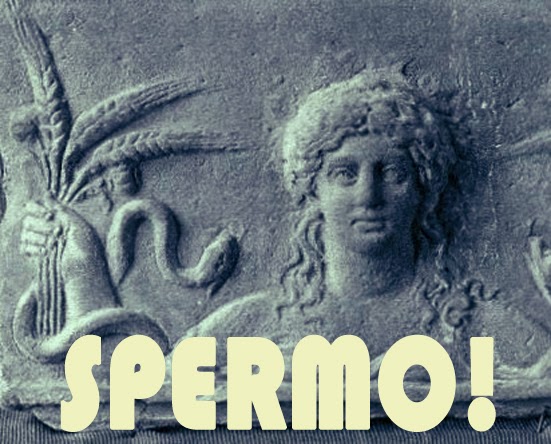

Yes, Spermo.

Seriously. The lady’s name is Spermo. SPERMO. SPERMO. As someone who has enjoyed and actively read about Greek mythology ever since he was a kid, I don’t know how it managed to escape me this long that one unlucky goddess got stuck with the name Spermo. But this one did. Everyone, meet Spermo. (Don’t shake her hand. I think you know why.)

As far as names go, Spermo totally got the shaft, so to speak, even though the etymology of her name — from the Greek sperma, “seed” — makes sense in terms of her family’s longstanding affiliation with agriculture. Spermo, you see, is one of the Oenotropae, a trio of sisters who each reign over a specific agricultural product — Spermo over grain, Oeno over wine and Elais over oil (the kind used in food, not the kind used as fuel). The group name Oenotropae translates as “the women who change wine,” so both Spermo and Elais have a reason to feel inferior, I guess. Spermo more so, clearly. The reason wine in particular gets emphasized with these three is that their father, Anius, is the son of Apollo and Rhoeo, who is in turn the daughter of the wine-affiliated Staphylus, who I mentioned in yesterday’s post. Therefore, Spermo is the great-granddaughter of the wine god Dionysus, whose small-dickedness was the focus of Sunday’s post. I guess that makes for a fun little trio of posts on this family and its quirks.

According to some sources, Spermo and her sisters are not goddesses but just human women with magic powers — specifically to turn anything they want into the agricultural item they’re associated with. (Not such a gift, that that transformative touch. Didn’t they ever hear about King Midas? Or Patrick Skene Catling’s 1952 children’s novel The Chocolate Touch?) In one version of their story, they are captured by the Greeks en route to the Trojan War so they can provide food for the troops, but Dionysus transforms the sisters into doves so they can escape. Also: Of freaking course they get turned into doves. Sometimes I wish I was a character in Greek mythology so I could get turned into an animal, but I’d probably just get decapitated in a war or something.

Family lineage and transformation into birds aside, you have to admit: Her name Spermo, and that’s pretty awesome.

Sunday, February 24, 2008

Too Many Dinty Moores

I had planned to add another entry to the list of people unfortunate enough to qualify for membership in the “ha ha — this person’s name” club when Spencer explained his annoyance with the name of Dinty Moore, an author he had to read in his creative nonfiction class. Clearly, anyone who shares a name with a canned Hormel product has quite a burden to bear. However, the relationship is a bit more involved than I originally thought.


Ultimately, the name Dinty Moore originated in the long-running comic strip Bringing Up Father, known more commonly as Maggie and Jiggs. Creator George McManus included in the strip a tavern-owner character named Dinty Moore in honor of his real-life friend Peter Moore, who then apparently latched onto McManus’s coattails by legally changing his first name to “Dinty” and establishing a chain of restaurants called Dinty Moore’s sometime in the 1920s. (This real-life restaurateur Dinty Moore, however, did not become into the essayist Dinty Moore, however.) Later, in the 30s, Minneapolis meat retailer C.F. Witt and Sons registered the Dinty Moore name for a canned, cured meat product. (No clue how they pulled this off, seeing as how at least the main Dinty Moore restaurant in midtown Manhattan stayed operational until the 1970s and one would imagine that two different brands of Dinty Moore edibles would constitute some sort of trademark violation.) In 1935, Hormel Foods — current-day king of prefabricated meat-like substances and purveyor of Spam — bought the Dinty Moore name from Witt and slapped it on its own beef stew, a product which a 2001 New York Times article on the subject notes as having a reputation for an abnormally long shelf life. (The blog Memoirs of a Gouda describes it as “vile hatred in food form.”) Hormel continues to market the product today and even invented a cartoon lumberjack character — named, of course, Dinty Moore — to help in this effort, though he was eventually abandoned.

Now, to get back to the writer: He, quite simply, seems to have been named for the original comic strip character, according to his Wikipedia profile, though the fact that he wasn’t born until 1955 makes him the youngest of all the above Dinty Moores. I would think that his parents probably had awareness that the name was used in reference to people and things other than the original cartoon tavern owner. And what kind of a namesake is that, anyway? And for this latter Dinty Moore to have embarked upon a writing career, I feel, has probably resulted in more than a few comparisons between his prose style and the long-lives-but-ultimately-indigestible stew that shares his name.

In an entry at book blog Critical Mass, Dinty the writer himself comments on the strangeness of his name, saying that the original comic strip Dinty “was a wiry, mustachioed, cigar-smoking scoundrel in spats and a bowler hat who pulled the main character — Jiggs — away from his wife and daughter and off to visit the taverns. Dinty Moore represented every Irish-American stereotype of the time: buckets of beer, fatty corned beef, back room card games, coarse language, and unreliability.” Moore, whose further musings on names was apparently published in a summer 2007 issue of The Southern Review, also notes that though he’s been known as “Dinty” to all family and friends his entire life, his Christian name is “William,” because a priest refused to baptize him otherwise. He even attempted to write as Bill Moore for a period, but ultimately reverted back to “Dinty.”

Thus, while I’m halfway tempted to categorize this post under “Ha Ha — This Person’s Name Is Needlessly Complicated And, Ultimately, Fairly Silly,” I think I’ll just stick with the usual post tag. Although given that I’ve now listed six different Dinty Moores — the comic character, the restaurateur, the restaurant itself, the canned beef, the Hormel cartoon lumberjack, and the writer who initially inspired this post — I’m no longer sure whose name, exactly, I’m mocking. At the very least, the writer is the number one Google hit for a search of his name, so he at least has that.

And, you know, a writing career.

EDIT: There’s also apparently and F.W. “Dinty” Moore” Trophy awarded to the top goaltender in the Ontario Hockey League. And another Dinty Moore from Ventura served in the Navy during World War II.

Pop culture names, previously: