Posted on a Hollywood telephone pole:
But you have to ask: How many people would classify their ghost problem as anything less than severe?
Showing posts with label ghosts. Show all posts
Sunday, February 5, 2012
Sunday, November 8, 2009
The Ghost in the Sink
Halloween may have come and gone, but the ghosts linger — specifically in the bubbles in the soaking dishes in my kitchen sink. This is one is less scary if you pretend the mouth hole is actually a big round nose. I cannot suggest anything that the two smaller holes could be aside from nipples. Soapy ghost nipples.
And I swear I will stop blogging about ghosts.
Read more:
die wunderkammer,
ghosts
Saturday, October 31, 2009
Fleeing a Haunted House
I had a nightmare on Wednesday, after I’d spent a few hours Magic Erasering the walls of my old bedroom to the point that my fingertip started bleeding. This ended the cleaning session, as the blood negated much of the erasers’ magic. It also may have planted the seeds for the bad dream. The narrative is simple: Much as I had in real life, I was standing in an empty version of my old bedroom, staring at plain white walls and rubbing the eraser in circles until every muscle in my arm ached. Unlike the actual version of events, I soon noticed that my fingers had actually started to pass through the wall itself — then wrists and then elbows. Around the time my face would have entered the now permeable drywall, I woke up. I’m not sure if dream me’s panicked yelling translated to any noise in waking life.
It stuck with me, this awful little movie that my brain invented without my permission. The next day — my last ever at the old address — I kept thinking about it, especially when I was standing in front of some vast expanse of white, sponging and essentially setting myself up for a reenactment of “Wacky Wall Washing.” Dreams don’t necessarily mean anything, I say, but that doesn’t mean that random images flashing in the night can’t be considered in the context of what happens during the daylight. For example, the night before the dream I watched TCM’s showing of The Haunting — the good 1963 version with Julie Harris. I’d seen it before, but I think I enjoyed it more the second time through, possibly because part of me related to Eleanor’s simultaneous attraction and repulsion to Hill House. Eleanor feared it because it was populated with ghosts, and I had come to hate my house for its oppressive stench of nostalgia. (Not helping the haunted house movie comparisons: The fact that my last few days cleaning it involved dodging spiders of every conceivable variety as they literally came out of the woodwork, all while the usually windy weather caused a spectral slamming of all the doors inside. Cue string section’s jump scene score.) I never thought I’d come to hate the old house: I loved it for a long time, and I have a lot of nice memories there. However, most of those memories involve people who aren’t around anymore. Just existing inside those walls had become a little painful, especially walking from one room to the next and thinking “This is where this happened. That is where that happened.” And then there’s the fact that the house itself is falling apart. In addition to being impossible to keep clean, the wood and metal that make up the house itself are decaying, almost as if collective memories were condensing inside, dripping down the walls and rotting through the walls.

Although I’m happy at the new place, where I’ve been living for almost a week, I will still miss the old one. That house had character, as everyone who visited had noted. (I imagine now that these friends used character to mean “dust,” “an odd floorplan,” “mismatched paint,” “no apparent living room,” “hardwood floors that are rapidly softening.”) The house was more of a character than anyone who ever lived in it. The day before the move, I told Aly that I felt like it wouldn’t happen — somehow, it would end up that we had to stay, because the house itself wanted us there, because the house wasn’t done with us. Just the fact that I started imagining that the old place had agency is probably a sign that it was time to get out, but I think these thoughts are especially telling when considered alongside a dream in which the house itself absorbed me into the walls.
Too many movie characters who go traipsing about in haunted houses never get out in time. Instead of running out while the front door still opens, they go deeper, into gloomy basements or dusty attics where evil things live, as we all know. I suppose I should be happy that I’m out now, sitting in a new place where all the ghosts were presumably packed up by the previous tenant. It’s an inappropriately beautiful October 31, and as I write this my bedroom is lit by a late afternoon glow the likes of which I would have never seen from my desk in my old bedroom.
I don’t care if the sentient, villainous house shows up in dreams again, because at least I know now that I’ll be waking up surrounded by new, more trustworthy walls.
It stuck with me, this awful little movie that my brain invented without my permission. The next day — my last ever at the old address — I kept thinking about it, especially when I was standing in front of some vast expanse of white, sponging and essentially setting myself up for a reenactment of “Wacky Wall Washing.” Dreams don’t necessarily mean anything, I say, but that doesn’t mean that random images flashing in the night can’t be considered in the context of what happens during the daylight. For example, the night before the dream I watched TCM’s showing of The Haunting — the good 1963 version with Julie Harris. I’d seen it before, but I think I enjoyed it more the second time through, possibly because part of me related to Eleanor’s simultaneous attraction and repulsion to Hill House. Eleanor feared it because it was populated with ghosts, and I had come to hate my house for its oppressive stench of nostalgia. (Not helping the haunted house movie comparisons: The fact that my last few days cleaning it involved dodging spiders of every conceivable variety as they literally came out of the woodwork, all while the usually windy weather caused a spectral slamming of all the doors inside. Cue string section’s jump scene score.) I never thought I’d come to hate the old house: I loved it for a long time, and I have a lot of nice memories there. However, most of those memories involve people who aren’t around anymore. Just existing inside those walls had become a little painful, especially walking from one room to the next and thinking “This is where this happened. That is where that happened.” And then there’s the fact that the house itself is falling apart. In addition to being impossible to keep clean, the wood and metal that make up the house itself are decaying, almost as if collective memories were condensing inside, dripping down the walls and rotting through the walls.

Although I’m happy at the new place, where I’ve been living for almost a week, I will still miss the old one. That house had character, as everyone who visited had noted. (I imagine now that these friends used character to mean “dust,” “an odd floorplan,” “mismatched paint,” “no apparent living room,” “hardwood floors that are rapidly softening.”) The house was more of a character than anyone who ever lived in it. The day before the move, I told Aly that I felt like it wouldn’t happen — somehow, it would end up that we had to stay, because the house itself wanted us there, because the house wasn’t done with us. Just the fact that I started imagining that the old place had agency is probably a sign that it was time to get out, but I think these thoughts are especially telling when considered alongside a dream in which the house itself absorbed me into the walls.
Too many movie characters who go traipsing about in haunted houses never get out in time. Instead of running out while the front door still opens, they go deeper, into gloomy basements or dusty attics where evil things live, as we all know. I suppose I should be happy that I’m out now, sitting in a new place where all the ghosts were presumably packed up by the previous tenant. It’s an inappropriately beautiful October 31, and as I write this my bedroom is lit by a late afternoon glow the likes of which I would have never seen from my desk in my old bedroom.
I don’t care if the sentient, villainous house shows up in dreams again, because at least I know now that I’ll be waking up surrounded by new, more trustworthy walls.
Sunday, July 12, 2009
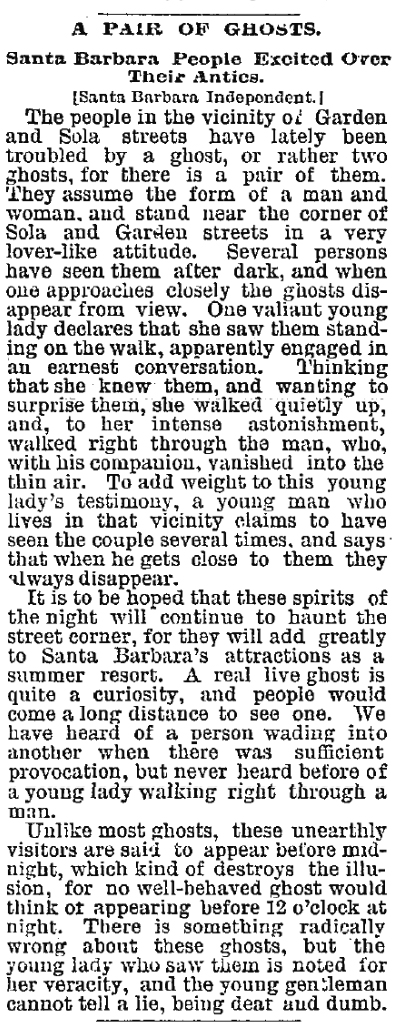
The Ghosts of Garden Street
I could say little to better introduce the following news article other than to note that it is a report that ran in the May 19, 1888, edition of the L.A. Times about repeated ghost sightings fairly close to where I live now. The report was drawn from an incarnation of the Santa Barbara Independent, which happens to be the name of the paper for which I now work.
Not sure what to love more — the concluding sentence, the overall dumbness of the whole article or the fact that in spite of this dumbness the author still pointedly noted that the alleged street corner haunting could be a profitable tourist draw. I feel that if anyone at my paper is ever accused of writing something that does not measure up to the journalistic standards mandated by the Independent’s history, they need only to recall this article.
Ghosts, previously:
Not sure what to love more — the concluding sentence, the overall dumbness of the whole article or the fact that in spite of this dumbness the author still pointedly noted that the alleged street corner haunting could be a profitable tourist draw. I feel that if anyone at my paper is ever accused of writing something that does not measure up to the journalistic standards mandated by the Independent’s history, they need only to recall this article.
Ghosts, previously:
Read more:
ghosts,
journalism,
l.a. times,
santa barbara
Thursday, May 21, 2009
Encyclopedia Drew and the Case of the Haunted Clock
The longer it’s been since I actually lived in Hollister, the rarer the occasion arises that I think to share my favorite story about it. This story is not representative of my hometown in any way. I’ll say that again, since people often tend to think the opposite: This story is not representative of my hometown in any way.
The summer after my freshman year of college, I headed back home, worked at the newspaper, and watched the house while my parents were away on extended vacation. In all, not a bad way to spend three hot months. By virtue of having the place to myself, however, I had to shop for groceries on my own. I’d never felt more grown up. Sure, I had made grocery trips during the previous year, when I lived in the dorms, but shopping for food myself in my hometown at the store my mom shops at made me feel like an adult in ways that little from my first year of college did.
On one trip to the grocery store, I was standing in line and noticed two older women queued up behind me. I glanced back and saw that they were both around my grandmother’s age and could have very well been friends of my grandma’s, given how social circles work in Hollister. The two women were chatting back and forth with the usual call-and-response pairs that people so often exchange when they haven’t caught up in a while.
Then there was a lull.
Then this: “Did you hear about Pearl?”
(An admission: Though this story should be considered non-fiction, I can’t be sure that the woman being discussed was actually named Pearl. She could have just as easily been named Fern or Inez or Dotty or Mabel or Genuflessa or Eunice or anything else from the stable of names that women of this generation were saddled with. For the sake of telling this story, I’ll stick with Pearl.)
“No. What happened to Pearl?” the other one asked.
“She’s in the hospital. She’s been very sick!” the first woman responded.
“That’s awful! I hadn’t heard. What’s wrong?” said the second woman.
“Well, it started out with a clock she had bought at an antique store,” the first women began to explain. “And right after Pearl brought the clock into the house, she started getting sick. And they didn’t know what was wrong with her. They did tests and they gave her this and that and she didn’t get better. And so then it turned out that there was a ghost living in the clock that she had bought and the ghost was what was making Pearl sick.”
“You’re kidding!” replied the second woman, her voice indicating genuine astonishment — not at the fact that a ghost played a role in the story but that the root of the illness turned out to be a ghost. “So what did they do?”
The answer: “Oh, well, they got rid of the clock.”
I delight in the story for several reasons.
As far as I could tell at the time, no one else heard the story. I looked around to see if anyone’s face might contort in a way that indicated they too were trying to follow the story’s crazy logic, but I saw no such reactions.
I don’t know what kills me more: The first woman’s belief that (a) ghosts can make you sick at all, much less to the point that you would require hospitalization; (b) that ghosts haunt clocks; (c) that this whole mess could be solved by something as simple as throwing away the apparently cursed clock. And that’s to say nothing of the fact that the second woman didn’t seem to question one bit of that logic and instead received the haunted clock story much as she would have a story about Pearl falling and breaking her hip.
It didn’t help at all that I’d just previously profiled this women as people who could potentially be my grandmother’s friends. I actually thought about bringing the matter up with my grandmother — “Grandma, do you by any chance have a friend named Pearl who recently spent time in the hospital?” — but I never did, mostly out of fear that investigation would only reveal that I was the only person in town who didn’t think that ghosts made you sick.
Finally, there’s the matter of who the story’s “they” was and how this distinguished group determined that the source of the disease was the clock. It could be that I’ve abridged this part in my mind or it could have been that the woman telling the story never mentioned it. It seems important enough to the chain of events, however, that either I should have remembered it or she should have spelled it out. I really hope the “they” she spoke of actually referred to two groups: the medically professionals at the hospital and some separate group of crazy people who think ghosts live in clocks.
Previous Encyclopedia Drew mysteries:
The summer after my freshman year of college, I headed back home, worked at the newspaper, and watched the house while my parents were away on extended vacation. In all, not a bad way to spend three hot months. By virtue of having the place to myself, however, I had to shop for groceries on my own. I’d never felt more grown up. Sure, I had made grocery trips during the previous year, when I lived in the dorms, but shopping for food myself in my hometown at the store my mom shops at made me feel like an adult in ways that little from my first year of college did.
On one trip to the grocery store, I was standing in line and noticed two older women queued up behind me. I glanced back and saw that they were both around my grandmother’s age and could have very well been friends of my grandma’s, given how social circles work in Hollister. The two women were chatting back and forth with the usual call-and-response pairs that people so often exchange when they haven’t caught up in a while.
Then there was a lull.
Then this: “Did you hear about Pearl?”
(An admission: Though this story should be considered non-fiction, I can’t be sure that the woman being discussed was actually named Pearl. She could have just as easily been named Fern or Inez or Dotty or Mabel or Genuflessa or Eunice or anything else from the stable of names that women of this generation were saddled with. For the sake of telling this story, I’ll stick with Pearl.)
“No. What happened to Pearl?” the other one asked.
“She’s in the hospital. She’s been very sick!” the first woman responded.
“That’s awful! I hadn’t heard. What’s wrong?” said the second woman.
“Well, it started out with a clock she had bought at an antique store,” the first women began to explain. “And right after Pearl brought the clock into the house, she started getting sick. And they didn’t know what was wrong with her. They did tests and they gave her this and that and she didn’t get better. And so then it turned out that there was a ghost living in the clock that she had bought and the ghost was what was making Pearl sick.”
“You’re kidding!” replied the second woman, her voice indicating genuine astonishment — not at the fact that a ghost played a role in the story but that the root of the illness turned out to be a ghost. “So what did they do?”
The answer: “Oh, well, they got rid of the clock.”
I delight in the story for several reasons.
As far as I could tell at the time, no one else heard the story. I looked around to see if anyone’s face might contort in a way that indicated they too were trying to follow the story’s crazy logic, but I saw no such reactions.
I don’t know what kills me more: The first woman’s belief that (a) ghosts can make you sick at all, much less to the point that you would require hospitalization; (b) that ghosts haunt clocks; (c) that this whole mess could be solved by something as simple as throwing away the apparently cursed clock. And that’s to say nothing of the fact that the second woman didn’t seem to question one bit of that logic and instead received the haunted clock story much as she would have a story about Pearl falling and breaking her hip.
It didn’t help at all that I’d just previously profiled this women as people who could potentially be my grandmother’s friends. I actually thought about bringing the matter up with my grandmother — “Grandma, do you by any chance have a friend named Pearl who recently spent time in the hospital?” — but I never did, mostly out of fear that investigation would only reveal that I was the only person in town who didn’t think that ghosts made you sick.
Finally, there’s the matter of who the story’s “they” was and how this distinguished group determined that the source of the disease was the clock. It could be that I’ve abridged this part in my mind or it could have been that the woman telling the story never mentioned it. It seems important enough to the chain of events, however, that either I should have remembered it or she should have spelled it out. I really hope the “they” she spoke of actually referred to two groups: the medically professionals at the hospital and some separate group of crazy people who think ghosts live in clocks.
Previous Encyclopedia Drew mysteries:
Read more:
a funny story,
ghosts,
hollister,
mysteries,
the encyclopedia drew mysteries
Tuesday, March 10, 2009
Doom Bus
Don’t be like Spencer. If you’re waiting at the stop and an empty bus arrives, its destination advertised only as “out of order / fuera de servicio,” don’t get on, even if the driver tells you he’ll take you where you need to go. Though you may well end up in the desired place, alive and unharmed, there’s also a significant chance that the place “you need to go” will turn out to be somewhere you’d only want to be in some larger sense that you didn’t anticipate — the afterlife, for example, or perhaps some freaky opposite land where “no” means “yes” and melting Dali clocks stalk the streets. In short, beyond the sunlit world one believes to be reality.
One small upside, even if this mysterious bus ends up being some sinister psychopomp: You get an opportunity to take photos like this one:
Is that the crisp light or morning you see through the windows? Or something more sinister? And what if this bus was full just moments before you boarded?
I feel like this scenario must rip off the plot of a Twilight Zone or Outer Limits, or, failing those, at least a Tales From the Darkside.
One small upside, even if this mysterious bus ends up being some sinister psychopomp: You get an opportunity to take photos like this one:
Is that the crisp light or morning you see through the windows? Or something more sinister? And what if this bus was full just moments before you boarded?
I feel like this scenario must rip off the plot of a Twilight Zone or Outer Limits, or, failing those, at least a Tales From the Darkside.
Subscribe to:
Posts (Atom)