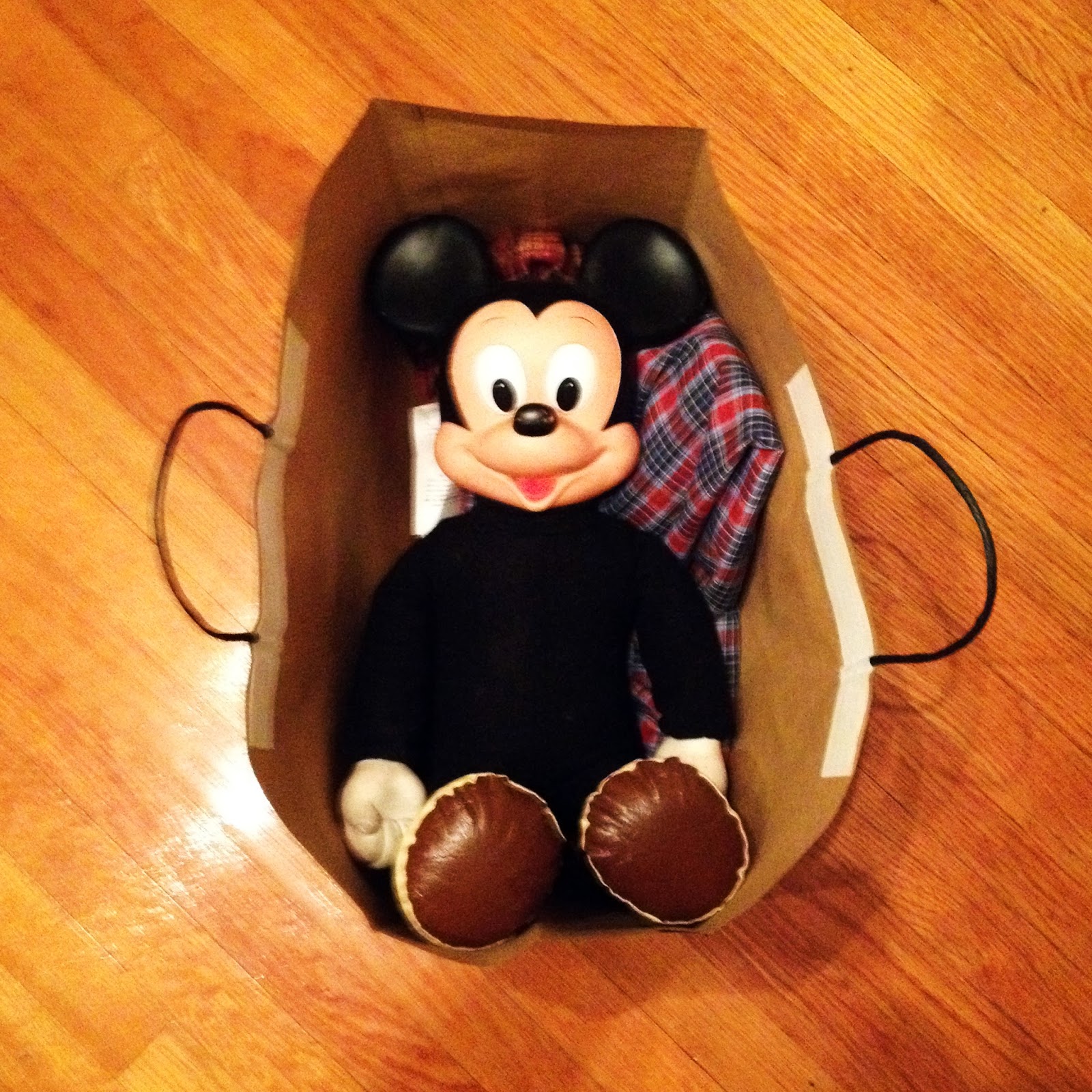
In line at the liquor store, I noticed the girl next to me looking down into my shopping bag. I looked too. This is what we both saw:
I looked up. So did she. Our eyes met. I said to her, as flatly as possible, “It is a Christmas present for Mother.” I didn’t break eye contact. She did.
And that, young lady, is why we shouldn’t be nosy.
Showing posts with label mickey mouse. Show all posts
Thursday, December 5, 2013
Wednesday, November 11, 2009
Oswald the Vengeful Rabbit
So since the game actually made it onto Gawker — and not just the Gawker family’s game blog, Kotaku — I suppose I should write something about Epic Mickey, a slightly twisted Disney video game that has me more excited about the round-eared one than I’ve been since I was a kid.
Disney has a long history with video games, going back to a 1981 Game & Watch title, Mickey Mouse. My earliest Disney game memory — and likely that of many people who will read this blog — is 1987 NES title, Mickey Mouscapade, which had Mickey and his ladyfriend hopping Mario-style through various levels, shooting stars (for some reason), fighting villains like the evil queen from Snow White (for some reason) and finally rescuing Alice from Alice in Wonderland (for some reason).

Mickey Mouscapade was great fun at the time, but, in retrospect, the game kind of sucked, even for a first-generation NES title. Easily the worst part was the play control; Minnie follows Mickey around, jumping slightly after he jumps and landing slightly behind where he lands. This resulted in Mickey successfully leaping over those bottomless pits that so often dot the landscape of platformer-style video games but Minnie falling in and plummeting to her death, causing Mickey as well to die (again, for some reason.) Regardless, Mickey definitely has a place in my fond memories of playing video games.
Epic Mickey looks different. Rather than stick Mickey and his Disney cohorts in a bright, shining universe with smiles on every rock, tree and cloud — you know, like where Mario has been living for the last twenty years — the game’s designers have tried to grow Mickey up a bit. Mickey’s new world is a little dark, a little steampunky. Take, for instance, this nightmarish half-robot version of Donald Duck.

Not exactly the same waterfowl that hugs the kiddies at Disneyland, is it? Gaze also at this trippy concept art.

If the in-game graphics of Epic Mickey come close to matching what’s above, then we’ll be in for a treat.
What has me most excited about this game, however, is the news that its big bad will be Oswald the Lucky Rabbit, a character Walt Disney and Ub Iwerks debuted in 1927, a year before the suspiciously similar-looking Mickey Mouse stole the spotlight.

Money disputes prompted Disney and Iwerks to eventually leave Universal Studios, which maintained ownership of Oswald until 2006. Wikipedia explains that as part of a deal between Disney and NBC Universal, the former traded the latter sportscaster Al Michaels for Oswald. Michaels now workings alongside John Madden at NBC, and Disney finally got the rights to a bunch of old Oswald the Lucky Rabbit cartoon shorts. (I have to wonder how Michaels must feel about this trade. “You, sir, are basically worth the same as an obscure cartoon character that few remember and who looks basically like our current mascot.” Wikipedia notes that Michaels at least publicly had the sense to make a joke about the trade: “Oswald is definitely worth more than a fourth-round draft choice. I’m going to be a trivia answer someday.”) In any case, Oswald is back — and presumably pissed for having been shoved aside for some many years while Mickey lived the good life, being all recognizable even to people who don’t own TVs or have access to movie theaters.
This sort of thing thrills me: a fictional universe with a long history pulling an obscure also-ran from its archives and giving him or her a chance to shine once again. It doesn’t happen often enough, though I suppose superhero comics do it pretty well. Who would have expected Batman’s Jason “Robin No. Two” Todd to be resurrected from the dead? To draw an example from a different form of pop culture, the new Melrose Place wins points for me — even though I haven’t watched it — for bringing back Laura Leighton’s character from the original series, Sydney Andrews, even though she too was once dead as a doornail. It’s fan service, I guess, but it’s something that really clicks with the geeks who know a given universe inside and out. (“They thought of that! That’s what I think of! I feel validated!”) It’s good to know that the people in charge of a given franchise know at least enough about it to appease the experts.
I don’t know how well the game Epic Mickey will be received, but it gets points from me for rescuing Oswald the Lucky Rabbit from obscurity. And I look forward to beating the crap out of him at the end of the game.
A closing thought: Mickey Mousecapade’s control issues notwithstanding, I do think that the -capade suffix needs to be used more often.
Game geek? Subscribe to the video games-only feed for Back of the Cereal Box.
Disney has a long history with video games, going back to a 1981 Game & Watch title, Mickey Mouse. My earliest Disney game memory — and likely that of many people who will read this blog — is 1987 NES title, Mickey Mouscapade, which had Mickey and his ladyfriend hopping Mario-style through various levels, shooting stars (for some reason), fighting villains like the evil queen from Snow White (for some reason) and finally rescuing Alice from Alice in Wonderland (for some reason).

Mickey Mouscapade was great fun at the time, but, in retrospect, the game kind of sucked, even for a first-generation NES title. Easily the worst part was the play control; Minnie follows Mickey around, jumping slightly after he jumps and landing slightly behind where he lands. This resulted in Mickey successfully leaping over those bottomless pits that so often dot the landscape of platformer-style video games but Minnie falling in and plummeting to her death, causing Mickey as well to die (again, for some reason.) Regardless, Mickey definitely has a place in my fond memories of playing video games.
Epic Mickey looks different. Rather than stick Mickey and his Disney cohorts in a bright, shining universe with smiles on every rock, tree and cloud — you know, like where Mario has been living for the last twenty years — the game’s designers have tried to grow Mickey up a bit. Mickey’s new world is a little dark, a little steampunky. Take, for instance, this nightmarish half-robot version of Donald Duck.

Not exactly the same waterfowl that hugs the kiddies at Disneyland, is it? Gaze also at this trippy concept art.

If the in-game graphics of Epic Mickey come close to matching what’s above, then we’ll be in for a treat.
What has me most excited about this game, however, is the news that its big bad will be Oswald the Lucky Rabbit, a character Walt Disney and Ub Iwerks debuted in 1927, a year before the suspiciously similar-looking Mickey Mouse stole the spotlight.

Money disputes prompted Disney and Iwerks to eventually leave Universal Studios, which maintained ownership of Oswald until 2006. Wikipedia explains that as part of a deal between Disney and NBC Universal, the former traded the latter sportscaster Al Michaels for Oswald. Michaels now workings alongside John Madden at NBC, and Disney finally got the rights to a bunch of old Oswald the Lucky Rabbit cartoon shorts. (I have to wonder how Michaels must feel about this trade. “You, sir, are basically worth the same as an obscure cartoon character that few remember and who looks basically like our current mascot.” Wikipedia notes that Michaels at least publicly had the sense to make a joke about the trade: “Oswald is definitely worth more than a fourth-round draft choice. I’m going to be a trivia answer someday.”) In any case, Oswald is back — and presumably pissed for having been shoved aside for some many years while Mickey lived the good life, being all recognizable even to people who don’t own TVs or have access to movie theaters.
This sort of thing thrills me: a fictional universe with a long history pulling an obscure also-ran from its archives and giving him or her a chance to shine once again. It doesn’t happen often enough, though I suppose superhero comics do it pretty well. Who would have expected Batman’s Jason “Robin No. Two” Todd to be resurrected from the dead? To draw an example from a different form of pop culture, the new Melrose Place wins points for me — even though I haven’t watched it — for bringing back Laura Leighton’s character from the original series, Sydney Andrews, even though she too was once dead as a doornail. It’s fan service, I guess, but it’s something that really clicks with the geeks who know a given universe inside and out. (“They thought of that! That’s what I think of! I feel validated!”) It’s good to know that the people in charge of a given franchise know at least enough about it to appease the experts.
I don’t know how well the game Epic Mickey will be received, but it gets points from me for rescuing Oswald the Lucky Rabbit from obscurity. And I look forward to beating the crap out of him at the end of the game.
A closing thought: Mickey Mousecapade’s control issues notwithstanding, I do think that the -capade suffix needs to be used more often.
Game geek? Subscribe to the video games-only feed for Back of the Cereal Box.
Read more:
disney,
epic mickey,
mickey mouse,
pop culture minutiae,
video games
Saturday, April 14, 2007
Penguin Kun Wars
Along with every other retrogaming geek who follows blogs on the subject, I found out this week about Nintendo8.com, a site that bypasses the clumsiness of vintage console emulation and instead allows you to play old Nintendo Entertainment System ROMs in a Java application that opens up right in your browser window.
In short, I can play the beloved Nintendo games from my childhood anywhere that I have speedy internet access. And not just the big titles, but obscure, old stuff like Mickey Mousecapade or Little Nemo: The Dream Master, neither of which the majority of people reading this now will probably recognize but which, time provided, they might enjoy. What’s additionally great is that Nintendo8.com allows me access to a whole library of old Nintendo titles that I even my better-allowanced couldn’t. Two words: “Japanese games.”
I’ve had vague awareness of old games that for whatever reason — goofiness, large amounts of text needing to be translated, inappropriate content of a sexual nature, the presence of heathen religious icons, or just astounding shittiness — never crossed to American shores. That has all changes. As such, I will be profiling some of the more entertaining Japanese-only games here for as long as it takes for Nintendo to shut this website down
Today: Penguin Kun Wars, which makes about as much sense as the title would imply. In a nutshell:
The title screen. Me: "Sure, I'll play this." I was three years old. Also, that's ASCII the video game company, with no formal relation to the character set.

What you, the apparent penguin, are up against: quite a few yellow bear- or mouse-looking creatures, about as many pandas, exactly three koalas and two of what I think might be a Japanese programmer's notion of what a beaver looks like.

Of course, within moments of the match beginning, the penguin is beaned by a ball and knocked unconcious. He screams in agony. The yellow bear-mouse is merciless.

No matter. This penguin can muster the strength to overcome the schemes of what is the game's easiest enemy.

And then, for no apparent reason, the bear-mouse follows the penguin for a bonus round. In space. Floating UFOs track the characters' movements, thus preventing both penguin and bear-mouse from catching or throwing balls.
No points were awarded in the bonus round.

And then Mr. Penguin moves up in the world. Curiously, each of the bear-mice seem to have lost in the first round, I'm guessing as a result of their having wasted energy pondering why and what they are.

Short but sweet. The match nature never intended — penguin vs. panda — ends in humilation for the former. And in front of such beautiful, symmetrical snowcapped mountains, too.

Not wanting to watch my penguin be reduced to tears again, the window is closed. Penguin Kun Wars will not be played again.
In short, I can play the beloved Nintendo games from my childhood anywhere that I have speedy internet access. And not just the big titles, but obscure, old stuff like Mickey Mousecapade or Little Nemo: The Dream Master, neither of which the majority of people reading this now will probably recognize but which, time provided, they might enjoy. What’s additionally great is that Nintendo8.com allows me access to a whole library of old Nintendo titles that I even my better-allowanced couldn’t. Two words: “Japanese games.”
I’ve had vague awareness of old games that for whatever reason — goofiness, large amounts of text needing to be translated, inappropriate content of a sexual nature, the presence of heathen religious icons, or just astounding shittiness — never crossed to American shores. That has all changes. As such, I will be profiling some of the more entertaining Japanese-only games here for as long as it takes for Nintendo to shut this website down
Today: Penguin Kun Wars, which makes about as much sense as the title would imply. In a nutshell:
- You are a penguin.
- You throw purple balls across a table at another woodland creature, the object of which being to get all the balls off your side of the table.
- At the match’s midway point, a glowing boomerang will begin spin across the table for no apparent reason.
The title screen. Me: "Sure, I'll play this." I was three years old. Also, that's ASCII the video game company, with no formal relation to the character set.

What you, the apparent penguin, are up against: quite a few yellow bear- or mouse-looking creatures, about as many pandas, exactly three koalas and two of what I think might be a Japanese programmer's notion of what a beaver looks like.

Of course, within moments of the match beginning, the penguin is beaned by a ball and knocked unconcious. He screams in agony. The yellow bear-mouse is merciless.

No matter. This penguin can muster the strength to overcome the schemes of what is the game's easiest enemy.

And then, for no apparent reason, the bear-mouse follows the penguin for a bonus round. In space. Floating UFOs track the characters' movements, thus preventing both penguin and bear-mouse from catching or throwing balls.
No points were awarded in the bonus round.

And then Mr. Penguin moves up in the world. Curiously, each of the bear-mice seem to have lost in the first round, I'm guessing as a result of their having wasted energy pondering why and what they are.

Short but sweet. The match nature never intended — penguin vs. panda — ends in humilation for the former. And in front of such beautiful, symmetrical snowcapped mountains, too.

Not wanting to watch my penguin be reduced to tears again, the window is closed. Penguin Kun Wars will not be played again.
Subscribe to:
Posts (Atom)

