Pages

Showing posts with label james bond. Show all posts

Friday, November 6, 2015

All About Octopussy

Yes, this is another post about Bond girls. I had to write about them for work, and the research yielded a few surprises, and the best of these by far is an explanation for why the hell anyone ever thought “Octopussy” would be an appropriate name for any human character, to say nothing of Bond’s love interest.


In Octopussy, Maud Adams plays the character whose nickname is “Octopussy,” thereby making this one film the only in the entire series to be named for female lead. Even separate from that name, she’s a standout character: She’s a moderately villainous businesswoman and jewel-smuggler who also happens to own a circus and live on a floating palace in India. Hey, get stuck with a name like “Octopussy” and you have to compensate somehow.


The film is loosely inspired by an Ian Fleming short story titled “Octopussy,” in which the name refers not to a human character but to someone’s pet octopus. And doesn’t the name make a lot more sense in that context? The story actually begins with its antagonist addressing the octopus directly: “‘You know what?’ said Major Dexter Smythe to the octopus. ‘You’re going to have a real treat today if I can manage it.’” Smythe later goes on to call the octopus both “Pussy” and “Octopussy.”

However, in reworking the story for the thirteenth James Bond film, the writers apparently thought, “No, this is a name that a human female should have. I see nothing wrong with that.” Dexter Smythe is already deceased at the outset of the film and seen only in photograph form. He’s mentioned as having been an octopus aficionado. Octopussy explains her name, kinda-sorta, with a single line that ties the film back to its source material: “My father became a leading authority on octopi. He loved them. His pet name for me was ‘Octopussy.’” Her actual name is never actually spoken within the film. (This Bond wiki page alleges that it’s Octavia Charlotte Smythe, but it’s apparently not her official real name.)

Awkward though it might be, that’s how Maud Adams ended up playing a character named “Octopussy.” The fact that she owns a circus might also be notable just in that the other Bond girl to have the word “pussy” in her name — Pussy Galore in Goldfinger — also leads a circus of sorts: Pussy Galore’s Flying Circus, a group of female aviators who may or may not all be lesbians.

Adams had already appeared as a secondary Bond girl in The Man With The Golden Gun: Andrea Anders, a character with a name so non-ridiculous that it’s shared by a sitcom actress. (She’s half of the trashy neighbor couple living next to Phil and Claire on Modern Family.) Adams also makes an uncredited appearance in A View to a Kill, which probably set s a record for any non-Moneypenny, non-Judi Dench Bond actress.

And that end note as as good as any to point out that Duran Duran’s theme song for A View to a Kill might just be the best Bond theme song of all — yes, even better than Shirley Bassey’s “Goldfinger”.


Monday, November 2, 2015

Lesser Bond Girls

No one can hold a candle to Pussy Galore, of course. That seems dangerous, first of all, but in the history of James Bond women, no one has a name that is quite so on-the-nose perfect-awful.


However, I have learned that there exists a whole harem of Bond girls who only appear in the books written after the Ian Fleming era and who have ridiculous-amazing-exceedingly awkward that the world needs to know about.

Here is a list of them. No elaboration is needed, I feel, just the news that these characters exist.

Lavender Peacock

Persephone “Percy” Proud

Sukie Tempesta

Ebbie Heritage

Clover Pennington

Elizabeth “Easy” St. John

Hera Volopoulos

Heidi Taunt and her sister, Hedi Taunt

Felicity Willing

Ophelia “Philly” Maidenstone

Edua Blessing Ogilvy-Grant

Jeopardy Lane

Rosebud Spreadeagle

Okay, one of those I made up. But is it really that implausible? All these seem on par with the sex pun-laden Bond girl names from the actual movies. Also, once tried to Weird Al all the James Bond movie titles with limited success. I have no idea what work I was avoiding in doing this, but it must have been really heinous. I cannot think of a way to make a food pun for Spectre and feel like a failure.

Sunday, May 22, 2011

Sexpun TK

Because Netflix’s streamable James Bond movies have been my world this week, I am presenting a list of Bond girls whose names serve as a pun, a sexual reference or something else with meaning beyond what a “straight” character name does. Here are the ones I could decipher or read something into:
  • Honey Rider in Dr. No: Kind of gets there in terms of suggesting that she’s sweet but also up for a roll in the hay.
  • Sylvia Trench in From Russia With Love: Not a pun, especially, but the sexual implications of the word trench are debatable.
  • Pussy Galore in Goldfinger: Well, doy. And double for appearing in a movie titled Goldfinger. Triple for the fact that in the book version, she is a lesbian until Bond “turns” her.
  • Fiona Volpe in Thunderball: Volpe is Italian for “fox,” which could be used to describe just about every woman to ever cross paths with James Bond.
  • Patricia Fearing in Never Say Never Again: She goes by Pat, and that combined with her last name indicates a character who is less than welcoming towards Bond’s physical advances. The fact that Fearing receives a massage from Bond makes me think her name is not coincidental.
  • Kissy Suzuki in You Only Live Twice: A fairly unsubtle reference that must have confused thoughtful English-speaking viewers as much as it did Japanese people who had never comes across a Japanese woman named Kissy.
  • Tiffany Case in Diamonds Are Forever: I think she’s the first Bond girl to have an awareness that her name means something. She earned it as a result of being born in a Tiffany & Co. store.
  • Plenty O’Toole in Diamonds Are Forever: And she totally is. It has nothing to do with her name, but can I just mentioned that this otherwise amusing Bond bit player has been completely ruined for me since I found out that she’s played by Lana Wood, Natalie Wood’s sister? This fact makes Plenty’s drowning death especially awkward.
  • Bambi and Thumper in Diamonds Are Forever: Because obviously if you acquire henchwomen who happen to be named after characters from a Disney movie, you’d have them work as a team.
  • Holly Goodhead in Moonraker: Yep.
  • Bibi Dahl in For Your Eyes Only: A name made all the more awkward by the fact that it’s associated with a hypersexual 15-year-old who tries her damnedest to get Bond to take her virginity.
  • Octopussy in Octopussy: The thing people may forget about this character is that she has a full, normal name, Octavia Charlotte Smythe, but she goes by Octopussy because her father was a scientist known for studying octopuses. I believe this is called “owning it.” But seriously, does it seem weird to anybody else that there was a movie called Octopussy?
  • Penelope Smallbone in Octopussy: She’s the mini-Moneypenny. Her first name reflects her connection to Moneypenny, and her last name enforces her inferior status while also hinting that she might have a teeny peen.
  • Fatima Blush in Never Say Never Again: Knowing the Bond series, I’d guess that that last name Blush — which is strange, seeing as how it’s connected to a non-Anglo-seeming character — is a reference to sex blush, though the fact that the character hates men might provide evidence that this isn’t the case.
  • May Day in A View to Kill: Just by her name, you can tell that she’s bad news. Alternately, you could interpret her name as a sign that she supports workers’ rights, but that would be stupid.
  • Jenny Flex in A View to Kill: As I noted in a previous post, it’s a pun on genuflect, “to bend the knee,” which is arguably sexual in that a woman might bend her knees to engage in various sexual positions.
  • Pan Ho in A View to Kill: As commenter Sam points out, you could interpret her name as meaning something like “all ho,” but that interpretation would be stretching plausibility… though not all that much more than names in other Bond films.
  • Xenia Onatopp in Goldeneye: Given the connotations of xenia and hospitality, it’s decidedly sexual.
  • Wai Lin in Tomorrow Never Dies: Would I put it past the Bond movie writers to create a character whose name reads like wailing? No.
  • Elektra King in The World Is Not Enough: Considering her major daddy issues and the fact that she’s the heiress to her father’s oil fortune, her name is anything but random.
  • Christmas Jones in The World Is Not Enough: A character seemingly named solely to set up the classic Bond quip, “I thought Christmas only comes once a year.”
  • Molly Warmflash in The World Is Not Enough: Maybe one of the Bond names that drags the series into self-parody. Unless that name is supposed to be a menopause reference, I guess.
  • Vesper Lynd in Casino Royale: It’s not sexual at all, but the name apparently has been interpreted by some as a pun on “West Berlin” as a reference to the fact that she’s a double agent loyal to two different powers.
  • Strawberry Fields in Quantum of Solace: As I noted in a previous post, In accordance with the Daniel Craig-era bond films skewing grittier and less campy, a classic Bond pun name wouldn’t work. That’s why this character — whose name references a Beatles song — refuses to tell Bond her first name. Only the credits reveal it to be Strawberry. Alas, she dies, and Strawberry Fields proves to not be, in fact, forever.
Did I miss anyone?

Tuesday, May 17, 2011

Me Love You Long Time… Mr. Bond

The gist: Pan Ho got screwed, but that doesn’t mean that she didn’t leave her mark on pop culture. In fact, you know of the actress who played her, in a sense, even if you have never seen a James Bond movie.

When a cache of Bond movies suddenly appeared on my Netflix instant queue, I said goodbye to mostly everything else and hello to a world intrigue, firearms, sex puns and frequently contrived drama. The Bond franchise generally gets a pass in my book. Even when these movies suck, and they occasionally do, I still generally say that watching a James Bond movie is better than not watching one. I’m a sucker that way.

First on the list was A View to Kill, the only James Bond movie that I’d never actually seen before. Reading the cast list results in one of those “Gosh, the 80s truly were a different time” moments, with Christopher Walken playing the big bad with just a glimmer of the glee he’d bring to roles later in his career. And the main Bond girl is an heiress-turned-geologist played by Tanya Roberts, the raspy-voiced beauty who today is primarily remembered as either the lead in Sheena, Queen of the Jungle (depending on how much AMC you watch) or Donna Pinciotti’s mom on That 70s Show (depending on you neglect to change the channel after the occasional weekday Simpsons rerun.) Roberts was also a member of Charlie’s Angels late in the original series’s run. I wonder: Can anyone else boast about being both a Bond girl and an Angel?

Had I known that A View to Kill features one of the better teams of henchwomen in the entire franchise, I probably would have sought it out over some of the more peen-dominated films. Please meet the all-female team of bodyguards that evert megalomaniac needs patrolling his estate: May Day, Jenny Flex and Pan Ho.


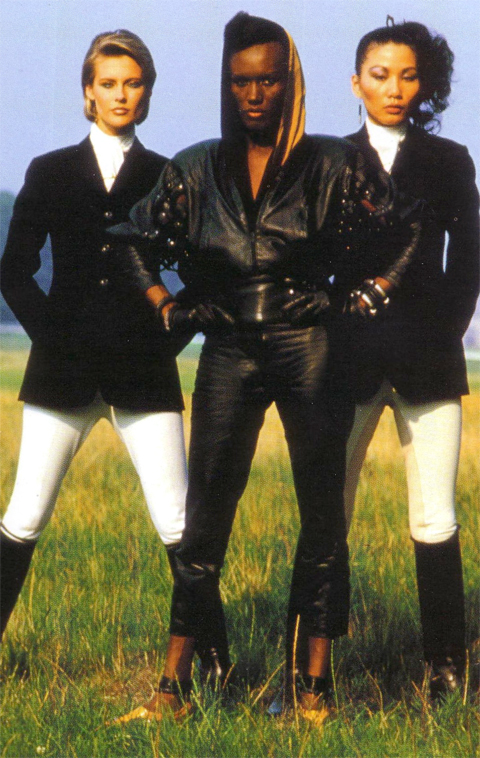
Grace Jones’s May Day steals the show, and rightly so, since she’s GRACE FUCKING JONES, strutting around like some sort of beautiful, evil praying mantis alien. Additionally, May Day has one of those last-minute changes of heart that prompts her to side with Bond and die an honorable death. Jenny Flex and Pan Ho, however, eat it before they can decide that the chance at a romp with Bond is more attractive that a life of servitude under a cruel, blond Christopher Walken. And at that, the viewer only Flex’s dead body floating in flooded chamber of… the San Andreas Fault? Is that where the big fight plays out? Alison Doody, the actress who played Flex, got more screen time as a shortsightedly ambitious villainess in Indiana Jones and the Last Crusade, but at least she joins the ranks of those lucky Bond girls whose names serve as puns. The term her name hints at — genuflect, literally “to bend the knee” — doesn’t flood the mind with sexual imagery the way that, say, Pussy Galore or Honey Rider do, but a pun is a pun. Why do you want to take more away from this woman?

Lastly, there’s Pan Ho, who gets a single line before dying. Worse, she never gets the honor of being a corpse bobbing about on screen. And the greatest insult of all: Her name isn’t even a sex pun, despite the presence of the word ho right at the end there, begging for an easy joke. I wonder if her minimal presence in the final cut of A View to Kill resulted from difficulties with the actress playing her, Papillon Soo Soo. (And yes, that’s her real name and yes, the real-life actress sounds more like a Bond girl than her character.)

But Soo Soo made a contribution to society anyway — one greater than perhaps A View to Kill itself. One of Soo Soo’s two other roles is in Full Metal Jacket, in which she delivers a line that was burned into the brain of anyone who existed around radios in early 90s: “Me so horny. Me love you long time.”


I think there’s bragging rights in this, something along the lines of “Yeah, I was in this James Bond movie, and it was cool, but then I played Nameless Da Nang Hooker in this other movie and they sampled me int this rap song that was, like, monumentally successful — certainly bigger than any of the songs that Grace Jones went on to record…. No, by the way, I’ve never watched That 70s Show.”

And that, in my book, is how Pan Ho, the little henchwoman who could, overcame the obscurity of her role in A View to Kill.

Tuesday, March 1, 2011

The Glittering Futuristic Landscape of 1999

Do you understand the joy of discovering that a term exists to describe an concept of which you were vaguely aware? For me, the reaction sounds something like this: “Oh my god that thing! It’s like what was in my head but it’s better and its words make whole sentences. Look at it! Look at thing, you!”

It had occurred to me before that The Simpsons and the James Bond universes have something in common that most other longstanding fictional universes don’t. Both have continuity, to an extent — Simpsons more so, Bond less so, some plot points get discarded along the way, but there’s a general sense of accumulation from one installment to the next. However, the featured characters’ sense of the past changes depending on what installment you’re watching. What I mean is this: James Bond doesn’t get old, but at least until the reboot of Casino Royale the movies could be viewed as consecutive episodes in a single character’s life, and some of the movies even explicitly referenced events from earlier ones. The Simpsons will sometimes “forget” about certain developments — not that it matters, but at this point, I’m not sure whether Principal Skinner is supposed to be his mom’s biological son or the imposter Armin Tamzarian — but there’s generally a tendency to impose permanent changes on characters, like Ned Flanders being a widower, Patty being a lesbian, Apu marrying Manjula and having octuplets.

But in ether case, even when continuity holds up, the starting point has to move forward because the characters don’t age. Thus, the pre-Daniel Craig James Bone timeline went from the Cold War being the present to the past, and the concept of “futuristic” technology changes radically depending on whether you’re watching a Sean Connery film or a Pierce Brosnan one. And with The Simpsons, the family’s static ages meant that flashbacks to Homer and Marge’s days before Bart was born had to shift from the late 70s and early 80s to the mid-90s. (And, awkwardly, wonderfully, that the vision of the future in the 1995 episode “Lisa’s Wedding” came and went in real life on August 1, 2010. Lisa didn’t get married, and though I was twelve at the time the episode aired and twenty-eight on the wedding date, Lisa herself is still eight and unmarried.)


Yet everything that happened in the past still happened, even if it wouldn’t make sense time-wise. Get it?

Well, this is a thing. It’s called a floating timeline. And it’s a weird line-up of pop cultural works that employ this device. Tintin? Archie comics? Doctor Who? South Park? Edgar Rice Burroughs’s Tarzan novels? The Nero Wolfe mysteries? The Babysitters Club? Nancy Drew? I mean, these have little else in common, aside from being long-running, though I suppose many are produced specifically for children and therefore can’t let their protagonists grow up and lose their appeal. Technically, Wikipedia lumps superhero comics and syndicated comic strips in this group, but I’m not sure these make for as neat of a fit. Most superhero shorelines are retconned and rebooted to hell — sometimes even using a trans-dimensional apocalypse as a literary device to straighten out the convolutions — to the point that shaving off a few years here and there doesn’t seem that so remarkable. (Fun note: The iconic murder of Bruce Wayne’s parents is so tied to the 30s and 40s style in which it was originally depicted that a 2010 flashback to this event has to note that “retro [was] big this year” in order to make sense of the timeline.) And comic strips create less of a “universe.” Calvin & Hobbes is more timeless than anything, and Garfield doesn’t really date itself, though I’ll say now that that fucking cat should be long dead, if not from old age then by a massive coronary.

Now I’m wondering if anything else has a floating timeline, but I can’t think of a single thing. Could this be it? Could this random-as-all-hell bunch be the only works that gauge time on a sliding scale?

Sunday, January 25, 2009

The Ground Beneath Her Gold, Dead Feet

Everything old is new again, except when those old things are actually based on older things, thus making them somehow even older than they already were.

Context: Watching the weird American version of BBC tonight, I saw the opening half-hour to Goldfinger, which I hadn’t seen since I was a kid. (I was so young, in fact, that I didn’t see any reason why Pussy Galore wasn’t a perfectly fine name for a lady.) During the scene in which James Bond discovers the corpse of Jill Masterson — painted in gold and displayed on Bond’s hotel bed, nude but ever-so-tastefully — the score recalls the opening chords of the famous “Goldfinger” theme, but in a quiet, somber way befitting the scene. This music was sampled throughout the 1996 song “Six Underground,” by Sneaker Pimps — a high school throwback reference if there ever was one. Time was, at the dawn of my freshman year, that you couldn’t listen to alternative rock radio without hearing “Six Underground” once an hour.

Hear it for yourself. First “Six Underground.”


And now the score to the tragic death of Jill Masterson.


It’s also worth noting that the song became especially popular when it was included on the soundtrack to the 1997 Val Kilmer film The Saint, the most recent incarnation of the adventures involving a man named Simon Templar. If you wanted, you could draw some parallels between Templar and Bond. They’re not exactly the same, but both men have more in common with each other than they would with, say, Sarah Plain and Tall or William “The Refrigerator” Perry.

A revised maxim: Everything old often remains old.

Sunday, November 23, 2008

Agent Fields Forever

Easily the highlight of the overall enjoyable but ultimately uneven Quantum of Solace: Agent Fields, the character played by Gemma Arterton. Essentially, she’s Girl No. Two, which is a bad position for a Bond Girl to be in. Sure enough, Agent Fields eventually joins Plenty O’Toole, Jill Masterton, Aki, Fiona Volpe, Andrea Anders, Corinne Dufour, Elektra King, Paris Carver, Xenia Onatopp, Miranda Frost, Solange Dimitrios, and at least a few others on the list of lesser Bond associates who end up dead, whether as a result of them being forces or good or forces evil.


The best part about Agent Fields, however, is that she was written subtly, even if her role in the story as a whole doesn’t hold up well to logic. Throughout the film, she never gives her first name. (Why would MI-6 send some cute, nubile office girl to temp Bond back to London? Shouldn’t M have predicted that Bond would just bang her silly and get her killed? Was there truly no one else that could have been sent? No birthing hipped, lady mustached monster of a woman that Bond wouldn’t dare take a poke at?) The credits, however, list her as “Strawberry Fields,” and that makes her an ideal inhabitant of the new world of James Bond. Though her full name makes her a silly pop culture reference, she seems to know this and has a conscious desire to not be some dumb Bond Girl. It’s almost as if she’s seen the films with Mary Goodnight and Pussy Galore. In a film that was unfortunately lacking in characterization and development, this minor character truly succeeded, at least for me.