Pages

Showing posts with label what do you do with a BA in english?. Show all posts

Saturday, June 27, 2015

The Further Adventures of Homoerotic Anime

Last year, I started posting supercuts of the more conspicuously sexual parts of Saint Seiya, an anime series that started airing in Japan in 1986 and which later surfaced in English-speaking areas as Knights of the Zodiac. It’s pretty classic “dudes in armor” fighting action. It’s also gayer than gay sex. I don’t think it was meant to be so laden with innuendo, but it’s hard to read this series of grunts, glances and one-on-one fight sequences as anything other than thinly veiled dickbutt.

Free time has been harder to come by since the last post, but I’ve still been watching, grabbing spare scenes as I happened across them. Here’s the latest series of head-scratchers.


Some context:

0:01 — Hyoga gets his powers from Cygnus, the constellation shaped like a swan, and therefore must flap around like an elegant bird to create ice magic. Totally hetero, in the way a beautiful male figure skating routine is also totally hetero. His special move is Diamond Dust, which sounds more like a Sailor Moon attack, which should be familiar to those who grew up playing RPGs, and which is an actual meteorological phenomenon.

0:25 — Cygnus clutches his hands into a fist-pumping pose and fires off white energy blasts.

1:10 — Women play an odd role on the show. The female saints must keep their faces covered with a mask at all times, and that makes it all the stranger that Argol wields Medusa’s face as a weapon. There’s a theory that Medusa’s face is a symbol of the vagina dentata. Think about it: it’s a fanged, snarling version of a thing that’s usually not dangerous, and it’s lethal to even behold to say nothing about interacting with it. It’s also surrounded by coiled snakes which, if you’re taking this analogy to its full extent, could be interpreted a similarly dangerous version of pubic hair. Medusa is weaponized female beauty, and the fact that she attacks by making enemies rock hard? The symbolism is almost too much. Death-boners, all around, in the same way that that one Poison Ivy episode of Batman had gave people deadly, permanent wood.

1:18 — Argol has to turn his backside on enemies to unleash his weaponized vagina power. Hmm.

2:00 — Whenever anyone talks about putting anything into something that’s quivering, it’s easy to assume it’s sexual.

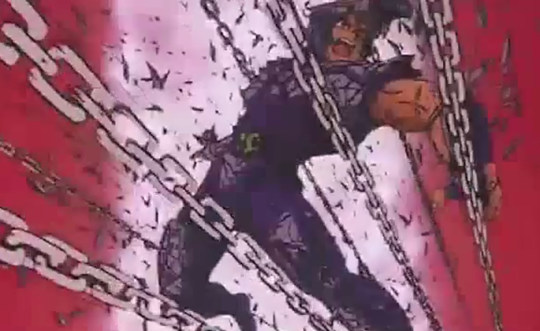
2:13 — I feel like Andromeda reads as a very feminine man. I mean, his name is Andromeda. He’s the only major male character to be named after a mythological character that is expressly female. But that makes it all the more interesting that his weapon is a snaking chain that lends itself to penile comparisons. In this scene, his chain goes limp.

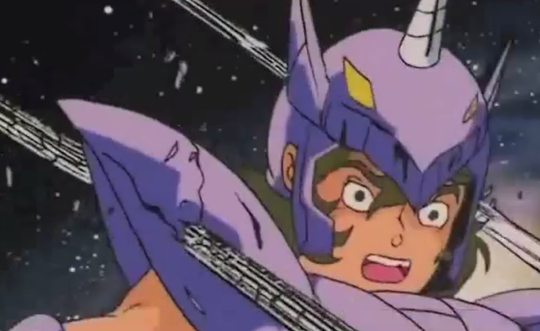
3:27 — Perseus’ outfit. Just saying.

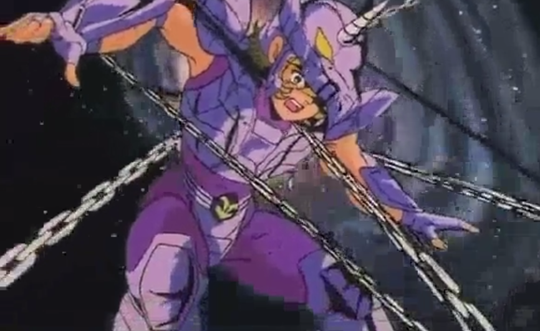
4:12 — Just look at the way Andromeda runs those chains through his hands. He’s like a snake-charmer.


And here are the previous clips.


(And there’s a little more on this particular weirdness here.)


Sunday, March 30, 2014

Battle of the Ambiguously Sexual Signifiers, Anime-Style

Honestly, I don’t know enough about anime to proclaim any given scene the most homoerotic-ever.  However, I know an opportunity for over-reading when I see one, and the 80s action series Saint Seiya is fruitful, so to speak.


In the universe of Saint Seiya (or Knights of the Zodiac, depending on what translation you’re watching), saints are armor-clad superheroes who derive their powers from constellations, because no one on the Japanese side of this project knew a Catholic person.

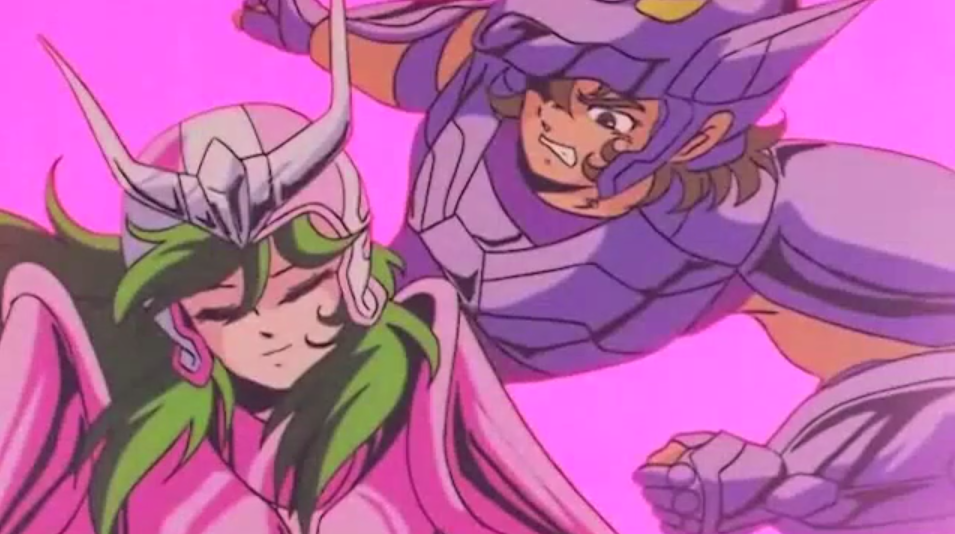
This scene, which comes from the series’ sixth episode, the pits the Andromeda saint — pink armor with an especially busomy-looking breastplate, and don’t forget that the constellation is named for Greek mythology’s No. 1 damsel in distress — against the purple-clad Unicorn saint. The more passive of the two, Andromeda resists fighting, but he’s goaded by Unicorn, whose most outstanding wardrobe feature, it should be noted, is a single protruding horn. “It sounds like the ladies really love you, don’t they, pretty boy?” Unicorn taunts. Andromeda is unflustered. “I’m sad, and filled with emptiness,” he says, which is clunky entendre but which still gets the point across. The two engage. We get a pink-hued freeze frame of the two intertwined — Unicorn looking focused and aggressive, Andromeda looking serene, even pleased.


Andromeda, however, flips the script when he proves more powerful by virtue of his telekinetic control of a chain — a long, snaking instrument that acts like an extension of his body and which has a pointed tip at the end. (“That chain! It’s like a living thing!”) The scene inexplicably shifts to a celestial backdrop, where he’s superimposed on an image of the Andromeda constellation. It’s a mix of signifiers — phallic weapon combined with maiden imagery. Time literally stands still. Unicorn persists in attacking, and Andromeda calmly sends the chains after him, penetrating him repeatedly. (“Of all the parts of the Nebula Chain, the top is the strongest!” Really.) Based on the noises you hear from the crowd (and the reaction shot you see of the Lady Purple Hair), it’s all being done for the delight of female spectators. You don’t hear a single male voice cheering.


The lesson? Appearances are deceiving, and the dude with flowing ladyhair may be the strongest one in the room.

That’s pretty loaded, just from the standpoints of gender and sexuality. I realize there are always problems in a person from one culture using his terms to analyze something produced by a second culture. But no matter how a Japanese audience would have read the scene back in 1986, this guy over in America in 2014 has a hard time not seeing a whole lot of sexual cues.

Why am I watching Saint Seiya in 2014? I don’t really know. I was trying to look up one minor trivia point and ended up finding a cache of the episodes available online. It turns out I like the look of Japanese animation from back when I was a kid even if I wasn’t watching it at the time. I don’t know why. Regardless, the combo of awkward translations plus bizarre line-readings makes for a more entertaining experience than you might think. Case in point: “My cosmos is about to explode,” which is either bad grammar or bad innuendo or both.


The less said about Death Queen Island, the better.

EDIT: I have encountered another.

Tuesday, January 21, 2014

Wicked Women of Literature / Heroines of Saturday Morning

We’ll get to this lady in a second, after a brief but related detour through academia. Promise.


If there’s one thing that I remember about The Faerie Queene, it’s the length. This sixteenth-century epic happens to be one of the longest poems in the English language. That’s not exactly an achievement, in the way that growing the world’s longest fingernails is a thing, yeah, in one sense, but on a more practical level, no one wants to see that. Cut your fingernails, you weirdo.

If there’s a second thing I remember about The Faerie Queene when my college literature class slogged through it, it would be my surprise at how soul-crushingly boring someone could make a sprawling epic about knights and maidens and sorceresses and dragons. You’d think it would rock. It emphatically does not. Edmund Spenser wrote the whole thing as a mash note to both Queen Elizabeth — whose stand-in in the poem is the title character, Queen Gloriana — as well as to Protestantism, and there’s something mean and deceitful in using adventure stories as a ruse for teaching Christian morality. (“Hey, wait a minute! This apparently fun thing is actually about Jesus! Everyone, they’re trying to teach us religion!”) I remember my eyes crossing as a I tried to differentiate one allegorical character from another — at one point, you meet three knights named Sansfoy, Sansjoy and Sansloy, or Faithless, Joyless and Lawless — and too many of the women have cutesy-cute, on-the-button-nose names that all smooshed into a pink blob in my brain — among them, Fidessa, Fraelissa, Duessa, Belphoebe, Amoretta, Florimell, Hellenore, Mirabella, Abessa and Pastorella.

And if there’s a third thing that I take away from The Faerie Queene, it’s the essay I had to write for the in-class midterm. As an English major, I found these offensive even in classes where I gave a damn about the reading material. We should have been asked to go home and slave over a ten- or twenty-page essay, not scrawl down ideas in a blue book without time to polish the writing in the way we’ve been taught to do. Regardless, I picked the essay topic that had us write on female villains in The Faerie Queene. I jotted down some ideas about how Spenser used the character Malecasta (literally “badly chaste,” figuratively “skank box”), and then I handed in the bluebook, happy to end my interactions with stupid Edmund Spenser and his adventures with the Protestant Jesus.

When I got the graded blue book back in class, I saw that I got partial credit on the essay. I went over my T.A.’s notes — a checkmark here, a “good” there — and then finally a sentence written at the bottom that read more or less like this: “Good points, well-reasoned, but you really needed to give the character’s proper name. I think you meant MALECASTA but you put CASTASPELLA. She’s from She-Ra.”

The T.A. was right. I had written “Castaspella” in every spot where I had meant to write “Malecasta.” I was pissed.

I think I threw that blue book away immediately after, but now I wish I’d framed it, as a testament to the fact that Edmund Spenser may have wasted weeks of my time, but he still couldn’t make a dent in what childhood cartoons had done to my brain.

That’s… a victory, right?


“Prisoners of Beast Island” > The Faerie Queene. Filmation > Edmund Spenser. There, I said it.

Sunday, December 15, 2013

The Original Fox Confessor

Never having bought a physical copy, I’d only seen the cover art for Neko Case’s 2006 album Fox Confessor Brings the Flood all squinched and shrunken in my iPhone screen. When I finally saw a high-res version a few days ago, I was pleased to learn that no, that isn’t a misshapen but monolithic bouffant the girl is sporting: It’s just the shadowy landscape behind her. Roll your chair back and make your eyes go blurry if you can’t see how I could have mistaken that shape for a Selma Bouvier-style ’do.


This seemed relevant at the moment — a phrase I find myself saying more and more often these days — and so I posted it on Facebook. My friend Bri asked me what the hell that album title was referring to. I had no idea, I realized. I looked. Here’s what I found out.

In 2006, Case told the Chicago Tribune that the album was her way of examining fairy tales:
I’ve always been fascinated by fairy tales, but we really don’t have fairy tales anymore. Movies have taken their place, and modern fiction seems to be in this rut of the coming-of-age story, which is getting really boring. I’m trying to find things on the outer limits of experience. I really love the Eastern European fairy tales because they're not only dark but they're also funny and not overly moral.
In the same article, Tribune music critic Greg Kot makes two more points about the “country noir” album’s allegorical nature:
Case’s heavy use of symbolism is also a means of avoiding more confessional and autobiographical songs, of which she has also tired. There’s plenty of Case’s story in these songs, it’s just more artfully veiled.
and
In the world staked out by Fox Confessor, life is divided into predators and prey, and Case’s songs are a menagerie of symbolic characters drawn from the eat-or-be-eaten wild: the naive sparrow, the devouring lion, the vampire who has a “tender place in my heart for strangers.”
All that was enough to make me think that Neko probably presented the album — the title, the lyrics and even the art — with at least a general symbolic game plan in mind, but like Kot says, the meaning is not necessarily obvious, and I had no idea what story she may be trying to tell with the album title, an apparent reference to an old world fairy tale about a fox and a wolf. Here’s the full text of one version, and for the TL/DR crowd, here’s my Cliffs Notes version: A thirsty fox wanders into a well to get a drink, but when he steps onto the water bucket, he sinks to the bottom. Down there, he’s doubly screwed because there’s no drinkable water, and he can’t get back up, but then a wolf comes along, and the fox tells the wolf that the bottom of the well is, in fact, paradise, but he can only enter if he confesses all his sins to the fox. The wolf does, and then the fox tells him to step into the other bucket. As the wolf moves down into the well, the fox’s bucket is lifted out. The fox runs away, and eventually when some friars go to get water, they find and kill the wolf. The end.

Like Case said, the story doesn’t beat you over the head with its moral, but the full text includes an intro that says it was a satire of religious hypocrisy, with the fox confessor — remember, a confessor in this context is probably the person hearing the confession, even though that word can also mean the person listing off their sins — offering the wolf promises of salvation but ultimately leaving him worse of than he was in the first place. (Oddly and perhaps notably, the text includes an untranslatable phrase, the widow’s curse, which case seems to be subverting in another Fox Confessor track, “A Widow’s Toast,” but again I’m unsure to what end. For what it’s worth, that song also has explicitly religious, explicitly Catholic themes.) This version of the “fox and wolf” story also lacks a flood — in fact, there’s the opposite of a great deal of water waiting at the bottom of the well — but it’s apparently just one variation on a theme.

I also found Scott Reid’s review of Fox Confessor for Coke Machine Glow, in which he describes a Ukrainian version of the fable that ends with the wolf entering the ocean because he foolishly believes the fox’s claims that he can control the tides. (It does not end well for the wolf.) From this review:
[T]o grossly oversimplify some really harsh but “darkly funny” (according to Neko) animal mythology, Fox Confessor Brings the Flood = the person-wild animal-higher power that you put your faith in fools you, so not only are your sins not absolved, there’s this big (pre-existent, not actually of confessor’s control) shit-flood that’s gonna wreck you and leave you either abandoned and begging for sweet reprieve or corpsed up on your predator’s doorstep like the old guy who married Anna Nicole Smith.
The review makes some interesting connections, but I in particular enjoy Reid’s analysis of the album’s title track, which actually features a fox confessor as a character.


It’s also example of how beautiful and dark and intriguingly abstract Neko Case can be, and why I’m still fiddling with this album seven years later. Writes Reid:
Here, [the narrator] drives by “beautiful” flooded fields in the first verse and floods her own sleeves (finally realizing she has nothing to “hold [her] faith in,” she breaks down) in the last. Both scenes bookend a confrontation with the fox confessor, who she follows, guilt-ridden, in “retreat.” But in retreat from what? The flooded fields? Well, no — in those she finds beauty, as any good gothic protagonist would. It’s the flooded sleeves, the emotional manifestation of her “orphan blues,” that leaves her so vulnerable and defeated. So, when the fox confessor tells her that it’s not her fault and understands her frustration (“It’s not for you to know / but for you to weep and wonder / when the death of your civilization precedes you”), of course she’s going to follow him, accepting that wherever it leads her will be a step up from what she’s going through. She ultimately gives in because she’s burdened with a monumental sense of loss: of faith, self-respect, options, love, power, hope, sanity, all that good shit. She’s inundated by an overwhelming lack of control and direction, left a pessimistic emotional wreck that’d rather accept a foolishly romanticized concept of death than deal with her own demons.
And finally, Reid even ties these themes in to Julie Morstad’s album cover illustration, which again intrigues me but doesn’t seem to fit in with any of the symbolism laid down in the lyrics or the folklore, aside from there being a female protagonist, foxes and that prevalent dark, mysterious beauty.


And here is some art from inside the CD jacket, where it’s easier to see that the girl has cloven feet:


 Reid makes as good an analysis as any:
The cover depicts a surreal combination of fable and subject: a black-haired girl with the cloven feet cradles severed heads. It gives the impression that she has some sort of ownership of death (the heads are hers, after all), an impossibility that just sets a defeating cycle in motion: that false ownership both temporarily distracts (she has to run out of heads sometime, then the foxes get her) and lures the fox, trapping the girl in frustration and guilt.
This is what I found, anyway. Of course, I’d be happy to hear how anyone else can put the pieces together. Meanwhile, listen to “Hold on, Hold on” again, and see what it shakes loose.

Tuesday, October 15, 2013

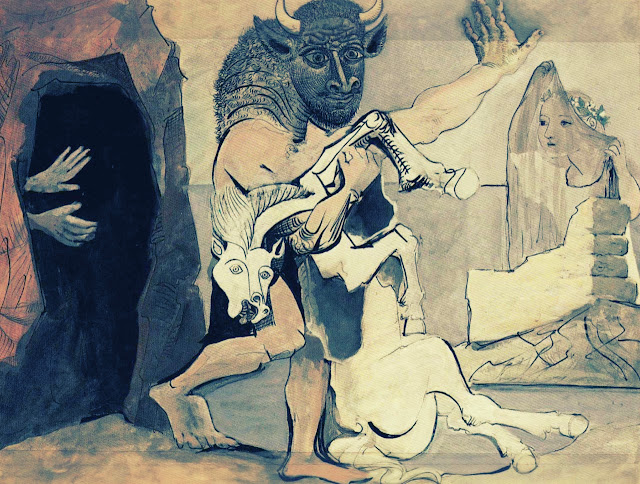
Why the Minotaur Is So Much More Fucked-Up Than You Thought

Half-man, half-bull, completely disturbing, more or less a warning against weird sex: the minotaur.

“minotaur with dead mare in front of a cave,” by pablo picasso
Last week’s American Horror Story premiere introduced Kathy Bates as Madame LaLaurie, a psychopathic society woman who expresses her creativity by incorporating classical touches into her acts of torture. In particular, she places a severed, hollowed-out bull's head onto to that of a slave as punishment, turning him into her own personal minotaur.

In Madame LaLaurie’s eyes, this punishment would be fitting, as she doesn’t look kindly on her slaves’ mixed ethnicity, and the minotaur is a primo classical example of a mixed thing, a mongrel, a thing-that-should-not-be. But while people know the basics of the minotaur’s story — he lives in a maze, the Athenian youths are sent down into his lair as a sacrifice to him/lunch for him, and Theseus ultimately kills him — there’s a backstory that’s even darker and weirder than all that.

Let’s skip over to the story of Icarus, the boy whose father invents wings that allow him to fly until they don’t. (Kerspslat.) Did you ever wonder what, exactly, Icarus and his father were trying to fly away from? Those faulty wings were no mere weekend project. Icarus and his father, the inventor Daedalus, were actually in prison in a tower on Crete, and they were sent there for two reasons: (1) to prevent Daedalus from blabbing about the Labyrinth, the maze he was forced to invent in order to trap the minotaur; and (2) because Daedalus was being punished for indirectly creating the minotaur. You see, Daedalus’s reputation for inventing was known even back in his day. And according to some versions of the minotaur story, his knack for inventing machinery proved a little too helpful. Queen Pasiphae was married to King Minos, ruler of Crete, who had offended the sea god Poseidon by declining to sacrifice a rather stunning bull. In revenge, Poseidon made Pasiphae fall madly in love with the bull, and when her human form proved incompatible with the bull’s, Pasiphae asked Daedalus for his assistance. The solution? A cow suit, logically enough, which Pasiphae crawled into and which was passable enough — and equipped with a rear flap, apparently — that she soon conceived the minotaur.

pompeiian fresco of daedalus and icarus presenting pasiphae with the bull suit
So yeah — the minotaur looks like he’s half-man, half-beast as a result of the most obvious possible reason: he literally is. A human woman, under a love spell placed by the mythology’s most vindictively manipulative sea god, did the nasty with a male bovine, and she subsequently gave birth to a child-like middle ground between bull and woman. (I wonder what she called the baby. Minnie? Lil Moo?) It’s interesting, really, that King Minos’s reaction to this news wasn’t to slay the boy-calf but to let it grow to burly, bashy, flesh-gnashy adulthood, whereupon he required imprisonment in the Labyrinth. Leniency for the minotaur not withstanding, Daedalus got the same fate: imprisonment, though curiously not in the super-prison that Minos just had Daedalus build but in a facility that’s easier to escape — thus the wings, thus the escape, thus Icarus going kersplat. (I assume Icarus was imprisoned alongside his dad as the result of some kind of father-son internship. So it goes.)

So remember, the next time you’re confronted with a minotaur — on TV, in your dreams, in literature, in some kind of withdrawal-induced nightmare vision — take a moment to remember that the minotaur doesn’t exist as do the centaurs or the mermaids, who are a half-human, half-animal race unto themselves. No, the minotaur is a one-off, thankfully, as well as classical mythology’s cautionary tale against bestiality.

You have to wonder, though: How much more disturbing would the minotaur have been if he had been a human head on a bull body?


Mythology, previously:

Friday, August 9, 2013

My Solution to the Back Acne Dilemma

Heads up: This post will not offer you a miracle cure for your back acne. That’s between you and your dermatologist. Instead, this post is about the word bacne — or backne, depending on your preference.

back acne bacne backne

This week I found myself texting the word backne — and yes, my SMS output is that sexy — when I realized I had no idea how the word should be spelled. My first inclination was how I spelled in the previous sentence, with the “k,” but then it occurred to me that bacne might be better, if vaguely evocative of Greek mythology. I’d heard the word, sure, and while I think it’s the best blended word to describe an unfortunate medical condition since cankle, I don’t read articles about skin care, professional sports or bodybuilding and therefore had never actually seen the word in print. Unable to decide on backne or bacne, I took to Twitter and to Facebook.

What I found out:
  • Apparently the trend at the moment is to use bacne. Thanks Mike “Pizza Back” Piazza!
  • However, a Google search for bacne yields 207,000 hits, while a search for backne gets 817,000.
  • Weirdly, if you search for backne, Google asks if you meant bacne, even though the latter is more popular. Does Google prefer bacne because it is more popular at the moment?
  • Doing Google searches for back acne yields image results that I find unsavory.
  • Even though I don’t hesitate on how to pronounce acne, I do with bacne. Is it a soft “c”? Is it “back-nay”? Is it a type of fancy bacon?
  • I don’t think “The spelling doesn’t make the pronunciation clear” is a good enough complaint in English, a language that has non-intuitively pronounced words like awry and chaos.
  • It seems less likely that you’d mispronounce backne, and it makes it clearer what you’re referring to right off the bat. That said, it emphasizes the word back in this portmanteau over acne. Does that mean back is more important, semantically speaking?
  • In the end, the Twitter responses almost unanimously recommended backne. Facebook initially said bacne but then the tide turned in favor of backne. Linguistic logic seemed to win out. That may be a first for social media.
  • There’s also back-knee, but that seems like an even stranger medical condition.
And that’s how you decide it’s backne instead of bacne. #TeamBackne.

Monday, July 29, 2013

Arrested Development and the Mysterious Nature of Cindi Lightballoon

For reasons I will never be able to explain, I seized on Cindi Lightballoon. Arrested Development has no shortage of strange character names, and while a lot of them seem to be an in-joke or an allusion or a pun, some go unexplained. Your Gene Parmesans, your Jan Eaglemans, your Trisha Thoons just exist in the Bluthverse, sounding like they should mean something if only you could just make the connection. Of these, the one who bothered me most was Cindi Lightballoon, George Sr.’s prison girlfriend, who was played by Jane Lynch back before she herself was imprisoned on Glee. That last name just seemed like too awkward a combination of familiar words to not mean something to someone. Having finished Arrested’s fourth season, I still can’t tell what her name means, but now I’m thinking that the show maybe made a callback to it.

In order to disguise her true identity when she’s trying to romance the politician Herman Love (“her man-love”?), Lindsay gives the fake name Cindy Featherbottom.


Now this might be one of the more layered names in the history of the show. First off, the name seems like a callback to the fake name Tobias gives when he becomes the family’s Mary Poppins-y, Mrs. Doubtfire-ish nanny, Mrs. Featherbottom. However, in the show’s fourth season, there’s also a new character named Cindy — an ostrich that lives with Lindsay while she’s squatting in Lucille’s apartment. Cindy literally has a feathered bottom, see, because she’s an ostrich. Because the show puts so much care into naming its characters and building on its own past, I was surprised the writers re-used a name. But maybe the doubling was intentional, because who besides the svelte, six-foot-tall Jane Lynch deserves to be called ostrich-like? (Struthious, to use the SAT vocab word.)


It’s a little mean, Sue Sylvester not withstanding, but I can’t let it go. I mean light : feather :: balloon : … bottom? No, wait, that doesn’t work at all. Damn. For the record, I tweeted the question at Chuck Martin, the Twitter-savvy of the two writers credited with this particular Arrested episode. He recommended I ask Mitch Hurwitz, who presumably has better things to do than answer niche fan questions and who has yet to respond.

Regardless of anything, we can all agree that having Cindy the Ostrich walk the red carpet at the fourth season premiere is the best thing ever.

TV names overthought, previously:

Monday, February 25, 2013

Where Are All the Evil Princesses?

Being mostly an indoors kid, I saw a good number of princesses get rescued. Books, movies and video games feature a lot of captive princesses, to the point that you’d think princesses would stop wearing those tiaras and pointy tassel hats, just as a safety precaution. The royal damsel in distress is such a popular trope that by now it seems like it should have become popular to subvert it: Hero sets out to rescue princess but finds that she’s actually not the embodiment of goodness he thought she was. It seems like such an obvious twist to have the princess turn out to be the big bad, hiding malice and ambition beneath a ball gown and courtly manners, but when I actually tried to think of examples, I couldn’t come up a single one. In fact, I struggled to think of more than a few “bad” princesses in all of popular culture.

via
It seems weird, this scarcity of devious princesses, given how many stories have evil kings and queens or even scheming, power-hungry princes — just off the top of my head, Loki in Thor, Humperdink in Princess Bride, Viserys in Game of Thrones. But the notion of the pure-hearted maiden is such a fundamental one, I’m thinking, that it generally precludes evil twists on the character, even despite historical accounts of princesses who weren’t above getting blood on their hands. (In particular, China’s Princess Pingyang could give many warlords a lesson or two in raising a ruckus.) So even if I’ve never seen the Pretty, Pretty Princess character so subverted that she turns out to be the big bad, some pop cultural princesses or princess-like characters have come close. Here’s what I have.
  • Medea is the daughter of the king of Colchis, but she’s rarely referred to as a princess. She is one, technically, and she’s an icon of vengeance. Not only does she betray her family to help Jason get the golden fleece, even dismembering her younger brother to prevent her father from tailing her, but she also goes to town on Jason once their relationship goes all kinds of sour. In fact, she burns Jason’s new wife to death, kills Jason’s kids and peaces out on a dragon-drawn chariot. No, really. But she does all this in reaction to Jason’s cruelty, not, say, evil for the sake of evil.
  • In King Lear, the older daughters, Regan and Goneril, are pretty heinous, and their scheming ends up annihilating the entire family, and they stand in contrast to the youngest sister, Princess Cordelia. (I can forgive Goneril because what else do you do with your life when you have name that sounds like a venereal disease?)
  • Electra is the daughter of Agamemnon, a king, and she goads her brother to kill their mother, Clytemnestra, but she only does this because ol’ mom killed dad. So if anyone’s the big bad, it’s Clytemnestra. Electra is the Christina to Clytemnestra’s Joan Crawford, and if anyone wants to co-write a Joan Crawford-inspired retelling of the Oresteia — a good idea, now that I think about it — I’m all for it. Then again, having your legacy be the Electra complex seems ignominy enough.
  • But then again, there’s Elektra King. The Sophie Marceau character in the James Bond film The World Is Not Enough fits the storyline I’m thinking of pretty closely, but she’s not a princess, even if her name is Elektra King — which, you know, subtle — and she’s the heiress to an oil empire. In the end, Bond discovers that Elektra has contracted a nasty case of Stockholm syndrome and become the lover and co-conspirator of the film’s big bad.
  • It was pointed out to me that the king’s daughter from “The Lady or the Tiger?” might work, depending on how you interpret the story’s ending. She allegedly inherited her father’s “semi-barbaric” qualities, and when she motions for her lover to pick one door over the other, there’s a fifty percent chance that she’s sending the guy to the hungry tiger and instant death. She loses him either way, you see, because should he pick the door hiding the lady, he has to marry her on the spot, so there is also a fifty percent chance that she is acting in a very un-Disney-like manner.
  • In the movie Return to Oz, the big bad is Princess Mombi, but it was pointed out to me that she’s not actually a princess; she’s an impostor. And the books don’t call her a princess. Instead, she is just a witch. Why not get technical about it?
  • In the DC Universe, one of the central Teen Titans, Starfire, inherits the title of princess of the planet Tamaran over her older sister, Blackfire, on account of the latter being lame and unpleasant. Blackfire holds a grudge, over throws the Tamaranean royal family, enslaves Starfire for a period and eventually becomes a major antagonist for the Titans.
  • There’s the obscure Capcom character Princess Devilotte de DeathSatan IX, who is to evil what drag queens are to feminine sexuality. She actually might be an exaggerated reaction to relative lack of characters like her, and that’s about as literary as anyone has ever gotten about someone with the name Princess Devilotte de DeathSatan IX.
  • The Batman villain Talia al Ghul sort of works, if you consider her pops to be a sort of king. It’s a stretch.
And that’s all I got. I’m sure I’ve overlooked some, but I think the takeaway is that princesses generally fall into the sunny, bright-eyed, singing-in-the-forest category. In fact, there’s not even an “evil princess” page on TV Tropes, and there’s a TV Tropes page for everything. Blame Disney if you want, but do tell me if you can think of any more.

In closing, please gaze upon this 1868 Frederick Sandys painting of Medea.

via
If that expression doesn’t read as “Do not fuck with me because I have ISSUES,” then I don’t know what does. Moo hoo ha, indeed.

EDIT: Bonus Mombi. Worst bonus, I know, but still.

via

Tuesday, May 29, 2012

Re: Moonrise Kingdom, Potential Paper Topics Therein

Wes Anderson’s latest offered a perfect moviegoing experience. And while you have every reason to just sit there and enjoy it for the magic that it is, you could also attempt to break it apart with your cruelly analytical English major mind. Personally, I don’t have the time. But in case you do…


Representations of animals (literal and metaphorical, real and artificial)

Mythologies and storytelling — “real” stories like Noah’s Ark and Ivanhoe vs. ones invented by characters themselves to explain unknown circumstances

Eyewear and associated other visual equipment

Types of vanishing (could be related to eyewear and vision)

Light — lightning, blackouts, lighthouses, faux lighthouses (could be an extension of the previous two)

What does the title mean? (The moon never appears, unless I’m mistaken. Is it a reference to rising tides and the island’s tidal rivers? Or is the moon another eye/source of light?)

Protagonists named Sam and Suzy — intentional reference to “Muskrat Love?” (seems less unlikely when you consider Wes Anderson’s previous movie)

This is all for now. However, if there’s not a band named The Francine Odysseys by the end of the year, I owe you a Coke. It’s the most marketable of all Suzy’s books. The more daring band, of course, would go with The Return of Auntie Lorraine.

Saturday, March 17, 2012

Your Mother Sews Socks That Smell! (Three Questions About The Exorcist)

Wondering why a rainy St. Patrick’s Day evening prompted me think about The Exorcist, I nearly wrote “Lord only knows.” Then I realized how that statement, in the context of this movie, might imply more than it meant. But that’s where my mind ended up tonight.

I probably think about this movie more than most people. To me, it’s not just a horror flick; it’s also one of the most pro-religious, pro-God movies I’ve ever seen, and if that statement seems surprising, you should give the movie another go with an eye toward its endgame and not all the blasphemy. However, it’s not just a film about God’s eventual triumph over evil. It has bits and pieces that don’t quite add up, and I’m posting them here, hoping of getting a response from some of the film-savvy regulars on this blog but more realistically imagining that other weirdos considering these matters will Google their way here and at least tell me that I’m not the only one wondering.

Burke Dennings. He’s the director friend of Chris MacNeil’s who gets tossed down the steps leading up to the apartment. He’s the first casualty of little Regan’s “troubles.” Before he dies, he’s depicted as an outgoing kook — the kind who makes parties fun but who maybe isn’t the type a woman would trust with her kid. Chris McNeil does anyway, and Dennings winds up dead as a result of his one-on-one time. Is there some kind of implied impropriety in his interactions with Regan? Specifically one that may have gotten him killed? Or am I just mapping Roman Polanski-ness onto the character? And yes, I’m aware that The Exorcist preceded Polanski’s sexual assault arrest by several years.

Sharon Spencer. In a similar sense, what motivates Chris’s assistant, the woman played by Kitty Winn? She sticks by Chris through all manner of badness. I mean, most people would consider a Satan infestation grounds for quitting. What’s her devotion all about?

Father Dyer. Now this is the weird one — the one that seems a lot less under-the-radar than the other two. Am I the only one who reads this guy as a gay character? No, no I’m not. But isn’t it strange that a film that ultimately delivers such a conservative meaning would prominently feature a Jesuit priest who speaks the line, “My idea of heaven is a solid white nightclub with me as a headliner for all eternity, and they love me”? I’m not sure that coding the character as gay is progressive or just bizarre, but it’s especially notable that this gay-seeming character was played by the Reverend William O’Malley, an actual Jesuit priest who also served as William Friedkin’s technical advisor on the set of The Exorcist. That said, according to a few online sources, he’s also famous for directing drama productions at the various schools he’s taught at. Which, well…

Am I overreaching? Maybe. But a movie that makes a character do that with a crucifix isn’t exactly daring viewers to reject sexual readings of the film.

One more bit before I’m done: There’s a surprising connection between The Exorcist and Groucho Marx.

Thursday, March 10, 2011

Who’s Got the Button?

So I’m a giant Twilight Zone geek. In fact, I like anthology series in general, just because their freedom from the season-long arc allows them to expose their protagonists to all manner of weirdness that would be verboten in a typical, unified series. Recently, I re-watched my favorite Twilight Zone episode. It’s not one from the original series but from the mid-eighties reboot: “Button, Button.” And in looking into the history of the episode, I was surprised to find out that writer Richard Matheson didn’t intend it the way the show eventually depicted.

The episode stars Mare Winningham (St. Elmo’s Fire) and Brad Davis (Midnight Express) as a couple badly in need of money. One day, a mysterious be-buttoned box arrives on their doorstep, and soon after an equally mysterious man shows up and explains that pressing the button will make the couple earn $200,000 with the single consequence being that someone, somewhere, whom “you don’t know” will die. The spineless husband and chain-smoking shrew of a wife agonize over the opportunity; she’s eager to elevate their standard of living, but he’s worried that the victim could be, for example, someone’s innocent child. Eventually, she hits the button. The next morning, the mysterious man arrives with the promised $200,000. He takes the box, which he says will be “reprogrammed” for a person “whom you don’t know.” The episode ends with the wife realizing her mistake and resigning herself to the grim fate that some stranger as greedy as she is will eventually push the button and cause her to die.

The episode, in case you’re interested:


If that plot sounds familiar despite your lack of Twilight Zone knowledge, that’s probably because it was used as the basis for the 2009 Cameron Diaz film The Box. Donnie Darko director Richard Kelly used this simple plot to spin off into all matter of metaphysical nonsense and conspiracy theory. The result was strange and unsatisfying but, for me, sort of fascinating, just to see what depths Kelly would drag the plot. The Box wasn’t without its surprise rewards — Arcade Fire, what are you doing there? Deborah Rush, what are you doing there? — but I didn’t feel it improved much on the original story, which is so wickedly sinister in its simplicity.

But I was surprised to learn that the ending that I thought so much of wasn’t actually Matheson’s. In his original short story, the wife presses the button and, the next morning, her husband dies in a train accident. When the mysterious man comes to collect the box, he explains why his prophecy was accurate: “ Did you really think that you knew your husband?” According to Wikipedia, Matheson so disapproved of the new ending that he asked to be credited with a pseudonym for the broadcast of the episode.

Now I’m at a loss. I love the original plot, with the awful wife forced to lived the rest of her days knowing that she may die at any moment. However, Matheson’s ending underscores the radically different ethics of the husband and wife — and perhaps punishes her even more for her misdeeds by making her responsible for the death of a person she actually loves. On yet another (third?) hand, the moralistic ending of a wife “not really knowing” her husband seems a heavy-handed, even by TV standards.

So I put the matter you all, thoughtful readers. What’s worse: accidentally ensuring your own death as a result of your greed, or causing the death of someone you ostensibly love, more or less because you didn’t know them as well as you thought you did?

By the way: Whatever you decide, the Wikipedia entry for “unintended consequences” makes for a pretty great read.

Tuesday, March 1, 2011

The Glittering Futuristic Landscape of 1999

Do you understand the joy of discovering that a term exists to describe an concept of which you were vaguely aware? For me, the reaction sounds something like this: “Oh my god that thing! It’s like what was in my head but it’s better and its words make whole sentences. Look at it! Look at thing, you!”

It had occurred to me before that The Simpsons and the James Bond universes have something in common that most other longstanding fictional universes don’t. Both have continuity, to an extent — Simpsons more so, Bond less so, some plot points get discarded along the way, but there’s a general sense of accumulation from one installment to the next. However, the featured characters’ sense of the past changes depending on what installment you’re watching. What I mean is this: James Bond doesn’t get old, but at least until the reboot of Casino Royale the movies could be viewed as consecutive episodes in a single character’s life, and some of the movies even explicitly referenced events from earlier ones. The Simpsons will sometimes “forget” about certain developments — not that it matters, but at this point, I’m not sure whether Principal Skinner is supposed to be his mom’s biological son or the imposter Armin Tamzarian — but there’s generally a tendency to impose permanent changes on characters, like Ned Flanders being a widower, Patty being a lesbian, Apu marrying Manjula and having octuplets.

But in ether case, even when continuity holds up, the starting point has to move forward because the characters don’t age. Thus, the pre-Daniel Craig James Bone timeline went from the Cold War being the present to the past, and the concept of “futuristic” technology changes radically depending on whether you’re watching a Sean Connery film or a Pierce Brosnan one. And with The Simpsons, the family’s static ages meant that flashbacks to Homer and Marge’s days before Bart was born had to shift from the late 70s and early 80s to the mid-90s. (And, awkwardly, wonderfully, that the vision of the future in the 1995 episode “Lisa’s Wedding” came and went in real life on August 1, 2010. Lisa didn’t get married, and though I was twelve at the time the episode aired and twenty-eight on the wedding date, Lisa herself is still eight and unmarried.)


Yet everything that happened in the past still happened, even if it wouldn’t make sense time-wise. Get it?

Well, this is a thing. It’s called a floating timeline. And it’s a weird line-up of pop cultural works that employ this device. Tintin? Archie comics? Doctor Who? South Park? Edgar Rice Burroughs’s Tarzan novels? The Nero Wolfe mysteries? The Babysitters Club? Nancy Drew? I mean, these have little else in common, aside from being long-running, though I suppose many are produced specifically for children and therefore can’t let their protagonists grow up and lose their appeal. Technically, Wikipedia lumps superhero comics and syndicated comic strips in this group, but I’m not sure these make for as neat of a fit. Most superhero shorelines are retconned and rebooted to hell — sometimes even using a trans-dimensional apocalypse as a literary device to straighten out the convolutions — to the point that shaving off a few years here and there doesn’t seem that so remarkable. (Fun note: The iconic murder of Bruce Wayne’s parents is so tied to the 30s and 40s style in which it was originally depicted that a 2010 flashback to this event has to note that “retro [was] big this year” in order to make sense of the timeline.) And comic strips create less of a “universe.” Calvin & Hobbes is more timeless than anything, and Garfield doesn’t really date itself, though I’ll say now that that fucking cat should be long dead, if not from old age then by a massive coronary.

Now I’m wondering if anything else has a floating timeline, but I can’t think of a single thing. Could this be it? Could this random-as-all-hell bunch be the only works that gauge time on a sliding scale?

Thursday, December 23, 2010

Surprise Ending (by Virtue of It Being Illogical, Inexplicable)

That post on Gilles de Rais — who’s a lot of things, a possible inspiration for Bluebeard being among them — sent me down the wikihole like the good, little wikirabbit I am. Now, I’m spending the lead-up to Christmas reading about bad folklore. You know — violent, Old World stories where people tend to meet terrible ends for no apparent reason and in which the morals are only apparent to toothless peasants who think bad air causes disease. They’re great, these stories. They read like outlines to the short films David Lynch decided not to make on grounds that they’d be too infuriatingly nonsensical.

Let me tell you one. In the English ballad “Lady Isabel and the Elf Knight,” the titular lady hears a magic horn and falls under the thrall of a bad man who plans to do to her what he did to all his previous wives: “dishonor” and then kill her. Sucks, right? But the resourceful lass takes the first opportunity to kill the bastard. In some versions, he turns away while she undresses (because rapists do that) and she “tumbles him in a stream.” In others, she makes her move when he accepts her offer to delouse him. In any case, he dies, and Lady Final Girl goes running back home.

Here’s the part that reminds you that storytellers back in the day enjoyed certain freedoms that they don’t now: Certain versions of the Lady Isabel tale end with the heroine returning arriving at her house and speaking to a caged parrot, and promising to buy it a golden cage if it doesn’t tell her father about the rapist elf who nearly had his way and then did away with her. From the Wikipedia summary: "Oh hold your tongue, my favourite bird, and tell no tales on me / Your cage I will make of the beaten gold, and hang in the willow-tree.” Bam! End of story. Personally, I learn that a new character has been introduced — and a talking animal at that — and I think “all right, sequel!” Not the medieval Brits, who just thought that was as good a point to end as any.

Personally, I think the parrot epilogue should fall back into use, narrative awkwardness notwithstanding. In fact, I can’t think of a single movie I’ve seen recently that wouldn’t improve from the addition of more wisetalking parrots immediately before the closing credits.

Wednesday, March 17, 2010

Trojan War Motifs in Roman Polanski’s The Ghost Writer

Spencer and I both saw The Ghost Writer this weekend. In discussing the movie, he pointed out something about a curious reoccurring scene: a gardener attempting to sweep up leaves from a beachside deck during a windstorm that keeps blowing more leaves into the area. A superficial viewing would lead one to believe that the scene is just comedic relief — and indeed a few people in the audience chuckled the last time we see the gardener, who eventually throws up hands in frustration with the impossible task. However, Ghost Writer is a Roman Polanksi film. And it doesn’t seem unlikely that a detail-oriented director like Polanski would stick a scene in just for giggles. Spencer didn’t think so, anyway. Via text: “So the man who was sweeping the patio is kind of a Sisyphus, yes?” I agreed.

Spencer then noted that in a later scene, Ewan McGregor’s character stands in front of a security system, the brand name of which is depicted in easy-to-read lettering as “Cyclops.” Since Polanski seemed to deliberately pointing out these elements — showing the Sisyphean gardener more than once, making the “Cyclops” brand name hard to miss — Spencer wondered if the film had additional allusions to Greek mythology. I thought about it a bit, and then it hit me: The argument could easily be made that Ghost Writer uses a series of allusions to Greek mythology to underscore the tragedy and pointlessness of the War on Terror by likening it to the Trojan War. It doesn’t fit perfectly, but it wouldn’t be as fun if it did.


So here’s a quick little analysis. Spoilers, of course. And please, go see the film if you haven’t. Hit the jump if you have — or if you enjoy being spoiled, you naughty rascal you.


Recall, if you will, the cause of the Trojan War: Helen of Troy. She’s famed as the most beautiful woman in the world, yet she’s just one person. Depending on your opinion of female beauty, she’s probably not worth a decade of war, countless lost lives and the annihilation of the city of Ilium, which I’ve heard had lovely parks. In short, the Trojan War was a war for nothing. Map the events of the Iliad onto contemporary politics and the parallels between them and the War or Terror are obvious. Like the Spartans sailing off in pursuit of a pretty woman, various international forces (but mostly Americans) invaded Iraq in search of weapons of mass destruction that, in the end, didn’t exist. (Kind of like how Helen probably wasn’t the epitome of beauty she’s now reputed to have been.) Neat, huh? I’m sure the comparison has been used before, but given how nicely it works, I’m surprised the analogy hasn’t been used more often.

kablammo! helen of troy: greek bombshell and weapon of mass destruction

Ghost Writer
is all about the War on Terror — or at least a very thinly veiled version of the one happening in real life. The film centers on Tony Blair stand-in Adam Lang (Pierce Brosnan), disgraced former British prime minister, who is facing trail for war crimes for his role in delivering suspected terrorists to the CIA. In the midst of this, a writer (McGregor, whose character’s name is never revealed) is ghosting Lang’s memoirs into a book. In doing so, he stays with Lang, Lang’s wife, and various staffers in a Martha’s Vineyard mansion where Lang is temporarily hiding to escape the unmitigated hatred of the British people. By staying with the Langs, McGregor’s character gets to know them well, learns various secrets about their marriage and rise to political power and ultimately ends up investigating the mysterious death of his predecessor.

Though McGregor’s character initially suspects that the former prime minister was a plant by the United States government to guide Britain to act in the Americans’ favor, he eventually learns that the real CIA operative is Ruth (Olivia Williams) — Lang’s wife and the real political mind in the family. (Shades of The Manchurian Candidate and, of course, Macbeth.) So let’s consider this in the context of the Trojan War analogy: Just as the U.S. managed to rope Britain into participating in the War on Terror, so too did Menelaus (Helen’s legal husband) convince his brother Agamemnon to join in the Trojan War. Other than a brotherly bond, Agamemnon had no real motivation to join a war. I mean, why would anyone? In fact, the only reason that Menelaus got the support that he did is that Helen’s wise father, Tyndareus, made all of Helen’s suitors — among them, Menelaus, Agamemnon, Odysseus, Ajax and Patroclus — make a pact that they would honor and defend whoever should win Helen’s hand.

In Ghost Writer, Lang resigned from office, essentially sending the Agamemnon figure in the story back home to his wife. If you remember the story of Agamemnon, the homecoming was a bad one, as his wife, Clytemnestra, axed him to death as he climbed into a bath. Her reasoning? Probably about three-fourths that Agamemnon sacrificed the couple’s oldest daughter, Iphigenia, in an effort to get good winds on the way to battle and one-fourth that he returned from the Trojan War with a concubine, Cassandra (the one nobody believed), who had given birth to not only one baby but twins. (My take: One baby would have been bad enough, but twins is just too insulting to bear.) A major departure that Ghost Writer takes from the Trojan War is that Ruth doesn’t directly kill Lang. Instead, Lang is assassinated by a British man — a former solider fuming that his solider son was killed in the war Lang chose to join. So Ruth killed Lang indirectly, given that she was pulling his strings and the entry into the war ultimately caused Lang’s murder. However, the person who physically pulled the trigger on Lang is a man who is angry about the death of his son, who has been sacrificed to aid a pointless war. And doesn’t that sound a bit like Clytemnestra? It’s a bit odd to consider, but it really does seem that Ghost Writer script has essentially mapped Clytemnestra onto two different characters.

What, then should we make of Kim Catrall’s character, Amelia Bly, the sexpot aide to the prime minister? According to a Daily Mail article on the Robert Harris novel from which Ghost Writer was adapted, she’s a re-creation of real life Blair aide Anji Hunter. For the purposes of this analysis, she’s also a Cassandra figure, not because people don’t believe what she says but because she’s having an affair with the Agamemnon character. The connection between these two is probably the most tenuous, especially considering that many don’t see Agamemnon’s relationship with Cassandra as a significant motivation for Clytemnestra to kill him.

It would be great, then, if I could make one more connection between the Ghost Writer characters and those involved in the Trojan War. The obvious candidate would be McGregor’s character, since he’s so central to the story. And when you consider that he’s the one who outsmarts the politicos and gets to heart of the various conspiracies and shady dealings that went down in the Lang administration, it seems he could likely be Odysseus, renowned for his cunning. McGregor’s character is also British, but travels to Martha’s Vineyard to work on the Lang book. As soon as life in the Lang household proves to be tumultuous, he seems to want out and long for home in London, where he eventually goes at the conclusion of the film. I feel safe making a parallel between McGregor’s character being trapped in the U.S. and Odysseus’s inability to return home to Ithaca for the ten years of the Trojan War and the following ten years of the Odyssey. And the fact that McGregor’s character never gets a name would seem to be a wink at Odysseus alias in the Odyssey, “Nobody.” Remember that when Odysseus blinds Polyphemus the cyclops, he identifies himself as “nobody” or “no man,” depending on the translation. And doesn’t that seem like an appropriate reference point for a nameless character whose role is to slip invisibly into Lang’s life and invisibly write up his memoirs?

In the end, the Sisyphus gardener and the Cyclops-brand security system are just tip-offs that something larger is happening beneath the surface of the film. Ghost Writer benefited, of course, from Polanski’s expert direction. But I feel enjoy it more for having these references, as they deepened the meaning of the film for me and helped me see connections between age-old stories and things happening today. I like the stories of Greek mythology. I like it when we’re reminded of why these stories are relevant. And I like it especially when they help to tell yet another great story.

A special thanks should go out to Zachary Mason’s novel The Lost Books of the Odyssey, which I just finished and which helped put the characters of the Iliad and the Odyssey on my mind. If you made it this far in this post, I encourage you to pick it up. It’s a joy for anyone who has ever loved the stories of the Trojan War and thereabouts and would like to see them brought to life once more.

Monday, February 15, 2010

Less Pumpkin, More Inferno

I’d never thought of it in this way, but there’s a theory put forth by Linda Badley in her 1996 book Writing Horror and the Body that likens Carrie to a dark modernization of the Cinderella story. Sue Snell is the godmother figure, who tries to make life better for the tormented Carrie. And both stories have their climax set at a formal party where the respective casts see the undoing of any efforts to elevate the status of the victimized Cinderella character.

Of course, in place of the carriage’s transformation back into a pumpkin, Carrie ends with her killing everybody in an firestorm, so that would be small difference between the two stories.

This post going up the day after Valentine’s Day is totally coincidental, I swear.

Tuesday, June 9, 2009

Ugly Myfanwy

Work tends to cause songs to mysteriously pop into my head, often making me absentmindedly whistle or hum something I haven’t heard in years and may never have even liked in the first place. Yesterday, it was “Backwater,” which I didn’t mind so much, but last week it was “Say You’ll Be There.” Today, it’s “The Rake’s Song” from the newest by The Decemberists, The Hazards of Love. In fact, “The Rake’s Song” was the album’s first publicly released track. And with good reason, too: It’s catchy as hell. I, however, could benefit from a different song to be stuck with, because this one is the most infanticide-centered pop tune since The Violent Femmes’ “Country Death Song.”

Like a good short story, “The Rake’s Song” lends itself to interpretation. For example: Is the narrator being truthful when he says that he’s always been a rake? He claims to be “wedded” and “whetted” in that order, as if marriage somehow forced him into better behavior. According to him, it’s the arrival of the kids that made him revert to more wicked ways — specifically that of his fourth child, ugly Myfanwy, whose problematic birth results in both her death and that of her mother. This pushes the narrator over the edge, or so he says, and he takes to killing off the remaining children, one by one, eventually leading him to become the villain of the story told over the course of Hazards of Love.

I’m not so sure we’re meant to take his words as true. After all, he is villain. Such characters lie. I feel it’s possible that the narrator may have actually been a fairly normal person prior to his wife’s death. His self-proclaimed history of lifelong, cold-blooded caddery could simply be his delusional way of rationalizing the fact that he murdered his kids, which itself was his rather extreme response to his wife’s death.

The names given to the ill-fated offspring also bother me to the point that I would like to ask Colin Meloy if some motives other than the number of syllables factored into the decision. In order, there’s Isaiah (represented in some lyrics as Eziah) with his “crinkled little fingers,” then “Charlotte and that wretched girl Dawn,” and finally Myfanwy. Who knows what time period Meloy envisioned the events of Hazards of Love taking place, but Dawn strikes me as atypically modern. And then there’s Myfanwy, which I keep mishearing as Nathalie, and which grates upon American ears even more than most Welsh names. Perhaps it’s intentional. The name — which seems to mean “my woman” — may also be an homage to the Welsk folk song “Myfanwy,” which features a man addressing his love, the titular woman, and asking why her feelings for him have soured. A precedent for such a shout out exists, at least, by virtue of the fact that the whole of Hazards of Love was inspired by a 1966 album by British folk singer Anne Briggs — or so says Pitchfork, anyway. A curiosity: Whereas Briggs’s Hazards of Love lacked a track by that name. The Deceberists’s Hazards of Love has no less than four.

Now, if you’ll excuse me, I shall continue to quietly hum my way through the murder of children. For the record, I think the track “Won’t Want for Love (Margaret in the Taiga)” is the best of the lot, and it contains no reference to the child-killing, so don’t get the wrong idea about me.

Tuesday, September 4, 2007

Vagina Dentata in the Mushroom Kingdom

It's late, but I'm seized by the urge to write. When this mood strikes me hard enough to pull my mind away from sleep, strange things that I haven't fully processed fly to the front in ways that make me think something may be a good idea when, in fact, it's actually not worth committing to type or even worth wasting mental energies on. Regardless, I'm awake now, and this is being written. So there.

As I mentioned before in the admittedly strange post on the faux-Greek goddess from a bygone video game, I've been following the progress of an upcoming Nintendo title — tragically saddled with the very Japanese title Super Smash Bros. Brawl — that, for all intents and purposes, will exist to delight me and solely me. It's a Drew fantasy — a culmination of pop culture crossovers the likes of which haven't been seen since Battle of the Network Stars blessed airwaves. In short — for those of you who don't remember or were so turned off by the depths of my geekdom that you simply refused to read either of the two Palutena posts — there will soon be a game which, upon insertion into my Wii, will pit the various Nintendo mascots, famous and little-known alike, against each other in battle, making for a kind of fanboy dream match in the grand tradition of the Flash-versus-Superman footrace debate. Masahiro Sakurai, the game's design director, has been giving daily glimpses of its progress on a blog — a brilliant marketing ploy that the brains behind TV shows, movies, music albums might want to consider — and I, like the entertainment-addled sheep drone I am, have been happily reading each post.

A little more than a week ago, Sakurai posted images from the game's story mode, which I imagine will attempt to make some sense of why these disparate characters — each with different body types and rendered in different artistic styles — would be interacting with and then beating the stuffing out of each other. (Example: Why would Donkey Kong have any reason to fight Link from Legend of Zelda? And if the fight has to happen, why wouldn't Link just stab the ape and be over with it?) The snippet of the story mode that Sakurai provided focused on the first boss character revealed so far, a giant, eyeless, lumbering, anthropomorphic plant monster named Petey Piranha.

Meet Petey.

braah! i should make you feel weird for so many reasons!

(A quick break: God, I love the Japanese. If it weren't for them, I would have never had a need to type out the phrase "giant, eyeless, lumbering, anthropomorphic plant monster.")

A relatively newer video game character who hails specifically from the Super Mario Bros. games, Petey is actually a hyped-up version of a minor monster that may be familiar to anyone who played the original Super Mario Bros. for the NES. Remember those strange Pac-Man-esque plants who hide in pipes, only to nip Mario's behind, cause him to die and drive many an inept seven-year-old to throw down their controller in frustration?

proto-Petey

Yes, those things. The age of video games has advanced quite a bit since 1985, at least graphically.

Anyway, Sakurai's post details that Petey has somehow grabbed a hold of Peach and Zelda — Nintendo's two leading ladies and arguably the two most famous damsels-in-distress in the history of video games. Not only does this herbofreak nab them both, mind you, but he also has trapped them inside two princess-sized birdcages, with one each held in one of his leafy "hands." The heroes then fight him, which you might think would be easy, given Petey's lack of eyes. Aside from lunging with his toothy mouth, Petey's main form of attack is swinging the cages — at you, at the ground, or directly into each other.


That last sentence forms the essential "what" of this post — the moment when mere pop culture nothing goes to strange levels and, at least in my head, demands examination. I've always said that there's something to video games. There has to be. People make them. Those people come from cultures with perspectives on life, death, sex and overall existence and something — something, I'm arguing — must filter into the final product and, thus, into the brains of the children and twenty-five-year-olds who play them. Personally, I think the scene Nintendo is offering with this bizarre fight is so laden with blatant, Freud-ready sexual metaphors that I laughed out loud when I first read of it.

First off, let's look at this wasabi-induced nightmare they're calling Petey Piranha. I'm initially drawn to his "head," which consists of big, rounded lips and a fringe of colorful petals. And let's not forget the very human pink insides. Despite that his name is "Petey," this plant monster, to me, is a passable example of the vagina dentata or "toothed vagina" motif. Observable in art and folklore to the point that it calls up quite a few results on a Google image search — one that is not exactly safe for work — from various world cultures, the idea of a ladyparts that can violently snap off a misterpart is, as far as I remember from Prof. Waid's class, a representation of a man's fear of sex, at least on its most basic level. Add to this gynecological symbolism the fact that Petey is, on his most basic level, a flower and the fact that he wears bikini bottoms and you get something spawned in the depths of a repressed gardener who's mother didn't love him enough. (Hide the shears.)

Now that we're on the same page as to what Petey is, let's look at what he's doing. First off, he's not being friendly. That fearsome roar clearly comes from a guy who has showed up specifically to cause trouble. He has also somehow imprisoned the two princess — demure, pretty, dress-wearing ladies who, especially in the early age of video games, took the passive "save me" role — and locked them up, effectively separating them from the male characters. (In the clip, Mario even gets cannonballed into the distance, leaving only the asexual, pink puffball Kirby to fight it out. Whatever happens at the end of this mess, nobody will be getting laid.) Then, as if to hammer the point in, Petey uses the imprisoned feminine characters as weapons, creating a situation where his opponent has a choice between being seized on by his toothy vagina mouth or being beaten silly by the imprisoned epitomes of video game femininity. And that's not even touching on the literalization of the porn premise "banging chicks in cages."


Fuck. They make this stuff for kids?

Screw Grand Theft Auto. At least that game is blatant in its attempt to corrupt the youth. This game is taking beloved, trusted video game icons and placing them in some of the most subversive, psychosexually suggestive situations I could dare to think of.

And I love it.

I just can't believe it happened, is happening, and will happen. Is Nintendo just trying to mindfuck their loyal customers? Or are the game's developers merely trying condemn the practice of passive femininity by literally knocking two princesses senseless? I suppose I should also mention the small bit of video game trivia I've picked up over my years of playing that might further help someone interested in trying to explain exactly what is going on with all this: In other countries, the character of Petey Piranha is known as "Mutant Tyranha" and is female. Does that make this all better? Or worse?

And seriously, if Banging Chicks in Cages isn't already the title of a porno, then it should be.