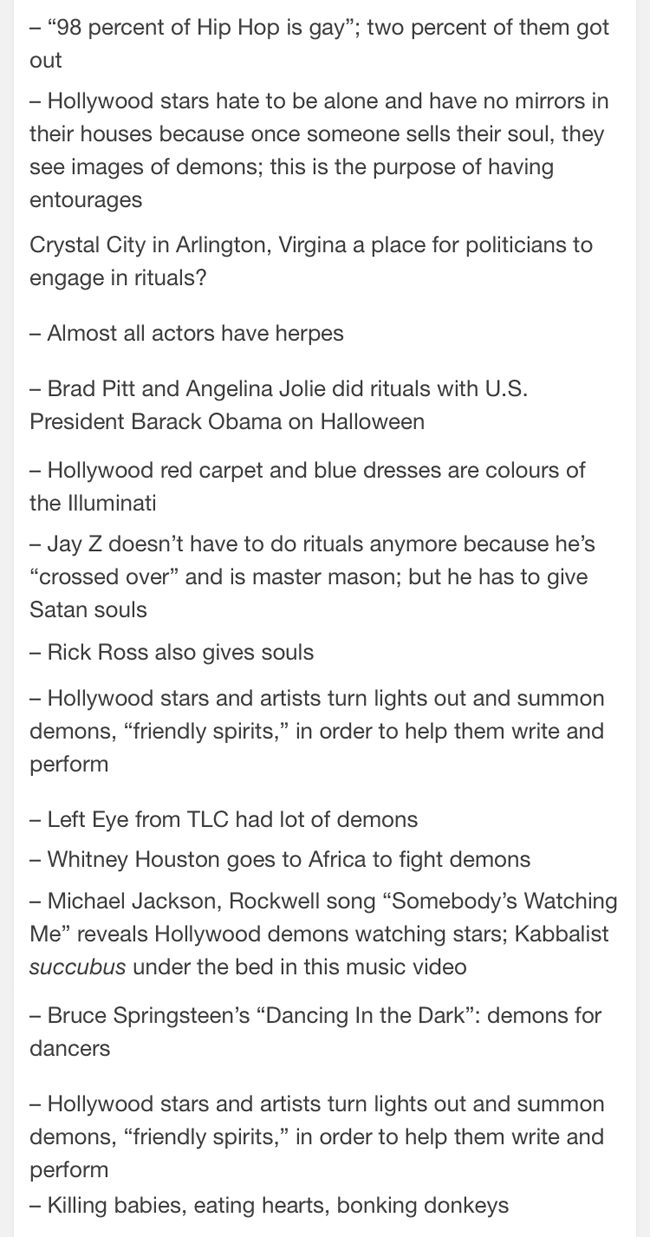
I know this is just the dumbest thing in the world, but sometimes you make a few stray clicks too far and end up on a whackadoo Illuminati conspiracy website, and it’s kind of like the web version of one of those poorly Xeroxed flyers homeless people try to give you. While you’re floating in all this word soup, you realize that a lot of the Hollywood conspiracies that the author is putting forth sound like pitches for movies you’d want to see.
An edited list:
And if someone hasn’t used the text Killing Babies, Eating Hearts, Bonking Donkeys as an album title at least, that’s a shame, because there’s some sick internal poetry to it.
Wednesday, January 20, 2016
Tuesday, January 19, 2016
Hey, Drew — Why Don’t You Have a Dog Yet?
(What follows is an imaginary conversation that has happened in bits and pieces over the last few months but which is not based off any one interaction in particular.)
OMG YOU GOT A DOG?!
No, not yet.
Oh. But you’re getting a dog?
It’s in the process. I am dog-shopping, by which I mean that I’ve been going to some of the recommended dog rescues and seeing who’s there, seeing who might be a good match for me. It’s higher stakes than dating but lower stakes than adopting a baby, I’d wager.
But you’re taking FOREVER.
I guess? I’ve been working at home for more than a year now, and I wanted to make sure this was a lifestyle I could do longterm before I brought a dog into it. Also, I had to do quite a bit of work in my backyard to make sure that it was secure for a dog — that I’d minimized the changes that one might have escaped or met an angry raccoon or something. It’s there now, though, and I’ve tested it out with some dogs that I’ve watched for friends. None have gotten out or been skeletonized by raccoons. (Don’t tell my friends I used their dogs as test subjects, maybe.)
OMG you should get a dog because on social media you’re just like “dog dog dog dog dog.”
Yes, I know I post about dogs a lot. Dogs occupy a large piece of my mental real estate. This likely will not change once I get a dog, you should probably know.
Ugh, just get a dog already.
No. I feel like this is something I need to take slowly. If you’re dating someone and you feel like you’re not a good match, you and the other person can just decide not to see each other anymore. I’m not sure that would work with a dog, and having that breakup conversation with a dog would just be the most awkward thing. You’d be all, “Well, Fritz, I feel like this just isn’t working out between us. I think you need to pack your things and find another human.” And the dog would be like “[licks you hand],” and you’d be all “Fritz, please. I’ve made my decision.” And then you’d watch him walking out the front door, bindle stick in mouth, whereupon he’d return himself to the shelter. (I’m guessing.) However, I suppose if the dog broke up with me because he found a human he loves more — that is, had more fresh-cooked steaks on hand — then I’d respect his wishes, but I don’t foresee that happened, mostly because I have a lot of steaks in the freezer.
But, like, just get a dog.
No, stop it. I want to make sure I find a dog that I can make happy and who will make me happy. And once the dog gets here, he’s staying no matter what, so it’s especially important that this turns out to be a good dog-human relationship.
When I got my dog, I just walked in and Patches was like “bark bark bark” and I was all, “That’s my dog! I’ll take that one.” And now little Patches and I are, like, super tight.
Well, see, I’ve met Patches.
What do you mean?
Hey! Look at the time! I have a playdate with a prospective dog companion, so I’d better run.
Wait, what were you trying to say about Patches?
[runs away]
Oh, I love my dog Patches. Hey, Patches — where are you, girl? Patches? Patches?! Shit, has anyone seen Patches?
OMG YOU GOT A DOG?!
No, not yet.
Oh. But you’re getting a dog?
It’s in the process. I am dog-shopping, by which I mean that I’ve been going to some of the recommended dog rescues and seeing who’s there, seeing who might be a good match for me. It’s higher stakes than dating but lower stakes than adopting a baby, I’d wager.
But you’re taking FOREVER.
I guess? I’ve been working at home for more than a year now, and I wanted to make sure this was a lifestyle I could do longterm before I brought a dog into it. Also, I had to do quite a bit of work in my backyard to make sure that it was secure for a dog — that I’d minimized the changes that one might have escaped or met an angry raccoon or something. It’s there now, though, and I’ve tested it out with some dogs that I’ve watched for friends. None have gotten out or been skeletonized by raccoons. (Don’t tell my friends I used their dogs as test subjects, maybe.)
OMG you should get a dog because on social media you’re just like “dog dog dog dog dog.”
Yes, I know I post about dogs a lot. Dogs occupy a large piece of my mental real estate. This likely will not change once I get a dog, you should probably know.
Ugh, just get a dog already.
No. I feel like this is something I need to take slowly. If you’re dating someone and you feel like you’re not a good match, you and the other person can just decide not to see each other anymore. I’m not sure that would work with a dog, and having that breakup conversation with a dog would just be the most awkward thing. You’d be all, “Well, Fritz, I feel like this just isn’t working out between us. I think you need to pack your things and find another human.” And the dog would be like “[licks you hand],” and you’d be all “Fritz, please. I’ve made my decision.” And then you’d watch him walking out the front door, bindle stick in mouth, whereupon he’d return himself to the shelter. (I’m guessing.) However, I suppose if the dog broke up with me because he found a human he loves more — that is, had more fresh-cooked steaks on hand — then I’d respect his wishes, but I don’t foresee that happened, mostly because I have a lot of steaks in the freezer.
But, like, just get a dog.
No, stop it. I want to make sure I find a dog that I can make happy and who will make me happy. And once the dog gets here, he’s staying no matter what, so it’s especially important that this turns out to be a good dog-human relationship.
When I got my dog, I just walked in and Patches was like “bark bark bark” and I was all, “That’s my dog! I’ll take that one.” And now little Patches and I are, like, super tight.
Well, see, I’ve met Patches.
What do you mean?
Hey! Look at the time! I have a playdate with a prospective dog companion, so I’d better run.
Wait, what were you trying to say about Patches?
[runs away]
Oh, I love my dog Patches. Hey, Patches — where are you, girl? Patches? Patches?! Shit, has anyone seen Patches?
{FIN}
| a dog i did not adopt despite off-the-charts levels of cute |
Read more:
a funny story,
dogs
Monday, January 11, 2016
We’re Not Going to Talk About Judy at All
I’m sad about David Bowie’s death. I mean to say this in the most reverent possible way, but his passing marks a huge loss for the world’s weirdo community, because David Bowie is one of those special people who was not only permitted to be weird but celebrated for that. And while it would be tough to overestimate Bowie’s influence in the music industry, it’s also worth pointing out that he acted, too.
Yes, Labyrinth was huge, not only as a introduction for many ’80s babies to Bowie himself but also an introduction to codpieces. However, the role that strikes me as especially important is the small one he played in Twin Peaks: Fire Walk With Me. His character, Agent Phillip Jeffries, barely appears in the film, but in those few seconds, he manages to sum up a lot about why David Bowie was cool: He’s otherworldly, he’s inexplicable, he leaves too soon and he makes you wish he stayed around just a short while longer.
Here’s the whole scene, in text form and video form.
Agent Cooper (Kyle MacLachlan) is at the FBI headquarters in Philadelphia when he realizes that it’s 10:10 a.m. on February 16 — a date he apparently once had a dream about. Coop steps into the hallway into the eye of a security camera, then walks back into the monitor room to see that he’s still appearing on camera, as if he were still in the hallway. Then out from the elevator walks Bowie’s character in a white suit. Agent Jeffries heads straight into the office of chief, Gordon Cole (David Lynch), starts babbling about Judy and questions who Coop is. The scene cuts to shots of the creepy Red Room residents as Jeffries talks, and then he vanishes.
It’s hard to understand everything that’s being said in the scene, but the preliminary script for Fire Walk With Me at the very least clears up some of what was intended to be said, even if the dialogue differs from what it spoken in the final cut of Fire Walk With Me.
The script provides a little more insight as to what David Lynch might have been thinking in writing the scene, but in true Lynch fashion, it answers no questions about who Judy might be, exactly what happened when Jeffries went to the other place and why he vanished a second time. If anything, I think the scene is supposed to foreshadow what happens to Coop (and to a lesser extent, Chris Isaak’s Agent Chet Desmond) in investigating these otherworldly elements and ending up zapped into the Red Room.
It should be noted that there’s a scene in the movie in which a monkey says Judy’s name, though I’m not sure I’d ever heard it clearly until now. Here’s that scene too, with a bit of context. Yes, it’s all very creepy.
There are also theories that Judy is the sister of Josie Packard (Joan Chen) or maybe Laura Palmer herself. (The fact that the monkey saying her name precedes a shot of dead Laura would seem support the latter.) I suppose this is one of the many loose threads that could get tied up in the forthcoming new season of Twin Peaks, but it seems like Bowie’s death would preclude us from seeing Agent Jeffries again — a bummer, yes, but that’s a comparatively small pity when you think about the strangeness of a world without David Bowie.
I interviewed Jake Shears last year about him taking on his first acting role and asked him if there was a instance of a musical performer-turned-actor that he found particular memorable, and he picked Bowie in Fire Walk With Me. I was stoked, but for those Lynchy reasons that always make words difficult, I can’t explain exactly why this scene resonates so much with me, or why I’d pick it as my favorite instance of Bowie acting in a movie over The Labyrinth or The Hunger. And now that he’s gone — vanished from the world just like Philip Jeffries, and more or less just as inexplicably — I think the scene means even more to me, even if I still couldn’t tell you exactly what it’s supposed to be about.
I have questions without answers, but why shouldn’t I? The world is suddenly missing someone who should have outlived us all, who should have returned to his home planet rather than dying as a result of something as mundane and human as cancer. None of it makes sense.
Yes, Labyrinth was huge, not only as a introduction for many ’80s babies to Bowie himself but also an introduction to codpieces. However, the role that strikes me as especially important is the small one he played in Twin Peaks: Fire Walk With Me. His character, Agent Phillip Jeffries, barely appears in the film, but in those few seconds, he manages to sum up a lot about why David Bowie was cool: He’s otherworldly, he’s inexplicable, he leaves too soon and he makes you wish he stayed around just a short while longer.
Here’s the whole scene, in text form and video form.
Agent Cooper (Kyle MacLachlan) is at the FBI headquarters in Philadelphia when he realizes that it’s 10:10 a.m. on February 16 — a date he apparently once had a dream about. Coop steps into the hallway into the eye of a security camera, then walks back into the monitor room to see that he’s still appearing on camera, as if he were still in the hallway. Then out from the elevator walks Bowie’s character in a white suit. Agent Jeffries heads straight into the office of chief, Gordon Cole (David Lynch), starts babbling about Judy and questions who Coop is. The scene cuts to shots of the creepy Red Room residents as Jeffries talks, and then he vanishes.
It’s hard to understand everything that’s being said in the scene, but the preliminary script for Fire Walk With Me at the very least clears up some of what was intended to be said, even if the dialogue differs from what it spoken in the final cut of Fire Walk With Me.
Jeffries: I'm not going to talk about Judy. Keep Judy out of this.And that’s it.
Cooper: But…
Cole: Stand fast, Coop.
Jeffries: (pointing at Cooper) Who do you think that is there?
Albert: (trying to calm Jeffries) Suffered some bumps on the old noggin, eh, Phil?
Cole: What the hell did he say? That’s Special Agent Dale Cooper. Are you okay, Jeffries? Where the hell have you been?
Jeffries: I want to tell you everything, but I don’t have a lot to go on. But I'll tell you one thing: Judy is positive about this.
Albert: How interesting. I thought we were going to keep Judy out of this.
(Jeffries stumbles to a chair.)
Jeffries: Listen to me carefully. I saw one of their meetings. It was above a convenience store.
Albert: Who’s meeting? Where have you been?
Cole: For God’s sakes, Jeffries, you’ve been gone for damn near two years.
Jeffries: It was a dream. We live inside a dream.
Albert: And it’s raining Post Toasties.
Jeffries: No, no. I found something… in Seattle… at Judy’s… at then, there they were.
(Albert is about to say something, but is stopped by Cole’s gentle pressure on his arm.)
Jeffries: They sat quietly for hours. I followed. (Jeffries begins to cry quietly at his table.) The ring… ring…
Cole: Albert, I’ll take that second mineral water.
(After a hesitation, Albert gets the message and discreetly leaves the room.)
Cole: Phillip, let’s calm down and get all of this interesting story on paper.
(Cole tries to raise someone on the intercom but it doesn't seem to have any juice. The static begins to build on the intercom. The wiring in the wall and the flourescent lights start to hum as well.)
Cole: Let me hear some good news. My device is faulty. Where the hell is the sound on this thing? (He pounds on the intercom) Mayday…
(Hearing “May,” Jeffries turns and stares at a calendar on the wall.)
Jeffries: May? 1989?
(Cooper looks out of the room to see if anyone is coming to help Cole, who is still trying to get the intercom to work. The static grows even louder.
Cole: What… Am I alone?
(Cole turns back to Jeffries, but there is no one there. Jeffries is gone. Papers from Cole’s desk are now sticking to Jeffries’ chair.)
The script provides a little more insight as to what David Lynch might have been thinking in writing the scene, but in true Lynch fashion, it answers no questions about who Judy might be, exactly what happened when Jeffries went to the other place and why he vanished a second time. If anything, I think the scene is supposed to foreshadow what happens to Coop (and to a lesser extent, Chris Isaak’s Agent Chet Desmond) in investigating these otherworldly elements and ending up zapped into the Red Room.
It should be noted that there’s a scene in the movie in which a monkey says Judy’s name, though I’m not sure I’d ever heard it clearly until now. Here’s that scene too, with a bit of context. Yes, it’s all very creepy.
There are also theories that Judy is the sister of Josie Packard (Joan Chen) or maybe Laura Palmer herself. (The fact that the monkey saying her name precedes a shot of dead Laura would seem support the latter.) I suppose this is one of the many loose threads that could get tied up in the forthcoming new season of Twin Peaks, but it seems like Bowie’s death would preclude us from seeing Agent Jeffries again — a bummer, yes, but that’s a comparatively small pity when you think about the strangeness of a world without David Bowie.
I interviewed Jake Shears last year about him taking on his first acting role and asked him if there was a instance of a musical performer-turned-actor that he found particular memorable, and he picked Bowie in Fire Walk With Me. I was stoked, but for those Lynchy reasons that always make words difficult, I can’t explain exactly why this scene resonates so much with me, or why I’d pick it as my favorite instance of Bowie acting in a movie over The Labyrinth or The Hunger. And now that he’s gone — vanished from the world just like Philip Jeffries, and more or less just as inexplicably — I think the scene means even more to me, even if I still couldn’t tell you exactly what it’s supposed to be about.
I have questions without answers, but why shouldn’t I? The world is suddenly missing someone who should have outlived us all, who should have returned to his home planet rather than dying as a result of something as mundane and human as cancer. None of it makes sense.
Read more:
david bowie,
david lynch,
twin peaks
Sunday, November 29, 2015
“As the parent of a gay person…”
I told my parents I was gay on St. Patrick’s Day in 2005, effectively ruining a pleasant corned beef dinner. I was three months away from graduating college, and I wanted to integrate the worlds I lived in. My college friends knew, but essentially no one from home did. I blame the closure of the bowling alley in my hometown; with no alternatives, the favored pastime there had become discussion of unplanned pregnancies, divorces and the various other ways young people had disgraced their good family names. In any case, I knew I had to tell my parents before someone else did.
More than ten years later, those worlds still aren’t integrated. Here in Los Angeles, I’ve constructed this Neverland of gay nerds with whom I can talk to about Chun Li and Barbara Gordon and Princess Zelda in the same sentence and not get looked at like I’m some kind of space alien. When I go home, I revert. I don’t pack the cutoffs. I leave behind the purple V-neck T-shirt and take the blue one. My life as I live it in Los Angeles does not get discussed unless I force it.
I went home earlier this year, and my mom asked how I was doing. “This guy I used to know in Santa Barbara passed away, and also I got dumped,” I said. Mom: “Oh, I’m sorry your friend passed away.” That bait dangled, untouched. I chose not to force it. Because the divide has remained over the past decade, it is hard for me to make that drive up Highway 5, knowing that I’m going to sit through days and days of questions about what’s growing in my garden, the activities of college friends I haven’t kept in touch with and the name of my apparently singular female friend — “Megan? Stephanie? Which is it? Wait, there are two?” — at the exclusion of anything more personal.
The single best example of this refusal to talk about the gay son’s stubborn gayness occurred while I was helping my mom clean out the liquor cabinet, which had been chiefly stocked over the years by visiting New Zealanders landing at SFO with duty-free offerings and the belief that my family drinks the hard stuff. I stood on a step ladder and handed bottles down one by one, and my mother, who often narrates what she’s doing, read the labels out loud as I passed them to her. “Smirnoff Vodka. Bombay Sapphire Gin. Beefeater Gin.” Then I passed her a bottle of Mount Gay rum. Mom: “Oh, it’s…. it’s rum.” The bottle later vanished.
As I do on most holidays at home, I spent this past Thanksgiving dutifully working — the big turkey dinner, raking leaves, getting ahead of freelance assignments — with the closest connection I have to any other world being Scruff, usually sitting unattended on the dresser in my childhood bedroom. Having come off from being the only gay at a wedding the previous weekend, I desperately felt like I needed something, even if that something wasn’t much of anything. At home, Scruff is mostly glimpses into the sad life I’d have led if I’d stayed in town: torsos that can’t host. I don’t really engage. It’s just a window on a world that reminds me that I’ve made good choices for myself. Well, that and an occasional invite to go up to San Francisco, unsolicited and politely declined. (Me: “I live in L.A. and I’m really only interested in dating,” and every time I say that I feel like I might as well be saying “I live in Chicago and I hate wind” or “I live in Maui and I’m allergic to sunsets.”)
With all that said, you can appreciate my surprise at what my mother said when she and I got into an argument about politics — why I can’t vote for a candidate running on a conservative social platform and why liberal politicians are apparently ruining the country with wasteful economic policy. I countered with all the examples of the good that liberal politicians have done in the face of conservative opposition, and the conversation eventually turned to the point that it was liberals, not conservatives, would made it possible for me to get married one day.
Mom: “Well, as the parent of a gay person, I understand that.”
It was followed by a “but” about taxes, of course. I was stunned that it happened at all. In the ten years since I told my parents I was gay, I’d never heard either of them ever refer to me as a gay person. (My grandmother referred to gays as “people who are that way,” and that euphemism has endured in the family long since.) I got hung up on that one sentence to the point that I think I lost the argument, just because my brain wouldn’t process anything aside from the fact that my mother acknowledged something that’s fairly important to how I live my life but which had gone unspoken, at least when I’m in the room.
I hugged my mom and told her it was good talking to her. It was the least acrimonious ending to a political argument in the history of my family.
It may not seem like much, especially to those weirdos with enthusiastically supportive families, but it was the single marker of progress I’ve had in a struggle that’s been going on for ten years. There’s still a lot to do yet — I recently mentioned that I was hoping to adopt a dog soon and was quickly cautioned against getting one that is too small — but it’s my single greatest takeaway from this Thanksgiving trip home.
(Yes, picture is unrelated. I needed a picture. It was this or a display shelf of Mount Gay rum.)
More than ten years later, those worlds still aren’t integrated. Here in Los Angeles, I’ve constructed this Neverland of gay nerds with whom I can talk to about Chun Li and Barbara Gordon and Princess Zelda in the same sentence and not get looked at like I’m some kind of space alien. When I go home, I revert. I don’t pack the cutoffs. I leave behind the purple V-neck T-shirt and take the blue one. My life as I live it in Los Angeles does not get discussed unless I force it.
I went home earlier this year, and my mom asked how I was doing. “This guy I used to know in Santa Barbara passed away, and also I got dumped,” I said. Mom: “Oh, I’m sorry your friend passed away.” That bait dangled, untouched. I chose not to force it. Because the divide has remained over the past decade, it is hard for me to make that drive up Highway 5, knowing that I’m going to sit through days and days of questions about what’s growing in my garden, the activities of college friends I haven’t kept in touch with and the name of my apparently singular female friend — “Megan? Stephanie? Which is it? Wait, there are two?” — at the exclusion of anything more personal.
The single best example of this refusal to talk about the gay son’s stubborn gayness occurred while I was helping my mom clean out the liquor cabinet, which had been chiefly stocked over the years by visiting New Zealanders landing at SFO with duty-free offerings and the belief that my family drinks the hard stuff. I stood on a step ladder and handed bottles down one by one, and my mother, who often narrates what she’s doing, read the labels out loud as I passed them to her. “Smirnoff Vodka. Bombay Sapphire Gin. Beefeater Gin.” Then I passed her a bottle of Mount Gay rum. Mom: “Oh, it’s…. it’s rum.” The bottle later vanished.
As I do on most holidays at home, I spent this past Thanksgiving dutifully working — the big turkey dinner, raking leaves, getting ahead of freelance assignments — with the closest connection I have to any other world being Scruff, usually sitting unattended on the dresser in my childhood bedroom. Having come off from being the only gay at a wedding the previous weekend, I desperately felt like I needed something, even if that something wasn’t much of anything. At home, Scruff is mostly glimpses into the sad life I’d have led if I’d stayed in town: torsos that can’t host. I don’t really engage. It’s just a window on a world that reminds me that I’ve made good choices for myself. Well, that and an occasional invite to go up to San Francisco, unsolicited and politely declined. (Me: “I live in L.A. and I’m really only interested in dating,” and every time I say that I feel like I might as well be saying “I live in Chicago and I hate wind” or “I live in Maui and I’m allergic to sunsets.”)
With all that said, you can appreciate my surprise at what my mother said when she and I got into an argument about politics — why I can’t vote for a candidate running on a conservative social platform and why liberal politicians are apparently ruining the country with wasteful economic policy. I countered with all the examples of the good that liberal politicians have done in the face of conservative opposition, and the conversation eventually turned to the point that it was liberals, not conservatives, would made it possible for me to get married one day.
Mom: “Well, as the parent of a gay person, I understand that.”
It was followed by a “but” about taxes, of course. I was stunned that it happened at all. In the ten years since I told my parents I was gay, I’d never heard either of them ever refer to me as a gay person. (My grandmother referred to gays as “people who are that way,” and that euphemism has endured in the family long since.) I got hung up on that one sentence to the point that I think I lost the argument, just because my brain wouldn’t process anything aside from the fact that my mother acknowledged something that’s fairly important to how I live my life but which had gone unspoken, at least when I’m in the room.
I hugged my mom and told her it was good talking to her. It was the least acrimonious ending to a political argument in the history of my family.
It may not seem like much, especially to those weirdos with enthusiastically supportive families, but it was the single marker of progress I’ve had in a struggle that’s been going on for ten years. There’s still a lot to do yet — I recently mentioned that I was hoping to adopt a dog soon and was quickly cautioned against getting one that is too small — but it’s my single greatest takeaway from this Thanksgiving trip home.
(Yes, picture is unrelated. I needed a picture. It was this or a display shelf of Mount Gay rum.)
Read more:
a funny story,
gay
Friday, November 27, 2015
Thirty Thanksgiving Questions for Which I Have No Answer
Excluded from the list: the traditional and constant “Why are you making that face?”
1. “Why aren’t you using a placemat?”
2. “But if you’re eating at the table, why aren’t you sliding the placemat over so your plate is on top of a placemat?”
3. “Well, what is a placemat for, then?”
4. “Why are you wearing a jacket and a sweater inside?”
5. “Also, why does everyone keep saying it’s cold in here when it’s clearly so hot?”
6. “Doesn’t it feel better to be eating dinner at a reasonable hour?”
7. “What made you decide to grow a mustache?”
8. “Did you have that at the wedding?”
9. “Did the groom say anything to you about it?”
10. “Did the bride say anything to you about it?”
11. “Did the bride’s parents say anything to you about it?”
12. “Well then how long are you keeping it for then?”
13. “Is this something all of your friends are doing?”
14. “Why are you using two kinds of mustard on your sandwich?”
15. “Why isn’t anybody eating the lemon pie that I bothered to go out and buy at the grocery store?”
16. “Why doesn’t your phone make the typing noise when you’re writing a text?”
17. “Why are you sitting in your bedroom watching your iPad rather than talking to your family?”
18. “Who is this Jessica Jones and is she your friend from L.A.?”
19. “Is she related to John Ritter?”
20. “Are you sure?”
21. “Didn’t they try that with Wonder Woman in the ’70s and no one watched it?”
22. “Why was that new James Bond so violent and also why were the women in it so unattractive?”
23. “Why don’t you see if any of your friends from high school are in town?”
24. “Do you use the placemats I sent you?”
25. “Do all your T-shirts have V-shaped necks now?”
26. “Isn’t that shirt too small for you?”
27. “If you get a dog, where is it going to sleep when you come home to visit?”
28. “Won’t that make the outside dogs jealous?”
29. “Who took the toaster out again after I put it away?”
30. “When are you coming home for Christmas?”
BTW, unsure but willing to guess that this is the “Why are you making that face?” face. It is actually just my face.
Read more:
a funny story
Friday, November 13, 2015
How to Buy Your First Suit When You’re an Idiot
You are thirty-three years old and don’t own a suit, not because you’ve been attending weddings and funerals in cutoffs and flip-flops but because you live in California, where rules about formal dress are bendy like yoga and palm trees. Should the need for formal dress arise, you have been cobbling together Frankenstein suits from old slacks and blazers you’ve accumulated over the years, from your dead grandfather and from the dead grandfathers of others, and so far this has been enough.
This, however, will not be enough for your college roommate’s wedding. Despite the fact that he wore cutoffs and flip-flops when you first met in the dorms, he has made the improbable decision to marry a woman of fashion, who actually even works in fashion and who has big ideas about clothes and the way we should wear them. As such, you have been told that you must acquire a suit — like, an actual suit, one that is comprised of especially garment-pieces that, when united, add up to more than the sum of their parts, and yes that’s a fantastic wedding metaphor.
In short, your college roommate’s bride will drag you kicking and screaming into a new phase of adulthood, the color scheme for which is apparently tonal gray — and yes, that’s another great metaphor.
This is how you get your first suit (by which I mean how I got my first suit, but I assume the process works identically for everyone).
One: Pout. The suit will cost money that you could spend on other things that would be more fun — for example, several T-shirt cannons with which you could enliven your college roommate’s wedding ceremony. “What, Nathan? You said she likes fashion,” is what you’d tell him after he wrestles you to the ground and while his family attempts to restore some semblance of order.
Two: Throw up your hands in despair. You are gay but not, like, suit gay, and the process of just going out and buying an appropriate suit is a task on the level of, say, building a working automobile out of sticks and tape. This is a subject to which you have literally given no thought over the course of your life, and your friends (who are also not suit guys but are closer to that than you are, perhaps) ask, “Well, what kind of suit do you want?” you can only say, “I don’t know. A wedding suit? A nice one that doesn’t cost that much money.”
Three: Get lost in all eleven pages of the bride’s PDFed suiting guide. (Yes, eleven. Yes PDFed.) This document lays out all suit-related possibilities. You are overwhelmed and cannot imagine how you could make tonal gray work for you without looking like a lower-tier member of the Power Rangers who specializes in legal affairs.
Four: Recall that you have friends who actually own a tailor shop specializing in bespoke suits. Recall that they live in New York. Recall that New York is not in California. Contemplate writing them a note in crayon that reads “U MAKE SUIT?” with a recent picture of yourself stapled to it. Decide against it.
Five: After much procrastination, go to Macy’s and find the men’s suit department to be a windblown shanty town without hope or light.
Six: During a visit home, you begrudgingly go to the Men’s Wearhouse, the place your parents recommended as having given your brother great deals on several suits that you imagine coming stuffed in some sort of KFC-style suit bucket. You regret being so judgmental when the salesclerk turns out to be well-versed in suitology and able to explain it to a dolt such as yourself. He measures you. He tells you that your shoulders are wider apart than they would normally be on a man of your height, and that your hips are unusually narrow. Even though this would be a compliment in a different context, it comes across as something you apologize for. You stand in front of the triple-mirror and compare your shoulders to your hips. “No, I think this is normal. This is okay, right?” you think. You decide to purchase a formal suit from a mall chain whose name is a pun.
Seven: You take the suit back to L.A. and find a tailor. He takes your measurements, checks your crannies. He gets all up in there like a T.S.A. agent trying to get a promotion. You wonder if the pants are being restitched based on a relief map of your balls. He asks what you want, and you say “It feels baggy. I’d like it a little more fitted.” He assures you this can be done, regardless of the spacious nature of Men’s Wearhouse garments. “We can do whatever you want,” he tells you. “I want T-shirt cannons,” you think but do not say aloud.
Eight: Days later, you try on the altered suit. “How do you like it?” the tailor asks eagerly. You can’t tell. It’s different, yes, but it’s nowhere near the fit to which you’re accustomed with jeans and T-shirts that have been tumbled and re-tumbled in the dryer over the span of years and maybe a decade. “Yeah, I’m not sure,” you say, remembering the comparison to the automobile made out of sticks and tape. You realize you have no idea what a properly fitted suit feels like. “It’s supposed to do this where my butt is?” you ask. The tailor seems annoyed. “It’s a suit. It’s not going to fit like jeans,” he explains. You can’t actually protest. You really couldn’t be any less out of your league here, and though you remember him saying that “whatever you want” part, you can’t think of a way to voice your concerns without implying that you understand suits — which, again, you do not.
Nine: You see the suit hanging in your closet every time you open it to retrieve one of the garments you do understand. You fear the suit. You may hate the suit. You think back to your brother’s wedding, when a tailor took your measurements for a rented suit and then delivered you a formless, baggy thing that you hated silently and then, after drinks, not so silently. It was chocolate brown. You looked like a zoot suiter in a Hershey’s commercial.
Ten: Finally, you try the suit on again. Your roommate is unable to advise if it’s doing what it’s supposed to do. You suppose that you just own this thing now. Maybe you should wear it to the grocery store and see what happens?
And this is how you’ve come to acquire your first suit.
Am I doing it right? Is this how tonal gray works? Am I an adult now? Is this what adulthood looks like?
Another take:
(And yes, by the way, this is in fact the same college roommate who declined my awesome suggestion for a song to walk down the aisle to.)
This, however, will not be enough for your college roommate’s wedding. Despite the fact that he wore cutoffs and flip-flops when you first met in the dorms, he has made the improbable decision to marry a woman of fashion, who actually even works in fashion and who has big ideas about clothes and the way we should wear them. As such, you have been told that you must acquire a suit — like, an actual suit, one that is comprised of especially garment-pieces that, when united, add up to more than the sum of their parts, and yes that’s a fantastic wedding metaphor.
In short, your college roommate’s bride will drag you kicking and screaming into a new phase of adulthood, the color scheme for which is apparently tonal gray — and yes, that’s another great metaphor.
This is how you get your first suit (by which I mean how I got my first suit, but I assume the process works identically for everyone).
One: Pout. The suit will cost money that you could spend on other things that would be more fun — for example, several T-shirt cannons with which you could enliven your college roommate’s wedding ceremony. “What, Nathan? You said she likes fashion,” is what you’d tell him after he wrestles you to the ground and while his family attempts to restore some semblance of order.
Two: Throw up your hands in despair. You are gay but not, like, suit gay, and the process of just going out and buying an appropriate suit is a task on the level of, say, building a working automobile out of sticks and tape. This is a subject to which you have literally given no thought over the course of your life, and your friends (who are also not suit guys but are closer to that than you are, perhaps) ask, “Well, what kind of suit do you want?” you can only say, “I don’t know. A wedding suit? A nice one that doesn’t cost that much money.”
Three: Get lost in all eleven pages of the bride’s PDFed suiting guide. (Yes, eleven. Yes PDFed.) This document lays out all suit-related possibilities. You are overwhelmed and cannot imagine how you could make tonal gray work for you without looking like a lower-tier member of the Power Rangers who specializes in legal affairs.
Four: Recall that you have friends who actually own a tailor shop specializing in bespoke suits. Recall that they live in New York. Recall that New York is not in California. Contemplate writing them a note in crayon that reads “U MAKE SUIT?” with a recent picture of yourself stapled to it. Decide against it.
Five: After much procrastination, go to Macy’s and find the men’s suit department to be a windblown shanty town without hope or light.
Six: During a visit home, you begrudgingly go to the Men’s Wearhouse, the place your parents recommended as having given your brother great deals on several suits that you imagine coming stuffed in some sort of KFC-style suit bucket. You regret being so judgmental when the salesclerk turns out to be well-versed in suitology and able to explain it to a dolt such as yourself. He measures you. He tells you that your shoulders are wider apart than they would normally be on a man of your height, and that your hips are unusually narrow. Even though this would be a compliment in a different context, it comes across as something you apologize for. You stand in front of the triple-mirror and compare your shoulders to your hips. “No, I think this is normal. This is okay, right?” you think. You decide to purchase a formal suit from a mall chain whose name is a pun.
Seven: You take the suit back to L.A. and find a tailor. He takes your measurements, checks your crannies. He gets all up in there like a T.S.A. agent trying to get a promotion. You wonder if the pants are being restitched based on a relief map of your balls. He asks what you want, and you say “It feels baggy. I’d like it a little more fitted.” He assures you this can be done, regardless of the spacious nature of Men’s Wearhouse garments. “We can do whatever you want,” he tells you. “I want T-shirt cannons,” you think but do not say aloud.
Eight: Days later, you try on the altered suit. “How do you like it?” the tailor asks eagerly. You can’t tell. It’s different, yes, but it’s nowhere near the fit to which you’re accustomed with jeans and T-shirts that have been tumbled and re-tumbled in the dryer over the span of years and maybe a decade. “Yeah, I’m not sure,” you say, remembering the comparison to the automobile made out of sticks and tape. You realize you have no idea what a properly fitted suit feels like. “It’s supposed to do this where my butt is?” you ask. The tailor seems annoyed. “It’s a suit. It’s not going to fit like jeans,” he explains. You can’t actually protest. You really couldn’t be any less out of your league here, and though you remember him saying that “whatever you want” part, you can’t think of a way to voice your concerns without implying that you understand suits — which, again, you do not.
Nine: You see the suit hanging in your closet every time you open it to retrieve one of the garments you do understand. You fear the suit. You may hate the suit. You think back to your brother’s wedding, when a tailor took your measurements for a rented suit and then delivered you a formless, baggy thing that you hated silently and then, after drinks, not so silently. It was chocolate brown. You looked like a zoot suiter in a Hershey’s commercial.
Ten: Finally, you try the suit on again. Your roommate is unable to advise if it’s doing what it’s supposed to do. You suppose that you just own this thing now. Maybe you should wear it to the grocery store and see what happens?
And this is how you’ve come to acquire your first suit.
Am I doing it right? Is this how tonal gray works? Am I an adult now? Is this what adulthood looks like?
Another take:
(And yes, by the way, this is in fact the same college roommate who declined my awesome suggestion for a song to walk down the aisle to.)
Read more:
a funny story,
nate
Friday, November 6, 2015
All About Octopussy
Yes, this is another post about Bond girls. I had to write about them for work, and the research yielded a few surprises, and the best of these by far is an explanation for why the hell anyone ever thought “Octopussy” would be an appropriate name for any human character, to say nothing of Bond’s love interest.
In Octopussy, Maud Adams plays the character whose nickname is “Octopussy,” thereby making this one film the only in the entire series to be named for female lead. Even separate from that name, she’s a standout character: She’s a moderately villainous businesswoman and jewel-smuggler who also happens to own a circus and live on a floating palace in India. Hey, get stuck with a name like “Octopussy” and you have to compensate somehow.
The film is loosely inspired by an Ian Fleming short story titled “Octopussy,” in which the name refers not to a human character but to someone’s pet octopus. And doesn’t the name make a lot more sense in that context? The story actually begins with its antagonist addressing the octopus directly: “‘You know what?’ said Major Dexter Smythe to the octopus. ‘You’re going to have a real treat today if I can manage it.’” Smythe later goes on to call the octopus both “Pussy” and “Octopussy.”
However, in reworking the story for the thirteenth James Bond film, the writers apparently thought, “No, this is a name that a human female should have. I see nothing wrong with that.” Dexter Smythe is already deceased at the outset of the film and seen only in photograph form. He’s mentioned as having been an octopus aficionado. Octopussy explains her name, kinda-sorta, with a single line that ties the film back to its source material: “My father became a leading authority on octopi. He loved them. His pet name for me was ‘Octopussy.’” Her actual name is never actually spoken within the film. (This Bond wiki page alleges that it’s Octavia Charlotte Smythe, but it’s apparently not her official real name.)
Awkward though it might be, that’s how Maud Adams ended up playing a character named “Octopussy.” The fact that she owns a circus might also be notable just in that the other Bond girl to have the word “pussy” in her name — Pussy Galore in Goldfinger — also leads a circus of sorts: Pussy Galore’s Flying Circus, a group of female aviators who may or may not all be lesbians.
Adams had already appeared as a secondary Bond girl in The Man With The Golden Gun: Andrea Anders, a character with a name so non-ridiculous that it’s shared by a sitcom actress. (She’s half of the trashy neighbor couple living next to Phil and Claire on Modern Family.) Adams also makes an uncredited appearance in A View to a Kill, which probably set s a record for any non-Moneypenny, non-Judi Dench Bond actress.
And that end note as as good as any to point out that Duran Duran’s theme song for A View to a Kill might just be the best Bond theme song of all — yes, even better than Shirley Bassey’s “Goldfinger”.
In Octopussy, Maud Adams plays the character whose nickname is “Octopussy,” thereby making this one film the only in the entire series to be named for female lead. Even separate from that name, she’s a standout character: She’s a moderately villainous businesswoman and jewel-smuggler who also happens to own a circus and live on a floating palace in India. Hey, get stuck with a name like “Octopussy” and you have to compensate somehow.
The film is loosely inspired by an Ian Fleming short story titled “Octopussy,” in which the name refers not to a human character but to someone’s pet octopus. And doesn’t the name make a lot more sense in that context? The story actually begins with its antagonist addressing the octopus directly: “‘You know what?’ said Major Dexter Smythe to the octopus. ‘You’re going to have a real treat today if I can manage it.’” Smythe later goes on to call the octopus both “Pussy” and “Octopussy.”
However, in reworking the story for the thirteenth James Bond film, the writers apparently thought, “No, this is a name that a human female should have. I see nothing wrong with that.” Dexter Smythe is already deceased at the outset of the film and seen only in photograph form. He’s mentioned as having been an octopus aficionado. Octopussy explains her name, kinda-sorta, with a single line that ties the film back to its source material: “My father became a leading authority on octopi. He loved them. His pet name for me was ‘Octopussy.’” Her actual name is never actually spoken within the film. (This Bond wiki page alleges that it’s Octavia Charlotte Smythe, but it’s apparently not her official real name.)
Awkward though it might be, that’s how Maud Adams ended up playing a character named “Octopussy.” The fact that she owns a circus might also be notable just in that the other Bond girl to have the word “pussy” in her name — Pussy Galore in Goldfinger — also leads a circus of sorts: Pussy Galore’s Flying Circus, a group of female aviators who may or may not all be lesbians.
Adams had already appeared as a secondary Bond girl in The Man With The Golden Gun: Andrea Anders, a character with a name so non-ridiculous that it’s shared by a sitcom actress. (She’s half of the trashy neighbor couple living next to Phil and Claire on Modern Family.) Adams also makes an uncredited appearance in A View to a Kill, which probably set s a record for any non-Moneypenny, non-Judi Dench Bond actress.
And that end note as as good as any to point out that Duran Duran’s theme song for A View to a Kill might just be the best Bond theme song of all — yes, even better than Shirley Bassey’s “Goldfinger”.
Read more:
james bond,
movies,
names
Subscribe to:
Posts (Atom)