Pages

Wednesday, October 31, 2012

Lost Highway: One Last Nightmare Before November

Hi. It’s Halloween, unless you’re reading this in New Jersey.

As we get closer to celebrating dead saints as opposed to dead regular people, I find myself thinking about scary movies and what I’ve seen on screen that has frightened me most. My finalists range from things I only found scary because I was young when I saw them — the skeksis in The Dark Crystal, for example — to more legitimate scares such as the first time poor li’l Casey Becker sees the ghostface mask in Scream,  which literally made me choke on a piece of popcorn. I’m almost inclined to give the nod to the nurse scene in Exorcist 3, just because no one ever mentions how Exorcist 3 actually isn’t a terrible film. In the end, however, it’s the party sequence in Lost Highway that gets my vote. It’s not a scene that would make you jump, and I suppose some horror movie purists would watch it and not particularly find it scary in any traditional sense. I, however, find it to be horribly affecting.

Watch for yourself, and know that it’s violence-free, with only a single “f”-word to make it not technically safe for work:


Yes, the fact that the kabuki-faced man is played by Robert Blake, a former Little Rascal and a real-life alleged murderer, adds to the overall creepiness, but what I find so disturbing about this scene is the way it re-creates the sensation of having a dream but not immediately realizing that you’re having a dream. It’s a slow build. Pretend you’re the Bill Pullman character, hanging out at a party and making casual conversation with this stranger. He’s odd, yes, but nothing that’s happening is necessarily impossible, really, until he delivers the line, “As a matter of fact, I’m there right now,” in reference to the fact that he’s somehow both at the party and at Bill Pullman’s house. Pullman, of course, doesn’t buy it. Why should he? Surely, this creepy stranger must be speaking figuratively, but then Robert Blake goads Pullman to call home. Blake’s voice answers. Blake, who’s standing right before Pullman, is also answering Bill Pullman’s home phone number.

When I dream weird, I frequently don’t realize that I’m dreaming until the narrative goes completely sideways. It’s a relief, honestly, to suddenly understand that your subconscious is taking the lead, because any alternative explanation sets you on a far more disturbing path. But leading up to that point, there’s always a progression that works like this: “Okay. Okay. Okay. Wait, what? Wait — WHAT?! OH HOLY SHIT.” I’d imagine I’m not the only one who’s experienced that escalating series of emotions. And I think David Lynch — himself a big fan of delving into the unconscious and subconscious — does a fine job of committing that moment of mind-melting horror to film.

Of course, Bill Pullman’s character doesn’t get to wake up, but let’s not get into the plot details of Lost Highway.

Tuesday, October 30, 2012

And So Forth (or — On Ampersands)

In the same way I’m intrigued by etymology and the way that we bury the history behind our words, I like to think about punctuation marks. These squiggles convey meaning, but I feel like we rarely stop and think about how they came to signify what they do. Well, Shady Characters considers them, but not everyone reads Shady Characters. (Everyone should, by the way.) I’d actually posted more than once on this subject a long while back, but I’ve decided to revisit it. Today, I’d just like to focus on the ampersand — etymologically and per se and, a mongrel Latin-English phrase more or less meaning “and by itself is and.” It’s pervasive, even when it seems like someone could have found the time to write out and, and even more strangely, it’s readily understood even when it takes on different forms.

Observe:


All of them slightly different, and almost certainly more varied than you’d expect from letters of the alphabet, but all of them being easily read as meaning “and.” Funny how that works. It’s certainly not the form itself that conveys the meaning, because I doubt that many people realize that the ampersand in all its forms is just a stylized rendering of the Latin word et, meaning “and” — as in et cetera. But it is. In each of the six variations I’ve provided, you can see a basic “e” shape conjoined to a “t” shape, in that order. Only in the last one do aesthetics trump readability, but even then you can see how the symbol is basically shorthand — a simpler way of communicating quickly, in the way that cursive speeds up handwriting.

That’s it. That’s the point: Ampersands are just et, written with the goal of celerity. I just feel like not many people notice this. I just feel like once it’s pointed out to you, it’s something you can’t not notice.

Sunday, October 28, 2012

One Minute to Midnight

It’s midnight. Embrace it.


Today (by which I mean tonight), I’m reviving a one-time mainstay of this blog, and I’m doing it in the spirit of the upcoming holiday.
mesonoxian (mez-o-NOCKS-ee-an) — adjective: of or pertaining to midnight.
But I’m also doing a bad job, I’m afraid, because the history here doesn’t make for such an interesting story: it’s just mesos, “middle,” plus the genitive of the Latin noctis, “night.” That’s very straightforward, if melodic in the way that vespertime puts all things evening-related into a linguistically beautiful context. So instead of delving into the wordiness of it all, I’m instead going to offer your twelve thoughts on the subject of midnight.
  1. As a kid, I thought of midnight as mythical. Like Never Never Land, it could be pondered but not actually reached, for the ability to maintain consciousness that long would render a person superhuman.
  2. During my twenties, however, staying up until midnight (whether for work or recreation) became commonplace, and the witching hour got pushed back to three- or even five-o’-clock.
  3. Today, I’m usually in bed by midnight but awake when it arrives. And reading. And sober.
  4. It bothers me when people refer to 12 a.m. or 12 p.m., because I know that the twelves are neither ante nor post meridiem. They are the meridiems.
  5. It was the first time I can recall being awake at midnight. I was terrified. I hid under the blankets, even though I was smart enough to realize that a few layers of fabric would do little to protect me from the slashes and gouges of monsters.
  6. Today, I’m unsure whether I was better off being terrified by imagined monsters or simply being intimidated by the real challenges of grown-up life.
  7. Once, as a kid, I went to bed and then woke up around midnight as a result of a noise that sounded like someone fake gagging in an especially theatrical fashion. In the morning, I learned two of the sheep had died. No one else heard the noise or knew what I was talking about. To this day, I have no idea what would have caused that noise.
  8. I almost wrote this entry about a different word, quarternight — the point halfway between sundown and midnight.
  9. I can remember having a babysitter and being allowed to watch the start of Saturday Night Live, so long as the TV was turned off by the time my parents got home. In particular, I remember a Bill Murray-hosted episode with a sketch called “The Whipmaster.” I was never allowed to watch it all the way to “Weekend Update,” however. Perhaps my elders were trying to protect me from Dennis Miller.
  10. “Midday to Midnight” is an unlikely song, for a number of reasons, but I am glad that it exists.
  11. I can say with certainty that I watched midnight broadcasts of the following movies: A Nightmare on Elm Street, The Rocky Horror Picture Show, Fellini’s Satyricon, Hedwig and the Angry Inch, Mulholland Drive, Spirited Away and The Brady Bunch Movie.
  12. For all the epiphanies I’ve had during sleepless midnights, I’ve had at least as many pointless moments of anxiety about matters that I would have recognized as unimportant at any other hour.
I shall think of something better for next week.

Previous words of the week after the jump.

Wednesday, October 24, 2012

A Field of Red Amaranth

At home, the land matters more than it does here in L.A., and when I say that, I’m not making some trite observation about the earthy superiority of people living in an agricultural community. It’s just that L.A. happens to have paved over itself to the point that the setting of the story has changed to one of shiny right angles and rolling asphalt. In Hollister, elbow room abounds, and people still make a living off the land — not as often as they did years ago, but it’s a defining quality of the city. The high school mascot, after all, is still the Haybaler. “Go Haybalers” is something I have never actually said.

But it’s more than hay, which, if we’re being honest, was replaced by apricots and walnuts years ago, because it’s not just what grows on the land. It’s the land.

An example: Hollister is next to the Salinas Valley, an even richer source of produce and economic green, with the Gabilan Mountains from Of Mice and Men separating Salinas’s Monterey County with Hollister’s San Benito County. This geographical barrier keeps Salinas’s unending fog trapped to the west, to the point that you can tell more or less when you’ve crossed from Monterey to San Benito because you can feel the sun shining again. Hollister has the great weather, my grandmother still points out. However, on all but the hottest days, you can usually look west and see a thick blanket of coastal misery waiting to ride late afternoon winds into Hollister. That’s another meteorological plus — cool nights, even on hot days — but it also creates a sense of foreboding: That damned fog just waiting for its moment.


I’d never thought about the fog in those terms until this weekend. I was actually driving toward it when I passed by an ag field that my mom had pointed out to me the last time I was home. “Do you know what that is?” she asked me, pointing at this plot of land growing conspicuously red-topped plants. I did, thanks to fancy L.A. salad culture. “It’s red amaranth,” I answered. My mom had never seen amaranth growing in Hollister, and I don’t think I’d ever seen it anywhere outside of the washed microgreens packages at Gelsons. “Honestly, I feel like people use it more for color than for taste,” I explained. This time, I was in the car alone, thinking of that poor girl who was murdered and whose car was found on fire, burning near an intersection of streets I didn’t recognize when I read the news report. When I passed where the amaranth was — it had been harvested — I realized that very spot was where they’d found the burning car. I instantly felt rude, in that inescapably Catholic way, for having stood on that land a few weeks previous, leaning over a fence to make sure that the bright red flowers were, in fact, amaranth, just so I wasn’t steering my mother wrong. Given what had eventually happened there, I felt like I’d trespassed, even though my more rational mind knew that the connection only existed in a symbolical sense — in an English major sense.

(I may have strange conceptions of space and responsibility and ownership and privacy, and that too may be a consequence of where I grew up.)

I didn’t get out of the car this time, and as I kept moving west I noticed the fog. I think my state of mind made it easy to see the fog as more than it was.


Still, I grew up there; you’d think I’d have noticed before.

Tuesday, October 23, 2012

The French Dandy

The below photo depicts my great-great-grandfather in his younger days. Despite the fact that he was not French, the words “the French dandy” are written across the back of the photo, presumably by some descendant who didn’t dig his style.


I have two things I’d like to say about this photo: First, I feel his style has actually held up well. I’m not sure how old this photograph is, but I’d like to commend my great-great-granddad for sporting a style of facial hair that would put him in good company with the guys who frequent certain bars in my neighborhood. Second, I may only carry a thirty-second of this man’s DNA, but I’m hoping that having ancestor who looked this cool — even for a moment or however moments it took to get photographed back then — might balance out the great-great-grand-gunsels and -goomfers whose DNA comprises the rest of me.

Sunday, October 21, 2012

Drunk Agriculture

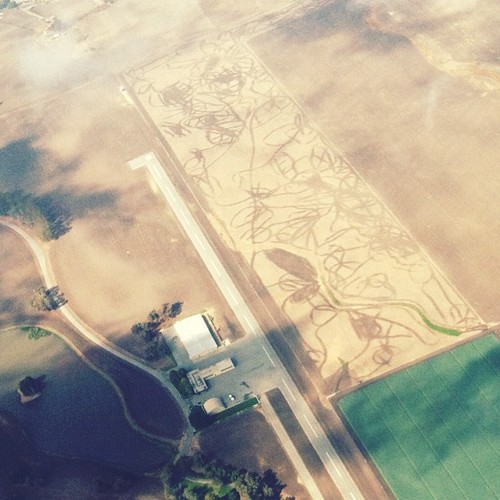
This weekend, I was afforded the opportunity to see my hometown from the sky, and among the observations I made — “People look like ants! Ants look like nothings!” and “I have become airsick!” and “Okay, now I feel better but I am so, so sorry” — was the following sight, captured through the magic of Instagram:


No, it’s not the solitary landing strip in the middle of San Benito County ag country, though that itself was a surprise. It’s the field that looks like it was manicured in a hilariously irregular fashion. Well, that’s being kind: It looks like someone trusted an intern with the task of crafting a festive harvest-time maze. It looks like a certain know-how skipped a generation. It looks like Farmer Joe maybe is brewing moonshine in addition to more traditional agricultural products. Whatever the story, is it not strange that this would happen on the farm of someone who owns a private landing strip and would therefore have the means to see how screwy it looked?

No one has been able to offer a reasonable explanation as to why someone would plow their field in this way, so I put the question to you, creative-ish people: Why do you think this happened?

Saturday, October 20, 2012

Ten Years Later? She's Still Not Sleeping

As of this weekend, The Ring is a decade old.


I wrote up a retrospective review for the blog Ten Years Ago, which you can read if you want to hear my thoughts on how the passage of time — and the passing of the Asian horror remake fad — have colored this film. (You know, more than those cyan filters colored it in the first place.) But you will have to click the link to read them. Here below, however, I give you my miscellaneous notes about The Ring, in classic A.V. Club style. Sadly, they may be more telling of how the last ten years have treated this movie than anything I say in my actual re-review.
  • I can’t decide if Ring parodies have helped or hurt the movie’s rep. It’s a toss-up, probably, but one spoof stands out: “Body Fuzion,” one of the first Saturday Night Live Digital Shorts. In the original broadcast, the Drew Barrymore-led workout clip turned out to be the video Aidan is watching, the one that prompted Rachel’s horrified reaction. In re-broadcasts, the Ring endjoke has been stripped, but I’m sure this version still exists somewhere online.
  • So who of this film’s cast has done the best career-wise? Watts’s career has cooled in recent years, but she’s playing Princess Diana in a buzzed-about upcoming film, and I feel most people still consider her a capable, reliable actress. The Ring also boasts a pre-O.C. Adam Brody as a spooked high schooler, but it’s maybe Pauley Perrette, who plays Noah’s college-aged fling, who’s come the farthest as far as mainstream popularity is concerned. No matter what anyone says, tons of people watch NCIS.
  • In a class by herself: Daveigh Chase. She’s something, even independent of Samara. She voiced both Lilo in Lilo & Stitch and Chihiro in Spirited Away, and she played the non-Gyllenhaal Darko sibling in Donnie Darko — a role she reprised in the rather meh sequel. She also played the manipulative Rhonda Volmer on Big Love, but her most recent feat to date is her involvement with a messy custody battle over a dog... named Stitch. Like I said, a class by herself.
  • Shannon Cochran played Samara’s mother, the one who bashed the little darling’s head in and dumped her in the well. She doesn’t have an extensive filmography, but she did play Pam Beasley’s mom in a 2005 episode of The Office before the role was recast. That puts Pam and Samara in the same category, at least in my head, and I think that is funny.
  • Gore Verbinski directed three Pirates of the Caribbean moves as well as the Oscar-winining Rango. Ehren Krueger wrote two Transformers movies. I maintain that The Ring is the best film either has been attached to.
  • The VHS tape isn’t the only antiquated technology in the film: landlines and non-flatscreen TVs abound. But this former newspaper editor had to cringe at the scenes of Rachel working in the bustling newsroom of the Seattle Post-Intelligencer, because that’s perhaps the most glaring example of something that was plausible in 2002 but is no longer so today.
  • Finally, if you’ve made it this far, you might be interested to read a personal intersection of my life and The Ring — the Amber Tamblyn corpse in particular. Enjoy!