Pages

Showing posts with label movie reviews. Show all posts

Saturday, October 20, 2012

Ten Years Later? She's Still Not Sleeping

As of this weekend, The Ring is a decade old.


I wrote up a retrospective review for the blog Ten Years Ago, which you can read if you want to hear my thoughts on how the passage of time — and the passing of the Asian horror remake fad — have colored this film. (You know, more than those cyan filters colored it in the first place.) But you will have to click the link to read them. Here below, however, I give you my miscellaneous notes about The Ring, in classic A.V. Club style. Sadly, they may be more telling of how the last ten years have treated this movie than anything I say in my actual re-review.
  • I can’t decide if Ring parodies have helped or hurt the movie’s rep. It’s a toss-up, probably, but one spoof stands out: “Body Fuzion,” one of the first Saturday Night Live Digital Shorts. In the original broadcast, the Drew Barrymore-led workout clip turned out to be the video Aidan is watching, the one that prompted Rachel’s horrified reaction. In re-broadcasts, the Ring endjoke has been stripped, but I’m sure this version still exists somewhere online.
  • So who of this film’s cast has done the best career-wise? Watts’s career has cooled in recent years, but she’s playing Princess Diana in a buzzed-about upcoming film, and I feel most people still consider her a capable, reliable actress. The Ring also boasts a pre-O.C. Adam Brody as a spooked high schooler, but it’s maybe Pauley Perrette, who plays Noah’s college-aged fling, who’s come the farthest as far as mainstream popularity is concerned. No matter what anyone says, tons of people watch NCIS.
  • In a class by herself: Daveigh Chase. She’s something, even independent of Samara. She voiced both Lilo in Lilo & Stitch and Chihiro in Spirited Away, and she played the non-Gyllenhaal Darko sibling in Donnie Darko — a role she reprised in the rather meh sequel. She also played the manipulative Rhonda Volmer on Big Love, but her most recent feat to date is her involvement with a messy custody battle over a dog... named Stitch. Like I said, a class by herself.
  • Shannon Cochran played Samara’s mother, the one who bashed the little darling’s head in and dumped her in the well. She doesn’t have an extensive filmography, but she did play Pam Beasley’s mom in a 2005 episode of The Office before the role was recast. That puts Pam and Samara in the same category, at least in my head, and I think that is funny.
  • Gore Verbinski directed three Pirates of the Caribbean moves as well as the Oscar-winining Rango. Ehren Krueger wrote two Transformers movies. I maintain that The Ring is the best film either has been attached to.
  • The VHS tape isn’t the only antiquated technology in the film: landlines and non-flatscreen TVs abound. But this former newspaper editor had to cringe at the scenes of Rachel working in the bustling newsroom of the Seattle Post-Intelligencer, because that’s perhaps the most glaring example of something that was plausible in 2002 but is no longer so today.
  • Finally, if you’ve made it this far, you might be interested to read a personal intersection of my life and The Ring — the Amber Tamblyn corpse in particular. Enjoy!

Friday, April 15, 2011

Scream 4: New Decade, Same Rules

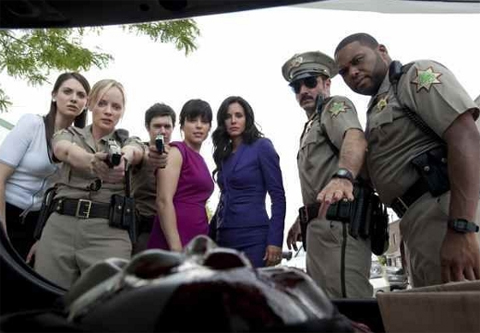
So Scream 4 hits theaters today, and therefore I can review it without needlessly spoiling. I held off on posting this beforehand, mostly because a thorough evaluation of the film would have to look at the plot as a whole, including who dies and who kills them. And I’ll get to that, but first let me offer a few non-spoilery thoughts. First, bad or good, Scream 4 will make enough money to warrant the release of Scream 5. Mark my words. Secondly, while Scream 4 doesn’t succeed on every level, it delivers enough scares and laughs to warrant its place in the franchise. Indeed, if most movie sequels were created with Scream 4’s love and respect for the movies that preceded it, then sequels wouldn’t have the bad reputation they have today.


The meat of it, in gory, insides-on-the-outside detail, after the jump.


A great example of Scream 4’s love for the previous Scream movies, I think, appears only a few minutes in, in the opening kill-off. Yes, like the other three movies, the main plot follows a vignette about some poor soul meeting a grisly end at the hands of Mr. Ghostface. In Scream 4, it’s Friday Nights Live actress Aimee Teegarden. And her final moments manage to call back to the two female victims of the first Scream: Drew Barrymore’s Casey Becker, as she’s ultimately reduced to feebly crawling away and the killer descends upon her, and Rose McGowan’s Tatum, as the killer lowers the garage door on her in a sort of taunting gesture. It’s a welcomed tip of the bloodstained mask to previous unlucky alumni of Woodsboro High.

At the same time, however, the opening scene departs from the original formula radically. For one, Aimee Teegarden isn’t a big-name star. I’ve never watched Friday Night Lights, and seeing her bumped off so early doesn’t generate the sense of horror I felt watching the little girl from E.T. get gutted in the original film. And then there’s the fact that before Teegarden’s character meets her doom, Scream 4 has already subjected the audience to two false starts. The movie opens with Shenae Grimes and Lucy Hale as the nubile young things preparing to watch a scary movie at home. You’d think they were the big-name victims — they’re at least familiar to the high school set, as Grimes stars on 90210 and Hale on Pretty Little Liars — But then Ghostface shows up and dispatches them rather rapidly, only to show that the whole scene is actually the beginning to a Stab movie. Then the action shifts to a different living room, with Anna Paquin and Kristen Bell watching the just-screen murder scene and commenting on the lameness of self-aware slashers… And you’d totally think that these two must be the celebri-corpses-to-be, given that they’re more like household names as a result of Bell’s cult following from Veronica Mars and Paquin’s from True Blood (not to mention that whole thing where she has an Oscar). But then Bell’s character tires of Paquin’s yammering and knifes her in the stomach, only for the scene to change again and reveal that both previous murder sequences were the movie-in-a-movie openings to yet a different Stab movie being watched by Teegarden and yet another familiar-to-teens, unknown-to-the-adult-world actress, Brittany Robertson. Finally, the killer shows up in this suburban, upper-middle class living room and the plot begins in earnest.

On one hand, it’s funny how the movie fucks with its viewers and their preconceived notions of how a Scream movie should unfold. And the scenes’ layering of fiction-on-reality-on-fiction works perfectly with the groundwork laid by the previous movies. On the other, it’s exhausting and a little too on-the-nose. And you’re still left with an opening scene victim who’s just not that famous. (Though considering that Scream 2’s opening scene victim was Jada Pinkett and Scream 3’s was Liev Schreiber, the opening victim’s A-list status may be more the exception than the rule. Yeah, Scream 3 did in Gossip Girl mom Kelly Rutherford too, but that was well before most people would have known her name.)

That, in a sense, sums up my feelings toward the whole film: at times great, and totally keeping up with the corn syrup-soaked legacy of the previous Screams and the first one in particular, but never fully re-creating the clenched-fists, edge-of-the-seat atmosphere of the first movie. Of course, this opinion probably has everything to do with the person reviewing: When I saw the first Scream, I had never seen a slasher movie in the theater before. Eleven years later, I’ve seen countless and am more or less numb to anything that could be thrown at me by a movie about a masked killer stalking sexy teens. So it goes.

As a big Scream fan, I enjoyed the nods to the past that occurred throughout the rest of the movie. For example, Gale Weathers being nearly filleted as a crowd of young people cheer through the opening to Stab, Heather Graham and all? It’s a great callback to Jada Pinkett’s murder scene in Scream 2 But the key word in that sentence is nearly. In the end, Gale survives. So do Dewey and Sidney. Everyone else dies, and this proved majorly problematic for me. I like the inference that “old Hollywood” and “old horror” ultimately outlasted the new generation of nobodies wanting their shot at fame. But if the people behind Scream 4 do indeed plan to make a fifth installment — and I honestly believe they will when they see the box office this one will make — I can’t imagine where they will go. This movie was the franchise’s chase with discarding the dead wood and moving in a new direction with characters who still have interesting territory to explore. Sidney, Gale and Dewey, however, don’t seem like they have far to go, and when the only other survivor is the minor comedy relief supplier, Deputy Judy Hicks (Marley Shelton), I have to wonder what could possibly await this little universe.

But I’m getting ahead of myself, talking about Scream 5. Scream 4 is what’s hitting theaters, and there’s still the single biggest plot point to consider: the killer. I have to admit I was surprised when the mask came off to reveal Emma Robert’s character, Jill, Sidney’s cousin and seemingly the next dark-haired final girl-in-training. It was the right move to make, especially in a series that hasn’t yet had a “girl” killer. (Mrs. Loomis in Scream 2 is a full-grown woman, and as a result of Laurie Metcalf’s portrayal, just barely qualifies as gendered.) And while I can’t fault Jill’s reasoning for killing off a good chunk of her graduating class — she just wanted to be famous, so she had organized the massacre so as to frame her boyfriend and make herself the new survivor, the new media darling, the successor to now-acclaimed authoress Sidney Prescott — but the dialogue explaining her motives was heavyhanded. She explained (and I’m paraphrasing here) that “you don’t need to be special to be famous today. You only need to have a lot of fucked-up shit happen to you” and she came just this short of making a joke about Kim Kardashian. I got the script’s implication about how fame works in 2011 versus in 1996, but I got it before Psycho Jill spelled it out so literally. Then again, maybe I’m forgetting that this movie’s target audience is teenagers weened on YouTube and Sparknotes and the exposition is therefore necessary. (Is Sparknotes even a thing anymore?) Personally, I more enjoyed the way Jill’s attempt to take over Sidney’s spot as the victimized survivor because it plays into the Hollywood ingenue cycle, in which of-the-moment actresses get replaced by more youthful newcomers, but the script seemed more concern with stepping onto a soapbox and addressing today’s prereqs for celebrity.

The rest of the movie, in scattered notes:

  • This film had a much higher body count than I had expected. At that, even, some of the kills were surprisingly gory. I didn’t expect to see Mariel Jaffe’s organs spill out, especially after the highly sanitized Scream 3. Way to earn that R rating, I guess.
  • So I think I like Emma Roberts and Hayden Panettiere now. Roberts I had only seen in the recent Nancy Drew reboot, which I only watched because I was on a plane. But I thought she succeeded in both extremes of her role: as the virginal victim and, once unmasked, as the unhinged killer. And the scene in which she beats the shit out of herself in order to make herself look like a victim had her pulling off some good physical comedy. Panettiere I had never been a fan of before, but she delivered her one-liners with good timing. In the end, I was sad when she got stabbed to death in a similar way to how I was sad when Parker Posey’s character bit it in Scream 3. I hoped that, in the end, her character might have somehow miraculously survived. She didn’t.
  • Speaking of Jennifer Jolie, I loved the scene in which Allison Brie’s character temporarily re-created the admirer-infuriator relationship that Jolie had with Gale Weathers in Scream 3. I didn’t love that Brie’s character acted more stupidly than a character in a Scream movie should. If you’re inside a car and the killer wants to kill you, why would you exit the vehicle and walk around stupidly rather than call the police on your phone? You deserved to get tossed off a parking garage, Annie Adderall.
  • Mary McDonnel (one of two Oscar-winners to bite it in this movie) was criminally underused, but at least she made the most of the few lines she had. I totally see why Lauren Graham walked away from the role, and I wonder how the character of Jill’s mom worked before the rewrites.
  • My guess as to who the killer was? Deputy Judy, especially when she revealed that she had gone to high school with Sidney. After Kevin Williamson had attempted to write Hallie as one of the killers in Scream 2 and Angelina as one of the killers in Scream 3, I was sure that this movie would feature a woman behind the mask. And I assumed that Williamson would have tried to re-incorporate the big reveal he wrote into the original Scream 3 draft, with actress and would-be Stab 3 star Angelina Tyler revealing herself to be Sidney’s jealous former classmate Angie Crick. (“I sat next to you in English class.”) Nope.
  • Another tip-off that the killer might be female? The soundtrack. Woman-fronted bands like The Sounds and Ida Maria suggested an emphasis on females doing what males might traditionally be expected to do. Noticeably lacking from this film’s soundtrack, however: “Red Right Hand.” New rules, I guess. But in its place “Axel F”? What the fuck?
  • In the early stages of production, Emma Roberts’s character was named Jill Kessler. In the final produce, it’s Jill Roberts. As in Emma Roberts? Was the character re-written to align with the actress playing her? It’s majorly weird, and a bit distracting, but it helps to flesh out Jill’s character a bit. In the film, Jill is jealous of Sidney’s fame and is angry for having lived nearly her whole life in her more famous relative’s shadow. Similarly, Emma Roberts has been compared to her much more famous aunt, Julia Roberts, for her whole career so far. Funny little parallel, right?
  • Given the message sent by the more established actors — Prescott, Cox and Arquette — outlasting the new crew, how interesting is it that the two killers are played by Emma Roberts and Rory Culkin, both of whom have immediately recognizable last names? (Culkin plays Charlie, Jill’s assistant and pawn, who ultimately gets done in by Jill in a similar fashion to Skeet Ulrich’s character overenthusiastically stabbing Matthew Lillard’s in the first Scream.) The implicit message? Established folk outlast younger folk, but the younger folk descended from Hollywood legacies outlast the ones with no major familial connection. This seems especially intentional given how important family bonds seem to be throughout the series.
And with all that, this screamer is about out of breath.

Monday, September 17, 2007

A Fistful of Quarters

Ultimately, when it comes to video games, the people who play them trump any pixel or electronic blip in terms of importance. A few recent examples notwithstanding, any video game is just a looped attract mode until a body bothers to step up and take the controls. It makes sense, then, that The King of Kong: A Fistful of Quarters focuses more on the two nuts who've devoted large chunks of their life to chasing to all-time top score of the 1981 arcade classic Donkey Kong than the game itself.


That's a good thing.

After all, anyone who's played Donkey Kong knows that the game doesn't waste a lot of time on exposition. Donkey Kong (the inexplicably named titular ape) steals a girl (known to the Japanese as "Lady" and to Americans as "Pauline) and waits atop a construction site for the hero (originally the carpenter "Jumpman," later retconned to be the plumber Mario.) Mario leaps over barrels and rescues Pauline, and then D.K. nabs her again. Much like the attract mode of an unplayed arcade game, the whole ordeal loops again and again. (Though not, as we learn in King of Kong, to infinity. More on that later.)

In a sense, that cycle could represent the trials of Steve Wiebe, who essentially serves as the documentary's hero. Arguably, director Seth Gordon does a fair job letting the real-life events play out without too much interference, and, thus, Wiebe's earnestness shines through during his struggles. Much like the little man hopping over the barrels, he repeatedly strives for a goal, we learn — being an athlete, being a musician, and finally becoming the world champion of Donkey Kong — only to have victory snatched away at the last minute. Ubergamer Billy Mitchell — who at the film's start holds the top score and who, at the time I'm writing this review, has reclaimed it once again — festers with creepiness as the film's antagonist, whose seeming reluctance to spar with Wiebe one-on-one lends him a certain sadness. The film practically begs the viewer to ask why, if Mitchell is truly the greatest player of this bygone video game, he won't prove himself in live competition with Wiebe.

I have to wonder if Mitchell really is the creepfest the film makes him to be. It makes sense to set the story up that way. Selling a documentary about gaming at all, much less about such a gamer niche culture, is tough, but putting an likable face like Wiebe's in the story helps. Like many of the people who are watching this film, Wiebe likes video games but doesn't seem like the retrogaming nerd-insider that virtually all of the other champions do. On that note, it seems plausible that Gordon could have just manipulated story to frame Mitchell as a villain, but I still can't discount the fact that Mitchell compared the controversial rivalry to the abortion issue. Yikes.

For those who don't know Donkey Kong from Q*Bert — and yes, Q*Bert comes up — King of Kong almost works as an anthropological study into a fringe society that puts video game mastery up there with feats of strength and academic excellence. These people are devoted more than most religious people I know. The utter amazement on these people's faces as Wiebe reaches the Donkey Kong kill screen — the glitch that prohibits a player from venturing more than five seconds into the twenty-second screen — makes me simultaneously proud and ashamed to love video games. Fortunately, the film offers a character who seems to share most of the world's bafflement with the game-crazed: Steve's Kristen Wiig-esque wife, who doles out well-intentioned but backhanded compliments as she attempts to understand her husband's obsession with Donkey Kong. (Also, as if to mirror the contrast between Steve and Billy, their respective wives could not be more dissimilar. If Mrs. Wiebe is Betty Hapschatt, then Mrs. Mitchell is Elvira. It's amazing.)

If you're like me, then you respect Donkey Kong for being a game that helped put Nintendo on the map and that gave a certain Italian plumber his break into video game history. It's a tough game, but beautiful in its simplicity. A certain geek endorphin kicked in when I saw those pixels projected onto the silver screen in a scale I haven't seen since The Wizard. It's great to see something that the rest of pop culture barely remembers being brought into the mainstream in such a creative way. And, for me, it was good to know that no matter how deep into geekdom my love for video games may take me, there's always someone geekier, at least as long as the guys from King of Kong are around.

That being said, I want to close with a random pop culture footnote that I find too hilarious to pass up. Mrs. Mitchell amuses me not only by virtue of being Mrs. Wiebe's polar opposite, but also in her resemblance to Pauline, the girl whom Donkey Kong kidnaps. In the 1981, when the game first came out, Pauline looked like this:


However, as time passed, the Princess usurped Pauline's place as Mario's main gal. She looked very similar, being skinny, blonde, Barbie-like and every bit the kind of damsel most men would want to rescue. As a result, Nintendo gave Pauline a makeover so people could tell the two characters apart.

First this:

Then this:


Finally, in the most recent Donkey Kong game — one released for the Nintendo DS last year — Pauline looked like this:


Everything, it seems, is not so easy for Pauline. And if Mrs. Mitchell were to be translated into video game form, the above woman would be her: the hair, the make-up, the very un-Nintendo-like giant boobs. Whether this was the result of careful selection on Billy Mitchell's part or mere coincidence, I find the resemblance eerie. And hilarious.

Tuesday, July 31, 2007

The Fate of Spider-Pig?

This is my belated review of The Simpsons Movie.

Fanboy ranting aside, I must say that The Simpsons Movie marked one of the better movie-going experiences I've had in a while. In addition to the Marge Simpson mask that I left the theater with, I can happily report that the film gave me a good 80 minutes of laughter — plus one moment of genuine concern when Julie Kavner surpassed the usual limitations of cartoon voice acting and, for a moment, really made me think Marge had decided to leave Homer forever.

I'm writing this now, when most of my readership has gone out and seen The Simpsons Movie, in hopes that I'd hear what you all thought. Though it amounted to as much as I could have hoped for from such a film, I have a few small critiques:
  • The lack of Mr. Burns. Easily my favorite character on the show, Mr. Burns's unabashed evil is something I look forward to. He has perhaps an even smaller role than even Flanders, which is a bit of a shame.
  • Other marginalized characters: Agnes Skinner, Moe, Apu, Patty and Selma, Groundskeeper Willy, Kirk Van Houten, Mrs. Krabappel, and Santa's Little Helper.
  • General focus on the Simpson family at the expense of the supporting characters. I realize that though I've laughed more at Homer than anyone else, the supporting roles make the show — especially the ones I perceive as either "predators" or "prey." And some of the ones who received airtime instead? Very strange. Lindsay Naegle? Really?
  • Total absence of Rainier Wolfcastle, as near as I can tell. Of course, President Arnold Schwarzenegger is basically the same character. But… you know.
  • And what, for the love of God, happened to poor Spider-Pig (a.k.a. Harry Plopper)? Did he die with the collapse of the Simpsons' home? I need closure on the character whose theme song has been stuck in my head all weekend.
  • Lamely, I read somewhere that the movie's creators tried to work in every character who has every been depicted as a resident of Springfield and therefore tried to catch as many non-speaking background characters as possible. Is it just me, then, or did I see Astrid Weller — Isabella Rossellini's character from the episode in which Homer makes outsider art — at a disproportionately high frequency?
Ralph Wiggum, however, appeared in precisely the amount he needed to. And Dr. Nick Riviera joining the likes of Maude Flanders, Bleeding Gums Murphy, Snowball II and Bea Simmons? A very welcome touch.

Saturday, April 7, 2007

Gruesome Friday

In inexcusable defiance of the Good Friday mandates, I spent one-eighth of it in a movie theater, staring at a film countless other sickos and disaffected weirdoes had no doubt been awaiting for months: Grindhouse. In my defense, I didn’t drink all day and while I was eating my hamburger I was secretly wishing that I had more French fries instead of a said meat patty.

That basically equals not eating meat, right?


Anyway, the point of the occasion was not just to catch the first legitimately good post-modern horror movie since Scream or even to watch two movies for the price of one. No, I went to see Tarantino’s latest. I saw Pulp Fiction on VHS, Jackie Brown on DVD and, finally, both volumes of Kill Bill in theaters — four times each, including once back-to-back at Campbell Hall. I think Tarantino’s movies are fun and eye-popping — yes, literally, ha ha — but also interesting commentaries on cinema itself and on the melting pot nature of California society. Simply put, I think Kill Bill was one of the most fascinating feminist films I have ever seen, even if it took a rather roundabout route to get to its message of maternal might.

To be fair, I was pleasantly surprised by Planet Terror, Robert Rodriguez’s contribution to the double feature. The idea of an Aliens-style zombie flick in which the undead are inexplicably wearing camouflage and shooting machine guns should repulse me, but Rodriguez made the jokes work surprisingly well and found a kickass leading lady in the form of Rose McGowan. I’ve had a small crush on McGowan ever since my 14-year-old self saw her in Scream — which incidentally came out ten years ago and marked the last time McGowan landed a decent role. As good as McGowan was, I’d be remiss to skip mention of Wendy Peppercorn herself, Marley Shelton, whose partially paralyzed bisexual syringe nympho doctor made for some of the film’s funniest moments, as the typical partially paralyzed bisexual syringe nympho stock characters often do.

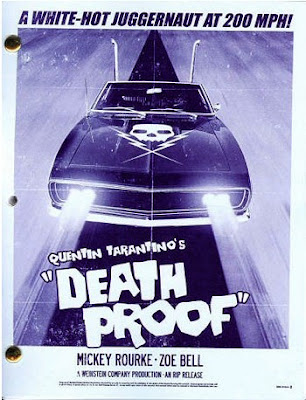
The real treat for me, however, was Death Proof, Tarantino’s contribution and a slasher in the loosest sense of the term. I’ve been perplexed by some reviews of Grindhouse which praise Planet Terror and deride Death Proof as dull, dialogue heavy and oddly paced. Granted, I’ve already blown by cover as a Tarantino fanboy by the preceding paragraphs, so my critical analysis of the film has already been rendered moot. Regardless, let me say that Death Proof expertly combined the slasher and car chase movies together to make a film that is uniquely American in its symbolism and perhaps a culmination of years of Freudian readings of previous lady-stalked-by-psycho-pervert movies.

I’ll go ahead anyway, if you’ll permit. (And please, if you have not seen the movie, please do so. It’s good. Also, what follows will spoil the film. You have been warned.)

Let me explain.

The film quickly introduces Jungle Julia (Sydney Poitier, formerly of Veronica Mars), an Austin DJ who meets up with two friends — Shanna (Jordan Ladd), a local, and Arlene (Vanessa Ferlito), a visitor — for drinks, food and more drinks. During the second round of drinking, Pam (Rose McGowan, playing the dumb blonde twin of her Planet Terror self) shows up and makes small talk with Stuntman Mike (Kurt Russel), a seemingly pitiable creep who drives a muscle car. When everybody is done drinking, Pam hitches a ride with Stuntman Mike, who assures that his car is “death proof” — only he means for him specifically and not Pam. Stuntman Mike whips the car around in such a manner that Pam is crushed to death inside the passenger side of the cab. Mike promptly flips a U and chases after Julia, Arlene and Shanna — who are purportedly heading up to a lakeside cabin for a girls’ weekend, a stereotypical set-up for a slasher movie plot if there ever was one — passes the girls, flips another U and then slams head-on into their car in one of the most jarringly gruesome crash scenes I have ever seen in a movie. Tarantino replays the moment of impact over and over again from each girl’s perspective. You see Julia’s leg get severed, Shanna be ejected high into the sky and the tires of Mike’s car drag across Arlene’s face in the back seat. It’s devastating, especially since the film does a decent job of making these girls seem likeable.

Mike survives.

Sometime later, we see another foursome: stuntwoman Kim (Tracie Thoms, light years away from her characters in Wonderfalls, Rent or The Devil Wears Prada), stuntwoman Zoe (Zoe Bell, Uma’s stuntwoman from Kill Bill, playing a slightly off version of her badass New Zealand herself), make-up artist Abernathy (Rosario Dawson) and starlet Lee (Mary Elizabeth Winstead). The girls are taking a road trip in celebration of a short holiday from work on a new movie.

Zoe admits that she wanted to pass through a certain rural town in order to test ride a certain model of Dodge Challenger — specifically the one Kowalski drives in Vanishing Point — and play ship’s mast, a game involving a person spreading themselves on a speeding car’s hood by securing hands to sideview mirrors with belts. They do — minus Lee, the collateral for use of the car — and Stuntman Mike shows up, delighting in the chance to run the women off the road. The women fight back, however, and following a half-hour car chase through the rural roads of Tennessee — actually Buellton and Solvang cow country — they manage to flip Mike’s car, whereupon they beat him to death in scene reminiscent of Faster, Pussycat! Kill! Kill!

Short and sweet.

What's driving me nuts is trying to figure out why the first group of girls died and the second survived. Death Proof marks the second occasion in which Tarantino has put female characters on a mission to violently rectify a wrong committed by an older male character. Now, as much of a dick as Tarantino can be, I think he earnestly loves women — as a group, as individuals and sometimes two at a time. And while the occasional grindhouse-era film did feature women as masters of their own fate — Switchblade Sisters, Lady Snowblood and Black Mama, White Mama, to name a few — more often than not the women in these movies either amounted to pretty background set pieces or cannon fodder. Thus, I feel like Tarantino is now making films that give these women a chance to strike back and mistreat their male captors with the same malice that their forerunners suffered.

So why favor the stuntwomen but allow the DJ and her friends to die so horribly?

I may be way off, but I feel like Tarantino may have written the two sets of women specifically to explain his thinking on the "right" kind of female movie character. Essentially, Julia and her friends are party girls. We don't see them do anything but drink, dance, smoke cigarettes, smoke pot and then die. Aside from breaking the cardinal rules of how to survive a horror film, Julia and her friends also exhibit ways in which they embody the stereotype of "the weaker sex."

Julia, an otherwise confident and powerful woman, steps away from the group to send pathetic text messages to some moviemaker love of hers. When it's clear the man will not be meeting up with her, she drunkenly texts "UR A ASSHOLE!" to him and mopes. Shanna seems too dumb to realize that the boys at the bar who can't remember her name probably don't give a shit about her other than as a sex object. And Arlene lets Julia guilt trip her into giving Stuntman Mike a lap dance as a dare. (The act, arguably, could be what seals the girls' fate as Mike's next victims.) Even Pam, a relatively minor character, speaks in a catty manner about growing up in Austin with Julia and then foolishly gets into a stranger’s car. Bad move, Pam.

The four later women act more sensibly. First off, they have passions — jobs they genuinely seem to love. Also, both Kim and Zoe are masculinized by the fact that they are stuntwomen and also, as we learn, gearheads. They get why the primo Dodge Challenger is such a big deal. However, both are feminine in their behavior — Kim admits to growing up watching John Hughes movies, for example, and all four dish about guys. They key difference here, as I see it, is how the rest of the girls treat their lovelorn member. Whereas Julia's friends don’t discourage her from pining for her director boyfriend, Abernathy's crew tell her to get over herself when she explains her unrequited love for her own auteur lover. Essentially, the group demands that its members stand up for themselves.

This notion comes into play when Abernathy, previously passive in how she deals with people, requests that they chase after Stuntman Mike. I believe her words come out as something like “Let’s kill the fucker.” Given such encouragement from a previously non-active character — a make-up artist and a mother, as Zoe mentions — the three launch after Mike’s car and eventually relish in beating the crap out of him. (He did, after all, endanger their lives as a means of getting his kicks.)

In a way, one could liken to Death Proof’s two parts to those of Psycho — with Julia, Arlene and Shanna being the dingy, flighty Marion Cranes who seem like they would be the central characters but who suddenly and violently fall victim to the killer. Kim, Zoe and Abernathy would be the level-headed Lila Cranes, who appear in the second segment and manage to reason their way out of a dangerous situation and avenge the death of their “sisters.”

That’s what I have so far, at least as something that can explain a movie that seems to be eliciting a divided reaction among viewers.

Other weirdness about Death Proof that merits mentioning:
  • In both segments, it’s the visitor who makes the group the target of Stuntman Mike. Initially, Arlene — a New Yorker, judging by her accent — sees Mike revving his car outside a restaurant they’re entering. Then she later gives him a lap dance knowing that he had followed the group from one stop to the next throughout the night. In the second part of the film, Zoe says being in the United States for the first time has finally given her an opportunity to check out the mythical car from Vanishing Point. Shortly after they find it, Mike shows up.
  • In the second segment, Abernathy mentions that the man she’s pining for slept with someone else — specifically Daryl Hannah’s stand-in on the movie she’s working on. Lanna Frank — Julia’s dealer and a less-important member of the group that dies in the first half of the film — is played by Monica Staggs, who actually was Daryl Hannah’s stunt double in Kill Bill.
  • When McGraw theorizes that Stuntman Mike kills women with his car in order to achieve sexual pleasure, he sets a very odd tone for the scene in which the stuntwomen, having turned the tables on Mike, chase after him, ramming him from behind. In the car crash-as-sicko sex metaphor, they’re raping him.
  • Both segments of Death Proof feature conversations in which someone is corrected for mispeaking. In the first, Shanna corrects a male character for calling her "Shauna." Shanna explains that "Every girl named Shanna has one thing in common: They hate the name 'Shauna.'" In the second part, Lee is joking chided for assuming Zoe is Australian. Says Abernathy: "Never call a Kiwi and Aussie."
  • Quentin Tarantino has to be the only white guy I know of who can write a part for a tall, beautiful black woman, cast Sidney Poitier’s daughter in the role, and then name the character “Jungle Julia” — all without getting his ass kicked.