
Showing posts with label scream 4. Show all posts
Showing posts with label scream 4. Show all posts
Saturday, April 16, 2011
The Final Girl (Who Likes Girls)
Question about Scream 4 that I haven’t had answered and that I’m posting online in hopes that the answer will just find me: What did Charlie and Robbie mean when they were explaining that the only way to survive a horror movie now is to be gay? Like, is that a thing — that gay characters in horror movies are somehow even safer than virgins? I’m struggling to think of a single gay character in a horror movie how fared better than the straights.

Friday, April 15, 2011
Scream 4: New Decade, Same Rules
So Scream 4 hits theaters today, and therefore I can review it without needlessly spoiling. I held off on posting this beforehand, mostly because a thorough evaluation of the film would have to look at the plot as a whole, including who dies and who kills them. And I’ll get to that, but first let me offer a few non-spoilery thoughts. First, bad or good, Scream 4 will make enough money to warrant the release of Scream 5. Mark my words. Secondly, while Scream 4 doesn’t succeed on every level, it delivers enough scares and laughs to warrant its place in the franchise. Indeed, if most movie sequels were created with Scream 4’s love and respect for the movies that preceded it, then sequels wouldn’t have the bad reputation they have today.
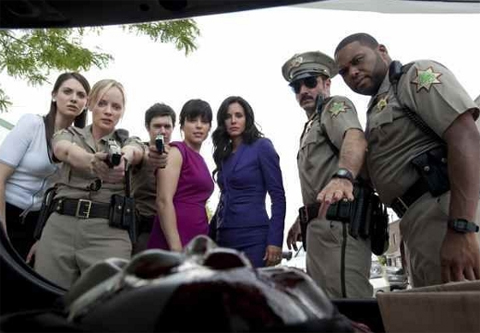
The meat of it, in gory, insides-on-the-outside detail, after the jump.
A great example of Scream 4’s love for the previous Scream movies, I think, appears only a few minutes in, in the opening kill-off. Yes, like the other three movies, the main plot follows a vignette about some poor soul meeting a grisly end at the hands of Mr. Ghostface. In Scream 4, it’s Friday Nights Live actress Aimee Teegarden. And her final moments manage to call back to the two female victims of the first Scream: Drew Barrymore’s Casey Becker, as she’s ultimately reduced to feebly crawling away and the killer descends upon her, and Rose McGowan’s Tatum, as the killer lowers the garage door on her in a sort of taunting gesture. It’s a welcomed tip of the bloodstained mask to previous unlucky alumni of Woodsboro High.
At the same time, however, the opening scene departs from the original formula radically. For one, Aimee Teegarden isn’t a big-name star. I’ve never watched Friday Night Lights, and seeing her bumped off so early doesn’t generate the sense of horror I felt watching the little girl from E.T. get gutted in the original film. And then there’s the fact that before Teegarden’s character meets her doom, Scream 4 has already subjected the audience to two false starts. The movie opens with Shenae Grimes and Lucy Hale as the nubile young things preparing to watch a scary movie at home. You’d think they were the big-name victims — they’re at least familiar to the high school set, as Grimes stars on 90210 and Hale on Pretty Little Liars — But then Ghostface shows up and dispatches them rather rapidly, only to show that the whole scene is actually the beginning to a Stab movie. Then the action shifts to a different living room, with Anna Paquin and Kristen Bell watching the just-screen murder scene and commenting on the lameness of self-aware slashers… And you’d totally think that these two must be the celebri-corpses-to-be, given that they’re more like household names as a result of Bell’s cult following from Veronica Mars and Paquin’s from True Blood (not to mention that whole thing where she has an Oscar). But then Bell’s character tires of Paquin’s yammering and knifes her in the stomach, only for the scene to change again and reveal that both previous murder sequences were the movie-in-a-movie openings to yet a different Stab movie being watched by Teegarden and yet another familiar-to-teens, unknown-to-the-adult-world actress, Brittany Robertson. Finally, the killer shows up in this suburban, upper-middle class living room and the plot begins in earnest.
On one hand, it’s funny how the movie fucks with its viewers and their preconceived notions of how a Scream movie should unfold. And the scenes’ layering of fiction-on-reality-on-fiction works perfectly with the groundwork laid by the previous movies. On the other, it’s exhausting and a little too on-the-nose. And you’re still left with an opening scene victim who’s just not that famous. (Though considering that Scream 2’s opening scene victim was Jada Pinkett and Scream 3’s was Liev Schreiber, the opening victim’s A-list status may be more the exception than the rule. Yeah, Scream 3 did in Gossip Girl mom Kelly Rutherford too, but that was well before most people would have known her name.)
That, in a sense, sums up my feelings toward the whole film: at times great, and totally keeping up with the corn syrup-soaked legacy of the previous Screams and the first one in particular, but never fully re-creating the clenched-fists, edge-of-the-seat atmosphere of the first movie. Of course, this opinion probably has everything to do with the person reviewing: When I saw the first Scream, I had never seen a slasher movie in the theater before. Eleven years later, I’ve seen countless and am more or less numb to anything that could be thrown at me by a movie about a masked killer stalking sexy teens. So it goes.
As a big Scream fan, I enjoyed the nods to the past that occurred throughout the rest of the movie. For example, Gale Weathers being nearly filleted as a crowd of young people cheer through the opening to Stab, Heather Graham and all? It’s a great callback to Jada Pinkett’s murder scene in Scream 2 But the key word in that sentence is nearly. In the end, Gale survives. So do Dewey and Sidney. Everyone else dies, and this proved majorly problematic for me. I like the inference that “old Hollywood” and “old horror” ultimately outlasted the new generation of nobodies wanting their shot at fame. But if the people behind Scream 4 do indeed plan to make a fifth installment — and I honestly believe they will when they see the box office this one will make — I can’t imagine where they will go. This movie was the franchise’s chase with discarding the dead wood and moving in a new direction with characters who still have interesting territory to explore. Sidney, Gale and Dewey, however, don’t seem like they have far to go, and when the only other survivor is the minor comedy relief supplier, Deputy Judy Hicks (Marley Shelton), I have to wonder what could possibly await this little universe.
But I’m getting ahead of myself, talking about Scream 5. Scream 4 is what’s hitting theaters, and there’s still the single biggest plot point to consider: the killer. I have to admit I was surprised when the mask came off to reveal Emma Robert’s character, Jill, Sidney’s cousin and seemingly the next dark-haired final girl-in-training. It was the right move to make, especially in a series that hasn’t yet had a “girl” killer. (Mrs. Loomis in Scream 2 is a full-grown woman, and as a result of Laurie Metcalf’s portrayal, just barely qualifies as gendered.) And while I can’t fault Jill’s reasoning for killing off a good chunk of her graduating class — she just wanted to be famous, so she had organized the massacre so as to frame her boyfriend and make herself the new survivor, the new media darling, the successor to now-acclaimed authoress Sidney Prescott — but the dialogue explaining her motives was heavyhanded. She explained (and I’m paraphrasing here) that “you don’t need to be special to be famous today. You only need to have a lot of fucked-up shit happen to you” and she came just this short of making a joke about Kim Kardashian. I got the script’s implication about how fame works in 2011 versus in 1996, but I got it before Psycho Jill spelled it out so literally. Then again, maybe I’m forgetting that this movie’s target audience is teenagers weened on YouTube and Sparknotes and the exposition is therefore necessary. (Is Sparknotes even a thing anymore?) Personally, I more enjoyed the way Jill’s attempt to take over Sidney’s spot as the victimized survivor because it plays into the Hollywood ingenue cycle, in which of-the-moment actresses get replaced by more youthful newcomers, but the script seemed more concern with stepping onto a soapbox and addressing today’s prereqs for celebrity.
The rest of the movie, in scattered notes:
A great example of Scream 4’s love for the previous Scream movies, I think, appears only a few minutes in, in the opening kill-off. Yes, like the other three movies, the main plot follows a vignette about some poor soul meeting a grisly end at the hands of Mr. Ghostface. In Scream 4, it’s Friday Nights Live actress Aimee Teegarden. And her final moments manage to call back to the two female victims of the first Scream: Drew Barrymore’s Casey Becker, as she’s ultimately reduced to feebly crawling away and the killer descends upon her, and Rose McGowan’s Tatum, as the killer lowers the garage door on her in a sort of taunting gesture. It’s a welcomed tip of the bloodstained mask to previous unlucky alumni of Woodsboro High.
At the same time, however, the opening scene departs from the original formula radically. For one, Aimee Teegarden isn’t a big-name star. I’ve never watched Friday Night Lights, and seeing her bumped off so early doesn’t generate the sense of horror I felt watching the little girl from E.T. get gutted in the original film. And then there’s the fact that before Teegarden’s character meets her doom, Scream 4 has already subjected the audience to two false starts. The movie opens with Shenae Grimes and Lucy Hale as the nubile young things preparing to watch a scary movie at home. You’d think they were the big-name victims — they’re at least familiar to the high school set, as Grimes stars on 90210 and Hale on Pretty Little Liars — But then Ghostface shows up and dispatches them rather rapidly, only to show that the whole scene is actually the beginning to a Stab movie. Then the action shifts to a different living room, with Anna Paquin and Kristen Bell watching the just-screen murder scene and commenting on the lameness of self-aware slashers… And you’d totally think that these two must be the celebri-corpses-to-be, given that they’re more like household names as a result of Bell’s cult following from Veronica Mars and Paquin’s from True Blood (not to mention that whole thing where she has an Oscar). But then Bell’s character tires of Paquin’s yammering and knifes her in the stomach, only for the scene to change again and reveal that both previous murder sequences were the movie-in-a-movie openings to yet a different Stab movie being watched by Teegarden and yet another familiar-to-teens, unknown-to-the-adult-world actress, Brittany Robertson. Finally, the killer shows up in this suburban, upper-middle class living room and the plot begins in earnest.
On one hand, it’s funny how the movie fucks with its viewers and their preconceived notions of how a Scream movie should unfold. And the scenes’ layering of fiction-on-reality-on-fiction works perfectly with the groundwork laid by the previous movies. On the other, it’s exhausting and a little too on-the-nose. And you’re still left with an opening scene victim who’s just not that famous. (Though considering that Scream 2’s opening scene victim was Jada Pinkett and Scream 3’s was Liev Schreiber, the opening victim’s A-list status may be more the exception than the rule. Yeah, Scream 3 did in Gossip Girl mom Kelly Rutherford too, but that was well before most people would have known her name.)
That, in a sense, sums up my feelings toward the whole film: at times great, and totally keeping up with the corn syrup-soaked legacy of the previous Screams and the first one in particular, but never fully re-creating the clenched-fists, edge-of-the-seat atmosphere of the first movie. Of course, this opinion probably has everything to do with the person reviewing: When I saw the first Scream, I had never seen a slasher movie in the theater before. Eleven years later, I’ve seen countless and am more or less numb to anything that could be thrown at me by a movie about a masked killer stalking sexy teens. So it goes.
As a big Scream fan, I enjoyed the nods to the past that occurred throughout the rest of the movie. For example, Gale Weathers being nearly filleted as a crowd of young people cheer through the opening to Stab, Heather Graham and all? It’s a great callback to Jada Pinkett’s murder scene in Scream 2 But the key word in that sentence is nearly. In the end, Gale survives. So do Dewey and Sidney. Everyone else dies, and this proved majorly problematic for me. I like the inference that “old Hollywood” and “old horror” ultimately outlasted the new generation of nobodies wanting their shot at fame. But if the people behind Scream 4 do indeed plan to make a fifth installment — and I honestly believe they will when they see the box office this one will make — I can’t imagine where they will go. This movie was the franchise’s chase with discarding the dead wood and moving in a new direction with characters who still have interesting territory to explore. Sidney, Gale and Dewey, however, don’t seem like they have far to go, and when the only other survivor is the minor comedy relief supplier, Deputy Judy Hicks (Marley Shelton), I have to wonder what could possibly await this little universe.
But I’m getting ahead of myself, talking about Scream 5. Scream 4 is what’s hitting theaters, and there’s still the single biggest plot point to consider: the killer. I have to admit I was surprised when the mask came off to reveal Emma Robert’s character, Jill, Sidney’s cousin and seemingly the next dark-haired final girl-in-training. It was the right move to make, especially in a series that hasn’t yet had a “girl” killer. (Mrs. Loomis in Scream 2 is a full-grown woman, and as a result of Laurie Metcalf’s portrayal, just barely qualifies as gendered.) And while I can’t fault Jill’s reasoning for killing off a good chunk of her graduating class — she just wanted to be famous, so she had organized the massacre so as to frame her boyfriend and make herself the new survivor, the new media darling, the successor to now-acclaimed authoress Sidney Prescott — but the dialogue explaining her motives was heavyhanded. She explained (and I’m paraphrasing here) that “you don’t need to be special to be famous today. You only need to have a lot of fucked-up shit happen to you” and she came just this short of making a joke about Kim Kardashian. I got the script’s implication about how fame works in 2011 versus in 1996, but I got it before Psycho Jill spelled it out so literally. Then again, maybe I’m forgetting that this movie’s target audience is teenagers weened on YouTube and Sparknotes and the exposition is therefore necessary. (Is Sparknotes even a thing anymore?) Personally, I more enjoyed the way Jill’s attempt to take over Sidney’s spot as the victimized survivor because it plays into the Hollywood ingenue cycle, in which of-the-moment actresses get replaced by more youthful newcomers, but the script seemed more concern with stepping onto a soapbox and addressing today’s prereqs for celebrity.
The rest of the movie, in scattered notes:
- This film had a much higher body count than I had expected. At that, even, some of the kills were surprisingly gory. I didn’t expect to see Mariel Jaffe’s organs spill out, especially after the highly sanitized Scream 3. Way to earn that R rating, I guess.
- So I think I like Emma Roberts and Hayden Panettiere now. Roberts I had only seen in the recent Nancy Drew reboot, which I only watched because I was on a plane. But I thought she succeeded in both extremes of her role: as the virginal victim and, once unmasked, as the unhinged killer. And the scene in which she beats the shit out of herself in order to make herself look like a victim had her pulling off some good physical comedy. Panettiere I had never been a fan of before, but she delivered her one-liners with good timing. In the end, I was sad when she got stabbed to death in a similar way to how I was sad when Parker Posey’s character bit it in Scream 3. I hoped that, in the end, her character might have somehow miraculously survived. She didn’t.
- Speaking of Jennifer Jolie, I loved the scene in which Allison Brie’s character temporarily re-created the admirer-infuriator relationship that Jolie had with Gale Weathers in Scream 3. I didn’t love that Brie’s character acted more stupidly than a character in a Scream movie should. If you’re inside a car and the killer wants to kill you, why would you exit the vehicle and walk around stupidly rather than call the police on your phone? You deserved to get tossed off a parking garage, Annie Adderall.
- Mary McDonnel (one of two Oscar-winners to bite it in this movie) was criminally underused, but at least she made the most of the few lines she had. I totally see why Lauren Graham walked away from the role, and I wonder how the character of Jill’s mom worked before the rewrites.
- My guess as to who the killer was? Deputy Judy, especially when she revealed that she had gone to high school with Sidney. After Kevin Williamson had attempted to write Hallie as one of the killers in Scream 2 and Angelina as one of the killers in Scream 3, I was sure that this movie would feature a woman behind the mask. And I assumed that Williamson would have tried to re-incorporate the big reveal he wrote into the original Scream 3 draft, with actress and would-be Stab 3 star Angelina Tyler revealing herself to be Sidney’s jealous former classmate Angie Crick. (“I sat next to you in English class.”) Nope.
- Another tip-off that the killer might be female? The soundtrack. Woman-fronted bands like The Sounds and Ida Maria suggested an emphasis on females doing what males might traditionally be expected to do. Noticeably lacking from this film’s soundtrack, however: “Red Right Hand.” New rules, I guess. But in its place “Axel F”? What the fuck?
- In the early stages of production, Emma Roberts’s character was named Jill Kessler. In the final produce, it’s Jill Roberts. As in Emma Roberts? Was the character re-written to align with the actress playing her? It’s majorly weird, and a bit distracting, but it helps to flesh out Jill’s character a bit. In the film, Jill is jealous of Sidney’s fame and is angry for having lived nearly her whole life in her more famous relative’s shadow. Similarly, Emma Roberts has been compared to her much more famous aunt, Julia Roberts, for her whole career so far. Funny little parallel, right?
- Given the message sent by the more established actors — Prescott, Cox and Arquette — outlasting the new crew, how interesting is it that the two killers are played by Emma Roberts and Rory Culkin, both of whom have immediately recognizable last names? (Culkin plays Charlie, Jill’s assistant and pawn, who ultimately gets done in by Jill in a similar fashion to Skeet Ulrich’s character overenthusiastically stabbing Matthew Lillard’s in the first Scream.) The implicit message? Established folk outlast younger folk, but the younger folk descended from Hollywood legacies outlast the ones with no major familial connection. This seems especially intentional given how important family bonds seem to be throughout the series.
Thursday, March 31, 2011
Do You Like Scary Deleted Scenes?
It’s not a spoiler to say so, I guess, but when I watched Scream 4 I didn’t see this scene.
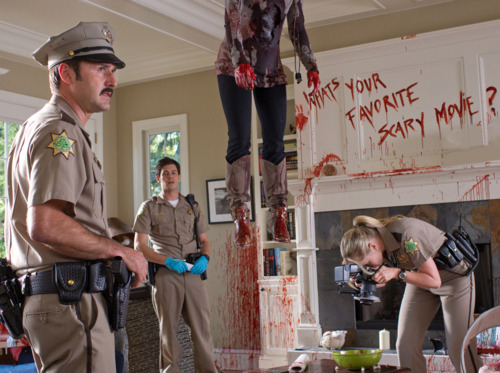
Unless I zoned out for it, it wasn’t in the movie. Seem like a pretty elaborate scene to leave on the cutting room floor, no?
That’s not to mention that Marielle Jaffe’s “Time for someone new to die” line and the scene it appears in — the homage to the water fountain scene in the original — also didn’t show up. It is in the trailer, however.
Did I go to the bathroom and forget that I stepped out for a few minutes?
Unless I zoned out for it, it wasn’t in the movie. Seem like a pretty elaborate scene to leave on the cutting room floor, no?
That’s not to mention that Marielle Jaffe’s “Time for someone new to die” line and the scene it appears in — the homage to the water fountain scene in the original — also didn’t show up. It is in the trailer, however.
Friday, March 25, 2011
Horror in the Grocery Store
First, a disclaimer: Yes, this is technically another post about Scream, superficially, anyway. But it’s also about me. I’m not sure that generates any more incentive to read this post, but that’s what I can give you.
Let me set the scene. The grocery store — the one nearest my house and the one that has been the setting for my oddest interactions since I moved to Los Angeles. I’m in line for check out when people come queue up behind me. I casually look to see who’s there, and in the instant I glance at the girl standing closest to me, I feel a twinge of recognition. I turn away, and that’s when I realize it’s a combination of “I know her!” and “The last time I saw her, she was dead.” The reaction hits me hard enough that I look back at her, mostly because I’ve never had to process the strangeness of seeing a person who I’ve previously seen die. It’s a pretty awkward double take. Had I been acting in a movie, the director would have accused me of overplaying the scene. I’m lingering. She notices. “Hi,” she says, annoyed and on the offense. I realize how weird I must seem and force a smile. “Hi,” I say, surely sounding like a creep. I turn around, this time for good, but I imagine that her disdain for me burns a hole into the back of my head.
I reacted in the way I did because I saw this actress die in Scream 4 just a few days ago. Though she’s acted in other projects, they’re mostly teen and tween fodder, and I’ve never watched them. Consequently, her performance in Scream 4 — in which the most memorable thing she does is get stabbed to death — is all I really know of her. And yet here she is, alive and buying food, just like me. It feels strange having to so quickly reconcile a real-life actress with her fate as a character on a screen, and I’d never experienced it this way before. Moving to Los Angeles, I figured that I’d occasionally see actors, and I have and it’s never been a problem. But at the grocery store, it was a problem, because it aggressively conflicted with the way I watch movies. When I walk into a theater and the lights go down, I wholeheartedly buy into the universe presented before me. I’m not a crazy person who thinks that what happens in movies and TV actually happens in real life, but the only way I know how to experience these stories is to surrender my reality to the one on the screen, at least until plot holes or bad acting or some technical fault render that world too implausible. And that’s what I did at and throughout the Scream 4 preview, even though the movie presented a few obstacles to that kind of viewing. Regardless, it felt jarring to have that illusion broken so suddenly.
It’s tough for me to put in words, I guess. I’m not traumatized and I’m not in disbelief, but I think I might appreciate more separation between my fiction and my fact. To use the Scream movies as an example, there are two actors who have died in the series who I’ve later seen in real life: Drew Barrymore (at Coachella a few years ago) and Elise Neal (at a party in LA a few months ago). Didn’t bother me. I’m familiar with both as actors outside of the Scream movies, and a comforting amount of time went by between seeing the movies and seeing the actors. Tonight was different.
Can I use an example? Great. I will. In searching for something to compare it to, I arrive at that scene in Mulholland Drive when Naomi Watts and Laura Elena Harring venture into the closed-up apartment, see the corpse and then go running out, images of them fragmenting off and spinning around their bodies for a few moments before converging back on the actresses. It’s an exaggerated example, I know, and yes, using a movie to explain the weirdness of reconciling a movie with real life might indicate that I’m an individual who has issues grasping reality. Whatever. The point is that the characters Watts and Harring play in that scene aren’t real, and that fake, Hollywoody reality eventually gives way to something harsher and grittier. Someone analyzing the symbolic language of film might interpret the scene with the visibly fragmented characters as foreshadowing for the beginning of the end of the fake reality. And that, in a muted, I-swear-I’m-not-crazy sense, is what I felt today. (Speaking of David Lynch weirdness, I at this point should probably mentioned that this morning I saw Laura Dern in my office parking lot. I recognized her and said hello. Yeah, Los Angeles is weird.)
What else can I draw into this mess of thoughts and movies and perception and myself? Only that I watched this week’s Community after the grocery store incident, and was taken aback by the Abed plotline, about him visiting the set of Cougar Town and experiencing a similar disconnect between “stories” and reality. He talks about seeing Courteney Cox and her being the trigger for his realization about fictional characters being false. And it was strange, given that I saw this very woman just a few days ago at the press conference for Scream 4. In fact, it was at that press conference that Hayden Panettiere, of all people, did a good job of summing up my feelings about the difference between real life and these fictional worlds we tend to invest ourselves in. Panettiere mentioned how strange it felt to her to grow up liking the Scream movies and then to be in this new one rather than just experiencing it by watching it. Granted, this sort of experience hits actors a whole lot harder, I’m sure, but I have to hand it to little Maddie Harrington for putting into words an uncanny, hard-to-describe sensation that I’d later experience — as a result of one of her costars, no less.
In the end, I learned nothing. Movies are fake, and I continue to know this. But that doesn’t mean that the way I watch movies and TV and any other staged fakeness might happen differently now.
I promise the next thing I post here won’t be Scream-related. But I think there’s a few more waiting to happen in the not-too-distant future. Apologies, non-fans. But hey — it’s just a movie.
 |
I reacted in the way I did because I saw this actress die in Scream 4 just a few days ago. Though she’s acted in other projects, they’re mostly teen and tween fodder, and I’ve never watched them. Consequently, her performance in Scream 4 — in which the most memorable thing she does is get stabbed to death — is all I really know of her. And yet here she is, alive and buying food, just like me. It feels strange having to so quickly reconcile a real-life actress with her fate as a character on a screen, and I’d never experienced it this way before. Moving to Los Angeles, I figured that I’d occasionally see actors, and I have and it’s never been a problem. But at the grocery store, it was a problem, because it aggressively conflicted with the way I watch movies. When I walk into a theater and the lights go down, I wholeheartedly buy into the universe presented before me. I’m not a crazy person who thinks that what happens in movies and TV actually happens in real life, but the only way I know how to experience these stories is to surrender my reality to the one on the screen, at least until plot holes or bad acting or some technical fault render that world too implausible. And that’s what I did at and throughout the Scream 4 preview, even though the movie presented a few obstacles to that kind of viewing. Regardless, it felt jarring to have that illusion broken so suddenly.
It’s tough for me to put in words, I guess. I’m not traumatized and I’m not in disbelief, but I think I might appreciate more separation between my fiction and my fact. To use the Scream movies as an example, there are two actors who have died in the series who I’ve later seen in real life: Drew Barrymore (at Coachella a few years ago) and Elise Neal (at a party in LA a few months ago). Didn’t bother me. I’m familiar with both as actors outside of the Scream movies, and a comforting amount of time went by between seeing the movies and seeing the actors. Tonight was different.
Can I use an example? Great. I will. In searching for something to compare it to, I arrive at that scene in Mulholland Drive when Naomi Watts and Laura Elena Harring venture into the closed-up apartment, see the corpse and then go running out, images of them fragmenting off and spinning around their bodies for a few moments before converging back on the actresses. It’s an exaggerated example, I know, and yes, using a movie to explain the weirdness of reconciling a movie with real life might indicate that I’m an individual who has issues grasping reality. Whatever. The point is that the characters Watts and Harring play in that scene aren’t real, and that fake, Hollywoody reality eventually gives way to something harsher and grittier. Someone analyzing the symbolic language of film might interpret the scene with the visibly fragmented characters as foreshadowing for the beginning of the end of the fake reality. And that, in a muted, I-swear-I’m-not-crazy sense, is what I felt today. (Speaking of David Lynch weirdness, I at this point should probably mentioned that this morning I saw Laura Dern in my office parking lot. I recognized her and said hello. Yeah, Los Angeles is weird.)
What else can I draw into this mess of thoughts and movies and perception and myself? Only that I watched this week’s Community after the grocery store incident, and was taken aback by the Abed plotline, about him visiting the set of Cougar Town and experiencing a similar disconnect between “stories” and reality. He talks about seeing Courteney Cox and her being the trigger for his realization about fictional characters being false. And it was strange, given that I saw this very woman just a few days ago at the press conference for Scream 4. In fact, it was at that press conference that Hayden Panettiere, of all people, did a good job of summing up my feelings about the difference between real life and these fictional worlds we tend to invest ourselves in. Panettiere mentioned how strange it felt to her to grow up liking the Scream movies and then to be in this new one rather than just experiencing it by watching it. Granted, this sort of experience hits actors a whole lot harder, I’m sure, but I have to hand it to little Maddie Harrington for putting into words an uncanny, hard-to-describe sensation that I’d later experience — as a result of one of her costars, no less.
In the end, I learned nothing. Movies are fake, and I continue to know this. But that doesn’t mean that the way I watch movies and TV and any other staged fakeness might happen differently now.
I promise the next thing I post here won’t be Scream-related. But I think there’s a few more waiting to happen in the not-too-distant future. Apologies, non-fans. But hey — it’s just a movie.
Friday, June 18, 2010
The Kevin Williamson School of Character Naming
Though I tried to avoid news about the new Scream sequel, I ended up reading an item about Lauren Graham being cast in it. I like Lauren Graham. I think she’s a talented actress — more of a comedic one, sure, but a good one nonetheless who may well get to use her full range in this new Scream movie. Her joining Scream 4 was enough to make me investigate this rather unexpected sequel in order to see what it was really about. The film has Emma Roberts playing what I assume to be the central role: Jill Kessler, the cousin of Neve Campbell’s character. Graham plays the character’s mother, Kate Kessler. Sidney Prescott (Cambell), Dewey Riley (David Arquette) and Gale Weathers (Courtney Cox) are all returning, even though the movie will focus largely on a new batch of potential corpses. The film takes place ten years after the events of Scream 3.
So there’s that. Personally, I feel the series should have died with the third movie and poor Jennifer Jolie — the kind of amazing character Parker Posey played, whose name seems to associate Jennifer Aniston and Angelina Jolie long before they ever had a reason to be associated. However, I will nonetheless see Scream 4 in the theater and be entertained, so perhaps this extension beyond the original planned trilogy will prove to be a worthwhile venture after all.
The fact that Roberts and Graham’s characters have the last name Kessler reminded me of a certain habit that series creator Kevin Williamson has when naming his characters. Williamson — the writer of Scream and most recently The Vampire Diaries — tends to favor certain types of names. Consider, if you will, the following:
In Scream, there’s Casey Becker (Drew Barrymore) and Stu Macher (Matthew Lillard). In Scream 2, there’s Cici Cooper (Sarah Michelle Gellar). In Dawson’s Creek, there’s Joey Potter (Katie Homes) and Pacey Witter (Joshua Jackson). In The Faculty, there’s Nurse Harper (Salma Hayek). In Teaching Miss Tingle, there’s Luke Churner (Barry Watson) and Principal Potter (Michael McKean). In the short-lived ABC series Wastleland, there’s Jesse Presser (Sasha Alexander) and Dawnie Parker (Marisa Coughlan). In the WB series Glory Days, there’s Zane Walker (Ben Crowley). In the CW series Hidden Palms, there’s Johnny Miller (Taylor Handley) and Liza Witter (Ellary Porterfield).
Weird, huh? I’d almost argue that he’s using “agent” names as a shorthand way of defining his characters, but I don’t think that’s the case. Having the last name Becker seems to have little bearing on Drew Barrymore’s character in Scream, unless the etymology of Becker goes back to something meaning “person who dies unexpectedly soon.” And it’s also not that Williamson is choosing common last names. Cooper and Parker might show up a lot in any given American phonebook, sure, but how often do you meet people with the last name Churner? Presser? Witter?
Though the “agent” names show up the most frequently in Williamson’s work, they’re not the only ones that show up more than once.
He also likes surnames that end in s:
And then there are a whole lot of names that show up twice in Williamson’s work — newscasters named Gail appear in both the Screams and Dawson’s Creek, Casey is also the name of Elijah Woods’s character in The Faculty, there’s a Dawnie in both Scream 2 and Wasteland, and Sarah Michelle Gellar’s character mentions a Dawson’s Beach in I Know What You Did Last Summer, just to name a few. And even though Williamson is apparently not credited with any work on Halloween: 20 Years Later, at least according to IMDb, I’m pretty sure he at least wrote a treatment for the film, which could account for why it features Jamie Lee Curtis’s character starting a new life as a high school English teacher named Ms. Tate, which happens to be the name of Sidney’s English teacher in Scream.
So what have we learned?
For one, I have a weirdly encyclopedic knowledge of the work of Kevin Williamson — not because I love all of it, but mostly because I loved Scream enough that I’ve interestedly tracked this writer’s career for the last decade-and-a-half. I also, for some reason, still remember the name of Sidney Prescott’s English teacher, even though she only appears in Scream for about ten seconds and even though her name may only be mentioned in the script and not the film itself. That all aside, what I was hoping to point out is that Williamson clearly has developed a few naming conventions within his work. I honestly wonder if it’s intentional or if it’s the result of something subconscious. For what it’s worth, the IMDb page for Scream 4 also lists Hayden Panettiere as playing Kirby Reed (girl with guy’s name), Rory Culkin as playing Charlie Walker (surname ends in er) and Lake Bell as playing Judy Hicks (surname ends in s). So if Williamson is aware of these habits, he certainly has no intention of changing them.
NOTE: Anyone who saw Scream 4 knows that Jill and Kate Kessler became Jill and Kate Roberts. I do not know if this happened before or after Ehren Kruger revised parts of the script, but Roberts is still a name that ends in s. Also, Kate ended up being played by Mary McDonnell, but that’s neither here nor there.
So there’s that. Personally, I feel the series should have died with the third movie and poor Jennifer Jolie — the kind of amazing character Parker Posey played, whose name seems to associate Jennifer Aniston and Angelina Jolie long before they ever had a reason to be associated. However, I will nonetheless see Scream 4 in the theater and be entertained, so perhaps this extension beyond the original planned trilogy will prove to be a worthwhile venture after all.
The fact that Roberts and Graham’s characters have the last name Kessler reminded me of a certain habit that series creator Kevin Williamson has when naming his characters. Williamson — the writer of Scream and most recently The Vampire Diaries — tends to favor certain types of names. Consider, if you will, the following:
In Scream, there’s Casey Becker (Drew Barrymore) and Stu Macher (Matthew Lillard). In Scream 2, there’s Cici Cooper (Sarah Michelle Gellar). In Dawson’s Creek, there’s Joey Potter (Katie Homes) and Pacey Witter (Joshua Jackson). In The Faculty, there’s Nurse Harper (Salma Hayek). In Teaching Miss Tingle, there’s Luke Churner (Barry Watson) and Principal Potter (Michael McKean). In the short-lived ABC series Wastleland, there’s Jesse Presser (Sasha Alexander) and Dawnie Parker (Marisa Coughlan). In the WB series Glory Days, there’s Zane Walker (Ben Crowley). In the CW series Hidden Palms, there’s Johnny Miller (Taylor Handley) and Liza Witter (Ellary Porterfield).
Weird, huh? I’d almost argue that he’s using “agent” names as a shorthand way of defining his characters, but I don’t think that’s the case. Having the last name Becker seems to have little bearing on Drew Barrymore’s character in Scream, unless the etymology of Becker goes back to something meaning “person who dies unexpectedly soon.” And it’s also not that Williamson is choosing common last names. Cooper and Parker might show up a lot in any given American phonebook, sure, but how often do you meet people with the last name Churner? Presser? Witter?
Though the “agent” names show up the most frequently in Williamson’s work, they’re not the only ones that show up more than once.
He also likes surnames that end in s:
In Scream, there’s Randy Meeks. In Scream 2, there’s Maureen Evans (Jada Pinkett) and Phil Stevens (Omar Epps). In Teaching Miss Tingle, there’s Miss Banks (Molly Ringwald). In Glory Days, there’s Ellie Sparks (Poppy Montgomery). In Hidden Palms, there’s Gretta Matthews (Amber Heard) and Nikki Barnes (Tessa Thompson).He also likes surnames that end in y:
In Scream, there’s Tatum Riley (Rose McGowan), Cotton Weary (Liev Schreiber) and Principal Himbry (Henry Winkler). In Dawson’s Creek, there’s Dawson Leery (James Van Der Beek) and Jen Lindley (Michelle Williams). In Hidden Palms, there’s Bob and Karen Hardy (D.W. Moffett and Gail O’Grady).And he also likes to give masculine names to female characters:
In Scream, there’s Sidney Prescott. In Scream 2, there’s Murphy (Portia de Rossi). In Dawson’s Creek, there’s Andie McPhee (Meredith Monroe). In The Faculty, there’s Stokely “Stokes” Mitchell (Clea DuVall). In Wasteland, there’s Sam Price (Rebecca Gayheart).(Note: These lists exclude Scream 3, which Williamson had a hand in creating but the script for which was written by Ehren Krueger. It also leaves out I Know What You Did Last Summer and The Vampire Diaries, since they’re both based on books I have not read and I’m therefore not sure whether the characters in these were named by Williamson. And, finally, it skips the majority of Dawson’s Creek, since Williamson left the show in its second season.)
And then there are a whole lot of names that show up twice in Williamson’s work — newscasters named Gail appear in both the Screams and Dawson’s Creek, Casey is also the name of Elijah Woods’s character in The Faculty, there’s a Dawnie in both Scream 2 and Wasteland, and Sarah Michelle Gellar’s character mentions a Dawson’s Beach in I Know What You Did Last Summer, just to name a few. And even though Williamson is apparently not credited with any work on Halloween: 20 Years Later, at least according to IMDb, I’m pretty sure he at least wrote a treatment for the film, which could account for why it features Jamie Lee Curtis’s character starting a new life as a high school English teacher named Ms. Tate, which happens to be the name of Sidney’s English teacher in Scream.
So what have we learned?
For one, I have a weirdly encyclopedic knowledge of the work of Kevin Williamson — not because I love all of it, but mostly because I loved Scream enough that I’ve interestedly tracked this writer’s career for the last decade-and-a-half. I also, for some reason, still remember the name of Sidney Prescott’s English teacher, even though she only appears in Scream for about ten seconds and even though her name may only be mentioned in the script and not the film itself. That all aside, what I was hoping to point out is that Williamson clearly has developed a few naming conventions within his work. I honestly wonder if it’s intentional or if it’s the result of something subconscious. For what it’s worth, the IMDb page for Scream 4 also lists Hayden Panettiere as playing Kirby Reed (girl with guy’s name), Rory Culkin as playing Charlie Walker (surname ends in er) and Lake Bell as playing Judy Hicks (surname ends in s). So if Williamson is aware of these habits, he certainly has no intention of changing them.

NOTE: Anyone who saw Scream 4 knows that Jill and Kate Kessler became Jill and Kate Roberts. I do not know if this happened before or after Ehren Kruger revised parts of the script, but Roberts is still a name that ends in s. Also, Kate ended up being played by Mary McDonnell, but that’s neither here nor there.
Tuesday, January 20, 2009
Still Screaming After All These Years
On the heels of my post about the movie adaptation of Where the Wild Things Are, I offer this, however unenthusiastically: We will someday see Scream 4. By which I mean that we may someday see commercials and billboards promoting it and likely bearing the text “Scream 4.” Whether any of us will go see the actual film is another matter altogether.
An allegedly credible source recently leaked the news that director Wes Craven (whose filmography includes the previous Scream movies, A Nightmare on Elm Street, and the poorly conceived but hilariously named Shocker) and screenwriter Kevin Williamson (Scream and Dawson’s Creek, both of which he departed from before their conclusions) may retream for another round of self-referential horror comedy, this one, of course, involving a newer, younger set of potential body bag-fillers. Whether the rumor even approaches the truth remains to be seen, of course, but the possibility of Scream 4 ever hitting theaters prompted me to reflect on the original movie.
Looking at this blog as a gauge of what has grabbed my attention over the past few years, a reader could hardly tell that the first Scream played a major role in my teenage years and, now that I think about it, helped me love movies in general. I haven’t written much about Scream here, perhaps because the passage of team has strengthened my critical eye and perhaps because I eventually realized that the people who rave about slasher movies are, in general, weirdos.
Whatever the reason, the three Scream movies now represent a part of my life that feels longer ago than it actually was: high school. And rightly so — the movies basically framed my high school years, with the first coming out at the start of my freshman year and the third in the winter of my senior year. A relic of my former life though these movies may no be, they nonetheless made an impact on me — and pop culture in general.
In short, this: The mantra of the frightened movie-goer who is trying to mentally escape the dread of being slashed to death on the spot by a cinematic psychokiller is “It’s only a movie. It’s only a movie. It’s only a movie,” or so we’re told. When it comes to Scream, however, I’m willing to argue that it’s not only a movie.

Outside the context of my life, I think it’s interesting to look at Scream in the context of the flood of that particular type of self-aware, teenage-centered TV shows and movies that followed and which were released between the time I was 14 and 18 years old. Many owed a debt to Scream in some way. Think about it: Scream put Williamson on the map. Following its success in 1996, we had Dawson’s Creek, which Williamson created; the “true” TV series incarnation of Buffy the Vampire Slayer, which mixed teenaged angst, pop culture references and horror in a way that it may not have been able to do successfully were it not for Scream; and movies like She’s All That, which starred an astounding number of alumni from previous Kevin Williamson efforts. And She’s All That was released in 1999 — only three years after Scream hit theaters — which goes to show how quickly Williamson built a small teenspoitation empire. Even today, anytime a twentysomething actor playing a Billy Everyteen spouts a pop culture reference to emphasize a point, I think of Williamson, the guy who once turned a conversation about an edited-for-TV broadcast of The Exorcist into a PG-13-appropriate booty call.
Independent of the pop culture continuum, Scream resonated with me personally because, to put it simply, I was the perfect person to watch it. The 14-year-old version of me who wandered into the theater to watch Scream literally knew nothing about it save for the fact that the girl from E.T. was in it. Seriously. That’s it. I didn’t even know that Drew Barrymore’s character died in the first ten minutes much less that she would do so in a particularly gruesome manner. (“Her insides on the outside,” as the late Tatum Riley put it so succinctly.) Beyond that, I hadn’t seen horror movies before Scream. I’d read about them — allowing me to understand a lot of the film’s in-jokes — and had always been to type to scan the backs of the VHS boxes in the video store horror section until would make me stop. But I’d never actually sat and watched anything that would have actually scared me. (Okay, I had technically seen Halloween 5 at a fifth grade birthday party sleep over, but — and this is full disclosure here — I hid my eyes for most of it. Also, the movie sucked, I realize now, and seeing it without knowing who Michael Myers was or what had transpired in the previous films made it more confusing than anything else.) While I sat watching Scream, all these factors combined to create a perfect storm: I sat in my seat completely engrossed, my leg shaking with anticipation and my body involuntarily jumping at the kind of scare scenes a horror movie veteran would have seen coming a hundred miles away.
Immediately after, I went home and did my homework, using this new thing called “the inter-net” to read about how the movie came to be and the various sources it drew upon. As a result, I rented Halloween. I rented Suspiria. I even rented “that werewolf movie with E.T.’s mom in it.” I started reading movie reviews — of Scream specifically, but soon whatever happened to be out. I bought movie magazines. I suddenly had some idea what was coming to a theater near me before it actually did. I had a passion.
It helped, of course, that the movie was actually good. I’ll still argue in its favor today, perhaps less wholeheartedly than I might have when I was still a teenager but with reasonable vigor nonetheless. Scream was funny and scary, I thought, and that’s not an easy combination to pull off. (Case in point: The Frighteners, directed by a pre-Lord of the Rings Peter Jackson.) It had some great lines, among them, “Movies don’t create psychos. Movies make psychos more creative.” And, finally, it was far better acted that just about every slasher movie in history. I honestly think Barrymore has seldom acted so convincingly outside the opening “Jiffy Pop” sequence.
One review of Scream — in Entertainment Weekly, if I remember correctly — called it the first movie to ever merit comparison to both Clueless and Psycho. I agree with this claim. It probably was, and this fact helps demonstrate the final reason why I think Scream deserves to be remembered as more than just a scary movie that managed to make money: It embodied the late 90s in one glaring, unfortunate way, what with its creation of a media-saturated teenaged world that would be repeatedly punctured by violence. Keep in mind that all those teenybopper movies and TV shows I mentioned took on the world during the years when the post office shooting spree trend gave way to the school shooting spree trend. In the way that school shootings unnerved those of us who went to school those small towns where nothing bad ever happens, the students of Scream’s Woodsboro High had to fear being struck down in their adolescent prime, likely for no reason, likely at the hands of someone they knew and had previously trusted not to kill them. I can’t realistically compare the grief that school shooting survivors suffered to the phony dread of slasher movies, but the fact that Scream had revived the genre to the point that its peak coincided with the Columbine High School massacre seems noteworthy, though not for the alleged cause-and-effect relationship that some claimed at the time.
All the preceding arguments may not win over those who never bothered with Scream or did and left the theater unmoved, I suppose, but they represent my reasons why those people perhaps should have bothered or might want to reevaluate their stance on the film. These reasons also encapsulate my motivations for doubting the motivations behind making Scream 4. As Ain’t It Cool News noted about the news of the purported sequel, “It seems possible that Wes Craven could be persuaded to come back to direct. Why? I’m told he's a big fan of the money.”
Indeed, I do assume that greed is a motivating factor here, and not some belief that some aspect of the Scream saga needs to be told again or some desire to once more parody the slasher films of the 80s. After all, those movies — with their photogenic, talentless serial killer fodder — aren’t even the dominant off-shoot of the horror genre anymore: It’s now Hostel-style gore flicks and bloodless remakes of Asian fright flicks. (The latter of which became a profitable type of movie only in the wake of The Ring, the script for which was written by Ehren Krueger, who took over the writing duties for Scream 3 after Williamson bailed to work Wasteland, his short-lived TV series follow up to Dawson’s Creek. And the torture porn and J-horror retreads already get mocked by the Scary Movie series, which itself began as a parody of Scream and I Know What You Did Last Summer and even takes its name from the Scream’s working title.
As most do, the Scream series deteriorated with each sequel, but not by much, at least, with Scream 2. Scream 3 did not fare as well, but even at the hands of a less talented screenwriter less familiar with the series, it still managed to offer some neat ideas, including some novel takes on the series-spanning theme of life and death interacting with the their representations in Hollywood. But though it ended the series with a series with more of a whimper than was deserved by the gasp of air that was the first movie.
No, the Scream series doesn’t need to extend into the new millennium, for the reasons I just mentioned — greed shouldn’t extend the life of movie franchises, the target of the series’ humor has been pretty well staked, the world may have moved to far beyond the point where a pop culture-saturated horror seems necessary — but also for my own indefensible, personal reason: I want to keep the 90s where they belong. For me, Scream was and is this particular time period in such away that I don’t look forward to watching some latter-day, tacked-on sequel try and absorb the pop culture that we now have ten years down the line. It can try, of course, and it might even succeed, but I’d much prefer to leave Scream, Scream 2 and Scream 3 in the same time period that allowed the bands appearing on their soundtracks to be popular. (Take a look at them, if you have a chance, and get a refresher in recently forgotten bands: Sugar Ray, Tonic, Less Than Jake, Orgy, System of a Down, Fuel even Creed, for god’s sake. Scary indeed.) Really, if there’s ever any hope for “smart” horror movies, one of the few to actually fit in that category should know better than to slowly let the life drain out of it over the course of endless sequels.
An allegedly credible source recently leaked the news that director Wes Craven (whose filmography includes the previous Scream movies, A Nightmare on Elm Street, and the poorly conceived but hilariously named Shocker) and screenwriter Kevin Williamson (Scream and Dawson’s Creek, both of which he departed from before their conclusions) may retream for another round of self-referential horror comedy, this one, of course, involving a newer, younger set of potential body bag-fillers. Whether the rumor even approaches the truth remains to be seen, of course, but the possibility of Scream 4 ever hitting theaters prompted me to reflect on the original movie.

Looking at this blog as a gauge of what has grabbed my attention over the past few years, a reader could hardly tell that the first Scream played a major role in my teenage years and, now that I think about it, helped me love movies in general. I haven’t written much about Scream here, perhaps because the passage of team has strengthened my critical eye and perhaps because I eventually realized that the people who rave about slasher movies are, in general, weirdos.
Whatever the reason, the three Scream movies now represent a part of my life that feels longer ago than it actually was: high school. And rightly so — the movies basically framed my high school years, with the first coming out at the start of my freshman year and the third in the winter of my senior year. A relic of my former life though these movies may no be, they nonetheless made an impact on me — and pop culture in general.
In short, this: The mantra of the frightened movie-goer who is trying to mentally escape the dread of being slashed to death on the spot by a cinematic psychokiller is “It’s only a movie. It’s only a movie. It’s only a movie,” or so we’re told. When it comes to Scream, however, I’m willing to argue that it’s not only a movie.

image from nerve.com
Outside the context of my life, I think it’s interesting to look at Scream in the context of the flood of that particular type of self-aware, teenage-centered TV shows and movies that followed and which were released between the time I was 14 and 18 years old. Many owed a debt to Scream in some way. Think about it: Scream put Williamson on the map. Following its success in 1996, we had Dawson’s Creek, which Williamson created; the “true” TV series incarnation of Buffy the Vampire Slayer, which mixed teenaged angst, pop culture references and horror in a way that it may not have been able to do successfully were it not for Scream; and movies like She’s All That, which starred an astounding number of alumni from previous Kevin Williamson efforts. And She’s All That was released in 1999 — only three years after Scream hit theaters — which goes to show how quickly Williamson built a small teenspoitation empire. Even today, anytime a twentysomething actor playing a Billy Everyteen spouts a pop culture reference to emphasize a point, I think of Williamson, the guy who once turned a conversation about an edited-for-TV broadcast of The Exorcist into a PG-13-appropriate booty call.
Independent of the pop culture continuum, Scream resonated with me personally because, to put it simply, I was the perfect person to watch it. The 14-year-old version of me who wandered into the theater to watch Scream literally knew nothing about it save for the fact that the girl from E.T. was in it. Seriously. That’s it. I didn’t even know that Drew Barrymore’s character died in the first ten minutes much less that she would do so in a particularly gruesome manner. (“Her insides on the outside,” as the late Tatum Riley put it so succinctly.) Beyond that, I hadn’t seen horror movies before Scream. I’d read about them — allowing me to understand a lot of the film’s in-jokes — and had always been to type to scan the backs of the VHS boxes in the video store horror section until would make me stop. But I’d never actually sat and watched anything that would have actually scared me. (Okay, I had technically seen Halloween 5 at a fifth grade birthday party sleep over, but — and this is full disclosure here — I hid my eyes for most of it. Also, the movie sucked, I realize now, and seeing it without knowing who Michael Myers was or what had transpired in the previous films made it more confusing than anything else.) While I sat watching Scream, all these factors combined to create a perfect storm: I sat in my seat completely engrossed, my leg shaking with anticipation and my body involuntarily jumping at the kind of scare scenes a horror movie veteran would have seen coming a hundred miles away.

Immediately after, I went home and did my homework, using this new thing called “the inter-net” to read about how the movie came to be and the various sources it drew upon. As a result, I rented Halloween. I rented Suspiria. I even rented “that werewolf movie with E.T.’s mom in it.” I started reading movie reviews — of Scream specifically, but soon whatever happened to be out. I bought movie magazines. I suddenly had some idea what was coming to a theater near me before it actually did. I had a passion.
It helped, of course, that the movie was actually good. I’ll still argue in its favor today, perhaps less wholeheartedly than I might have when I was still a teenager but with reasonable vigor nonetheless. Scream was funny and scary, I thought, and that’s not an easy combination to pull off. (Case in point: The Frighteners, directed by a pre-Lord of the Rings Peter Jackson.) It had some great lines, among them, “Movies don’t create psychos. Movies make psychos more creative.” And, finally, it was far better acted that just about every slasher movie in history. I honestly think Barrymore has seldom acted so convincingly outside the opening “Jiffy Pop” sequence.
One review of Scream — in Entertainment Weekly, if I remember correctly — called it the first movie to ever merit comparison to both Clueless and Psycho. I agree with this claim. It probably was, and this fact helps demonstrate the final reason why I think Scream deserves to be remembered as more than just a scary movie that managed to make money: It embodied the late 90s in one glaring, unfortunate way, what with its creation of a media-saturated teenaged world that would be repeatedly punctured by violence. Keep in mind that all those teenybopper movies and TV shows I mentioned took on the world during the years when the post office shooting spree trend gave way to the school shooting spree trend. In the way that school shootings unnerved those of us who went to school those small towns where nothing bad ever happens, the students of Scream’s Woodsboro High had to fear being struck down in their adolescent prime, likely for no reason, likely at the hands of someone they knew and had previously trusted not to kill them. I can’t realistically compare the grief that school shooting survivors suffered to the phony dread of slasher movies, but the fact that Scream had revived the genre to the point that its peak coincided with the Columbine High School massacre seems noteworthy, though not for the alleged cause-and-effect relationship that some claimed at the time.
All the preceding arguments may not win over those who never bothered with Scream or did and left the theater unmoved, I suppose, but they represent my reasons why those people perhaps should have bothered or might want to reevaluate their stance on the film. These reasons also encapsulate my motivations for doubting the motivations behind making Scream 4. As Ain’t It Cool News noted about the news of the purported sequel, “It seems possible that Wes Craven could be persuaded to come back to direct. Why? I’m told he's a big fan of the money.”

Indeed, I do assume that greed is a motivating factor here, and not some belief that some aspect of the Scream saga needs to be told again or some desire to once more parody the slasher films of the 80s. After all, those movies — with their photogenic, talentless serial killer fodder — aren’t even the dominant off-shoot of the horror genre anymore: It’s now Hostel-style gore flicks and bloodless remakes of Asian fright flicks. (The latter of which became a profitable type of movie only in the wake of The Ring, the script for which was written by Ehren Krueger, who took over the writing duties for Scream 3 after Williamson bailed to work Wasteland, his short-lived TV series follow up to Dawson’s Creek. And the torture porn and J-horror retreads already get mocked by the Scary Movie series, which itself began as a parody of Scream and I Know What You Did Last Summer and even takes its name from the Scream’s working title.
As most do, the Scream series deteriorated with each sequel, but not by much, at least, with Scream 2. Scream 3 did not fare as well, but even at the hands of a less talented screenwriter less familiar with the series, it still managed to offer some neat ideas, including some novel takes on the series-spanning theme of life and death interacting with the their representations in Hollywood. But though it ended the series with a series with more of a whimper than was deserved by the gasp of air that was the first movie.
No, the Scream series doesn’t need to extend into the new millennium, for the reasons I just mentioned — greed shouldn’t extend the life of movie franchises, the target of the series’ humor has been pretty well staked, the world may have moved to far beyond the point where a pop culture-saturated horror seems necessary — but also for my own indefensible, personal reason: I want to keep the 90s where they belong. For me, Scream was and is this particular time period in such away that I don’t look forward to watching some latter-day, tacked-on sequel try and absorb the pop culture that we now have ten years down the line. It can try, of course, and it might even succeed, but I’d much prefer to leave Scream, Scream 2 and Scream 3 in the same time period that allowed the bands appearing on their soundtracks to be popular. (Take a look at them, if you have a chance, and get a refresher in recently forgotten bands: Sugar Ray, Tonic, Less Than Jake, Orgy, System of a Down, Fuel even Creed, for god’s sake. Scary indeed.) Really, if there’s ever any hope for “smart” horror movies, one of the few to actually fit in that category should know better than to slowly let the life drain out of it over the course of endless sequels.
Subscribe to:
Posts (Atom)