Pages

Monday, October 4, 2010

A Polish Tail: Diacritical Mark Goes West

When someone walks around with a little thing hanging off his or her body, it could simply be a loose thread needing a kindly stranger to pluck it away. If the person is male, it could also be that he’s naked, in which case strangers should keep their hands to themselves. In either situation, the events make for a diverting story for the dinner table.

The little things that hang off letters, however, do so with good reason: They inform your pronunciation, or, if you’re American, they look alll confusing and cute and exotic. I just found out one of these typographical hanging threads has a name, and this name happens to be fun to say. What more could I need to select a word of the week?
ogonek (oh-GOH-neck) — noun: a hook-shaped diacritical mark attached beneath a vowel and typically indicating nasalization.
What might these mutant appendages look like, you ask?
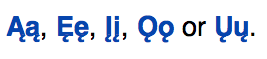

Pretty much just like you’d imagine. (Note: You may have a dull imagination.)

The term comes from Polish, where it literally means “little tail.” And though Polish is the most famous language to feature the ogonek, it should be familiar to students of other languages as well, including Lithuanian, Elfdalian and the language that Winnebagos speak, which I just learned is called Ho-Chunk, which, of course, is amazing. A similar symbol appears beneath the letter “e” in some Latin texts (the symbol is called e caudata, or “tailed e”) and in Old Norse (it’s o caudata, duh) but in nether of these contexts does the ogonek mean that the vowel gets nasalized. So watch out for that.

The ogonek should not be confused with a more familiar diacritical mark, the cedilla (cédille in French). Whereas the ogonek resembles a simple hook — and it apparently can point either to the left or the right — the cedilla is more stylized. In fact, it’s the bottom half of a cursive lower-case “z,” though I never realized that until today. (Even the name literally means “little ‘z,’” though it owes more to the British name for the letter, zed. This realization is on par with learning that the ampersand is just a stylized “e” and “t” from the Latin word for “and.” Or that the clouds in Super Mario Bros. are just re-colored bushes. Take your pick.) Wikipedia has a nice little graphic showing how the cedilla came to be.


So now you know: The ogonek is not a cedilla, and it always tells you that a vowel should be pronounced nasally, except when it doesn’t. Thanks, Poland.

Previous strange and wonderful words:
Word nerd? Subscribe to Back of the Cereal Box’s word-related posts by clicking here.

Sunday, October 3, 2010

The Ultimate Ultimate

After much deliberation, I have decided that the best final words a person can ever speak are these: “Avenge me.” It seems obvious, I suppose, but you have to consider the effect these words would have when spoken regardless of setting, audience or cause of death. For example, major bonus points if you die of old age and still demand that you be avenged. Similarly major bonus points if you’re speaking to someone who has no familial or emotional connection to you.

A close runner-up: “You must find the golden monkey before sundown.” I mostly took this one out of the running because it won’t work if the dying person suffers from dementia, in which case those around him or her will likely assume that this also resulted from the end-of-life crazies.

On what I believe is an unrelated note, please enjoy this photo of a buffalo standing in a living room. I had intended to write about it, but got distracted pondering the ultimate ultimate line of dialogue.


For group discussion: Could the buffalo represent death?

Wednesday, September 29, 2010

Seeing Things / Running Through Your Head

Sprawling and sinister though the clouds may have seemed, I was willing to give them a pass on size and character and instead just appreciate them for their color. I usually see chromatic displays like this only in the form of screensavers.


Then, on my drive home through L.A. traffic, it began to rain — just two days after the hottest day ever recorded in the city. Then thunder and lightening. And then a double rainbow. Yep, should have gone with my gut; these were clearly apocalypse clouds.

And I just moved all my stuff in, too.

Famous, Blue Teeth

I love words and brand names and anything that sounds like an urban legend, yet I'd never looked into the history of the term Bluetooth until friend/associate/fellow conspirator Katie brought to my attention where this term came from.

Bluetooth, which now serves as a catchall descriptor for all manner of wireless technology, came into the worldwide lexicon as a result of either a historically-minded techno geek or a technologically-minded history geek. It takes its name from Harald I of Denmark, in honor of his unification of dissonant Danish tribes, as Wikipedia puts it. Similarly, Bluetooth technology aims to do the same with modern communications. How amazing: A cool-sounding brand name with a sensible origin rooted in a figure historical but nonetheless obscure (at least to those who didn't grow up learning Scandinavian history). My first reaction, of course, was that that this must be a folk etymology, because things that sound too-cool-to-be-true often are.

Nope. It's legit.

Harald existed. Born in 920 BCE to Gorm the Old and Thyra Dannebod — and yes, this is some Lord of the Rings shit right here — Harald was known to his subjects as Harald Blåtand, which could be translated as "Harald Bluetooth" but, according to a Snopes message board thread, could also be "Harald the great man," "Harald the black man," "Harald the great chief" or "Harald the black chief," depending on who you ask. (BTW, "Greatman," "Blackman," "Greatchief" and "Blackchief" don't make such snappy brand names.) But none of these alternate translations explain how this Blåtand nickname got attached to Harald. Theories abound online — there's everything from a janky, rotten tooth to a predilection for blueberries — but I have yet to find a definitive answer. If you know, please don't hesitate to tell me.

I realize this very story has probably been reported to death on techie and word nerd blogs worldwide, but the history was just too weird for me to ignore, even if I technically ignored it for an entire month after Katie sent it to me. (Hi Katie!)

Personally, I would like to think that Harald's chompers remained blue only because his servants feared the man strong enough to unify warring viking tribes and therefore would not dare to point out that he had some blue crap in his teeth.

Saturday, September 25, 2010

What Happened to Kirby?

It shames me little to admit that I still receive emails from Nintendo about upcoming products that I may or may not be interested in. The gaming blogosphere actually keeps me informed of such happenings well in advance of these emails, but I still enjoy them — little candy-colored breaks during my day that remind me of the franchises that I so loved as a kid and (in many cases) still love today. Just this week, Nintendo sent out one about the first Wii to title starring Kirby, that pink puffball whose main attack against enemies is sucking them into his mouth.


Indeed, Nintendo, what did happen to Kirby? Did he take Viagra? Get a certain surgery to increase his manliness? (And if it’s the latter, should we be surprised, given that he can most easily be described with the words “pink puffball”?)

It’s no smutty joke, at least not intentionally, but still one must wonder why the Nintendo marketing team wouldn’t try to keep gamers’ minds from leaping straight into the gutter and wallowing in the filth therein.

Here’s the full image, by the way:


What at first glace would appear to be a humongo schlong is actually a shooting star — one of the iconic Kirby series items that seems to be making a reappearance in the new game, Kirby’s Epic Yarn Kotaku put it best when it dubbed the image “Kirby’s Epic Yard.” Bonus points for allowing me to feel like I’m not the only one who went there.

Thursday, September 23, 2010

The Weirdness of the Lambs

I cannot turn down a chance to look at something alleged to be weird. So when I see a headline “Those Catherine trailers aren’t getting any less bizarre” in Google Reader, I click through, knowing full well the article will tell me about some video game I won’t ever play. Anyway, yeah, I watch the trailer, which is weird even for me but is also from Japan, where people fly robots to work and, like, marry houseplants in lavish ceremonies. Our weird, to the Japanese, is normal and their weird, frequently, is brain-melting. Click through and watch for yourself, if you must. (In may not be safe for work, unless you work in Japan, in which case you probably watched it on the hologram screens on the subway on the way to work.) But you only need to know that what I saw was weird enough that I looked up the Wikipedia page for this game Catherine to see why I just watched these things. And I found a passage that I honestly didn’t think I’d read today or ever:
It is stated, from [gaming magazine] Famitsu, that Vincent will not be alone in his nightmares and that he’ll be encountering a large number of lambs. In a dream sequence, the lambs, as well as Vincent, are being chased by a giant pair of hands, one of them holding a blood-covered fork.
This is under the section “Gameplay.”

So yeah, I wouldn’t have thought to do that.

And in case you might think that I just happened across the page after it got vandalized, there was also this:


Story checks out. Inasmuch as it could, I mean.

Wednesday, September 22, 2010

Up There With Schenectady, Sheboygan and Rancho Cucamonga

A brief open letter to a reader in Walla Walla:
Hi there, reader. I have noticed you in my Google Analytics because you visit the blog fairly regular, but also because I think your city name is funny. But you always find this blog by Googling my name. May I ask why? I mean no offense, I’m just curious as to why you always Google my name instead of just bookmarking my site.

Do you think your town name is funny too?

Love,
Drew