
The little things that hang off letters, however, do so with good reason: They inform your pronunciation, or, if you’re American, they look alll confusing and cute and exotic. I just found out one of these typographical hanging threads has a name, and this name happens to be fun to say. What more could I need to select a word of the week?
ogonek (oh-GOH-neck) — noun: a hook-shaped diacritical mark attached beneath a vowel and typically indicating nasalization.What might these mutant appendages look like, you ask?
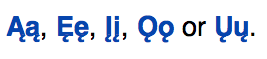
Pretty much just like you’d imagine. (Note: You may have a dull imagination.)
The term comes from Polish, where it literally means “little tail.” And though Polish is the most famous language to feature the ogonek, it should be familiar to students of other languages as well, including Lithuanian, Elfdalian and the language that Winnebagos speak, which I just learned is called Ho-Chunk, which, of course, is amazing. A similar symbol appears beneath the letter “e” in some Latin texts (the symbol is called e caudata, or “tailed e”) and in Old Norse (it’s o caudata, duh) but in nether of these contexts does the ogonek mean that the vowel gets nasalized. So watch out for that.
The ogonek should not be confused with a more familiar diacritical mark, the cedilla (cédille in French). Whereas the ogonek resembles a simple hook — and it apparently can point either to the left or the right — the cedilla is more stylized. In fact, it’s the bottom half of a cursive lower-case “z,” though I never realized that until today. (Even the name literally means “little ‘z,’” though it owes more to the British name for the letter, zed. This realization is on par with learning that the ampersand is just a stylized “e” and “t” from the Latin word for “and.” Or that the clouds in Super Mario Bros. are just re-colored bushes. Take your pick.) Wikipedia has a nice little graphic showing how the cedilla came to be.

Previous strange and wonderful words:
- adulterine, ageusia, ambeer, anosmia
- barrack, bissextile, bloofer, breastsummer
- catholicon, cecaelia, couvade, cranberry morpheme, crwth, cummingtonite
- deasil, decussate, deuteragonist, dingle
- eidolon, epeolatry, epopt, espalier, etui
- fabiform, fissilingual, Föhnkrankheit, folderol, froward
- gallinipper, grandgore, grue, guilloche, gyaru
- hippopotomonstrosesquipedaliophobia, hogo, honorificabilitudinitatibus
- itaiitai, ignivomous
- jabroni, jamais vu, jehu, jumentous
- kaffir, kakopygian, knipperdollin
- leman, lemniscate, limnovore, linsey-woolsey, longicorn
- malacia, malison, milt, mongo, morepork
- nef, nihilartikel, nobiliary particle, nosism
- ombré, ooglification, orchidectomy, ordured, orf
- pace, pareidolia, pavonated, petrichor, pismire, pong, puggle, purse
- quacksalver, quagga, qualtagh, quidnunc
- ronion, roynish, rubirosa
- salmagundi, scrutator, seneschal, shebang, sinople, stevedore, suovetaurilia
- tergiversate, thagomizer, thon, tiffin, tittery-whoppet, tmesis, toby, tyro
- ucalegon, ultramontane
- veneficial, verdigris, vespertilionine, vinegeroon
- williwaw, witzelsucht, wooper looper
- xenodocheionology, xyster
- yazoo, ypsiliform, yoink
- zanjero, zenzizenzizenzic, zinnober, zugzwang
