Pages

Showing posts with label linguistics. Show all posts

Sunday, September 11, 2011

The Adventures of Miminy-Piminy and Namby-Pamby

A word of the week that manages to open the door to a worthwhile bit of linguistic trivia while at the same time sounding a little stupid:
hobson-jobson (HOB-suhn-JOB-suhn) — noun: the alteration of a word borrowed from a foreign language to accord more closely with the linguistic patterns of the borrowing language.
The term came about as a result of English-speakers hearing the Shia chant of “Yā Ḥasan! Yā Ḥosain,” not understanding it and doing their best to estimate with their floppy, English tongues. And it became popular enough that two linguists, when compiling an 1886 dictionary of Indian words that had crept into English, chose to title the book Hobson-Jobson. Today, the term gets used — in the rare occasion that people know what it means, of course — to refer to any word that gets borrowed from language A and then mashed, Play-Doh Fun Factory-style, into the confines of language B.

As Wiktionary points out, the English hoosegow, “jail,” is the result of English’s flirtation with the Spanish word juzgado, “a judicial court.” If the English word plonk, meaning “cheap, low-quality wine,” truly does come from the French vin blanc, “white wine,” then it’s a hobson-jobson too. And the same with hocus-pocus, if it did, in fact, arrive in English as a result of non-Latin-speaking churchgoers mishearing the priestly pronouncement Hoc set corpus meum, “This is my body.” Sometimes the switch is less dramatic. I’d guess that Montana, the state name, is also a hobson-jobson, just by virtue of it coming from the Spanish montaña but most Americans not being able to or just not caring to pay attention to that tilde hovering over the “n.” Yeah, Montana just means “mountain.” Kind of weird, right? When you think about it?

In her paper on the dictionary Hobson-Jobson and hobson-jobsons in general, Traci Nagle makes a point about English words that have this structure: They tend to be the vocabulary of little kids (Humpty Dumpty, Hokey Pokey) or dicks putting something down (namby-pamby, mumbo-jumbo). If this is true, is hobson-jobson childish or sneering? Kind of both, more the latter, it turns out. From Wikipedia: “Hobson and Jobson were stock characters in Victorian times, used to indicate a pair of yokels, clowns, or idiots.” But it’s debatable whether the men putting together the Anglo-Indian dictionary were commenting on themselves or other people involved in the borrowing of words from one language to another.

Previous words of the week after the jump.
Word nerd? Subscribe to Back of the Cereal Box’s word-related posts by clicking here.


Monday, October 4, 2010

A Polish Tail: Diacritical Mark Goes West

When someone walks around with a little thing hanging off his or her body, it could simply be a loose thread needing a kindly stranger to pluck it away. If the person is male, it could also be that he’s naked, in which case strangers should keep their hands to themselves. In either situation, the events make for a diverting story for the dinner table.

The little things that hang off letters, however, do so with good reason: They inform your pronunciation, or, if you’re American, they look alll confusing and cute and exotic. I just found out one of these typographical hanging threads has a name, and this name happens to be fun to say. What more could I need to select a word of the week?
ogonek (oh-GOH-neck) — noun: a hook-shaped diacritical mark attached beneath a vowel and typically indicating nasalization.
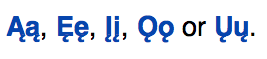
What might these mutant appendages look like, you ask?


Pretty much just like you’d imagine. (Note: You may have a dull imagination.)

The term comes from Polish, where it literally means “little tail.” And though Polish is the most famous language to feature the ogonek, it should be familiar to students of other languages as well, including Lithuanian, Elfdalian and the language that Winnebagos speak, which I just learned is called Ho-Chunk, which, of course, is amazing. A similar symbol appears beneath the letter “e” in some Latin texts (the symbol is called e caudata, or “tailed e”) and in Old Norse (it’s o caudata, duh) but in nether of these contexts does the ogonek mean that the vowel gets nasalized. So watch out for that.

The ogonek should not be confused with a more familiar diacritical mark, the cedilla (cédille in French). Whereas the ogonek resembles a simple hook — and it apparently can point either to the left or the right — the cedilla is more stylized. In fact, it’s the bottom half of a cursive lower-case “z,” though I never realized that until today. (Even the name literally means “little ‘z,’” though it owes more to the British name for the letter, zed. This realization is on par with learning that the ampersand is just a stylized “e” and “t” from the Latin word for “and.” Or that the clouds in Super Mario Bros. are just re-colored bushes. Take your pick.) Wikipedia has a nice little graphic showing how the cedilla came to be.


So now you know: The ogonek is not a cedilla, and it always tells you that a vowel should be pronounced nasally, except when it doesn’t. Thanks, Poland.

Previous strange and wonderful words:
Word nerd? Subscribe to Back of the Cereal Box’s word-related posts by clicking here.

Friday, June 12, 2009

Rich Man’s Hockey

I attended a match at the Santa Barbara Polo Club on Sunday — my first ever, in fact. And despite preconceived notions of the stands being populated solely by upper-crusties, I was pleasantly surprised by how much I enjoyed it all. Horses, yelling, the regular thwack of mallets striking hard surfaces — and, because I did it in Santa Barbara, the strangeness of being able to see mountains, grass, the 101, and the Pacific Ocean all in one quick turn of the head.

I did my best to capture the thrill of horseback sport with my phone camera, but the results were somewhat lacking.

polo2

polo1

I had better luck photographing things just a few feet away.

polo3

Because those photos were mostly unsatisfying, I’ll interpret the event the best way I know how.

The word polo arrives in English from Balti, a language that, while spoken in India, is part of the Sino-Tibetan language family and not the Indo-European one that includes, for example, Hindi and English and about all the languages spoken in the lands between. In its original form, pulu, the word just meant “ball.” I can’t help noticing similarities between pulu and words like pellet and pelota and others that descend from the Latin pila, also meaning “ball.” Unless I’m mistaken, there’s not too much reason that the pulu and pila would be related, given their divergent histories. (It’s usually at this point that I’d check this on the American Heritage Dictionary, but I’ve found that its online hideout, Bartleby, no longer seems to feature it or anything dictionaries.)

By sitting through Sunday’s match, I also learned that polo’s six seven-minute periods of play are called chukkers or chukkas. (The same pair of terms can also refer to the boots polo players wear, however.) Unlike polo itself, chukker does descend from Hindi, going back to the Sanskrit cakra meaning “circle” or “wheel.” The same Sanskrit word also gives us chakra, which should be familiar to even the most yogically challenged and which are explained and often even represented as round, wheel-like things. Again, I’ve got nothing to back this up, but I wonder if chukker’s etymological connection to wheels could work along the same lines as the English round in the sense of a bout of play or even a setting of drinks. You know, wheels being round and all.

Further links (per recommendation by Zemanta, which I am not quite sure about)

Monday, September 22, 2008

Fluttering Fleas, But Not Flabby Flannel

I’ve learned something new: There’s a name for something I have wondered about for a long time. Simply put, there’s a tendency for certain letter groups to appear in words that have similar meanings regardless of whether those words have a shared etymology.

The term is phonestheme.

The example first given in the Wikipedia page on the subject is the gl- phonestheme, which occurs in many English words referring to light and vision. (Glitter, glisten, glow, gleam, glare, etc.) An important aspect of these words is that neither the gl nor the letters that follow mean anything on their own. (No such word as itter or isten, for example.) They also don’t necessarily need to appear at the beginning of words. As Wikipedia puts it:
While phonesthemes have mostly been identified in the onsets of words and syllables, they can have other forms. There has been some argument that endings like -ash and -ack in English also serve as phonesthemes, due to their patterning in words that denote forceful, destructive contact (smash, crash, bash, etc.) and abrupt contact (smack, whack, crack, etc.), respectively.
Interesting, no? There’s a few aspects of this I haven’t wrapped my head around yet, so I feel like I should read more on the subject. (If anyone of you can point be toward good resources on the subject, I’d appreciate it.) For example, I don’t understand why this happens. I would also like to know what linguists make of outliers.

For example, I have the letters ack in my last name, but no one would lump that in with the -ack group. Is it because my ack occurs in the middle of the my last name? And what to make of back and rack and Zack? Why wouldn’t they fit the pattern?

As I said before, I had some idea that phonesthemes existed before I learned what to call them. A while back, the very cool and always informative word blog Bradshaw of the Future put up a post on the etymologies of various words that begin with the letters cl and that also refer to noise. Clack, clip, clap, cluck, and several others. I have always wondered about the fl words, which so often refer to various either quick motion or motion in the air, and I said so in a comment on the cl post.
I've always wondered but have never looked into the English words beginning with fl, which often describe some sort of quick movement, often through the air. Flick, float, flutter, flight, flap, fleet, flee, flit, flash, flea, fling, fly, flip, flurry, flag, flail, flare, flake, flay... There are even more than this. Not all share the association, of course. Flan, flabby, flannel, etc. All generally fun words to say, I've found. Have you any idea what the deal with these is?
Goofy, the Bradshaw blogger, responded last week with a post just on fl words, noting their various etymologies. Very helpful, particularly because it provided my first encounter with phonesthemes. Now I’m firing in a hundred different directions.
Some other phonesthemes for your face:
  • sn-, referring to mouth and nose goings-on: snarl, snout, snicker, snack, etc.
  • sl-, referring to frictionless movement: slide, sled, slick, etc.
  • -tter, referring to rapid, uneven motion: mutter, stutter, flutter, patter, titter, glitter, jitter, chatter, twitter
  • squ-, referring to eruptive sounds: squeal, squeak, squash, squirt, squawk, squabble, squall
As you may have noted, a lot of these words seem like they could be onomatopoetic. The -ack words, for example, could have arisen through imitation of noise created when the actions associated with them happen. This, however, doesn’t work for all phonesthemes, as the gl- words like glisten and glimmer don’t make noise. So where then must this mental association come from?

Are English phonesthemes shared by other languages?

If not, why shouldn’t they, if we’re apparently so hardwired to make these associations?

What is it about English, then, that prompts us to make such connections?

Could it be that people recognize the pattern on a few related words and then subconsciously only accept into their language new words that fit that pattern?

Do people even process language in this manner?

What would the advantage be of doing so?

I’m clearly full of questions, but that’s probably because this is the most interesting thing I’ve learned in a long time. I’m not clear on the linguistic definition of icon, which the Wikipedia page on phonesthemes uses in a section under the subject line “Important considerations.”
  1. If the words aggregated in these groups… were nothing more than arbitrary symbols, rather than being icons, their totally arbitrary nature would preclude any such systematic connections with meaning.
  2. Although groups of phonesthemes can be identified, this type of iconic sign, in any language, is rather rare.
  3. Despite [the above rule], there may well be far many more iconic words in, say, the English language, than we are aware of.
  4. It is also important that not each identified phoneme operates as a phonestheme every time it is used. (e.g., words square and squadron have no connection with discordant eruptive sounds common to the -squ group of squeal, squeak squall).
  5. Despite [the above rule], it is very clear that, in many cases, some level of iconic communication certainly does take place in a number of words within any language.
  6. Although people do seem to spend inordinate amounts of time creating a new word (such as deciding upon a “good name” for a new business), no one has ever been able to produce any evidence that speakers are consciously aware of such (iconic) signaling processes when they create new words.
Something about that sentence “There may well be far many more iconic words in, say, the English language, than we are aware of” strikes me as vaguely haunting.