Pages

Tuesday, July 26, 2016

Why So Many Gay Guys Like Barb From Stranger Things

Heads up: This will spoil the first season of Stranger Things. If you haven’t finished it and don’t want it spoiled, don’t read this yet. Also, what are you waiting for? It’s only eight episodes. Call in sick today and finish it.

I’d been stoked for Stranger Things, and I felt gratified once it went live on Netflix that other people seemed to enjoy it as much as I did. However, all the social media posts about the show seemed to be echoing back to me one observation in particular that I didn’t expect: that Barb was awesome. I liked her a lot, despite her scant screen time, but I’m a weirdo who always roots for the underdog girl. In this instance, I was not alone in pulling for Barb. It also happens that most of the people posting about Stranger Things in my various feeds happened to be gay nerds of one stripe or another. So what is it about this mom-jeaned wonder that made gay dudes dig her? (You know, aside from her on-point-for-the-era fashion sense.)
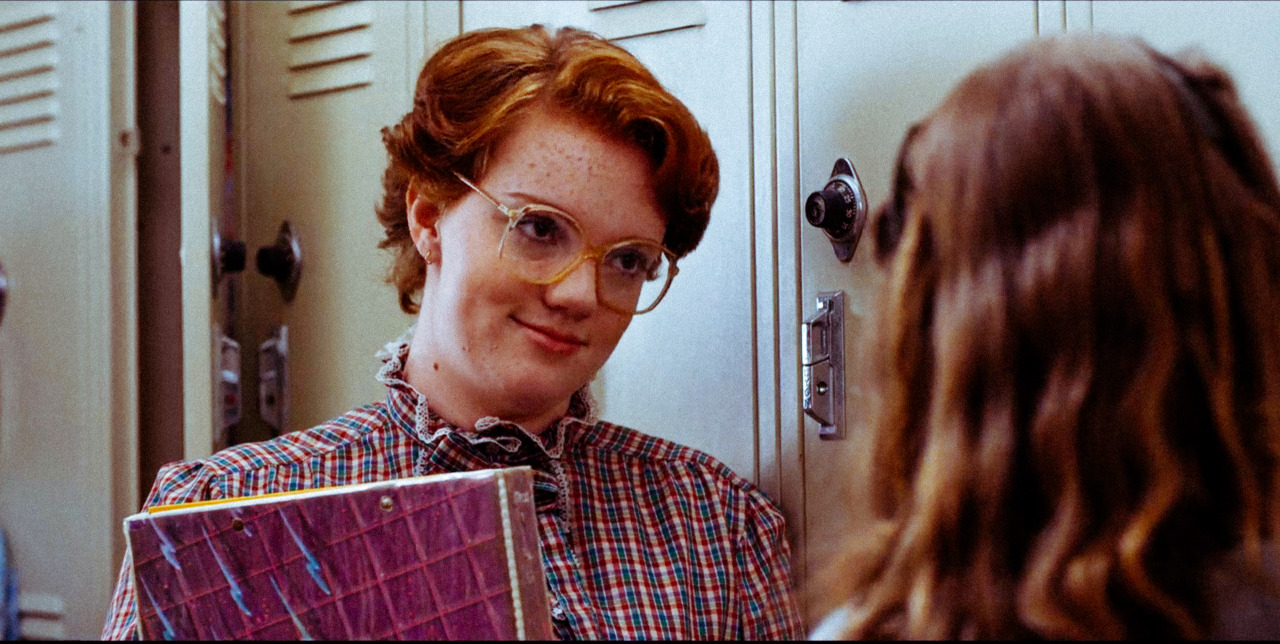

After all, Barb (Shannon Purser) vanishes before the opening credits of episode three, when the shambling horror that is the show’s big bad pulls her into the swimming pool of doom, never to be seen again… save for a particularly nasty shot of her in the penultimate episode, when the viewer learns that yes, she’s completely dunzo—a corpse in the Upside-Down with a hell leech squiggling around in her mouth. It’s brutal to learn, especially if you, like me, had been hoping that she’d be rescued.

We gay nerds like our genre heroines, but Stranger Things actually offers four other female characters who get to do a lot more than Barb does. There’s Joyce (Winona Ryder), a small-time Sarah Connor who’s just the latest in a long line of fearless, strong moms in sci-fi works. There’s Eleven (Millie Bobby Brown), the telekinetic marvel who actually takes down the bad guys. There’s Nancy (Natalie Dyer), the Lisa Simpson-level goody two-shoes who finds an inner courage to become a hero in her own right. And there’s even Nancy’s mom (Cara Buono, a.k.a. Dr. Faye from Mad Men) who gets more to do than Barb does just by virtue of the fact that she survives through all eight episodes.

So why the hell would we like Barb so much? My theory is that for gay guys—and maybe also non-gay guys who had similarly difficult high school experiences—Barb reminds us of the selves we left behind back in the day, the not-yet-fully-realized versions that we want to go back and help or save or maybe just hug.

Based on the little we get to know about Barb in the first two episodes, we get that she’s Nancy’s smart and loyal best friend. She has a flair for fashion, but that doesn’t really put her on the radar of any of the popular kids, and she’s literally out of focus in the background of some of the shots in which Nancy is interacting with them. (If there’s a he-Barb lurking around somewhere, who can see her for the radiant, ruffled flower she is, we never get to see him.) She only gets invited to the party at the home of BMOC Steve Harrington (Joe Keery) because she is Nancy’s plus-one, and again, the boys don’t seem interested in her to the point that no one even reacts with much concern when she cuts her hand—and even then, she only cuts her hand in a vain attempt to shotgun a beer, just to prove to these cretins that yes, she’s like everyone else and can party like a normal kid. That felt familiar.

To paraphrase that great poet of our generation, Katy Perry, she’s a plastic bag who has yet to realize her status as a firework. Watching the second episode in particular, I wanted to tell Barb that it would be okay—that she’d get in to a good college where a bunch of art fags would celebrate her prim but daring style, and that everything would be okay in the end.


Only that doesn’t happen. It doesn’t get better for Barb. She dies without anyone aside from Nancy realizing how great she is, and even then, Nancy’s last interaction with her is shooing her away while she goes to make penis-vagina with Steve. Yes, even that is telling of the kind of relationships a lot of closeted gay guys had with their ladyfriends of choice back in the age of raging hormones. We’d be there, steadfast and protective, until the prospect of a more deeply realized male-female relationship presented itself, at which point we’d be left to wait downstairs while some people’s virginities were lost and others remained intact.

I’m projecting, sure, but I feel like for this gay guy in particular, the horror of Barb’s death wasn’t just that it seemed like if anyone should have been safe, it would have been her. No, it’s the weird “what if?” of never moving on from the Upside-Down of high school life and never having people finally appreciate you for the things that make you special. She has glam hausfrau style down, for sure, but I’m certain that’s not the only reason we gay nerds are rooting for her in a fashion way out of proportion to how much we see her onscreen.

I love you, Barb. I wish it had been different for you.


Miscellaneous notes:
  • I keep accidentally referring to the Upside-Down as the Underwhere, which I think should be the name of something.
  • I can’t stop listening to the previous compositions by Survive, the band that did the show’s soundtrack. Survive is the Disasterpeace of 2016.
  • Variety had a good interview with the Duffer Brothers that offers, among other things, some rationale about why Barb and Barb alone should have been the one character to get offed in the show’s first season, as well as the tidbit that Shannon Purser had never professionally acted before this series.
  • If you haven’t yet, check out my fucking up of the Stranger Things trailer in the style of footage from a decayed VHS cassette.
  • Cole Escola did a less-than-one-minute bit about Barb’s mom learning about what the fuck happened to her daughter, and it’s gold.
  • I was born in 1982, but that doesn’t mean I understand how women dressed in the first decade of my life. Consequently, it’s hard to tell if Barb’s style would have read as avant-garde in 1983 or just plain dowdy. I have similar issues with Jane Fonda’s wardrobe in 9 to 5.
  • Just in case you wanted a closer look at our last image of Barb, you can see it here. It’s awful. Barb deserved better.
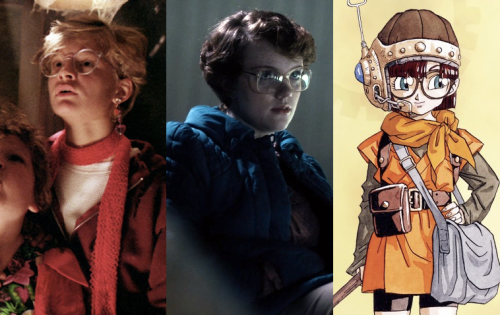
  • I maintain that Barb is equal parts Martha Plimpton’s character from The Goonies and Lucca from Chrono Trigger.

Homo culture, previously:

Sunday, July 17, 2016

The Generation of Pixels and VHS Static

I had one of those weekends where plans just fizzle away, because your friends have conspired to cancel appointments jointly and consecutively, all in an effort to make you appreciate the joys of staying home. And with my newfound free time, I accomplished two things: I watched the bulk of Stranger Things on Netflix and I learned how to use After Effects. These two things are actually related.


Nearly every review of Stranger Things has noted that it plays out like some Steven Spielberg fairytale we might have watched in the ’80s, only with a dark twist that in my mind is exemplified by the John Carpenter jolt of how the title arrives at the end of the series trailer. (I can’t explain why the appearance of the series title gives me goosebumps, but it does—every time I’ve watched the trailer. Maybe that font is haunted?)

As for After Effects, I used it take crisp, clean footage and fuck it up in the style of footage from a damaged VHS tape. That may seem like a pointless skill to acquire, VHS having long gone the way of the typewriter, but I assure you it’s not, because VHS has gone the way of the typewriter. I was doing it for a larger project, but in damaging my first chunk of footage, I was surprised by my emotional reaction to seeing something rendered in the flickers and saturation bleeds of an old medium. I miss them, it turns out. Those errors became hallmarks of movie-watching back in the day—and, along with pixels, hallmarks of childhood escapism as well—to the point that on some level I will always associate them with how a movie should look.

This is not my theory. In A Year With Swollen Appendices, Brian Eno lays it out very clearly: “Whatever you now find weird, ugly, uncomfortable and nasty about a new medium will surely become its signature. CD distortion, the jitteriness of digital video, the crap sound of 8-bit—all of these will be cherished and emulated as soon as they can be avoided. It’s the sound of failure: So much modern art is the sound of things going out of control, of a medium pushing to its limits and breaking apart.” This has implications way beyond the pop culture I grew up with, but I think it does help explain why I continue to noodle around with pixel art from the 8- and 16-bit generations, as well as why it felt so satisfying to introduce all that distortion to a perfectly good chunk of video. It felt right.

It helps that the footage in question came from Inferno, the sequel to Suspiria. My introduction to Dario Argento came from my hometown video store—no, not Blockbuster, but still long-shuttered all the same—and while I never actually saw Inferno until the age of DVD-quality video, it seems like I should have.

Here is the scene in question in its original, clean form. (Fair warning—there is a corpse that appears in this clip, just after the 3:30 mark, but I feel like it’s a PG-13 corpse at worst. It also features Irene Miracle, whom I feel is a strong PG in and of herself.) I believe it comes from a DVD rip.


And here is the same scene again—improved by virtue of being made worse.


That staticky mess? That sloppy color? It looks beautiful to me in a way I’m not sure someone else would understand if they didn’t have the mid-’80s-to-early-’90s frame of reference that I do. Who knows? Maybe you’re pining for Ted Turner-mandated colorization or the shaky monochrome of a midcentury TV set with rabbit ears. But this brings me back to Stranger Things. It truly is a lot like something we might have watched twenty-five years ago, except for the darker elements and the fact that it looks like a million bucks. Were there a way to watch it with a filter that emulated a VHS tape that had been left in a hot attic for too long, I would. Again, it would feel right. In fact, someone with more technological savvy than I have should invent that app right now—Instagram filters for your TV, so you can recall the pixels and noise and V-hold blips from whatever era most suits you.

Someone born in 2000 might never have watched anything on VHS. I wonder what they’ll pine for. Crisp but slightly less than high-definition video? Polygons? Maybe they haven’t figured out what they’ll miss yet. But I know. Give me VHS static and pixels, please.


And if there were a way to layer TV static onto this, I think I’d die happy.

Friday, July 1, 2016

Where Is the Video? (A Short Play About Journalism)

Journalist: Hi. I sent you the piece on the finance committee meeting. Let me know what you think.

Editor: I saw that. I saw that. I’ve got one question for you, though: Where is the video?

Journalist: The video?

Editor: See, you’ve sent me a lot of text, but I don’t see a video attachment.

Journalist: I… don’t have a video for it.

Editor: Well, then we have a problem. No one reads news articles for text nowadays. They want a motherfucking video. So where is the video?

Journalist: I’m not sure the piece needs a video. If you read it, I think everything is there—like, in the text.

Editor: [takes off his glasses] People don’t want to click onto your story and just see goddamned words. They want an auto-loading video to show up and immediately push the words down. They want preroll. They want an ad jingle. They want a video that covers a huge chunk of the text and they want to wait for it to play through—just sitting there staring at it. Then they want to scroll down a few inches and see another video. They want videos in the sidebar. They want the related videos to have related videos. And do you know what they want when they get to the bottom of your fucking Stephen King novel of a news article?

Journalist: A video?

Editor: THEY WANT A FUCKING VIDEO.

Journalist: Well, I didn’t take a video of the meeting, so there is no video for this story.

Editor: See, that’s where you’re wrong. We have a policy of including videos on all stories we run, regardless of whether they actually have anything to do with the matter at hand. In fact, our policy is to embed a short video about Kate Bosworth in all stories that don’t come with a special-made video asset.

Journalist: Kate… You mean the one from Superman Returns?

Editor: KATE FUCKING BOSWORTH. Yes. Have you seen this video? It’s amazing. She throws a milkshake at a seagull. It’s ace content. It’s our all-time most-viewed video.

Journalist: I don’t think—

Editor: One word for you: PULITZER.

[Angry seagull noises come from the editor’s computer.]

Editor: And I’ve got even better news for you. Your piece is running with our Charmin ad package.

Journalist: The toilet paper?

Editor: Thirty seconds after the user loads your story, those fucking Charmn bears are going to come dancing onto the screen. You know them—the ones with toilet paper stuck to their dirty fucking asses? And they keep dancing their asses toward the screen, and the user has to click all the toilet paper bits off their butts or they won’t go away.

Journalist: [stands with mouth agape]

Editor: I don’t want to hear any fucking complaints about it, neither. Those dancing bears and their dirty fucking shit asses are sending Bitsy and LaDonna and the rest of the new media team to SXSW this year.

Journalist: Did you read my piece?

Editor: Sure, seemed great.

Journalist: Did it have everything in it that it needed?

Editor: [snorts] You wrote it. You tell me.

Journalist: Have you seen Enid? I usually get copyedits back from her, but she’s not picking up her phone.

Editor: Canned her.

Journalist: What? You fired the copyeditor?

Editor: No, I fired the assistant to the video editor. We moved her over to the video team. Thought she might be productive there. Did you see the videos she made? Garbage. Fucking garbage.

Journalist: Well, she’s a copyeditor so—

Editor: They only got 50,000 views. Absolute fucking garbage. We fired her on the spot—and then broke her fingers to make sure she got the message.

Journalist: I think I’m going to go home.

Editor: Periscope it. We’ll put it on the main page.


{fin}

Sunday, June 26, 2016

The Deep Legend of Purple Zelda

Discussed herein: the original Legend of Zelda, the band Deep Purple, the man responsible for what are arguably the two most famous compositions in video game music history, and open-ended questions about music law.

legend of zelda deep purple

Last week, a Los Angeles jury concluded that no, Led Zeppelin’s “Stairway to Heaven” did not plagiarize another song—or, at least, appropriate enough of that other song to constitute plagiarism and subsequent monetary compensation. Led Zeppelin got to continue living atop a towering pile of money that did not become a slightly-less-towering pile of money, and the 1960s band Spirit got a neat little footnote in its history when the estate of the band’s singer, Randy California, unsuccessfully tried to argue that a brief snippet from the intro to “Stairway to Heaven” sounded too much like Spirit’s 1968 song “Taurus.”

Neither being a member of that jury nor someone who claims to understand music on a constructional level, I can’t say whether that verdict was just. I can say, however, that to my ears, the two songs sound similar enough that it seems that the one could have helped bring about the other, regardless of whether anyone deserved money for that inspiration.

Listen for yourself. The “Stairway”-esque part of “Taurus” begins around the 44-second mark.


And here is “Stairway to Heaven,” just in case you’ve been living under a rock for the last forty years.


The plaintiff’s lawyers had claimed that because Spirit had played on the same bill as Led Zeppelin back in the day, it was plausible that members of the latter had heard “Taurus” and therefore used bits of it in writing “Stairway,” which was released in 1971. In my head, that seems like a fair enough argument, and I feel like people following the story in the news probably did too, especially in light of how the family of Marvin Gaye successfully sued Robin Thicke, to say nothing of similar squabbles making the news recently. (Tom Petty vs. Sam Smith comes to mind, even if it ended amicably, and now Ed Sheeran is being sued for alleged plagiarism as well.)

These kinds of stories stand out to me because I’m the kind of guy who frequently hears similarities between two songs that other people dismiss with “No, that’s just a common chord progression” or “No, that’s just a feature of this genre of music” or “No, you’re crazy.” For example, I think the old song “Smoke Rings” sounds remarkably like a downtempo version of the overworld theme from Super Mario Bros. 2.


I’m okay with accepting that the connection I’m making only exists in my head, but there’s this one similarity in particular that always jumps into mind when I read stories like these, because I think it’s a stronger connection to most: the Deep Purple track “April” and the dungeon theme from Legend of Zelda. And yes, there’s something slightly more thrilling to me about the prospect of a song working its way across the pop cultural continuum and ending up in a video game, at least in some form, years later.

“April” is the final track to Deep Purple’s third album, released in 1969. It’s a doozy. You probably know Deep Purple as the bad that performs “Smoke on the Water” or the hard rock version of that song from I Know What You Did Last Summer, but “April” is worth a listen too. It’s grand and orchestral, especially in its intro, and wouldn’t be out of place as the soundtrack to some medieval fantasy sequence, I say.


Or maybe that association comes from the apparent Legend of Zelda connection. At around the 2:00-mark in “April,” there’s a brief section that should sound familiar to anyone who played through the original Legend of Zelda for the NES. It’s the bit that concludes the game’s dungeon theme before the track loops back to the beginning. (That dungeon theme isn’t very long, and if you played through the game, you’d hear this section of music hundreds of times over.)

I made a video that lines the sections up side-by-side, in case that’s helpful.


Given my history of the playing “thing is like other thing” game, I’d be willing to write this similarity off as a random, meaningless one, but there’s slightly more to the story. Koji Kondo is the music whiz responsible for a lot of Nintendo’s most memorable compositions, including all the music for the original Legend of Zelda. What’s interesting about the Deep Purple connection is that Kondo himself has admitted to being a fan of the band. In a 2005 Nintendo Power interview, Kondo even said he once played in a band that frequently covered Deep Purple, so the odds that he would be familiar with “April” would be fairly high—at least as probable as Led Zeppelin having heard “Taurus.” Of course, in the end, the jury found that Zeppelin hadn’t stolen those guitar riffs—or at least that if they had, they weren’t substantial enough to warrant Zeppelin having to pay off anyone as a result.

I suppose, then, that I have to conclude this post on a note of confusion. I don’t understand how we can make a legal differentiation between homage, sample, legitimate borrowing, and lawsuit-worthy theft. (And yes, I have thought about how it’s notable that the multimillion-dollar exception to the rule would be a song titled “Blurred Lines.”) So I pose the question to anyone reading this who understands music or music law better than I do: Am I confused because these distinctions are better made by people who understand music on a fundamental level that I don’t? Or is it just that no one knows—and that every post-“Blurred Lines” lawsuit is gambling in favor of the odds of some judge or jury saying, “Yeah I hear it. Here, have a wheelbarrow full of money”? Is it weird that laypeople, musically speaking, would ever be given the opportunity to issue a verdict about something that seems like it should take inside knowledge of the music industry to understand?

Meanwhile, I keep “April” on my playlists in case I ever encounter a situation that needs to feel more epic. And every time I get two minutes in, I get to think about Legend of Zelda, whether or not it’s just a coincidence.

Miscellaneous notes:
  • Yes, this is was something I’ve written about on this blog before—eight years ago, in fact. I decided the Zeppelin lawsuit made the story timely enough for an update and expansion. I originally came across the info in the “cloubush” thread, which, eight years later, is still going strong.
  • There actually is a purple Zelda, literally. Her name is Hilda. She’s Zelda but purple. Go figure.
  • Koji Kondo composed the soundtracks for Super Mario Bros. and Legend of Zelda but not those for Metroid and Kid Icarus. He did, however, do the music for three early NES games that weren’t released in the U.S.—Mysterious Castle Murasame, Devil World and Shin Onigashima. Given how iconic the Zelda and Mario themes ended up becoming, we American gamers missed out.
  • Kondo also composed the music that ended up in Super Mario Bros. 2, and I wonder if the Deep Purple thing makes it anymore likely that he would have been inspired by “Smoke Rings” in creating that game’s soundtrack.
  • In 1970, Spirit released an album saddled with the improbable title Twelve Dreams of Dr. Sardonicus, and that’s one of those names that seems like a joke on The Simpsons.
  • Not that I nor anyone else actually needs to hear “Stairway to Heaven” again, but did you know that Dolly Parton does a cover of it? It’s actually not bad—not that Dolly is capable of bad things—and I wager she finds a layer to it that other cover-ers may not.
  • Spirit’s biggest commercial hit was 1968’s “I Got a Line of You,” which I’d heard before and which I’m surprised was done by the same band that did “Taurus.”


Video game music, previously:

Friday, June 24, 2016

Skunk, Interrupted

Fair warning: This post is not for the squeamish, though I’ll do my best to avod being needlessly graphic.


Tonight is the one-year anniversary of the incident I refer to as “when the tree went through my face.” If you don’t remember or I haven’t related this to you in person, know that it amounted to a freak accident involving my nasal cavity, some sharp tree branches and an overstuffed green waste container. I had actually planned to write something funny about what I’d learned in the year since the accident, but that post probably would have sucked. If I’m being honest, all I learned was not to cram sharp objects into anything with wheels and that freak accidents happen suddenly and in ways you don’t expect.

Here’s the funny thing, though: Tonight, almost to the minute that the tree branch cut through my nose one year ago, something else happened.

I was heading into the garage to write, and Thurman came bounding out the back door after me. This is not unusual, as he normally takes a late-night piddle walk in the yard, but in a split second he’d disappeared into a dark corner. Almost immediately, I heard the noise he makes when he’s shaking one of his toys in his mouth. And almost just as quickly he came trotting back out into the light, whereupon he started diving into the dirt face-first—a cherished activity I call “land swimming.” Then I noticed the sulphuric, spoiled garlic smell of skunk.

I checked to make sure the little stinker had gotten away—more because I didn’t want him to spray again than because I was worried for its safety—and then I saw that no, it could not have gotten away, for he was now bisected. If you can imagine where a skunk’s pant line would be (were a skunk to wear pants) this one was now nude from that line down. His leg fur—and his tail—were lying a foot away from the rest of him; everything else, including what would normally be inside the “pants,” was still connected to the top part.

Much in the same way that the branch thing left me feeling like I should probably do something but unable to decide what I should do, I looked at the skunk halves and then back at my dog, who seemed upset but also was keeping himself busy. Here, then, is what I did.
  1. Asked my roommate what to do.
  2. Checked Thurman for injuries. I found none.
  3. Took Thurman into the shower and scrubbed his fur as best I could.
  4. Called the late-night vet and explained the situation. They told me that so long as Thurman’s vaccinations were up to date, I didn’t have much to worry about.
  5. Drove to the liquor store, got there as it was closing, and begged them to open back up for me so I could buy trash bags. “My dog killed a skunk and I need to get rid of the carcass,” I explained. “Yeah, I could tell it was something with a skunk,” said the cashier. The fact that I had to dispose of a body—animal or otherwise—didn’t seem to phase him.
  6. Got my roommate out of bed to hold the flashlight while I shoveled the skunk pieces into a grocery bag—and yes, this did make me think about the new season of Orange Is the New Black.
  7. Fought back the urge to vomit, because years of slasher movies still haven’t prepared me for real-life gore.
  8. Tied the grocery bag inside a trash bag and then tossed it into a dumpster down the street.
  9. Showered, then washed everything that had been in contact with skunk juice, whether first-degree or second-degree.
  10. Finally, I continue to smell skunk everywhere, even as I type this. I have no way of knowing how much of it is just ambient skunk particles outside, how much of it is inside my house, how much is on Thurman even post-shower and how much is actually me. The hilarious capper to all this is that my roommate can’t smell—I explain it as “He’s like Daredevil, only with his nose”—so I will have no way of objectively knowing if I’m carrying the skunk curse until I interact with someone else outside my home. Maybe it will be you!
As far as late-night emergencies that have happened to me on June 23, this one isn’t so bad. I’m not sitting in an E.R. waiting to get stitched up, and I’ll be in bed long before sunrise, but it is an enticing coincidence to have these two nights, one year apart, where I was getting ready to settle in and instead had my plans tossed apart by unforeseen badness that assaulted my nose in one way or another.

I guess I could write about how dogs are dogs, even if you love them. (Just earlier today, we unsuccessfully tried to coax Thurman into enjoying a wading pool, and it’s weird to think about the dopey dog who was scared of a water-filled plastic tub tearing into another animal and decisively ending that other creature in just a few seconds.) But the thing that sticks out to me right now is how quickly and suddenly something awful—or at least very, aggressively noteworthy. I’m a person who worries a lot, and I spend way too much mental energy calculating all the Final Destination-esque ways a given situation could lead to my undoing. But in the same way I didn’t think twice about that overstuffed green waste container, I also didn’t think twice about letting Thurman into the yard tonight. That happens every night, and every pervious one has resulted in successful piddles and nothing more. This one didn’t turn out to be a crisis—and not a medical crisis, best of all—but it’s worth pointing out that this wasn’t something I worried about, wasn’t something I foresaw as turning bad for me. Maybe that’s the lesson I should have taken away from one year ago: All that worrying can’t prepare you for the freak occurrence that actually does happen.

I still love Thurman, even if I know he can end a life in a split second, ninja-style. I chose to remember his greatest hit of the day as looking adorably rumpled as we finally conceded that he would not be a wading pool dog.


That might be the greatest takeaway of all, from this or from anything: Don’t focus on what went bad or what might go bad in the future, because maybe something else didn’t suck or won’t suck.

Right?

Tuesday, June 21, 2016

Orange Is the New Twilight Zone

A non-spoiler non-warning: This post briefly discusses an episode from the new season of Orange Is the New Black but not in any way that would ruin anything for you. However, this post will spoil a 52-year-old episode of The Twilight Zone, in case that is also a concern.


Midway through the fourth season of Orange Is the New Black, one character uses an episode of The Twilight Zone as a metaphor for mental illness. In the context, it’s actually pretty effective: This Twilight Zone in particular involves a couple who wake up in a strange town that’s inexplicably deserted and full of fake items—fake food in the fridge, fake grass, a fake squirrel on a fake tree. They’re just lost, hopelessly, in this strange, empty town. If you’re not familiar with The Twilight Zone, you might think this episode would be good. After all, it was apparently memorable enough to warrant a mention on a show airing half a century later. I would like to take the opportunity to relieve you of this belief, however. It’s terrible.

Whenever I catch a bit of the New Year’s Day Twilight Zone marathon, it’s almost always this episode that I end up seeing, just as a result of dumb bad luck—though I’m sure Rod Sterling would have me believe it’s part of some conspiracy to teach me a lesson about flouting societal conventions. I’m sure there are worse episodes. They made 156 of them in the original series alone, and there’s bound to be a few clunkers. But just as a result of the fact that I’ve seen this one again and again, I am adamant about it being one with a decent enough premise but a terrible payoff made all the crappier by a plot hole big enough to drive a Borgward Isabella through.

Here, then, is why the episode in question, “Stopover in a Quiet Town,” is terrible—so you can know without sitting through all thirty minutes of it yourself.


Like Orange Is the New Black says, it centers on a couple—Bob Frazier (Barry Nelson, the first person ever to play James Bond onscreen) and his wife, Millie (Nancy Malone, who bears a passing resemblance to Amy Poehler). They wake up in a strange house. They’d been at a party the night before, and Millie drove home because Bob was too drunk to get behind the wheel. Neither can remember how they might have ended up in this house, however, and only Millie has some vague recollection of a strange shadow pursuing them. Figuring some kindly strangers took them in, they head downstairs. The house is empty. The fridge opens, but there’s only a prop loaf of bread and a prop turkey inside. The phone doesn’t work.

They head outside, and while everything looks like a normal suburban town, none of the houses seem to be occupied. They assume everyone left for Sunday morning services, but the church is also deserted. They begin to lose it, and Bob starts implying that Millie may have gotten them lost. Millie thinks that they might have been in an accident, died and gone to hell. Bob lights a cigarette and the grass catches fire—because it’s papier-mâché. Finally, they hear a train whistle and get on the train, which is also empty but which they’re happy to find because it could potentially take them anywhere that’s not this Creepsburg, USA. Soon enough, however, the train pulls back into the exact same train station they just left.

At a loss, they get out, but then the shadow returns, moving over the landscape. Bob and Millie run in terror, but it catches up to them. The shadow was from a hand, it turns out—a giant hand that belongs to a giant little girl. Bob and Millie art ant-sized in this girl’s hand, and she just giggles at them menacingly.


Then we see a mother (also giant) stride into frame: “Be careful with your pets, dear. Daddy brought them all the way from Earth,” she says. The Fraziers are placed back down in their prison, and Sterling delivers the closing narration: “The moral of what you’ve just seen is clear. If you drink, don’t drive. And if your wife has had a couple, she shouldn’t drive either. You might both just wake up with a whale of a headache in a deserted village… in the Twilight Zone.”

Here are all the problems I have with this episode:
  • The level of detail in the giant child’s playset is astonishing. For example, they woke up in a made bed. Did this horrible little girl’s giant, stubby fingers have the dexterity to arrange sheets and a comforter? That was enclosed within a bedroom?
  • The Fraziers didn’t notice if the house had electricity or not.
  • When they go outside, it just looks like a sunny, quiet street, when there shouldn’t have been a source of sunlight—or, you know, sky, since they would have looked up and seen it was a child’s bedroom, albeit a supersized one.
  • The aliens who kidnapped the Fraziers look and act exactly like humans, just bigger.
  • They speak English.
  • They call Earth “Earth.”
  • The giant girl has no apparent means to feed the Fraziers, nor to dispose of their waste once they are fed.
  • The giant girl’s father purportedly went to Earth just to get two tiny humans and nothing more—which seems especially weird considering that the giant family put no system in place to ensure the Fraziers’ survival.
  • If our planet were to be visited by a person who was proportional in size to humans as humans are to ants, then, like, the entire continent of North America would probably see it. It would be a history-shattering emergency. Also, if Space Dad landed on Earth, I assume he’d destroy it or at least knock it hopelessly off its orbit. So I guess Earth is done for in this story.
  • Finally, the moral sucks. It’s laudable for the writers to be cautioning against drunk driving, especially during a time during which I imagine all Americans to be constantly drunk, constantly smoking and constantly throwing garbage from their car windows as they drive their cars, which they also do constantly. But the way Sterling’s narration states it, it smacks of sexism today. “Don’t drive drunk, men. Also, even if your idiot wife is under the legal limit (as Millie would have been if she only had two drinks, like she says), she can’t drive either because she might stupidly drive your car onto a giant man’s spaceship without realizing it.” It’s just very of-the-era but nonetheless awkward the way the message is framed at men first, and then extended to women as well, as if anyone needed reminding that alcohol affects women more or less the same way as it does men.
Again, there are other Twilight Zone episodes that have giant plot holes and tacked-on morality, but this particular example keeps popping up in my life, and I just wanted to warn you against letting Orange Is the New Black making you think this was something you should seek out. That, I suppose, is my PSA.

In case you don’t believe me, here’s the episode in all its clunky glory.


EDIT: I realize I have actually have mentioned this episode before as an example of terrible Twilight Zone plots in my Lousy Twilight Zone Plot Generator. Give it a spin! See where that gets you!

Sunday, May 29, 2016

Me & Maria

If we’re social media friends, then you may know that I scored a sit-down interview with Maria Bamford two years ago. And the reason you may know this is that I’ve been shamelessly dropping the following photo of Maria and me into conversations about Lady Dynamite on Facebook.


I’m not doing it to be a prick. It’s more that I’m so very stoked that an increasing number of people are hip to the fact that Maria Bamford is funny-awesome. Also? I really like the interview she gave me because it sums up a lot of the reasons I think she’s great. She’s funny. She’s exceedingly nice. We talk Adventure Time, flavors of Kettle Chips and the gentrification of east-of-Hollywood Los Angeles, among other things. This is why I got into journalism.

Keeping in mind my pride about this interview, you can imagine how excited I got when I was chopping zucchini while watching the fifth episode of Lady Dynamite and saw it flash to Maria’s character’s OK Cupid profile.


See, this jumped out at me because that profile photo came from my piece.


Someone else’s piece? No. Not at all. My fucking piece. My motherfucking fucking piece.

Robyn von Swank, who has photographed many an L.A. comedian, took that photo of Maria Bamford at Camilo’s in Eagle Rock, specifically for the article. The piece, by the way, was meant to be the kickoff to a whole series of sit-downs with comedians about late-night eats, but it was nixed by my station’s higher-ups for reasons that I was never too clear about. (Whatever.) Even if the column didn’t grow into a series, I’m happy it has apparently lived on as a teeny-tiny bit of one of the more wonderfully weird TV thingums I’ve seen in recent memory. Seriously—with Jessica Jones and Kimmy Schmidt and this, Netflix is offering me the offbeat heroines that no traditional network has been lately.

A sensible writer would end the story there, but there’s this one extra bit that I feel a need to mention—but with the preface/trigger warning that it’s cat-related.

Before Thurman became part of my life, the closest thing I had to a pet was Mayo, an obnoxiously loud white cat who lived in a house on the way to my gym. He’d visited my home before, but he mysteriously vanished shortly before Thurman moved in, and I’ve been quietly hoping that he found his own happiness and that’s what I can credit with causing his quietness. Last night, I finished the fourth episode of Lady Dynamite, which has Maria and Brandon Routh appearing in a photo montage that I’m 99-percent sure was shot in my neighborhood. The montage guest-stars a white cat that I think is Mayo and certainly hope is Mayo, now all flossy and Netflix-ready, though I admit that hope is based more of the fact that I want a happy ending for this animal than it is any real kind of certainty that Mayo crossed over into Hollywood stardom.


I suppose I could reach out, but I question how much could actually be gained from something along the lines of “Hi, Maria! This is Drew. From the restaurant? I like your computer show. I was wondering: Is the cat in episode four a boy? Was he offensively loud? Has he found happiness?” Surely there are better reasons to bother a famous person. I shall let this remain a mystery, and I will hope in my heart-of-hearts that I could have crossed spiritual paths with Lady Dynamite more than once.

In closing, here is a screengrab of the “Oh, that’s a bummer” scientist puppy shortly before his assassination by Adam Pally.