Pages

Sunday, June 26, 2016

The Deep Legend of Purple Zelda

Discussed herein: the original Legend of Zelda, the band Deep Purple, the man responsible for what are arguably the two most famous compositions in video game music history, and open-ended questions about music law.

legend of zelda deep purple

Last week, a Los Angeles jury concluded that no, Led Zeppelin’s “Stairway to Heaven” did not plagiarize another song—or, at least, appropriate enough of that other song to constitute plagiarism and subsequent monetary compensation. Led Zeppelin got to continue living atop a towering pile of money that did not become a slightly-less-towering pile of money, and the 1960s band Spirit got a neat little footnote in its history when the estate of the band’s singer, Randy California, unsuccessfully tried to argue that a brief snippet from the intro to “Stairway to Heaven” sounded too much like Spirit’s 1968 song “Taurus.”

Neither being a member of that jury nor someone who claims to understand music on a constructional level, I can’t say whether that verdict was just. I can say, however, that to my ears, the two songs sound similar enough that it seems that the one could have helped bring about the other, regardless of whether anyone deserved money for that inspiration.

Listen for yourself. The “Stairway”-esque part of “Taurus” begins around the 44-second mark.


And here is “Stairway to Heaven,” just in case you’ve been living under a rock for the last forty years.


The plaintiff’s lawyers had claimed that because Spirit had played on the same bill as Led Zeppelin back in the day, it was plausible that members of the latter had heard “Taurus” and therefore used bits of it in writing “Stairway,” which was released in 1971. In my head, that seems like a fair enough argument, and I feel like people following the story in the news probably did too, especially in light of how the family of Marvin Gaye successfully sued Robin Thicke, to say nothing of similar squabbles making the news recently. (Tom Petty vs. Sam Smith comes to mind, even if it ended amicably, and now Ed Sheeran is being sued for alleged plagiarism as well.)

These kinds of stories stand out to me because I’m the kind of guy who frequently hears similarities between two songs that other people dismiss with “No, that’s just a common chord progression” or “No, that’s just a feature of this genre of music” or “No, you’re crazy.” For example, I think the old song “Smoke Rings” sounds remarkably like a downtempo version of the overworld theme from Super Mario Bros. 2.


I’m okay with accepting that the connection I’m making only exists in my head, but there’s this one similarity in particular that always jumps into mind when I read stories like these, because I think it’s a stronger connection to most: the Deep Purple track “April” and the dungeon theme from Legend of Zelda. And yes, there’s something slightly more thrilling to me about the prospect of a song working its way across the pop cultural continuum and ending up in a video game, at least in some form, years later.

“April” is the final track to Deep Purple’s third album, released in 1969. It’s a doozy. You probably know Deep Purple as the bad that performs “Smoke on the Water” or the hard rock version of that song from I Know What You Did Last Summer, but “April” is worth a listen too. It’s grand and orchestral, especially in its intro, and wouldn’t be out of place as the soundtrack to some medieval fantasy sequence, I say.


Or maybe that association comes from the apparent Legend of Zelda connection. At around the 2:00-mark in “April,” there’s a brief section that should sound familiar to anyone who played through the original Legend of Zelda for the NES. It’s the bit that concludes the game’s dungeon theme before the track loops back to the beginning. (That dungeon theme isn’t very long, and if you played through the game, you’d hear this section of music hundreds of times over.)

I made a video that lines the sections up side-by-side, in case that’s helpful.


Given my history of the playing “thing is like other thing” game, I’d be willing to write this similarity off as a random, meaningless one, but there’s slightly more to the story. Koji Kondo is the music whiz responsible for a lot of Nintendo’s most memorable compositions, including all the music for the original Legend of Zelda. What’s interesting about the Deep Purple connection is that Kondo himself has admitted to being a fan of the band. In a 2005 Nintendo Power interview, Kondo even said he once played in a band that frequently covered Deep Purple, so the odds that he would be familiar with “April” would be fairly high—at least as probable as Led Zeppelin having heard “Taurus.” Of course, in the end, the jury found that Zeppelin hadn’t stolen those guitar riffs—or at least that if they had, they weren’t substantial enough to warrant Zeppelin having to pay off anyone as a result.

I suppose, then, that I have to conclude this post on a note of confusion. I don’t understand how we can make a legal differentiation between homage, sample, legitimate borrowing, and lawsuit-worthy theft. (And yes, I have thought about how it’s notable that the multimillion-dollar exception to the rule would be a song titled “Blurred Lines.”) So I pose the question to anyone reading this who understands music or music law better than I do: Am I confused because these distinctions are better made by people who understand music on a fundamental level that I don’t? Or is it just that no one knows—and that every post-“Blurred Lines” lawsuit is gambling in favor of the odds of some judge or jury saying, “Yeah I hear it. Here, have a wheelbarrow full of money”? Is it weird that laypeople, musically speaking, would ever be given the opportunity to issue a verdict about something that seems like it should take inside knowledge of the music industry to understand?

Meanwhile, I keep “April” on my playlists in case I ever encounter a situation that needs to feel more epic. And every time I get two minutes in, I get to think about Legend of Zelda, whether or not it’s just a coincidence.

Miscellaneous notes:
  • Yes, this is was something I’ve written about on this blog before—eight years ago, in fact. I decided the Zeppelin lawsuit made the story timely enough for an update and expansion. I originally came across the info in the “cloubush” thread, which, eight years later, is still going strong.
  • There actually is a purple Zelda, literally. Her name is Hilda. She’s Zelda but purple. Go figure.
  • Koji Kondo composed the soundtracks for Super Mario Bros. and Legend of Zelda but not those for Metroid and Kid Icarus. He did, however, do the music for three early NES games that weren’t released in the U.S.—Mysterious Castle Murasame, Devil World and Shin Onigashima. Given how iconic the Zelda and Mario themes ended up becoming, we American gamers missed out.
  • Kondo also composed the music that ended up in Super Mario Bros. 2, and I wonder if the Deep Purple thing makes it anymore likely that he would have been inspired by “Smoke Rings” in creating that game’s soundtrack.
  • In 1970, Spirit released an album saddled with the improbable title Twelve Dreams of Dr. Sardonicus, and that’s one of those names that seems like a joke on The Simpsons.
  • Not that I nor anyone else actually needs to hear “Stairway to Heaven” again, but did you know that Dolly Parton does a cover of it? It’s actually not bad—not that Dolly is capable of bad things—and I wager she finds a layer to it that other cover-ers may not.
  • Spirit’s biggest commercial hit was 1968’s “I Got a Line of You,” which I’d heard before and which I’m surprised was done by the same band that did “Taurus.”


Video game music, previously:

Friday, June 24, 2016

Skunk, Interrupted

Fair warning: This post is not for the squeamish, though I’ll do my best to avod being needlessly graphic.


Tonight is the one-year anniversary of the incident I refer to as “when the tree went through my face.” If you don’t remember or I haven’t related this to you in person, know that it amounted to a freak accident involving my nasal cavity, some sharp tree branches and an overstuffed green waste container. I had actually planned to write something funny about what I’d learned in the year since the accident, but that post probably would have sucked. If I’m being honest, all I learned was not to cram sharp objects into anything with wheels and that freak accidents happen suddenly and in ways you don’t expect.

Here’s the funny thing, though: Tonight, almost to the minute that the tree branch cut through my nose one year ago, something else happened.

I was heading into the garage to write, and Thurman came bounding out the back door after me. This is not unusual, as he normally takes a late-night piddle walk in the yard, but in a split second he’d disappeared into a dark corner. Almost immediately, I heard the noise he makes when he’s shaking one of his toys in his mouth. And almost just as quickly he came trotting back out into the light, whereupon he started diving into the dirt face-first—a cherished activity I call “land swimming.” Then I noticed the sulphuric, spoiled garlic smell of skunk.

I checked to make sure the little stinker had gotten away—more because I didn’t want him to spray again than because I was worried for its safety—and then I saw that no, it could not have gotten away, for he was now bisected. If you can imagine where a skunk’s pant line would be (were a skunk to wear pants) this one was now nude from that line down. His leg fur—and his tail—were lying a foot away from the rest of him; everything else, including what would normally be inside the “pants,” was still connected to the top part.

Much in the same way that the branch thing left me feeling like I should probably do something but unable to decide what I should do, I looked at the skunk halves and then back at my dog, who seemed upset but also was keeping himself busy. Here, then, is what I did.
  1. Asked my roommate what to do.
  2. Checked Thurman for injuries. I found none.
  3. Took Thurman into the shower and scrubbed his fur as best I could.
  4. Called the late-night vet and explained the situation. They told me that so long as Thurman’s vaccinations were up to date, I didn’t have much to worry about.
  5. Drove to the liquor store, got there as it was closing, and begged them to open back up for me so I could buy trash bags. “My dog killed a skunk and I need to get rid of the carcass,” I explained. “Yeah, I could tell it was something with a skunk,” said the cashier. The fact that I had to dispose of a body—animal or otherwise—didn’t seem to phase him.
  6. Got my roommate out of bed to hold the flashlight while I shoveled the skunk pieces into a grocery bag—and yes, this did make me think about the new season of Orange Is the New Black.
  7. Fought back the urge to vomit, because years of slasher movies still haven’t prepared me for real-life gore.
  8. Tied the grocery bag inside a trash bag and then tossed it into a dumpster down the street.
  9. Showered, then washed everything that had been in contact with skunk juice, whether first-degree or second-degree.
  10. Finally, I continue to smell skunk everywhere, even as I type this. I have no way of knowing how much of it is just ambient skunk particles outside, how much of it is inside my house, how much is on Thurman even post-shower and how much is actually me. The hilarious capper to all this is that my roommate can’t smell—I explain it as “He’s like Daredevil, only with his nose”—so I will have no way of objectively knowing if I’m carrying the skunk curse until I interact with someone else outside my home. Maybe it will be you!
As far as late-night emergencies that have happened to me on June 23, this one isn’t so bad. I’m not sitting in an E.R. waiting to get stitched up, and I’ll be in bed long before sunrise, but it is an enticing coincidence to have these two nights, one year apart, where I was getting ready to settle in and instead had my plans tossed apart by unforeseen badness that assaulted my nose in one way or another.

I guess I could write about how dogs are dogs, even if you love them. (Just earlier today, we unsuccessfully tried to coax Thurman into enjoying a wading pool, and it’s weird to think about the dopey dog who was scared of a water-filled plastic tub tearing into another animal and decisively ending that other creature in just a few seconds.) But the thing that sticks out to me right now is how quickly and suddenly something awful—or at least very, aggressively noteworthy. I’m a person who worries a lot, and I spend way too much mental energy calculating all the Final Destination-esque ways a given situation could lead to my undoing. But in the same way I didn’t think twice about that overstuffed green waste container, I also didn’t think twice about letting Thurman into the yard tonight. That happens every night, and every pervious one has resulted in successful piddles and nothing more. This one didn’t turn out to be a crisis—and not a medical crisis, best of all—but it’s worth pointing out that this wasn’t something I worried about, wasn’t something I foresaw as turning bad for me. Maybe that’s the lesson I should have taken away from one year ago: All that worrying can’t prepare you for the freak occurrence that actually does happen.

I still love Thurman, even if I know he can end a life in a split second, ninja-style. I chose to remember his greatest hit of the day as looking adorably rumpled as we finally conceded that he would not be a wading pool dog.


That might be the greatest takeaway of all, from this or from anything: Don’t focus on what went bad or what might go bad in the future, because maybe something else didn’t suck or won’t suck.

Right?

Tuesday, June 21, 2016

Orange Is the New Twilight Zone

A non-spoiler non-warning: This post briefly discusses an episode from the new season of Orange Is the New Black but not in any way that would ruin anything for you. However, this post will spoil a 52-year-old episode of The Twilight Zone, in case that is also a concern.


Midway through the fourth season of Orange Is the New Black, one character uses an episode of The Twilight Zone as a metaphor for mental illness. In the context, it’s actually pretty effective: This Twilight Zone in particular involves a couple who wake up in a strange town that’s inexplicably deserted and full of fake items—fake food in the fridge, fake grass, a fake squirrel on a fake tree. They’re just lost, hopelessly, in this strange, empty town. If you’re not familiar with The Twilight Zone, you might think this episode would be good. After all, it was apparently memorable enough to warrant a mention on a show airing half a century later. I would like to take the opportunity to relieve you of this belief, however. It’s terrible.

Whenever I catch a bit of the New Year’s Day Twilight Zone marathon, it’s almost always this episode that I end up seeing, just as a result of dumb bad luck—though I’m sure Rod Sterling would have me believe it’s part of some conspiracy to teach me a lesson about flouting societal conventions. I’m sure there are worse episodes. They made 156 of them in the original series alone, and there’s bound to be a few clunkers. But just as a result of the fact that I’ve seen this one again and again, I am adamant about it being one with a decent enough premise but a terrible payoff made all the crappier by a plot hole big enough to drive a Borgward Isabella through.

Here, then, is why the episode in question, “Stopover in a Quiet Town,” is terrible—so you can know without sitting through all thirty minutes of it yourself.


Like Orange Is the New Black says, it centers on a couple—Bob Frazier (Barry Nelson, the first person ever to play James Bond onscreen) and his wife, Millie (Nancy Malone, who bears a passing resemblance to Amy Poehler). They wake up in a strange house. They’d been at a party the night before, and Millie drove home because Bob was too drunk to get behind the wheel. Neither can remember how they might have ended up in this house, however, and only Millie has some vague recollection of a strange shadow pursuing them. Figuring some kindly strangers took them in, they head downstairs. The house is empty. The fridge opens, but there’s only a prop loaf of bread and a prop turkey inside. The phone doesn’t work.

They head outside, and while everything looks like a normal suburban town, none of the houses seem to be occupied. They assume everyone left for Sunday morning services, but the church is also deserted. They begin to lose it, and Bob starts implying that Millie may have gotten them lost. Millie thinks that they might have been in an accident, died and gone to hell. Bob lights a cigarette and the grass catches fire—because it’s papier-mâché. Finally, they hear a train whistle and get on the train, which is also empty but which they’re happy to find because it could potentially take them anywhere that’s not this Creepsburg, USA. Soon enough, however, the train pulls back into the exact same train station they just left.

At a loss, they get out, but then the shadow returns, moving over the landscape. Bob and Millie run in terror, but it catches up to them. The shadow was from a hand, it turns out—a giant hand that belongs to a giant little girl. Bob and Millie art ant-sized in this girl’s hand, and she just giggles at them menacingly.


Then we see a mother (also giant) stride into frame: “Be careful with your pets, dear. Daddy brought them all the way from Earth,” she says. The Fraziers are placed back down in their prison, and Sterling delivers the closing narration: “The moral of what you’ve just seen is clear. If you drink, don’t drive. And if your wife has had a couple, she shouldn’t drive either. You might both just wake up with a whale of a headache in a deserted village… in the Twilight Zone.”

Here are all the problems I have with this episode:
  • The level of detail in the giant child’s playset is astonishing. For example, they woke up in a made bed. Did this horrible little girl’s giant, stubby fingers have the dexterity to arrange sheets and a comforter? That was enclosed within a bedroom?
  • The Fraziers didn’t notice if the house had electricity or not.
  • When they go outside, it just looks like a sunny, quiet street, when there shouldn’t have been a source of sunlight—or, you know, sky, since they would have looked up and seen it was a child’s bedroom, albeit a supersized one.
  • The aliens who kidnapped the Fraziers look and act exactly like humans, just bigger.
  • They speak English.
  • They call Earth “Earth.”
  • The giant girl has no apparent means to feed the Fraziers, nor to dispose of their waste once they are fed.
  • The giant girl’s father purportedly went to Earth just to get two tiny humans and nothing more—which seems especially weird considering that the giant family put no system in place to ensure the Fraziers’ survival.
  • If our planet were to be visited by a person who was proportional in size to humans as humans are to ants, then, like, the entire continent of North America would probably see it. It would be a history-shattering emergency. Also, if Space Dad landed on Earth, I assume he’d destroy it or at least knock it hopelessly off its orbit. So I guess Earth is done for in this story.
  • Finally, the moral sucks. It’s laudable for the writers to be cautioning against drunk driving, especially during a time during which I imagine all Americans to be constantly drunk, constantly smoking and constantly throwing garbage from their car windows as they drive their cars, which they also do constantly. But the way Sterling’s narration states it, it smacks of sexism today. “Don’t drive drunk, men. Also, even if your idiot wife is under the legal limit (as Millie would have been if she only had two drinks, like she says), she can’t drive either because she might stupidly drive your car onto a giant man’s spaceship without realizing it.” It’s just very of-the-era but nonetheless awkward the way the message is framed at men first, and then extended to women as well, as if anyone needed reminding that alcohol affects women more or less the same way as it does men.
Again, there are other Twilight Zone episodes that have giant plot holes and tacked-on morality, but this particular example keeps popping up in my life, and I just wanted to warn you against letting Orange Is the New Black making you think this was something you should seek out. That, I suppose, is my PSA.

In case you don’t believe me, here’s the episode in all its clunky glory.


EDIT: I realize I have actually have mentioned this episode before as an example of terrible Twilight Zone plots in my Lousy Twilight Zone Plot Generator. Give it a spin! See where that gets you!

Sunday, May 29, 2016

Me & Maria

If we’re social media friends, then you may know that I scored a sit-down interview with Maria Bamford two years ago. And the reason you may know this is that I’ve been shamelessly dropping the following photo of Maria and me into conversations about Lady Dynamite on Facebook.


I’m not doing it to be a prick. It’s more that I’m so very stoked that an increasing number of people are hip to the fact that Maria Bamford is funny-awesome. Also? I really like the interview she gave me because it sums up a lot of the reasons I think she’s great. She’s funny. She’s exceedingly nice. We talk Adventure Time, flavors of Kettle Chips and the gentrification of east-of-Hollywood Los Angeles, among other things. This is why I got into journalism.

Keeping in mind my pride about this interview, you can imagine how excited I got when I was chopping zucchini while watching the fifth episode of Lady Dynamite and saw it flash to Maria’s character’s OK Cupid profile.


See, this jumped out at me because that profile photo came from my piece.


Someone else’s piece? No. Not at all. My fucking piece. My motherfucking fucking piece.

Robyn von Swank, who has photographed many an L.A. comedian, took that photo of Maria Bamford at Camilo’s in Eagle Rock, specifically for the article. The piece, by the way, was meant to be the kickoff to a whole series of sit-downs with comedians about late-night eats, but it was nixed by my station’s higher-ups for reasons that I was never too clear about. (Whatever.) Even if the column didn’t grow into a series, I’m happy it has apparently lived on as a teeny-tiny bit of one of the more wonderfully weird TV thingums I’ve seen in recent memory. Seriously—with Jessica Jones and Kimmy Schmidt and this, Netflix is offering me the offbeat heroines that no traditional network has been lately.

A sensible writer would end the story there, but there’s this one extra bit that I feel a need to mention—but with the preface/trigger warning that it’s cat-related.

Before Thurman became part of my life, the closest thing I had to a pet was Mayo, an obnoxiously loud white cat who lived in a house on the way to my gym. He’d visited my home before, but he mysteriously vanished shortly before Thurman moved in, and I’ve been quietly hoping that he found his own happiness and that’s what I can credit with causing his quietness. Last night, I finished the fourth episode of Lady Dynamite, which has Maria and Brandon Routh appearing in a photo montage that I’m 99-percent sure was shot in my neighborhood. The montage guest-stars a white cat that I think is Mayo and certainly hope is Mayo, now all flossy and Netflix-ready, though I admit that hope is based more of the fact that I want a happy ending for this animal than it is any real kind of certainty that Mayo crossed over into Hollywood stardom.


I suppose I could reach out, but I question how much could actually be gained from something along the lines of “Hi, Maria! This is Drew. From the restaurant? I like your computer show. I was wondering: Is the cat in episode four a boy? Was he offensively loud? Has he found happiness?” Surely there are better reasons to bother a famous person. I shall let this remain a mystery, and I will hope in my heart-of-hearts that I could have crossed spiritual paths with Lady Dynamite more than once.

In closing, here is a screengrab of the “Oh, that’s a bummer” scientist puppy shortly before his assassination by Adam Pally.

Sunday, April 24, 2016

How Howard Phillips Gave Princess Peach to Little Gay Nerds

The TLDR version: My friend’s stepdad is responsible for Princess Peach being my gay nerd icon, because his actions resulted in her being a playable character in Super Mario Bros. 2.


I’d wager it’s strange for anyone to live in Los Angeles, but it’s especially weird when you were that certain type of lonely kid who used pop culture to relate to the world around you, just because this dumb city happens to be where a lot of that stuff originated. Stay here long enough, and you may end up bumping into one of the people responsible for some movie or TV show that hit you on a personal level. So far, I’ve had a few interactions with people where I had to temporarily dump journalistic pretense and say, “By the way, thank you — that thing you did helped me feel less broken.”

Back at the 2012 Indiecade in Culver City, I met Howard Phillips, a guy who shaped the childhoods of many young video game nerds by being the Nintendo’s first American employee and its unofficial ambassador to the U.S. I originally knew him from Howard & Nester, the Nintendo Power comic that had a cartoon version of him alongside Nester, the magazine’s mascot and a character Phillips himself created.

via the howard & nester comics archive

At Indiecade, the non-cartoon Howard Phillips was meeting and greeting a lot of people who, like me, grew up playing Nintendo games and realized that he helped shape their experiences. And I got to talk to him a little more than the average fan because I’m friends with his stepdaughter Katherine. She and I worked together at the time, and she had once bragged that her stepdad was the Game Master. I initially assumed she meant Captain N: The Game Master and that she was crazy, but she explained that “the Game Master” was one of Phillips’ monikers during his Nintendo heyday and that she therefore grew up having a level of access to Nintendo products that would have made my head explode. When I got a few extra minutes to speak with Phillips as Indiecade, the conversation veered into Super Mario Bros. 2, which was my favorite game — a fact that should already be known to you if you read my blog.

Phillips happens to be the person who informed Nintendo of Japan execs that the “true” sequel to the original Super Mario Bros. was too difficult for American players. And while there was a lot of doing on the part of Nintendo’s Japanese developers to transform a game called Doki Doki Panic into something that starred Mario and Luigi, the impetus, as I’ve understood the story, was this single decision my friend’s stepdad. When I spoke to him, I’m not sure I truly grasped that had it not been for him, this weird game with vegetable-plucking, magic carpets and a curious preponderance of masks probably wouldn’t have become part of my life. But more than just that, Super Mario Bros. 2 is important because it was the first game in the series that let you play as Princess Peach.

Back then, Peach was still known as Princess Toadstool, but she was otherwise the same character we have today: blond and wearing a tiara but nonetheless able to fight the bad guys as effectively as Mario and Luigi could. She was a captive in the first Super Mario Bros. and again in Super Mario Bros. 3 — and in fact when news of that later game came trickling out in the pages of Nintendo Power, I remember thinking, “It’s weird how they’re only showing screens with Mario and Luigi,” because why the hell would Nintendo ditch one of the best parts of the previous game with this new fancy sequel? But that’s exactly what Nintendo did. It would take until the Super Nintendo to see Peach playable again — but only in spinoffs like Super Mario Kart and Super Mario RPG. In fact, it wouldn’t be until 2007’s Super Paper Mario that she would be allowed into the side-scrolling, hop-and-bop action of the original titles, and it wouldn’t be until 2013’s Super Mario 3D World, which is in many ways a spiritual successor to Super Mario Bros. 2, that you could play as her in a “real,” non-spinoff Mario game.

(EDIT: It’s been pointed out that I forgot to mention 2005’s Super Princess Peach, the game that had the princess using her rapidly changing emotions as weapons — angry fire, pouring water for sad tears, etc. It’s possible I just wanted to forget it.)


In Super Mario Bros. 2, you could select which character you wanted to venture through each level, and on many occasions I’d play the whole thing through as Peach, just because I could and especially because I didn’t have to play as a male character if I didn’t want to. As time went on, I’d default to the female character in any game that gave the option. In Street Fighter II, I was Chun-Li. In Mortal Kombat, I was Sonya. In Donkey Kong County 2, I would routinely pick Dixie Kong and her whirling helicopter ponytail over Diddy Kong, the male counterpart who had no magic ponytail.

Growing up in a more rural, more conservative town, this was well and good for home console gaming but slightly awkward in public at arcades. I can remember going to a pizza parlor birthday party and bouncing from Darkstalkers (where I played as Felicia, the oversexualized cat-girl) to Tekken (where I played as Anna, a brassy female fatale who fights in an evening gown). This prompted one of the other kids to ask, “Why do you always play as the girl?” That was a scary question. I felt like I’d been caught doing something I shouldn’t have, and I think I weaseled out of answering by lying about these characters being the best ones per all those video game magazines I read. But I honestly didn’t know what the motivation was at the time. I liked playing as female characters but couldn’t explain why.

In fact, I think I only came up with a reason relatively recently. When I was a kid, I had no idea I was gay. Looking back, me being gay helps explain a lot of things I did, and I think it might explain this. I knew I didn’t want to be a woman, but I something about playing as a female character in these games felt right because they represented an alternative to the overtly macho types that comprised the majority of the character select screen, especially in fighting games.

As a boy, I was expected to succeed at certain things that I was simply not cut out to do: sports, being handy with tools, exuding confidence, not crying at the drop of a hat and “boy play” with miniature cars or whatever the hell else is socially acceptable for male children to entertain themselves with. I failed constantly, and as a result, I felt like I was disappointing the people who had these expectations. The one stereotypically male pursuit I excelled at was video games, and something compelled me to do so as female characters because they could be every bit as successful as male characters, even if they didn’t look the part of a traditional hero.


Like Peach. Look at her. Farrah Fawcett flip, jewelry, a ball gown that’s wholly impractical for adventuring. She’s pink — so very pink — because there was a considerably long time in video games when most female characters were pink, just so there’d be no mistaking their gender. In short, Peach is kind of a big sissy, but so was I, in a lot of ways, and the fact that she was coded in this manner made her all the more attractive to me. While none of the other three heroes in Super Mario Bros. 2 were exactly Stud McBeefcake — come on, Toad is damn near genderless — there was no doubt from the first time I fired up that game that the princess would be my hero of choice. She still is.

Post-Lara Croft, post-Bayonetta, post-it becoming general knowledge that the dude from Metroid is actually a woman, Peach probably seems antiquated to a lot of gamers. She’s a vestige of an age in which female characters generally just yelled for help as the big bad carried them away. However, she’s also quite possibly the female character who’s been playable in the most games ever, and in my head, it makes her all the cooler than she can still be the best, on her own merits, neither because of or in spite of her unabashed girliness. Should you choose her to be, Peach can kill the monsters, win the race, score the winning shot and, in the case of Super Smash Bros., kick the stuffing out of everyone and anyone.

In case you’ve made it this far and don’t know, Smash Bros. features video game mascots fighting each other, and from the second game on, Peach has been a playable character. I’m ending on this note because it ties back to Howard Phillips and Super Mario Bros. 2. Each character fights using moves that originated in whatever game they’re representing, and Peach’s repertoire draws from Super Mario Bros. 2. She pulls turnips from the ground and tosses them at her opponents, for example, and she can float in midair, and both of these elements originated in my favorite game.


Now, even if Phillips hadn’t set into motion the chain of events that created the American Super Mario Bros. 2, it’s quite likely that Peach would have ended up playable in subsequent Mario games anyway. She’s the main female character, after all. But she wouldn’t have ended up the way she is now had it not been for Nintendo ultimately deciding to substitute Doki Doki Panic for the game released as Super Mario Bros. 2 outside Japan. Doki Doki Panic’s heroes, a jolly Arab family, were transformed into Mario characters.


Imajin, the main hero with the average stats, became Mario. Papa, the strong one, became Toad. Mama, who jumped high, became Luigi, and cute little sister Lina, who could hover in midair and who, yes, is clad in pink, became Peach. Lina and the rest of her family have since been relegated to footnotes in video game history, but every time someone plays as Peach in Smash Bros. and floats for a second in the air to trip up their opponent, they’re using Lina’s old move. Thanks to Phillips (and Nintendo (and Super Mario Bros. 2))), she’s not completely lost. She’s just hidden.

This is all a very roundabout history lesson, but it seemed important to me. It’s the little details that make given movie or TV show or whatever resonate with you for the rest of your life. I like that Princess Peach is a big, pink powderpuff of a character, and that she’ll probably always be that way. It clicked with me when I was a kid, and as strange as it might sound, I feel like it put me on a path to figuring myself out later in life, all in addition to shaping subsequent video games for decades to come. And it all happened because my friend’s stepdad made a decision. He would probably be surprised to know that it had any big effect on one little gay nerd in the middle of California, but I’m happy to put it out there.


Miscellaneous notes:
  • Earlier this month, I wrote did a post about Troop Beverly Hills and how Shelley Long’s character treats her femininity as an asset and not an obstacle. I would have seen Troop Beverly Hills at the height of my Super Mario Bros. 2 fixation, now that I think about it, and writing that piece probably resulted in this piece.
  • Nester did eventually make it outside the pages of Nintendo Power, even appearing in a few games. Most notably, he got his own game in 1996, the Virtual Boy title Nester’s Funky Bowling, where he appeared alongside not Howard but a girl version of him named Hester.
  • You may remember Katherine as the owner of the dog who fell victim to a hilarious skunkening last year. She currently hosts a delightful but suggestively named podcast about food history.
  • The history behind how the American Super Mario Bros. 2 came to exist is explained in beautiful detail in Jon Irwin’s 2014 book, and if you loved the game half as much as I did, you may also enjoy this deep dig into it. Game Historian also has a good video on the history of Mario 2.
  • Peach may be the most famous playable character in a Nintendo game, but she’s not the first. Metroid came out two years before, though many players wouldn’t have realized its hero, Samus, was female. Mach Rider, which came out a year before Metroid, might also have a female hero, and then there’s Bubbles, the anthropomorphic goldfish hero of Clu Clu Land, which came out in 1984, even before Mach Rider, though there’s hardly much about Bubbles to identify her even as a goldfish much less a female one.
  • Two unheralded NES-era with female protagonists: The Krion Conquest and Ghost Lion, one of which stars a girl who may or may not be Kathy Santoni from Full House.
  • Finally, my love for female heroes made me fall in love with Athena, a SNK game that was ported to the NES. It’s not great, I realize in retrospect. Bad play control and punishing difficulty, but the lead character is girly as hell, and at one point you could transform into a mermaid. I was hooked, in spite of it all.

Wednesday, April 13, 2016

Various Nostalgic Pop Culture Icons My Dog Looks Like

Yes, I finally got a dog. I’d apologize for not saying so sooner, but in the best possible way, he’s why I haven’t had much free time the past two months.

His name is Thurman. He is a rescue. He is five years old. I’d had reservations about the problems a rescue dog might bring with him, but Thurman has proven himself to be a fully-formed little gentleman — well-mannered and socialized to the point that as soon as he got here, it seemed like he’d always been here. And while he’s taken up my time with walks and all the other things dogs require, he doesn’t seem like a burden; making him happy seems like the best possible use of my time. I suppose this is what parenthood feels like, only without the crippling fear that this cared-for thing will one day go to college and learn to resent me.

This is how Thurman looks, in general.


This is Thurman again.


Here is Thurman looking like a supermodel.


And here is me and Thurman looking his most Muppet-y.


It’s on that last note, “Muppet-y,” that I get to the subject of the post: If I am to believe what the general public tells me, Thurman resembles all manner of characters from the collected pop-cultural memory of ’80s babies. Here, then, is an up-to-date list on every fantastic animal character people have claimed he looks like.

Master Splinter from Teenage Mutant Ninja Turtles


Not the Splinter from the cartoons but specifically the Jim Henson-produced puppet used in the 1990 live-action movie. I kind of get it. The hair and the beard are in the ballpark, but I’d like to think that Thurman carries himself with a certain noble nature that a rodent couldn’t manage — sensei or not.

Falcor from Neverending Story


I don’t get this one, really. Falcor looks like a dog, sure, but lots of real-life things look more like Falcor than does this particular dog — this one and this one in particular. Sure, I’ve compared him to Falcor myself, but that's more just because I like to hold him like a giant baby and pretend he is flying.

Gmork from Neverending Story


I think what people are referring to when they tell me Thurman looks like Falcor is actually Gmork, the evil, snub-nosed wolf that works for the Nothing in The Neverending Story. Thurman also has a little piggy nose himself. It’s technically a cleft nose — like a cleft palate but just specifically with his nose. No, it doesn’t seem to bother him any, but it does seem to prompt a lot of people to ask what happened to him. I think I’m going to start responding with “He got in a fight with the last person who asked an invasive question.”

Gizmo from Gremlins


It’s the hair. And the ears.

Sir Didymus from Labyrinth


Again, it’s the hair but specifically the beard, notwithstanding the fact that Sir Didymus actually rides a dog. This is more or less how I’d imagine Thurman might talk, since I like to think he is a wizard who was trapped in a dog body and just got used to it. Also, it should be noted that I wish I could make Thurman wear a hat like the one Didymus wears.

Snarf from Thundercats


I consider this comparison offensive and do not wish to comment on it further.

Conclusions? A lot of supporting characters from childhood movies and TV shows had amusingly shaggy hair. My dog will never know about any of them, though he seems to be happy to have complete strangers address him on the street.

By the way, I got Thurman through A Purposeful Rescue, an L.A.-based group that I fully recommend if you’re in the market for your own Thurman. And okay, fine, here is one more photo of my dog.


Should you want to see more photos of Thurman, I made him his own Instagram account, less to be obnoxious and more to prevent myself from spamming my dog-agnostic friends with a ceaseless stream of every cute fucking thing he does.

Thursday, March 3, 2016

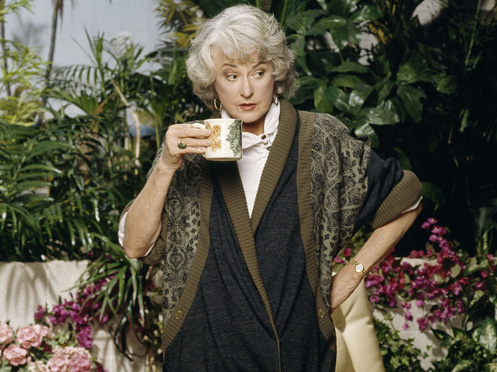
The Best Bea Arthur Story I’ve Ever Heard

I grew up with The Golden Girls. I watched it on Saturday nights with my parents, because when you’re a kid living somewhere that’s a bit further than a bike ride from any of your friends, that’s a standard evening’s entertainment.


I remember that Sophia Petrillo taught me the word “slut,” which I promptly used at school. I got in trouble, of course, and when my teacher asked me where I’d learned that word, I said “Golden Girls.” It’s weird thinking about how a show about four old ladies could have been a corrupting influence, but I’d wager it did more good than harm.

Years later, I found out the show had a huge gay following, and this was surprising because I thought it was just a weird thing that I really liked. It was gratifying. It made me feel more connected to a community I didn’t have that much first-hand experience with, even if I didn’t immediately understand why it would have resonated with gay dudes. This past week, I got to interview some of the people who wrote for the show. We talked about their experiences on the show, but also why they thought the show got the devoted following it did, and why people — gay and otherwise — still watch the show today.

The piece appears in the print edition of Frontiers, but I’m going to direct you to the online version. I ended up getting so many good stories from those writers that I added an extra 1,000 words online — just because I knew there were people out there who would want to learn as much as possible about what it was like behind the scenes on the show.

And in particular, I’d like to draw your attention to one story that is my absolute favorite. I was speaking to Mort Nathan, an executive producer on the show who also co-wrote a lot of episodes, including the one where Rose dates a little person, and he told me something that affirms everything I’d want Bea Arthur to be.

TV Guide had done a piece on the show: ‘The Golden Girls—Is it still as good as it was the first year?’ And they asked random people what they thought of the show, and this one housewife said she didn’t think the show was as good and that Bea Arthur’s character wasn’t as interesting. They mentioned her by name—Mrs. Betty Johnson, Sioux Falls, Iowa. So Bea reads this at lunch and then gets on the phone and asks information for this Betty Johnson’s number. And she calls her. And she picks up, this TV Guide woman, and Bea says, ‘This is Bea Arthur, and I want to talk to you about what you said in TV Guide.’ The woman was horrified. She said she was misquoted. ‘I didn’t mean it. Is it really you? I love the show. I take it back.’ And Bea goes, ‘That’s what I thought. OK, that’s better.’”

I just can’t believe she fucking called the woman. I mean, can you imagine? Hearing that voice on the other end of the line, and she’s knows you said something about her and she wants to have words with you? And this is pre-Twitter, pre-internet. She just found this woman and reached out. I love it. It’s awesome.

Winifred Hervey, who also wrote a lot of great Golden Girls episodes, also told me that story, but she added one part that makes me like it even more: “And then Bea said, ‘That person’s going to go tell everyone that I called her, and no one’s going to believe her.’”

Just perfect.