People, we must decide a better alternative to “I’m sorry” as the response to hearing that someone’s someone has died. I recognize that “my condolences” makes you sound like a count who is visiting the Americas as part of some sort of world tour and who is likely near death himself, and I unfortunately have nothing better to suggest, but I can only report that “I’m so sorry” is conversational homicide. Upon being told this, there’s simply nothing I can think to say or do. “Thanks?” can’t cut it. And “No worries, you didn’t do it on purpose,” never gets the response I think it will, even though I think it hits on the fact that “I’m sorry” in just about every other conversation is an admission of guilt and not a simple expression of “I have sorrow.” Yes, I do understand that “I’m sorry” is basically the death empathy version of “namaste” — “I recognize in you the ache caused by the recognition of mortality, for I have it too” — but I just can’t figure out what to say in return. “Bingo”? Is the answer “bingo”? Is there a hand signal I can be giving? (Folds hands, bows solemnly.)
... Just tell me how I should be doing this.

Thursday, April 25, 2013

Monday, April 22, 2013
Me Gusta la Banana
I think we have a new contender for worst song ever: the 1984 recording “Banana” by someone calling herself Jane Chiquita.
If the pairing of name and subject matter seem a little on the nose, then you too may be questioning whether this could be a joke. Or maybe it’s just some poor woman’s realization of her banana-centric destiny, at which point she, having completed the task for which she was sent to Earth, simply stopped existing. What I’d like to think — what I’m hoping, really — is that the song is about dicks and the suits in the studio said, “No, Jane, you can’t record a song just about dicks, even though this is Italy,” and so she was all, “Fine. Let’s make it about flesh-colored swords. No, wait — bananas! That’s easier to rhyme.” Because I can’t wrap my head around anyone thinking it would be a good idea just to make a song about how much they like bananas, though it wouldn’t be the first time someone had been tricked into singing about dicks.
Me being shortsighted, I took Latin as my foreign language, and so I can’t be sure what she’s actually singing about? Is this song in Spanish or Italian? Can someone smarter tell me if the lyrics are filthy? Or is it just a celebration of potassium?
If the pairing of name and subject matter seem a little on the nose, then you too may be questioning whether this could be a joke. Or maybe it’s just some poor woman’s realization of her banana-centric destiny, at which point she, having completed the task for which she was sent to Earth, simply stopped existing. What I’d like to think — what I’m hoping, really — is that the song is about dicks and the suits in the studio said, “No, Jane, you can’t record a song just about dicks, even though this is Italy,” and so she was all, “Fine. Let’s make it about flesh-colored swords. No, wait — bananas! That’s easier to rhyme.” Because I can’t wrap my head around anyone thinking it would be a good idea just to make a song about how much they like bananas, though it wouldn’t be the first time someone had been tricked into singing about dicks.
Me being shortsighted, I took Latin as my foreign language, and so I can’t be sure what she’s actually singing about? Is this song in Spanish or Italian? Can someone smarter tell me if the lyrics are filthy? Or is it just a celebration of potassium?
Sunday, April 21, 2013
A Literal Measure of Beauty (or — How Many Ships Have You Launched Lately?)
Finally, an objective way to gauge everyone’s appearance!
Helen, wife to Menelaus and therefore the queen of Sparta, was kidnapped by Paris, a prince of Troy, and we’re told this offence set off the Trojan War. The phrase “the face that launched a thousand ships,” however, doesn’t appear anywhere in the Iliad. No, it’s actually Christopher Marlowe’s 1592 play The Tragical History of Doctor Faustus that first uses that phrase in reference to Helen, who appears as a non-speaking character. In fact, as Wikipedia points out, the Iliad actually notes that 1,186 ships left for Troy: “As such, Helen herself has a beauty rating of 1.186 helens, capable of launching more than a thousand ships.”
There seems to be some disagreement over who invented the word, with some sources crediting mathematician W.A.H. Rushton and others Isaac Asimov. Because Marlowe’s full description of Helen includes that she “launched a thousand ships, and burnt the topless towers of Ilium,” David Lance Goines writes that the arson potential is also important: “If ships launched were the sole measure of beauty, Eleanor Roosevelt and Mamie Eisenhower would emerge, without peer, as the most desirable of women. Marilyn Monroe would not even be in the running. The pyromaniacal inclinations of the toothsome Mamie and Eleanor were, however, imperceptible. They didn't even smoke.” Goines therefore calculates that a millihelen should be beauty enough to launch one Homeric warship and burn down a house. Goines also estimates that those possessing an attohelen of beauty (10-18 helens) could inspire someone to “light up a Lucky Strike while strolling past a shipyard,” while those possessing a picohelen (10-12 helens) would be capable of getting someone to “barbecue a couple of steaks and toss an inner tube into the pool.”
And if unusual units of measurement are your thing, know that there is also a unit of measurement called the barn, so there are actual scientific implications to describing something as being “as big as a barn.”
millihelen (MILL-eh-HELL-en) — noun: the amount of beauty needed to launch a single ship.Today, Helen of Troy is known as the beauty who launched a thousand ships. Taken as a literal measurement, then, a millihelen would be one-thousandth of a helen, and therefore pulchritude enough to launch one ship. Once you get beyond ships, the math gets complicated. How many millihelens would one need to launch four guys riding two tandem bicycles? Or a VW Thing full of dogs? Or a tricked-out cropduster piloted by Erik Estrada? That’s for the eggheads to figure out, I suppose. There is probably a doctoral thesis somewhere in here.
 |
| rossana podesta, launching more than ships in a scene from the 1956 epic helen of troy |
There seems to be some disagreement over who invented the word, with some sources crediting mathematician W.A.H. Rushton and others Isaac Asimov. Because Marlowe’s full description of Helen includes that she “launched a thousand ships, and burnt the topless towers of Ilium,” David Lance Goines writes that the arson potential is also important: “If ships launched were the sole measure of beauty, Eleanor Roosevelt and Mamie Eisenhower would emerge, without peer, as the most desirable of women. Marilyn Monroe would not even be in the running. The pyromaniacal inclinations of the toothsome Mamie and Eleanor were, however, imperceptible. They didn't even smoke.” Goines therefore calculates that a millihelen should be beauty enough to launch one Homeric warship and burn down a house. Goines also estimates that those possessing an attohelen of beauty (10-18 helens) could inspire someone to “light up a Lucky Strike while strolling past a shipyard,” while those possessing a picohelen (10-12 helens) would be capable of getting someone to “barbecue a couple of steaks and toss an inner tube into the pool.”
And if unusual units of measurement are your thing, know that there is also a unit of measurement called the barn, so there are actual scientific implications to describing something as being “as big as a barn.”
Previous words of the week after the jump.
Saturday, April 20, 2013
The Day Storke Tower Broke
I went to college at UCSB, the campus of which centers around Storke Tower, a 175-foot phallus erected in honor of Thomas Storke, who helped found the school. It’s not just mere penis worship: Storke was also the editor and publisher of the Santa Barbara News-Press, and during his tenure the paper published a series of editorials condemning the John Birch Society that ultimately won Storke a Pulitzer. It’s fitting, then, that the office of the college paper, my once-beloved Daily Nexus, sits beneath it, even though this should logically mean that its situated in the tower’s pubic forest or possibly the ball sac, if you’re extending the penis metaphor (and when are not?). The tower also houses a 61-bell carillon that spells out the university motto, “Let there be light,” at ten to the hour. It does this by striking a series of bells that are assigned to letters of the alphabet. In practice, it sounds amelodic, but spend enough time on campus and you get used to it. Besides, you just try and get the bells in your genitals to play anything symbolic every hour. Then you’ll see how hard it is.
Sometimes, however, the carillon breaks and that’s when it gets especially interesting. When the bells are just being struck at random, it lends the campus this strange, Hammer Horror atmosphere. Back when he still had reason to be on campus, Spencer recorded the bells sounding all creepy one day. And just now, I found the clip and figured I’d put it on YouTube. Brief though it might be, it gets the mood across fairly well.
May this me the most amelodic portion of your day. Onward toward more melodious tomorrows.
Sometimes, however, the carillon breaks and that’s when it gets especially interesting. When the bells are just being struck at random, it lends the campus this strange, Hammer Horror atmosphere. Back when he still had reason to be on campus, Spencer recorded the bells sounding all creepy one day. And just now, I found the clip and figured I’d put it on YouTube. Brief though it might be, it gets the mood across fairly well.
May this me the most amelodic portion of your day. Onward toward more melodious tomorrows.
Friday, April 19, 2013
A Midnight Swim With Anthony Perkins
Generally, people know one thing about Anthony Perkins, and that’s Norman Bates, which is both a great and terrible thing.
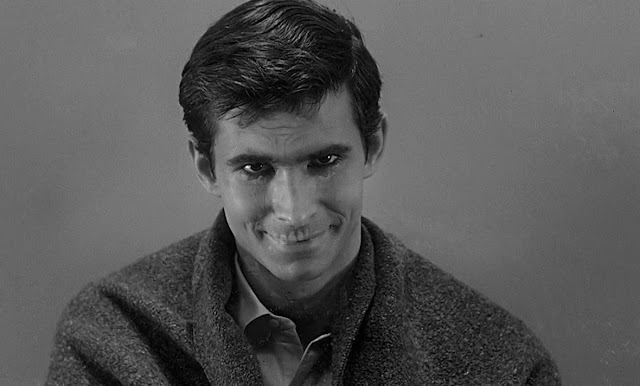
We remember this character because Perkins gave him a fidgety humanity that many movie heavies lack, and that’s a testament to Perkins’ effectiveness as an actor: to make movie-goers identify more with the murderer than with the flighty dumdum who gets murdered. But then again, I suppose the less cinematically literate among us just focus on the cross-dressing aspect of Norman’s character, and that somehow dovetails into Perkins’ real-life sexuality, which tends to be the second thing people know about Anthony Perkins and, like Norman’s, tends to be an unresolved gray area.
Anthony Perkins was more than just the bad guy from Psycho however. In fact, Norman Bates probably added up to a very small part of his life. For example, there’s script The Last of Sheila, which, as I mentioned before, Perkins wrote with Stephen Sondheim. It’s a tight script, and one of those rare murder mysteries that don’t cheat. If you’re especially clever, you could guess the killer in the first twenty minutes. The clues are there. They’re just hard to notice.
On the subject of Anthony Perkins being multi-talented, there’s also the fact that he had a brief pop career. Just three years prior to Pyscho release, Perkins scored a hit with a Hawaiian-tinged love song, “Moonlight Swim.” Lyrically, it’s quite simple — “Let’s go on a moonlight swim / We’re in love and above / There’s a crazy gold balloon / That sits winking down and / Inviting us to come on in” — and he’s not necessarily any smoother-sounding than any other late-50s crooner, but “Midnight Swim” isn’t without its charms. Have a listen:
But here’s the thing: I’d probably dismiss the song entirely were it sung by someone other than the guy who played one of the most famous movie murderers ever. Perkins’ role retroactively makes the song way creepy. I mean, if Norman Bates were asking you to get “far away from the crowd / all alone upon the beach,” you should probably conclude that he wants to stab you to death. There’s none of that menace inherent in the song, however. That’s just us, projecting Perkins’ most famous role onto the plain sweetness of the song, which in this new context seems like a facade hiding something rather sinister. Why else sound so cheerful?
While Perkins didn’t go on to become a music star — singing love ballads, murder ballads, both or neither — his son Elvis Perkins has made good on the musical potential. In 2008, he put out “Shampoo,” a decent indie rock single that, a dark love song whose references to wigs and hair, now that I think about it, still take me back to Norman Bates. Alfred Hitchcock, what have you done?
Psycho, previously:

We remember this character because Perkins gave him a fidgety humanity that many movie heavies lack, and that’s a testament to Perkins’ effectiveness as an actor: to make movie-goers identify more with the murderer than with the flighty dumdum who gets murdered. But then again, I suppose the less cinematically literate among us just focus on the cross-dressing aspect of Norman’s character, and that somehow dovetails into Perkins’ real-life sexuality, which tends to be the second thing people know about Anthony Perkins and, like Norman’s, tends to be an unresolved gray area.
Anthony Perkins was more than just the bad guy from Psycho however. In fact, Norman Bates probably added up to a very small part of his life. For example, there’s script The Last of Sheila, which, as I mentioned before, Perkins wrote with Stephen Sondheim. It’s a tight script, and one of those rare murder mysteries that don’t cheat. If you’re especially clever, you could guess the killer in the first twenty minutes. The clues are there. They’re just hard to notice.
On the subject of Anthony Perkins being multi-talented, there’s also the fact that he had a brief pop career. Just three years prior to Pyscho release, Perkins scored a hit with a Hawaiian-tinged love song, “Moonlight Swim.” Lyrically, it’s quite simple — “Let’s go on a moonlight swim / We’re in love and above / There’s a crazy gold balloon / That sits winking down and / Inviting us to come on in” — and he’s not necessarily any smoother-sounding than any other late-50s crooner, but “Midnight Swim” isn’t without its charms. Have a listen:
But here’s the thing: I’d probably dismiss the song entirely were it sung by someone other than the guy who played one of the most famous movie murderers ever. Perkins’ role retroactively makes the song way creepy. I mean, if Norman Bates were asking you to get “far away from the crowd / all alone upon the beach,” you should probably conclude that he wants to stab you to death. There’s none of that menace inherent in the song, however. That’s just us, projecting Perkins’ most famous role onto the plain sweetness of the song, which in this new context seems like a facade hiding something rather sinister. Why else sound so cheerful?
While Perkins didn’t go on to become a music star — singing love ballads, murder ballads, both or neither — his son Elvis Perkins has made good on the musical potential. In 2008, he put out “Shampoo,” a decent indie rock single that, a dark love song whose references to wigs and hair, now that I think about it, still take me back to Norman Bates. Alfred Hitchcock, what have you done?
Psycho, previously:
Tuesday, April 16, 2013
Shadow of the Monsoon
"Yeah, looking at it now. The art is great, and I like the way you've contrasted the wistful look of Private Wilkies against the calculating expression on Frau Harolda. The abstracted plants in the foreground are lovely. So… listen, we feel a little awkward about asking this, but… do you think that a monsoon is a type of jungle cat?"

Oh, the treasures of The Iliad, which redeems the Valley. (One here and one here. They suited the square from of Instagram better. This one did not.)

Oh, the treasures of The Iliad, which redeems the Valley. (One here and one here. They suited the square from of Instagram better. This one did not.)
Monday, April 15, 2013
"I've Been Reading a Lot of Scripts Lately. You Know, It's a Lot Cheaper Than Going to the Movies."
Whereas a lot of people like to point out Wikipedia's shortcomings, I will praise it for a quality that many of you may have overlooked: its ridiculously detailed synopses of movies you should never bother watching. It takes all of two minutes to glean all the highlights, and best of all, these scenes will look better -- sexier, gorier, better choreographed, what have you -- in your imagination than they ever would if you actually watched them, given the films' limited special effects budgets and the technological limits of 1977, which was a great year for terrible movies you shouldn't watch. (Case in point: the Jaws rip-off Tintorera, which I can't imagine being better in movie form than it is in paragraph form.) More than that, however, the synopses have been shaped by the inscrutable impulses of the weirdos who edit Wikipedia, and sometimes the specificity of detail that these people chose to go into is just baffling.
There's almost an art to this, and if you pull single paragraphs out of these, they work as surreal flash fiction -- no point, no pay-off, just weirdness for weirdness's sake, in a way that makes me secretly glad that these words exist together, in this order, as a result of people collaborating across space and time and then deciding, "Yeah, that's good enough."
Here's a good example:
Ha. "Fima."
There's almost an art to this, and if you pull single paragraphs out of these, they work as surreal flash fiction -- no point, no pay-off, just weirdness for weirdness's sake, in a way that makes me secretly glad that these words exist together, in this order, as a result of people collaborating across space and time and then deciding, "Yeah, that's good enough."
Here's a good example:
Back in her own apartment, Kim discovers her sink is full of cockroaches; she frantically sprays insecticide on them. She settles down on the kitchen table to eat dinner and flips open the book Fima loaned her. The page she randomly arrives at is titled "The Spiral: Symbol of Women's Power". Kim glances at her plate of noodles and notices that they are arranged in a vague spiral. She spies another roach crawling out of a loaf of bread. Using the book, she bats at it. In the process, her spaghetti dish crashes to the floor. Leaving it on the floor, she leaves to spend Christmas Eve with Hank's family.Here's the film, if you really must know, but please, no questions about what possessed me to read the synopsis in the first place. And yes, this game works for works of literature, too, but I have a theory that there are more bad movies than bad books. Prove me wrong, world.
Ha. "Fima."
Subscribe to:
Posts (Atom)