Pages

Sunday, March 13, 2011

Dangerous Living in Los Angeles, California

I’ve no idea what led to this home’s foundationless, precarious situation on top of the hill overlooking Tuxedo Terrace, but I’m almost certain it’s in the process of moving to a safer place.


I said “almost” because people in this part of the world seem to habitually build expensive homes in a way that ensures that they won’t exist long — in fire-prone canyons or near eroding cliffs, for example. And though it seems implausible that anyone would ever build a home with the intention of it teetering precariously and showoffishly, I suppose that it would probably happen in Los Angeles if it were to happen anywhere in the world.

Friday, March 11, 2011

About That Shepherd

People don’t generally read this blog on Fridays, I’ve noticed. In fact, readership usually is higher on Saturdays and Sundays. Weird, right? I mean, I’d guess that my primary readership is bored college graduates looking for a momentary distraction from the tedium of their jobs. And my readership being mostly American, I’d assume you all have to work on Friday. Yet somehow, on the last day of the week, when people are probably most tired of work, they seem to turn elsewhere for distraction. Porn? Daydreams about torching your place of employment? Stealing office supplies? Please, tell me. I’m genuinely boggled as to what causes the Friday dip.

Cruella in Better Days

I rarely write anything in advance or plan posts here to appear in a certain order, but sometimes they line up serendipitously. Like today’s. It shares some territory with what I wrote yesterday about the difference between my favorite Twilight Zone episode and the short story that inspired it. Shortly after it went up, I saw a post on 2719 Hyperion — a Disney nostalgia blog that makes for a great read, even if Disney isn’t necessarily your thing — about the translation of Dodie Smith’s book The One Hundred and One Dalmatians to the animated Disney movie. Quite a bit grew, changed and vanished between one and the other, but what stood out most to me was how badly the animators beat ol’ Cruella De Vil with the ugly stick. Check her out as she appeared in what I think is the book’s original illustrations:


Crazy, right?

While you can’t argue that the Disney version of Cruella isn’t iconic, I actually prefer the hot flapper version of the character over the skunk-haired corpse. It’s obvious when the evil-looking person actually is evil. A story about the hollowness of vanity might have benefitted from a villain who is superficially attractive (if in a very of-the-era way) but whose insides are fuggo-nastiness. You know, like attractive people in real life.

Bonus: Did you know that Dodie Smith wrote a sequel to The Hundred and One Dalmatians titled The Starlight Barking about all the humans in the world falling under a magical trance and a space dog named Lord Sirius offering to beam all earth-canines away to be spared the ravages of an oncoming nuclear war? No, of course you didn’t know that.

Thursday, March 10, 2011

Who’s Got the Button?

So I’m a giant Twilight Zone geek. In fact, I like anthology series in general, just because their freedom from the season-long arc allows them to expose their protagonists to all manner of weirdness that would be verboten in a typical, unified series. Recently, I re-watched my favorite Twilight Zone episode. It’s not one from the original series but from the mid-eighties reboot: “Button, Button.” And in looking into the history of the episode, I was surprised to find out that writer Richard Matheson didn’t intend it the way the show eventually depicted.

The episode stars Mare Winningham (St. Elmo’s Fire) and Brad Davis (Midnight Express) as a couple badly in need of money. One day, a mysterious be-buttoned box arrives on their doorstep, and soon after an equally mysterious man shows up and explains that pressing the button will make the couple earn $200,000 with the single consequence being that someone, somewhere, whom “you don’t know” will die. The spineless husband and chain-smoking shrew of a wife agonize over the opportunity; she’s eager to elevate their standard of living, but he’s worried that the victim could be, for example, someone’s innocent child. Eventually, she hits the button. The next morning, the mysterious man arrives with the promised $200,000. He takes the box, which he says will be “reprogrammed” for a person “whom you don’t know.” The episode ends with the wife realizing her mistake and resigning herself to the grim fate that some stranger as greedy as she is will eventually push the button and cause her to die.

The episode, in case you’re interested:


If that plot sounds familiar despite your lack of Twilight Zone knowledge, that’s probably because it was used as the basis for the 2009 Cameron Diaz film The Box. Donnie Darko director Richard Kelly used this simple plot to spin off into all matter of metaphysical nonsense and conspiracy theory. The result was strange and unsatisfying but, for me, sort of fascinating, just to see what depths Kelly would drag the plot. The Box wasn’t without its surprise rewards — Arcade Fire, what are you doing there? Deborah Rush, what are you doing there? — but I didn’t feel it improved much on the original story, which is so wickedly sinister in its simplicity.

But I was surprised to learn that the ending that I thought so much of wasn’t actually Matheson’s. In his original short story, the wife presses the button and, the next morning, her husband dies in a train accident. When the mysterious man comes to collect the box, he explains why his prophecy was accurate: “ Did you really think that you knew your husband?” According to Wikipedia, Matheson so disapproved of the new ending that he asked to be credited with a pseudonym for the broadcast of the episode.

Now I’m at a loss. I love the original plot, with the awful wife forced to lived the rest of her days knowing that she may die at any moment. However, Matheson’s ending underscores the radically different ethics of the husband and wife — and perhaps punishes her even more for her misdeeds by making her responsible for the death of a person she actually loves. On yet another (third?) hand, the moralistic ending of a wife “not really knowing” her husband seems a heavy-handed, even by TV standards.

So I put the matter you all, thoughtful readers. What’s worse: accidentally ensuring your own death as a result of your greed, or causing the death of someone you ostensibly love, more or less because you didn’t know them as well as you thought you did?

By the way: Whatever you decide, the Wikipedia entry for “unintended consequences” makes for a pretty great read.

Tuesday, March 8, 2011

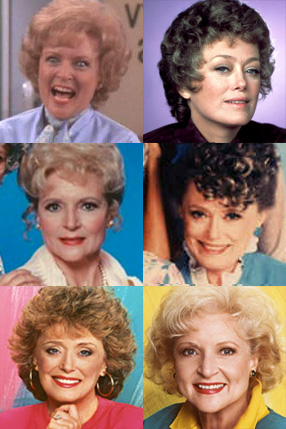
Rose, Blanche and the Various Colors in Between

Except for Estelle Getty, the stars of Golden Girls would have been familiar to most TV viewers, and, at that, they would have been already associated with certain types of characters. This is perhaps most true for Bea Arthur, as Dorothy Zbornak is cut from the same cloth as Maude from Maude. But I’m not talking about Bea Arthur today. (Apologies, Bea.) No, I’m more concerned with this: On Golden Girls, Betty White and Rue McClanahan got a chance to play characters who contrasted against the types they’d previously played on TV.

White would have been familiar as the superficially sweet but truthfully evil Sue Ann Nivens from The Mary Tyler Moore Show. And after that, Betty White appeared on Mama’s Family (version 1.0, pre-syndication years) as Ellen, the snobbish oldest daughter of Vicki Lawrence’s character. McClanahan, on the other hand, would have been best remembered as Vivian, the dim but goodhearted friend of Maude. And after that, she became the prim Aunt Fran on the same era of Mama’s Family that White appeared on. Thus, if Golden Girls had stuck to the trend, Betty White should have played man-hungry Blanche and Rue McClanahan should have played airheaded pollyana Rose.


In fact, as many Golden Girls buffs know, that was originally the plan. However, White and McClanahan were aware enough of the public’s perception of them as actresses that they thought it would be better TV — and, truth be known, more fun — to play against type, so they swapped roles at the suggestion of Jay Sandrich, frequent Mary Tyler Moore director and also the director of the Golden Girls pilot. As White explained in an interview:
[If] I was going to play another man-hungry neighborhood you-know-what, the audience was going to equate it with Sue Ann and just a continuation of her role. So [Sandrich] had the bright idea to have Rue, who was intended to play Rose, play Blanche. Rue had just come off Mama’s Family, where she played a quiet and rather mousey sister. So it was a perfect switch, in hindsight. … And Rue, my god, she took Blanche out into orbit where I would have never dared to go. So I just think it worked out beautifully. If I had half the sex life Blanche had I would have been dead from exhaustion.
As a result, the roles of Rose Nylund and Blanche Devereaux came to define White and McClananhan, regardless of how many characters they had portrayed previously. (By the way, the English major in me can’t help pointing out that the meaning of the characters’ names would make more sense if Blanche, “white,” had been the naive one and Rose, a sensual red color, would have been the vixen.) Credit the success of the show or the life that either actress breathed into the characters, but I can think of few other actors who became so defined by their roles so late in their careers. Even today, nearly twenty years after Golden Girls concluded, it seems hard to think of either Betty White or Rue McClanahan without also thinking about Rose and Blanche. And I’d guess that could result from Rose being a little closer to Betty White’s actual personality and Blanche being closer to Rue McClanahan’s. The former’s marriage to Allen Ludden is the stuff of frosting and hayrides and all-American picnics; the latter had tumultuous relationships with men, though she was married to her sixth and final husband the longest, from 1997 to her death in 2010.

Of course, I can only guess, but it’s fun to think about.

Unrelated, more or less: Isn’t it weird that Rue McClanahan was in Starship Troopers?

TV, previously:

Monday, March 7, 2011

I Should Like to Have My Me-Sized Umbrella Back, Please

You cannot argue that it’s been too long since I’ve posted anything about a slow loris.


A legitimate question: Why do they take away her tiny umbrella when it so clearly gives her pleasure?

Ghost Phones

How should we discuss the spaces where public phones once existed but no longer do?


I mean, realistically the point is moot because we wouldn’t need to refer to these spaces. Yet they exist, and they’re all awkward about it, looking exactly like a place where a phone was but isn’t anymore. They’re like tree stumps, these lingering reminders that a once-useful thing stood in a given place. Only tree stumps can actually serve a purpose: You can sit on them, or you can stand on them if you’re giving a speech to woodland creatures. The places-where-phones-once-were, however, don’t do anything aside from remind you that we don’t need public phones anymore and make you feel strangely wistful about bygone now-obsolete technology. If you’re me, they also make you ponder the strangeness of how disconnecting the lines could probably save money yet removing all physical evidence of the phones’ existence would cost money, hence this odd, otherwise unusable space that we have now. The above photo, taken at MOCA, can’t really be used for anything. You can’t sit in the slots, no coat hooks are provided and it hasn’t even been modified into anything artistic or aesthetically pleasing. (What the fuck, MOCA? You of all institutions…) In fact, I can imagine only one reason to preserve these kinda-sorta booths with insufficient privacy panels: to baffle future generations as to what purpose they might have ever served. You know, at the point in the future at which it no longer is common knowledge that people once had to insert physical currency into a public machine in order to make calls. Mark my words. This will happen. And we will feel old.