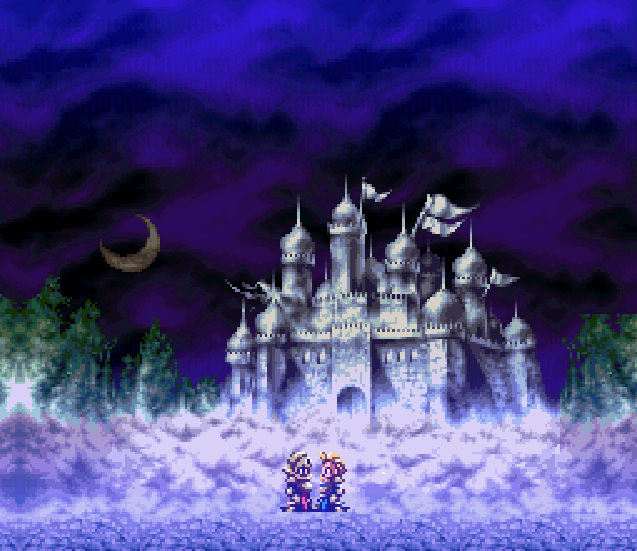
And then there’s
Final Fantasy. In a sense, I’m barely going to even touch on this sprawling series. Since the first game debuted in 1987, twelve sequels have been released for various home consoles, each of them offering small universes teeming with characters borrowed from various worldwide folklores and mythologies, pop culture and countless other sources. Tracking them all down on my own would be daunting — not to mention pointless, since
a long-running collection of them already exists online.
In fact, that very list — which is hosted at the website
Final Fantasy Compendium — represents the progression of a project started by a guy named Mark Rosa back in 1995. I remember stumbling onto it shortly after I learned what the internet was and being blown away not only by how much these games drew from real-world sources but also how the background helped to deepen the game’s content. I don’t know what ever happened to Mark Rosa — the last version of the list
is preserved online for posterity’s sake — but this list is most definitely a product of the work he did years ago.
So here, then, is my short take on
Final Fantasy, focusing on mistranslation and origins obscured by the Japanese-to-English translation process.
Is it lame to say I have a favorite piece of video game etymology? It probably is, but at this point in this particular list, I think I’m light years beyond typical levels of lame. Regardless, my favorite of the series is that of a recurring, generic enemy character called the
Malboro — or, sometimes,
Molbol,
Marbol and
Morbol. (From my perspective, the name could be transliterated into English just as easily as
Morbor,
Marbar or
Maruburu as well. The literal transliteration of the Japanese name would be
Moruboru.)

bad breath or carcinogenic breath, depending on the etymologyIt’s a lumbering plant monster that attacks with toxic breath. It’s presumed, then, that its name might be a reference to the
Marlboro brand of cigarettes, which could also be interpreted as giving people bad breath in more than one way.
However, others conjecture that the name could come from
a combination of the Latin mal, “bad,” and the second word part boros, allegedly meaning “breath” in either Latin or Greek.
I don’t think it’s true. Unless I’m mistaken, the words for “breath” in either language don’t look much like
boros. A video game folk etymology, I guess.
Similarly, others claim a connection between this thing’s name and
a purported Japanese onomatopoeia boro boro, which represents the noise of an upset stomach. From what I’ve found,
boro boro more commonly refers to a low rumbling noise, specifically like that of a rolling object.
Not being a Japanese-speaker by any stretch, I couldn’t say whether this word could refer to a volcanic digestive system or not. And yeah, I realize I said back in the
Zelda section that the Japanese onomatopoeia for the noise of a large rolling thing is
goro goro. I’m not saying it’s not. For all I know, Japanese abounds with onomatopoetic synonyms.
Certain games also feature a palette swap of the Marlboro called
Oscar. Given the characters green color and nasty disposition, it seems like a likely reference to the
Sesame Street character
Oscar the Grouch.
sabin (sabine/mash/matthew), celes (celeste/celes) and terra (tina)
In previous posts, I wrote about
Final Fantasy VI and the strange way certain character names were altered from the original Japanese version to the English one. (For example, I think the latter half of character pair of Wedge and Biggs sounded better with
his original, mistranslated name, Vicks, in spite of associations with VapoRub.) Not all the switches are bad. The character named
Cyan in the English version is
Cayenne in the original Japanese, and I have to say that I prefer the color name over the spicy name.
One switch I didn’t mention is that of a character who in the Japanese version is named
Mash but who in the American version is renamed
Sabin. The popular belief — likely put forth originally in Rosa’s document — is that Sabin’s name could come from medical researcher
Albert Sabin, who is credited with developing an oral polio vaccine, the connection being that polio inhibits the body’s motion and that the video game character is a martial artist who excels in fighting barehanded — thus, he has no problems exhibiting muscular control. Tenuous, I’ll admit, but slightly more meaningful than if the character had been assigned an almost unheard-of masculine form of the feminine name
Sabina for no reason at all. Equally as unclear to me is the origin of the character’s Japanese name. Those who weigh in on various online forums on such matters disagree over whether
Mash would be better translated as
Matthew or something like
Matthius or
Mattheus.
If nothing else, this confusion demonstrates how problematic it can be to translate from Japanese into English. (
A commenter has pointed out that
Mash may come simply come from the fact that Sabin’s special moves are triggered by entering specific button combinations, or by mashing the control pad. I like it.)
On a similar note, there’s a previous post I put up here on two other
Final Fantasy VI characters:
Celes and Terra. They’re arguably the game’s two central characters, with each being the protagonist of one of the game’s halves. When considered as a pair, with
Celes meaning “sky” and
Terra meaning “earth,” the names make for an interesting symbolic reading. Terra’s Japanese name,
Tina, blows the connection, however.
(A reader emailed me with another note about Terra’s name that I felt was worth mentioning. He asked if the name could have a double meaning — “earth” from the Latin and “monster” from the Greek root
terato-, meaning “monster.” This second root would actually seem to be the present in
Final Fantasy VI in the name of the earth-elemental summon
Terrato. As a name,
Terra is pretty much always means “earth,” but because
Final Fantasy VI’s Terra can actually transform into a monster,
terato- doesn’t seem completely implausible.)
your run-of-the-mill phantom train
As does any good video game,
Final Fantasy VI features an evil, sentient locomotive. It’s called the
Phantom Train in the English versions of the game. A later sequel,
Final Fantasy VIII, features a similar character called
Doomtrain in the English version and, seemingly without explanation, something that approximates
either Grasharaboras or Gurasharaborasu in the Japanese version.
In
a previous post, I talk about how the bizarro Japanese name is a mangling of a
Glasya-Labolas — the name of an obscure demon in fringe Christian lore and whose appearance is described as being decidedly un-locomotive-like. This small oddity is marks one of the strangest video game references I have encountered.
Final Fantasy VIII uses the series’ rich history of meaningful names to enhance the game’s plot. Specifically, the game repeatedly flashes back to events in the life of a character called
Laguna, whose name is Spanish for “lagoon” but also allegedly references
Laguna Beach — neighbor to Costa Mesa, which was once home to the California offices of Squaresoft, the company that released
Final Fantasy VII.
The real hero of the game, however, is a pouty orphan named
Squall, who leads a band of ragtag warriors to save the world but who never gets any confirmation as to who his parents are. The careful player knows, however: It’s Laguna and his ladyfriend,
Raine. The game strongly hints at this, but the names practically confirm it:
Laguna,
Raine, and
Squall each reference water in some way.
The fact that Laguna’s last name is
Loire — a river in France — seems to further emphasize the importance of water names. Entirely separate from this water-themed nuclear family but equally notable for this entry is another central character,
Irvine, who is named for the Southern California city
of the same name.
left to right: son, dad and mom of the water family
As if that wasn’t enough meaning to pack into or extract from Laguna’s name, there’s one bit more: Like most
Final Fantasy games,
Final Fantasy VIII features an airship on which the heroes can jet around the world. In this case, it’s named
Ragnarok, after the kinda-sorta-apocalypse from Norse mythology. The word appears a few times in various
Final Fantasy games, but in
Final Fantasy VIII, it’s especially significant because its syllables, when represented in Japanese, bear a resemblance to those of Laguna Loire’s name represented in Japanese:
ra-gu-na-ro.
(If this little theory is correct, that final “K” apparently gets squeezed out of the Japanese pronunciation.)
That classic “L”/“R” confusion rears its head often, especially in earlier installments of the series. To this day, incarnations of
Final Fantasy IV still feature a female character named
Rydia, for example, though it seems fairly obvious that her name should be
Lydia, an old-fashioned but not uncommon Western name. However, it’s always been
Rydia , even in the Japanese literature featuring English characters, so Square is either running with the error or honestly wanted to name the character this.
 rydia, then the two prince edwards
In
Final Fantasy IV, Rydia finds a love interest in a ninja named
Edge. And you have to admit: For a manly ninja character,
Edge is a damn cool name. In what I can only interpret as a subtle joke, however, the character’s name is actually a contraction of his first name,
Edward, with his last name,
Geraldine, which is far, far less cool. I mean, I’d go by
Edge too. Edge’s real name is especially notable in that he shares it with another playable character,
Edward, a bard. Both characters happen to be princes. In the Japanese version, this second Edward is named
Gilbart — that is, not
Gilbert — and I wonder if that second syllable is supposed to be a play on the word
bard. Most likely, Gilbart ended up being
Edward in the American version as a result of the fact that
Gilbart has more letters than the American system was programmed to accept. Nonetheless: two princes named
Edward in one game.
The latter, lute-playing Edward — whose full name is
Gilbart Chris von Muir, curiously, with
Chris being his middle name rather than
Christopher — is clearly the inferior of the two, though he, like
Zelda II’s Error, has helped generated one of the most famous video game geek catchphrases. The original script of
Final Fantasy IV had another character denounce Edward as a “spoony bard” — a line that has remained in subsequent translations of the game despite its strangeness. Though quite a few regard the line as a mistranslation,
it’s not technically incorrect.
The word
spoony, “enamored in a silly or sentimental way,” is both a legitimate English word and an accurate description of Edward.
It gets made fun of anyway.
The original Japanese insult, however, has been translated as
“son of a bitch.”Excluding a giant chunk yet to come, the only other
Final Fantasy IV characters I felt merited etymological discussion were two that previously got their own posts:
Ogopopogo and
Octomammoth. Click through if you remember them or have any interest.
Regarding further “L”/“R” confusion, the cast of
Final Fantasy V fares even worse than poor Rydia — and that would seem more or less typical for the game I consider
the one “feminist” Final Fantasy game. One character gets translated variously as either
Lenna or
Reina, the latter of which means “queen.” A second is always known as
Faris, though I can’t help noting that her name, if it were to suffer an “L”/“R” switch, would become something a lot like the English word
phallus, which seems especially notable when you consider that Faris is a woman masquerading as a man. (And then some: The male protagonist’s name,
Bartz, is
Butz in the Japanese version. That puts Phallus, Butz and Queen going on an adventure together.) Partway through the game, the player finds that Faris is Lenna’s long-lost sister and her real name is
Sarisa. Considering it refers to
a type of Greek spear but nonetheless sounds feminine, it’s a fairly appropriate name for a strong female character, phallus jokes aside.
Unfortunately, the game’s first English translation mistakenly transliterated
Sarisa as
Salsa, which isn’t a good name for anyone. And yet the biggest loser in the translation game would be a third female character,
Krile, whose English name was apparently the best approximation of the Japanese
Kururu, even though previous fan-made translations used the far-better
Cara and even
Carol would have probably done the trick.
And one of the spin-offs,
Final Fantasy Tactics, seems to feature the same famous name translated in two different ways and assigned to two different characters. The game’s hero is a member of a family by the last name of
Beoulve, which looks a great deal like a mistranslated version of the name of the epic hero
Beowulf. Appropriate though the connection might be, it’s probably a near-miss, as the game features another character named
Beowulf. Still, the resemblance is remarkable. And I have never heard of any better theories for where the name
Beoulve comes from.
Final Fantasy, previously:
The whole “It’s a Secret to Everybody” series:
- Part One: Legend of Zelda
- Part Two: Mario, Donkey Kong and Wario
- Part Three: Sonic the Hedgehog
- Part Four: Street Fighter and other Capcom titles
- Part Six: Final Fantasy IV and Dante’s Inferno
- Part Seven: Metroid and Kid Icarus
- Part Eight: Castlevania
- Part Nine: Earthbound/Mother
- Part Ten: Chrono Trigger
- Part Eleven: Secret of Mana/Seiken Densetsu
- Part Twelve: Mega Man
- Part Thirteen: Miscellaneous Nintendo titles (Kirby, Pikmin, Pokemon, Animal Crossing, Duck Hunt, Clu Clu Land)
- Part Fourteen: Odds and Ends (Guilty Gear, Ogre Battle, Samurai Shodown, Pac-Man, Mappy, Adventure Island)
- Part Fifteen: The Worst Names in Video Games
- And the entire original post