Elephants have no knee joints, so if they fall down they cannot get up again. To avoid falling, the elephant leans against a tree while it sleeps. To capture an elephant, a hunter can cut part way through a tree; when the elephant leans against it, the tree breaks and the elephant falls. Unable to rise, the beast cries out, and a large elephant tries to lift it up, but fails. In some accounts, twelve elephants next attempt to lift it, and also fail. Finally a small elephant comes and succeeds in raising the fallen one.And here are more:
The elephant’s life span is three hundred years. They travel in herds, are afraid of mice, and courteously salute men in whatever way they can. They once lived in both in Africa and India, but now only live in India.And finally this chunk of information:
The dragon is the enemy of the elephant, and hides near paths where elephants walk so that it can catch them with its tail and kill them by suffocation. ... When it is time to give birth, the female wades into a pool up to her belly and gives birth there. If she gave birth on land, the elephant's enemy the dragon would devour the baby. To make sure the dragon cannot attack, the male elephant stands guard and tramples the dragon if it approaches the pool.Yep, that’s the one I was looking for — the one that explains, inasmuch as it can be explained, the strange medieval meme of illustrating elephants locked in combat with dragons. Poking around Tumblr, I found this post, which featured an elephant that was either appealingly stylized or appealingly erroneous:
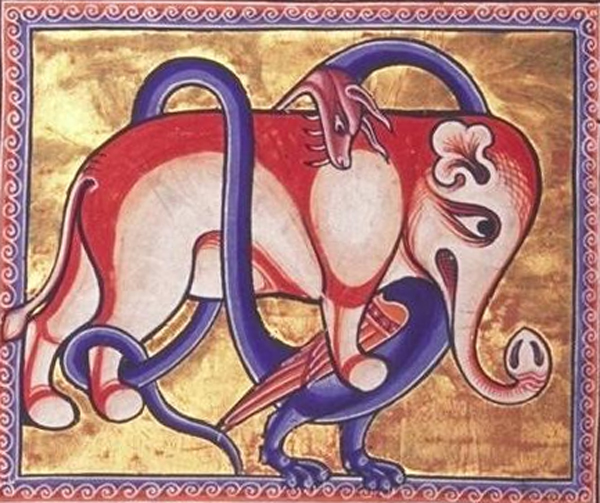
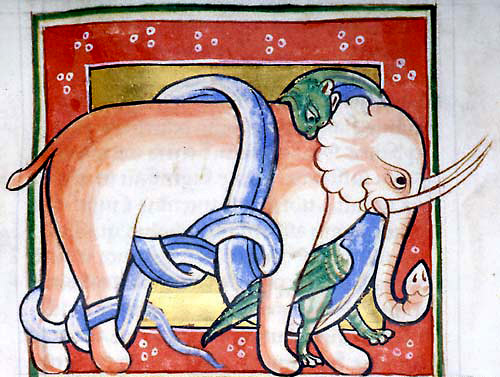


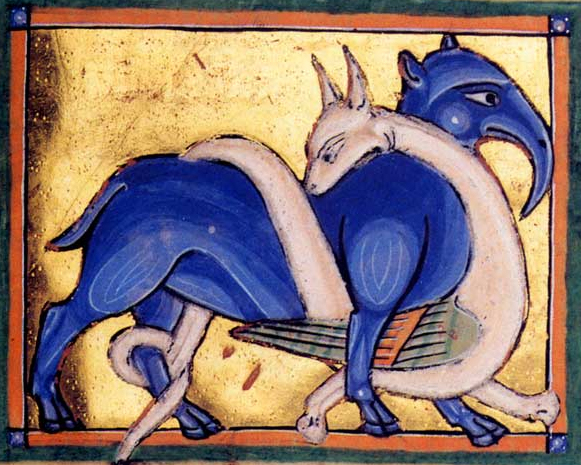

I suppose it shouldn’t be surprising that elephants would appear in medieval European art. Elephants did and still do, after all, live within walking distance of Europe — it would be a long walk, yes, and it might even be more like stamping distance, if we’re being technical about it, but still. Looking at the depictions themselves, however, I’d guess that many artists based their illustrations off descriptions of elephants without ever having seen one in person. So what gives? It’s apparently allegorical. Quoting the Medieval Bestiary once again:
The elephant and its mate represent Adam and Eve. When they were still without sin in the Garden of Eden, they did not mate, but when the dragon seduced them and Eve ate the fruit of the tree and gave some to Adam, they were forced to leave Paradise and enter the world, which was like a turbulent lake of pleasures and passions. The elephants mated and she conceived, and “gave birth on the waters of guilt.” The big elephant represents the law, which could not raise up mankind from sin, nor could the twelve elephants, which represent the prophets. Christ is the small elephant who succeeded to raising the fallen. The burning skin and bones of the elephant represent the commandments of God, which allow nothing evil to enter the pure soul.So there you go: perfectly sensible.
In closing, I want to say that I really hope some fourth-grader researching elephants stumbles onto this blog post and presents all this information to his class.