Pages

Sunday, April 24, 2016

How Howard Phillips Gave Princess Peach to Little Gay Nerds

The TLDR version: My friend’s stepdad is responsible for Princess Peach being my gay nerd icon, because his actions resulted in her being a playable character in Super Mario Bros. 2.


I’d wager it’s strange for anyone to live in Los Angeles, but it’s especially weird when you were that certain type of lonely kid who used pop culture to relate to the world around you, just because this dumb city happens to be where a lot of that stuff originated. Stay here long enough, and you may end up bumping into one of the people responsible for some movie or TV show that hit you on a personal level. So far, I’ve had a few interactions with people where I had to temporarily dump journalistic pretense and say, “By the way, thank you — that thing you did helped me feel less broken.”

Back at the 2012 Indiecade in Culver City, I met Howard Phillips, a guy who shaped the childhoods of many young video game nerds by being the Nintendo’s first American employee and its unofficial ambassador to the U.S. I originally knew him from Howard & Nester, the Nintendo Power comic that had a cartoon version of him alongside Nester, the magazine’s mascot and a character Phillips himself created.

via the howard & nester comics archive

At Indiecade, the non-cartoon Howard Phillips was meeting and greeting a lot of people who, like me, grew up playing Nintendo games and realized that he helped shape their experiences. And I got to talk to him a little more than the average fan because I’m friends with his stepdaughter Katherine. She and I worked together at the time, and she had once bragged that her stepdad was the Game Master. I initially assumed she meant Captain N: The Game Master and that she was crazy, but she explained that “the Game Master” was one of Phillips’ monikers during his Nintendo heyday and that she therefore grew up having a level of access to Nintendo products that would have made my head explode. When I got a few extra minutes to speak with Phillips as Indiecade, the conversation veered into Super Mario Bros. 2, which was my favorite game — a fact that should already be known to you if you read my blog.

Phillips happens to be the person who informed Nintendo of Japan execs that the “true” sequel to the original Super Mario Bros. was too difficult for American players. And while there was a lot of doing on the part of Nintendo’s Japanese developers to transform a game called Doki Doki Panic into something that starred Mario and Luigi, the impetus, as I’ve understood the story, was this single decision my friend’s stepdad. When I spoke to him, I’m not sure I truly grasped that had it not been for him, this weird game with vegetable-plucking, magic carpets and a curious preponderance of masks probably wouldn’t have become part of my life. But more than just that, Super Mario Bros. 2 is important because it was the first game in the series that let you play as Princess Peach.

Back then, Peach was still known as Princess Toadstool, but she was otherwise the same character we have today: blond and wearing a tiara but nonetheless able to fight the bad guys as effectively as Mario and Luigi could. She was a captive in the first Super Mario Bros. and again in Super Mario Bros. 3 — and in fact when news of that later game came trickling out in the pages of Nintendo Power, I remember thinking, “It’s weird how they’re only showing screens with Mario and Luigi,” because why the hell would Nintendo ditch one of the best parts of the previous game with this new fancy sequel? But that’s exactly what Nintendo did. It would take until the Super Nintendo to see Peach playable again — but only in spinoffs like Super Mario Kart and Super Mario RPG. In fact, it wouldn’t be until 2007’s Super Paper Mario that she would be allowed into the side-scrolling, hop-and-bop action of the original titles, and it wouldn’t be until 2013’s Super Mario 3D World, which is in many ways a spiritual successor to Super Mario Bros. 2, that you could play as her in a “real,” non-spinoff Mario game.

(EDIT: It’s been pointed out that I forgot to mention 2005’s Super Princess Peach, the game that had the princess using her rapidly changing emotions as weapons — angry fire, pouring water for sad tears, etc. It’s possible I just wanted to forget it.)


In Super Mario Bros. 2, you could select which character you wanted to venture through each level, and on many occasions I’d play the whole thing through as Peach, just because I could and especially because I didn’t have to play as a male character if I didn’t want to. As time went on, I’d default to the female character in any game that gave the option. In Street Fighter II, I was Chun-Li. In Mortal Kombat, I was Sonya. In Donkey Kong County 2, I would routinely pick Dixie Kong and her whirling helicopter ponytail over Diddy Kong, the male counterpart who had no magic ponytail.

Growing up in a more rural, more conservative town, this was well and good for home console gaming but slightly awkward in public at arcades. I can remember going to a pizza parlor birthday party and bouncing from Darkstalkers (where I played as Felicia, the oversexualized cat-girl) to Tekken (where I played as Anna, a brassy female fatale who fights in an evening gown). This prompted one of the other kids to ask, “Why do you always play as the girl?” That was a scary question. I felt like I’d been caught doing something I shouldn’t have, and I think I weaseled out of answering by lying about these characters being the best ones per all those video game magazines I read. But I honestly didn’t know what the motivation was at the time. I liked playing as female characters but couldn’t explain why.

In fact, I think I only came up with a reason relatively recently. When I was a kid, I had no idea I was gay. Looking back, me being gay helps explain a lot of things I did, and I think it might explain this. I knew I didn’t want to be a woman, but I something about playing as a female character in these games felt right because they represented an alternative to the overtly macho types that comprised the majority of the character select screen, especially in fighting games.

As a boy, I was expected to succeed at certain things that I was simply not cut out to do: sports, being handy with tools, exuding confidence, not crying at the drop of a hat and “boy play” with miniature cars or whatever the hell else is socially acceptable for male children to entertain themselves with. I failed constantly, and as a result, I felt like I was disappointing the people who had these expectations. The one stereotypically male pursuit I excelled at was video games, and something compelled me to do so as female characters because they could be every bit as successful as male characters, even if they didn’t look the part of a traditional hero.


Like Peach. Look at her. Farrah Fawcett flip, jewelry, a ball gown that’s wholly impractical for adventuring. She’s pink — so very pink — because there was a considerably long time in video games when most female characters were pink, just so there’d be no mistaking their gender. In short, Peach is kind of a big sissy, but so was I, in a lot of ways, and the fact that she was coded in this manner made her all the more attractive to me. While none of the other three heroes in Super Mario Bros. 2 were exactly Stud McBeefcake — come on, Toad is damn near genderless — there was no doubt from the first time I fired up that game that the princess would be my hero of choice. She still is.

Post-Lara Croft, post-Bayonetta, post-it becoming general knowledge that the dude from Metroid is actually a woman, Peach probably seems antiquated to a lot of gamers. She’s a vestige of an age in which female characters generally just yelled for help as the big bad carried them away. However, she’s also quite possibly the female character who’s been playable in the most games ever, and in my head, it makes her all the cooler than she can still be the best, on her own merits, neither because of or in spite of her unabashed girliness. Should you choose her to be, Peach can kill the monsters, win the race, score the winning shot and, in the case of Super Smash Bros., kick the stuffing out of everyone and anyone.

In case you’ve made it this far and don’t know, Smash Bros. features video game mascots fighting each other, and from the second game on, Peach has been a playable character. I’m ending on this note because it ties back to Howard Phillips and Super Mario Bros. 2. Each character fights using moves that originated in whatever game they’re representing, and Peach’s repertoire draws from Super Mario Bros. 2. She pulls turnips from the ground and tosses them at her opponents, for example, and she can float in midair, and both of these elements originated in my favorite game.


Now, even if Phillips hadn’t set into motion the chain of events that created the American Super Mario Bros. 2, it’s quite likely that Peach would have ended up playable in subsequent Mario games anyway. She’s the main female character, after all. But she wouldn’t have ended up the way she is now had it not been for Nintendo ultimately deciding to substitute Doki Doki Panic for the game released as Super Mario Bros. 2 outside Japan. Doki Doki Panic’s heroes, a jolly Arab family, were transformed into Mario characters.


Imajin, the main hero with the average stats, became Mario. Papa, the strong one, became Toad. Mama, who jumped high, became Luigi, and cute little sister Lina, who could hover in midair and who, yes, is clad in pink, became Peach. Lina and the rest of her family have since been relegated to footnotes in video game history, but every time someone plays as Peach in Smash Bros. and floats for a second in the air to trip up their opponent, they’re using Lina’s old move. Thanks to Phillips (and Nintendo (and Super Mario Bros. 2))), she’s not completely lost. She’s just hidden.

This is all a very roundabout history lesson, but it seemed important to me. It’s the little details that make given movie or TV show or whatever resonate with you for the rest of your life. I like that Princess Peach is a big, pink powderpuff of a character, and that she’ll probably always be that way. It clicked with me when I was a kid, and as strange as it might sound, I feel like it put me on a path to figuring myself out later in life, all in addition to shaping subsequent video games for decades to come. And it all happened because my friend’s stepdad made a decision. He would probably be surprised to know that it had any big effect on one little gay nerd in the middle of California, but I’m happy to put it out there.


Miscellaneous notes:
  • Earlier this month, I wrote did a post about Troop Beverly Hills and how Shelley Long’s character treats her femininity as an asset and not an obstacle. I would have seen Troop Beverly Hills at the height of my Super Mario Bros. 2 fixation, now that I think about it, and writing that piece probably resulted in this piece.
  • Nester did eventually make it outside the pages of Nintendo Power, even appearing in a few games. Most notably, he got his own game in 1996, the Virtual Boy title Nester’s Funky Bowling, where he appeared alongside not Howard but a girl version of him named Hester.
  • You may remember Katherine as the owner of the dog who fell victim to a hilarious skunkening last year. She currently hosts a delightful but suggestively named podcast about food history.
  • The history behind how the American Super Mario Bros. 2 came to exist is explained in beautiful detail in Jon Irwin’s 2014 book, and if you loved the game half as much as I did, you may also enjoy this deep dig into it. Game Historian also has a good video on the history of Mario 2.
  • Peach may be the most famous playable character in a Nintendo game, but she’s not the first. Metroid came out two years before, though many players wouldn’t have realized its hero, Samus, was female. Mach Rider, which came out a year before Metroid, might also have a female hero, and then there’s Bubbles, the anthropomorphic goldfish hero of Clu Clu Land, which came out in 1984, even before Mach Rider, though there’s hardly much about Bubbles to identify her even as a goldfish much less a female one.
  • Two unheralded NES-era with female protagonists: The Krion Conquest and Ghost Lion, one of which stars a girl who may or may not be Kathy Santoni from Full House.
  • Finally, my love for female heroes made me fall in love with Athena, a SNK game that was ported to the NES. It’s not great, I realize in retrospect. Bad play control and punishing difficulty, but the lead character is girly as hell, and at one point you could transform into a mermaid. I was hooked, in spite of it all.

Wednesday, April 13, 2016

Various Nostalgic Pop Culture Icons My Dog Looks Like

Yes, I finally got a dog. I’d apologize for not saying so sooner, but in the best possible way, he’s why I haven’t had much free time the past two months.

His name is Thurman. He is a rescue. He is five years old. I’d had reservations about the problems a rescue dog might bring with him, but Thurman has proven himself to be a fully-formed little gentleman — well-mannered and socialized to the point that as soon as he got here, it seemed like he’d always been here. And while he’s taken up my time with walks and all the other things dogs require, he doesn’t seem like a burden; making him happy seems like the best possible use of my time. I suppose this is what parenthood feels like, only without the crippling fear that this cared-for thing will one day go to college and learn to resent me.

This is how Thurman looks, in general.


This is Thurman again.


Here is Thurman looking like a supermodel.


And here is me and Thurman looking his most Muppet-y.


It’s on that last note, “Muppet-y,” that I get to the subject of the post: If I am to believe what the general public tells me, Thurman resembles all manner of characters from the collected pop-cultural memory of ’80s babies. Here, then, is an up-to-date list on every fantastic animal character people have claimed he looks like.

Master Splinter from Teenage Mutant Ninja Turtles


Not the Splinter from the cartoons but specifically the Jim Henson-produced puppet used in the 1990 live-action movie. I kind of get it. The hair and the beard are in the ballpark, but I’d like to think that Thurman carries himself with a certain noble nature that a rodent couldn’t manage — sensei or not.

Falcor from Neverending Story


I don’t get this one, really. Falcor looks like a dog, sure, but lots of real-life things look more like Falcor than does this particular dog — this one and this one in particular. Sure, I’ve compared him to Falcor myself, but that's more just because I like to hold him like a giant baby and pretend he is flying.

Gmork from Neverending Story


I think what people are referring to when they tell me Thurman looks like Falcor is actually Gmork, the evil, snub-nosed wolf that works for the Nothing in The Neverending Story. Thurman also has a little piggy nose himself. It’s technically a cleft nose — like a cleft palate but just specifically with his nose. No, it doesn’t seem to bother him any, but it does seem to prompt a lot of people to ask what happened to him. I think I’m going to start responding with “He got in a fight with the last person who asked an invasive question.”

Gizmo from Gremlins


It’s the hair. And the ears.

Sir Didymus from Labyrinth


Again, it’s the hair but specifically the beard, notwithstanding the fact that Sir Didymus actually rides a dog. This is more or less how I’d imagine Thurman might talk, since I like to think he is a wizard who was trapped in a dog body and just got used to it. Also, it should be noted that I wish I could make Thurman wear a hat like the one Didymus wears.

Snarf from Thundercats


I consider this comparison offensive and do not wish to comment on it further.

Conclusions? A lot of supporting characters from childhood movies and TV shows had amusingly shaggy hair. My dog will never know about any of them, though he seems to be happy to have complete strangers address him on the street.

By the way, I got Thurman through A Purposeful Rescue, an L.A.-based group that I fully recommend if you’re in the market for your own Thurman. And okay, fine, here is one more photo of my dog.


Should you want to see more photos of Thurman, I made him his own Instagram account, less to be obnoxious and more to prevent myself from spamming my dog-agnostic friends with a ceaseless stream of every cute fucking thing he does.

Thursday, March 3, 2016

The Best Bea Arthur Story I’ve Ever Heard

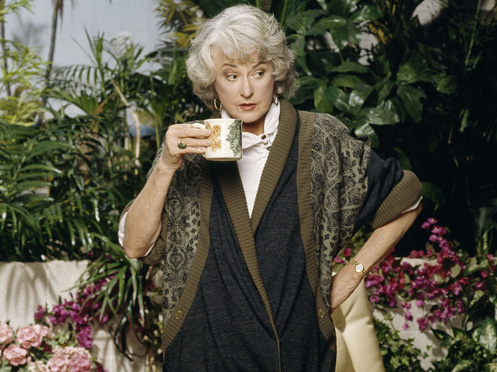
I grew up with The Golden Girls. I watched it on Saturday nights with my parents, because when you’re a kid living somewhere that’s a bit further than a bike ride from any of your friends, that’s a standard evening’s entertainment.


I remember that Sophia Petrillo taught me the word “slut,” which I promptly used at school. I got in trouble, of course, and when my teacher asked me where I’d learned that word, I said “Golden Girls.” It’s weird thinking about how a show about four old ladies could have been a corrupting influence, but I’d wager it did more good than harm.

Years later, I found out the show had a huge gay following, and this was surprising because I thought it was just a weird thing that I really liked. It was gratifying. It made me feel more connected to a community I didn’t have that much first-hand experience with, even if I didn’t immediately understand why it would have resonated with gay dudes. This past week, I got to interview some of the people who wrote for the show. We talked about their experiences on the show, but also why they thought the show got the devoted following it did, and why people — gay and otherwise — still watch the show today.

The piece appears in the print edition of Frontiers, but I’m going to direct you to the online version. I ended up getting so many good stories from those writers that I added an extra 1,000 words online — just because I knew there were people out there who would want to learn as much as possible about what it was like behind the scenes on the show.

And in particular, I’d like to draw your attention to one story that is my absolute favorite. I was speaking to Mort Nathan, an executive producer on the show who also co-wrote a lot of episodes, including the one where Rose dates a little person, and he told me something that affirms everything I’d want Bea Arthur to be.

TV Guide had done a piece on the show: ‘The Golden Girls—Is it still as good as it was the first year?’ And they asked random people what they thought of the show, and this one housewife said she didn’t think the show was as good and that Bea Arthur’s character wasn’t as interesting. They mentioned her by name—Mrs. Betty Johnson, Sioux Falls, Iowa. So Bea reads this at lunch and then gets on the phone and asks information for this Betty Johnson’s number. And she calls her. And she picks up, this TV Guide woman, and Bea says, ‘This is Bea Arthur, and I want to talk to you about what you said in TV Guide.’ The woman was horrified. She said she was misquoted. ‘I didn’t mean it. Is it really you? I love the show. I take it back.’ And Bea goes, ‘That’s what I thought. OK, that’s better.’”

I just can’t believe she fucking called the woman. I mean, can you imagine? Hearing that voice on the other end of the line, and she’s knows you said something about her and she wants to have words with you? And this is pre-Twitter, pre-internet. She just found this woman and reached out. I love it. It’s awesome.

Winifred Hervey, who also wrote a lot of great Golden Girls episodes, also told me that story, but she added one part that makes me like it even more: “And then Bea said, ‘That person’s going to go tell everyone that I called her, and no one’s going to believe her.’”

Just perfect.

Monday, February 15, 2016

Feel the Dern

This is all for today, but you have to admit: It’s pretty important.

Sunday, February 14, 2016

Marcia Clark in Lanford

People may be talking about what a good job Sarah Paulson is doing on The People vs. O.J. Simpson in playing Marcia Clark, but I keep thinking of the actress who donned that curly moptop before her, and even before Tina Fey on Kimmy Schmidt: Laurie Metcalf on Roseanne.


I looked online and couldn’t find the scene posted anywhere handy, so I created a clip of it myself, just in case you maybe haven’t seen it or did see it and wonder if perhaps you dreamed it.


Late in the show’s seventh season, Marcia Clark literally popped out of Roseanne’s living room TV to chat about the difficulties of being a working mom. Watching it more than twenty years later, it’s a little clunky — that joke about ex-husbands goes down about as well as any joke about current events, decades after the fact, and it’s more disturbing than funny that Roseanne is blithely cutting food with the knife that killed Nicole Brown Simpson — but to this day, it’s this bit I think about when I hear Marcia Clark’s name, not Marcia Clark herself. Dueling Beckys notwithstanding, Roseanne did better with continuity than other ’90s sitcoms, but I like that they could also take a break from that to get weird. “Hey, what if this happened?” “Eh, sure. Why not? Let’s stick it into the closing credits.”

Closing thought: Are people maybe just impressed with Paulson’s role just because Ryan Murphy’s TV machine has permitted her to take a break from playing literal monsters? Do you think she was like “Hey, what if I played someone my mother could tell her friends about?”

Tuesday, February 9, 2016

The Dark Side of Mama’s Family

The short version: Before Mama’s Family, there was a TV movie about the Harper family in which Mama dies at the end. And that’s weird.

I talked to Carol Burnett on the phone last week. It was for an interview I was doing about her getting the lifetime achievement honor at the Screen Actors Guild Awards. She was perfectly lovely, and I’m sure all the stories about her being genuine and beatific and otherwise purely wonderful are true. The thing that struck me the most about talking to her was how it felt like I was talking to a beloved aunt. I’m sure this reaction is common. She has that way about her.

I’d actually only seen a handful of the most famous sketches from The Carol Burnett show beforehand, so I noodled around on YouTube watching whatever came up. The show was pretty wild, and I think our conception of sketch comedy has become so shaped by Saturday Night Live that we forget how well long-form sketches can work. Take this 1975 takeoff on Cinderella, for example, with the Pointer Sisters playing the evil stepsisters.


My introduction to Carol Burnett, however, came in the form of Mama’s Family, which aired on a weird indie station in my hometown that also provided Matlock, Perry Mason and whatever movies they could get their hands on. But even then, it wasn’t easy to trace the show back to Carol Burnett. Though Thelma Harper and her family started on a recurring skit on The Carol Burnett Show, Burnett herself only reprised the role of Eunice — awful, striving Eunice — in only a handful of Mama’s Family episodes. And beyond the second season, after NBC cancelled the series and episodes were running in syndication first, Burnett doesn’t appear at all.

In going back to look at old sketches, I also found out that in 1982, CBS aired Eunice, a ninety-minute movie about the Harper family that works more like a four-act play. Eunice led to Mama’s Family premiering in January 1983, clearly, but it’s a lot different. It plays out more like All in the Family or maybe some Norman Lear one-off about the death of the American dream. It’s dark. It’s also good in a way that Mama’s Family wasn’t and maybe never tried to be.

Here’s the entire film, though I’m going to post one important scene later in the piece.


The film consists of four vignettes spread across time — in 1955, 1963, 1973 and 1978 — and over the course of them you see Eunice evolve from a young woman with creative aspirations into a sad, alcoholic divorcée. Ken Barry, who played the dumb son Vinton on Mama’s Family is in the movie too, but playing a different character: Phillip, Eunice’s writer brother who becomes successful and leaves the family to move to Los Angeles. The fact that he left is a major point of discord for Mama and Eunice. He also may be coded as gay, but I’m also possibly jus projecting because Phillip is me, if you ignore the whole “successful writer” part. Betty White plays Ellen, Mama’s third child, more or less as she does on the show — stuck up and eager to rub Ellen’s nose in her relatively comfortable life.

The most interesting difference between Eunice and Mama’s Family is the fact that the movie kills off Mama before the final vignette, which centers around the three Harper children returning to the family home after the funeral. It’s a heartbreaking scene, really. Faced with her failure of a life and a lack of anyone to live for now that her mother has died, Eunice crumbles. Phillip convinces her that she should follow her dreams and move to L.A. with him. She agrees, and for a moment she has hope. But then she gets a call from an elderly aunt suffering from a sore back, and Eunice agrees to help her out, even let her move into Mama’s old room. She decides to postpone moving to L.A., and the film ends with the implication that she’ll never go.

Watch the clip — even a little bit of it. You’ll be surprised how straight Burnett and the rest play it. They get real. The audience chuckles a bit before they realize that for this big scene, the cast is not trying for laughs.


It’s interesting that Mama’s Family would evolve out this TV movie, because the sitcom was very much centered around a family unit that was dysfunctional but ultimately necessary. Eunice, however, seems to argue that family life can be toxic and ultimately destructive to anyone who dreams of something more than simply marrying and reproducing. Phillip only achieves creative success by leaving the family, whereas not leaving it destroys Eunice.

There are scattered hints at Mama’s Family throughout. Naomi Oates, she of the off-the-shoulder margarita waitress look and the character who would marry Vinton on the show, gets mentioned as Eunice’s drinking buddy. Also mentioned but unseen is Bubba, who in the movie runs away from home. And while the unseen aunt with the sore back isn’t Fran (Rue McClanahan), I’m going to consider her a kinda-sorta forerunner, just because I like Aunt Fran.

This deep into the post, I suppose I should explain why the hell I decided to write about an old sitcom that I suspect most people don’t remember as well as I do, to say nothing of remembering it fondly. When I was a kid, Mama’s Family hit just right. As Mama, Vicki Lawrence said funny things and spat out PG-rated insults to dummies. I would still watch even in high school, even if teenaged me had gravitated more toward Mary Tyler Moore at that point. It was a comfort thing.

Eunice, however, is good, and that’s 33-year-old me saying that. On its own, it’s like a dark little play about how small-town America isn’t a safe place for certain kinds of children. This version of Raytown (and real-life Raytowns around the country) work hard to stamp out the desire to try hard and be different. I’m speaking from my own experience, of course, but that’s why this pop culture footnote resonated so strongly. As a predecessor to Mama’s Family, however, Eunice is the kind of stuff I live for — a weird, forgotten history to something most people remember as this benign, familiar thing. It’s like finding a lost Brady Bunch pilot where Carol’s husband dies of a self-inflicted gunshot and Mike’s ex-wife runs off because the fourth Brady boy drowned in the bathtub.

And if you have any sort of soft spot for Mama’s Family, either in spite of or because of how corny it could be, watch Eunice. It’s a look into an alternate dimension, and how often do we get a chance at those?

Miscellaneous notes:

In case you’ve ever wondered why Burnett and never appeared in the syndicated episode’s of Mama’s Family, read about that here. Furthermore, McClanahan and White didn’t appear in the syndicated episodes because they’d both taken roles on a little show called The Golden Girls, where they famously flip-flopped the roles they’d initially been offered. McClanahan, who played the naif on Mama’s Family, took the role of the seductress, and White, who played Ellen with a cruelty that’s really strange to watch, given White’s current status as American’s grandma, took on the role the dumdum. If you want to see how very rotten and un-Rose Nylund-like White’s character is in Eunice, click here. The Golden Girls character swap was so effective that it essentially redefined both actresses’ public personas.

And in case you’ve wondered why Carol Burnett Show cast member Harvey Korman never appeared on Mama’s Family, know that he did: as a stuffy academic who introduced the early episodes, Masterpiece Theater-style. These intros were cut from syndicated broadcasts, and that’s too bad, because they help you see the show as knowingly corny Americana instead of some earnestly dopey version of American life.


One character who did join the show after the syndicated episodes started was Bubba, who’d previously only been mentioned before. I have nothing to add here aside from the fact that as a kid I really liked Bubba, and in retrospect that was probably a crush on Allan Kayser that I wasn’t consciously processing. Even today, I gotta say that he made suspenders look good. He still does, actually.


At the start of this piece, I wanted to call Carol Burnett avuncular, but that’s kind of not the right word, since it means both “friendly” and “like an uncle.” Burnett, however, is friendly and like an aunt, and apparently there is no word that means that. For what it’s worth, the interview was with both Burnett and Bob Mackie, who designed all the costumes on The Carol Burnett Show and who my family has always jokingly called “Uncle Bob.” So it was Uncle Bob and Aunt Carol.

The indie station I mentioned is the same one that introduced me to the horrifying, Sanrio-produced stop-motion Nutcracker and the weird, time-traveling Phantom of the Opera where Molly Shannon plays Meg. It probably set me on a weird path, pop culture-wise.

And in closing, Eunice made some amazing faces.


Wednesday, January 20, 2016

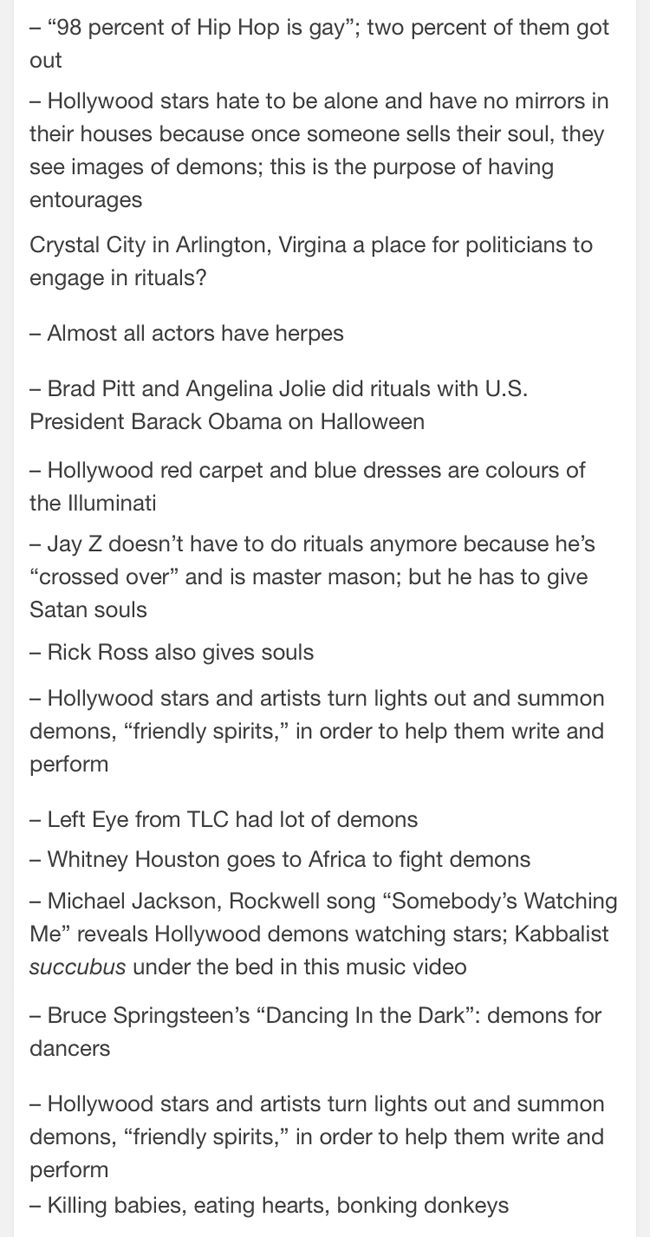
“Whitney Houston Goes to Africa to Fight Demons”

I know this is just the dumbest thing in the world, but sometimes you make a few stray clicks too far and end up on a whackadoo Illuminati conspiracy website, and it’s kind of like the web version of one of those poorly Xeroxed flyers homeless people try to give you. While you’re floating in all this word soup, you realize that a lot of the Hollywood conspiracies that the author is putting forth sound like pitches for movies you’d want to see.

An edited list:


And if someone hasn’t used the text Killing Babies, Eating Hearts, Bonking Donkeys as an album title at least, that’s a shame, because there’s some sick internal poetry to it.