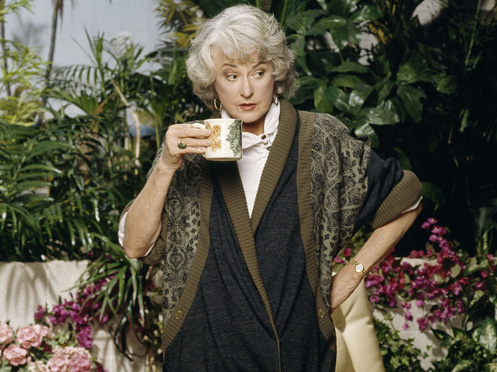
I grew up with The Golden Girls. I watched it on Saturday nights with my parents, because when you’re a kid living somewhere that’s a bit further than a bike ride from any of your friends, that’s a standard evening’s entertainment.
I remember that Sophia Petrillo taught me the word “slut,” which I promptly used at school. I got in trouble, of course, and when my teacher asked me where I’d learned that word, I said “Golden Girls.” It’s weird thinking about how a show about four old ladies could have been a corrupting influence, but I’d wager it did more good than harm.
Years later, I found out the show had a huge gay following, and this was surprising because I thought it was just a weird thing that I really liked. It was gratifying. It made me feel more connected to a community I didn’t have that much first-hand experience with, even if I didn’t immediately understand why it would have resonated with gay dudes. This past week, I got to interview some of the people who wrote for the show. We talked about their experiences on the show, but also why they thought the show got the devoted following it did, and why people — gay and otherwise — still watch the show today.
The piece appears in the print edition of Frontiers, but I’m going to direct you to the online version. I ended up getting so many good stories from those writers that I added an extra 1,000 words online — just because I knew there were people out there who would want to learn as much as possible about what it was like behind the scenes on the show.
And in particular, I’d like to draw your attention to one story that is my absolute favorite. I was speaking to Mort Nathan, an executive producer on the show who also co-wrote a lot of episodes, including the one where Rose dates a little person, and he told me something that affirms everything I’d want Bea Arthur to be.
“TV Guide had done a piece on the show: ‘The Golden Girls—Is it still as good as it was the first year?’ And they asked random people what they thought of the show, and this one housewife said she didn’t think the show was as good and that Bea Arthur’s character wasn’t as interesting. They mentioned her by name—Mrs. Betty Johnson, Sioux Falls, Iowa. So Bea reads this at lunch and then gets on the phone and asks information for this Betty Johnson’s number. And she calls her. And she picks up, this TV Guide woman, and Bea says, ‘This is Bea Arthur, and I want to talk to you about what you said in TV Guide.’ The woman was horrified. She said she was misquoted. ‘I didn’t mean it. Is it really you? I love the show. I take it back.’ And Bea goes, ‘That’s what I thought. OK, that’s better.’”
I just can’t believe she fucking called the woman. I mean, can you imagine? Hearing that voice on the other end of the line, and she’s knows you said something about her and she wants to have words with you? And this is pre-Twitter, pre-internet. She just found this woman and reached out. I love it. It’s awesome.
Winifred Hervey, who also wrote a lot of great Golden Girls episodes, also told me that story, but she added one part that makes me like it even more: “And then Bea said, ‘That person’s going to go tell everyone that I called her, and no one’s going to believe her.’”
People may be talking about what a good job Sarah Paulson is doing on The People vs. O.J. Simpson in playing Marcia Clark, but I keep thinking of the actress who donned that curly moptop before her, and even before Tina Fey on Kimmy Schmidt: Laurie Metcalf on Roseanne.
I looked online and couldn’t find the scene posted anywhere handy, so I created a clip of it myself, just in case you maybe haven’t seen it or did see it and wonder if perhaps you dreamed it.
Late in the show’s seventh season, Marcia Clark literally popped out of Roseanne’s living room TV to chat about the difficulties of being a working mom. Watching it more than twenty years later, it’s a little clunky — that joke about ex-husbands goes down about as well as any joke about current events, decades after the fact, and it’s more disturbing than funny that Roseanne is blithely cutting food with the knife that killed Nicole Brown Simpson — but to this day, it’s this bit I think about when I hear Marcia Clark’s name, not Marcia Clark herself. Dueling Beckys notwithstanding, Roseanne did better with continuity than other ’90s sitcoms, but I like that they could also take a break from that to get weird. “Hey, what if this happened?” “Eh, sure. Why not? Let’s stick it into the closing credits.”
Closing thought: Are people maybe just impressed with Paulson’s role just because Ryan Murphy’s TV machine has permitted her to take a break from playing literal monsters? Do you think she was like “Hey, what if I played someone my mother could tell her friends about?”
The short version: Before Mama’s Family, there was a TV movie about the Harper family in which Mama dies at the end. And that’s weird.
I talked to Carol Burnett on the phone last week. It was for an interview I was doing about her getting the lifetime achievement honor at the Screen Actors Guild Awards. She was perfectly lovely, and I’m sure all the stories about her being genuine and beatific and otherwise purely wonderful are true. The thing that struck me the most about talking to her was how it felt like I was talking to a beloved aunt. I’m sure this reaction is common. She has that way about her.
I’d actually only seen a handful of the most famous sketches from The Carol Burnett show beforehand, so I noodled around on YouTube watching whatever came up. The show was pretty wild, and I think our conception of sketch comedy has become so shaped by Saturday Night Live that we forget how well long-form sketches can work. Take this 1975 takeoff on Cinderella, for example, with the Pointer Sisters playing the evil stepsisters.
My introduction to Carol Burnett, however, came in the form of Mama’s Family, which aired on a weird indie station in my hometown that also provided Matlock, Perry Mason and whatever movies they could get their hands on. But even then, it wasn’t easy to trace the show back to Carol Burnett. Though Thelma Harper and her family started on a recurring skit on The Carol Burnett Show, Burnett herself only reprised the role of Eunice — awful, striving Eunice — in only a handful of Mama’s Family episodes. And beyond the second season, after NBC cancelled the series and episodes were running in syndication first, Burnett doesn’t appear at all.
In going back to look at old sketches, I also found out that in 1982, CBS aired Eunice, a ninety-minute movie about the Harper family that works more like a four-act play. Eunice led to Mama’s Family premiering in January 1983, clearly, but it’s a lot different. It plays out more like All in the Family or maybe some Norman Lear one-off about the death of the American dream. It’s dark. It’s also good in a way that Mama’s Family wasn’t and maybe never tried to be.
Here’s the entire film, though I’m going to post one important scene later in the piece.
The film consists of four vignettes spread across time — in 1955, 1963, 1973 and 1978 — and over the course of them you see Eunice evolve from a young woman with creative aspirations into a sad, alcoholic divorcée. Ken Barry, who played the dumb son Vinton on Mama’s Family is in the movie too, but playing a different character: Phillip, Eunice’s writer brother who becomes successful and leaves the family to move to Los Angeles. The fact that he left is a major point of discord for Mama and Eunice. He also may be coded as gay, but I’m also possibly jus projecting because Phillip is me, if you ignore the whole “successful writer” part. Betty White plays Ellen, Mama’s third child, more or less as she does on the show — stuck up and eager to rub Ellen’s nose in her relatively comfortable life.
The most interesting difference between Eunice and Mama’s Family is the fact that the movie kills off Mama before the final vignette, which centers around the three Harper children returning to the family home after the funeral. It’s a heartbreaking scene, really. Faced with her failure of a life and a lack of anyone to live for now that her mother has died, Eunice crumbles. Phillip convinces her that she should follow her dreams and move to L.A. with him. She agrees, and for a moment she has hope. But then she gets a call from an elderly aunt suffering from a sore back, and Eunice agrees to help her out, even let her move into Mama’s old room. She decides to postpone moving to L.A., and the film ends with the implication that she’ll never go.
Watch the clip — even a little bit of it. You’ll be surprised how straight Burnett and the rest play it. They get real. The audience chuckles a bit before they realize that for this big scene, the cast is not trying for laughs.
It’s interesting that Mama’s Family would evolve out this TV movie, because the sitcom was very much centered around a family unit that was dysfunctional but ultimately necessary. Eunice, however, seems to argue that family life can be toxic and ultimately destructive to anyone who dreams of something more than simply marrying and reproducing. Phillip only achieves creative success by leaving the family, whereas not leaving it destroys Eunice.
There are scattered hints at Mama’s Family throughout. Naomi Oates, she of the off-the-shoulder margarita waitress look and the character who would marry Vinton on the show, gets mentioned as Eunice’s drinking buddy. Also mentioned but unseen is Bubba, who in the movie runs away from home. And while the unseen aunt with the sore back isn’t Fran (Rue McClanahan), I’m going to consider her a kinda-sorta forerunner, just because I like Aunt Fran.
This deep into the post, I suppose I should explain why the hell I decided to write about an old sitcom that I suspect most people don’t remember as well as I do, to say nothing of remembering it fondly. When I was a kid, Mama’s Family hit just right. As Mama, Vicki Lawrence said funny things and spat out PG-rated insults to dummies. I would still watch even in high school, even if teenaged me had gravitated more toward Mary Tyler Moore at that point. It was a comfort thing.
Eunice, however, is good, and that’s 33-year-old me saying that. On its own, it’s like a dark little play about how small-town America isn’t a safe place for certain kinds of children. This version of Raytown (and real-life Raytowns around the country) work hard to stamp out the desire to try hard and be different. I’m speaking from my own experience, of course, but that’s why this pop culture footnote resonated so strongly. As a predecessor to Mama’s Family, however, Eunice is the kind of stuff I live for — a weird, forgotten history to something most people remember as this benign, familiar thing. It’s like finding a lost Brady Bunch pilot where Carol’s husband dies of a self-inflicted gunshot and Mike’s ex-wife runs off because the fourth Brady boy drowned in the bathtub.
And if you have any sort of soft spot for Mama’s Family, either in spite of or because of how corny it could be, watch Eunice. It’s a look into an alternate dimension, and how often do we get a chance at those?
Miscellaneous notes:
In case you’ve ever wondered why Burnett and never appeared in the syndicated episode’s of Mama’s Family, read about that here. Furthermore, McClanahan and White didn’t appear in the syndicated episodes because they’d both taken roles on a little show called The Golden Girls, where they famously flip-flopped the roles they’d initially been offered. McClanahan, who played the naif on Mama’s Family, took the role of the seductress, and White, who played Ellen with a cruelty that’s really strange to watch, given White’s current status as American’s grandma, took on the role the dumdum. If you want to see how very rotten and un-Rose Nylund-like White’s character is in Eunice, click here. The Golden Girls character swap was so effective that it essentially redefined both actresses’ public personas.
And in case you’ve wondered why Carol Burnett Show cast member Harvey Korman never appeared on Mama’s Family, know that he did: as a stuffy academic who introduced the early episodes, Masterpiece Theater-style. These intros were cut from syndicated broadcasts, and that’s too bad, because they help you see the show as knowingly corny Americana instead of some earnestly dopey version of American life.
One character who did join the show after the syndicated episodes started was Bubba, who’d previously only been mentioned before. I have nothing to add here aside from the fact that as a kid I really liked Bubba, and in retrospect that was probably a crush on Allan Kayser that I wasn’t consciously processing. Even today, I gotta say that he made suspenders look good. He still does, actually.
At the start of this piece, I wanted to call Carol Burnett avuncular, but that’s kind of not the right word, since it means both “friendly” and “like an uncle.” Burnett, however, is friendly and like an aunt, and apparently there is no word that means that. For what it’s worth, the interview was with both Burnett and Bob Mackie, who designed all the costumes on The Carol Burnett Show and who my family has always jokingly called “Uncle Bob.” So it was Uncle Bob and Aunt Carol.
The indie station I mentioned is the same one that introduced me to the horrifying, Sanrio-produced stop-motion Nutcracker and the weird, time-traveling Phantom of the Opera where Molly Shannon plays Meg. It probably set me on a weird path, pop culture-wise.
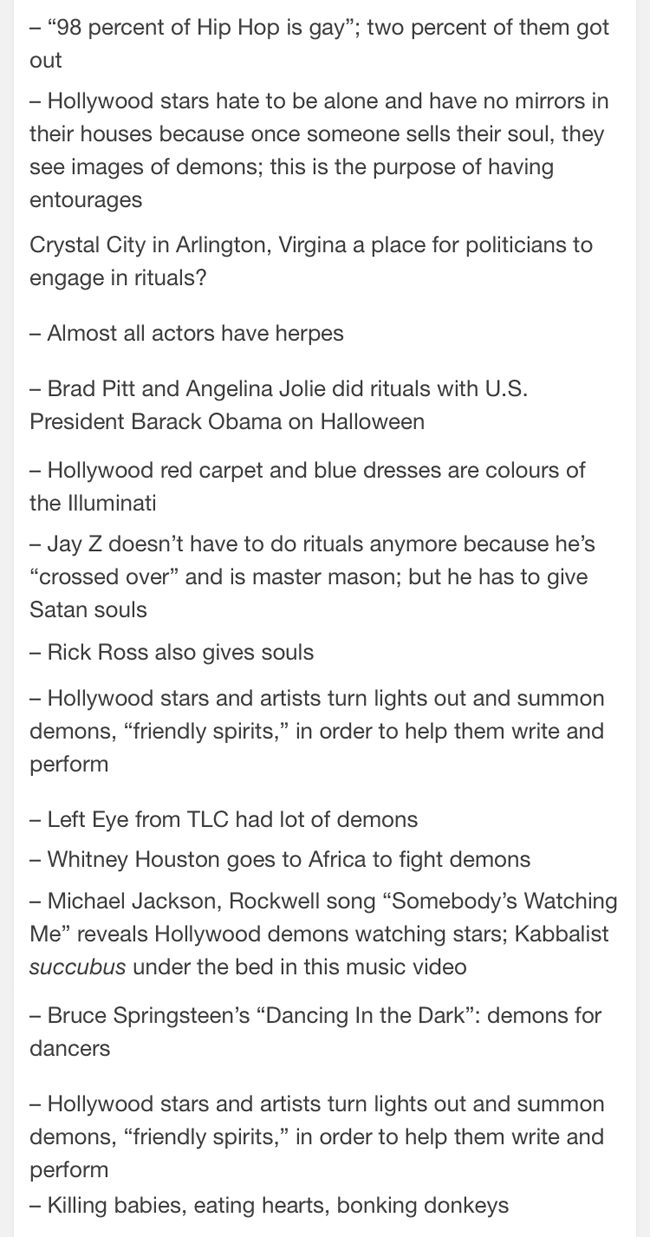
I know this is just the dumbest thing in the world, but sometimes you make a few stray clicks too far and end up on a whackadoo Illuminati conspiracy website, and it’s kind of like the web version of one of those poorly Xeroxed flyers homeless people try to give you. While you’re floating in all this word soup, you realize that a lot of the Hollywood conspiracies that the author is putting forth sound like pitches for movies you’d want to see.
An edited list:
And if someone hasn’t used the text Killing Babies, Eating Hearts, Bonking Donkeys as an album title at least, that’s a shame, because there’s some sick internal poetry to it.
(What follows is an imaginary conversation that has happened in bits and pieces over the last few months but which is not based off any one interaction in particular.) OMG YOU GOT A DOG?!
No, not yet.
Oh. But you’re getting a dog?
It’s in the process. I am dog-shopping, by which I mean that I’ve been going to some of the recommended dog rescues and seeing who’s there, seeing who might be a good match for me. It’s higher stakes than dating but lower stakes than adopting a baby, I’d wager.
But you’re taking FOREVER.
I guess? I’ve been working at home for more than a year now, and I wanted to make sure this was a lifestyle I could do longterm before I brought a dog into it. Also, I had to do quite a bit of work in my backyard to make sure that it was secure for a dog — that I’d minimized the changes that one might have escaped or met an angry raccoon or something. It’s there now, though, and I’ve tested it out with some dogs that I’ve watched for friends. None have gotten out or been skeletonized by raccoons. (Don’t tell my friends I used their dogs as test subjects, maybe.)
OMG you should get a dog because on social media you’re just like “dog dog dog dog dog.”
Yes, I know I post about dogs a lot. Dogs occupy a large piece of my mental real estate. This likely will not change once I get a dog, you should probably know.
Ugh, just get a dog already.
No. I feel like this is something I need to take slowly. If you’re dating someone and you feel like you’re not a good match, you and the other person can just decide not to see each other anymore. I’m not sure that would work with a dog, and having that breakup conversation with a dog would just be the most awkward thing. You’d be all, “Well, Fritz, I feel like this just isn’t working out between us. I think you need to pack your things and find another human.” And the dog would be like “[licks you hand],” and you’d be all “Fritz, please. I’ve made my decision.” And then you’d watch him walking out the front door, bindle stick in mouth, whereupon he’d return himself to the shelter. (I’m guessing.) However, I suppose if the dog broke up with me because he found a human he loves more — that is, had more fresh-cooked steaks on hand — then I’d respect his wishes, but I don’t foresee that happened, mostly because I have a lot of steaks in the freezer.
But, like, just get a dog.
No, stop it. I want to make sure I find a dog that I can make happy and who will make me happy. And once the dog gets here, he’s staying no matter what, so it’s especially important that this turns out to be a good dog-human relationship.
When I got my dog, I just walked in and Patches was like “bark bark bark” and I was all, “That’s my dog! I’ll take that one.” And now little Patches and I are, like, super tight.
Well, see, I’ve met Patches.
What do you mean?
Hey! Look at the time! I have a playdate with a prospective dog companion, so I’d better run.
Wait, what were you trying to say about Patches?
[runs away]
Oh, I love my dog Patches. Hey, Patches — where are you, girl? Patches? Patches?! Shit, has anyone seen Patches?
I’m sad about David Bowie’s death. I mean to say this in the most reverent possible way, but his passing marks a huge loss for the world’s weirdo community, because David Bowie is one of those special people who was not only permitted to be weird but celebrated for that. And while it would be tough to overestimate Bowie’s influence in the music industry, it’s also worth pointing out that he acted, too.
Yes, Labyrinth was huge, not only as a introduction for many ’80s babies to Bowie himself but also an introduction to codpieces. However, the role that strikes me as especially important is the small one he played in Twin Peaks: Fire Walk With Me. His character, Agent Phillip Jeffries, barely appears in the film, but in those few seconds, he manages to sum up a lot about why David Bowie was cool: He’s otherworldly, he’s inexplicable, he leaves too soon and he makes you wish he stayed around just a short while longer.
Here’s the whole scene, in text form and video form.
Agent Cooper (Kyle MacLachlan) is at the FBI headquarters in Philadelphia when he realizes that it’s 10:10 a.m. on February 16 — a date he apparently once had a dream about. Coop steps into the hallway into the eye of a security camera, then walks back into the monitor room to see that he’s still appearing on camera, as if he were still in the hallway. Then out from the elevator walks Bowie’s character in a white suit. Agent Jeffries heads straight into the office of chief, Gordon Cole (David Lynch), starts babbling about Judy and questions who Coop is. The scene cuts to shots of the creepy Red Room residents as Jeffries talks, and then he vanishes.
It’s hard to understand everything that’s being said in the scene, but the preliminary script for Fire Walk With Me at the very least clears up some of what was intended to be said, even if the dialogue differs from what it spoken in the final cut of Fire Walk With Me.
Jeffries: I'm not going to talk about Judy. Keep Judy out of this. Cooper: But… Cole: Stand fast, Coop. Jeffries: (pointing at Cooper) Who do you think that is there? Albert: (trying to calm Jeffries) Suffered some bumps on the old noggin, eh, Phil? Cole: What the hell did he say? That’s Special Agent Dale Cooper. Are you okay, Jeffries? Where the hell have you been? Jeffries: I want to tell you everything, but I don’t have a lot to go on. But I'll tell you one thing: Judy is positive about this. Albert: How interesting. I thought we were going to keep Judy out of this.
(Jeffries stumbles to a chair.)
Jeffries: Listen to me carefully. I saw one of their meetings. It was above a convenience store. Albert: Who’s meeting? Where have you been? Cole: For God’s sakes, Jeffries, you’ve been gone for damn near two years. Jeffries: It was a dream. We live inside a dream. Albert: And it’s raining Post Toasties. Jeffries: No, no. I found something… in Seattle… at Judy’s… at then, there they were.
(Albert is about to say something, but is stopped by Cole’s gentle pressure on his arm.)
Jeffries: They sat quietly for hours. I followed. (Jeffries begins to cry quietly at his table.) The ring… ring… Cole: Albert, I’ll take that second mineral water.
(After a hesitation, Albert gets the message and discreetly leaves the room.)
Cole: Phillip, let’s calm down and get all of this interesting story on paper.
(Cole tries to raise someone on the intercom but it doesn't seem to have any juice. The static begins to build on the intercom. The wiring in the wall and the flourescent lights start to hum as well.)
Cole: Let me hear some good news. My device is faulty. Where the hell is the sound on this thing? (He pounds on the intercom) Mayday…
(Hearing “May,” Jeffries turns and stares at a calendar on the wall.)
Jeffries: May? 1989?
(Cooper looks out of the room to see if anyone is coming to help Cole, who is still trying to get the intercom to work. The static grows even louder.
Cole: What… Am I alone?
(Cole turns back to Jeffries, but there is no one there. Jeffries is gone. Papers from Cole’s desk are now sticking to Jeffries’ chair.)
And that’s it.
The script provides a little more insight as to what David Lynch might have been thinking in writing the scene, but in true Lynch fashion, it answers no questions about who Judy might be, exactly what happened when Jeffries went to the other place and why he vanished a second time. If anything, I think the scene is supposed to foreshadow what happens to Coop (and to a lesser extent, Chris Isaak’s Agent Chet Desmond) in investigating these otherworldly elements and ending up zapped into the Red Room.
It should be noted that there’s a scene in the movie in which a monkey says Judy’s name, though I’m not sure I’d ever heard it clearly until now. Here’s that scene too, with a bit of context. Yes, it’s all very creepy.
There are also theories that Judy is the sister of Josie Packard (Joan Chen) or maybe Laura Palmer herself. (The fact that the monkey saying her name precedes a shot of dead Laura would seem support the latter.) I suppose this is one of the many loose threads that could get tied up in the forthcoming new season of Twin Peaks, but it seems like Bowie’s death would preclude us from seeing Agent Jeffries again — a bummer, yes, but that’s a comparatively small pity when you think about the strangeness of a world without David Bowie.
I interviewed Jake Shears last year about him taking on his first acting role and asked him if there was a instance of a musical performer-turned-actor that he found particular memorable, and he picked Bowie in Fire Walk With Me. I was stoked, but for those Lynchy reasons that always make words difficult, I can’t explain exactly why this scene resonates so much with me, or why I’d pick it as my favorite instance of Bowie acting in a movie over The Labyrinth or The Hunger. And now that he’s gone — vanished from the world just like Philip Jeffries, and more or less just as inexplicably — I think the scene means even more to me, even if I still couldn’t tell you exactly what it’s supposed to be about.
I have questions without answers, but why shouldn’t I? The world is suddenly missing someone who should have outlived us all, who should have returned to his home planet rather than dying as a result of something as mundane and human as cancer. None of it makes sense.