I haven’t posted about Steven Universe since late last year, when I was all agog about the pilot. I have been watching, though, and I’ve been liking how the show has slowly built a universe that’s equal parts kaiju fights and beachside campfires.
The show has also offered the world three awesome superheroines: the willowy, Diane Chambers-like Pearl, the brash, Cree Summer-sounding Amethyst and my personal favorite, Garnet, a towering, laconic woman whose stylish glasses hide a third eye, because she’s that rad. She comes off like a cross between Storm and Cyclops — always collected, always with a plan… the glasses, I guess — and I can’t think of another kids’ show that features a character quite like her.
Garnet isn’t big on emoting, especially in comparison to her teammates. This suits her character just fine, but I initially wondered if this arose from the fact that the woman who voices her hasn’t acted all that much. She’s Estelle, who came to fame alongside those other mononymic British singers Adele and Duffy. I didn’t think I was familiar with Estelle’s non-superhero work until I realized she sang “American Boy,” this flirty, upbeat track that seems at odds with Garnet’s stoic personality. I wouldn’t have guessed that the same person could sing that song and play Garnet, but hey — maybe Estelle has acting range after all.
Here’s the weird thing: The version of “American Boy” I have came to me via a mix CD exchange back in 2008, and it seems different from all the versions I’m seeing on iITunes, on YouTube and elsewhere online. The version that became popular features Kanye West rapping alongside Estelle. My version doesn’t. I prefer it. (If there’s an option for a Kanye-less version of anything, I prefer it, generally.) I don’t know if my version is an original mix or retread focusing just on Estelle’s vocals. But because I just couldn’t find it all that easily online, here’s Estelle’s “American Boy,” minus Kanye.
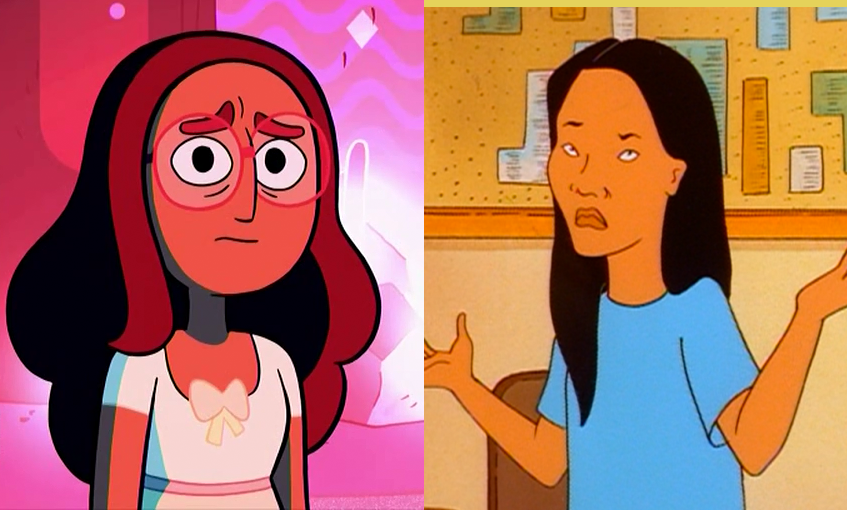
One quick Steven Universe-related postscript: On the show, Steven is a pudgy, irrepressibly imaginative boy who maybe-sorta has a love interest in Connie Maheswaran, a bookish girl-next-door type with overprotective parents. I’d like to think her name is an homage to Connie Souphanousinphone from King of the Hill, the bookish girl-next-door type who also had overprotective parents and who dated Bobby, another pudgy, irrepressibly imaginative boy.
Anyone else see this? I will maybe inquire further to find out if it’s actually a thing.
One: Growing up and being more familiar with the later, Hovian era of the show than the Chambersian era, I always thought the elegantly dressed woman holding up a martini glass was supposed to be Rebecca Howe, retrofied. Today, I know she’s not, since she shows up well before Diane leaves and Rebecca arrives, but I nonetheless can’t unsee Rebecca.
Is it the nose?
Also, how did I watch this show for thirty-two years without realizing the lecherous, zombie-looking drunk grasping Retro Rebecca’s leg in the bottom-right corner? Regardless, what a great visual metaphor for everything wonderful and everything awful about bars.
Two: Does anyone else think that the guy who sings the Cheers theme sounds remarkably like Woody Harrelson?
Again, it’s just a weird coincidence, since Woody doesn’t show up until the fourth season, but I notice the similarity every time I hear the opening credits.
Three: Speaking of the show’s music, the incidental score that leads in from commercials feature this melancholy woodwind tune — oboe? clarinet? flute? I am orchestrally illiterate — that repeatedly makes me think of the first notes from the “game over” music from Final Fantasy VI. (Yes, this is as drilled-down as my geek interests get: a footnote from an old RPG meets the score from an 80s sitcom.)
Four: Who would have thought that time-traveling Macaulay Culkin would have been hiding in the last frame of the opening credits all these years?
Discussion question: Exactly what is the purpose of the old-timey photos and illustrations in the series’ opening credits? Is it to suggest that the bar is time-honored part of American life? Or is it telling us that Cheers was quietly, subtly about time travel this whole time?
Adults lie, as a rule, and adults often lie to kids. I realize that many of these lies result from the kids not being ready for greater, larger truths. That’s why storks bring babies until children become old enough to learn that no, actually, they explode out of mommy’s tummy, and that’s why you can’t subtract a larger number from a smaller number until yes, actually, you can by delving into the sick, sad world of negatives.
Lately, however, I’ve been thinking back to things teachers told me. I went to Catholic school, and even the best ones present kids with a whole weird set of educational challenges. For example, I had an otherwise good teacher who once explained to the class that the Garden of Eden not only physically existed but also still exists today — we just haven’t found it yet. Isn’t that a weird thing to tell a classroom full of kids to whom you also teach science and history? That there’s a magic garden hiding somewhere in old Mesopotamia land, guarded by an angel wielding a flaming sword?
One of these conversations I can remember especially clearly, because I, a dumb child, took the teacher’s word and subsequently let what she told me linger unchecked, shaping my understanding of communism. Last night, I was watching The Americans — a show where adults lie, as a rule, and where adults often lie to kids. The series shows very little about the Russian spies’ lives before they arrived in the U.S., so an invested viewer like me has to imagine Philip and Elizabeth before they took those names. Even as a college-educated adult who reads the papers and sometimes even books, it turns out, my mental version of Soviet Russia is still informed by what my teacher told me twenty-six years ago.
Here is the conversation, not verbatim because I somehow lost my notes but with the gist intact. I don’t remember what prompted discussion of the Cold War in class. Probably nothing. I was a “My cat’s breath smells like cat food” sort of kid.
Me: What is communism?
The teacher: Communism is how people live in Russia.
Me: But what is it?
The teacher: It’s the way the government works there. It’s different to how it works here.
Me: How is it different?
The teacher: We have more freedom here, and freedom is good.
Me: What can’t they do there?
The teacher: In America, you get to do what you want. In Russia, the people in charge tell you what to do. You never get to decide what you do, because someone is always telling you what to do, every minute of every day. Doesn’t that sound terrible?
[Note: Please observe the irony of a schoolteacher touting American freedom to a child to whom she dictates what to do all day.]
Me: Yes.
The teacher: Also, in Russia, you’re not allowed to own anything. The government owns everything. So if the government decides that you shouldn’t have the books you own, they would take them from you, and you wouldn’t be able to do anything about it. Is that something you would like, Drew?
[Note: Please observe the irony in a schoolteacher, who forced books full of math problems on me, explaining how it would be bad if the government showed up and took those books away.]
Me: No, I wouldn’t like that.
The teacher: Also, in Russia, you can’t just go buy anything like you do in America. You have to stand in line to buy it. And you stand in line all day, in the cold. If you wanted to buy a potato, you’d first have to stand in a long line to get a piece of paper that says you can buy a potato, and then after that you would have to a second long line and wait there until it’s your turn to get your potato.
Me: What if you want to buy two potatoes?
The teacher: Then you’d have to wait in the first line all over again.
[Note: Please observe the irony in my teacher’s description of communism also being a somewhat abstracted description of an economic system in which people earn wages to buy goods, just with longer lines.]
The teacher: And the Russians think that the whole world should work like this, and they’d like it if they came here and made us wait in lines to get potatoes. And that’s why we don’t like communism. Do you understand?
I understood what she wanted me to understand, but mostly I just felt saddened by the idea of my mother having to stand in line all day just to get the four potatoes that she, my father, my brother and I would eat. That seemed pretty miserable, and at the time that seemed like reason enough to justify the Cold War. Who would be home to feed the dog if my mom is stuck in the potato lines? Hell, what if the government took the dog away? How unimaginably long would the lines for fish sticks be? What if the government came for my Nintendo? Obviously, this communism stuff was bad news.
This, then, shaped my understanding of communism. I took at class in college on the history of the Cold War, and I’ve read books about communism and life in the Soviet Union. I get how what I learned in second grade was a less than full explanation of how communism works, and I maybe even understand how the full scope of it would have been beyond the understanding of even the most inquisitive seven-year-olds. Still, there’s a part of me that watches The Americans and tries to imagine what Soviet life would have actually entailed and has to catch myself reverting to my 1989 understanding of how communism works. Those connections are hard to shake, it turns out.
I wonder if image it all better if I’d delayed the “What is communism?” conversation until I was smart enough for a bigger, deeper definition. I wonder if this teacher had any idea her explanation would stick so well. And given how a different teacher at the same school thought the Garden of Eden was an extant location that modern humanity had just somehow missed, I also have to wonder how much her actual, adult understanding of communism differed from what she told her class.
Off subject, technically, but also not really: Did you know that the Tetris “Type C” music is an arrangement of an actual composition by Johann Sebastian Bach? I didn’t until today. That’s neat. That’s something, right?
I enjoy Rashida Jones. She tends towards projects I like, and she can go deadpan stare-to-deadpan stare with the best of the Office alums. I also consider her to be a good Hollywood legacy. As the daughter of Peggy Lipton and Quincy Jones, she probably could have stumbled into a job anywhere in Hollywood and “succeeded.” While I’m sure her famous parents helped her get established, but the niche she’s found in quirky comedies is her own.
Compare her to Kelly Osbourne, who has gained a reputation as someone who wears daring fashion and who comments on and/or condemns the daring fashion choices of others. Again, that’s her thing, and while her famous name helped her get there, you can’t really accuse her of getting to that spot solely as a result of her famous dad. However, there’s also that cover of “Papa Don’t Preach” Kelly Osbourne released in 2002. It didn’t kickstart her music career. Pop singer probably wasn’t the best fit for her, and she probably did end up in the recording studio solely as a result of her parents’ influence. To me, that’s an important distinction to make with Hollywood babies: Rashida Jones never had a “Papa Don’t Preach.”
Anyway, I’m happy Rashida Jones is doing what she’s doing, but as a result of her continued success, she creates additional opportunities for dumb people to say, “Oh, I had no idea she was half black!” I have encountered this reaction a number of times in causal conversation, and just today I read a very awkward post about a red carpet reporter complimenting her “tropical” tan. Eep.
So to this reporter and everyone else who is surprised to learn that Rashida Jones is half black, I pose a few questions.
Really? Her name is Rashida Jones. Rashida Jones. If this were a universe where there was not a famous person named Rashida Jones and I said, “I’m getting lunch with my friend, Rashida Jones,” what rational person wouldn’t picture my hypothetical lunchmate being a black woman? Like, in what part of the world would it seem logical that a woman named Rashida Jones wouldn’t be black? It’s like the reverse of that joke on 30 Rock where Michael Sheen, a white Englishman, played a character named Wesley Snipes. (“You know what's insane? That the actor is named Wesley Snipes! If you were shown a picture of him and a picture of me, and were asked who should be named Wesley Snipes, you’d pick the pale Englishman every time! Every time, Liz!”)
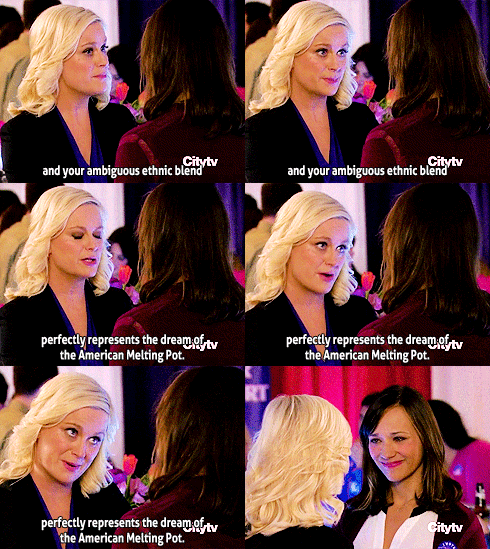
Now, I understand that some might respond to that initial line of questioning with something like, “Oh, I wouldn’t assume that someone who has a name that sounds black is necessarily black.” That’s valid. Besides, many of the characters Jones has played have not been black. Two of her more notable roles have been as Italian-American women named Karen — Karen Scarfolli on Freaks and Geeks and Karen Filippelli on The Office. And on Boston Public, she actually had her hair dyed blond, the whitewashing implications of which are pretty awkward. But there’s a second level to this disbelief that a woman named Rashida Jones that usually goes unspoken, and I think it’s this: She was on Parks and Recreation and in hipster comedies like My Idiot Brother and Celeste and Jesse Forever and I Love You, Man, and “Those aren’t black things.” That’s not exactly true, genre-wise — hell, even New Girl has two black main cast members now — but I think it’s worth it for the “Rashida Jones is black?!” crowd to examine why they think it would be so surprising for a black woman to have the career that Rashida Jones has.
Mostly unrelated, race-wise, but I’m bringing it up now anyway: Rashida Jones being the daughter of Peggy “Norma Jennings” Lipton and Zooey Deschanel being the daughter of Mary Jo “Eileen Hayward” Deschanel, wouldn’t it be cool if these two Twin Peaks babies were given something to do in the upcoming series revival?
I’ve had my own troubles with skunks, but my friend recently lived through a Deep, Dark Fear that I have about walking a dog in this part of Los Angeles: a skunk ambush. The skunks rule my neighborhood, you see, but they’ve left me alone so far because I don’t get all up in their glands. Dogs, however, wouldn’t be so polite.
Matilda is Katherine’s dog. She’s is, in fact, not always so polite. You may remember her from a unsuccessful interaction with the fake owl in my backyard.
7:49 p.m. — Arrive at the restaurant slightly early. Take a moment to walk around the block just so you can nonchalantly cruise in a few minutes late as if you hadn’t rushed to get there and stressed about being late the entire time.
8:04 p.m. — Enter the restaurant. Give your name. Feel a slight twinge of panic as they look over the reservation list. Expect to be reprimanded for arriving four minutes late. “We saw you walking around the block,” the hostess never says. You are the first to arrive.
8:07 p.m. — Consider for a moment the oddness in the fact that you have not spoken to him (that is, texted with him) since the day before. Ignore it.
8:14 p.m. — “You know, I’m starving. Maybe I will just get an appetizer. And yeah, a glass of the pinot too. No, the pinot noir.” What lunatic would mean pinot gris he says they say “a glass of the pinot”?
8:21 p.m. — Check his Facebook even though you’re not friends with him. You learn that he changed his Facebook banner after Christmas but before New Year’s. This yields no clues.
8:26 p.m. — Fidgeting.
8:27 p.m. — “Sure, I’ll have another.”
8:31 p.m. — Wonder if your cell carrier has failed, possibly as a result of solar flares or a terrorist attack. Send a text message to a friend. It’s a funny dog pic from Tumblr. She replies promptly. Fuck.
8:37 p.m. — Wonder if he may have died in a burning ball of death en route to the restaurant.
8:38 p.m. — Decide you’d rather he died in a burning ball of death.
8:39 p.m. — Feel terrible about yourself.
8:46 p.m. — “Maybe she had car trouble,” says the waitress, trying to be helpful. “Do you want more bread?” she asks. You cannot eat gluten. You have not touched the bread.
8:49 p.m. — Kill everyone in the restaurant with your thoughts.
8:51 p.m. — Stomp through the city causing explosions and assorted other forms of telekinetic mayhem, Carrie White-style.
8:58 p.m. — Transform into a winged demon monster that soars through the sky in search of anyone who has given this man the slightest kindness. Hunt down all in his family line. None survive.
9:28 p.m. — Extinguish all human life.
9:41 p.m. — Extinguish all life on Earth beyond hamsters. Earth belongs to the hamsters now. Hamster planet.
10:22 p.m. — Arrive back at home. Heat up those leftovers you thought you were going to have tomorrow night. Hey, it’s pretty quiet now, at least.
5:45 p.m., two days later —
The circus of horrors that is my life, previously:
Way back when, I made the mistake of listing off all the species I could think of whose genus names are the same as their species names. In short, their scientific name is the same word repeated: Bison bison, Chinchilla chinchilla, Iguana iguana, as well as the more exotic-sounding ones such as Bubo bubo (the Eurasian eagle-owl) and Mephitis mephitis (the striped skunk).
I call the post a mistake because it’s subsequently only given some people the opportunity to point out how I’m an idiot for omitting their favorite same-name scientific creatures. Among those I skipped were Gulo gulo — the common wolverine, which I’ve just found out is called “skunk bear” in some circles — and the sea snail Volva volva volva, which, yes, is named for exactly the reason that you’d guess. But just before the end of 2014, another double-namer was brought to my attention that seemed worthy enough for its own post.
This is that post. (And unlike some, this person pointed it out nicely.)
Yep, Boops boops, a big-eyed little fish otherwise known as the bogue. Technically, that name is pronounced “BOH-ops BOH-ops” — literally “cow eye, cow eye” — but why not better the world and just refer to this guy as “BOOPS BOOPS”? The Wikipedia page for the species even has a perfectly reasonable, scientifically accurate caption that nonetheless sounds like it the chorus of some old-timey children’s rhyme.
All hail Boops boops, your new favorite intersex Atlantic demersal and semi-pelagic feeding fish!
And if I still haven’t mentioned your favorite double-named species, please notify me without calling me an idiot.
[Touches own nose. “Boops boops!” Touches own nose. “Boops boops!”]