Pages

Wednesday, October 1, 2014

How to Lick Your Finger

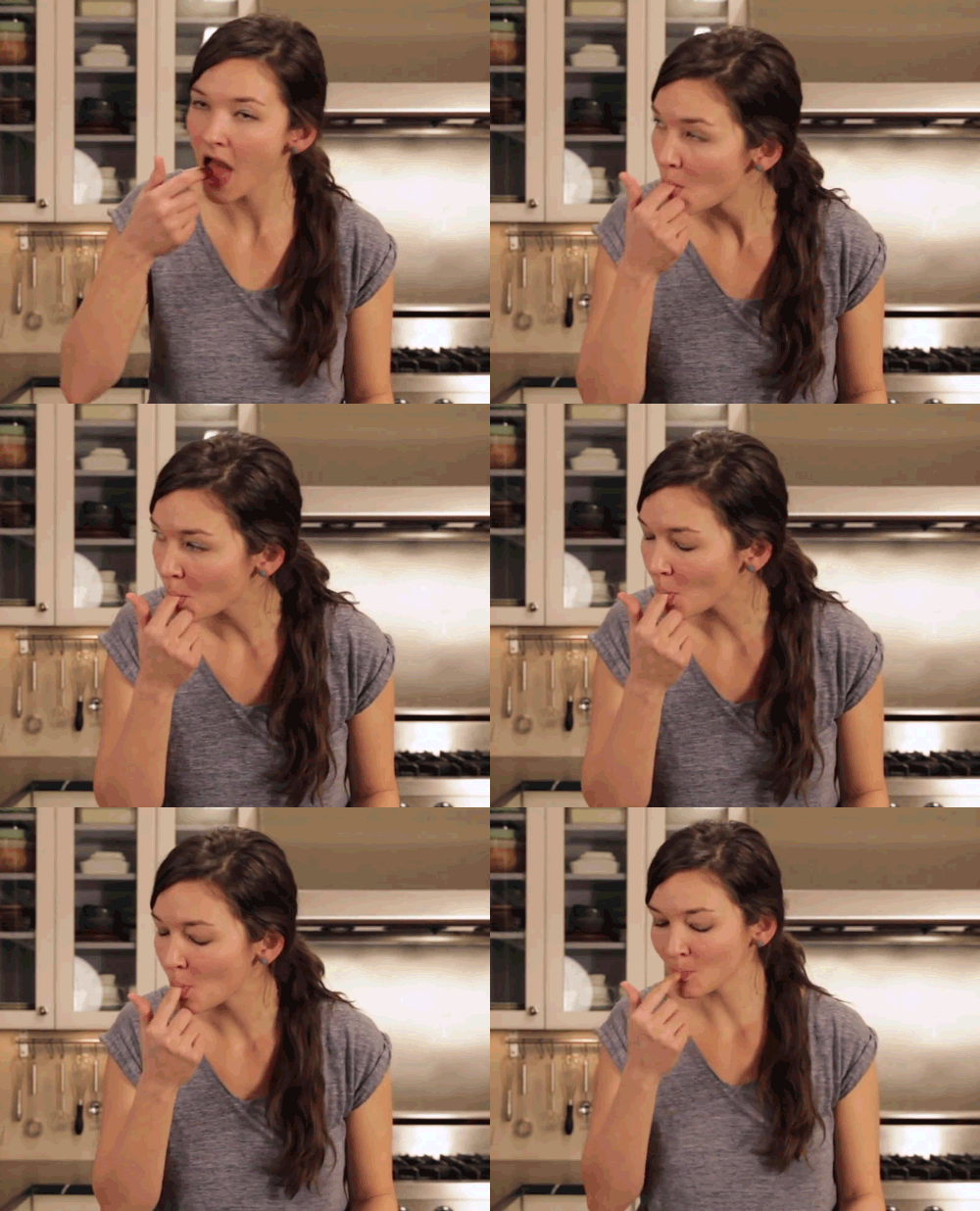
Earlier this week, I received a visit from my friend and former roommate Kristen. During the visit she informed me that there exists online a video of her principally making an ice bath — as in the ones used for culinary purposes — but which notably concludes with her licking a dollop of tasty, cool dessert off her finger.

I don’t know why she told me this.

I have self-restraint problems.

Here, then, is the obvious evolution of this moment, in the highest form that exists online.

finger licking

I… couldn’t help myself.

I feel bad now. Here, look at my favorite photo of Kristen.

From Quentin Tarantino to Jayne Mansfield in Three Songs

You probably remember the 5.6.7.8’s from the finale of Kill Bill: Vol. One. They’re the all-girl rockers covering “Woo Hoo” and “I’m Blue” onstage before everyone starts losing limbs. You may also know them as the band that all those Vonage ads made you start hating, but they seem to have stopped, and thank god for that.


But they have this other, better song called “I Walk Like Jayne Mansfield.” It’s an original, and even if I shuffled “Woo Hoo” off my iTunes — again, because Vonage — this one remained.


Just recently, I found what, precisely, the 5.6.7.8’s were playing off with that track: Mansfield’s side career as a singer and, in particular, the 1965 track “Suey.”


She’s not singing, exactly. She’s sing-talking. If you wanted to get weird about it, you could say that what she’s doing is kinda-sorta a progenitor to rap. Though she certainly wasn’t the only one to do it, she is sing-talking over a beat, and what else is rap, really?

By the way, that’s Jimi Hendrix on lead guitar.


If you’d like to hear Mansfield’s actual singing voice, she had a B-side that same year, “As the Clouds Drift By,” which also features guitar work by Hendrix.


For a song that should be melancholy, it sounds ridiculously saccharine to the point that it’s trying to cover up for something dark. But then you realize you’re watching a slideshow of Mansfield’s heyday while listening to lyrics like “How you left me alone” and “Why’d you drift away?” and “I wonder where you are,” and it gets dark.

Also, after having heard the 5.6.7.8’s version of “Woo Hoo” a million times, it’s strange to hear the original. Ladies and gentlemen, The Rock-a-Teens!


Side note: If Casey Wilson wasn’t born to play Jayne Mansfield in a biopic, I don't know what to believe anymore.

Musical connections I should have made earlier, previously:

Tuesday, September 30, 2014

Pre-emptive Answers to Your Questions About My Apparent Wheat Allergy

A fun fact about me that readers may not know is that for the last few years, I haven’t been consuming wheat. Shortly after I moved to Los Angeles, I developed a stubborn rash. Several months and several doctors later, the only method we found to make the rash go away was to not eat wheat — no bread, no pasta, no beer. This hasn’t been so difficult, since hippy-dippy Los Angeles is probably one of the easiest cities in the nation to find gluten-free food. However, my flagrantly anti-wheat lifestyle seems to be a matter of curiosity for everyone else. Here, then, I’d like to preemptively answer any of the questions you might have about it.

wheatless wednesday everyday (via)
Isn’t it very L.A. of you to go gluten-free right after you move there?

I suppose. This city does have a lot of people who avoid gluten for other reasons — they think it’s inherently unhealthy or that it will make them lose weigh to cut wheat out of their diet. I’m not doing it for those reasons. I’m doing it a cuz that rash I mentioned.

Wouldn’t you be kind of screwed if you had moved to, say, Omaha?

For this and so many other reasons, yes.

I’ve read about celiac disease. It affects a much smaller portion of the population than people think, and what you’re describing doesn’t sound like celiac disease. Why are you being such a stupid faker?

First off, you’re a terrible person. Second, I don’t have celiac disease, at least according to the way I have understood that disorder. I suppose you could say that I have a gluten sensitivity, but I think it’s more accurate and much clearer to simply explain that if I eat wheat products, I get a rash, and I’d rather not eat bread than be Scabbly the Rash Man. It’s that simple.

Could it be something else in those products that’s causing the rash?

Yes, totally. The process of going to doctor after doctor was an ordeal, and since not eating these products solves the problem, I’m just going to stick with it, regardless of whether it’s the wheat or something else that’s actually causing the rash.

What happens if you eat this piece of bread?

Jesus, get it out of my face. As near as I can tell, I will get a rash that’s more or less in proportion to how much wheatiness I eat.

What about gluten-free bread?

What about it?

Well, couldn’t you get by on gluten-free products?

Here’s the thing: In my opinion, gluten-free versions of typically gluten-full products suck, much in the same way that soy-based fake meats suck. These things aren’t meant to be sourdough or chorizo or whatever we’re trying to gussy them up as. You can kind of make it work, but the end product will always be an inferior substitute for the real thing. Essentially, I just don’t eat bread anymore. It’s not that hard.

Did you lose weight as a result of giving up all those wheat products?

Yes, but not for the reason you’re thinking. Essentially, I cut bread and pasta and pastries and beer out of my life. Those are things that make you fat. Because I just stopped consuming them altogether and didn’t replace them with gluten-free versions of them, I did lose weight. But people who simply switch to gluten-free foods probably would not. Gluten-free food is not inherently healthier, just more expensive. Also, in general, paying more attention to the composition of everything I eat has helped me make healthier food choices.

No beer, huh? Wait, didn’t you go to UCSB?

Yes, and I did consume a superhuman amount of beer there without any negative skin conditions resulting.

What about gluten-free beer?

As someone far pithier than I once put it, gluten-free beer tastes like someone came in a mud puddle.

Oh.

Yes. I drink wine now.

Do you miss beer though?

Yes. A room-temperature glass of red wine doesn’t really quench your thirst after a long day of yard work the way a cold beer would. But whatever.

Do you miss bread?

Not really. Instead of carbo-bombing before dinner out, I just eat nothing.

Do you miss pizza?

I wouldn’t waste my own family for a real, high-quality pizza that I could eat all on my own without any negative consequences, but I would waste your family for one, if that explains it at all.

Wait, can you eat rice?

Yes. Rice is not wheat.

Wait, can you eat couscous?

No. Couscous is just pasta.

Wait, can you eat soba noodles?

Yes. Soba is made from buckwheat, which actually isn’t wheat at all, though you still have to check the package to make sure that wheat was not added in.

Wait, can you eat polenta?

Yes. Polenta is made from corn.

Wait, can you eat whole-wheat bread?

Are you fucking kidding me? Stop.

Wait, what about bread pudding?

...

Wait, can you eat pineapples?

I don’t think you know anything about food.

Can you eat fiberglass?

No.

Can I eat fiberglass?

You know what? Only one way to find out.

Wait, if I cook this in a pan that I used to make Amish friendship bread in, will you die?

[gets up to leave]

Aren’t you just doing this for attention?

No. It’s a real pain in the ass — or wherever else the rash wants to be. And I fucking dread having to ask questions about wheat content at restaurants, because I know the server is thinking, “Oh, this guy probably isn’t actually allergic. He’s probably just a jerkhole.” I have to be picky about restaurants I eat at now, to the point that I don’t think I could ever date a vegetarian, just because our eatery options would be too few. But in the end, this is easier than, say, having to give up a food product I love more, such as fruits or vegetables, and it’s a little more elegant than walking around with the rash.

Hey, some of us were thinking about getting pizza and some beers after work.

Cool, I’ll just have one of those iceberg lettuce salads that pizzerias are so famous for. And a Fanta.

Here, I got you a muffin made out of almonds and tapioca and mashed up flax seeds.

You really shouldn’t have.

the wicked witch of the midwest, basically (via)

If you’d like to read more about wheat on my blog, for some reason, I have literally one other post that would be of interest, and it’s about a Greek grain goddess named Spermo. No, really.
Saturday, September 27, 2014

“Megan Is Fat.”

Why do people own birds as pets? Aren’t they annoying more often than not? And less so with the cuddly? I don’t even understand the appeal of the ones that can talk. It’s a neat parlor trick at first, but wouldn’t you get sick of having a not-so-fuzzy, peck-y, claw-y pet who can seize upon a single word and then repeat it endlessly?

At my new place, I have a neighbor who has birds. (It’s actually the same neighbor who told me the “She everywhere” story, in case you’re compiling my anecdotes into some sort of master timeline.) They don’t speak so much as make shrill, inhuman noises at each other all day, to the point that I have wondered if it’s actually an incapacitated relative that my neighbor has chained up in the back room. It may be, honestly. It may also be two incapacitated relatives or one incapacitated relative and one bird, having a “fwaaargh”-off. Really, that’s the story I should be writing.

But no. I write instead about something I remembered when I drove through my old neighborhood today. I passed a house where there is always a caged parrot on the front porch. It whistles. It makes cell phone ringtone noises. Sometimes it sounds like a truck backing up. That’s about it, and really, were I its owner, I’d also keep the damn thing outside.

One day, while walking by, I saw two young boys crouched outside the cage. They were repeating the same phrase over and over, and it was simply “Megan is fat.”

“Megan is fat. Megan is fat. Megan is fat. Megan is fat. Megan is fat.” In unison, the two of them.

That’s the story.

I laughed, but not for the reasons you might think. No, it’s more a laugh about how funny it is that some people think of children as these pure-souled little angel beings who represent the promise of a better tomorrow, when children are actually heartless little shit-monsters. I don’t know who Megan was or what Megan did, but can you imagine being Megan and trying to un-teach a parrot from calling you fat? All day? Constantly? Repeatedly?

Best case scenario: The parrot bit those kids, and Megan saw it happen.

Friday, September 26, 2014

A Little Heartache Before the Weekend

You don’t have to thank me. I was happy to.

Twelve Alternatives to Murder, She Wrote

Murder, She Scrawled 

Murder, She Sighed 

Murder, She Slurred 

Murder, She Weaved 

Murder, She Painted 

Murder, She Guessed 

Murder, She Ignored 

Murder, She Fantasized 

Murder, She Requested 

Murder, She Committed 

Murder, She Gloated 

Murder, She Blamed on Someone Else in Cabot Cove, and Holy Shit, Have You Ever Thought Maybe Jessica Fletcher Is a Serial Killer and She’s Pinning All These Murders on Innocent Townspeople?


Fletcher-faces via here, here and here.

Tuesday, September 23, 2014

A Useless New Word and a Picture of a Duckling

I honestly love English. I love the breadth of its vocabulary. Dozens of synonyms exist alongside each other, but often one word can encapsulate the exact concept you have in your head. It’s messy, as far as languages go, but it’s rich — like a tangled jungle where all manner of wild things can grow. English doesn’t have the largest vocabulary of any language in the world. (As The Economist points out, that’s… just not a thing, when you think about it logically.) But it does offer some options to its speakers, and I’m proud to specialize in the language that affords speakers not just purple and violet but also indigo and magenta and mauve and lavender and freaking palatinate.

Still, sometimes it fails us. There are the autoantonyms. On the subject of color, there’s sinople, a word that basically no one ever uses but can refer to either red or green, depending on the context. There’s shelled, as in shelled pistachios, which you think would work in a straightforward fashion but I found does not, necessarily, when I asked a clerk at Trader Joe’s about them.
Him: Shelled pistachios? Like, pistachios with their shells on?

Me: No. Shelled pistachios as in pistachios that have their shells removed.

Him: So they’re shelled if they don’t have their shells on?

Me: Yes, they’ve been shelled.

Him: That’s confusing.
It’s not confusing to most people, but when you approach the expression shelled pistachio like you’d never heard it before and instead along the lines of a clothed person or a covered bridge, yeah, it seems counterintuitive. (And yes, the Trader Joe’s clerk must have been new.)

And then there’s the trouble with describing time. It’s maybe one of English’s greatest failings, simply because we need to describe yet-to-occur events quite often, and English sucks at it. Biannual is probably the biggest offender, simply because an event could just as likely occur every two years as it could twice a year. Because biannual can mean either, you can almost never be sure in the context of any sentence which meaning was intended. Bimonthly can mean either twice a month or every two months, and I suppose events could occur on either schedule. You’d think that biweekly wouldn’t post such a problem, since we can’t evenly divide our seven-day week and therefore events would be less likely to occur twice a week, but no. When I ran the opinion desk at the college paper and hire regular columnists, I had to ban the word biweekly from all the ad copy, just because every single applicant asked whether they’d need to write two columns a week or one column every two weeks. The modified copy read every two weeks, even thought that’s less succinct. (Fortnightly was rejected on grounds of sounding affected and quaint.)

This is the ambiguity that people are attempting to solve with oxt, an invented word that means “not this coming one but the next one,” as in “We’ll kill them this weekend and then bury the bodies oxt weekend.” Despite having its own promotional website, I’m guessing oxt will go the way of Esperanto and the interrobang, even if it does solve a longstanding problem has resulted in too many people being all dressed up with nowhere to go.

And it’s with all this that I present a strange and wonderful word — the first new one in about a year.
hebdomadal (heb-DOM-uh-dul) — adjective: 1. taking place once every seven days. 2. a weekly magazine, newspaper or other publication.
Like I described it in the post title, it’s useless. Most people won’t know what hebdomadal means, and besides we already have the word weekly, which may be one of the English words that doesn’t benefit from a synonym. In fact, the Etymonline entry for hebdomadally calls it “pedantic humor.” But in its favor is the fact that this word — which comes from the Greek hebdomas, “the number seven; a period of seven days” — is perfectly exact. It will only ever refer to something that happens every seven days.

As useless as hebdomadal may be, a related word could actually solve the biweekly ambiguity. If oxt is being dangled out there, then hell, why not dekatesseral?

“We’d need columns from you on a dekatesseral basis, and if you can’t figure out what that means, we don’t want you.”

I suppose that might discriminate against the non-Greek applicants. So it goes.

And here, as promised, is that picture of the duck.


Previous words of the week after the jump.