Pages

Wednesday, August 29, 2012

Elevating the Pixel? Or Just Moving It Around?

It’s hard for me to admit this, but I’ve been experimenting for some months now — with pixels. They’re not my pixels. Largely, these pixels were put in place, square by square, by a Japanese person decades ago. I’m just taking them out of their original video game context and modifying them to varying degrees.

(via sprites from this game)
(via sprites found here)
(via sprites from this game)
It’s not art, though there are some true artists out there doing amazing work with pixels. Like Paul Robertson. You can’t question his artist credentials. So then what the hell am I doing, aside from passing time between one task and another? Can I just say that I’m digitally doodling? Is it e-collage?

And what do we call these throwback compositions: images inspired by and often made within the constraints of antiquated technology? Do we just call it all pixel art, as this process was called back in the 80s? Or is the retro aspect to what people are doing now — making art that’s inspired by old video games and that exists on its own, separate from actual video games — inherently different?

More digi-doodles after the jump.

(via sprites i found here)
(via sprites from this game)
(via sprites found here)
(via sprites i found here)

Monday, August 27, 2012

Sneezing Around the World, Part Three

So I accidentally made a little series on sneezing. Excuse me.

In the first part, I noted how many languages’ words for sneeze actually sound like sneezing. And in the second, I listed as many worldwide onomatopoetic sneeze words as I could find. It would me sense to finish this little adventure into the realm of nasal explosions with a list of how different languages respond to sneezing, I felt, but it turns out that Wikipedia is already over that one — not only with every translation of bless you you could think of but also often with the polite response to the sneezer gives to the blesser.

Some highlights, however:
  • According to Wikipedia, deaf people using American Sign Language typically don’t respond to sneezes. Is that true? Does that make sense? I feel like it doesn’t, especially how the noise of the sneeze is hardly the most intrusive aspect of the act.
  • Japanese people also generally don’t respond to sneezes.
  • The Belarusian and Chechen responses to sneezing varies according to the gender of the sneezer.
  • Wikipedia translates the Cantonese sneeze response as “a great fortunate occurrence,” which is certainly an enthusiastic way to view sneezing.
  • The Czech response translates as “Bless God,” which seems counterproductive if you live in a culture where God traditionally issues all the benedictions.
  • An alternative Georgian sneeze response translates as “Million dollars” — “referencing the belief that one loses money while sneezing,” Wikipedia explains.
  • Germans don’t have to use Gesundheit, “health,” and can instead wish for contentment, wealth or beauty.
  • The Persian sneeze response translates as “May purity be bestowed upon you,” and although that’s nice, a tissue might be a more effective means of achieving that purity.
  • One of the Portuguese responses to sneezing is santinho, “little saint.”
  • In Vietnamese, if the sneezer is a small child, you can say something that translates as “rice and salt.”
Of course, in all this discussion of equivalents for bless you, I’d like to point back to my old post, “Fucking the Subjunctive,” in which I talk about how the subjunctive has not vanished from modern English. In fact, a form on the subjunctive mood is used in two common but antithetical English expressions: bless you and fuck you.

Finally, some people suffer from a rare disorder that causes them to sneeze uncontrollably after a large meal. No, really: It’s called snatiation, a portmanteau of sneeze and satiation.

Sunday, August 26, 2012

Does Nintendo Hate Eggplants?

Though literally late to the game, I’m playing through Nintendo’s new Kid Icarus. As I get older, I forget sometimes how much I enjoy playing video games, so it’s nice to have one to unwind. And it’s especially fun to see Nintendo’s take on characters that I first met more than twenty years ago and largely hadn’t seen since.

This includes the Eggplant Wizard.

(via)
For those who never played the original NES Kid Icarus, the Eggplant Wizard was a recurring enemy that attacked by transforming the hero, Pit, into an eggplant with legs. Eggplants not being known for their nimbleness or courage, an eggplantified Pit had little recourse aside from jumping about and trying to dodge the sharper-clawed monsters coming at him. In Kid Icarus: Uprising, the Eggplant Wizard returns, looking a bit more polished than he did back in the day, but ultimately being every bit as annoying.


In fact, there’s even a Tempura Wizard that will transform Pit into a tempura shrimp on legs and then try to eat him, but that’s a different story, to be told in my nightmares. No, this article is about eggplants. People who never played Kid Icarus might have known the Eggplant Wizard anyway because he was a featured villain on Captain N: The Game Master, the mostly terrible Saturday morning cartoon series that featured characters from NES-era video games.

(via)
The series placed the wizard alongside actual big bads — like King Hippo from Punch-Out!! and the Mother Brain from Metroid — as if he were more than a generic annoyance, but that’s hardly the weirdest creative made by a show that tried to promote the Game Boy by introducing a sentient, stretchable Game Boy as a character. But the Eggplant Wizard’s presence on Captain N probably marks the highest-profile moment for aubergine in a video game-related medium.

But here’s the weird part: There’s kind of a history of Nintendo featuring evil eggplants. I’m not the only one to notice the weird preponderance of eggplants in video games. The website Sydlexia actually features a whole history of the eggplant on the Nintendo Entertainment System. That list begins with Ice Climber, a vertically scrolling title where your Eskimo heroes can collect various produce items for bonus points, Pac-Man-style.

It’s in Wrecking Crew, released six months after Ice Climber, that the eggplants turn evil. In this quasi-Mario Bros. spinoff, Mario has to contend with three headaches: ambulatory wrenches, a burly, Bluto-esque foreman, and the Eggplant Men.


As far as Nintendo-produced games go, Sydlexia’s list ends with Kid Icarus, which came out in 1986. A handful of third party games feature eggplants too, however, sometimes in a negative context — the very Mario-like Adventure Island games feature it as an anti-power-up that saps your strength and slows the music down — and sometimes in a positive one — the princess in Kickle Cubicle has a guard of eggplant retainers. I’ll leave it up to you how to assess the eggplants in Princess Tomato in Salad Kingdom, which are a sexy anthropomorphic barmaid and a Fidel Castro parody, respectively. But after sorting through the extensive files my brain keeps on useless video game knowledge, I can think of two more recent, but less-than-pleasant Nintendo eggplants.

In Wario Land 4, the first boss is a doll-toting toddler eggplant that gets a lot less cute once you’ve roughed her up a few times.


In one of the Mario baseball games, Waluigi — who himself is eggplant-colored, even if it’s Wario who’s eggplant-shaped — has a power-up called the Whiskered Eggplant. It’s an eggplant with a mustache, and yes, “eggplant with a moustache” could essentially be a description for Waluigi himself.


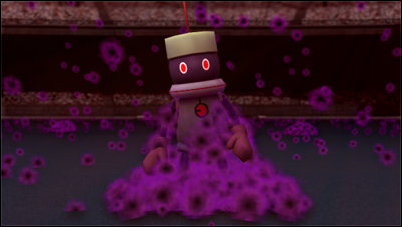
And then there’s Smash Bros. Brawl, where the story mode features an army of little foot soldiers that, to me, looked so much like the Eggplant Men from Wrecking Crew that I just assumed they were. Apparently they’re not, but you have to admit, the resemblance is really strong, associated purple clouds and all.


And truly, what could be more harrowing than facing down an army of eggplants bent on world domination?

A better question: What gives?

Well, it’s possible I just forgot all the positive depictions of eggplants I’ve ever seen in a video game, and I’m twisting Nintendo’s gallery of products to reflect my own anti-eggplant agenda. (It’s possible. I don’t actually care for eggplant.) Or I could have just not played the majority of pro-eggplant games out there. However, it’s also possible that the eggplant might be more commonplace in Japan than it is here in the U.S., and that fact’s being reflected in the games that Japan makes. But if that’s the case, maybe the eggplant carries certain connotations in Japan that are inspiring video game designers to make it evil. I looked. I found next to nothing, aside from an old wives’ tale about eggplants causing infertility in newly married woman.

Maybe it’s just that someone at Nintendo regards eggplants the same way I do — purple and gross?

Saturday, August 25, 2012

Of Kebab and Helicopters

The setup: There’s now a doner kebab place up the street from me, and until I looked it up, I didn’t know what doner kebab was aside from a vaguely meat-related thing. Spoiler: It’s not free, donated meat. Probably for the best.

The background: I like it when words get broken up in a way that’s different than how they originally came together. Like helicopter. If you asked most people to guess what two word parts formed helicopter, they’d probably say “Why are you talking to me about word parts? You’re ruining my cocktail party.” But if you pinballed off everyone else at the gathering, you might eventually end up talking to the second-most boring person there, and, lacking other options, he or she’d probably guess that helicopter was formed by the word parts heli, which we use today in words like helipad, and copter, which is actually a word on its own today. But that’s not actually how the word formed: it’s helico — from the Greek word for “spiral,” helix — plus pter — from the Greek word for “wing,” pteron, as in pterodactyl. And while that makes sense, it’s just not what most people would guess.

The tasty nugget of knowledge: The word kebab works in a similar way, I learned today. If you were, say, roasting vegetables on a barbecue, you might not hesitate to call them kebabs. In fact, in preparing to cook them, you might explain that you were going to stick some vegetables on a kebab and throw them on the barbecue. That’s not what kebab meant in the past, however: According to Etymonline, shish kebab goes back to a Turkish word siskebabp, with the sis meaning “skewer” and kebap meaning “roast meat.” Somewhere along the line, Americans switched it and decided that the kebab was the pointy thing and the sish was the delicious thing, and that thinking exists even though we have doner kebab — the Turkish version of what might be called gyros in a Greek place — being all delicious and meaty but lacking a pointy component in spite of that kebab being there.

One more thing: Doner means “turning,” which makes sense if you’ve ever seen the meat being sliced off an endlessly rotating spit. But I feel like a lot of people don’t put it together that gyro means the same thing, and gyro comes from the same Greek word that gives us gyrate and gyre. Doy. Why didn’t I ever realize that?

Thursday, August 23, 2012

Sneezing Around the World, Part Two

On Sunday, I posted the various worldwide translations for the word sneeze, and Carl commented that he’d be interested in learning the various words for the actual sound of sneezing — you know, the noise the English-speaking render as achoo.

Carl’s comment:
I have been more interested in the other language equivalents of “achoo.” I remember when I worked in a Japanese school, I heard one the teachers say/sneeze “hakushon,” and I thought to myself, “That’s not what a sneeze sounds like Shes faking it” But now I think about all the times I've said/sneezed “achoo” and if those were fake too.
Here’s a list of the various onomatopoeia I could find for sneezing. (Links at the bottom of the post.)
  • Arabic: atchu
  • Batak: atcim
  • Bengali: hach-chu
  • Bulgarian: apchix
  • Catalan: atxum, atxís, atxim
  • Chinese: hāt-chī (Cantonese), ā tì (Mandarin)
  • Czech: hepčí, kychnut
  • Cypriot: apshoo (which is purported to also be the name of a village in Cyprus, though I can’t find it here)
  • Danish: atju, hatju
  • Dutch: hatsjoe, hatsjie
  • Estonian: atsihh, atsih aptsihh, aptsih
  • Finnish: atshii, atshiu, atsiuh, atshii, atshiu, atsiuh
  • French: atchoum
  • German: hatschi, hatschu
  • Greek: apsu, apsiu
  • Hebrew: apchi, itush
  • Hindi: achhee, aak-chheen, aak-chhoon
  • Hungarian: hapci
  • Icelandic: atsjú
  • Indonesian: hacciihh, wa-hing
  • Italian; etciú
  • Japanese: hakushon, kushu
  • Kazakh: apschoo
  • Korean: etchi
  • Latvian: apčī
  • Lithuanian: apčiū, apči
  • Macedonian: apchixa
  • Norwegian: aatsjoo
  • Persian: achu
  • Polish: apsik
  • Portuguese: atchim, atchô
  • Romanian: hapciu
  • Russian: apchkhi
  • Serbian: apciha
  • Sinhalese: hacis
  • Slovak: hapčí
  • Slovene: ačih, ačiha
  • Spanish: achú, achísorachís
  • Swedish: atjoo, atjo
  • Tagalog: hatsing
  • Tamil: a-choo
  • Thai: hud-chei
  • Turkish: hapşu
  • Vietnamese: hắt xì, ắt xì
Are some of these more widely accepted than others, in the way that achoo is what most English dictionaries seem say is the standard way of representing the sneeze noise? Probably, but it’s an interpretable sound, you have to admit. Even English has alternate renderings for achoo, among them hachoo, tchoo, achew, atishoo, kerchoo, kachoo and (apparently) ahem. And no, the similarity between atishoo and a tissue seem to be coincidental, according to Etymonline, though now that I think about it, doesn’t handkerchief sound weirdly like a sneeze noise as well?

In response to Carl’s comment, it does seem like haukushon would be in the minority: Most of the sneeze words end in a vowel. Maybe the Japanese and the other ending-in-a-vowel sneezers are just more polite by virtue of trying to close their mouths and limit the outflow of sneeze particles?

Also, do Japanese sneezers truly say haukushon when their nasal situation gets critical while English sneezers say achoo? How would a person raised in isolation sneeze? Or would they say anything?

Sources: the Wikipedia page for sneeze, the Wikipedia page for cross-linguistic onomatopoeias, a Meta Filter thread, this page on sneezing that seems to be a repurposing of an old version of the Wikipedia page, a Word Reference forum thread, and a list of Japanese onomatopoeia on Transparent Language.

And check out Part Three!

Monday, August 20, 2012

Language Professors HATE Him!

Wait.


Okay, I can get behind the logic of dermatologists hating that one woman who discovered that anti-aging secret — it was blueberries and badger smegma, by the way — and even why dentists hate that other woman who discovered that teeth-whitening secret — it was sandpaper, by the way — but this? Disregarding for a moment the fact that linguists would probably love the person who discovered the secret to learning a language in ten days, language professors don’t generally teach language: They study it. The only person who would hate the man who invents a new, quicker method of learning language would be, like, the immigrant lady who cornered the market on teaching her native language to businessmen at the late-night learning annex. And even then, there’s still palm-reading and keys made while you wait.

Also: “Pimsleur Approach” sounds like an affliction one would acquire from drinking Pimm’s Cups to the point of slurring speech, which, just maybe, is the secret to new language mastery.

Also also: Most verbal-minded folk would have noticed that the second “H” is the wrong font size and should actually be on the same scale as the “L” or the “P.”

Also also also: Is that really the highest-resolution photo you could find? Really?

Also also also also: I will click on the pop-up when the headline reads Professional Break Dancers HATE Him!, Fitted Sheet-Folders HATE Him! or Parallel Parking Experts HATE Him! Nothing else can fool me.

Sunday, August 19, 2012

Sneezing Around the World

In the tail end of yesterday’s post, I wrote that Greek at some point used the word ptairo to mean “sneeze.” This is significant, just because ptairo kind of sounds like a sneeze — maybe along the lines of ptooie with a more explosive ending. So I got to thinking: Do other languages’ word for “sneeze” sound like sneezing? Using the magic of Google Translate, I’ve made a short list.

Whenever possible, I used the phonetic rendering of the word. Some languages such as Farsi, Arabic and Hebrew I left out because a phonetic spelling wasn’t offered on Google Translate. In many cases, I wasn’t sure if the word being translated was the noun or the verb — not all languages use the same word the way English does — but they’re all referring to the sudden rocketing of snot from the nasal passages.

Decide for yourself:
  • Afrikaans: nies
  • Albanian: teshtij
  • Albanian: p’rrshtal
  • Azerbaijani: asqırmaq
  • Belarusian: čchać
  • Bengali: hām̐ci
  • Bulgarian: kikhane
  • Chinese: dǎ pēntì
  • Croatian: kihati
  • Czech: kýchnout
  • Danish: nyse
  • Dutch: niezen
  • Esperanto: terni
  • Estonian: aevastama
  • Filipino: pagbabahin
  • Finish: aivastaa
  • French: éternuer
  • German: niesen
  • Greek: ftárnisma (and yes, I notice that this isn’t ptairo, but that first syllable isn’t not far off)
  • Gujarti: chīṅka
  • Hatian Creole: etènye
  • Hindi: chīṅka
  • Hungarian: tüsszentés
  • Indonesian: bersin
  • Italian: starnutire
  • Japanese: kushami
  • Korean: jaechaegi
  • Latin: sternuisse
  • Latvian: šķaudīt
  • Lithuanian: čiaudėti
  • Macedonian: kivnete
  • Maltese: tgħatas
  • Norwegian: nyse
  • Polish: kichać
  • Portuguese: espirrar
  • Romanian: strănut
  • Russian: chikhatʹ
  • Serbian: kijanje
  • Slovak: kýchnuť
  • Spanish: estornudar
  • Swahili: kuchafya
  • Swedish: nysa
  • Tamil: tum'mu
  • Thai: cām
  • Turkish: hapşırmak
  • Ukrainian: chkhaty
  • Vietnamese: nhảy mui
  • Welsh: tisian
  • Yiddish: nysn
My favorites? Czech and Turkish. The one I’m most disappointed in? Yiddish. Come on, Yiddish. With your rich library of throat-clearing sounds, I expected more from you.