Pages

Friday, October 7, 2011

The Nobelest of Sitcoms

What pop culture association can I make with the announcement that Liberian president Ellen Johnson Sirleaf is getting this year’s Nobel Peace Prize? Oh, only this one: Ms. Sirleaf is the aunt of Retta, better known to the parts of the world with good taste in TV as Donna Meagle on Parks and Recreation.

 This is the face of a Nobel Prize’s winner’s niece right here.


Also, unrelated but not really:


 Just because.

Thursday, October 6, 2011

Nowhere Near the Land of Goshen

So I found this on the lawn in front of my apartment building.


It should be noted that I don’t live on the 11800 block of Goshen Avenue. I live near enough Goshen that I could walk to it but no so close that I, for example, would want to carry an extricated street sign from there to where I live. Clearly, not everyone agrees. As it stands now, all that stop sign is doing is stopping the grass — and it’s doing that quite well, at least in one specific octagonal region, and will continue to do so until someone realizes this sign isn’t where it’s supposed to be.

Wednesday, October 5, 2011

Not Yet Having Seen American Horror Story

I can’t say that I’m not excited about American Horror Story. I am, despite my feelings toward Glee, the latter two-thirds of Nip/Tuck and Ryan Murphy in general. TV generally doesn’t do horror and rarely does it well — remember NBC’s Fear Itself? — but I’m hopeful about the prospect of people tuning in every week to see something strange, something disturbing and something unlike anything else on basic cable. After all, horror allows the kind of broad metaphors that writers can use to touch on subjects that remain off-limits to other genres, and I’m fairly certain that American Horror Story will go deeper than, say, our nation’s concerns about the housing market. (The devaluation of homes is scary! Get it?)

But independent from the actual show, which premieres tonight, there’s the advertising.


Every night, I drive beneath a billboard that displays the above image: a pregnant lady pointing her womb fruit at some sort of vinyl fetish sex ninja straight out of Ryan Murphy’s darkest fantasy. My reactions gradually shifted from “This is a really messed-up thing to see every day” to “I’m kind of glad I don’t have kids in the car asking what Midnight Stealth Spider-Man™ is doing to the trampy lady” to “What an interesting-seeming family” to “Hey there, Mr. sexy Gimp! You have yourself a good evening!” In short, the shock wore so quickly that I know find that to be the disturbing thing. I hope this won’t hold true for the actual show.

In any case, I will be watching tonight, eagerly waiting for the debut of Vinyl Man, whom I already have come to view as a friendly acquaintance.

(For reference’s sake, here is my post about why I stopped watching Glee and why I’m okay with that.)

Monday, October 3, 2011

The Ballad of Bad Ronald

So maybe there was this actor from back in the day, Scott Jacoby, and people might know him from playing Dorothy’s son on The Golden Girls. But this actor also appeared in this notably twisted TV movie in 1974, Bad Ronald, a thrillerish sort of thing about a painfully shy teenager living with his overprotective mother.


In the movie, Ronald accidentally kills his sister, and the mom — convinced that the authorities will not believe that the death is accidental — hides Ronald, which is well and good until the mom herself dies, the house sells and Ronald becomes a real-life boogeyman, hiding within the house from its new owners as he slowly he slips into a fantasy world of his own making.

And maybe I’d heard about this movie years ago, when a coworker described it to me but couldn’t remember the name. And then maybe I saw this other TV movie with Scott Jacoby — this rather groundbreaking one with Hal Holbrook and Martin Sheen — and I finally ended up finding Bad Ronald. And then maybe I found the cover art for the DVD release of this movie. And then maybe it looked like this:


And maybe I, upon seeing it, couldn’t mentally separate this photo from the Andy Samberg character Shy Ronnie — who actually reminds me of Bad Ronald a great deal, red glasses and all — only Bad Ronald actually looks more like Andy Samberg.


I mean, right?


And then maybe I decided to rematch the original “Shy Ronnie” video — yeah, the one with Rihanna— rather than exploring Bad Ronald any further.

Previous things that are like other things:

Sunday, October 2, 2011

Lesson Learned: Don’t Recycle

Hello. I am significantly less inclined to visit my apartment building’s recycling bin in the middle of the night. Thanks, life!


Some context: It was very dark. You can see as well as you can in this photo because I used my flash. But at the time, I could just barely make out the features of a human face, blankly peering out from the garbage.

The Italian George Hamilton

The post-June Gloom months have passed with only the vaguest glimmers of summer. Though I’d like to say that October will offer Los Angeles’s last chance at the heat we’re supposedly famous for, it’s already rained once and further precipitation is expected this week. I think the sun may have just have skipped Southern California this year. As such, a portion of my fellow Angelenos will have to tan their skin using less natural means. And that sad fact was my motivation in picking the word of the week.
slampadato (slam-PAHD-ah-toh) — noun: one who tans his or her skin using sunlamps.
I must clarify here that the definition and the pronunciation are mine. Honestly, I’m not convinced this word actually exists. It probably does, but it’s hard to tell because slampadato appeared in a July post at Mental Floss about words that lack a direct English translation. This post went viral, and consequently a Google search for slampadato or its listmates turns up mostly other lists calling attention to the fact that such hard-to-translate words exist. (Among those listmates, notably: luftmensch (“an impractical dreamer with no business sense” in Yiddish), boketto (“gazing vacantly into the distance” in Japanese), and Kummerspeck (a German word figuratively meaning “excess weight gain from emotional eating” but literally meaning “grief bacon.”)) It’s considerably harder to find anything that explains where the word comes from, how old it might be, whether it’s slang or whether it’s widely understood.

I’m inclined to think that slampadato is a word that some Italians might know, at least, because it’s featured in a 2006 L.A. Times article on Adam Jacot de Boinod’s book The Meaning of Tingo, itself a collection of the world’s most oddly specific words. (Tingo, by the way, is apparently an Easter Island word referring to the practice of borrowing a friend’s belongings one by one, until there are none left, Homer-to-Flanders-style.) And this Google+ post about slampadato at least got a response from someone with an Italian-sounding name claiming that it is in fact a word.

can you spot the slampadatos in this photo?
So what else is there to say about slampadato? Other than that it looks suspiciously like lampada, the Italian word for “lamp,” not much. I say English should adopt it. It’s a much better term than tanorexic, which describes a tanning addict but logically seems like it should refer someone who avoids sun exposure as much as possible. (In my head, anyway, anorexia : tanorexia :: overeating : sun-gorging or something along those lines.) Besides, slampadato is fun to say. And that’s the real measure of a word’s worth, right?

Previous words of the week after the jump.
Word nerd? Subscribe to Back of the Cereal Box’s word-related posts by clicking here.

Wednesday, September 28, 2011

Hercules Rockefeller and Other Paragons of Masculinity

Not too long ago, an article on the strange, sad life of Rock Hudson went up at The Hairpin, and while Hudson’s story merits the time it takes to tell it, my takeaway was Henry Willson, the Hollywood superagent, talent scout and peenhound who created the actor’s public persona. Even given Hudson’s sad end, he stands out as one of the most successful Hollywood Frankensteins that Willson plucked from obscurity and then rebuilt them head-to-toe into something more marquee-friendly, more deserving of the affection of the American public. This process often necessitated a rechristening, and Wilson seemed to have very specific ideas about what a masculine movie star name sounded like. I mean, consider Roy Harold Fitzgerald, the Midwestern boy that Wilson transformed into, to borrow The Hairpin’s phrasing, the “Ken doll with a dye job” who is remembered today as Rock Hudson.
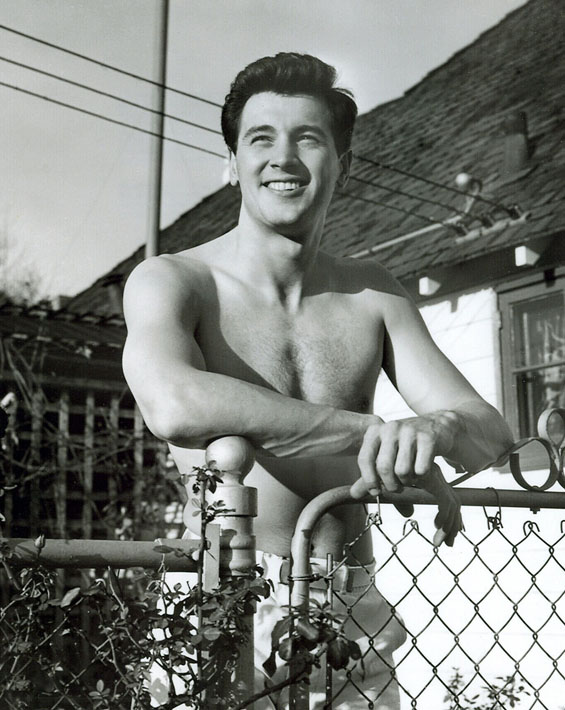
rock, but it could just as easily be any of the other men on this list

Here are all the Willson dreamboats I could find, ordered by the increasing macho ridiculousness of their names:
  • Nicholas Aloysius Adamshock became Nick Adams, which is actually a fairly sensible shortening.
  • Gail Shilkles became Craig Stevens — and for the better, I’d say.
  • Raymon Lee Cramton became Chad Everett.
  • Norman Eugene Walker became Clint Walker.
  • Armand Joseph Catalano became the far blander-sounding Guy Williams, though with that name he at least starred in the TV series Zorro and Lost in Space.
  • Carmen Orrico is today known as John Saxon, and with that name he’s racked up a few notable horror credits, including A Nightmare on Elm Street, Tenebrae and the original Black Christmas. But according to a few sites, like this one, he narrowly avoided being given the name Rand Saxon.
  • Merle Johnson became Troy Donahue. (And, by the way, Donahue along with a Willson creation who didn’t change his name, Doug McClure, are the sources of the name of Simpsons character Troy McClure, who stars in “rained out ballgame”-style B-movies inspired by the the kind of movies the actors on this list appeared in.)
  • Francis Timothy McCown became Rory Calhoun, the western star whose name, when entered into the Google search box, calls up that one Simpsons reference rather quickly in the list of frequent searches.
  • Robert Ozell Moseley — a man born in a California town whose name, while we’re on the subject, is Pumpkin Center — became Guy Madison. (Madison, by the way is sited in this Salon article as the slab o’ man that inspired the term beefcake.)
  • Arthur Andrew Kelm became Tab Hunter, the soda pop who shoots deer.
  • Earl Carver became Cal Bolder, which pretty much gets to the hart of Willson’s renaming process.
  • James Westmoreland was saddled with the very awkward Rad Fulton, though he later reverted to his original name and continued acting.
  • Orison Whipple Hunderford became Ty Hardin, which, yes, sounds like a porn name, and an obvious one at that.
  • John Papiro was transformed into the weirdly white power-sounding Race Gentry.
  • And, finally, Norman Jay Rambeau was given the name that The Hairpin calls out as the worst (also the best): Dack Rambo. Apparently Willson had run out of one-syllable names that sounded butch enough and had simply decided to make them up. (Dack, by the way, had a twin brother — “TWINS!!!” is what Willson surely said one slow afternoon at the docks — named Orman Ray, whom Willson renamed Dirk Rambo. This other brother died young, however.)
I’m sure there are others. (In fact, I know there are: I can’t find enough information on Chance Gentry or Chance Nesbitt to determine who they were before Willson got his hands on them.) But with the exceptions of Rory Calhoun and Troy Donahue, each name fits the pattern of single-syllable first name plus double-syllable last name. I don’t know why that screams “American movie-going market” exactly, but I suppose there is something inherently manly in that first monosyllabic strike — like a punch to the gut or the firing of a gun — that suggests the brute force of a man of action. It also tends to sound Germanic, as opposed to the flowing three- and four-beat names more typical of Italian or Spanish names. And the last names evoke some combination of ruggedness or general Americanness or both. It’s pretty obvious to see, especially today, but that’s not to sat that people couldn’t see through the names even back then. According to this article, Kaye Ballard suggested four more that Willson could add to the stable: “Grid Iron, Cuff Links, Plate Glass and Bran Muffin.”

I’d be lying if I said things weren’t different today. Actors get to keep their awkward names, and some are even born with names that sound like the product of a focus group spitballing in an underventilated conference room. (It annoys me to no end that we have a moderately famous person named Channing Tatum now.) One thing I can say for sure: Henry Willson would have loved Heath Ledger.